
by Michael R. Allen
When development firm Sangita proposed demolition of the three Midtown buildings at 3834-38 Laclede Avenue last May, this writer offered no protest. Later last year the two two-story buildings, built as stores and flats, and the one-story storefront fell to the blows of wreckers, and soon spring up a double-pen drive-though building housing not just Jimmy but also Papa John.
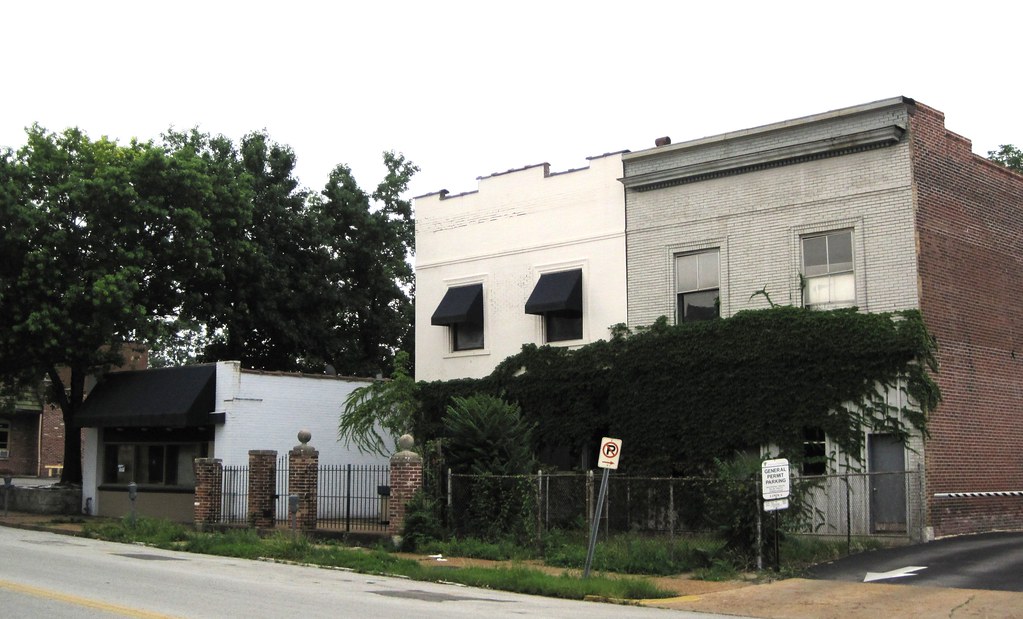
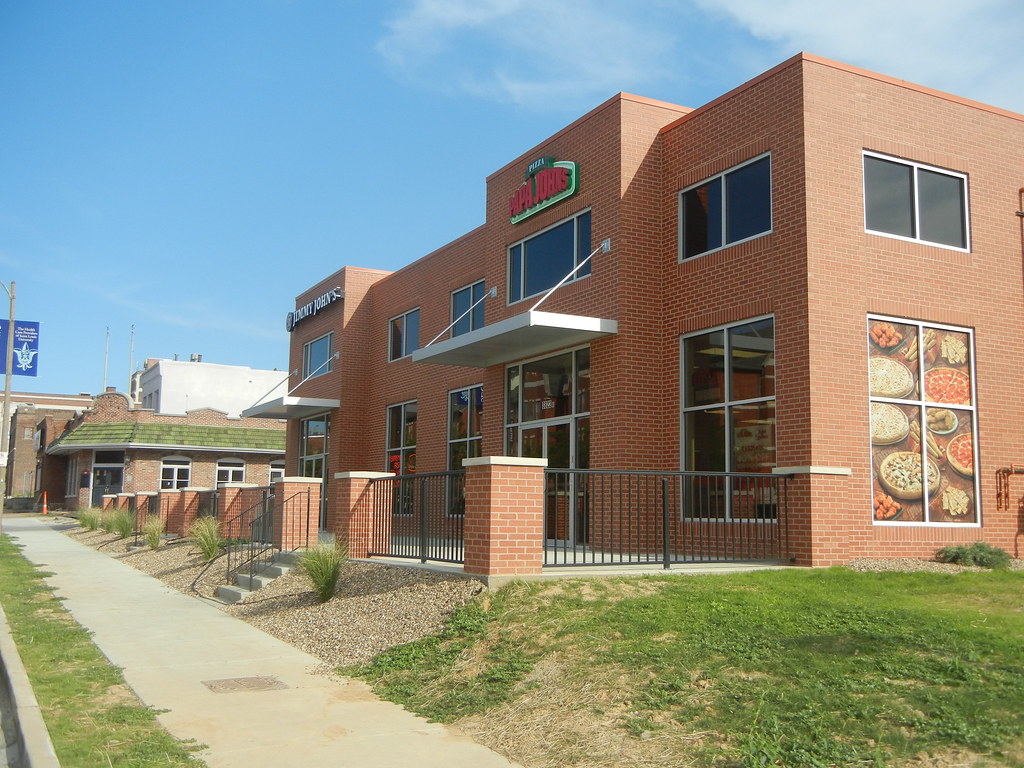
I am sorry to report that the result is a step backward for the urban character of the street. The bigger outrage is not so much the demolition of average vernacular buildings, but their replacement by architecture of far inferior design and character. Cities are inherently changing bodies, and demolition and replacement shape great streets. Without demolition, there would be no Wainwright Building, no “flying saucer” at Council Plaza and no great hotel at Lindell and Kingshighway, let alone two. Still, changes that are willfully regressive movements in architectural detail, urban form and construction quality are detrimental. Simply: not all change is bad, but some change really is bad.
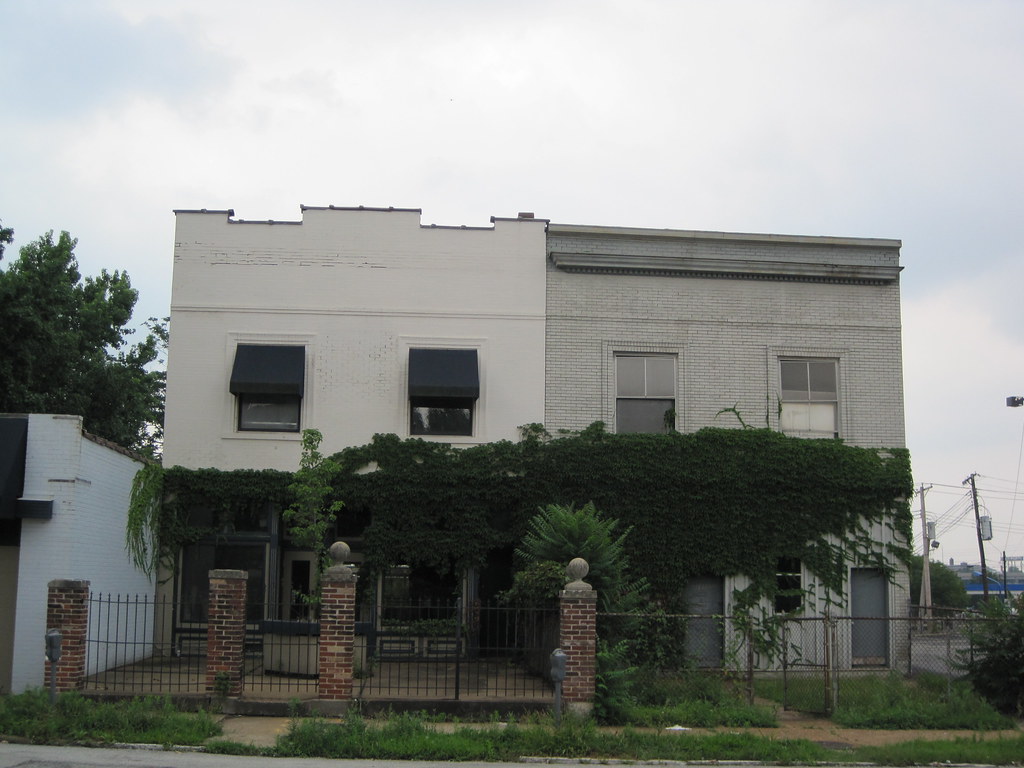
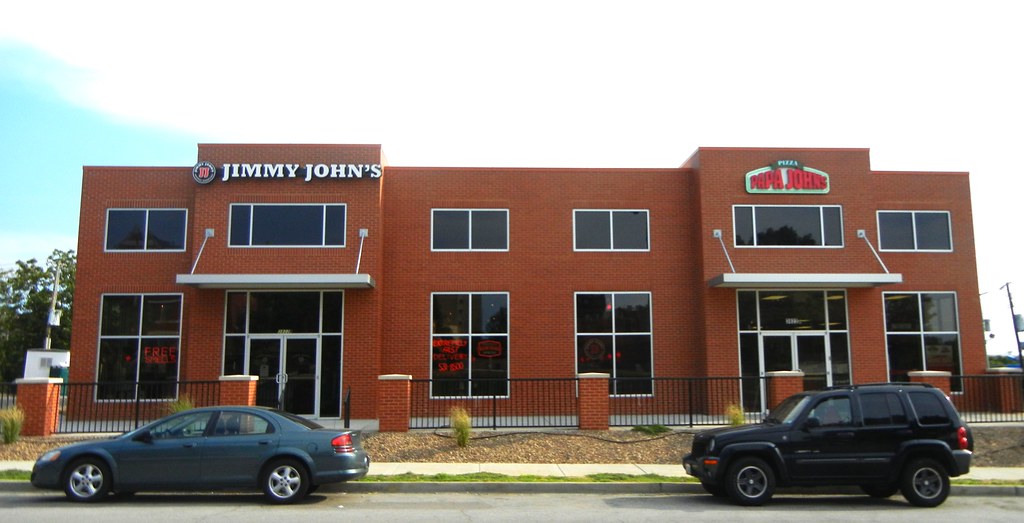
The new fast food restaurant fails to advance the architectural lifespan of its real estate. Where three buildings with distinct separation and setback stood now is a unitary, flat mass. The building’s primary site factor is placement of a drive-through lane and giant parking area, which mitigates any positive benefit of the placement of the building form closer to the sidewalk than most drive-through buildings. The building also alters the sidewalk relationship, since its raised patio is much differently accessed than three buildings at sidewalk level (even if two had ten foot setbacks).
While the new building is clad in brick and mocks a second floor, its design is flat and its elements undifferentiated. Oh, there are the raised entrance bays, but the brick work and fenestration is almost seamless, unlike the careful attention to relief seen in the buildings demolished here. The old buildings were designed with basic learned knowledge of how to relieve a brick mass through careful projection of courses and window surrounds. Nothing fancy — just effective techniques as old as brick masonry itself. Also, the width and warmth of the cast iron storefronts is lost in the first story of the new building, with its comparatively narrow openings.
For now, Laclede Avenue gets a building that reminds us that urbanity is more than simply appropriating forms, heights and abstract ideals of materiality (like red brick). Although Steven W. Semes was writing about building additions, his statement in his essay “From Contrast to Compatibility: A New Preservation Philosophy” comes to mind: “In the absence of a common architectural language, the juxtaposition of merely abstract ‘compatibilities’ can create visual dissonance rather than the desired harmony.”
16 replies on “Regression on Laclede Avenue”
So, the second floor is fake?! That’s hysterical. Are they going to put some fake flowers in the window, or maybe a silhouette of a cheerful undergrad waving to the customers?
capitalism at its finest. take as much as possible; give nothing back.
Trash food, trash buildings that don’t quite deserve the name “architecture”.
how long do you think it will take until the building will look dilapidated?
With a little creativity papa johns and jimmy johns could have reused the old buildings.
The current brick boxes are okay but I am getting tired of new development in saint Louis
Being just ‘okay’.
Without a site plan it is hard to say completely what is happening. I went to Goggle maps, I think their image is from the earlier reincarnation. The area is devastated by parking. They will never build ( in the near future anyway) the quality of masonry buildings they are tearing down. (Look at the Parthenon after 2 thousand years)
On the positive side it looks like the new buildings have tried to respond to urbanity (again, unless I go by the site I’m not sure where the drive in is located).
The architecture, the fake second floor are all poorly done, of that there is no doubt.
Where does this failure come from? Is the architects, the developers, the city regs, or the city government itself?
It looks to me like the two existing buildings were perfect candidates to meet corporate needs.
But of course they would have to think, reusing buildings requires many different strategies vs the one or two solution strategies used by corporations in both suburban and urban environments.
Still, the positive is that urban friendly buildings are on the corporations radar. (The citizens should demand more. But the surrounding area illustrates the futility of preservation without concerns for city and transit planning).
Getting corporations to build in an environmental friendly way is useless if the surrounding area is a parking lot hell.
Had St. Louis’ developers been content with “okay” most of us following urban development today would not be living here.
St. Louis University has wrecked Laclede Avenue between Grand and Vandeventer, but the south side of the block between Spring and Vandeventer is almost completely privately owned and has many human-scaled buildings on it. That block could be a great commercial “edge” to the sprawling campus, and the location of these chain restaurants shows that the location makes economic sense. The new building’s drive through wraps around, creating voids to either side where additional storefronts could be placed.
You are correct of course that there is a commercial “edge”, the only point I was trying to make was not only the lack of coherent strategies when considering redeveloping individual buildings such as these, but also the total gap in any kind of comprehensive thinking about what is going to happen in the surroundings.
It is hard to discern if the city has any interest at all in the larger
picture, other than perhaps some crude zoning concepts.
As a side note, I wonder if this project received any government money? You know TIF, tax credits, those sorts of things. That would certainly be a way to help direct the rebuilding of the city in an integrated fashion.
Parking lots are thrown up anywhere, demolitions are ongoing, normally without replacements. Urban planning of any sort is random or more likely nonexistent.
In fact the commercial “edge could easily come under attack without a commitment to maintain that human scale.
Historic districts like Soulard and Lafayette Square are some of the few areas with broader guidelines for development, and even they have limits.
The city shouldn’t be turned into a museum, but it should function as a whole and continuous city.
And on Laclede that continuity is broken by parking lots and other empty spaces near this building. You can’t get rid of parking, but you can mitigate it.
I hope the commercial edge is maintained, but I also would guess you might agree the rest of the street should have had more attention paid to it,
A few weeks ago a local leader told me that interested groups have been trying to ‘save’ St Louis for 46 years. Looking at the rescue results, one wonders how so many local leaders got it so wrong. Decade after decade.
Part of the problem is that St Louis does not have strong architectural criticism.
This building has problems but a critic has to address the problems in order to suggest better solutions. The primary problem with this building is that the commercial signage has no proper setting. It’s whacked onto the face of the parapet and destroys whatever simple architecture the architect had in mind.
Another problem is the mixed message of the contained courtyard. The weensy fenced court is a residential gesture and not in keeping with the commercial use.
We live in extraoridinarily modern times. Everyone is living in their Iphones. Faux disney-fied architecture has an air of absurdity in 2012. The future lies in contemporary architecture that reflects the nature of the time and the people. Architecture critics, even de facto ones, can help that effort by encouraging good modern solutions.
The courtyard is a big problem, but I am not sure that the signage is a devastating problem. The signs can be removed, and probably will when these chains fold or ditch the building. I don’t think that traditional construction is amodern; traditional styles can be. Overall, this building is trying too hard to be traditional to be modern. The buildings lost to build it didn’t.
I agree with that. I also don’t think that parking itself will kill a commercial district. If this building’s parking was simply placed in the rear and accessed via the alley or a small driveway, it would not really matter how much parking there was to the pedestrian on Laclede who would not see it while strolling the sidewalk.
You are right, developers could set parking up to improve the street scape and walk ability. The problem is whether the developer makes the effort to integrate parking with the street, the surroundings and the building. If there are financial incentives to comply it would help (and denying them if they don’t is just as important)
Walgreens and CVS projects are visually terrible, hamper both pedestrians and transit, but, I am guessing, receive various government granted financial incentives. I would also guess that the LaClede project received government help of some type. It would be interesting to know.
Architectural critics are nonexistent in St. Louis. Bob Duffy was the closest before he retired, but there has been no one with the stature of a Ada Louis Huxtable or Paul Goldberger ever in St. Louis.
I agree this has been an ongoing problem for decades and is the general result of American ignorance about art (which we all live in everyday). American education has been cutting opportunities much longer than the last few years.
Unfortunately that same ignorance extends into government, as we see year after year.
Blogs such as Preservation Research Office help span the gap, but clearly there is a long way to go.
uh not capitalisism. without king biondi i’m sure the old buildings wouldve been thriving with a bar, maybe a record store, a headshop, a much cooler pizza or sub shop. it was a political problem not economic one.
Interesting. I’m not familiar with the block or the background. Possible to explain?