
by Michael R. Allen
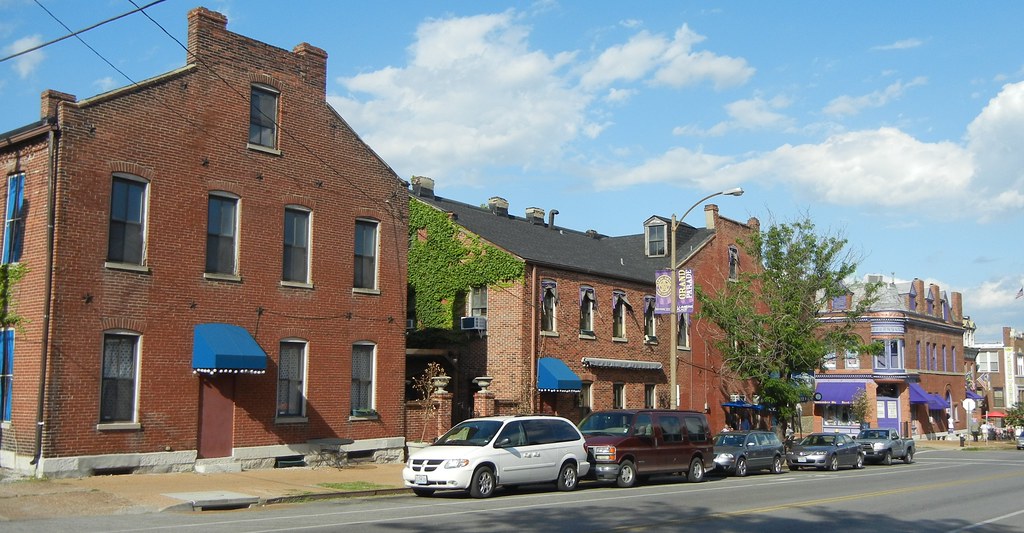
On May 21, the Preservation Board denied an application for solar collector installation from Robert Hiscox, owner of the Bastille bar at 1027 Russell in Soulard. Hiscox proposed installing black collector panels on the south-facing rear sloped roof of his building, shown at the center of the photograph above. Soulard is a local historic district governed by design standards last updated by ordinance in 1991.
The Soulard local historic district standards are not explicit about solar panels, which means that their installation requires a variance. The standards mandate that the character of sloped roofs be maintained through adherence to one of several times of approved roofing (most of which were not in use before 1900, I might point out). In a few instances, the Cultural Resources Office (CRO) has recommended that the Preservation Board grant a variance, and the Board has done just that. This time, however, CRO recommended denial of a variance based on the public visibility of the Bastille’s street-facing rear roof.
In her report to the Preservation Board, CRO Director Betsy Bradley wrote that “Russell Avenue is one of the wider streets in the district and links the historic district with interstate highway access and neighborhoods to the west, and therefore a street important in the perception of the historic character of the Soulard district.” Certainly, the Bastille’s roof is very visible and panels would change the visual character of the block. The Preservation Board made the right decision based on the current standards, which need to be rewritten to provide clear rules about solar collectors.
In an article by David Hunn in last week’s St. Louis Post-Dispatch, there is discussion of the need to revise the Soulard standards and other local district standards to create definite guidelines for the use of energy efficient technologies like solar collectors. Should new standards permit solar collectors to be installed on street-facing roofs? Perhaps. Standing-seam galvanized roofing was once a roofing material widely used on gable roofs in Soulard. A manufacturers’ challenge is to make solar panels that could mimic such a material, which could then be incorporated in revised standards.
Yet another consideration came from my colleague Mike Jackson at the Illinois Historic Preservation Agency, who e-mailed me after the story came out. Mike made the point that solar panels’ efficiency are generally only 10%, making them far less “green” than they seem. Purchasing power from regional off-site sustainable sources like wind farms, while undertaking efficiency measures on building envelopes, actually is more efficient for historic building owners than a few solar panels. Solar panels will become more efficient, but they may not be the greenest way to enhance historic buildings. Thus we should be careful when revising local district standards based on current technology.
7 replies on “Soulard Solar Collectors”
Stupid, really. Solar panels? Really, that big of a deal? In spite of the somewhat low-balled claim by the official the IHPA (efficiencies hover between 15-20%, actually, in most installations), solar is a good option, especially if one is looking to provide some back-up for a power outage. Plus, the feeling of independence is one which the petitioner was mindful of when planning the array. Plus, think of it this way: if we had millions of roofs in this country providing energy at peak times, then that’s dozens–perhaps hundreds–of power plants which won’t be necessary. Providing more capital for more productive areas. Say, building more wind turbines and solar arrays. Not to mention greater independence for the property owner. Of course, I’m a little biased, seeing as how I would love to have not only solar PV (at least 2-3kW–6kW would be my ideal) but solar water heating on my white roof. Which actually is more cost-effective from a time-weighted standpoint, as it takes about 5-7 years to pay off, as opposed to a solar PV array, which, depending on subsidies/breaks, etc., takes anywhere from 10-25 years to pay off. Not coincidentally, roughly the length of time it takes to pay off replacement windows.Â
 Oh, by the way…A new study came out recently regarding the power which can be provided by solar PV and wind turbines. The study was conducted with data gathered in Germany. Amongst other things, it showed that on a weekend day, power for the German grid was provided for–in 50% percent of the time–by solar PV and wind turbines. So much for the “oh, noes, this hippie crap can’t provide enough energy” PRopaganda.
You can probably put some relevant words into a search engine (mine happens to be GoodSearch) and find the study–or at least articles providing a link to the study.
Yet another example of this backwards city not wanting to realize what century we are in. Â As the owner of a historic home in Benton Park, I’m dismayed by much of what the preservation board does. Â And its not just things like Pevely, but things I see everyday in my neighborhood. Â Some horrid designed structures are approved and tolerated because (I suspect) the developer is in with the city, even though their “rehab” is complete garbage. Â This is about as dumb as the Town and Country solar decision of a few months back. Â Michael, I once derided you for liking that horrid airplane wing that crashed through the building on Gravois. Â In my view, this is nowhere near as bad as that ugly thing. Â Additionally, if we dont’ find ways to address the very serious problems that come from coal and nuclear power all the preservation in the world won’t matter because there will be no one here to enjoy it. Â
Didn’t the preservation board let an entire historic building collapse right down the street from here? If it weren’t so sad it would be laughable.  Recently, on Jefferson down the street from my house, they tore down 3 historic buildings, two of which were 100% in tact.  Guess what for?  Yep, a parking lot!!  I read the preservation board determination on why, and it was evident that having a daycare center on that site was more important to the city than having a daycare center on that site that respected the existing build environment.  Why is this city so afraid of being anything but last place?
The credibility of the Preservation Board is finished. The approval of the Pevely Building Demo made that clear. It is the same scenario, the regular folk have to follow the rules, the corporate insiders get to do whatever the hell they please.
The solar panel decision demonstrates a lack leadership and shows the Preservation Board (and CRO) are little more than dilettantes. America is at a crossroads concerning energy. No matter how small of an impact solar panels might have, the panels should be approved. I have studied old St. Louis architecture extensively and the old timers were creative, innovative and willing to make changes when necessary. They were completely unlike the hidebound bureaucrats who somehow imagine they know better than everyone else.
I seriously doubt anyone driving down Russell who happened to see the solar panels (unlikely in probably 99 percent of the passerby’s) would be concerned. What are they going to do? “Oh my God, solar panels!, this is not really a historic district”
Its all a big joke, unfortunately the joke is on the citizens who have to live with the incompetence of the Preservation Board in myriad ways.
Proper corbels on the chimneys and improper design of gutters on historic gables (modern gutters don’t cut it) are just a couple of ways the Preservation Board jeopardizes the life of historic buildings while screwing around with solar panels. So much for being experts.
I also take issue with your buddy Mike Jackson’s contention that solar panels are only 10 percent efficient. I have found none that low, but the starting point is the sun vs coal or other fossil fuels. So even though coal efficiency may be around 30 per cent (the same as some solar panels). It is polluting the hell out of our environment: welcome to global warming everyone. There is no equivalence, no matter how much your buddy Mr Jackson tries to rationalize it.
The solar panels should be installed in Soulard. St. Louis continues its 60 year decline with the mental gymnastics of Preservation Board and the CRO as just another piece of that decline. They should really just disband, they are near worthless at this point.
we saved this for you:
http://galleries.heraldtribune.com/default.aspx?id=352768#http://ibis.htcreative.com/getGalleryImages/uploadedImages/photos/2012/06/10/zoom/2833163.jpg
[…] there has been at least one recent case in which the owner of a building within a local historic district initially faced denial by CRO of […]