
by Michael R. Allen
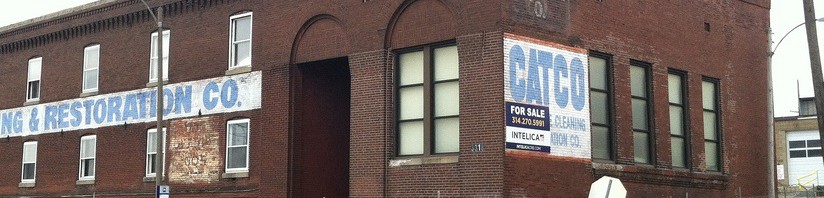
This week St. Louis University started wrecking a historic industrial building near the intersection of Chouteau and Grand avenues — not the Pevely Dairy Company Building, but the old Goodwin Manufacturing Company warehouse most recently owned by CATCO. The two-story mill method brick building dates to 1887, and features handsome corbelling and a recessed, raised entrance (its most curious feature). While the building is not greatly uncommon, it has the human scale now largely gone from its surroundings.
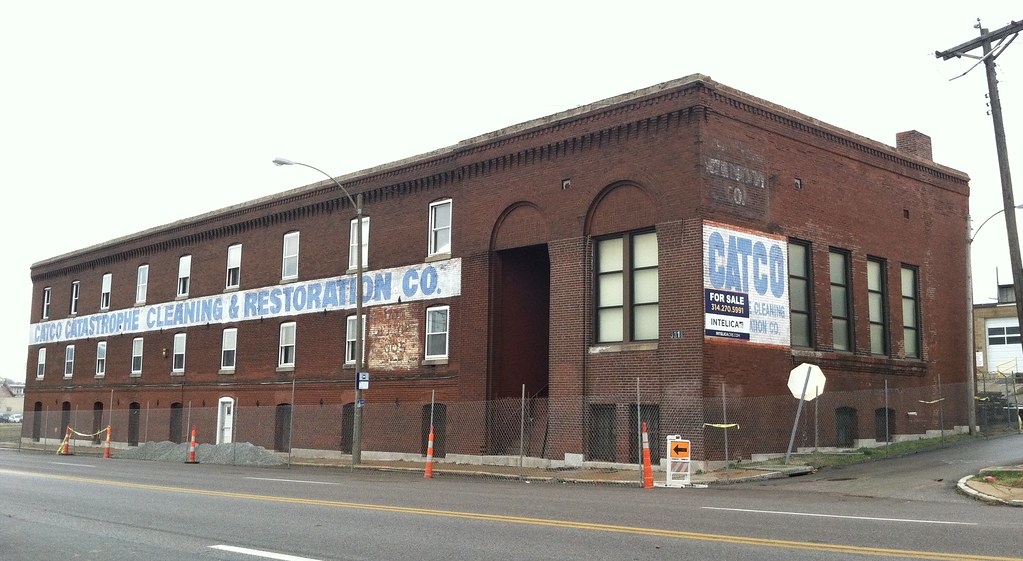
Demolition proceeded without fanfare because the historic warehouse lacked any protection under city law. The building is in the 19th Ward, whose Alderwoman Marlene Davis will not put her ward under preservation review that might enable preservation of buildings like this one. The building is not a City Landmark and is not listed in the National Register of Historic Places, either (although it might have been eligible).
The lost building was part of a larger manufacturing complex on Chouteau between Virginia and Ranken avenues built and operated by the Goodwin Manufacturing Company. The Goodwin plant did some dirty business: making candles and other products from tallow purchased as byproduct from area meat packing houses. The factory buildings that perforated the city air with awful rendering smells are long gone, but the warehouse that held finished products is a fine remainder of the plant.

According to historian Andrew Hurley in his essay “Regulation of Nuisance Trades in St. Louis,” in the volume Common Fields, a group of fifty residents attended a Board of Health meeting in 1893 to complain about the activities of the Goodwin Manufacturing Company. Hurley provides the accounts of a widow whose tenants had moved out due to the odors from the candle works and a property owner who claimed that the nuisance industry was going to cause his property value to drop by half. These complaints did not force the Goodwin Manufacturing Company to close; instead the surrounding area grew more industrial in character in the next thirty years. (The idea that property values dropping is a cause for government action has some ironic weight given that now much of the area is owned by nonprofit SLU, exempt from property taxes.)
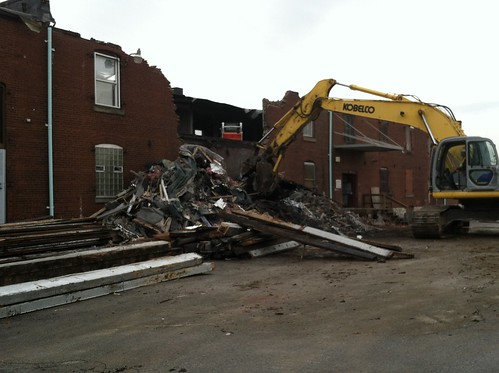

Demolition of the warehouse seems to be less than an acute blow to an area whose character is hardly conducive to pedestrian life and economic activity. Yet the building had structural and economic life left, and the university’s tax-exempt status means that the site loses not only potential economic productivity but even basic property tax revenue. St. Louis University’s plans for the site are not known.
Of course, the CATCO building sat on the market for months, and was not exactly priced high. The university reported a sale price of $179,000 on December 14, 2012. Preservationists could well have bought and spared the building, as with many others. While demolition review is a worthy protection, ultimately preservationists need to engage the economics of old buildings in addition to the legalities. The Brickstarter effort in Old North and the Cotton Belt Building mural on Rally STL are just small examples of how enterprise is becoming the new frontier for historic preservation in St. Louis.
Yet St. Louis University definitely could learn about the economics of adaptive reuse too. That warehouse, the Pevely Dairy complex and other buildings wrecked by the university in recent years could have instead become spaces for support functions that would build up the medical center area. The area lacks housing, retail and space for vendor companies to set up shop. A medical center should be the nucleus of dense interrelated activity, and the magnet for jobs. Instead, St. Louis University is following the dated modernist planning theory of use segregation. The result is that Grand and Chouteau, a stone’s throw from a MetroLink stop and a major mid-city crossroads, has just one business at its corners: a Captain D’s.
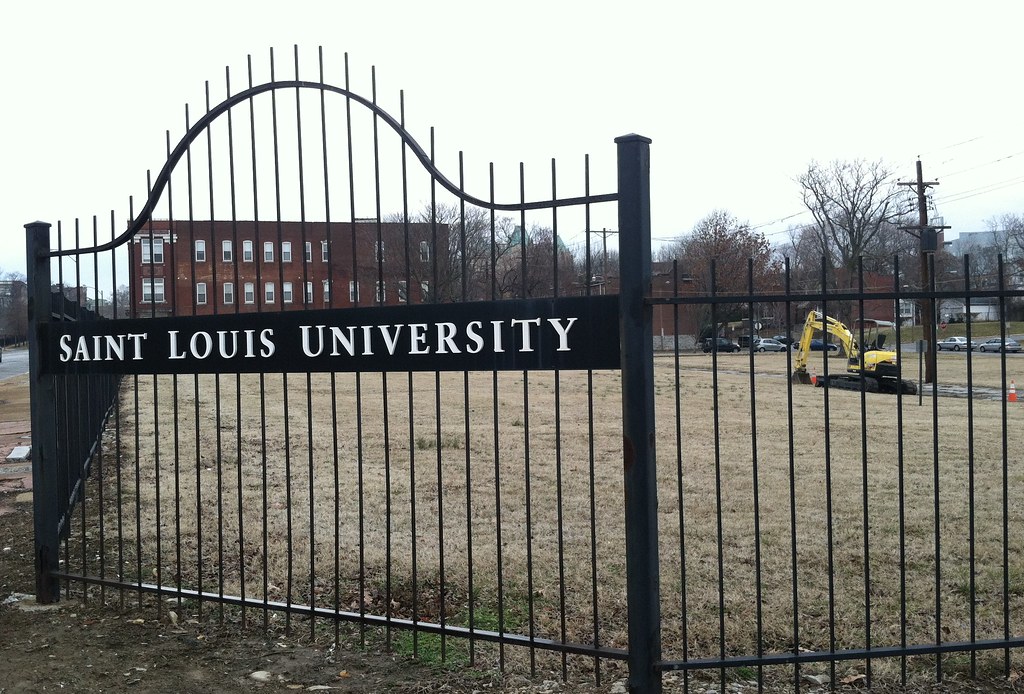
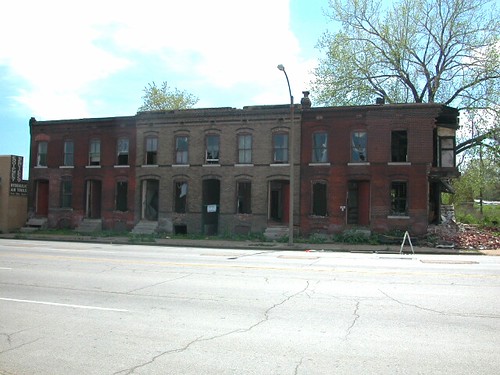
Naysayers might take heed by nearby activity on St. Louis University land at Compton and Park avenues. From the looks of the scene, the university is about to demolish a vacant lot!
9 replies on “SLU Devours Another Building”
This is just atrocious. I remember driving by this building 2 weeks ago and seeing a for sale sign and thinking it could be turned into some handsome apartments and give some context to the Pevely site. Unfortunately Biondi strikes again. So very frustrating. Why can’t the Mayor’s office push for or demand citywide demolition review? Atleast give what buildings remain a fair chance.
Instead of fixing up the empty building’s into condo’s orApt’s they weather tear them down. I’d move back to the South side if I could find a house cheap oe even given a discount for buying and moving back.
Biondi’s time will be expiring sooner than many have predicted. Carefully parse the news arriving over coming weeks for its real import. Let’s hope new leadership won’t follow his destructive path.
Another fine structure sacrificed to the SLU ghetto. At this point, I think SLU is just doing this shite to piss people off.
So, will somebody please tell me–again–how Il Duce Biondi has done sooooooooooo much for the City and SLU? Between “Grand Center” (HA!) and their demos, and SLU and their demos, this area is a dead zone. So much stupid, spiteful behavior on the part of leadership in this part of town.
As for new leadership, if the Board has kept Biondi on for this long, after it has long since been apparent that his guidance is damaging not only the University, but the surrounding City, I have little hope that any new leadership will be not only effective at, but willing, to change the course of SLU’s direction. Besides, looking at the acres and acres and acres of vacant lots and parking in and around Grand Center and SLU, the damage has already been done, and in my opinion–minus the influx of hundreds of millions, if not the low billions, of dollars in development–has rendered this area an irretrievably lost wasteland. Congratulations, Mr. Biondi and Mr. Schoemehl. Quite a legacy you’ve built for yourselves.
I hope you rot.
I think it can be helpful to send annoying e-mails to city officials about this kind of think. My e-mail to Mayor Slay: “Dear Mayor Slay, Please have a look at the following link (http://preservationresearch.com/2013/02/slu-devours-another-building/#more-2991). I moved to St. Louis only in 2010. In those three years SLU has demolished more historic buildings than I can count on my two hands. They seem to have enough empty lots for their next 100 years of development as a university, so it’s quite likely than many of these will sit unoccupied for upwards of that long. SLU does not pay taxes, and their demolition project further depresses land values of nearby buildings and lots. This seems to me to be clear evidence that we need city wide demolition review. Nearly all of the buildings I’ve seen them demolish are perfectly salvageable buildings with far more potential to make St. Louis a unique and desirable city than any cheap infill that would likely follow, or a mere empty lot, which will most likely be there for years to come. Please work to prevent these demolitions. Not just by SLU, but in general. St. Louis is destroying it’s character, and character is, when it comes down to it, what often makes the difference in getting new residents to stay and pay taxes long tem. I’ll be putting this concern to Lewis Reed to hear his opinion as well.”
I think it can be helpful to send annoying e-mails to city officials about this kind of think. My e-mail to Mayor Slay: “Dear Mayor Slay, Please have a look at the following link (http://preservationresearch.com/2013/02/slu-devours-another-building/#more-2991). I moved to St. Louis only in 2010. In those three years SLU has demolished more historic buildings than I can count on my two hands. They seem to have enough empty lots for their next 100 years of development as a university, so it’s quite likely than many of these will sit unoccupied for upwards of that long. SLU does not pay taxes, and their demolition project further depresses land values of nearby buildings and lots. This seems to me to be clear evidence that we need city wide demolition review. Nearly all of the buildings I’ve seen them demolish are perfectly salvageable buildings with far more potential to make St. Louis a unique and desirable city than any cheap infill that would likely follow, or a mere empty lot, which will most likely be there for years to come. Please work to prevent these demolitions. Not just by SLU, but in general. St. Louis is destroying it’s character, and character is, when it comes down to it, what often makes the difference in getting new residents to stay and pay taxes long tem. I’ll be putting this concern to Lewis Reed to hear his opinion as well.”
Agreed. Even though the mayor does not have direct power, the mayor has persuasive influence — and is willing to use it. Mayor Slay’s blog posts on the flying saucer and AAA Building helped turn around preservation battles for the good side.
Citywide demolition review needs to come from ordinance at the Board of Aldermen. My guess is that Mayor Slay would support it, but won’t push for it without strong aldermanic support.
Agreed. Even though the mayor does not have direct power, the mayor has persuasive influence — and is willing to use it. Mayor Slay’s blog posts on the flying saucer and AAA Building helped turn around preservation battles for the good side.