Categories
Central West End Demolition Historic Preservation Mid-Century Modern Preservation Board

Why the Friends of the San Luis Continue

by Michael R. Allen

On July 27, Circuit Court Judge Robert Dierker, Jr. dismissed the Friends of the San Luis‘ petition for injunctive relief. The petition sought to stop demolition of the San Luis Apartments so that the Friends could file an appeal of the Preservation Board’s approval of the demolition. Dierker not only dismissed the case, but did so on the basis that the Friends had no legal standing to bring forth a preservation appeal under the city’s preservation laws.

So, the building is gone and the case dismissed. Why are the Friends of the San Luis still fighting?

If left unchallenged, Judge Dierker’s ruling could set case precedent that citizens and advocacy groups lack the right to appeal decisions of the Preservation Board. Since the Preservation Board and its enabling laws govern the entire city, all citizens are affected by the decisions of the Board and deserve the right to appeal on procedural grounds.

Why would the Friends of the San Luis care about the right to appeal? Didn’t you want to save one building?

True, our organization was formed to advocate for a specific building. Yet our ability to do so was undercut by Dierker’s decision. The members of the Friends of the San Luis are active in other preservation matters in which the right to appeal is essential. If people have to go to court to prove our right to participate on every matter, concerned citizens won’t be able to actually fight for our city’s historic buildings. We must legally clarify that right to protect citizen preservation advocacy.

Okay. What’s next?

We will file an appeal of Dierker’s ruling to the Missouri Court of Appeals on the basis of his narrow definition of who has appeal rights. That appeal must be filed within 30 days of the ruling. Then, the Missouri Court of Appeals will schedule its hearing.

What if you lose at the Missouri Court of Appeals?

We could appeal further to the Missouri Supreme Court. However, if the St. Louis preservation ordinance’s right to appeal is not clear enough to withstand appellant judicial review, then there is a bigger problem than one judge’s point of view. Then we will know that the ordinance itself needs more clear language protecting citizen right to appeal.

Categories
Brick Theft LRA North St. Louis Northside Regeneration St. Louis Place

The Precarious Condition of Two Beautiful Houses on St. Louis Avenue

by Michael R. Allen

Brick rustlers have returned to the lovely stone-faced house at 1930-6 St. Louis Avenue (see ““Who Would Destroy This Building?”, January 7, 2007). Most recently a funeral home, the house was first built in 1873 by wholesale grocery merchant Bernhardt Winkelman. Winkelman was one of the numerous new-money German-Americans whose lavish homes gave St. Louis Avenue the nickname “Millionaire’s Row.” Today, a different millionaire owns the property: developer Paul J. McKee, Jr. through holding company N & G Ventures.

The damage from 2007 concerned only a one-story flat-roofed addition behind the home, but this week’s damage concerns the side wall of part of the house. Since joists run laterally and rest in the brick side walls of most 19th century buildings, this damage will eventually cause collapse of the roof and floors. However, the thieves have only struck an addition to the Winkelmann house’s ell, so the original section is not yet damaged.

On May 21 and other occasions, McKee mentioned having a list of 60 “legacy properties” in his possession worthy of preservation. Is this house one of them? It should be. However, the list is a mystery to myself and many people in city government and the development world with whom I have discussed preservation issues related to the NorthSide project. We do know that the house at 1930 St. Louis Avenue made an official list that gives it undisputed historic status: the house is a contributing resource to the Clemens House-Columbia Brewery Historic District. It ought to be preserved, and McKee should secure it against further attack.

Across the street is another fine stone-faced house with a lovely wooden Italianate cornice. The house at 1925 St. Louis Avenue dates to 1879 and is owned by the city’s Land Reutilization Authority (LRA). The house is outside of the present historic district boundary. The front looks ragged but sturdy, but a walk around the side reveals the sad truth.

The east side wall of the ell is in shambles, although the second floor and roof are holding on for now. The condition of this house raises a preservation question related to NorthSide that has not been widely discussed: what happens to the numerous vacant historic buildings within the NorthSide footprint not owned by McEagle Properties and its subsidiaries? Most of those buildings are on the list of needed properties that McEagle submitted to the city’s Tax Increment Financing Commission in May. Is the building at 1927 St. Louis Avenue one of the 60 “legacy properties”? There are more than 60 historic buildings owned by McEagle worthy of preservation, and at least as many in the project area owned by LRA and other entities.

City officials should not wait for the list of legacy properties to set into motion a sensible preservation plan for the NorthSide project. If public financing is on the table, that can be leveraged to ensure that buildings like the two above can be mothballed for eventual redevelopment in future phases of the NorthSide project.

Categories
Abandonment Hyde Park LRA North St. Louis Tower Grove East

Doug Hartmann Gets Two Years, Life of Shame

by Michael R. Allen

The fire-damaged Nord St. Louis Turnverein is just the most spectacular instance of the impact of Doug Hartmann’s real estate empire on the city of St. Louis. During Hartmann’s negligent ownership, the Turnverein went up in a huge blaze on July 6, 2006. Hartmann’s wild ride was already over, actually, and a sale of the property to developer Peter George was underway. George went on to close, and plans to rebuilt the landmark at great cost. If only Hartmann had been half as generous.

The Turnverein is an egregious example. Most of Hartmann’s nearly 150 properties in the city ended up like the corner storefront at the northeast corner of Wyoming and Arkansas avenues in Tower Grove East. Built in 1906, the building was shabby but occupied before Hartmann’s DHP Investments purchased it in 2006. Some work took place, including removal of the second floor windows. Then, everything stopped. Eventually, the building reverted to the city’s Land Reutilization through tax default. To this day, the weeds regularly grow waist high around the building, and a reuse timeline is not certain.

The building at Arkansas and Wyoming is like others that Hartmann accumulated to keep his Ponzi scheme afloat: occupied when purchased, and left a vacant nuisance. Hartmann’s grand plans of taking stable but not gut-rehabbed old buildings and turning them into top-dollar rehabs convinced many investors and banks to finance his fraudulent scheme. In retrospect, the buildings were better off as-is, and the whole mess was a symptom of a momentary development binge.

Last Thursday, Hartmann, of the 1300 block of Crooked Stick Drive in O’Fallon, Missouri, received the lenient sentence for which he had bargained with prosecutors: two years, plus $34 million in restitution that U.S. District Judge Henry Autrey admits will likely never be collected. (Have investigators checked for a Hartmann Swiss bank account?)

Acting United States Attorney Michael W. Reap ought to be ashamed for this pathetic sentence deal. The damage that Hartmann has done to city neighborhoods has taken more than two years to sort out, and much remains to be sorted. Hartmann could be a free man before the corner building at Arkansas and Wyoming is rehabbed.

The sad fact is that the drug runners who use Hartmann’s buildings for operations will face stiffer time in the slammer when they get locked up. If only these folks could meet Hartmann in prison! Of course, our white suburban fiend gets the justice that he does not deserve: a slap on the wrist in a cozy white-collar jail for bankrupting good people, cheating investors and leaving neighborhoods more vulnerable. Those who protest the inequity of our justice system are vindicated again. However, Hartmann will hardly be a free man upon return. We know his crimes too well now.

Categories
Historic Preservation Mid-Century Modern Midtown Urbanism

More "Urban" Is Not Always Better

by Michael R. Allen

The old Raiffie Vending Company building at 3663 Forest Park Avenue may not look like much, especially since its owner has let it sit without windows for the past three years. However, the two-story modern brick building has great qualities. Built in 1948, the building has a streamline modernist style that, while not greatly articulated here, is quietly attractive. Since the windows were part of the building design, the stylistic character was more clear before removal. Built of steel and brick masonry, the building is solid. This is the type of construction that is infinitely adaptable and practical for almost any use imaginable.

Of course, your mind might change when you see the new hotel that Sasak Corporation plans to build on the site of the modern warehouse. Five stories tall with wide street-level retail openings, this building adds more building density and urban connection to the site. Its masonry work is more interesting than that of the plain little box that now occupied the site, right? The hotel is a more urban building, you might think, and will add urban vitality to the site. Despite some flaws, like the 100-space garage in back being visible from the street through a pointless drive in front, this building makes the block more “urban” than the Raiffie building and thus constitutes an improvement.

Wrong.

Here is where the difference between rendering and reality comes into play. The developers are proposing to build this hotel at a cost of $90 per square foot, a price range below that of your average do-it-yourself Old North rehab. The masonry may look lovely in a tiny JPG, but it’s not going to be brick in real life. The hotel will be clad in precast panels, spaced by those oh-so-obvious black seams.

Is the shift to “more urban” worth it if it means throwing away better construction for a cheaply-built building that meets all of the rote urbanist qualities? I say no emphatically. We can’t keep throwing away buildings while we sit on an alarming amount of vacant land. There are many other sites in Midtown where a hotel could be built, and the old warehouse at 3663 Forest Park itself could be adapted if the developers wanted to try. But they’d have to spend more than $90 per square foot.

Categories
Century Building Downtown

I Support Marcia and Roger!

by Michael R. Allen

Often I think that preservationists may be the only people who have moved on from the loss of the Century Building. We have found new projects, new hope and new ways of using media to spread appreciation for the St. Louis built environment. The Old Post Office developers are realizing the final part of their project, with the Culinaria opening tomorrow and Old Post Office Plaza now the scene of theater and concerts. Landmarks Association of St. Louis even quietly renewed its membership in the National Trust for Historic Preservation.

All should be well in St. Louis nearly five years after the last scrap of building material was moved off site. Then why does the lawsuit against Roger Plackemeier and Marcia Behrendt persist?

That lawsuit is a pointless lingering thread that threatens the livelihood of two citizens who fought a gallant fight and did not prevail. The suit’s plaintiffs include the Old Post Office development company formed by DESCO and DFC Group, the Missouri Development Finance Board and the city via the Land Clearance for Redevelopment Authority. Perhaps the developers have an axe to grind, but why do the public entities persist?

Citizen participation is an important right in our democratic system, and its exercise unfortunately often is fruitless. Such was the case here, at least in terms of preserving a building. The citizens who fought to save the Century Building renewed the energy and relevance of historic preservation and urban design in St. Louis, providing encouragement to a new generation of advocates.

The counter-suit against Marcia and Roger is set for trial on September 14, and they need help raising funds for their legal defense. I plan to give generously, and urge all those who want to truly move past the Century Building battle to do the same. Details follow.

The Royale Treatment
Wednesday, August 12 from 6:00 – 8:00 p.m.
The Royale, 3132 S. Kingshighway

The Century Building may be gone, but not forgotten! Preservationists Marcia Behrendt and Roger Plackemeier are defendants in a SLAPP suit from the City of St. Louis and the State of Missouri over the demolition of this historic landmark. You can aid their defense and show a support for St. Louis’ architectural treasures.

Dave Drebes Players will be the featured entertainment. Complimentary appetizers will be provided by the Royale. Suggested donation of $5 at the door.

Downtown residents, Marcia Behrendt and Roger Plackemeier, took action in attempt to save the Century Building. They were plaintiffs in litigation that, among other things, sought to prevent its demolition and save our city’s architectural heritage. The City of St. Louis, the State of Missouri and the project developers filed a counter lawsuit against them, alleging malicious prosecution — and seeking actual damages exceeding $1.5 million, plus punitive damages “in an amount sufficient to deter said defendants and others from like conduct.”

This malicious prosecution has continued for over four years and the trial is set for September 14, 2009.

Marcia and Roger took a stand for their neighborhood – downtown – and all who love our City’s architectural heritage. The lawsuit against them is a classic SLAPP suit – a strategic lawsuit against public participation. Presumably the city and state, through agencies, have unlimited funds to pursue these two individuals for years. This is where you can help! Marcia and Roger need assistance with their legal costs. Your donation will help.

Please come and support Marcia and Roger and learn more about the status of the litigation and what you can do to help.

All donations will be accepted and are tax-deductible. Check or money orders should be payable to ReVitalize St. Louis and mailed to:

Royale Treatment – Downtown Defense Fund
C/o ReVitalize St. Louis
PO Box 771751
St. Louis, MO 63177

Royale Treatment – Downtown Defense Fund is sponsored by ReVitalize St. Louis and the Royale. ReVitalize St. Louis is a registered 501c3 nonprofit organization. For more information, please visit http://www.rvstl.org. To learn more about the Royale, please visit http://www.theroyale.com

Categories
New York City Planning St. Louis Board of Aldermen

Can St. Louis Lure Small Businesses?

by Michael R. Allen

This week New Geography published an interesting article by Steve Null entitled “New York City Closes Shop”. The article reports that under the anti-small business policies of New York City Mayor Michael Bloomberg, over 83,000 small businesses have been forced to close since 2001. That astounding figure represents just the recent effort to “crack down” on commerce that predecessors Rudy Giuliani, David Dinkins and Ed Koch all enforced as well.

Has this trend pushed small business out of the Big Apple? If so, what can smaller cities do to lure some of the entrepreneurs that might end up looking for a more encouraging urban business environment?

While Chicago has been a beneficiary of New York’s terrible policies, St. Louis could lure some of the business. St. Louis has an abundance of historic commercial districts, where old buildings offer cheap rents and low purchase prices. Small business owners can afford to rent a small space in New York and maybe an entire building in Chicago. In St. Louis, they can buy a building — or two. The low cost of living is a base incentive.

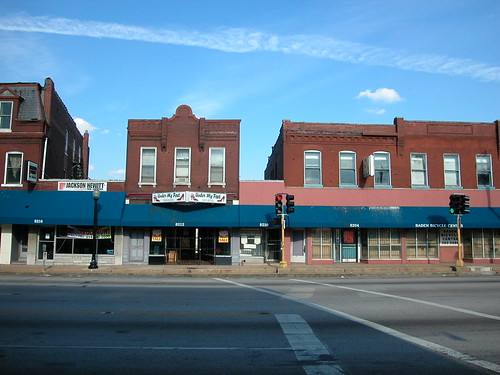
The 8200 block of North Broadway in the Baden neighborhood, 2006.
However, St. Louis needs more than a low cost of living and old buildings to draw businesses from larger cities. We need better urban planning policies to promote commercial districts by retaining storefront buildings and keeping out fast food, drug stores and other uses that break up urban streetscapes needed to draw shoppers. We need public sector investment in infrastructure like sidewalks, alleys and lighting. The business license fees and sales tax rates in the city are too high, especially on food and drink. Most of all, we need to break down the ward-by-ward differences in business and license policy with strict citywide standards that make sense to people from the outside world.

I’m not suggesting that a wave of would-be New Yorkers are coming. In fact, many of the small business owners we need to attract are those who chose Clayton, St. Charles or Belleville — or Memphis, Cleveland or Kansas City — over the city proper. The bottom line is that we have to create a city that not only has sensible small business policy but actively encourages small business to keep our neighborhood commercial districts thriving.

I would be very interested in comments from city small business owners.

Categories
Events North St. Louis Northside Regeneration

Northside Development Forum Tomorrow

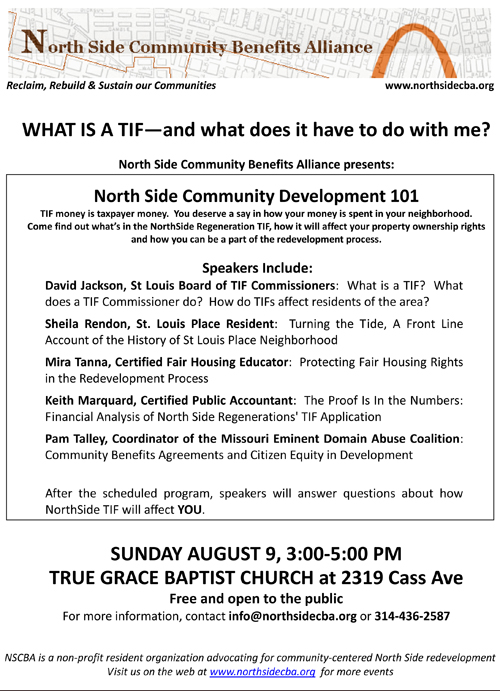
The Northside Community Benefits Alliance is hosting a forum tomorrow entitled “North Side Community Development 101.”

Categories
Belleville, Illinois Historic Preservation Metro East

Old Belleville Turner Hall Could Be Yours

by Michael R. Allen

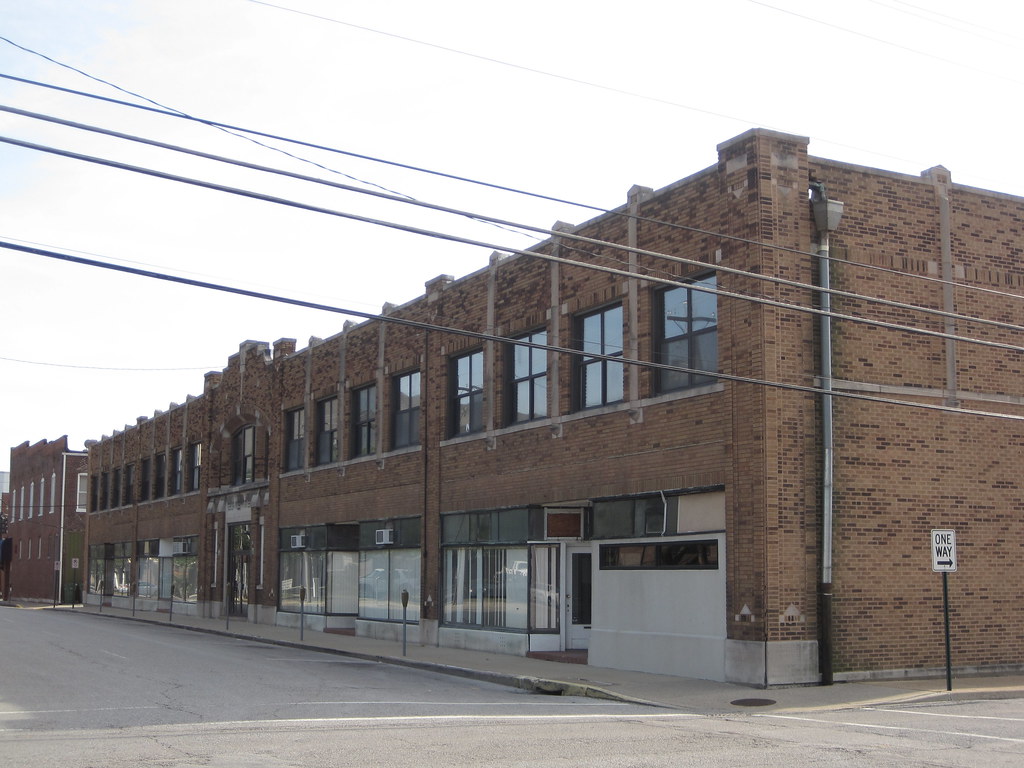
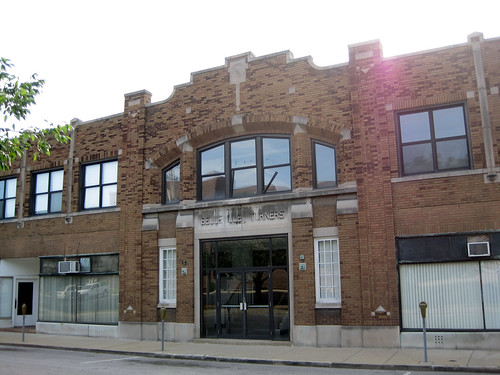
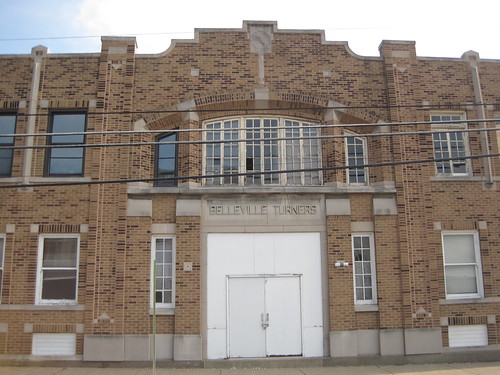
The city of Belleville, Illinois has extended through August 30 the period for its Request for Proposals for the old city-owned Belleville Turner Hall. Located just north of the bustling Main Street business district at the southwest corner of 1st and A streets, the large building enjoys strong architectural and social significance.

The RFP can be found online here with instructions on how to contact the city for interested developers. This is a great opportunity: a large mixed-use building adjacent to a commercial district that seems to add new shops and pedestrians every week.

The Belleville YMCA used the building from 1960 through 2005, so the building is most commonly called the Old YMCA Building. Hence, the advocacy website for the effort to preserve the building is called Y Save the Y. That site has a lot of historical information as well as photographs.

Designed by Julius Floto and completed in 1923, the Craftsman-influenced Turner Hall features a wooden bow-truss gymnasium and a theater on the second floor with storefronts below. The 20,000 square foot building combined the large spaces required by the Turners with space for small businesses along the downtown the sidewalk. To this day, the building remains remarkably intact (inside and out) and the Illinois Historic Preservation Agency has determined that the building is individually eligible for listing in the National Register of Historic Places. Citizens have submitted a nomination that is pending.

There is an interesting architectural connection between the Belleville Turner Hall and Frank Lloyd Wright: Julius Floto, an structural engineer by training, was the structural engineer for the Imperial Hotel in Tokyo. After the hotel survived the 1923 Tokyo earthquake, Floto published the article “Imperial Hotel, Tokyo, Japan” in the February 1924 issue of Architectural Record. The article detailed the structural properties that made the hotel survive the devastation.

Categories
North St. Louis Northside Regeneration

McEagle TIF Hearing Will Be in the Evening

by Michael R. Allen

By a 5-4 vote, the TIF Commission today set a public hearing on the Northside Regeneration LLC (McEagle) application for September 23 at 6 p.m. at City Hall, room to be determined. The Commission deadlocked in a 4-4 vote between commissioners who preferred an 8 a.m. meeting and those who wanted a meeting at a time more convenient to the public. Chairman David Newberger broke the tie in favor of public participation.

McEagle Chairman Paul J. McKee, Jr. made a presentation and then joined Alderwoman Marlene Davis (D-19th) and Deputy Mayor Barbara Geisman for questions from the Commission. The meeting lasted nearly two hours. The TIF Commission seemed favorable to the project, although focused on learning more about key details. One question that was not answered was whether or not the Commission and City Hall would support city guarantee of half of the $410 million bonds if McEagle fails to monetize them. Geisman has indicated in press statements that the city is not supporting such backing at this time, and that the final TIF application will be much changed.

The TIF Commission meeting shows that the city is serious about completing a redevelopment agreement by year’s end, and also serious about negotiating with McEagle to craft a better deal for the city. It’s time for citizens who want changes made to speak clearly and carefully. What should be changed? How?

Categories
Demolition Edwardsville, Illinois Historic Preservation Illinois Metro East

Madison County Still Could Save Part of Poor Farm Complex

by Michael R. Allen

On Monday, wreckers from Premier Demolition of St. Louis began demolishing the two remaining buildings of the Madison County Poor Farm at 333 S. Main Street in Edwardsville, Illinois. The buildings, owned by Madison County, had recently been used as the Madison County Sheltered Care Home for developmentally disabled and mentally ill persons. There was considerable controversy when the County Board voted to close the home and move the residents to other facilities. While there seems to be reasonable doubt over the closure, there was no question that the buildings themselves are historically significant. The question was whether or not the Madison County Board had the foresight to avoid rushing to demolish a Civil War-era building and its cohort.

The demolition is hasty and regrettable for two reasons:

First, there is no plan to do anything with the large site save seeding the building footprints after the foundations are filled. The buildings were sound and in decent repair, and posed no public safety risk to residents of Edwardsville. The cost of demolition is around $70,000. The same amount could have mothballed the buildings for future use, or been spent on a more pressing county issue.

Second, the Edwardsville Historic Preservation Commission (HPC) designated the complex a city landmark in 2000 and voted to block demolition. City landmark status is a rare designation anywhere, and it denotes wide community recognition of a site being one of the most important to the identity of a city. That the HPC and its chairwoman Kathryn Hopkins fought so hard against demolition should have at least delayed the County Board’s rush to tear down an irreplaceable landmark.

Postcard view found online here.

The complex began its life as the Madison County Poor Farm in the 1860s. Originally, the site was 180 acres with additional residential buildings on site. This facility was like those found in counties and cities across America: a refuge for the indigent who could not work due to age, infirmity or other malady. (St. Louis County’s Poor Farm was located on present-day Arsenal Street west of Sublette. Two buildings remain at 59th and Arsenal, while the rest of the complex was wrecked in 1982.)

The system was sad but practical. People who could not afford to live elsewhere came to the farm. Some had small jobs working on the grounds or in the food plots that fed the residents. Others were idle, living out their days in the institution. When residents died, they were buried in a cemetery behind the Poor Farm, where to this day 600 unmarked graves and one general monument remain.

The historic view above shows the two extant buildings. The two-story Italianate-style building at left was the Superintendent’s Building, built in 1865. Architecturally, the building was designed in the rustic strain of the Italianate style, which made use of asymmetry, a central design feature like a tower, projecting bay or cupola and tall, arched windows. This style was prevalant in American residential, institutional and commercial design from 1855 through around 1885.
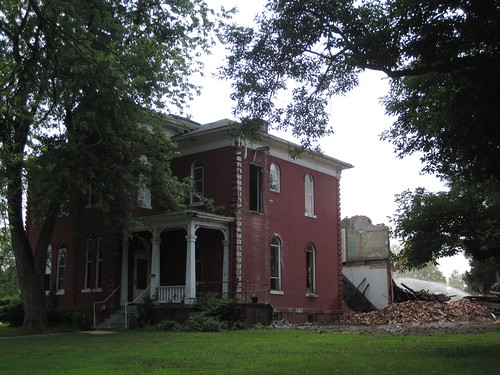
The Superintendent’s Building is a refined work in the style. The building has quoins running up each corner, masonry arches over each window rather than the common cast iron hood-molds and fine decorative brackets under the roof overhang placed at the corners.

The projecting central bay has a defining fornt gable and some rather striking tall, narrow windows.
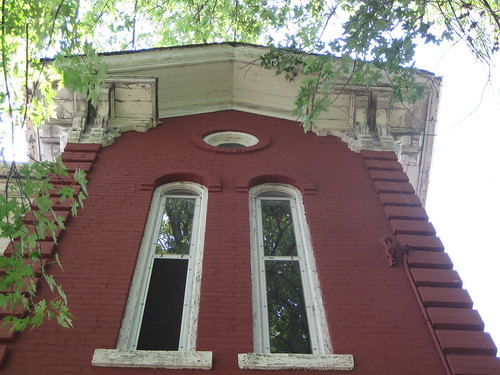
As these photographs show, the Superindent’s Building is not currently under demolition. In fact, the interior has barely been touched. However, workers have removed historic window sash from behind the storm windows. Has the sash been destroyed?

The residential hall, built in 1900, has not escaped death. While the front elevation of the building looks intact, displaying a simple Italianate-inspired design that harmonizes with the earlier neighbor, the back reveals that demolition has removed nearly half of the building mass.

Alas, the residential hall is lost. However, the Superindent’s Building is largely intact, structurally sound and not affected by demolition of the surrounding building fabric. The Madison County Board could still intervene to stop its destruction. While removal of the residential hall diminishes the context of the Superintendent’s Building, it does not impact the architectural integrity of the remaining building. There is still a chance to preserve part of the landmark Poor Farm.

One possibility would be to complete demolition of the surrounding buildings, mothball the Superintendent’s Building and issue a Request for Proposals for the site from developers who might wish to renovate the building. The County could end up breaking even on the old Poor Farm.

Perhaps a word to Madison County Board Chairman Alan Dunstan could stop total destruction:

Honorable Alan J. Dunstan
Madison County Administration Building
157 N. Main Street
Suite 165
Edwardsville, IL 62025-1963
(618) 296-4341