Categories
Central West End DeVille Motor Hotel Historic Preservation Mid-Century Modern

Daily DeVille #4

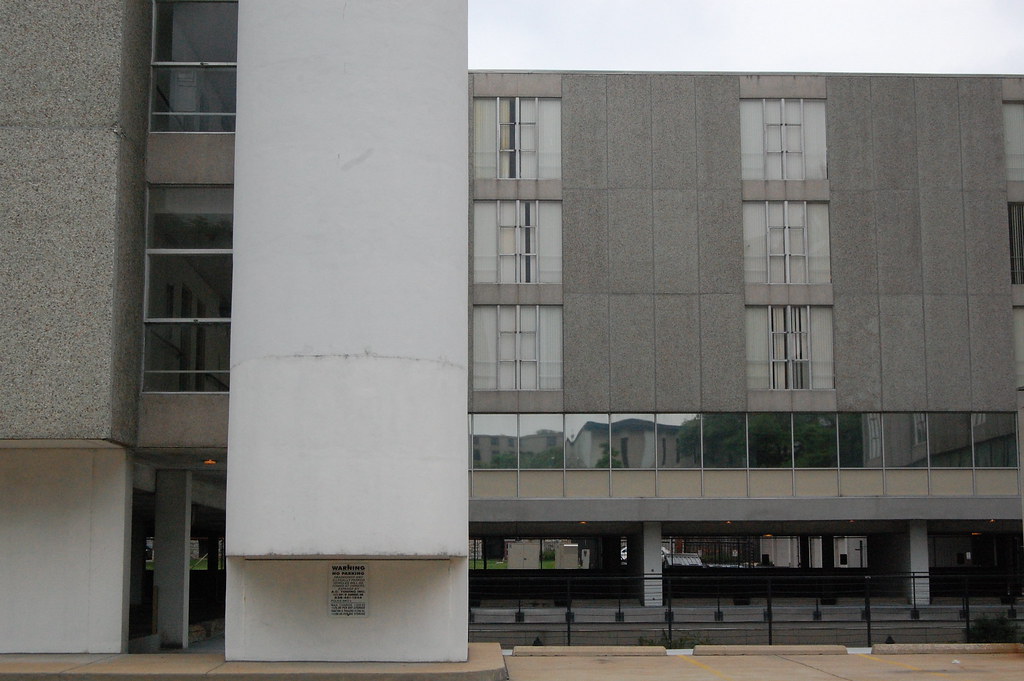
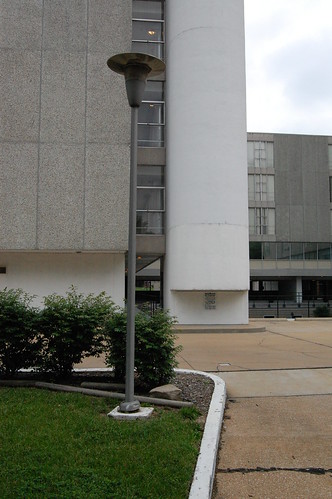
Cultural Resources Office Director Kathleen Shea has now posted her recommendation to the Preservation Board for the demolition of the former DeVille Motor Hotel and its replacement by a parking lot. Shea seems ambivalent about the Archdiocese’s proposal. Meanwhile, opposition to the demolition grows.

Since the DeVille’s architect was Charles Colbert of New Orleans, the New Orleans architectural community is stirred up. The Board of Directors of the New Orleans chapter of the American Institute of Architects sent a plea to the St. Louis Preservation Board. The National Trust for Historic Preservation is also opposed. Long engaged in the struggle, Landmarks Association of St. Louis sent a note to members this week urging them to send letters to the Preservation Board and Alderwoman Lyda Krewson (D-28th).

Fliers are circulating around the Central West End with information about the demolition. Many Central West End residents oppose the demolition, while many also simply object to the proposal that a prominent corner in the city’s poster neighborhood for urban living be occupied by a parking lot.

Categories
North St. Louis St. Louis Place

Hogan Street, Then and Now

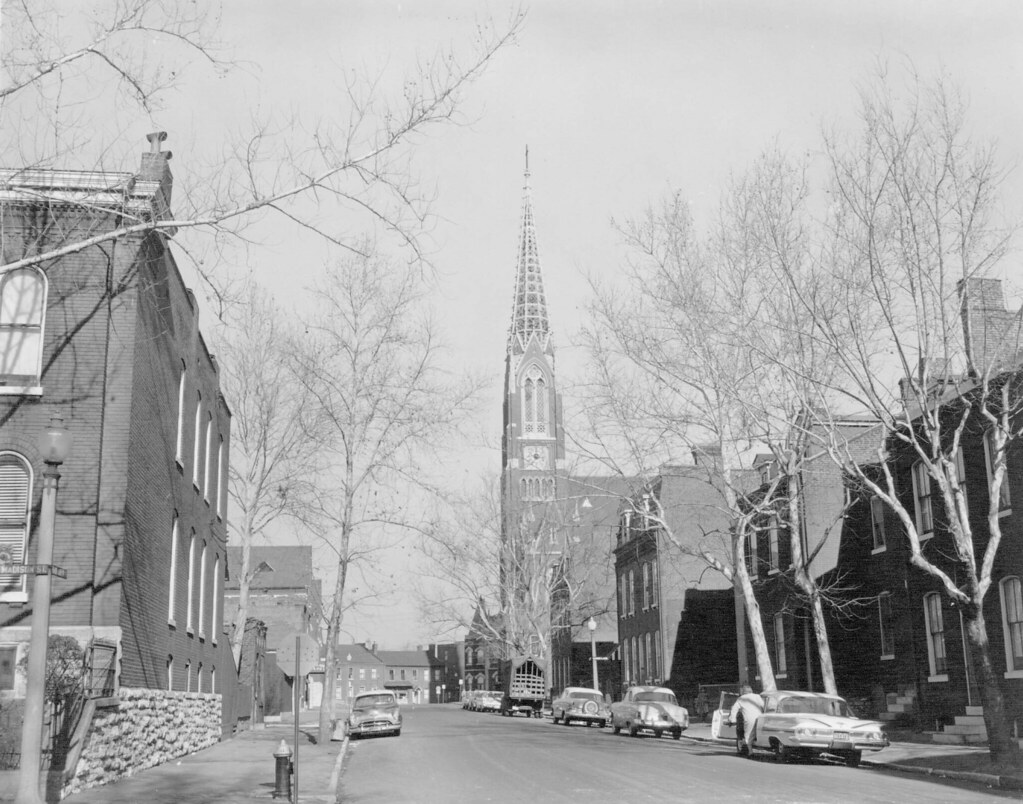
Here’s a 1960 view of Hogan Street looking north from Madison in St. Louis Place. The density of brick houses is striking. Also notable is the open-work sandstone spire on St. Liborius Roman Catholic Church, which would be removed in 1965.

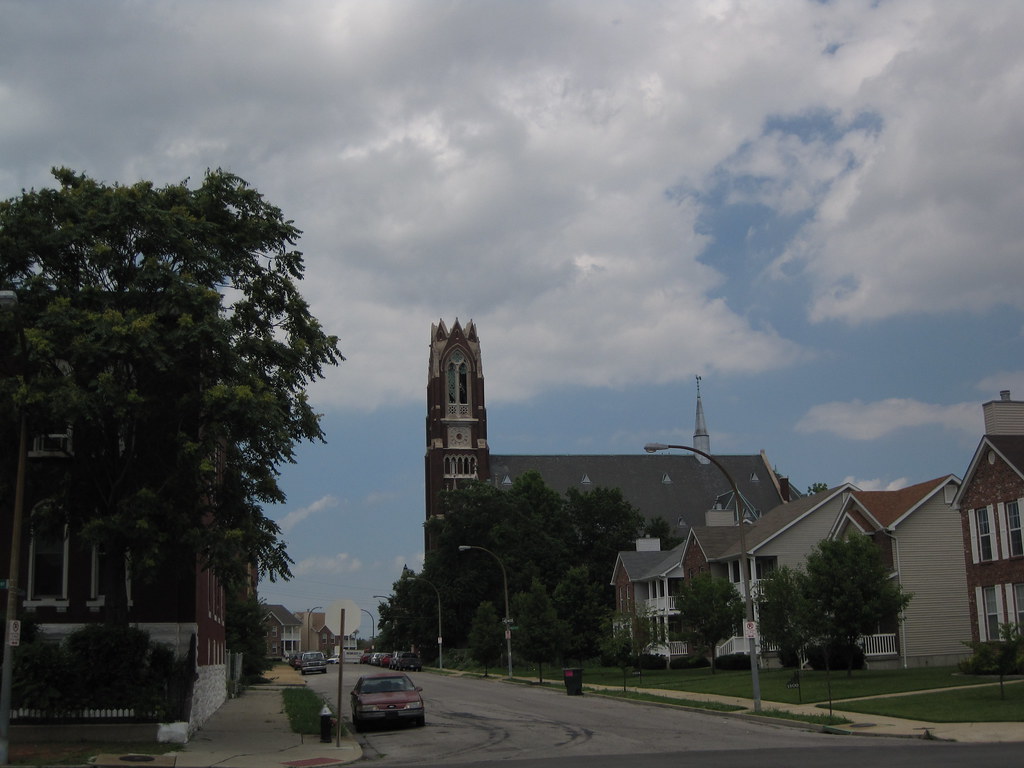
This is the same view today. The house at the corner and its stone wall remain, as does St. Liborius church. The brick houses and tenements are gone, replaced by new houses and (not visible here, but adjacent to the church) the New Roots Farm.

Categories
Central West End DeVille Motor Hotel Historic Preservation Mid-Century Modern

Daily DeVille #3

Demolition of the former DeVille Motor Hotel, 4483 Lindell Boulevard, will be on Monday’s Preservation Board agenda. Read more here.

Categories
Architects Historic Preservation People

W. Philip Cotton, Jr. (1932-2009)

by Michael R. Allen

Today’s passing of W. Philip Cotton, Jr. marks the end of an era. Phil — born in Columbia, Missouri as William Philip Cotton, Jr. — was one of St. Louis’ early preservation pioneers. An architect by training, Phil became a tireless advocate for historic architecture out of the necessity of his times. After graduating from Princeton in 1954, Phil moved back to St. Louis in time for the urban renewal years.

In 1966, Phil wrote the National Historic Landmark nomination for the Wainwright Building. He also was active in efforts to get Lafayette Square designated as a Historic District in the National Register of Historic Places. The 1969 listing of the Square helped prevent plans for a highway that would have destroyed the eastern end of the neighborhood. In this time, Phil was also an outspoken advocate for the reform of city tax laws that rewarded owner inaction in maintenance and discouraged investment.

Also in 1969, Phil was part of a group of architects, historians and planners that created Heritage/St. Louis. Heritage/St. Louis is one of the early advocates’ greatest gifts to future preservationists: a citywide architectural survey conducted by volunteers between 1969 and 1976. Although documentation was simply a photograph, address and short assessment of buildings, the survey allowed for thousands of buildings to be documented — many for the last time. Heritage/St. Louis’ inventory of images from north St. Louis grows more valuable every day. Sponsored by the Landmarks Association of St. Louis (on whose board Phil once served) and the City Plan Commission, Heritage St. Louis’ daily operations were oversaw by Executive Director Cotton.

The aim of the project, a 500-page book on the city’s architecture to be published in the bicentennial year, was never realized. However, the survey sheets — now in the archives of Landmarks Association — are a civic treasure. Alongside this work, Phil also saw that architectural drawings for many major St. Louis buildings were microfilmed. One of Phil’s greatest contributions to preservation was his understanding of the value of thorough documentation.

Alongside this work in the city, Phil also was active in the county (producing the survey 100 Historic Buildings in St. Louis County in 1970) and the state of Missouri. In the mid 1970s, Phil Cotton drafted the outline of the statewide preservation organization later to become Missouri Preservation. He remain a counselor to that organization until his death.

Phil also championed the city’s official landmark program, and nominated the first 35 sites, structures and buildings to receive that designation. The city landmark program granted more than symbolic value or financial aid for preservation, but legal safeguards. Knowing Phil, I am not surprised that he sought the highest protection for the landmarks he valued the most.

Of course, throughout his service to the city and state as an advocate, Phil was an active preservation architect. Among his many restoration projects are the Piper Palm House in Tower Grove Park, the Mark Twain boyhood home in Hannibal, Missouri, the Collins House in Collinsville, Illinois, the Gittemeier House in Florissant, the Saline County Courthouse in Missouri and others. Not surprising, also, that Phil Cotton was an organist and aficionado of classical music whose knowledge was revered by his friends. Phil’s interest in architecture seemed to stem from a larger concern about the legacy of culture we all share and must steward.

In recent years, Phil remained as persistent as ever — even in the face of illness. He continued his service as a trustee of the Steedman Architectural Library of the St. Louis Public Library. He was named to the College of Fellows of the American Institute of Architects in 2002. When I first met Phil a few years ago, he was hard at work on editing a reprint of John Albury Bryan’s Lafayette Square, published in 2007. Dogged and principled, opinionated and generous, articulate and fastidious, Phil Cotton left us a legacy to admire and emulate.

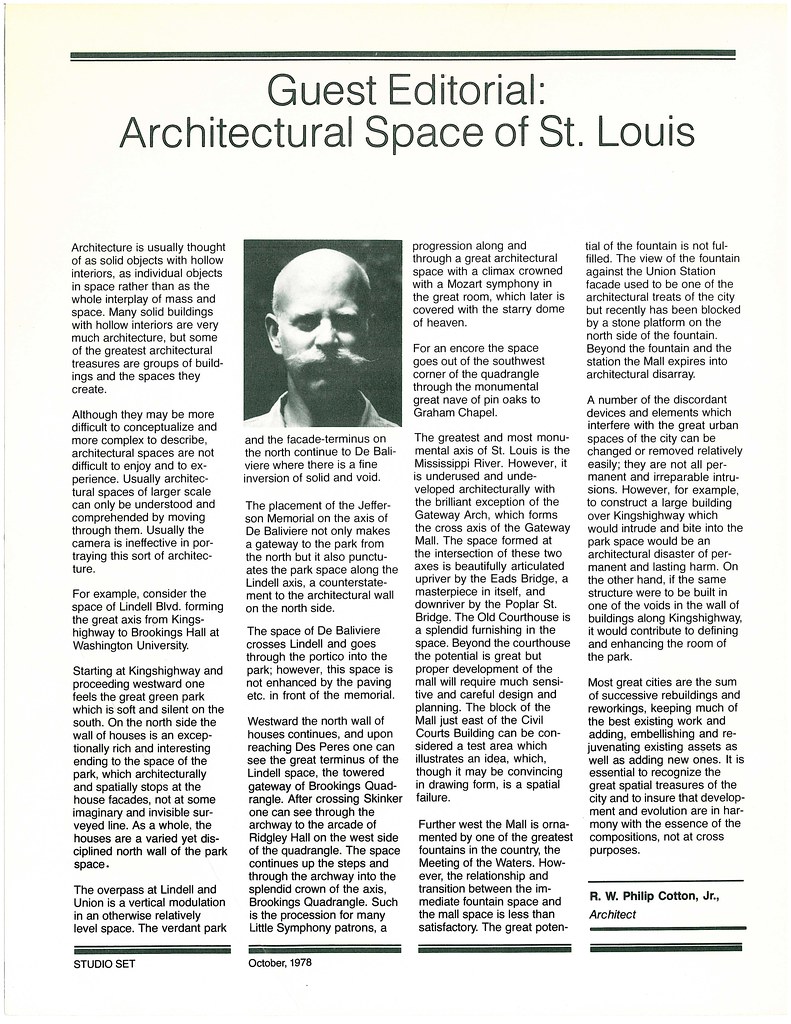
(A copy of Phil’s 1978 essay “Architectural Space of St. Louis” is online here.)

Categories
Central West End DeVille Motor Hotel Historic Preservation Illinois Mid-Century Modern Motels

Springfield’s State House Inn: Another Successful Mid-Century Motel Renovation

by Michael R. Allen

Photograph from the Historic Sites Commission of Springfield website.

The first motel in Springfield, Illinois was the State House Inn at 101 E. Adams Street in the heart of downtown. Built in 1961 and designed by Henry Newhouse, the State House Inn is a contemporary of St. Louis’ threatened DeVille Motor Hotel.

However, the State House Inn is celebrated by its city and has received the benefit of a historically-sensitive renovation. In 2003, the motel reopened after a three-year, $8 million renovation. Today, the motel’s guests enjoy lovely modern lodgings just a short walk from Springfield’s major attractions as well as the Amtrak station.

Could the DeVille be the beneficiary of a similar renovation? While not downtown, the DeVille is a short walk from some of the city’s attractions — the Cathedral, Forest Park — and near light rail that connects to our Greyhound/Amtrak station. The Central West End stays open later than downtown Springfield, too, with many restaurants and bars within a short walk of the motel. With the same applied imagination that the State House Inn received, the DeVille could be one of St. Louis’ coolest places to stay.

Categories
Central West End DeVille Motor Hotel Historic Preservation Mid-Century Modern Preservation Board

Daily DeVille #2

Demolition of the former DeVille Motor Hotel, 4483 Lindell Boulevard, will be on Monday’s Preservation Board agenda. Read more here.

Categories
Central West End DeVille Motor Hotel Historic Preservation Mid-Century Modern

Daily DeVille #1

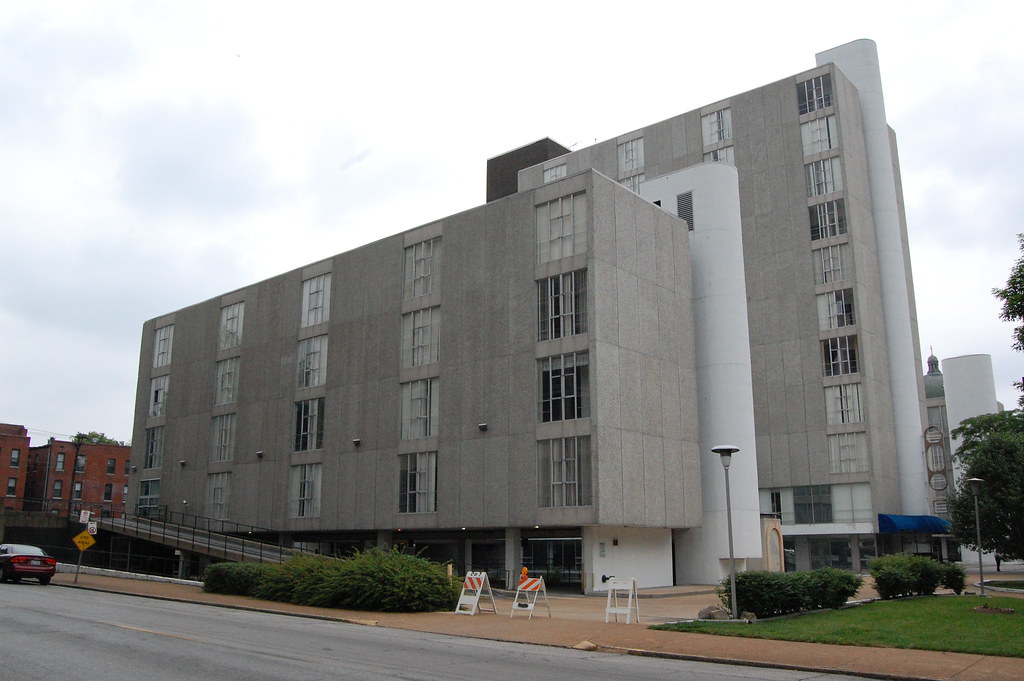
The DeVille Motor Hotel viewed from the corner of Taylor and Lindell. Oh mighty modern motel, how you soar!

Categories
Illinois

One Cool Garage

by Michael R. Allen

Walking around Grafton recently, I noticed this garage on First Street. Our Lady of the Waters, what a fine building! The walls are built entirely out of structural clay tile, with a lovely tapestry of mixed colors. The corners and edges around the doors and windows are even bull-nosed. I have little else to add save that one does not find clay tile buildings like this often in the St. Louis region. Yay!

Categories
Central West End DeVille Motor Hotel Historic Preservation Mid-Century Modern Preservation Board

Help Stop a New Parking Lot on Lindell

by Michael R. Allen

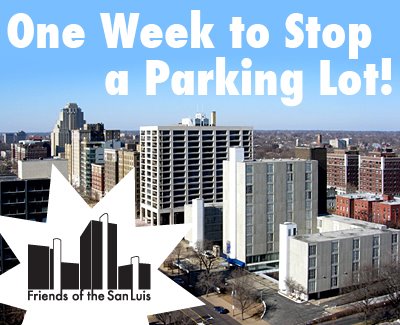
Graphic by Kara Clark Holland.

The day has arrived: On next Monday, June 22, the St. Louis Preservation Board will consider the demolition of the DeVille Motor Hotel (recently the San Luis Apartments) at 4483 Lindell Boulevard. The Archdiocese of St. Louis has asked the Board to conduct a preliminary review of its plan to demolish the mid-century motel and build a surface parking lot. As a preliminary review, the issue is not tied to an actual demolition permit. However, if the Board grants preliminary review, the city’s Cultural Resources Office must approve the demolition permit (after any stipulations placed on issuance have been met). If the preliminary review ends up with a denial, the Archdiocese will have to return to the Preservation Board with a new plan.

While some have said that this is a “done deal,” that is not true. The Preservation Board can block the demolition next Monday. However, your help is needed — the Board seeks direction not only from the applicant and preservation professionals, but from the wider public. Central West End residents especially should chime in.

I should also note that those who don’t particularly like the DeVille but loathe the urban design travesty of a surface lot on Lindell Boulevard will be best served by board denial of the current proposal. Once the parking lot is approved, the idea of a new building on the site is at the Archdiocese’s discretion. Don’t hold your breath.

Please send your written comments, no matter how brief, to the Preservation Board by submitting an e-mail to Board Secretary Adonna Buford at BufordA@stlouiscity.com. You might consider copying your letter to Alderwoman Lyda Krewson (D-28th), who represents the DeVille site and whose leadership on this matter would be helpful.

You can also send a letter via postal mail to:

Preservation Board
c/o Cultural Resources Office
1015 Locust Street, Suite 1200
St. Louis, MO 63101

If you would like to present your comments in person, the Preservation Board meeting is at 4:00 P.M. on the 22nd at 1015 Locust, Suite 1200. There are several items on the agenda before the San Luis, so the meeting may be long.

Everything you need to know about the issue is online at No Parking Lot on Lindell!.

Categories
Demolition Downtown Parking

Lost: The Mercantile Club

by Michael R. Allen

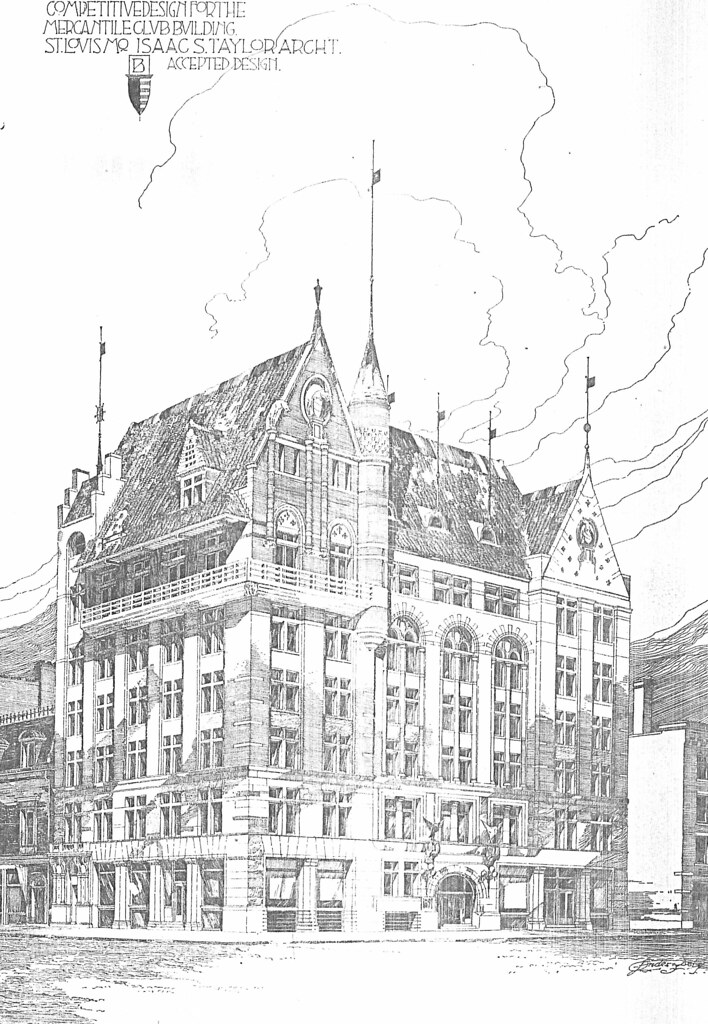
Recent discussion about development around the intersection of Seventh and Locust streets — prompted by a plan to convert St. Louis Centre into a parking garage — brings to mind one of that intersection’s lost landmarks. The Mercantile Club stood at the southwest corner of that intersection, where now there is a parking lot.

The illustration here appeared in the Northwestern Architect in December 1891, showing the successful entry by Isaac S. Taylor in the Club design competition. Completed in 1892 according to the plan shown here, Taylor’s design beat the work of other architects, including Louis Sullivan. (Had Sullivan won, Seventh Street would have been home to three of his works, with the Union Trust Building directly adjacent to the south.)

Taylor’s design clearly was influenced by the Romanesque Revival architecture of H.H. Richardson as well as the architecture French Renaissance, which favored high-pitched roofs and turrets. The base of the building was Missouri granite, with brick above punctuated with terra cotta ornament.

The site had been occupied by the town home of Henry Shaw, which was relocated to a site on Tower Grove Avenue at the Missouri Botanical Garden. In 1891, the Mercantile Club was a rising and successful group consisting largely of downtown businessmen, and the site chosen for the club home was in the heart of members’ commercial interests.

Later known as the Compton Building, the Mercantile Club fell in the early 1970s for the current surface lot.