Categories
Historic Preservation People

Welcome, New Cultural Resources Office Director Betsy Bradley

by Michael R. Allen

At the start of the new year, we will have a strong new ally for historic preservation in St. Louis: incoming Cultural Resources Office Director Betsy Bradley. Betsy comes to St. Louis from the Wyoming State Historic Preservation Office, but her urban credentials include seven years as a staffer to the New York City Landmarks Preservation Commission. Most importantly, Betsy gives the city a professional with extensive experience in cultural resources management, education and even publication. I have no doubt that Betsy will be a shot in the arm for city preservation efforts.

While not a native, Betsy already has some roots here: her husband is Jefferson National Expansion Memorial Superintendent Tom Bradley.  I have had the chance to get to know Betsy in the last year and know her to be calm, thoughtful and inquisitive.  Of course I was ecstatic when I learned that the Planning and Urban Design Agency chose Betsy for the Cultural Resources Office directorship.  (That job most recently was held by the unflappable Kate Shea from 1989 through this July.)

A key strength that Betsy brings is having been a member of citizen preservation review boards like our Preservation Board. Betsy has served on the commissions in Shaker Heights, Ohio, and Taylors Falls, Minnesota. She understands the deliberative aspect to CRO’s decision making, often the source of conflict. Furthermore, Betsy has connected her cultural resources work to academic communities through teaching. Currently, she is an adjunct professor at Baltimore’s Goucher College, which offers a renowned distance-learning master’s degree in historic preservation. Formerly, Betsy taught at the University of St. Thomas, Ursuline College and Youngstown State University. Betsy will be able to connect work in St. Louis to a larger community of cultural resources professionals and aspiring professionals.

In addition to her impressive resume of service, Betsy is the author of The Works: The Industrial Architecture of the United States (Oxford University Press, 1999). Preservation of industrial resources is a big and unresolved challenge in St. Louis and its Rust Belt brethren, so we should be pleased that our city’s top cultural resources officer has done extensive study of the issue.

Betsy Bradley starts in January. Fellow preservationists, a lot of good lies ahead.

Categories
Mid-Century Modern St. Louis County

Modern STL Publishes First Self-Guided Modern Architecture Tour

by Michael R. Allen

Only a few months young, Modern STL has already hit the ground running to identify and promote the region’s modern architecture. Today Modern STL published its first self-guided architectural tour, encompassing Kirkwood, Crestwood, Oakland and Glendale in southwest St. Louis County. From Frank Lloyd Wright’s Kraus House to a grouping of Harris Armstrong-designed homes to several notable post-war subdivisions, the area is rich with mid-century heritage.
The tour is available both as a Google Map and as a two-page PDF for easy printing. Both are available here. Modern STL will be publishing other self-guided tours in the future. Any suggestions?

Categories
Benton Park West Cherokee Street Gravois Park PRO Collection South St. Louis

1950s Parade Scene, Cherokee at Compton

by Michael R. Allen

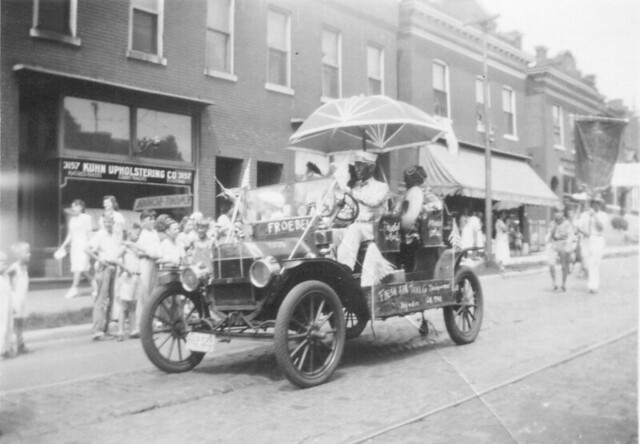
In November, we acquired a collection of 209 black and white amateur photographs taken in and around St. Louis between 1930 and 1980. Most of the photographs are from the 1950s and a large number feature parade scenes. Today we post two taken by the same photographer on the same date showing the intersection of Cherokee and Compton streets in south St. Louis.

A parade heading west on Cherokee Street near Compton Avenue in the 1950s. Photographs from the Preservation Research Office Collection.
The same view today.

The view in the first photograph shows the north side of the 3100 block of Cherokee Street toward the west end.  At right are the buildings now housing Tower Tacos (3149 Cherokee) and Fort Gondo Compound for the Arts (3151).  At left is the larger corner building where Peridot and the StyleHouse, housing clothing purveyors and St. Louis patriots STL Style and Lighthouse Design.  Kuhn Upholstering Company is long gone.  The Fort Gondo and Tower Taco buildings have lost their shaped front parapets.  Overall, however, the view remains remarkably the same.

The parade turned south onto Compton Avenue from Cherokee Street.
The same view today.

The second view looks north on Compton Avenue. Again, little has changed in the fifty-odd years since the parade passed by — just the removal of awnings. Even parades still pass by on Cherokee Street, at least around every Cinco de Mayo.

Categories
Midtown Streets

Vandeventer, Your Granite is Showing

by Michael R. Allen

While heading north on Vandeventer Avenue today we spotted an open cut just south of Lindell Boulevard, in which workers were repairing pipes. The cross-section of street looked like this:

One can easily see a layer of red Missouri granite paving blocks under the asphalt. Granite paving like this came into use in St. Louis during the early 1880s.  Peter Vandeventer opened the Vandeventer Place addition in 1870, and the street was laid out then from Cass Avenue on the north to Lindell Boulevard on the south.  The southern extension between Lindell Boulevard and Old Manchester Road (now also called Vandeventer) is shown on Pitzman’s 1878 atlas of St. Louis County and City.

Vandeventer likely was unpaved at the start, so the granite blocks may be the street’s original paving.  Judging from what is evident today, they are likely intact and buried directly under the asphalt.  We are never very far from our roots, are we?

Categories
Brick Theft North St. Louis Northside Regeneration St. Louis Place

Where Stolen Bricks Go

by Michael R. Allen

On December 7th, a resident of the Old North neighborhood caught a man stealing bricks from a stack in front of her house. When she asked him to put them back, instead of complying he hurried into his maroon Jeep Cherokee and drove off.

Police did not have a hard time finding the thief. After the resident called in the crime, officers headed to Unlimited Bricks at 2600 University Avenue where, as if following the directions of a brick rustling script, the thief’s vehicle was parked. The man was selling bricks to the yard, owned by Charles Rosene. After the victim identified the man, he was arrested and taken into custody.

Readers may wonder how Unlimited Bricks was still in business after the Board of Adjustment revoked its occupancy permit on November 17. (A lot of the credit for this action goes to the tireless effort of Fifth Ward Neighborhood Stabilization Officer Kathryn Woodard, supported by Alderwoman April Ford-Griffin.) While the business had a legal time to appeal that ruling, it had to obey the revocation order pending appeal. Unlimited Bricks — a business that is not incorporated in this state — truly was an outlaw operation when it nearly fenced some stolen front yard bricks. No more.

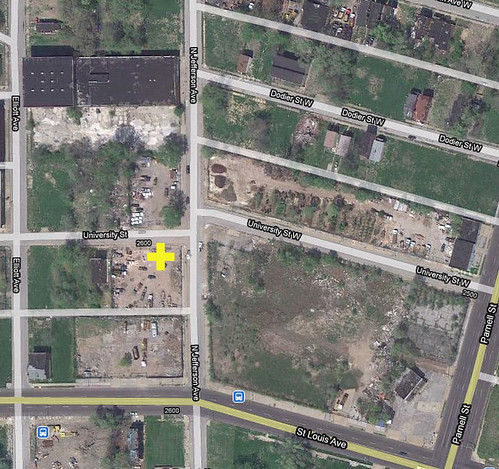
Map of the area around Unlimited Bricks, which is marked by a yellow cross.

Thanks to the Old North resident’s complaint, the St. Louis Metropolitan Police worked quickly to get the Building Division to condemn the property for occupancy on December 8. Rosene has had an active occupancy permit since July 1, 2005. Noncompliance with the revoked occupancy permit will land Rosene with fines of $500 per incident, so if you are in the area please check on 2600 University and see if the yard is running. If it is, call the police. They will know the operation all too well.

Those who are not familiar with the corner of University and North Jefferson, shown in the aerial photograph above, can be excused. The vicinity of the yard is a waste land of wrecker’s yards and unlicensed dumps. Looking at a summer-shot aerial photograph, one can see how accurate the term “brownfield” is in describing certain conditions of battered urban landscape. This is the vortex where near north bricks go for fencing out of the neighborhood. This area is very much like a black hole that consumes area building stock and churns out cash to a handful of harvesters, again and again until there is no more possible destruction.

To the south and southeast of the Rosene property are lots owned by the Hemphill wrecking family. Around those are still more half-used lots. Typically, these lots have tall chain link fencing — often missing in sections — and haphazard gravel paving. The lots have many scrub trees around the fence lines, so that in the summer they are almost forested. In the middle will be some wrecking equipment, salvaged materials or random items.

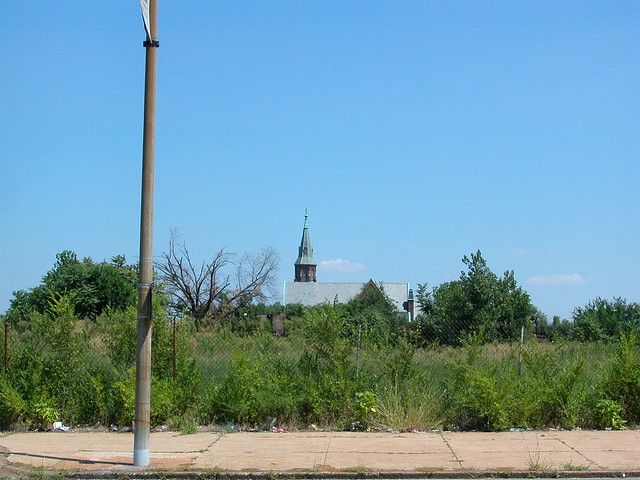
View north from St. Louis Avenue across the abyss of wrecking yards.

On the south side of St. Louis Avenue on the east side of Elliott Avenue is a grimly comic landscape of a tall slope of of dirt, dumped from wrecking jobs, on a lot so unkempt one wonders how it can possess any legal occupancy permit. Not all of the yards in the area are so unsightly, and wreckers who hold licenses do honest labor for money. Yet the conglomeration of messy yards around St. Louis Avenue and Jefferson, just northwest of the old Pruitt-Igoe site, are a black eye for the north side.

One is not surprised that the Northside Regeneration plan takes aim at this swath of blight.  Yet the fact is that it does not take $8 billion plans to shut down illegal brick yards and clean up vacant lots. Citizen action, not the weight of promised redevelopment, has shut down Unlimited Bricks. What else can it do?

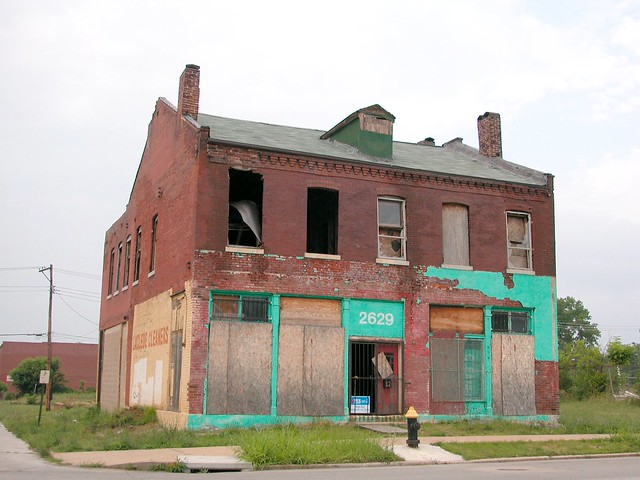
The building at 2629 St. Louis Avenue, owned by Northside Regeneration LLC.

One of the few remaining buildings in the wrecking wasteland is the handsome 19th century commercial building at the northeast corner of St. Louis and Elliott Avenues, owned by Paul J. McKee Jr.’s companies for years now. Its strong form is a vigilant reminder that the dead center can also be a land of urban life, where bricks build community rather than petty fortunes.

Categories
South St. Louis Tower Grove East

Red Brick and Snow

Goodness, does a snowfall bring out the saturated red of St. Louis brick!

Categories
Historic Preservation

“St. Louis Labor History Tour” Online

by Michael R. Allen


Searching for a copy of the difficult-to-find St. Louis Labor History Tour this week, we should have known where we would find it: on the Internet, and on the editor’s own website! Rosemary Feurer’s excellent website Labor History Links has the booklet online in PDF format. St. Louis Labor History Tour was edited by Feurer with contributions by Dave Roediger, Marilyn Slaughter, Lon Smith and Diana Young. The 27-page booklet was published in 1994 and 1996 by one St. Louis Bread and Roses, Inc.

St. Louis Labor History Tour tells, among others, the stories of the “Washington Avenue Massacre,” a 1900 incident in which three striking streetcar workers were killed by an upper-class posse; the telephone operators’ efforts to unionize Southwestern Bell between 1913 and 1919; and, one of the biggest forgotten tales, the unemployed marches on City Hall in the 1930s.

Categories
Adaptive Reuse Historic Preservation Mid-Century Modern Midtown New York City

New York Project Suggests Direction for Hotel on Forest Park

by Michael R. Allen

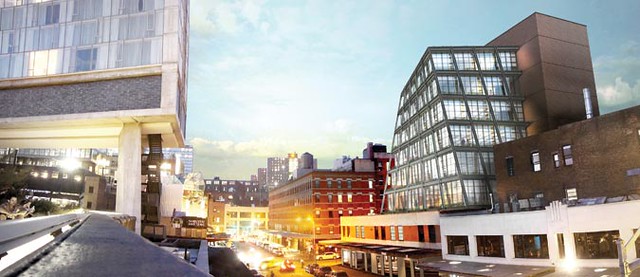
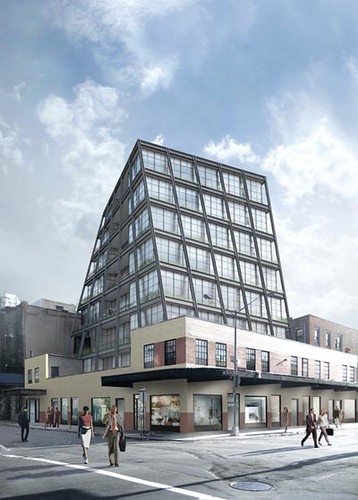
Today The Architect’s Newspaper carried a story that poses a suggestion to St. Louis, by way of New York. In “Tower Twists and Preservationists Shout”, Alan G. Brake tells the tale of a proposed design by architect Morris Adjmi in the Gansevoort Market Historic District on Manhattan.

Taconic Investments hired Adjmi to design a seven-story condominium-and-retail structure placed on top of an art moderne market building. The building, dating to 1938 and enjoying no singular official distinction, is at 13th and Washington inside of a local historic district. Hence, Adjmi’s plan for a slightly twisted tower with sloped grid walls had to be approved by the Landmark Preservation Commission last month. The Commission debated the proposal but failed to find a majority for or against the plan.

What was reassuring was that the Commission spent time debating how appropriate the tower was to the area, which is a former meat market district with mostly low-rise buildings (except for the tower straddling the High Line across the street, outside of the historic district boundary). This is why I thought about St. Louis as I read the article.

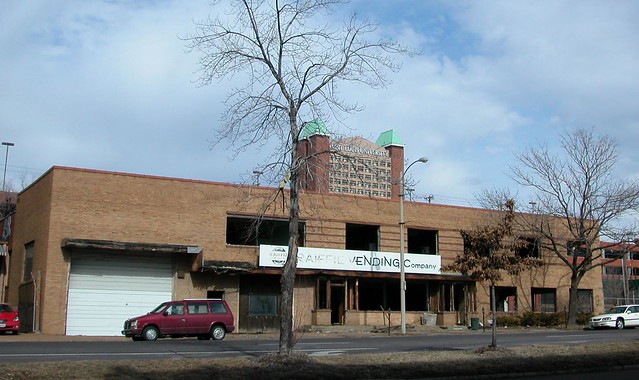
Twice in the last two years, our Preservation Board considered the demolition of a simple two-story art moderne building, the old Raiffie Vending Building at 3663 Forest Park Boulevard in Midtown. The two-story building dates to 1948 and has a handsome, plain buff brick face. The building is a fine contributing player in the industrial district of Forest Park Boulevard west of Grand, but it has little individual historic or architectural distinction.

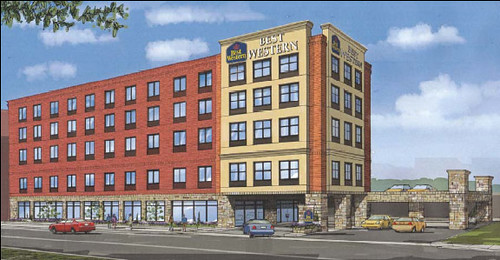
The Sask Corporation has owned the building for several years and bought it to build a chain motel on the site. In August 2009, the Sasak Corporation proposed the design shown above to the Preservation Board ( see “More Urban Is Not Always Better”, August 11, 2009). The Board denied demolition on a preliminary basis. While the Raiffie building is not in any historic districts, it is in a Preservation Review area, the 17th Ward.

In September 2010, Sasak Corporation came back to the Preservation Board with an even less inspired plan, shown above. The Best Western had “better” materials than the 2009 plan, although its red brick panels, stucco corner and strange stone base were a regression from the previous rendering.  The Preservation Board approved demolition contingent on Sasak securing a building permit for the Best Western.  That has not happened, although Sasak applied for a demolition permit on November 15th.

Morris Adjmi may have to tone down his Manhattan design, but he would be welcome to try it at 3663 Forest Park in St. Louis. Here we have a building without singular significance outside of a local historic district that has already been approved for demolition. What a great candidate it would be for a thoughtful, provocative building rising from its center or rear. Midtown has a small skyline of tall buildings in which a new high-rise would not be inappropriate. In the case of the Best Western, the most elegant and expensive-looking front — cost of the hotel has been a concern among Midtown players — is the building that is already there. The hotel developers could very well use it, and do something imaginative above.

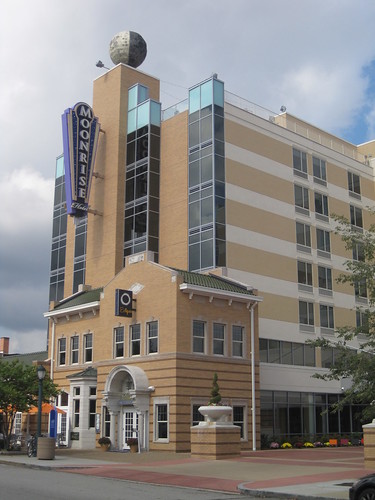
A parting thought on the subject: The Moonrise Hotel on Delmar already attempted to use an existing facade to hide a rather programmatic hotel high-rise from a smaller-scaled business district. This was not a very successful endeavor. The hotel and the old Ronald L. Jones Funeral Home building have little real relationship, and besides, the funeral home itself was actually demolished and imprecisely reconstructed. The reconstruction shows, and something modern would have been better.

On Forest Park, a modern high-rise addition to the old Raiffie Vending building could avoid the mistakes of the Moonrise by leaving whatever part of the building to be retained in place, to keep its historic character as best as possible. If New York turns down Morris Adjmi, maybe St. Louis would welcome his work here — or elsewhere.

Categories
Historic Boats

Goldenrod Showboat Video Released

Tyler LaVite has produced the short video The Goldenrod Showboat: A Short History, now posted on YouTube. Take a look:

Categories
North St. Louis Northside Regeneration St. Louis Place

Northside Regeneration Still Buying

by Michael R. Allen

Make no mistake about the fact that Northside Regeneration LLC continues to buy property. On October 27, the Recorder of Deeds recorded seven purchases by Northside Regeneration (and signed by Eagle Realty’s Harvey Noble) at a Sheriff’s land tax sale held on October 8. All of these properties are vacant lots.

The properties and sales prices are:

  • 1822 N. 22nd Street ($707)
  • 3510 N. Jefferson Avenue ($5,000)
  • 2714 Madison Avenue ($1,456)
  • 2331 Hebert Street ($783)
  • 2323-25 Hebert Street ($717)
  • 2301 Hebert Street ($688)
  • 2329 Hebert Street ($717)
  •  
    The amounts paid are whatever bid was needed to win the property. In most cases at the Sheriff’s sale, there is only one bid. In that case, the amount paid is the minimum price equal to the amount of unpaid land tax. Purchasing property at a Sheriff’s sale is much easier for a private citizen than going through the Land Reutilization Authority (LRA). All a winning bidder needs to do to secure the property is to have cash on hand to pay on the same day. No aldermanic approval or redevelopment plans are needed.

    The properties on Hebert were owned by the Pyramid Companies for their development of single-family homes east of Sullivan Place. Some of the houses were built. While other Pyramid properties passed to creditors or investors, these simply sat without their taxes paid for three consecutive years. Pyramid had partnered with McEagle Properties to develop housing at WingHaven in O’Fallon, Missouri before the two companies abruptly parted ways.