Categories
North St. Louis Old North Streets

Progress on 14th Street

by Michael R. Allen

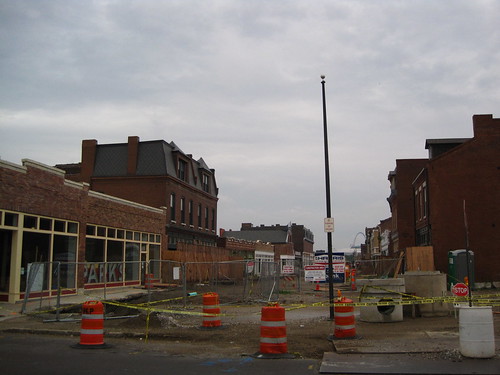
The mall is dead! Crews finally have removed all of the raised pedestrian mall on 14th Street in Old North. Work is underway on reconstructing the streets and sidewalks that will connect the neighborhood to the rehabbed buildings in the two-block stretch between St. Louis and Warren avenues.

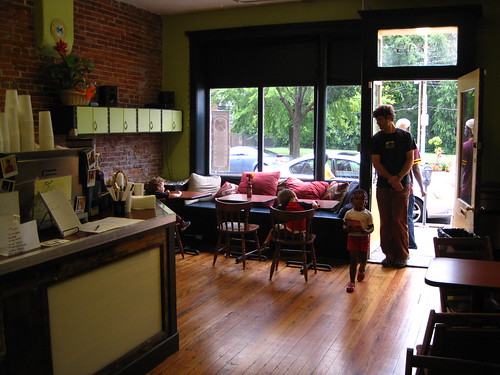
One block north of the former mall, the Urban Studio Cafe opened last week at 2815 N. 14th Street next door to Crown Candy Kitchen. The cafe offers coffee, pastries and (starting tomorrow) lunch items.

The Urban Studio Cafe is open from 8 a.m. until 2 p.m. daily. What a huge difference it makes for Old North to have a spot for residents to gather and hang out away from home! This is the type of “commercial development” that the north side needs most — development that builds up the social capital of neighborhoods.

Categories
Art North St. Louis Northside Regeneration

Northside Community Mural Proposal

by Anna Ialeggio

Dear Friends & Neighbors,

My name is Anna, and I live in the 5th ward. I have been following the McEagle developments with skepticism and trepidation. My frustration comes from the assumption that, in the name of progress, it’s all right to deny residents the right to participate in shaping their neighborhoods. I don’t believe that enough justification can ever exist to hand over the reins of half a city to a single private developing entity. Friends, we need to be honest with each other: this isn’t a choice that North City was given. This is a corner that North City was backed into. Now we’re in that corner, and we have to address the fact that development which doesn’t flow directly from the community will ever have the impact, dignity, or longevity that it ideally could. This is what worries me (quote from the Post-Dispatch 9/5/09, my emphasis):

Last month, the CBA held a meeting of its own, in a Cass Avenue church that’s on the eminent domain list. There were about 75 people there, most from the project area, for a talk about TIF and eminent domain and how to protect their rights.

At one point, the organizers asked for a show of hands: How many people had been in a room with Paul McKee? Had heard his plans from his own mouth? HAD BEEN ABLE TO ASK QUESTIONS?

Three hands went up.

This is a challenge that we can rise to. I’d like to help my neighbors ask questions, make suggestions, tell their stories, in such a way that nobody, least of all Paul McKee, can dismiss it. This is where the idea of a mural comes in. I’ve got an awful lot of paint, and somebody out there has a big wall that could be dressed up. We’ve all got something to say, and we can work together to help each other figure out what it is and how best to say it. This might be especially great for a community center, church, or school. We can make something that will be a testimonial to the determination and creativity of our neighborhoods. Everyone has a right to be a part of the future of where they live…

Developers build DEVELOPMENTS.
Communities build COMMUNITIES!

Please get in touch if you’re interested, or have a suitable wall.

anna.ialeggio -at- gmail.com

Categories
North St. Louis Northside Regeneration

NorthSide Press This Weeks Shows Support, Opposition

by Michael R. Allen

On Thursday, the St. Louis American published pro and con opinion pieces on the NorthSide project in its business section. The American has generally offered positive editorial encouragement, so this is a welcome and useful move on the paper’s part. The pro-NorthSide piece by Demetrious Johnson again is indicative of the wide swath of support that McEagle is building in the African-American community that opponents cannot ignore. The anti-NorthSide — or at least skeptical — piece by accountant Keith Marquard analyzes the first draft of the developer’s tax increment financing application and finds it lacking. I hope that opposition sticks to careful, fact-based analysis like this in the weeks ahead.

An article in today’s St. Louis Post-Dispatch by Tim Logan, “Selling NorthSide: Slowly, steadily, McKee pitches plan to the neighborhood he wants to remake” (link to expire because the paper takes content down quickly), draws the focus onto McEagle’s outreach in north St. Louis. The article makes it clear that the developer — personified through Paul J. McKee, Jr. even though a corporation is the actual developer — lacks widespread support or opposition. The supporters quoted still have doubts and questions, and the opponents seem to support the general idea of developing the wide swath of north St. Louis while concerned with eminent domain.

The Post article corresponds well with the tone that I encounter in the affected neighborhoods — lots of skepticism, some support and some outright unbending opposition. Everyone wants better communication and more effective leadership from the aldermen and the mayor’s office. Few people seem opposed to the vision laid out by McEagle, just key details. Some who support much of the plan doubt the developer’s capacity amid a tough real estate economy, news of a foreclosure against McEagle at NorthPark and the scale of the plan.

The picture emerging in early September makes it extremely clear that the NorthSide project is most controversial in part, not in whole, and that the time is here for strong public-side leadership to shape and constrain the project. At this stage, the project is still a vision, and there are no redevelopment bills pending at the Board of Aldermen. It’s easy to change a bill before it is written — if public demand is clear and elected officials are ready to take the lead.

Categories
Events North St. Louis O'Fallon

Good Times in O’Fallon Park

by Michael R. Allen

Last night, vocalist Denise Thimes closed out the last night of the O’Fallon Park Jazz Concert Series. Hundreds of people, including St. Louis Mayor Francis Slay, attended the concert, which was packed with a spirited long set from Thimes.

More than once, Thimes proclaimed her genuine giddiness that once again people were spending a beautiful late summer night at a concert in O’Fallon Park. Thimes and the crowd both shared the great feeling that things are on a different track for the historic park and its surrounding neighborhood.

The concert series is one of the many initiatives of the area’s recently-elected Alderman Antonio French (D-21st), and it is definitely a fun, visible way to proclaim that change is here. With the forthcoming groundbreaking on the new recreation center in the park, O’Fallon Park is finally getting its due, and along with it north St. Louis.

Video can be found on the 21st Ward website, and photographs are on Flickr.

No slight is intended toward two of my other favorite north side park-based concert series: the Whitaker Urban Evening Series at St. Louis Place Park and the Concerts at Ivory Perry Park. Alas, these have also concluded — make sure you check one out next year!

Categories
North St. Louis Northside Regeneration St. Louis Place

Existing Employment in St. Louis Place Should Be Retained

by Michael R. Allen

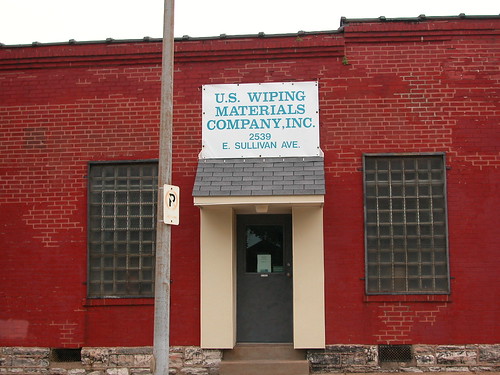
The website of St. Louis’ own U.S. Wiping Materials Company, Inc. boasts that the company “has been in business for over 100 years. Being centrally located in St. Louis Missouri has allowed us the ability to provide cost-effective shipping in a timely manner to all of North America.”

The central location for U.S. Wiping Material, manufacturer and distributor of towels, rags and wipers of all kinds, is a one-story brick industrial building at 2539 East Sullivan Avenue in St. Louis Place. Built in 1914, the building is a sturdy home to the company.

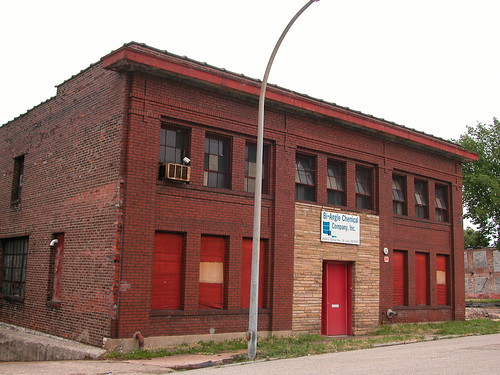
Next door to U.S. Wiping is the Bi-Angle Chemical Company, Inc. at 2531 East Sullivan Avenue. This plastics company is located in a handsome two-story Craftsman-style building built in 1916. The workforce is not huge, but workers can be seen all day on the back docks taking their breaks.

U.S. Wiping and Bi-Angle are located on a fairly deserted block between extra-wide Parnell Avenue and 25th Street, where Sullivan dead-ends at the Sullivan Place apartment complex. These companies’ building are located within the proposed boundaries of McEagle’s NorthSide project. While just outside of the boundary of one of the developer’s proposed “employment centers,” these employers may not be safe. A slide shown by McEagle on May 21, 2009 at Central Baptist Church shows these two building demolished. At the same meeting, McEagle chief Paul J. McKee, Jr. promised that McEagle would not move “a single job” out of the project area.

Of course, these companies might voluntarily sell to McEagle — but that would mean the loss of jobs in the heart of St. Louis Place, a move the developer says it wants to avoid. U.S. Wiping and Bi-Angle provide jobs, pay earnings and real estate taxes and hold down the fort on a lonely block. These companies and their buildings should be retained as part of the new development, not courted for departure.

To the south, Hopmann Cornice Company faces destruction for the NorthSide project (see “What Happens to Hopmann Cornice?”, June 3, 2009). Located on Benton Avenue between Parnell and Jefferson, Hopmann is located in a southern tail of the proposed “employmenmt center” and Benton Street is proposed for removal. While Hopmann employs a very small number of employees — as few as two at times — this is a family-owned business providing a highly specialized craft. The Hopmanns have survived in St. Louis Place since 1880, and their eviction would be a tragic end to a proud family legacy.

As a family-owned business, McEagle ought to be sympathetic to Hopmann Cornice and work around its small-footprint shop. After all, if the goal of NorthSide is to provide multi-acre business sites, how would retention of a 0.17-acre site impede any of the project goals? (The U.S. Wiping and Bi-Angle sites are 0.496 acres and 0.16 acres, respectively.)

Categories
North St. Louis Northside Regeneration St. Louis Board of Aldermen

An Update of Sorts on NorthSide

by Michael R. Allen

Dale Singer’s article “Questions still being raised about McKee’s north side development” (St. Louis Beacon, August 31) provides an update on the politics of this redevelopment project.

A few items jump out at me.

No Eminent Domain on Churches

Paul J. McKee, Jr. lays to rest one of the rumors circulating: that his companies plan to use eminent domain on churches. McKee says:

“We’ve bought some churches from people who want to sell them. If they want to sell them, we’ll buy them. But can you imagine asking for eminent domain for churches? That would be short of insanity. We spend a lot of time putting to sleep those kind of rumors.”

Indeed, many churches have voluntarily sold parcels and church buildings to the developers, and others are actively supporting the project. Those that remain could enjoy great benefits to their surroundings should the plan come to fruition. The origin of the church rumor was nothing more than the poorly-prepared list of parcels needed for the project that was released by the St. Louis Development Corporation. Seriously, that list looked less like a sinister plot than a cut-and-paste job with owner-occupied parcels removed and everything else retained without a final proofreading.

What Happened to the Forum?

McKee’s comments about McEagle’s removal of the public forum on his website is lacking. Here’s what the article reports:

McKee also defended the fact that a website for the project shut down an area where people could go on and make anonymous comments. He said the forum had degenerated and was not serving any constructive purpose.

In reality, McEagle moderated every aspect of the site. Julie Guignon at McEagle had to approve requests to set up an account on the board, and either Guignon or someone else deleted inappropriate posts. The only posts that were ever published were all thoughtful, intelligent requests for information or maintenance, and were made in response to leading questions like “What Information Do You Want to See?” posted by a site moderator. None of the suggestions or questions ever got a real response.

McEagle’s formerly open media strategy had received kudos from the St. Louis Social Media Report. As an often skeptical observer of the project and its public relations blunders, I was quick to praise the unconventional move.

Let me retract that praise and call the media strategy a bizarre failure. McEagle tapped into social media like no developer before, received praise even from long-time critics, posted some content and then…killed its own momentum (and new found good will) by closing up shop prematurely.

CBA Group Opposed to Any TIF?

The Northside Community Benefits Alliance seems opposed to any form of tax increment financing for the NorthSide project. Keith Marquand, the group’s treasurer, is quoted:

“Ronald Reagan had the saying, ‘Trust but verify,’ ” he said. “I don’t understand why we should have any basis for trust whatsoever. Look at the city’s record with TIF projects. … The city doesn’t have a very good record of enforcing agreements with developers.”

I think that McEagle has the votes to pass even a $410 million TIF through the Board of Aldermen. The TIF alone doesn’t upset me because I think that TIFs were designed exactly for the purpose proposed by McEagle: renewal of truly distressed areas. The real problem, of course, remains the scale of development, resident displacement and lack of solid urban design and historic preservation guidelines.

What is questionable, and what does not likely have a majority of aldermanic votes, is city backing of half of the TIF. After St. Louis Centre’s failure and the city’s wise refusal to grant backing to Ballpark Village, McEagle faces an uphill battle on that point.

Of note in the initial TIF application is that without city backing, the developer projects a 3.21% profit on the project, and with such backing projects an 8.21% profit. Hence, the project is still profitable without the city backing the bonds.

On the other hand, if the City of St. Louis had to pay $205 million should the developer default — and remember, no one assumed that Pyramid would ever fail — the city government would go bankrupt.

Categories
Housing JeffVanderLou North St. Louis Northside Regeneration

Large Housing Development Underway in NorthSide Project Area

by Michael R. Allen

Thomas Avenue in the southeastern reaches of the JeffVanderLou neighborhood definitely is a construction zone. All day long, the street buzzes with the sound of large trucks, contractors speaking and power saws buzzing. The September deadline looms, and the developers are tough-minded about meeting that deadline. After all, these developers are known to be serious and uncompromising about their mission.

Has construction on the NorthSide project started in a big and visible way?

Not quite. The construction is part of a phased 90-house development, and sits fully engulfed by the boundaries of the NorthSide project. However, the developer is not McEagle Properties but the non-profit Habitat for Humanity. The project has not received tax increment financing, nor is is formally part of the larger and more visible development. The Habitat for Humanity project in JeffVanderLou is a modest, steady effort that will transform a few blocks and 90 families’ lives. If that is all that the project accomplishes — and I doubt that will be the end — it will have fulfilled a great need long before the larger project leads to even a shovel turn of earth.

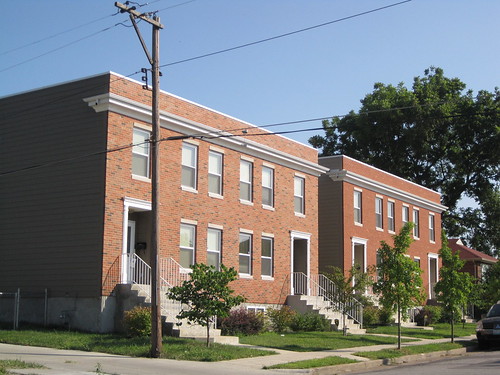
Habitat for Humanity actually began this project in 2003, when it built 20 houses on Bacon, Garrison and St. Louis avenues in the northeast corner of the neighborhood. The St. Louis Equity Fund and the Jeff-Vander-Lou Initiative were development partners, and the Equity Fund remains involved in the subsequent phases. Neighborhood residents identified the need for this project as part of intensive community planning conducted as part of the Jeff-Vander-Lou Initiative process. This was development that came from the grassroots to serve the grassroots. These first homes largely consisted of two-story, flat-roofed townhouse-style buildings clad in brick and brick-like panels. Two of the double units on Bacon are shown here:

Architectural critics can pick at the details and materials, but I think that the houses demonstrate a creative use of a limited budget. The houses are compatible in form with their urban surroundings, and each one occupies a vacant lot. Construction ameliorated the effect of 20 vacant parcels in a pocket of the neighborhood. Readers who have lived in areas where there are 20 or more vacant parcels in a two-block area know exactly how transformative that can be.

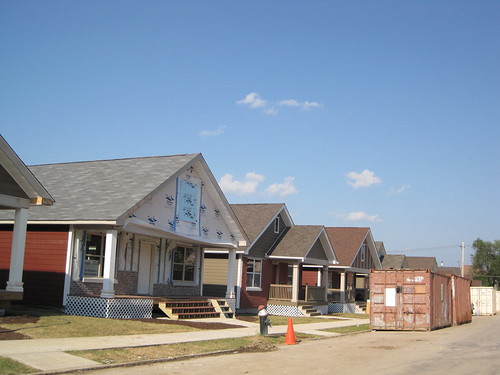
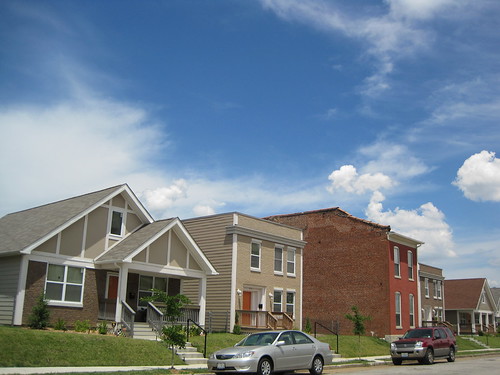
Like McEagle, Habitat for Humanity thought about JeffVanderLou on a large scale. The organization identified the need for more construction in the southeast part of the neighborhood, around the intersection of Sheridan Avenue and Martin Luther King Drive north of the reclaimed Blumeyer housing project. In summer 2008, Habitat for Humanity built 27 houses on Sheridan Avenue that received the Platinum LEED certification. As the photograph above shows, Habitat built around existing occupied buildings (there was some demolition of vacant buildings) and introduced a different house model.

The predominate house model is now a front-gabled, one-story home with front porch. Habitat for Humanity’s architects developed two different models that alternate on longer expanses. There are differences in material colors, and homeowners have chosen some personal variations like substituting actual brick veneer for the concrete brick-like material more common to the development.

I think that the one-story model is charming, especially with the generous front porches. These houses embrace the life of the street, sending a strong message in a neighborhood that still has a lot of street crime. Eyes and ears on those porches will make a positive difference.

The houses now under construction on Thomas east of Elliott are 24 one-story, 1,184-square-foot houses that will sell for $77,000 each. These homes are of modest scale and materials, but there are unique things about them in addition to affordable price: these houses also meet Platinum LEED certification standards. Not only are these houses satisfying necessity in the social economy, they are doing the same in the ecological economy.

When this phase ends in September, a final phase that concludes in December will be underway. By New Year’s Eve, 90 for-sale houses will have been added to JeffVanderLou in six years. That’s an impressive feat for non-profit developers working on a community-driven process. Even more impressive will be the social impact of the houses.

As we contemplate the redevelopment ordinance that will initiate a much larger, private vision of development for this area, we should not forget that our best successes come from dreaming big but working small. Those who say that the scale of the solution must match the scale of the problem are right, but they are overlooking the scale of the community. As the Habitat for Humanity project shows, block by block makes a difference — and adds up to big results quicker than we think.

Some photographs of the Habitat for Humanity project are online here. Television station KETC’s Living St. Louis produced a segment on the project that appears online here.

Categories
College Hill Housing North St. Louis

Corner House at DeSoto and Emily Avenues, College Hill

by Michael R. Allen

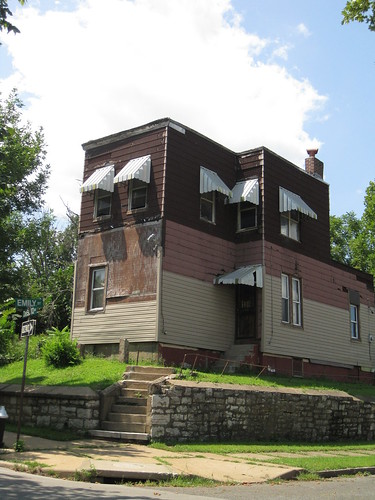
I absolutely love this two-car garage that becomes part of the retaining wall! This garage is located behind the house at 2101 E. DeSoto Avenue, and faces out onto Emily Avenue. The roof of the garage is close enough to yard level that it could easily be used for a patio or garden space with necessary modification of the roof structure.

Unfortunately, the house — built in 1893 and missing many of its College Hill neighbors — has been vacant since 2007. The corner entrance through the retaining wall is another thoughtful feature. Under the layers of siding, there may be the home’s original wooden siding. The cornice is long gone. Still, rehabilitation would be easy, with the two-story frame house in great shape for a building of its age and construction method.

Categories
North St. Louis Northside Regeneration

Loans to NorthSide in the News

by Michael R. Allen

The news of the failure of Corn Belt Bank and Trust is hitting St. Louis a little late — the bank failed in February. Now the failure is newsworthy because of the fact that the Pittsfield, Illinois-based bank loaned $14.8 million to holding companies controlled by McEagle Properties and its Chairman, Paul J. McKee, Jr.

McEagle was not Corn Belt’s only St. Louis customer. Corn Belt had a branch office in Clayton and made numerous real estate loans in the St. Louis market. To date, only one of those loans has been resolved through a deed of release filed by the Federal Deposit Insurance Corporation.

The problem with Corn Belt was that it was undercapitalized. Illinois regulators first issued a cease and desist order in December 2008 ordering the bank to resolve many problems with its management including “engaging in hazardous lending and lax collection practices.”

According to McKee, the loans with Corn Belt had the interest rolled into the loan so that there were no monthly payments. While such an arrangement was desirable to McKee (and, frankly, any other customer!), such loans sound exactly like “hazardous lending.”

Corn Belt is one of two banks that have made loans to the NorthSide project. The other bank is the Bank of Washington in Washington, Missouri. In January, the Bank of Washington extended a line of development credit to McEagle with a maximum amount of $27.6 million. Securing this loan are the holdings of six McEagle north side holding companies (Larmer, Union Martin, Babcock Resources, Dodier Investors, MLK 3000 and Sheridan Place).

Perhaps related to the loan to the NorthSide project is the loan of $20 million in Capital Purchase Program funds to the Bank of Washington in May. These funds were created as part of the Obama administration’s stimulus funding initiative.

L.B. Eckelcamp, bank chairman and prominent Republican political donor, told The Missourian in May that “[the funding] will allow us to remain extremely well capitalized and still increase our ability to take deposits and make loans by more than $100,000,000.”

Categories
Brick Theft Historic Preservation North St. Louis St. Louis Place

Brick Thieves Assail Presumed Legacy Property

by Michael R. Allen

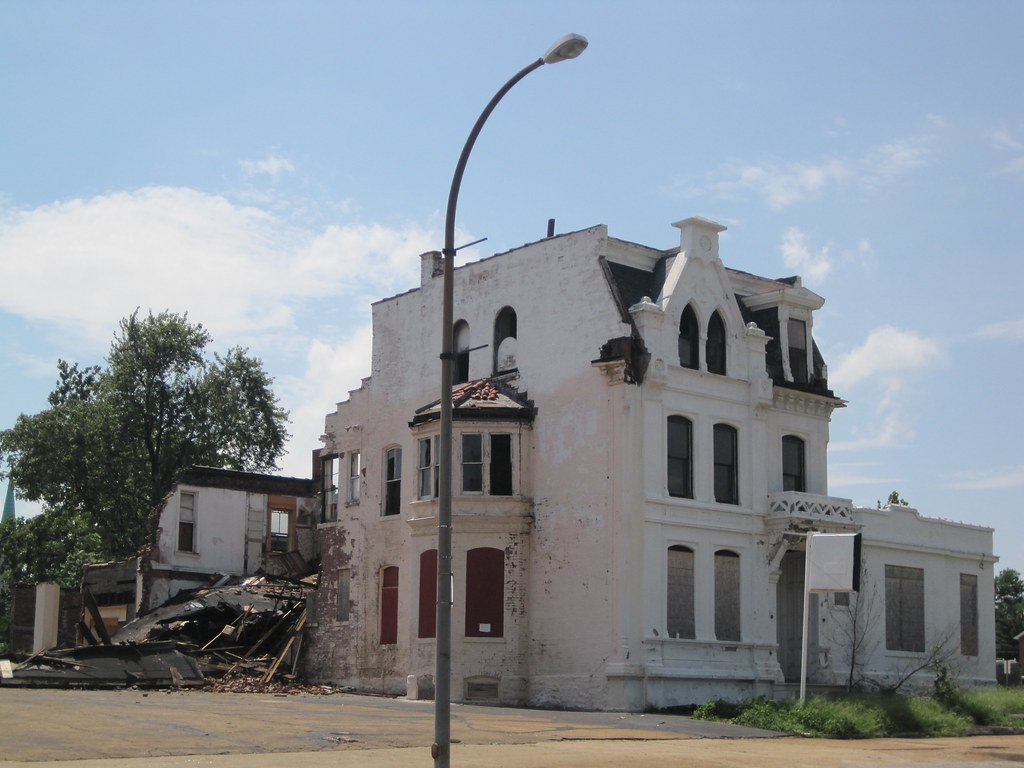
Criminals can work pretty damn fast, as the condition of the McEagle Properties-owned house at 1930-6 St. Louis Avenue shows. Two weeks ago, the vacant house was sound. Last Wednesday, the side wall had started to come down at the hands of the north side vultures (see “The Precarious Condition of Two Houses on St. Louis Avenue,” (August 12, 2009). Today, almost all of the ell of the old house stood destroyed. The bricks no doubt have cycled through Pope’s or one of the other yards around 25th and University, then on to hands more legally clean of fencing stolen goods but no less complicit.

Meanwhile, McEagle has taken no visible step to safeguard the over 150 historic buildings that it owns in north St. Louis, or work with residents to report brick thieves, who prey also on other buildings. Perhaps no one has seen the activity here. After all, thieves picked apart many buildings to the south of this house, McEagle emptied the three houses to the east of this building and two of the three buildings across the street is vacant. Four years ago, the brick thieves would have been afraid to pick on this block, and now they seem to be able to rule the roost.

However, what is done is done. Complaining about the past won’t secure a future for the McEagle-owned historic buildings across north city. What will do the trick is actual preservation planning: architectural survey of St. Louis Place and JeffVanderLou, listing of eligible buildings and districts, placement of the 5th and 19th wards in preservation review (solely the responsibility of the alderwomen) and strict rules about security and stabilization as part of the redevelopment ordinances facing the Board of Aldermen. If McEagle and planner Mark Johns of Civitas are serious about saving “legacy properties,” it’s time to tell us how they will do that.

The facts on one hand: Brick thieves demolishing McEagle buildings. Historic buildings deteriorating and left open to the elements. On the other: A promise. Promises don’t save historic buildings, or we’d all be rehabbers. I don’t mean to condone or chastise McEagle for the past failures, but urge the developer and city leaders to take action now as part of the negotiation. If McEagle lacks the capacity, then it should work openly with the city and other developers who can bring funds for preservation planning, stabilization and rehabilitation. We can’t save everything, and we’ve lost a lot. (We lost more in St. Louis Place and JeffVanderLou before McEagle arrived, in fairness.) Yet we can take the circumstances we have and turn a developer’s promise into action that will reassure residents of north St. Louis that McEagle is as serious about the attempt as it is about the sell.