Categories
Fairground North St. Louis Storefront Addition

Storefront Additions: West Florissant and Linton

by Michael R. Allen

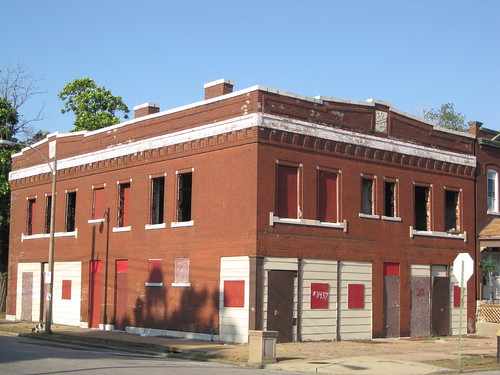
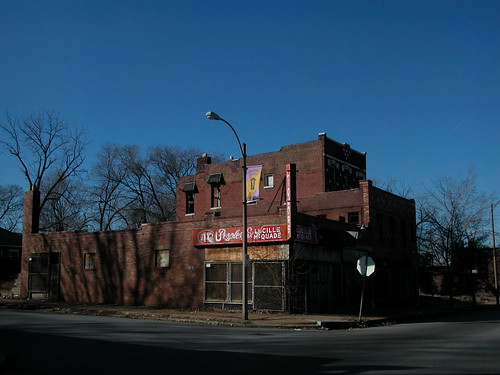
The striking group of vacant buildings at the northwest corner of West Florissant and Linton Avenues (3900-4 West Florissant Avenue, technically) in the Fairgrounds neighborhood has long attracted the attention of photographers, amateur architectural historians and passer-by. The colorful name on the liquor store sign at the corner, Lucille McQuade, tempts the imagination to conjure Lucille. Sassy liquor store owner, sitting behind the corner with a quick no bullshit face for the teenagers trying to buy a Colt? I don’t know, but I do know Lucille’s old store is not long for this world.
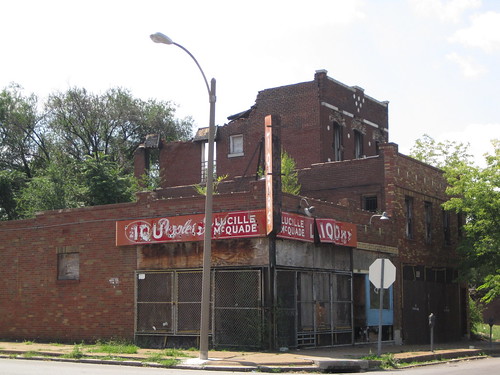
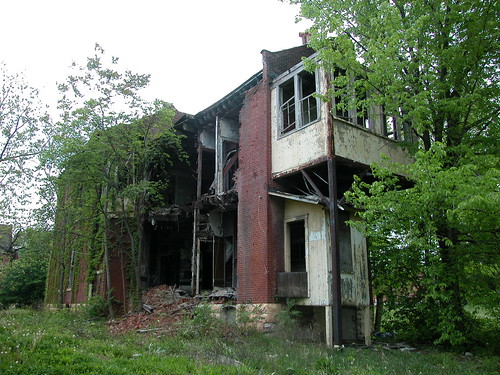
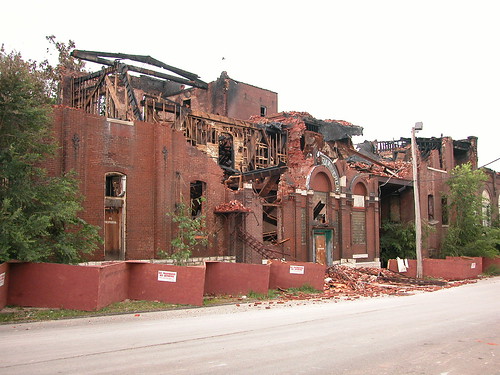
Two years have passed since I took the first photograph in this post. The three buildings now look even worse. Well, the corner building (built in 1933) is same and sound, although the enamelled sign board has been crumpled by a would-be thief. The two-story house, built in 1896, was first robbed of limestone keystone and voussoirs above the second floor windows. Then came the fire in May of this year that triggered collapse of most of the building structure. The formal front elevation struggles to maintain its composure, and the side walls are largely intact. However, anything wooden has fallen down where gravity has lured all buildings forever.
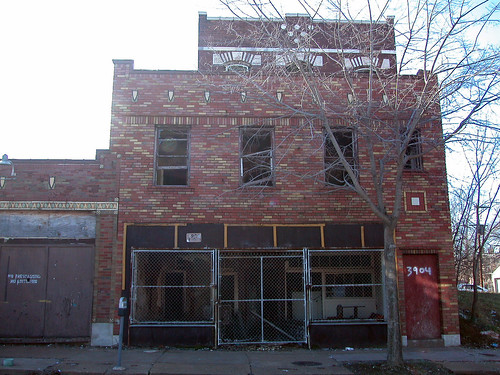
Yet all is not lost, because the house’s commercial front (built some time after 1933) is intact. This front actually covers the front and wraps around the side. Bricks from the house have fallen through the roof, perhaps, but this fireproof building addition is intact and could be rescued from its crippled parent. The pale-toned tapestry brick and the terra cotta shields are particularly bright on this building. Notice how the new front is built over the pier of the one-story corner store, which shares some of its vocabulary.
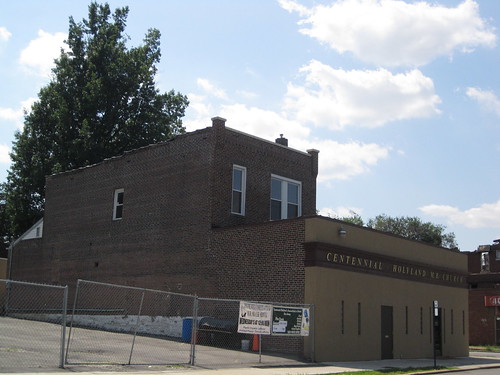
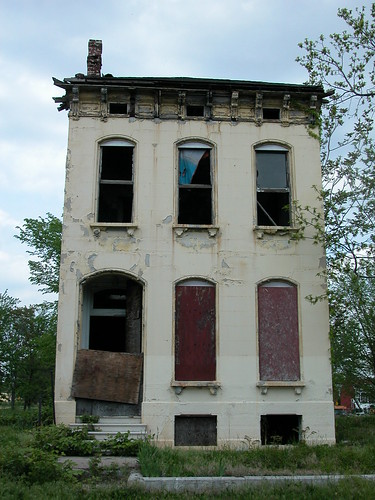
If we lose the buildings on one side of Linton, we have two other storefront additions on the other. United Railways built a street car line on West Florissant between 1910 and 1915, and as residents of older neighborhoods like Old North and Hyde Park moved in this direction, there was demand for more retail. The residential buildings around this intersection were located near earlier commercial buildings, and adaptation into commercial use was logical for owners. The tenement building above, located at 3856 West Florissant Avenue, was built in 1890 and built out to the sidewalk with a store in 1927.
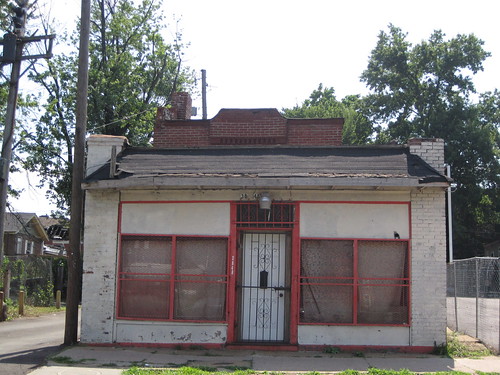
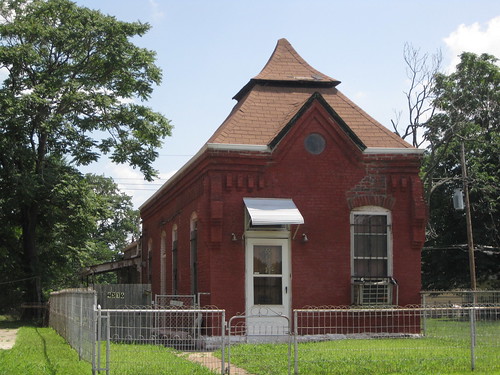
On the same block at the alley line is the building at 3848 West Florissant Avenue. The house is a small brick shaped-parapet structure on a raised foundation dating to 1892. The commercial addition dates to some time after 1910. Use has come full circle, as the storefront is now used as a residence.

Categories
College Hill Fairground Housing North St. Louis

Architectural Creativity on Prairie Avenue

by Michael R. Allen

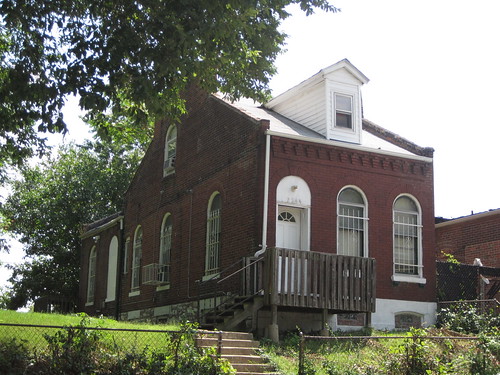
Two blocks of Prairie Avenue on each side of West Florissant Avenue are home to some of the most interesting small houses from St. Louis’ 19th century vernacular past. Above is the two-flat at 2111 East Prairie. This unique duplex dates to 1884 and is the lone survivor of a row of four. The trapezoidal entrance bay with its tall, narrow windows gives an otherwise conventional box a commanding street presence. The contrast between the masonry cornice work on this bay and the rest of the building reinforces the presence of the entrance. Now, this has been converted into a single-family home.

Across the street toward Florissant Avenue is the side-gabled house at 2144 East Prairie, built in 1885. Homes like this are common across St. Louis, but how many have Roman arches over all window and door openings — not just on the front, but on the sides as well?

While not eccentric like the others here, I had to mention the frame house at 2128 East Prairie, built in 1884. This side-entrance house is in fine shape, and worthy of preservation. Owned by the Land Reutilization Authority and located in the ailing College Hill neighborhood, there are already two strikes against the house.

One block west across Florissant stands one of the coolest shotgun houses ever built in our fair city. The house at 4316 Prairie (the bend in the street changes numbering from east-west to north-south) dates to 1896 and is fully within the fin de siecle eclectic vein of American architecture. The double pyramidal roof may be unique to a house of this size in St. Louis. Alas, this house is also a survivor of a row of four identical houses. The houses at 4312 and 4314 were LRA-owned and demolished in 2004, while the fourth house at 4310 was lost before 1980. In 2002, Landmarks Association of St. Louis prepared a nomination to the National Register of Historic Places of the three remaining house paid for by Community Development Block Grant funds, but for some reason the organization and Alderman Freeman Bosley Sr. (D-3rd), who represents this area, never proceeded with submission of the nomination.

These two blocks of Prairie Avenue lie in different neighborhoods — east of West Florissant is College Hill, and west is Fairground. Both neighborhoods are within the city’s Third Ward. These blocks are each largely devoid of houses at all these days, with over 50% of the parcels on each street face vacant. Thus, the odd houses stand out more. However, I think their unique qualities must have seemed even stranger when contrasted with so many more conventional vernacular buildings around them. Context is always key.

Categories
Historic Preservation North St. Louis Northside Regeneration

Keep Your Buildings Standing to Keep Your Neighborhoods Strong

by Michael R. Allen

The title of this post is the title of my latest commentary for radio station KWMU, which aired today and can be found online here.

Categories
Historic Preservation North St. Louis

St. Louis American Editorializes on North Side Preservation

by Michael R. Allen

Today’s edition of the St. Louis American carried the smart editorial “Urban Preservation and Politics.” That the city’s African-American newspaper sees fit to editorialize about historic preservation in north St. Louis shows that we re amid a paradigm shift, at least insofar as elected officials across north city are concerned. By placing his ward into the city’s preservation review program, Alderman Antonio French (D-21st) may have started an economic and housing development revolution.

Categories
Brick Theft LRA North St. Louis Northside Regeneration St. Louis Place

The Precarious Condition of Two Beautiful Houses on St. Louis Avenue

by Michael R. Allen

Brick rustlers have returned to the lovely stone-faced house at 1930-6 St. Louis Avenue (see ““Who Would Destroy This Building?”, January 7, 2007). Most recently a funeral home, the house was first built in 1873 by wholesale grocery merchant Bernhardt Winkelman. Winkelman was one of the numerous new-money German-Americans whose lavish homes gave St. Louis Avenue the nickname “Millionaire’s Row.” Today, a different millionaire owns the property: developer Paul J. McKee, Jr. through holding company N & G Ventures.

The damage from 2007 concerned only a one-story flat-roofed addition behind the home, but this week’s damage concerns the side wall of part of the house. Since joists run laterally and rest in the brick side walls of most 19th century buildings, this damage will eventually cause collapse of the roof and floors. However, the thieves have only struck an addition to the Winkelmann house’s ell, so the original section is not yet damaged.

On May 21 and other occasions, McKee mentioned having a list of 60 “legacy properties” in his possession worthy of preservation. Is this house one of them? It should be. However, the list is a mystery to myself and many people in city government and the development world with whom I have discussed preservation issues related to the NorthSide project. We do know that the house at 1930 St. Louis Avenue made an official list that gives it undisputed historic status: the house is a contributing resource to the Clemens House-Columbia Brewery Historic District. It ought to be preserved, and McKee should secure it against further attack.

Across the street is another fine stone-faced house with a lovely wooden Italianate cornice. The house at 1925 St. Louis Avenue dates to 1879 and is owned by the city’s Land Reutilization Authority (LRA). The house is outside of the present historic district boundary. The front looks ragged but sturdy, but a walk around the side reveals the sad truth.

The east side wall of the ell is in shambles, although the second floor and roof are holding on for now. The condition of this house raises a preservation question related to NorthSide that has not been widely discussed: what happens to the numerous vacant historic buildings within the NorthSide footprint not owned by McEagle Properties and its subsidiaries? Most of those buildings are on the list of needed properties that McEagle submitted to the city’s Tax Increment Financing Commission in May. Is the building at 1927 St. Louis Avenue one of the 60 “legacy properties”? There are more than 60 historic buildings owned by McEagle worthy of preservation, and at least as many in the project area owned by LRA and other entities.

City officials should not wait for the list of legacy properties to set into motion a sensible preservation plan for the NorthSide project. If public financing is on the table, that can be leveraged to ensure that buildings like the two above can be mothballed for eventual redevelopment in future phases of the NorthSide project.

Categories
Abandonment Hyde Park LRA North St. Louis Tower Grove East

Doug Hartmann Gets Two Years, Life of Shame

by Michael R. Allen

The fire-damaged Nord St. Louis Turnverein is just the most spectacular instance of the impact of Doug Hartmann’s real estate empire on the city of St. Louis. During Hartmann’s negligent ownership, the Turnverein went up in a huge blaze on July 6, 2006. Hartmann’s wild ride was already over, actually, and a sale of the property to developer Peter George was underway. George went on to close, and plans to rebuilt the landmark at great cost. If only Hartmann had been half as generous.

The Turnverein is an egregious example. Most of Hartmann’s nearly 150 properties in the city ended up like the corner storefront at the northeast corner of Wyoming and Arkansas avenues in Tower Grove East. Built in 1906, the building was shabby but occupied before Hartmann’s DHP Investments purchased it in 2006. Some work took place, including removal of the second floor windows. Then, everything stopped. Eventually, the building reverted to the city’s Land Reutilization through tax default. To this day, the weeds regularly grow waist high around the building, and a reuse timeline is not certain.

The building at Arkansas and Wyoming is like others that Hartmann accumulated to keep his Ponzi scheme afloat: occupied when purchased, and left a vacant nuisance. Hartmann’s grand plans of taking stable but not gut-rehabbed old buildings and turning them into top-dollar rehabs convinced many investors and banks to finance his fraudulent scheme. In retrospect, the buildings were better off as-is, and the whole mess was a symptom of a momentary development binge.

Last Thursday, Hartmann, of the 1300 block of Crooked Stick Drive in O’Fallon, Missouri, received the lenient sentence for which he had bargained with prosecutors: two years, plus $34 million in restitution that U.S. District Judge Henry Autrey admits will likely never be collected. (Have investigators checked for a Hartmann Swiss bank account?)

Acting United States Attorney Michael W. Reap ought to be ashamed for this pathetic sentence deal. The damage that Hartmann has done to city neighborhoods has taken more than two years to sort out, and much remains to be sorted. Hartmann could be a free man before the corner building at Arkansas and Wyoming is rehabbed.

The sad fact is that the drug runners who use Hartmann’s buildings for operations will face stiffer time in the slammer when they get locked up. If only these folks could meet Hartmann in prison! Of course, our white suburban fiend gets the justice that he does not deserve: a slap on the wrist in a cozy white-collar jail for bankrupting good people, cheating investors and leaving neighborhoods more vulnerable. Those who protest the inequity of our justice system are vindicated again. However, Hartmann will hardly be a free man upon return. We know his crimes too well now.

Categories
Events North St. Louis Northside Regeneration

Northside Development Forum Tomorrow

The Northside Community Benefits Alliance is hosting a forum tomorrow entitled “North Side Community Development 101.”

Categories
North St. Louis Northside Regeneration

McEagle TIF Hearing Will Be in the Evening

by Michael R. Allen

By a 5-4 vote, the TIF Commission today set a public hearing on the Northside Regeneration LLC (McEagle) application for September 23 at 6 p.m. at City Hall, room to be determined. The Commission deadlocked in a 4-4 vote between commissioners who preferred an 8 a.m. meeting and those who wanted a meeting at a time more convenient to the public. Chairman David Newberger broke the tie in favor of public participation.

McEagle Chairman Paul J. McKee, Jr. made a presentation and then joined Alderwoman Marlene Davis (D-19th) and Deputy Mayor Barbara Geisman for questions from the Commission. The meeting lasted nearly two hours. The TIF Commission seemed favorable to the project, although focused on learning more about key details. One question that was not answered was whether or not the Commission and City Hall would support city guarantee of half of the $410 million bonds if McEagle fails to monetize them. Geisman has indicated in press statements that the city is not supporting such backing at this time, and that the final TIF application will be much changed.

The TIF Commission meeting shows that the city is serious about completing a redevelopment agreement by year’s end, and also serious about negotiating with McEagle to craft a better deal for the city. It’s time for citizens who want changes made to speak clearly and carefully. What should be changed? How?

Categories
North St. Louis Northside Regeneration

NorthSide TIF Hearing Should Be Held in Evening When Public Can Attend

The agenda for tomorrow morning’s meeting of the Board of Tax Increment Financing (TIF) Commissioners contains an agenda item for which we were all waiting:

RESOLUTION NO. 09-TIFC-312 – RESOLUTION AUTHORIZING THE ISSUANCE OF A “NOTICE OF PUBLIC HEARING,” TO BE HELD ON SEPTEMBER 23, 2009 AT 8:00 A.M. FOR THE NORTHSIDE REGENERATION TAX INCREMENT REDEVELOPMENT PLAN FOR THE NORTHSIDE REGENERATION TAX INCREMENT REDEVELOPMENT AREA

Many people affected by the NorthSide proposal have been waiting for notice that city government was proceeding with its approval process. Since May 21, all residents and business owners knew were the suggested dates offered by McEagle Properties at a meeting.

However, a TIF Commission public hearing held at 8:00 a.m. is not likely to give many affected residents and property owners the chance to attend and provide input on the project. Of course the TIF Commission is considering only the TIF portion of the project, and its members are not in a position to consider other aspects of the project, but the public is likely to have a few comments on the size of the TIF package, the parts of the project on which the money will be spent and other relevant matters.

The TIF Commission should set its public hearing for the evening, not the early morning. Many TIF deals generate few comments, but the scope of NorthSide demands special care be given to duly including the public. The TIF Commission should not let people hijack the hearing as a de facto forum on the development project itself, but it should allow ample time for relevant testimony.

How about a 6:00 or 7:00 p.m. hearing?

A look at the slide shown by McEagle on May 21 indicates that the project’s approval process is two months behind McEagle’s desired schedule.

Categories
North St. Louis Northside Regeneration

NorthSide’s Discussion Board Gone?

by Michael R. Allen

After a one month, McEagle’s discussion board for NorthSide vanished from the Internet today. On the forum page is the message “We are currently in the process of restructuring our discussion board. Please check back in the future for updates.”

The discussion board recently had sprouted spam threads with titles including “R82 in Lexington buy xenical and propecia online,” “husband that is cheating?” “How to Plan and Build a Business Part-Time.”

Besides the spam, the fboard was notable for its silence. On July 10, blogger Rick Bonasch posted “Mum’s the word at McEagle’s NorthSide forum” at the NorthSide Blog, noting the lack of replies from McEagle to questions and comments posted on the board. On the board, after several posters including myself asked when answers might be coming, Julie Gagnon of McEagle responded that McEagle would handle responses at weekly project meetings and report back to online readers. No such post was ever made.