Categories
Brick Theft JeffVanderLou LRA North St. Louis Northside Regeneration

A Block of Montgomery Street Two Years Later

by Michael R. Allen

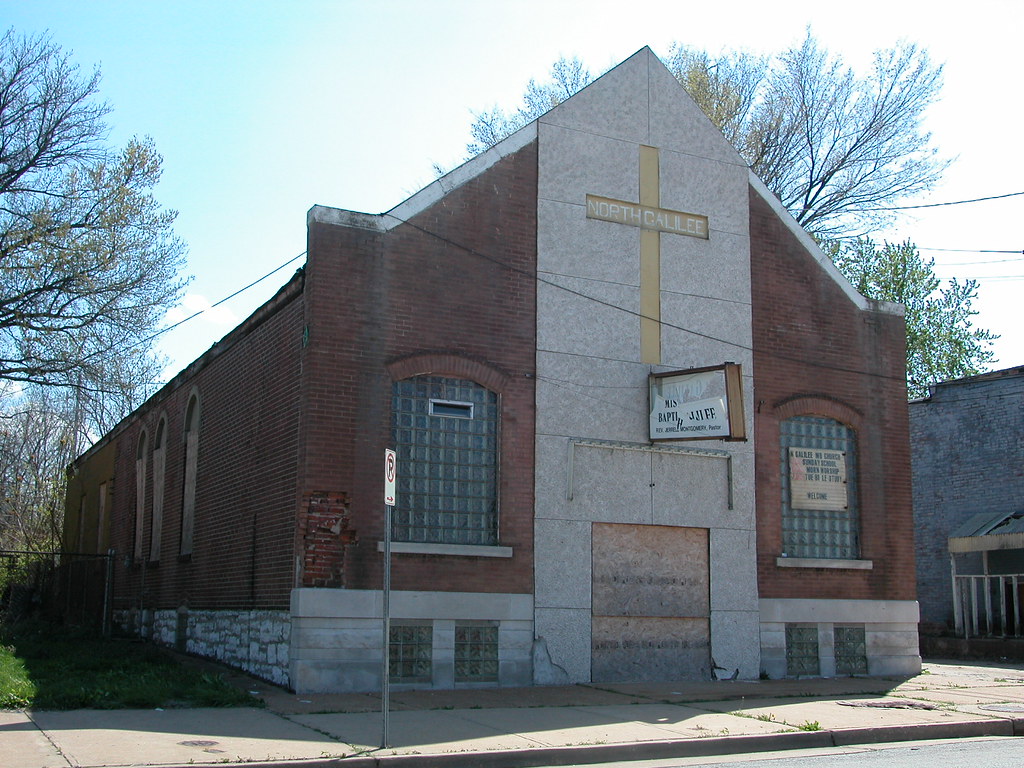
Yes, the congregation eventually sold the church voluntarily. I still remember the day back in 2006 when the pastor of the North Galilee Missionary Baptist Church called us at Landmarks Association of St. Louis asking for help with a real estate agent who had approached the church for an offer. Our advice was that the buyer was likely Paul McKee, Jr. and McEagle Properties, and the church should not worry about standing firm because this was a big, long-term project and there was no need to move out right away. However, by summer 2007, North Galilee was long gone.

Now, in 2009, the cornerstone is removed. North Galilee Missionary Baptist Church has moved to Moline Acres in St. Louis County. The building that housed African-American Christian worship since 1906 — over 100 years — sits empty, with its front door constantly pried apart by vandals seeking copper. The block that the church anchored was once proud — a solid part of the JeffVanderLou neighborhood. Now, the block barely recognizes the state it was in in January 2007 when I first photographed it.

At that point, the church was surrounded by fairly well-kept brick housing that was privately owned. This block stood out in a neighborhood where much of the remaining historic housing stock east of Grand is owned by a few large owners, including the valiant St. Louis Equity Fund. Here was a block that spoke not only to the past but to the future — institutional stability, private ownership and safety. Needless to say, McEagle got a foothold in 2006 and proceeded to buy out every private owner in the next two years.

It’s day and night. When I now set foot on the block, I feel a heavy sense of loss.

Here is the view of the church and three neighboring shotgun-style houses in January 2007:
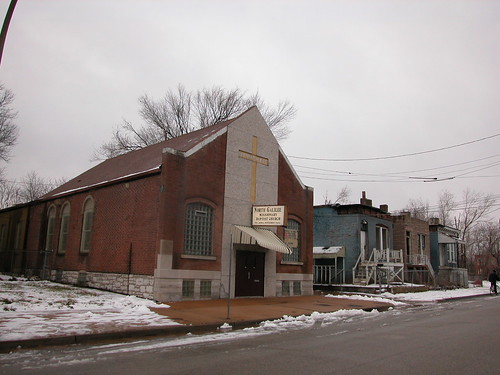
One of the houses was occupied then, while one was owned by McEagle and another by the city’s Land Reutilization Authority. The three houses remain:
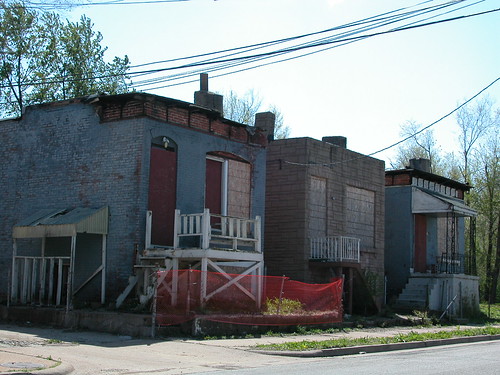

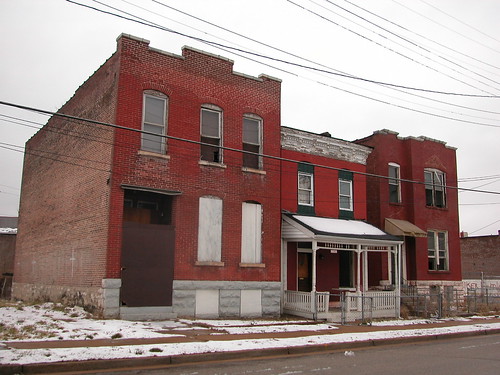
Across the street stood three two-story houses. The center house still had its elaborate historic wooden porch in January 2007:
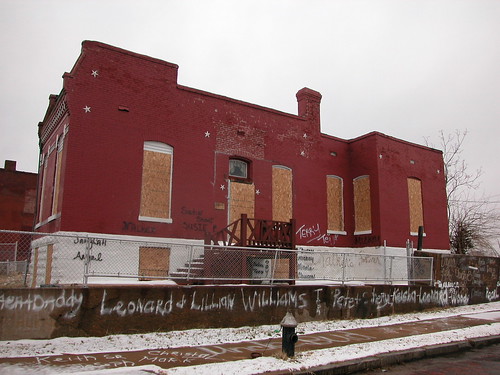
East of the group of three houses stood an already-boarded one-story shotgun house. Apparently, life at this house was happy, as now-covered graffiti left by its occupants indicated two years ago:

This side of the block has changed radically in the past two years as McEagle finished acquisition and brick thieves destroyed the group of three houses. Here’s a recent view:
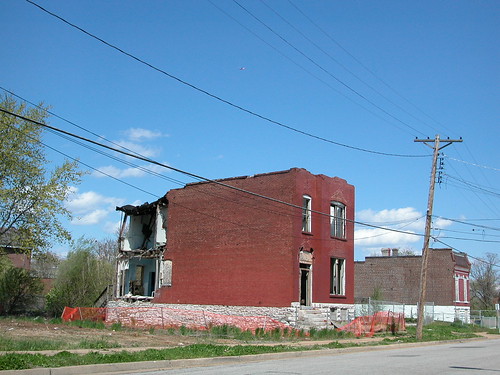
When McEagle discusses saving all buildings that can be saved, what does that statement mean? For the 2900 block of Montgomery Avenue, a block that would have been an ideal block for preservation and infill, that promise is retroactive and meaningless. The buildings fell. The church moved to the county. Day is night, up is down, and the neighborhood is out one of its most hopeful blocks and a historic African-American house of worship.

Categories
Documentation North St. Louis

The Dart Veers North

by Michael R. Allen

Check out dArt St. Louis: 100 people threw a dart at a map of the city of St. Louis and photographed the spot where their dart landed.

Looking through the photographs, I am struck by how many were taken in North St. Louis. While I was not present to watch the dart throw — perhaps the north end of the map had some kind of advantage — I think it’s great that the interesting and varied locations of the north side received so much attention. By my count, at least half of the photographs come from the northern half of the city.

What will be interesting is to re-photograph those locations in 25 years. What will these places look like then?

Categories
Downtown Infrastructure North St. Louis Northside Regeneration Planning

City Hall Asking Right Questions about McEagle Project

by Michael R. Allen

Friday’s St. Louis Business Journal carried two stories on McEagle’s NorthSide project that quoted Deputy Mayor Barbara Geisman and Mayoral Chief of Staff Jeff Rainford. (Articles are available online only to subscribers.) The primary article, “Will Paul McKee and City hall bond?” dealt with the developer’s request that the city guarantee via general revenue half of the $410 million in tax increment financing bonds sought. From the comments in the article, it sounds like City Hall is not ready to roll over on the request.

Rainford says that Mayor Francis Slay is skeptical on the city backing the bonds, and that Slay will only do so under “extraordinary circumstances.” Rainford acknowledged ongoing negotiations between the mayor’s office and McEagle, but the article did not elaborate on what “extraordinary circumstances” would be.

Deputy Mayor Geisman went further, stating that the city doesn’t know enough about the project yet to consider a request for general revenue backing. The article ends with a frank — and encouraging — quote from Geisman: “Lots of people ask for lots of things; it doesn’t mean they’re going to get it.”

While there is much to admire in the scope of McEagle’s vision as it has been laid out, the TIF request is abrupt and based on unsubstantiated financial information. The size of the request alone raises questions, but the push for city backing is premature. As the Business Journal article notes, the only three times when the city backed TIF bonds — St. Louis Marketplace, the convention hotel and Pyramid’s acquisition of One City Center — the city has ended up on the hook for failed or troubled development projects. McEagle has yet to demonstrate that its project would be any different.

I am heartened that City Hall has shifted gears from largely favorable comments to on-point comments. Hopefully this indicates a stance of tough bargaining, because a city that is eliminating jobs and implementing furloughs cannot afford to throw the treasury open for an untested vision.

That said, the second article, “McKee eyes land swap with MoDot for first phase,” showed some of the possibilities of the McEagle development. McEagle wants to eliminate the 22nd street ramps and use that site for new office development, and it seems that City Hall favors that approach. Readers know how much I want City Hall to support eliminating needless highway components, so I am glad that Geisman seems positive about removal of some of the most useless highway infrastructure in the region.

I have little to complain about the 22nd Street part of the McEagle vision: it removes useless and divisive infrastructure, adds density, does not affect any houses, businesses or historic buildings and it could result in a termination of the visually-challenged Gateway Mall other than a chain link fence. McEagle wants this to be the first phase — why not separate this area out into its own redevelopment area with its own enabling legislation?

One major problem with the McEagle project has been the lack of public-side planning. If city government was vigilant about setting and enforcing urban planning goals, the McEagle project would conform to those objectives and not be as problematic as it has been. Barring real planning, City Hall ought to use its powers to make sense of the project for the benefit of the city. Beyond the TIF deal, City Hall should look at the possibility of breaking the project down into smaller redevelopment areas, creating real historic preservation planning and placing the promises unveiled on May 21 into an actual contract between the city and the developer. A good deal is possible, and City Hall is at the center of that.

Categories
Media North St. Louis Northside Regeneration

McEagle Releases First Video on "NorthSide"


The McEagle NorthSide vide channel can be found here.

Categories
Central West End Demolition DeVille Motor Hotel Mid-Century Modern North St. Louis Preservation Board

Preservation Board Grants Preliminary Approval DeVille, North Grand Demolitions

by Michael R. Allen

Last night, the Preservation Board voted 3-2 to grant preliminary approval of a surface parking lot and demolition of the San Luis Apartments (formerly the DeVille Motor Hotel). I’m on my way out of town today so I will offer thoughts when I return. For now, I should point out that five out of nine Preservation Board members were present, while 20 citizens testified against demolition. While this ration is unusual, it shows the discrepancy between citizen interest and Preservation Board member interest in one of biggest urban design matters this year.

Alderwoman Lyda Krewson (D-28th) tipped the balance by coming out in favor of approval at the end of the meeting. Her remarks were a roller coaster ride of what side she would take, but when she came back to the issue of Archdiocese parking needs (politically germane, but beyond the legal scope of the ordinances governing Preservation Board action) hearts sank. Frankly, she might have done better for herself had she not spoken at all instead of aligning herself with the surface lot plan that even she admits is not appropriate for that corner.

While my colleagues will be writing about the DeVille over the next few days, I want to point out that another demolition was approved by the Preservation Board yesterday in a questionable manner. When I arrived at the Board meeting, I found preliminary review of the demolition of the commercial building at 3501-9 North Grand Avenue was on the agenda. This matter did not appear on the agenda posted online a week before the meeting, nor did it appear in any special notice sent within 24 hours of the start of the meeting.

The public, including residents of the area around the building (intersection of Grand and Hebert), would never have known this matter was on the Board agenda. Most people probably still don’t.

Alderman Freeman Bosley, Sr. (D-3rd), often a preservation-minded alderman, had the item placed on the agenda and was the official applicant. However, building owner Darryl Mitchell appeared to announce that he had already applied for a demolition permit and that he was the applicant. The Preservation Board changed the record to reflect this testimony, which may or may not be allowed under Preservation Board procedures.

Perhaps this matter is irrelevant given that the Board granted preliminary approval 4-0 and only two people from an audience of more than 40 testified, but I think the procedure followed was wrong. If an actual demolition permit was on the table, then it cannot be considered as a preliminary review. The Cultural Resources Office staff had not reviewed the permit yet, so the matter certainly was not an appeal.

Since this was a preliminary review, the Board can bring the matter back and give the demolition permit its appropriately-announced legal hearing. I hope that the Board does so.

Categories
Media North St. Louis Northside Regeneration

McEagle North Side Project in the News

Local:

Developer Paul McKee pushes city, state officials to grab stimulus funds – Bill Lambrecht, St. Louis Post-Dispatch, June 21.

And national:

The New Neighborhood – Miriam Moynihan, The Architect’s Newspaper, June 18.

Categories
Academy Neighborhood Demolition North St. Louis Old North Preservation Board

Planning Commission Overturns Two Preservation Board Decisions

by Michael R. Allen

On June 3, the Planning Commission unanimously adopted a resolution to grant demolition of the corner commercial building at 5286-98 Page Boulevard if owner Berean Seventh Day Adventist Church met several conditions. Those conditions are completion of permit-appropriate construction drawings for the proposed surface parking lot within 30 days and securing of construction financing within 90 days. If those dates are not met, the permit stands denied and the church will have to appeal the denial to the St. Louis Circuit Court.

How did the demolition permit end up at the Planning Commission, and why would that body approve demolition for a parking lot? In January 2008, the Preservation Board upheld Cultural Resources Office staff denial of the demolition permit by a vote of 5-2. Per city preservation law, Berean appealed this decision to the Planning Commission. The next step in the appeals process would be court. The Planning Commission has authority to review and “modify” decisions of the Preservation Board, which is what the June 3 decision is considered. (Note that the Planning Commission does not typically solicit or accept citizen testimony, although the public may attend its meetings.)

At the behest of the Planning Commission, the Berean church worked with Dale Ruthsatz at the St. Louis Development Corporation to improve the original plan for a parking lot. The new plan calls for “green” features such as permeable paving and landscaping. Parking entrances have been moved off of Page and Union and onto the alley, so that pedestrians on these streets won’t be bothered by traffic. Eventually, the church wants to build a community center on the site. Planning Commission members expressed the sentiment that they wanted to exercise leverage over the parking lot design rather than let the matter go to court where the city might lose its case and its design review.

Back in April, the Planning Commission also overturned — or, rather, modified — the Preservation Board decision on a certain house at 2619-21 Hadley Street. The back story is slightly complicated. Suffice to say that the Haven of Grace, a shelter for homeless pregnant women, wanted the old house gone — after it had resolved to rehabilitate it in order to secure a demolition permit for another historic building.

The Haven of Grace pursued demolition relentlessly. After the Preservation Board in August 2008 reaffirmed its original decision, the organization appealed to the Planning Commission. The legal strategy of the Haven of Grace was effective enough to lead to the Planning Commission’s vote to overturn the Preservation Board decision, but not enough to do so without penalty. The Planning Commission stipulated that the Haven of Grace must pay $25,000 to city that will be used for building stabilization by the Cultural Resources Office.

While there are few chances for the city to secure $25,000 for stabilization, the Planning Commission action may be a dangerous precedent. My hope is that it is an isolated instance of such a questionable outcome. It’s certainly better than a victory for demolition with no trade-off.

The house on Hadley Street is now gone. Watching the demolition, it was clear to me that the house was in much better condition that I had assumed. The floors looked sturdy, original millwork abounded and even the plaster walls looked to be in fair condition. An expenditure of $25,000 could have mothballed this house for better days.

The Planning Commission’s compromises demonstrate the flaws in our current system or preservation review and planning. In fairness to the Planning Commission, the city lacks progressive ordinances here. I understand the inclination toward meting out compromise rather than take matter into lengthy circuit court battles. However, if the Preservation Board’s decisions on these matters were made fairly and by wide margins of voting members, they should be upheld on appeal.

The Planning Commission should not feel trapped. The Preservation Board should not be rendered powerless because an applicant (or elected official) has the money and time to make things difficult for the city. We need better design ordinances and city agencies empowered to do more than just say “no.” Ultimately, we need a better framework in which to make planning decisions.

Categories
North St. Louis St. Louis Place

Hogan Street, Then and Now

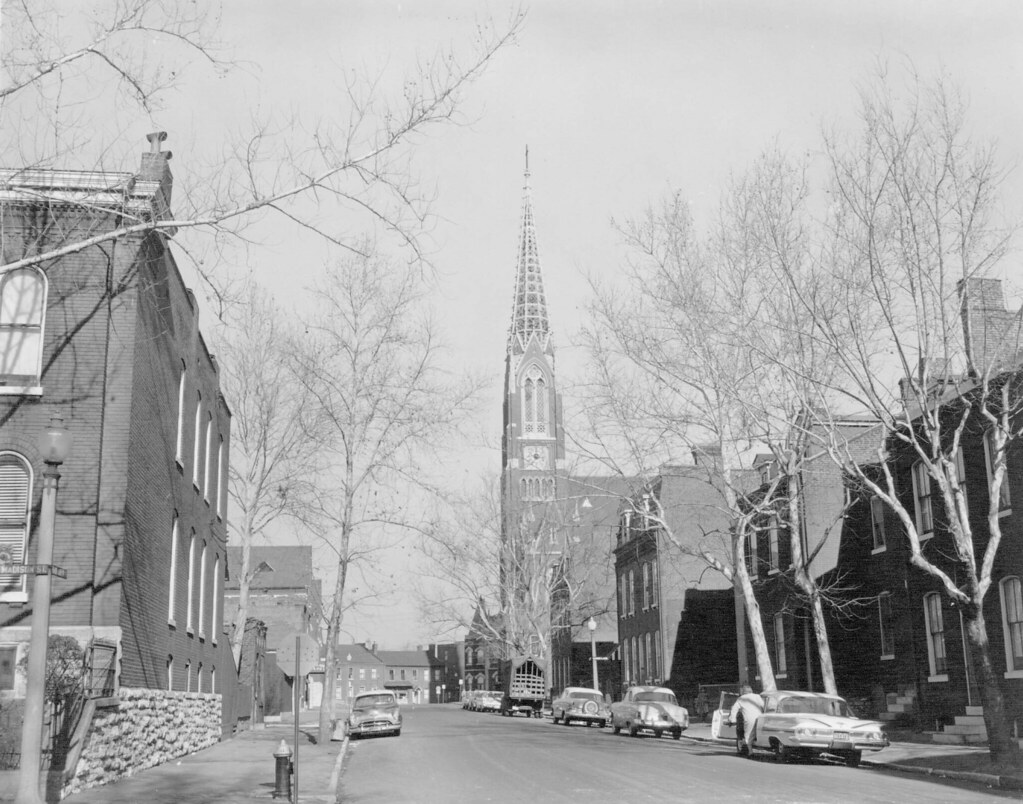
Here’s a 1960 view of Hogan Street looking north from Madison in St. Louis Place. The density of brick houses is striking. Also notable is the open-work sandstone spire on St. Liborius Roman Catholic Church, which would be removed in 1965.

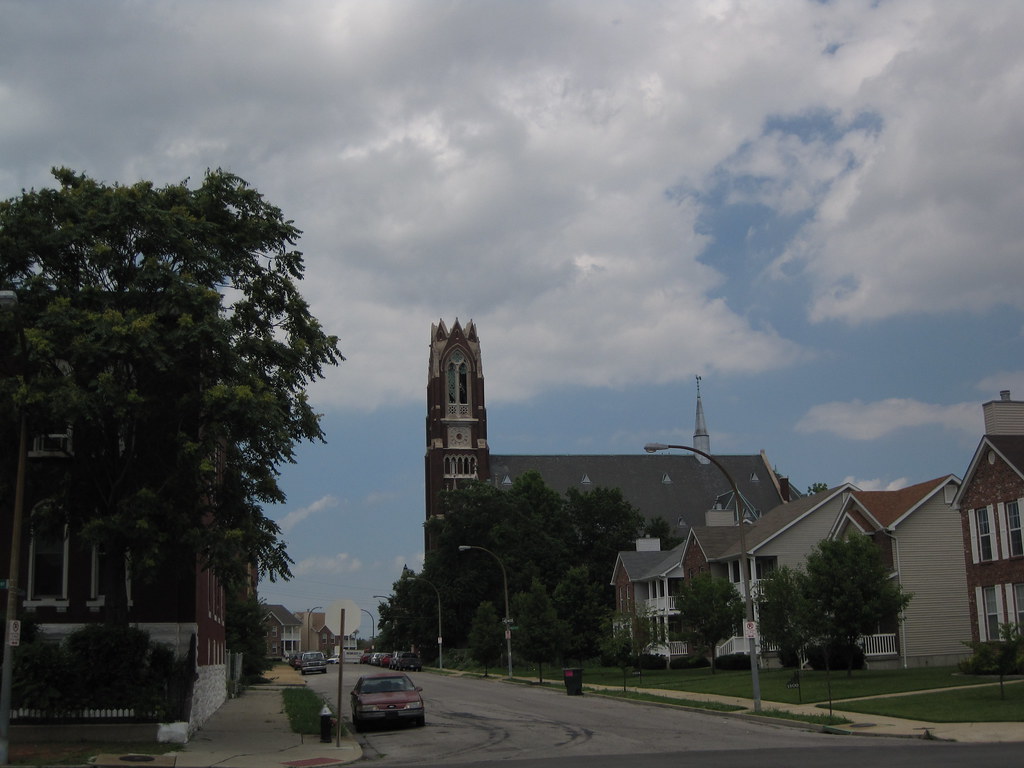
This is the same view today. The house at the corner and its stone wall remain, as does St. Liborius church. The brick houses and tenements are gone, replaced by new houses and (not visible here, but adjacent to the church) the New Roots Farm.

Categories
Brick Theft Historic Preservation North St. Louis Northside Regeneration St. Louis Place Theft

A Hebert Street Story

by Michael R. Allen

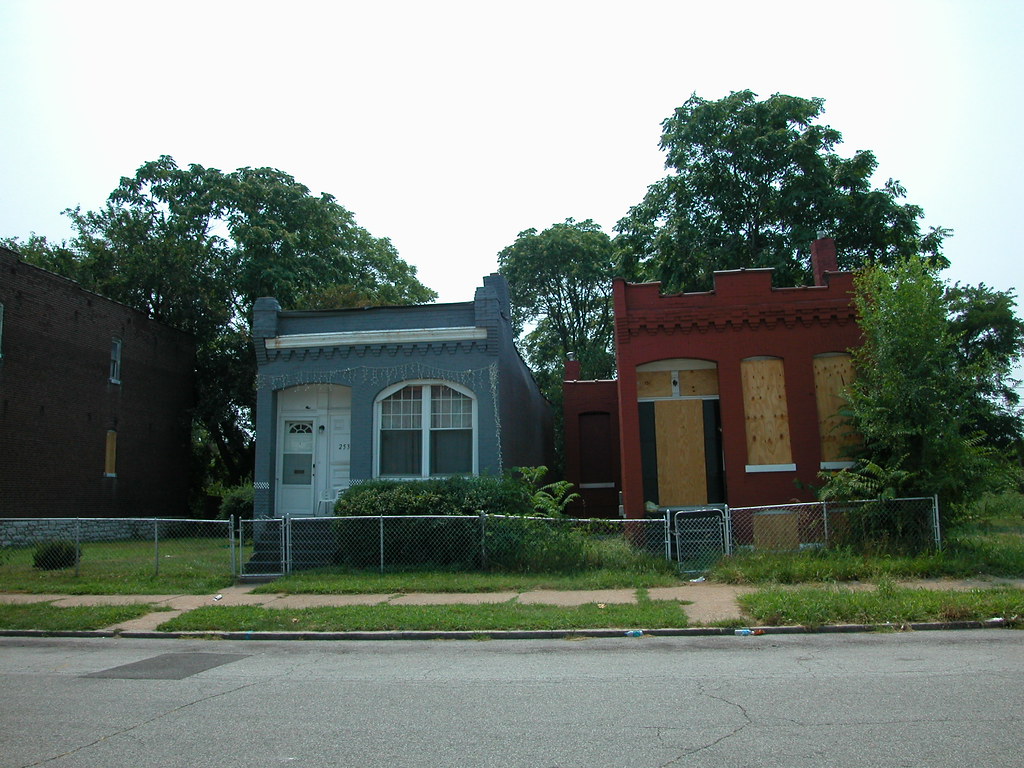
Our story starts in the heat of the summer, 2007. Two one-story shotgun houses sit on a block of Hebert Street between 25th Street and Parnell in St. Louis Place. Both houses have sat side by side since 1895, when they were built. On the left, 2530 Hebert Street is occupied by a family. On the right, 2532 Hebert is boarded up and has been owned by a holding company called N & G Ventures since December 2005. The overgrowth is evident, with tall woody growth and mosquitoes presenting a nuisance to the family next door.

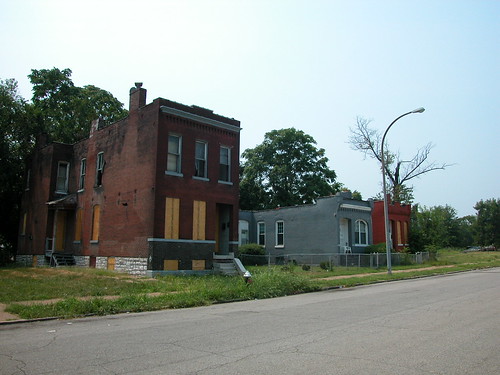
Draw back for a bigger picture, and we see that the two-story house to the east of the occupied house is also vacant and boarded. A company called MLK 3000 purchased that house in March 2007, requiring that its owner evict the tenants before the sale closed. We see that other buildings have fallen vacant and been demolished on this block, leaving vacant lots in varying degrees of maintenance.

The family living at 2530 Hebert Street have lived through tough times that got worse. In 2007, the identity of the holding company owner became public knowledge. McEagle Properties was buying land and buildings in north St. Louis for a large development. Details of the plan were unknown.

In May 2008, a string of arson hit this area of St. Louis Place. Ten vacant buildings went up in flames within a three day period. Police arrested a suspect who was released uncharged. No one has been charged with the arson. However, off the record officers say that the arsons were connected to the brick theft that has plagued north St. Louis for years and has escalated in St. Louis Place since 2006.

Perhaps it is not surprising that our family on Hebert Street sold their home to a McEagle holding company, Union Marin, in July 2008, for $75,000. Who else would have paid the family that much to relieve them of living on what had become a desolate block? They could have sold directly to McEagle for a decent price, or to one of the middle-man speculators who would have paid them $50,000 and sold to McEagle at $75,000.

Let’s move forward a year and see what happened to the houses on Hebert Street.


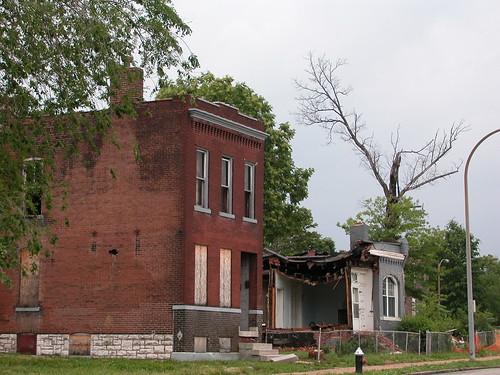
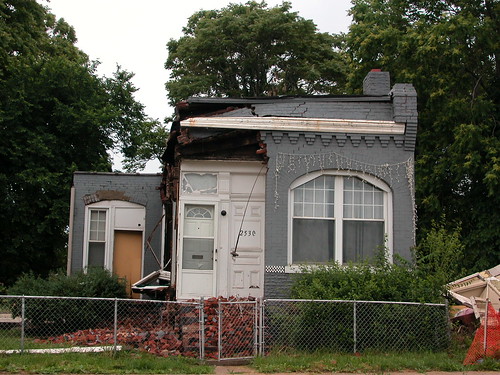
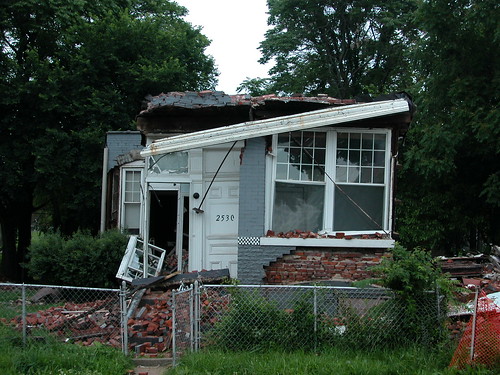
Ah, the brick thieves struck the fine little homes! On May 25, 2009, not only was 2532 Hebert Street reduced to a foundation, but the house that had been occupied less than a year earlier was down to three walls. That’s what happens when there are no eyes and ears on a block to watch out for criminals.

The brick thieves have been striking this area for years, often taking their bricks to nearby dealers around 25th and University streets. The thieves work in broad daylight and on weekends, and yet few ever get caught by police.

No matter — this week the house at 2530 Hebert Street is down to fewer than two full walls. The scene is garish, with the well-painted front doors and their decorative surrounds leading into a wrecked home. The water runs in the basement, where a washing machine can be seen. The sagging floors are ready to collapse any day now.

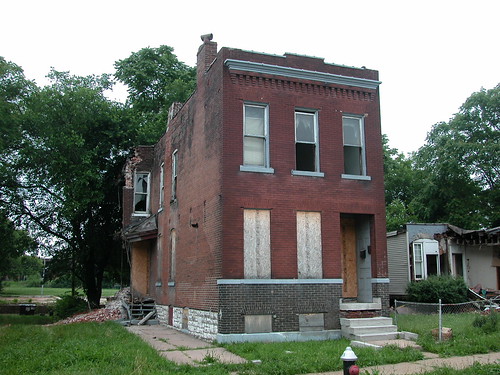
Next door, the formerly-solid two-story house has now been hit. The thieves have struck this house since May 25, because there was no damage evident then. What sort of city lets this sort of crime happen so brazenly? That’s a question for another story.

Perhaps none of this matters at all: on the slides that McEagle showed at a meeting on May 21, this block was part of a large “employment center” where many extant historic buildings were replaced by large new ones. If the city assents to this plan through a redevelopment ordinance, many other buildings will disappear. However, the shocking and illegal campaign of brick theft is not a fair or civilized way to prepare the development area.

I hope that our story ends with the arrest and conviction of the thieves who destroyed the house son Hebert as well as the dealers who fence brick knowing the illicit source. In fact, a happy end would have the larger penalties assessed against those who profit the most from brick theft — not the poor guys with pick axes, but the people who sell the brick out of town to build the McMansions of the Sun Belt. Then, we would have an open conversation about historic preservation and the McEagle project, reach consensus, watch a great project get built and all would live happily ever after.

Categories
Downtown I-70 Removal Infrastructure North St. Louis Northside Regeneration Planning

Six Ways to Remove a Freeway — How About Seven?

by Michael R. Allen

Six Case Studies in Freeway Removal is a an excellent overview of successful efforts to eliminate interstate highways in urban areas that created barriers. While there are examples from large cities like San Francisco, Toronto and Vancouver where one might expect progressive government, there are also studies from Milwaukee and Chattanooga where advocates for reconnecting the urban fabric faced greater odds.

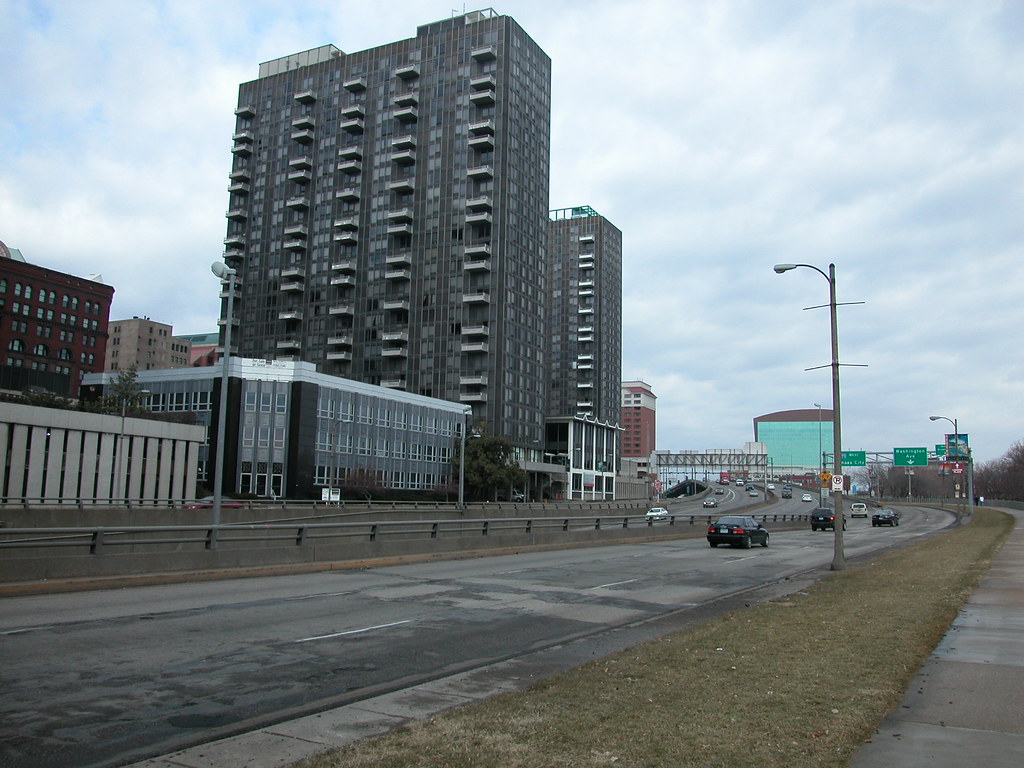
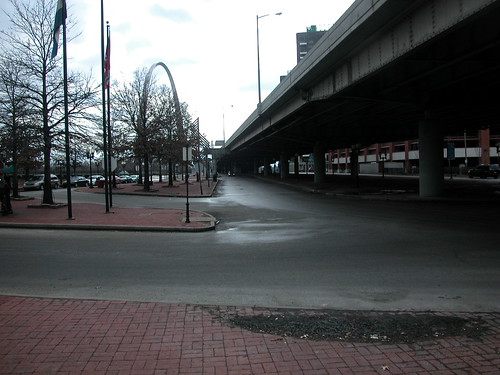
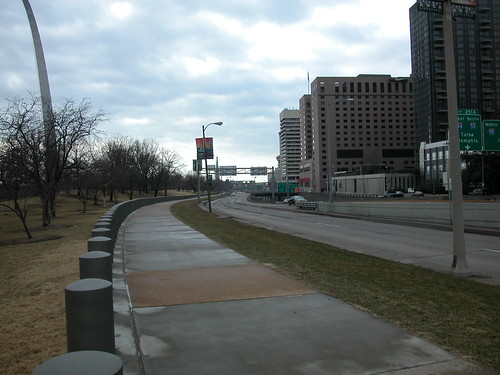
There are constant themes in each project profiled in Six Case Studies in Freeway Removal: beautification and functionality were major goals of cities that removed freeways or freeway sections, spillover traffic was absorbed without major new congestion and freeway removal almost always lead to higher property values. St. Louis leaders contemplating the mess at the western edge of the Gateway Arch grounds ought to consider the findings of this study, and commission one aimed at the particular local problem that I-70 poses.


One of my first reactions to the case studies from other cities is that the I-70 problem is not that big. Taking the logical dimension of removal from the Poplar Street Bridge on the south to Cass Avenue on the north, one sees that we don’t have as long or as vital a stretch of highway as other cities removed. What we will have in a few years, after the new river bridge opens, is a redundant second section of an interstate highway that disrupts the connection between downtown and the riverfront.

Is St. Louis ready to join the ranks of the cities that have found the leadership needed to think big? A few months ago, I might have been pessimistic. Now, I see that City Hall and many leaders are willing to take a major urban planning risk with McEagle Properties’ NorthSide project. Putting aside the details of NorthSide, that project takes a leap of faith — the scope is vast, the cost great and the potential for changing the central city tremendous. Part of the project even involves removing interstate highway infrastructure, the 22nd Street ramps connecting to Interstate 64. The project aims to capture southbound I-70 exit traffic and send it onto Tucker Boulevard, not eastward toward Memorial Drive. That flow could lessen traffic volume on the old I-70 and Memorial Drive.

Is there a connection between NorthSide and removal of I-70 downtown? Not yeat, but there is a binding tendency in each project: big-picture economic development planning. While NorthSide’s proponent is its developer, proponents of removing I-70 are citizens who see tremendous development opportunity along a human-scaled street. The removal of I-70 would weave the riverfront back into downtown, and it would create acres of land ripe for transformative downtown development. Like NorthSide, the process could take decades, but the results would be redevelopment on a scale beyond our wildest dreams. Add in the Chouteau Greenway project, and in thirty years Downtown could be ringed not by bleak interstate, asphalt parking and towing lots and vacant buildings but by connections to exciting new projects and renewed old neighborhoods.

Other cities took the leap of faith needed to set this level of vision into motion. Will St. Louis?