Categories
Abandonment Architecture North St. Louis Northside Regeneration Old North

How Not to Board Up a Broken Window

by Michael R. Allen

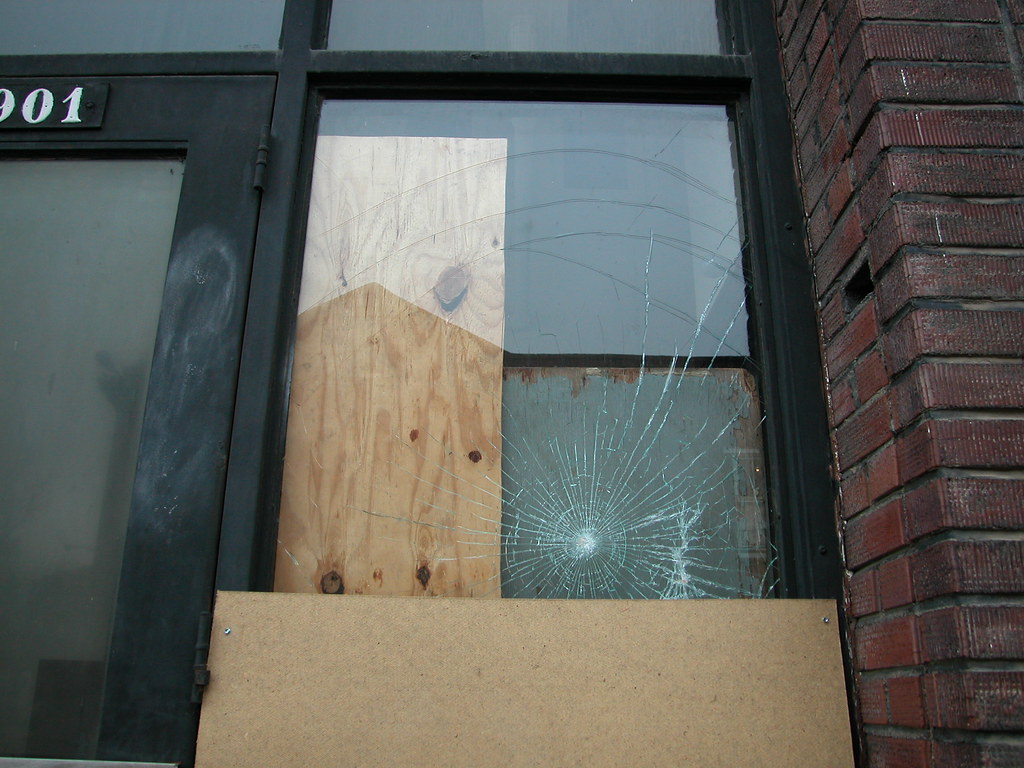
Here is the entrance to the Fourth Baptist Church at 13th and Sullivan in Old North St. Louis. You can see that someone has broken the window at right, and that someone has very poorly attempted to board over the damage. Hint: If the broken area still shows, you haven’t boarded over the damage.

In August 2007, someone threw a rock at the window and caused the spider-web-like broken lines. Neighbors tried to get the owner, a nearly-defunct congregation, to board up the broken window. I cut my hand taping the damage to stabilize the glass. Several Citizens’ Service Bureau complaints led to the congregation’s finally boarding up the broken glass. Then, this December, the other side of the doorway gets the same treatment — from vandal and owner. Neighbors still haven’t seen a full repair.

The church building itself is an important landmark, and deserves better treatment. The congregation does not have the funds to maintain the building; they vacated in 2002. Meanwhile, the building has become a nuisance to neighbors as the congregation refuses to commit to selling and won’t make even small efforts to stay abreast of vandalism.  Hopefully Fourth Baptist will board up the broken window and sell their church to someone who will invest in the future of the church and the neighborhood.

Categories
Architecture Demolition Fountain Park Historic Preservation North St. Louis

Demolition Imminent at Page and Kingshighway?

by Michael R. Allen


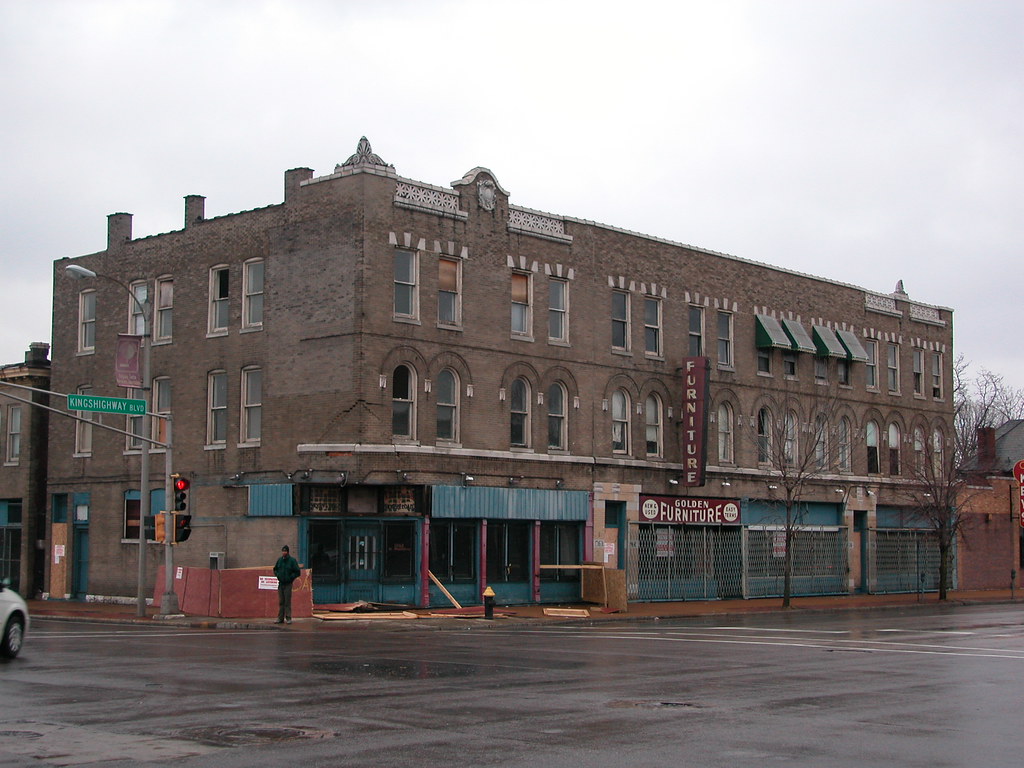
On January 10, the city’s Building Division issued emergency condemnation (for demolition) of the landmark building at the southeast corner of Page and Kingshighway boulevards. The Roberts Brothers Properties LLC owns the building and two adjacent two-story commercial buildings. A motorist struck and toppled the corner iron column on the building, which has been vacant for a year or two since Golden Furniture moved out. The Building Division has not yet followed up with any emergency demolition permit, although such action is almost certain. (Curious Feet St. Louis reported the news awhile ago.)

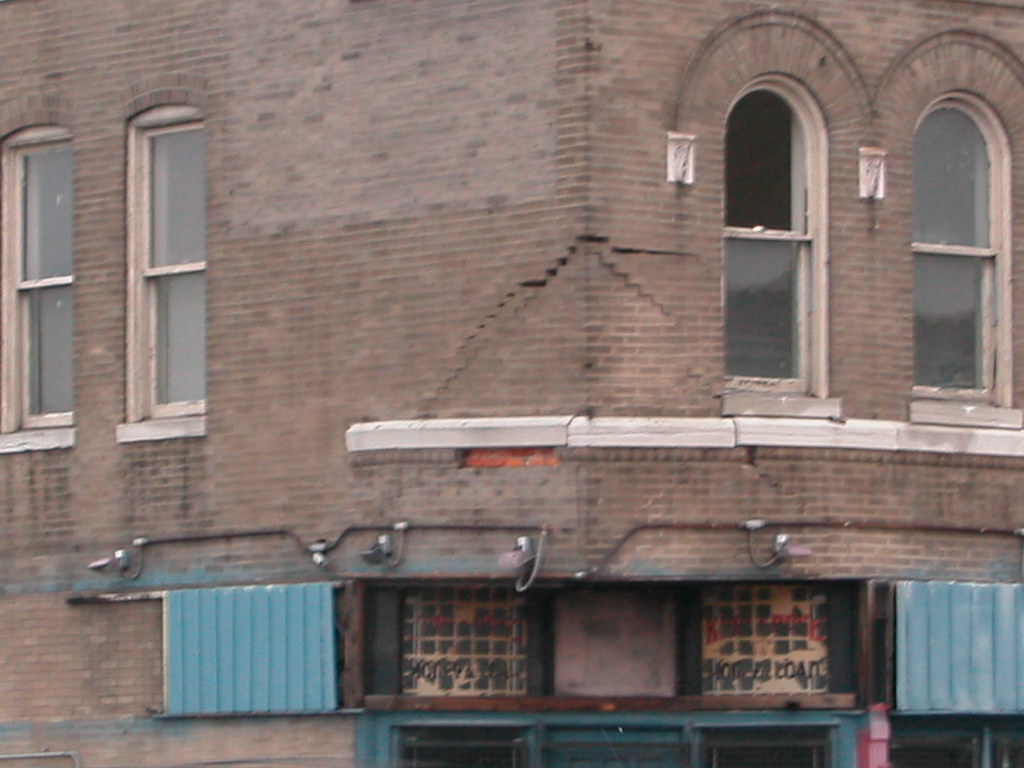
The loss of the corner column has already led to significant shifting of the building’s weight downward at the corner. The brick wall shows how the bottom of the second floor is pulling downward. At the moment, this is a problem that can be corrected with a jack or another iron column. (What happened to the building’s original column? Why not just re-install it?)
The situation has become one of those self-fulfilling prophecies that dampens one’s attempt to be hopeful for the commercial buildings of north St. Louis. Here we have beautiful commercial buildings that define a major intersection, and which were in use until recently. A big-time owner lets leases lapse, perhaps plotting demolition for replacement with some silly strip mall like the owner’s project across Page. Then, an accident happens. The Building Division steps in, goes through its procedures, while the owner does nothing. The owner does not jack up the corner with a support, which would avert further damage. The corner pulls down, triggering a major collapse. The Building Division rushes in to get demolition started. The owner sits back and lets events unfold, while hatching plans for new development. Preservation and minimal code enforcement never had chances.

This is frustrating because the building is elegant and obviously in decent shape. The Roberts brothers could view ownership of these buildings as great fortune — they get to possess unique historic buildings at a major intersection. They get to take a step to ensure that north city retains the level of historic character that makes real estate in south city so valuable. They could renew a cultural resources and pave the way for long-term rising of real estate values in north city, instead of falling into the temptation to build a short-lived retail center with short-term pay-off.

The Building Division is not a preservation agency. Yet the Building Division could step in and make the owners put a support at the corner. After all, that’s stipulated by the building code. The owners’ intentions should not influence the Building Division’s enforcement. Whether or not the owners want to tear down the buildings is a moot point until there is a demolition permit. Up to that point, the division should seek to force the owners to make repairs of structural necessity.

Beyond code enforcement, preservation makes sense. Page Boulevard has many threats to corner commercial buildings at the moment, and has already lost several. Kingshighway north of Delmar is likewise losing its lines of commercial buildings. Presence of anchor landmarks sometimes makes the difference between people remembering having been to a neighborhood or not. These buildings are in Fountain Park, which possesses a memorable interior. Yet its perimeter would lose a little less character with the loss of these buildings. The oval park, the famous curved storefront, the historic homes, schools and churches present a distinct and impressive identity. A corner strip mall, festooned with a developer’s name, with litter blowing across black asphalt in front of squat little retail boxes demonstrates no distinct character and in fact could have a blighting effect on neighboring block that retain their character. Fountain Park is a little less remarkable with every lost landmark.

These buildings are inherently remarkable, too. Built between 1904 and 1908 from designs by architect Otto J. Wilhelmi, the group shows a mix of modern sensibility and Victorian-era stylishness. The two-story buildings are rather plain expressions of the commercial storefront form while three three-story building is a blend of stark iron storefronts, paired Romanesque windows with pronounced archivolts on the second floor and windows with terra cotta keystones and voussoirs that suggest the Georgia Revival style. Then there is the white glazed terra cotta ornament of the parapet, which draws upon Classical Revival styles and features a projecting acanthus and the corner and near the south end. The building permit for the building mentions a galvanized cornice, long-gone. All three buildings are clad in buff speckled brick prevalent in north city commercial architecture of the period. In all, the buildings are unusually eclectic for this part of north city — and that statement means a lot. If only the owners recognized the treasures that they already have.


Categories
Demolition Flounder House Historic Preservation North St. Louis Preservation Board South St. Louis

Preservation Board Agenda Includes Demolitions of Flounder House, Building on Page

by Michael R. Allen

The St. Louis Preservation Board meets on Monday to consider a rather short agenda.

Notable items on the agenda include:

  • Preliminary review of an application by Alderwoman Kacie Starr Triplett (D-6th) to demolish a one-and-a-half-story flounder house at 2915 Minnesota Avenue. The house, built before 1884, is an example of a true flounder house. Flounder houses have half-gabled roofs with a slope from one side of the front wall to the other. Flounder houses were popular in nineteenth century St. Louis due to the speed of construction, but few survive. Many have been successfully rehabbed in recent years, and the smaller ones seem well-suited as economical alternatives to the glut of expensive, energy-inefficient multi-family conversions. Staff recommends denial of the permit.
  • Preliminary review for a new building at 1412 Mississippi Avenue in Lafayette Square. This building would occupy one of the last gaps in the street faces surrounding Lafayette Park — the vacant lot at the southeast corner of Park and Mississippi. The Lawrence Group proposes a three-story building with heavy Romanesque massing topped by a Mansard roof with numerous dormers. The building is reminiscent of the ungainly building that houses the Soda Fountain Square restaurant. Hopefully the board and staff will provide guidance to improve the design.
  • Appeal of staff denial of a demolition permit for the building at 5100-2 Page Boulevard, subject of an earlier post in this blog. Staff recommends upholding the denial. Alderman Frank Williamson (D-26th) supports demolition.
  • Categories
    Downtown North St. Louis Old North

    Snow City

    Looking southeast from the corner of 13th and Mullanphy Streets in St. Louis yesterday evening.

    Categories
    Architecture Historic Preservation LRA North St. Louis Old North

    A Middle Path?

    by Michael R. Allen


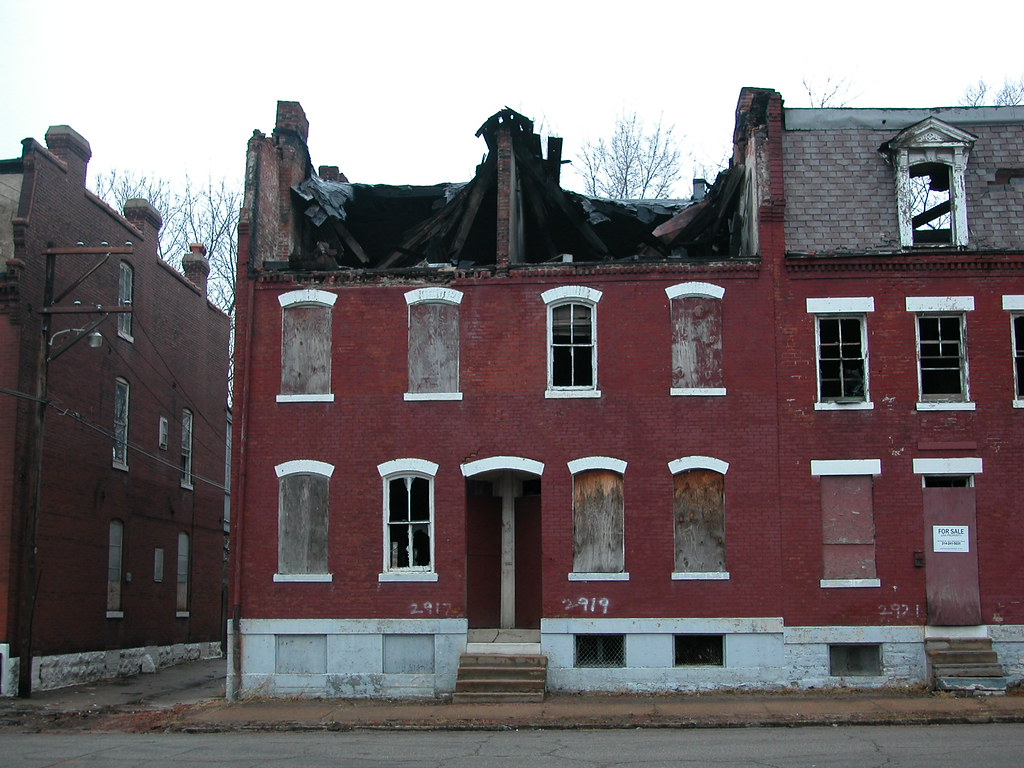
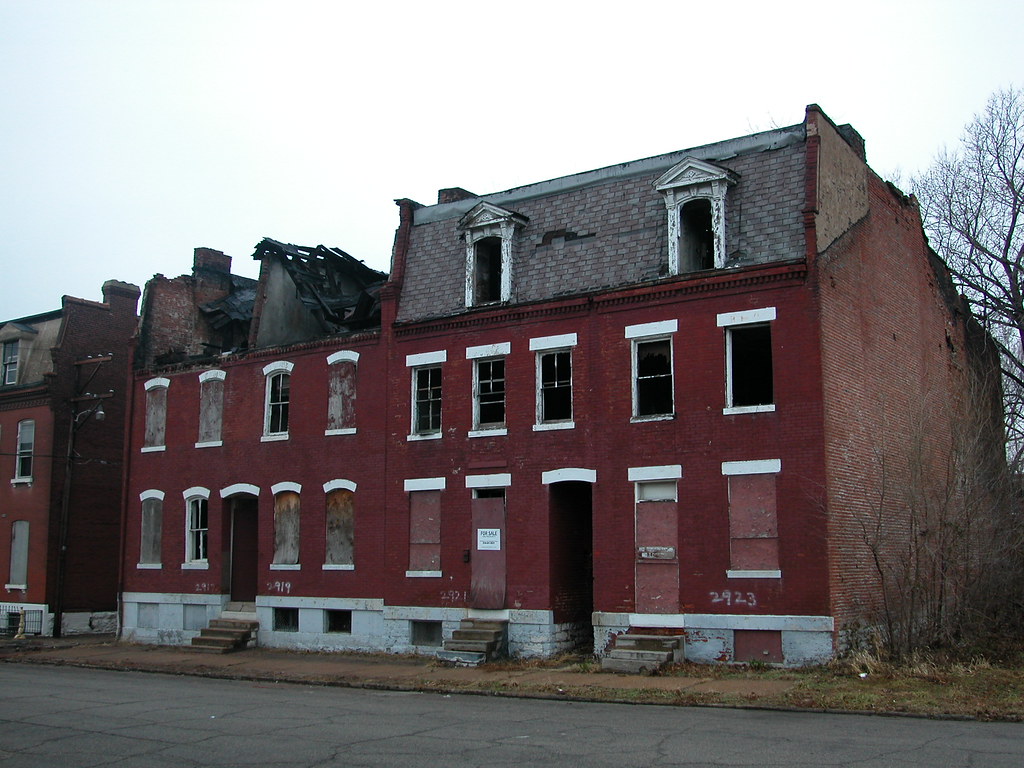
    Above is the grim scene that I encountered two weeks ago after a blustery winter storm: the vacant city-owned building at 2917-21 N. 13th Street in Old North St. Louis had suffered a roof collapse. The building, built around 1880, stands one block north from my house in the densest section of a neighborhood famed for its loss of building density. Mt neighbors and I were aghast to see what misfortune had struck a vacant building already beset by misfortune.

    The building and an adjacent building to the north form a graceful row that hugs the sidewalk line. Before, the buildings’ back walls had fallen. Loose bricks on the parapet of the alley side elevation had caused the Land Reutilization Authority to consider emergency demolition, but LRA backed off after the Old North St. Louis Restoration Group reminded LRA that they were trying to market the poor buildings for historic rehabilitation.

    Now, the mansard roof with its two dormers had completely collapsed outward and the flat roof above had fallen inside of this part of the row. But again the Restoration Group acted quickly. Development Coordinator Karen Heet fended off the Building Division and managed to get the debris out of the public right-of-way (a favorite demolition excuse) within 24 hours of the collapse.

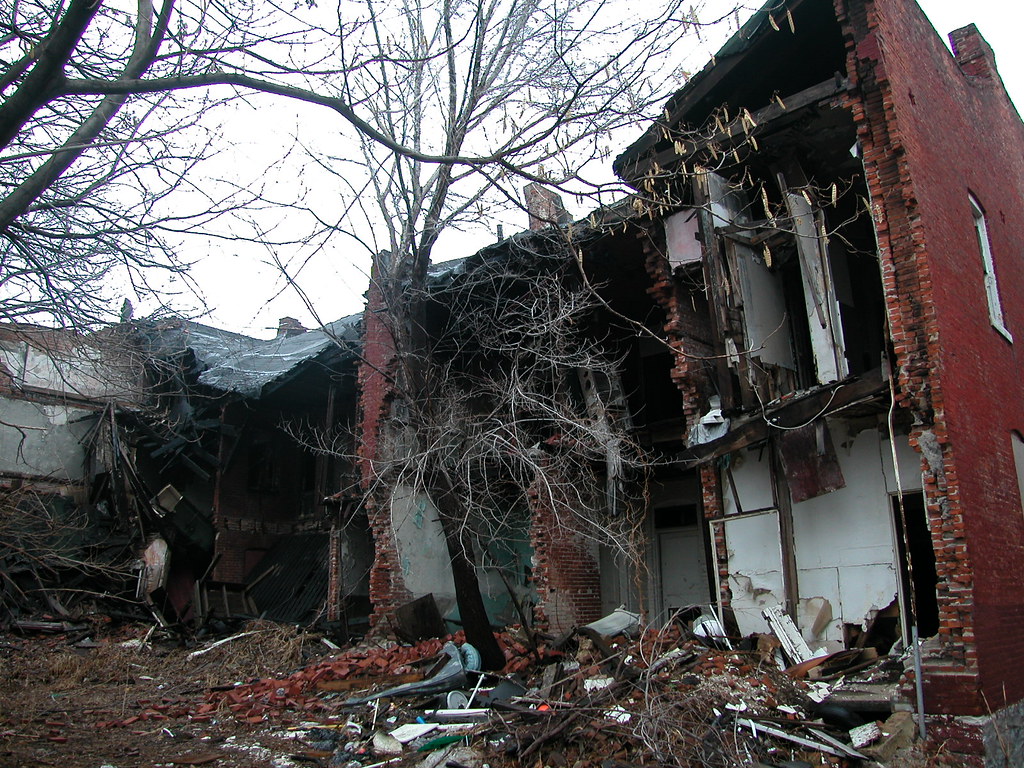
    Karen has posed a very interesting idea for reusing the buildings. A look at the rear of the row helps underscore her logic.


    Rather than try to rebuild the buildings, which have lost significant building material, Karen would like to try something else. She suggests demolishing the interiors and retaining only the front and side elevations. Inside, a developer could build a new building on the old foundations using the existing brick walls as facades. The new building could be modular and modern, allowing Old North to offer a different housing unit while retaining the impressive street face of this row. I think that idea is worth attempting.

    There are many historic buildings in the city with severe damage that are ineligible for historic rehabilitation tax credits. Some of these buildings are located outside of historic districts and are never going to eligible for such designation. Others are buildings that once were contributing to historic districts but have had so many sections collapse their rebuilding would count as “reconstruction” and not “rehabilitation” and thus would be ineligible for both state and federal historic rehab credits. Still others are badly remuddled old buildings that don’t count as contributing resources in districts.

    In such cases, a straightforward attempt at replicating the old building fabric may be cost-prohibitive or simply limiting. The old Archigram concept of using masonry walls as armaments for modular housing offers an intriguing solution to situations where we have a pretty wall and little else. In other cases, more of the original building may be retained than in others. The important thing is that we don’t commit to a dichotomy in which the only common form of rehab is the tax-credit project and the only alternative is demolition for new construction. There is a full spectrum of architectural options, and saving any of the embodied energy in an old building at all is far more green than starting completely fresh.

    Anyone interested in purchasing and rebuilding the buildings on 13th Street can call Karen at 314-241-5031.

    More information on the row, including earlier photographs, can be found here.

    Categories
    Architecture Historic Preservation LRA National Register North St. Louis Wells-Goodfellow

    Two Craftsman Buildings in Wells-Goodfellow

    by Michael R. Allen


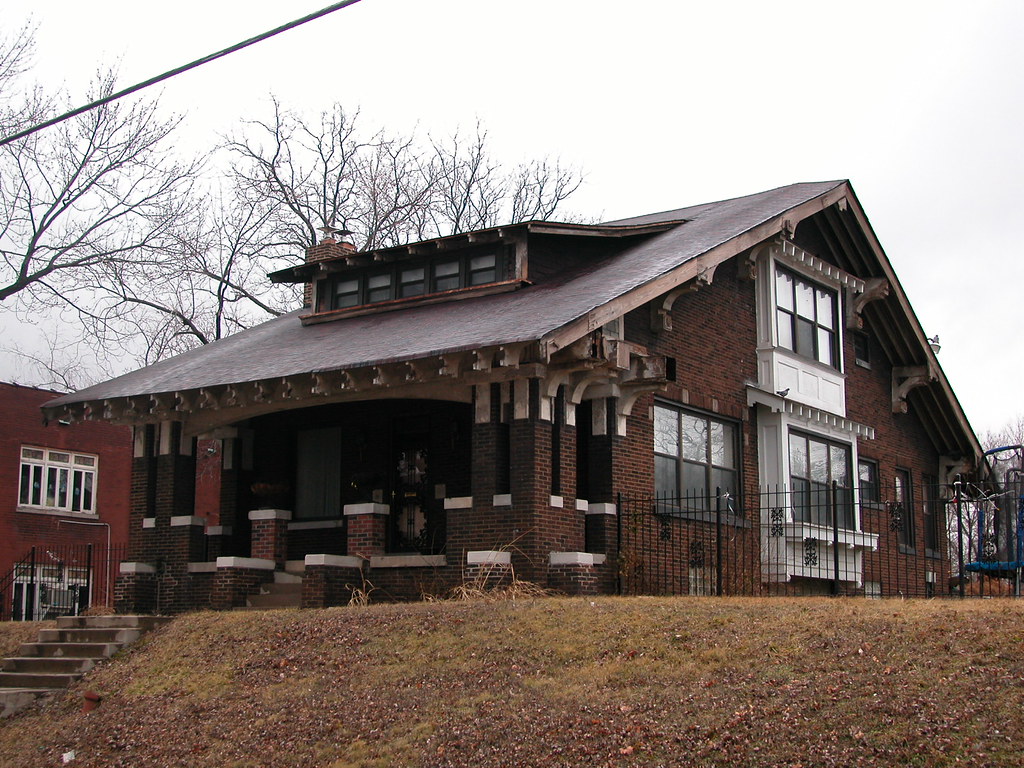
    While photographing a building across the street for work, I stumbled across this Craftsman gem on Ridge Avenue (just west of Hamilton Avenue) in Wells-Goodfellow. The size of the brackets on the porch end of the roof is incredible. Brackets, half-timbering and wide gable roofs were hallmarks of the Craftsman style, which was part of the revival style craze that dominated American residential architecture between 1890 and 1930. The Craftsman style drew upon the Arts & Crafts movement as well as historic rural European vernacular styles. St. Louis has great examples in north and south city, especially west of O’Fallon Park and in Tower Grove South.

    Coincidentally, this home is only a few blocks from one of the city’s most prominent Craftsman landmarks, the Wellston Station at 6111 Martin Luther King Drive.


    Photo by Rob Powers for Built St. Louis

    I don’t know much about the house on Ridge, but I co-wrote the National Register of Historic Places nomination for the Wellston Station. The Station was built in 1911 and designed by Martin Arhelger for the St. Louis Transit Company, the streetcar arm of United Railways. United Railways held the monopoly on mass transit in the city until 1963 when it was subsumed into the Bi-State Development Agency.

    Under its wide roof, the Wellston Station provided covered boarding, and a shelter with waiting rooms and toilets, for the first fixed-track streetcars on Easton Avenue (now MLK). Wellston Station was the destination for the last streetcar run in the city’s history: the run of the Hodiamont street car in 1966. For years after that, the building served as a bus shelter, but the grandeur was out of scale with cash-strapped Bi-State. Bi-State aimed to convert the building to a farmers’ market, but in 2006 abruptly turned it over to the Land Reutilization Authority. In May 2007, the National Park Service placed the Wellston Station on the National Register. That designation has not yet led to redevelopment, although a burger joint still rents the front end of the waiting room area. (The waiting room has always had a storefront at the street side.)

    Two Craftsman gabled buildings in Wells-Goodfellow — one a domestic building, the other a remnant of a once-robust public sector economy. May they both be part of the city’s future.

    Categories
    Academy Neighborhood Demolition Historic Preservation North St. Louis

    Another Fine Building on Page Boulevard

    by Michael R. Allen


    The original version of the agenda for the January 28, 2008 meeting of the St. Louis Preservation Board included an appeal of staff denial of demolition of the commercial building at 5100 Page Boulevard. This building stands just east of another building whose fate on the same agenda, 5286-98 Page. The final agenda did not include the appeal. Whether or not it returns is up to the owner of the building, Rosie Love.

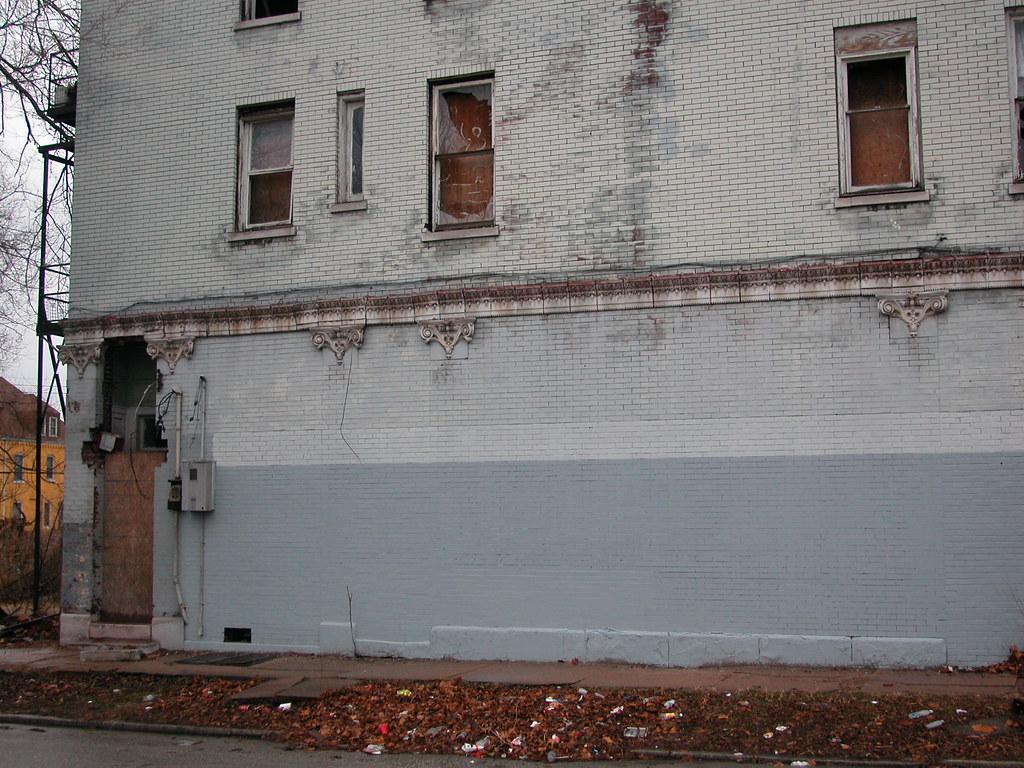
    Curiosity sent me to look at the building. I was pleasantly surprised to find a sturdy three-story building with a mansard-style roof and lovely masonry details. The stepped-down parapet alongside the mansard gives the corner some pizazz, while a terra cotta cornice below the mansard has an eye-catching swag garland motif. The brick cornice on the secondary east elevation adds a less formal vertical line.


    What is perhaps most intriguing is the bricked-in storefront configuration on the east wall. Under a continuous cornice with an egg-and-dart pattern are some strange capitals; these top brick false pilasters that run vertically between the storefront opening. Looking at the painted wall closely, one can see the distinct vertical lines between the pilasters and the infill. How wonderful it must have been to have the storefront opened up to both the main and side streets!

    The building is, of course, vacant and deteriorating. It’s been empty for some time. Geo St. Louis shows records of an occupancy permit for a convenience store in 1995 and a permit for a “grandfathered pay phone” in 1998.

    The front wall has some damage at the cornice line, while missing downspouts on the rear elevation has caused severe mortar erosion. Still, there are no collapsed wall sections yet. Numerous buildings in worse condition have been spared demolition by the Cultural Resources Office and the Preservation Board.

    The Academy neighborhood (and the Mount Cabanne-Raymond Place National Historic District that encompasses much of the neighborhood) needs its commercial edges to remain strong. Delmar on the south has become a lost cause, but Page retains many corner commercial buildings like this one and the one at 5286-98 Page, which bookend rows of historic residences. With its proximity to the Central West End and its largely intact building stock, this area is bound to be an emergent rehabbing neighborhood. We need to keep the neighborhood’s buildings around for the new day ahead.

    Categories
    Demolition North St. Louis Preservation Board

    Preservation Board Spares Building at 5286-98 Page

    by Michael R. Allen

    At the meeting of the Preservation Board on Monday, January 28, the Board upheld staff denial of a demolition permit for the historic commercial building at 5286-98 Page Boulevard. Consideration of the item was somber and quick. Attorney Richard Kenney entered a compilation of all of the Berean Seventh Day Adventist Church’s exhibits, while Cultural Resources Office Director Kathleen Shea entered hers. After Kenney declined to testify, Board Chairman Richard Callow asked for a motion.

    Board member David Richardson moved to uphold staff denial. Board members John Burse, Melanie Fathman, Mike Killeen and Anthony Robinson joined Richardson in voting for his motion. Board members Mary Johnson and Alderman Terry Kennedy (D-18th) voted against.

    The next step may be Circuit Court, where any appeal of the Board decision would land.

    Previous coverage:

    Fate of Building at Page and Union Deferred Again (January 9, 2008)

    Confusion at Page and Union (November 27, 2007)

    Categories
    Central West End Demolition Granite City, Illinois Historic Preservation North St. Louis

    Demolition Threats All Over Town

    by Michael R. Allen

    Vanishing STL alerts us to the possibility that the Washington University Medical Center may demolish the Shriners’ Hospital and Central Institute for the Deaf buildings.

    Meanwhile, Curious Feet notes two impending demolitions: a large storefront building at Page and Kingshighway in St. Louis and an old bank building in downtown Granite City.

    Categories
    Demolition Martin Luther King Drive North St. Louis Wells-Goodfellow

    MLK in St. Louis

    by Michael R. Allen

    Perhaps my experience of Dr. Martin Luther King, Jr. Day in St. Louis was epitomized by watching a lone wrecker. The man was palletizing bricks and stoking a bright orange barrel fire fed by millwork and door casements of the building he was wrecking. The cold did not deter his determination to get in a day’s work. The building he was wrecking? A commercial building on Martin Luther King Drive.

    The scene was a reminder of some harsh realities of this city. North side laborers, even with skills, are far more likely to find work tearing down their own neighborhoods than rebuilding them. Our city is one of many American cities who renamed a downtrodden thoroughfare for one of the greatest Americans to live, and then did nothing to staunch the decay that dishonors the name on the street. Our city’s leaders, black and white, found time on the holiday to pander and squabble while many citizens were busy earning money for food and shelter.

    Further west on the street, past Kingshighway, I encountered the relatively vibrant street culture of the Wellston Loop. People were out walking, traveling from store to store. A barbeque restaurant was crowded, with patron’s cars spread out over an adjacent vacant lot. New sidewalks were in the middle of construction, and several buildings were amid major renovation projects. That’s reality on MLK, too.