
The Cultural Resources Office of the City of St. Louis has opened the position of Historic Preservation Planner I to applications. Deadline is November 21.
by Michael R. Allen

The charming art deco Massac Theater graces Main Street in Metropolis, Illinois, a small town at the southern tip of Illinois well-known for DC Comics’ designation of the town as “Hometown of Superman” in 1972. Although the front elevation appears well-maintained, the theater has been completely abandoned since the late 1980s, when a radio station using the front section of the building moved out. The theater screened its last film, Superman, in 1978.
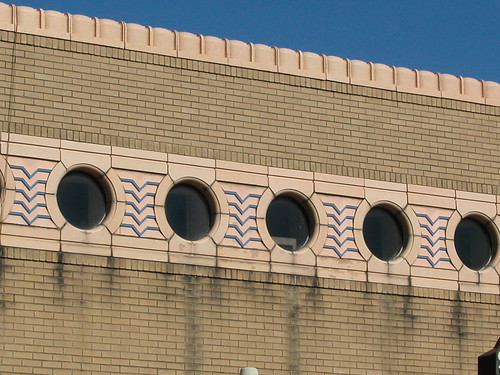
The Massac Theater opened in 1938 with 537 seats, a large size for a town the size of Metropolis. The front and side elevations were laid in buff brick; polychrome cream and blue terra cotta disrupt the front elevation with vertical finial-topped piers to each side of the entrance joined a ribbon of portal windows. A jazzy marquee, still intact, further enhances the exterior. Entrances on each side of a box office lead to a low-ceilinged front lobby which expands into a larger lobby space. Although the partition between the lobby and the auditorium is now gone, twin staircases with fine metal rail detailing, probably leading to a missing balcony, indicate some sort of atrium in the lobby. Past the staircases is the bow-trussed auditorium, now cordoned off with a plywood wall.
Here is a view of the lobby.
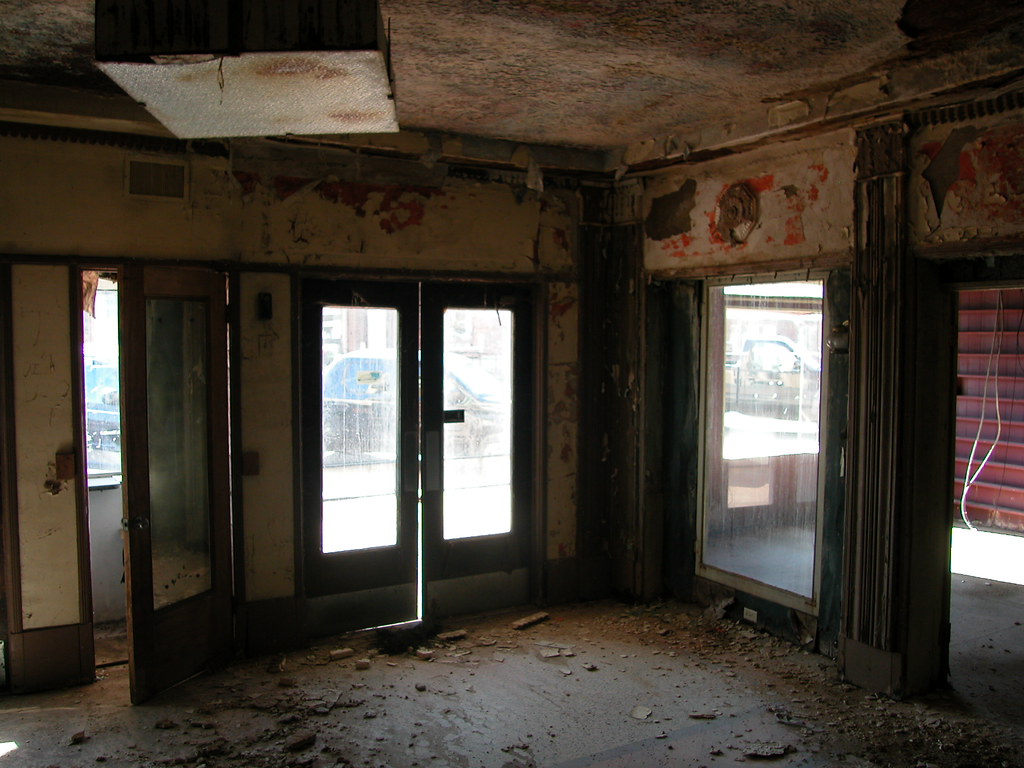
The view below looks toward the front entrance from inside of the theater. Note the staircases.

The auditorium is shocking — the walls are stripped down to backing block, the seats and flooring missing, and the roof is largely collapsed. Weather-beaten sections of roof deck cover the floor of the auditorium.

Condemned by the city government, the theater sits forlorn. The radio station left behind myriad record, files, desks and other furnishings. No one knows what the future will bring here. Metropolis has not had a movie theater since the Massac closed, but with access to nearby Paducah and its multiplex theater on sprawling Hinkleville Road, the demand for reopening a single-screen downtown movie theater is low. Most of the entertainment in Metropolis nowadays takes place at the giant Harrah’s casino that blocks the downtown area from its riverfront on the Ohio River.
by Michael R. Allen
For the last few weeks, local preservationists have been trading rumors of the impending salvage sale of St. Louis’ long lost floating National Historic Landmark Goldenrod Showboat. According to an article in today’s St. Louis Post-Dispatch, the sale may be averted and the old show boat moved from its dry dock in Kampsville, Illinois. Whether or not the boat heads back to St. Louis is uncertain.
Categories
Sky Lobby
by Michael R. Allen
From a press release on the hotel at Lumiere Place (via MayorSlay.com):
The Hotel features a “sky lobby” on the eighth floor that overlooks a lushly landscaped rooftop pool area with the city’s best view of the Arch and skyline.
This isn’t the first time I’ve encountered the phrase “sky lobby.” “Sky lobby” seems to be marketing-speak for “the first seven levels of this hotel comprise a parking garage.”
Categories
Blink of an Eye
by Michael R. Allen
Yesterday morning I walked past the building at the southwest corner of 14th and Washington that once housed Ehrlich’s Cleaners. The two-story commercial building is undergoing demolition, and by yesterday morning was reduced to little more than a cast iron storefront and some first floor walls. A one-story building that stood to the west was already demolished. The buildings are being razed for the 22-story SkyHouse residential building.
Something on the remains of the western wall caught my eye. There was a ghost sign! Actually, the sign was too pristine to be a proper ghost. The building next door must have gone up when the sign was still new, and its wall then protected the sign for the next eighty years.
The sign advertised beer, with some words evident — beer, [dr]aught, bottled. Maybe the beer advertised was from the Lemp or Hyde Park breweries.
After work, I walked past again. However, by 5:15 p.m. there was no sign to walk past, no cast iron front to admire. The western wall and most of the storefront had fallen in the course of the day. I did not take any photograph earlier.
For me, the only extant traces of the sign were the song lyrics in my head, from Neutral Milk Hotel:
What a beautiful dream
That could flash on the screen
In a blink of an eye and be gone from me
I also carried the hope that someone else took a photograph while the sign was exposed.
by Michael R. Allen
Last week, the St. Louis Preservation Board unanimously granted preliminary approval to the Gateway Foundation’s plan to convert two blocks of the Gateway Mall into a sculpture garden. These are the two very formal blocks between Eighth and Tenth streets that were completed in 1993. The garden, which would include landscaping coordinated by the Missouri Botanical Gardens, is actually a good plan in itself. In fact, there is a level of thoughtfulness to the plan that I confess comes as surprise to me. The principal architects, Nelson Byrd Woltz Landscape Architects, looked outside of the mall for inspiration.
The architects cast aside the impossible dreams of formal symmetry, civic grandiosity and identity-making that have plagued the mall’s cast of prior architects. Rather than waste half of each block on passive lawn space, as the current design for those blocks does, the architects instead realize the number of intricate details that a city park can have. There are rows of trees along Market Street (for some reason widely viewed as a grand formal drive), and paved “plaza” areas. There is a fountain. But there also are limestone walls (faced in actual limestone on the plans the Board approved), flower beds, smaller lawns and a cafe building at the corner of Chestnut and 8th. Most important to the design are contrasting axes. A central linear axis on the western block abruptly bends on the eastern block, defying the forced sight lines of the mall. A wide arc forms an axis that spans both blocks on the northern side. A meandering curve runs across the southern end of both blocks, suggesting the lines used to demarcate creeks and rivers on state maps.
In fact, the whole concoction has pronounced map-like influences. While the translation of the logical god’s-eye view to actual pedestrian experience may muddle the intent, at least the plans celebrate the often conflicting lines that compose our physical and political geography. One of the architects told the Preservation Board that the linear axis follows the footprint of the actual alley that once existed on the blocks, joined with perpendicular lines drawn from old lot lines. This architect actually stated that his inspiration was an old Sanborn fire insurance map of the blocks.
The parks design succeeds inasmuch as it does not attempt to impose a particular experience on an urban space, but rather presents possibilities for user-directed action. However, there are drawbacks. On the plan, Ninth Street looks too narrow to accommodate its current four lanes. Likewise, Market Street appears to lose its northern lane. These losses eliminate metered parking — a necessity for a healthy downtown block.
The largest problem is not the fault of the designers but of our continued political cowardice: the city won’t will itself to erase the Gateway Mall idea from its mind. We are committing political will and civic endowment to major changes for these two blocks, but once completed they sit amid one of the most unintelligible urban landscapes in the nation. These blocks can counteract all of the problems of the mall, but without visual reinforcement their statement will be lost. They will be surrounded by the mediocrity of anti-urban 1980s buildings, which draw their users inside and away from even the best parks. The blocks will still be segments of a string of parks that are mostly useless and unattractive. With so much open space and inhospitable built surroundings, the sculpture garden will still function more as a self-contained destination than a component of a healthy downtown.
Instead of next turning to renovation plans for the rest of the Gateway Mall, city leaders should work to enclose the sculpture garden with good design. The Gateway Foundation is doing a huge service to the city by financing the construction and upkeep. That service should be matched with a program to enhance the context: renovate the block containing “Twain” (or even move “Twain” and build on that block); build on the block of Market between Ninth and Tenth where the second IBM Plaza tower was intended; rework the base of the first IBM Plaza tower; build a new building or even just shops on Chestnut south of the original Southwestern Bell building; redesign the base of the hideous Data Building. In short, we need to fulfill the premise that $20 million invested in the Gateway Mall will make a functional difference for this part of downtown.
Read the story on the Landmarks Association of St. Louis website. (Thanks to Paul Hohmann for documenting this travesty.)
by Michael R. Allen

Rose Willis speaks at last night’s meeting. Photo by the author.
Developer Paul J. McKee’s plans for north St. Louis were the subject of last night’s packed public meeting of Metropolitan Congregations United (MCU), held at Holy Trinity Church in Hyde Park. Although invited, McKee did not attend.
The tenor of the meeting surprised critics — MCU’s leaders were openly critical of McKee. Although the matter was only discussed for 20 minutes, and no questions from the crowd entertained, MCU laid out their action plan on the issue. Lead speaker Roger Duncan laid out MCU’s four development principles: community input (an item that received thunderous applause), creation of housing at prices all can afford, no displacement of residents, respect for existing character and street grid. Duncan and Father Rich Creason, pastor of Holy Trinity, made clear that MCU was not claiming that McKee had agreed to these principles. They admitted that McKee did not accept their invitation, and that they were unsure of his intent.
While few residents of the near north side actually attended the meeting (out of the few aware of the meeting), one of their biggest concerns was discussed. 19th Ward Block Captain Rose Willis spoke about living next door to a run-down McKee-owned property and the developer’s pattern of negligence.
Creason unveiled a community stakeholders’ table that MCU is assembling to build community consensus on a development agenda for the area McKee is targeting. This group includes organizations like the Old North St. Louis Restoration Group, the JeffVanderLou Initiative and the Third Ward neighborhood Council. the group also includes the St. Louis Development Corporation, the quasi-governmental corporation that encompasses the city’s alphabet soup of development entities. Even stranger was that mayoral Chief of Staff Jeff Rainford was on hand to represent SLDC.
Creason ended the meeting by urging all in attendance to send to McKee a signed copy of a card that MCU distributed urging the developer to meet with the MCU stakeholders’ group. Creason stated that he wanted McKee to receive 2,000 cards in the mail.
MCU has put itself in a difficult spot by trying to forge communication between stakeholders and McKee. I commend MCU for making the attempt. However, I think that the process could be fruitless without real public engagement. McKee has already met with representatives of the stakeholders’ group; as part of city government, SLDC will be involved no matter what. McKee has not met with rank-and-file members of neighborhood groups. These stakeholder groups have not necessarily even communicated to members their involvement in discussions with McKee. Some stakeholder groups are missing, such as those concerned with urban design, green space and mass transit.
Essentially, the stakeholders could end up being a nice compartment for negotiations already underway outside of the public eye. What MCU needs to do is to get McKee to make good on his promise to explain himself in public — to the residents of the area he wants to develop. Anything short of that is not the starting point of a new direction, but one more step down a path without a clear end.
McKee had a great opportunity last night to make a public appearance before a tame crowd. With few affected residents present, vocal antagonism was unlikely. The developer could have cut through the polarization with even a silent appearance, and demonstrated the leadership that defenders attribute to him. He did not make that first move to address the public. If MCU wants to help, it needs to continue to urge him to do so. All residents of the near north side are at the stakeholders’ table by default. Solutions start with them, and with McKee. As long as those parties remain apart, all we have is uncertainty, fear and cynicism. We need hope.
by Michael R. Allen
The administration of Detroit Mayor Kwame Kilpatrick is proposing selling off 92 of the city’s 367 parks. Most of the parks on the sale list are pocket parks and small playgrounds, many of which are surrounded by vacant lots and some of which are in severe disrepair. Kilpatrick seems to think that some of the park sites would be ripe for new development. The plan raises the issue of public space planning in deindustrialized cities. The amount of park space in Detroit reflects peak density that has not existed in decades. Does the city need so much park space when so much of the city itself is green ghetto land?
Maybe not. Detroit is seeing redevelopment right now. Kilpatrick’s interest in selling the parks shows confidence in their having some market value as lots. The city has shrunk, but as it grows it may need the parks. While there are many of the 92 parks that probably will never be useful, there are some that are useful now and would be useful in neighborhoods where infill construction will lead to higher density. Staking out public space now will ensure that neighborhoods don’t lack amenities that belong to all residents.
Detroit might consider holding off on a massive sale, and releasing the parks one by one after further community input and investigation of development activity. Perhaps some parks should just be mothballed — infrastructure demolished and grass planted. One thing we learn from cities like Detroit is the inherent power of a vacant urban lot. From the vacant lots will spring the development of the future — and public space needs to be part of that.
KMOV Channel 4: North St. Louis developer under fire from religious group
From the transcript: A spokesman for Paul McKee told News 4 it would be premature to talk to the public because “we really don’t have any plans.”
Pub Def: VIDEO: McKee a No-Show at Meeting