
Categories
Academy Neighborhood Churches Demolition Historic Preservation Preservation Board

Confusion at Page and Union

by Michael R. Allen

Monday’s meeting of the Preservation Board was one of the most bizarre in recent memory — and that’s saying something. Visitors to the meeting found a room full of over 60 people when the board convened at 4:00 p.m. Normally, there may be around 15 or 20 people in the audience at the start of a meeting, and many less by the end. Had the board offered a raffle prize?

Alas, the cause for the crowd was political: the majority of people in the audience were members of the Berean Seventh Day Adventist Church on Union Avenue, which was appealing Cultural Resources Office staff denial of a demolition permit for the building at the southeast corner of Page Boulevard and Union Avenue. Their purpose seems benign: they want to replace a fire-damaged, abandoned building that neighbors loathe with a gymnasiusm and educational center. There is an interim step of surface parking, but the new building should be standing within two years.
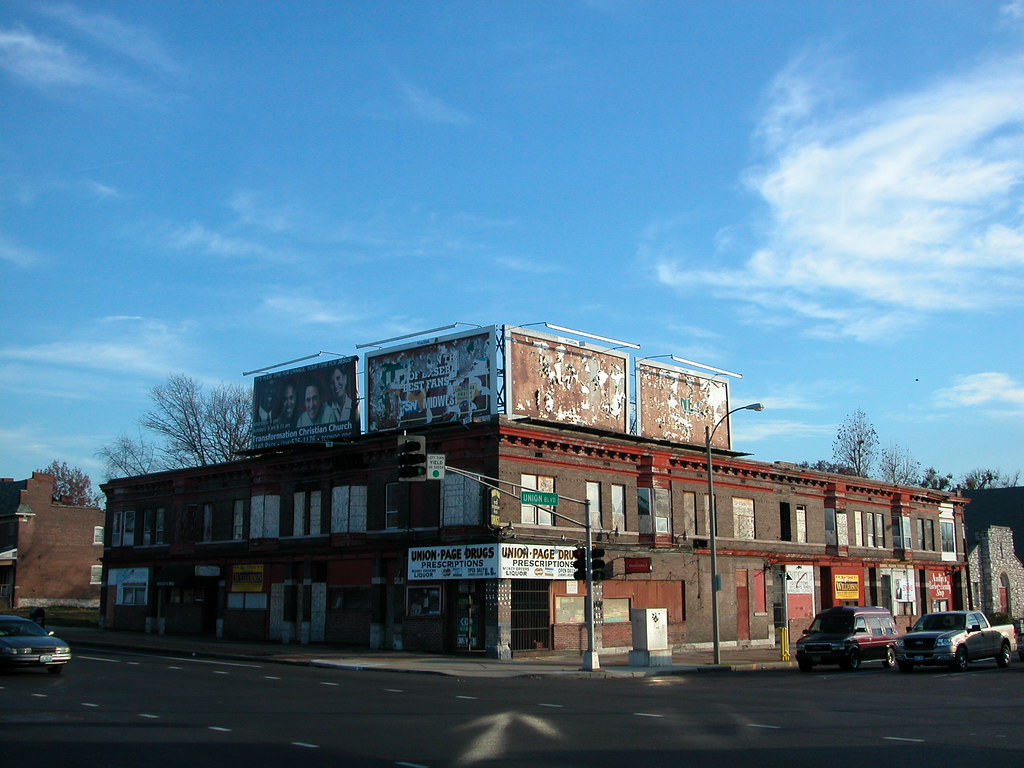
Yet closer examination of the church’s plan and the conduct of the church through the demolition permit process makes their plan seem quite controversial. First, the church applied for a permit in April 2007. After denial, the church attorney sought and obtained two continuances without so much as letting CRO staff know why. Then they finally show up, long after the denial, with a crowd of congregants and an attorney with a thick new brief.

Then there is the fact that the gymnasium and educational center plans dissolve under scrutiny. The church simply does not have solid plans. They have a possible site plan and rendering, prepared by an unregistered intern architect working for St. Louis Design Alliance. They don’t really have a time line or cost estimates. The church plans to build the shell of the building and gradually finish the interior. Even the parking concern seems weak given that they have use of Walgreens’ parking lot across the street in evenings.

Most important, there is the building that the church wants to demolish. The two-story brick commercial building is the last discernibly urban building at one of the most prominent intersections on the north side. The building comes up to the sidewalk, offering definition to the area. Literally, the building anchors the corner. Page and Union abound with glorious buildings, but their intersection has become ugly with Walgreens and a supermarket presenting parking lots to the corner on the west side. That’s a sad fact, but a changeable one. This building offers the first step toward that change.

Architect George H. Kennerly designed the building, which was built in 1905. The elaborate tin cornice and cladding around the projecting bays show Classical Revival and perhaps some Italianate influences. Although marred by peeling paint, the tin is in excellent condition and would restore beautifully. The bay windows create an eloquent rhythm and provide definition to the otherwise boxy form. A small fire has left the building with some damage, including roof collapse, but overall it’s sound. This is the type of building that seems infinitely adaptable to community needs. Every neighborhood needs buildings with combinations of walk-in and walk-up spaces.

Furthermore, the building is within the boundaries of the Mount Cabanne/Raymond Place National Historic District. That fact is noteworthy for two reasons: historic rehab tax credits are available there, and that district has lost many buildings like this one at its southern edge along Delmar.

The Preservation Board did not consider the appeal until nearly 7:30 p.m. Attorney Richard Kenney of Polsinelli Shalton Flanigan Suelthaus began the church’s presentation, which seemed to add other speakers impromptu. Kenney presented a brief written by William Kuehling of his firm. City Counselor objected to Kenney’s evidence, which made many assertions about the inability of the church to reuse the building. Frankly, the church’s use of so many people to testify weakened their case through confusion and exhaustion of nonpartisan witnesses and Board members. Recounting and contesting the church members’ testimony would be tedious and unhelpful to readers of this blog. Eventually, Chairman Richard Callow announced that the Board would take no vote until CRO staff and Board members could carefully examine the church’s evidence. (A special January Preservation Board meting is likely.) However, testimony continued until after 10:00 p.m.

Not one person testified in favor of preservation; myself and others had left for other enagagements. However, the hearing of the matter is still open and citizens should send testimony to the Preservation Board by emailing Board Secretary Adona Buford (BufordA@stlouiscity.com).

Meantime, one hopes that the church is not too intractable to reconsider their options. The church owns vacant lots on Page, owns an incredible building (potentially worth money to a developer) and enjoys support of its neighborhood, nearby businesses and its Alderman, Frank Williamson. The battle mentality is premature; with the church’s connections it could find a way to do what it wants without robbing a neighborhood of an important architectural anchor.

(Photographs by the author.)
Categories
Historic Preservation LRA North St. Louis Preservation Board West End

Preservation Board Spares House on Bartmer

by Michael R. Allen

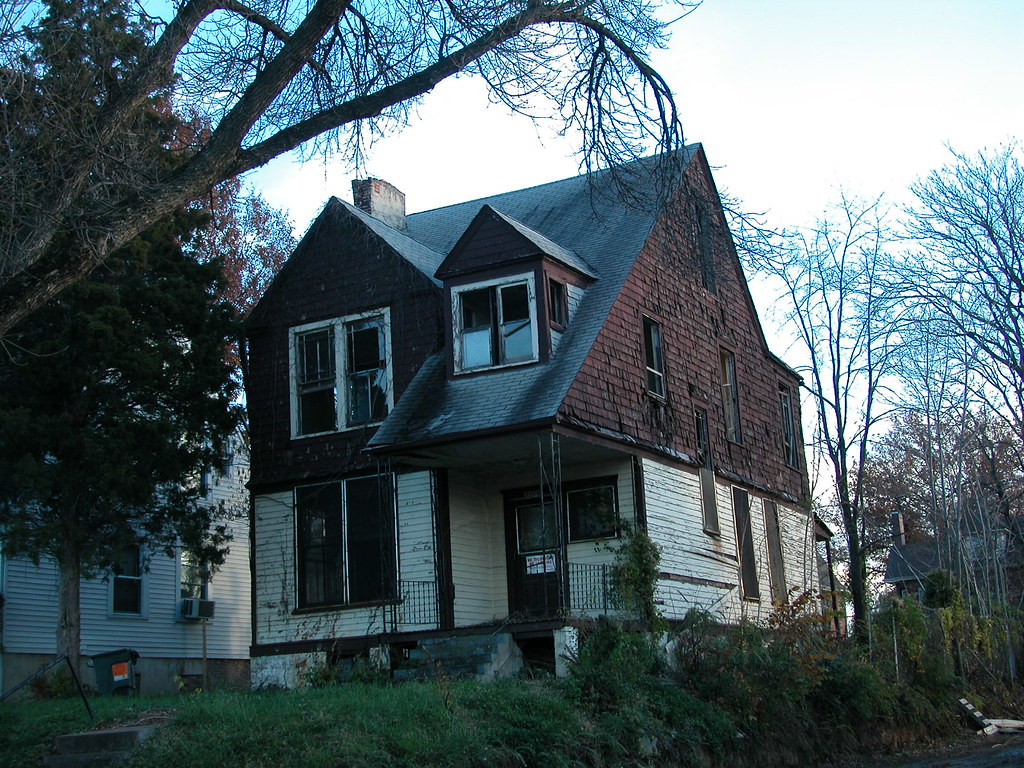
At its monthly meeting on Monday, the St. Louis Preservation Board wisely voted 5-2 against the demolition of a Shingle Style frame house at 5594 Bartmer Avenue in the city’s West End neighborhood. The house was built in 1898 and while not the most exquisite example of the Shingle Style in the city (that may be on nearby Cabanne Place) is one of probably less than two dozen remaining homes in the style. The demolition was proposed as a preliminary review, with no actual permit under consideration. Preliminary review is often used by potential applicants and staff of the Cultural Resources Office (CRO) to gauge Board opinion without beginning formal application process.

In this case, Alderman Frank Williamson (D-26th) brought the matter to CRO two months ago, citing citizen complaints about the condition of the home. The house has been vacant since at least 1998 and is owned by the city’s Land Reutilization Authority. The house is located outside of any national historic district where tax credits would be able to be used in its rehabilitation. However, the 5400 and 5500 blocks of Bartmer show an unusual collection of large historic homes with consistent deep setbacks and early 20th century period styles. Blocks to the west also show consistency. There is no doubt that some historic district on Bartmer is possible.

Two months ago, CRO staff presented the matter to the Preservation Board, which elected to defer consideration for 60 days while staff prepared a thorough report on the building’s condition and reuse potential. Ald. Williamson appeared at the first meeting and said that he wanted to tell the citizens something was going to happen, although demolition was not the only outcome he would accept.

CRO staff prepared a report that covers issues of condition, historic integrity and potential market value. Among other conclusions, the repprt showed that not only is the house “sound” under the definition established by the Preservation Review ordinance, it retains almost all of its original architectural features inside! Staff strongly recommends preservation of the house. Meanwhile, Ald. Williamson decided to support demolition. Two citizens sent letters of opposition, including blogger Douglas Duckworth (read his letter here). On Monday, the Board heard testimony against the demolition from myself and in favor from Myron Jefferson, who is building a new house at 5596 Bartmer to the west. Jefferson stated that he would not have built his house if he had known the house next door was not going to be torn down.

According to CRO Director Kathleen Shea, the LRA has agreed to make the house at 5594 Bartmer a priority for its limited marketing efforts. Apparently LRA will not seek its demolition until it has drawn attention to potential buyers. While the gesture is small, it’s the most that LRA can do — and more than usual. Ald. Williamson might want to coordinate with LRA in finding a creative future for the house.

Board Member Mary Johnson told the Board that the board would impede the “development project” of “developer” Jefferson unfairly if it voted down the demolition. Johnson cited Joe Edwards’ Moonshine Hotel project in the Delmar Loop as an example where the Board allowed demolition of a historic building, the Ronald Jones Funeral Chapel, for a development project. Edwards is demolishing the chapel but reconstructing its front and some of its side elevations as part of the hotel project.

Board Member David Richardson retorted that Jefferson was not the owner of the property next door. Jefferson does not seek to purchase the house at 5594 Bartmer and was not the applicant for demolition. In making the motion to accept staff recommendation, Board Member Anthony Robinson explained that builders can’t control vacant property when building a new house. Robinson said that when he built his residence, his block had five vacant houses and six vacant lots. All of the houses have been rehabbed and all but one of the lots built upon since Robinson finished his house a few years ago.

Voting in support of the CRO staff recommendation authored by Director Kathleen Shea were Melanie Fathman, John Burse, Robinson, Mike Killeen and Richardson. Voting against were Johnson and Ald. Terry Kennedy (D-18th). Chairman Richard Callow abstained from voting.

Categories
Documentation

Citizens’ Service Bureau Records Now Password-Protected on Geo St. Louis

Geo St. Louis no longer displays records of Citizens’ Service Bureau (CSB) complaints for parcels. Now, only users with passwords can access those records. The site instructs people who want a password to contact the Planning and Urban Design Agency via a generic feedback form. I wonder what precipitated the change, and I wonder who can get a password.

Many residents of Old North St. Louis, where I live, use Geo St. Louis to see just how much of a problem a property is. CSB complaints offer neighbors (and potential neighbors!) the chance to monitor the history of problem properties to determine if a recently-observed nuisance is part of a chronic pattern of neglect. Some neighborhoods lack staffed neighborhood organizations, and citizens may need direct access to CSB complaint records. Geo St. Louis has been a leader among American cities’ public geospatial systems in terms of breadth and depth of information available to any site user.

While those records are public and a citizen has always been able to to obtain them with a written request, the sudden departure of open online access seems unnecessary.

Categories
Academy Neighborhood Central West End Demolition Historic Preservation Hyde Park Local Historic District North St. Louis Preservation Board South St. Louis West End

Preview of Monday’s Preservation Board Agenda

by Michael R. Allen

The St. Louis Preservation Board meets Monday at 4:00 p.m. at the offices of the Planning and Urban Design Agency on the twelfth floor of 1015 Locust Street. Meetings typically last three hours.

Here are some highlights from the agenda:

Preliminary Reviews

5594 Bartmer Avenue: The proposed demolition of a beautiful and rare Shingle Style house appeared on the Preservation Board agenda two months ago and was deferred pending study of the reuse potential by the staff of the Cultural Resources Office. Staff has written an excellent report on the building condition and reuse feasibility based on a thorough site visit; read that here. Staff recommends denial of the permit and exploration of a National Historic District for Bartmer Avenue. This house and its neighbors fall outside of any historic districts that would enable the use of historic rehabilitation tax credits.

2300 Newhouse Avenue: The proposed new construction of six frame homes with attached garages in the western edge of Hyde Park manages to add yet another absurd faux historic design to the architecturally mongrelized neighborhood. Here we have brick fronts with shaped parapets imitating 20th century buildings that can be found in Hyde Park, but there is a twist: the parapets are actually gable ends on a front-gabled building! The sides and rear show the pitched roof and reveal the illusion the front barely conceals. Furthermore, the developer includes attached garages and has not submitted a site plan showing setbacks. Staff recommends denial as proposed.

Appeals of Staff Denials

5286 Page Avenue: The appeal of staff denial of a demolition permit for the two-story commercial building at the southeast corner of Page and Union has been on the agenda for months, always being continued at the request of the owners. Another continuance is possible. The building is a contributing resource to the Mount Cabanne/Raymond Place National Historic District and the last remaining commercial building at a prominent intersection degraded by a Walgreens across the street. Staff urges upholding their denial.

4218 Maryland: The unlawful alterations made to this house transformed it in disturbing ways: rebuilt bizarre porch, new cheap door and sidelights that don’t even fit the opening, alteration of brick pattern and color on front elevation and removal of two front bay windows and replacement with flat openings. Yikes! Staff recommends upholding their denial.

Appeal of Preservation Board Denial

2013-15 Park Avenue: The builder of infill housing in Lafayette Square wants to amend earlier plans to face the side elevations with brick and instead face them with vinyl siding. Staff recommends upholding their denial of this request, and wisely so. Here we have strong neighborhood support for a strict local historic district ordinance that expressly prohibits sided primary and secondary elevations. One expects Lafayette Square to be the last local district where vinyl siding should be approved; the neighborhood is both bellwether and inspiration for the power of local district ordinances to shape attractive neighborhoods. (The Lafayette Square standards can also be an example of the the blind spots of such ordinances, but not regarding the use of vinyl siding.)

Categories
Events People

Kick Ass Awards on Monday Will Honor Marti Frumhoff

by Michael R. Allen

The fine folks behind 52nd City have chosen to posthumously honor Marti Frumhoff with one of their annual Kick Ass Awards, to be presented on Monday. I can’t think of a more worthy recipient; in fact, I’m a bit embarrassed that I received the award two years ago ahead of Marti due to work empowered by the encouragement and inspiration provided by Marti and others she had inspired.

The awards are at Duff’s Restaurant, 392 N. Euclid, from 6:30 – 9:00 p.m., Monday, November 26. Details here.

Categories
Chicago Documentation Media People

Past the Margins of Chicago

by Michael R. Allen

Rob Powers (creator of Built St. Louis) has launched A Chicago Sojourn to chronicle the non-iconic corners of his new home. In his first post, Rob writes that “I’ve always gravitated to the forgotten: in St. Louis, in Milwaukee, everywhere I go. And so it shall be here.”

Beautifully-designed Forgotten Chicago features photo essays on those traces of Chicago’s past few celebrate, let alone investigate. Recent topics the Schoenhofen Brewery, pre-1909 street numbering system and Chicago’s largest vacant lot, the site of US Steel’s South Works. Jacob Kaplan and photographer Serhii Chrucky are the editors.

Categories
Abandonment Cleveland Urbanism

Foreclosure, Crime and Neighborhood Disintegration

by Michael R. Allen

According to an article on the CNN website entitled “Crime scene: foreclosure”, Cleveland’s historic Slavic Village neighborhood is in the nation’s top ZIP code for foreclosures. An estimated 800 buildings sit vacant there. The neighborhood has out-of-control crime, correlated to the foreclosure rate. Houses get stripped within 72 hours of being vacated, and aren’ty worth enough money to justify repair. Police are inattentive, and the city can’t afford to do much trash cleanup or demolition. People flee in droves, leaving those who remain in fear. Lenders continue to foreclose, with little concern about the effects.

This situation sounds a lot like conditions in north St. Louis in the 1960s, 1970s and 1980s. The article’s eerie conclusion reads “as the number of empty lots and abandoned houses grows where houses and residents were once packed in a tight community, there are fewer and fewer neighbors to fight the battle.”

(Thanks to Barbara Manzara for the link.)

Categories
North St. Louis Northside Regeneration

LLCs and LCs Linked to McKee Change Agents

by Michael R. Allen

On October 24, several companies linked to developer Paul J. McKee’s north St. Louis real estate project switched registered agents.

Holding companies Babcock Resources LLC, Blairmont Associates LC, Dodier Investors LLC, MLK 3000 LLC, N & G Ventures LC, Noble Development Company LLC, PATH Enterprise Company LLC, Sheridan Place LC and VHS Partners LLC switched from anonymous third-party agency through CT Corporation System to PEM Agency Corporation (whose own registered agent is Glenn Mitchell, Director of Property for McEagle).

Holding company Allston Alliance LC switched agents to PEM Agency Corporation from developer John Steffen.

Three companies used for loans to the holding companies, Salvador Equity Management LLC, Rice Capital Group LLC and Parkburg Fund LC also switched agents from CT Corporation System to PEM Agency Corporation.

Categories
North St. Louis Old North

Old North St. Louis Restoration Group Receives $200,000 Bank of America Award

by Michael R. Allen

Last week, the Bank of America Charitable Foundation awarded the Old North St. Louis Restoration Group (ONSLRG) $200,000 grant at its fourth annual Neighborhood Excellence Initiative awards. The Restoration Group will use the money to renovate its new office and meeting space in the 14th Street Mall Redevelopment Area and to purchase properties that play strategic roles in stabilizing sections of the neighborhood. These are pressing needs for the group as it begins to operate as a high-profile community development corporation that handles a huge workload.

Currently, the ONSLRG staff does an amazing amount of work with only three full-time staffers operating out of modest rented space. The momentum that ONSLRG has created is impressive, but demanding — the harder the organization works, the more people inside and outside of the neighborhood want assistance with development, nuisance properties and community matters. This award gives ONSLRG capacity to keep up with accelerating interest in Old North.

Some Online Research Sources

by Michael R. Allen

The Charles W. Cushman Photograph Collection features cool color photos of St. Louis from 1949 & 1966, including shots of the Merchant’s Exchange, Garrick Theater, Woodbine Hotel and Plaza Square Apartments showing the original panel colors. Find these images by searching for Saint Louis. (Via Urban St. Louis.)

The University of Missouri has digitized their Sanborn fire insurance map collection for the entire state. For those unfamiliar with Sanborn maps, the maps were made to assess fire risk and include detailed maps of cities that include parcel lines, building footprints, locations of stairs and elevators within buildings, building materials used in construction and other facts. These maps are essential reference to architectural historians surveying large districts. Insurance and real estate companies typically owned sets and added paste-in updates mailed out by Sanborn. The St. Louis volumes in the university’s collection were not updated past 1908, a fairly early date. Look at the collection here. (Via Lindsey Derrington.)

Lastly, the 1876 volume by J. A. Dacus and James Buel entitled A Tour of St. Louis has been published by Google in its entirety. (Via Andrew Weil.)