From Louis Sullivan to Philip Johnson: A Look at St. Louis Commercial Architecture
Saturday, May 21 from 9:00 a.m. until 12:00 p.m.
The Friends of American Art and Design of the St. Louis Art Museum invite you to join us for our next program on Saturday, May 21 as we head downtown to explore some of St. Louis’ historic architecture. In 1888, the tallest building in St. Louis wasn’t a skyscraper — it was a sugar refinery. As industry demanded ever taller and larger buildings, technology evolved to accommodate it. Join us as we travel the landscape of downtown St. Louis, tracing the architect’s quest for height and mass throughout the 20th century. We’ll look at warehouses, power plants, industrial sites, and skyscrapers from Louis Sullivan to Philip Johnson.
Our bus will depart at 9:00am from the Museum and return by 12:00pm. We will be guided by local architectural historians Michael R. Allen and Lynn Josse. We will tour (both by bus and on-foot) some of the city’s notable landmarks. Beverages and a snack will be served. Thank you for your dedication to the arts and patronage to the Museum. Should you have any questions feel free to contact us at 314.655.5390 or members@slam.org. The tour fee is $25.
Brick theft destroyed this building on the 1900 block of Wright Street. Photograph from February 25, 2008.
The city’s brick theft crisis may be ended if the Board of Aldermen passes a proposed ordinance intact. Last Friday Alderman Freeman Bosley, Sr. (D-3rd) introduced a long-awaited new ordinance to tighten regulation of brick dealers. The bill, BB 57 (link to full text), makes the following changes to existing city law:
Limits brick yard operation to between 5:00 a.m. Monday and 6:00 p.m. Friday. A lot of brick theft and fencing takes place on weekends. This change would not stop theft and fencing from happening on weekends, of course, but it would allow the city to shut down any yard open on the weekend.
Cameras required during business hours to record every transaction. This makes sense. The fly-by-night yards will have a hard time meeting this requirement since they use open air spaces lacking electricity and shelters.
Dealers must photograph every seller’s vehicle and all of the bricks purchased, and also get a copy of a valid demolition permit. These are again very smart changes. The photography requirements are clear and will mandate records of vehicles. This will help combat the practice of crews using the same vehicle with different drivers. The requirement to obtain a copy of a valid demolition permit really is the law that we’ve needed for years. That is plain, simple and enforceable.
The Director of Public Safety shall have power to revoke any brick dealer permit. This is another big and fundamental policy change. There is a notification and hearing process, so it is fair but tough. The Director of Public Safety won’t need to go after more than a few dealers, but in those cases will have a swift and direct way to take them out of business.
Each stolen brick shall be considered a separate instance of theft. Currently, the maximum misdemeanor penalty under city law is $500, and voters rejected the last proposed increase. However, $500 per brick will add up quickly — as will the alternative possibilities of 90 days sentence or community service per brick.
Alderman Bosley’s bill goes straight to the center of the brick theft economy by shifting the penalty burden to dealers. Dealers are convergence points in the network, and it is nearly impossible to catch all of the thieves. Taking out dealers who buy stolen goods may disrupt the network. Of course, there is a possibility that less-regulated brick dealers in St. Louis County or the Metro East will step in and fill any void for fencing stolen brick that this bill would create. Ideally, the Board of Aldermen will pass Alderman Bosley’s bill and soon after adjacent municipalities and counties with brick dealers will pass similar laws. However, stolen brick usually does not travel far, so the proposed ordinance will do a lot of good in itself.
Twelfth Annual Big BIG Tour on Sunday, May 15, 2011
St Louis’ only free city-wide tour of for-sale residential properties will kick off its 2011 Big BIG Tour on Sunday, May 15, 2011 from 11am to 3pm with the City Living Expo.
The City Living Expo and Big BIG Tour starting point is St. Louis Language Immersion Schools, located at 4011 Papin St., St. Louis, MO 63110 just south of the eastbound Hwy 40 / I-64 off ramp onto Vandeventer Ave. St. Louis Language Immersion Schools is a great central location in The Grove District / Forest Park Southeast Neighborhood, allowing attendees to easily explore the Big BIG Tour properties listed throughout the City.
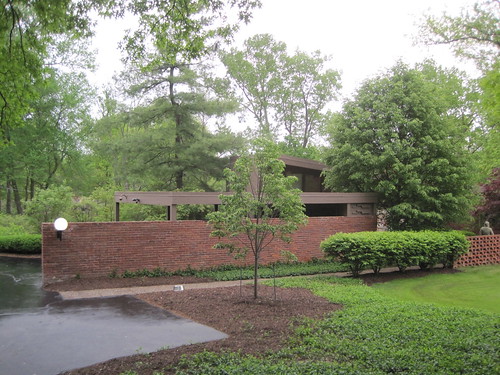
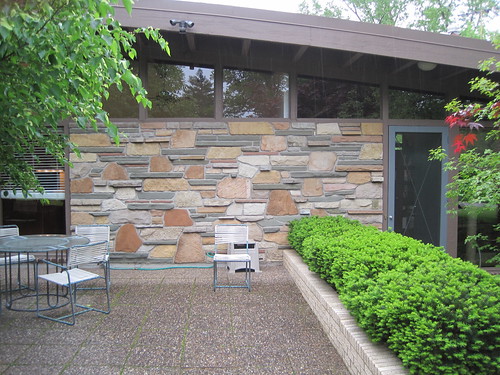
Two weeks ago, the Sheldon Art Galleries kicked off the St. Louis end of National Preservation Month with a tour of four houses designed by Isadore Shank. Shank (1902-1992) was one of St. Louis’ most masterful designers of Modern buildings, and his career produced many significant residences, apartment buildings, office buildings and even a city hall. Shank and his colleague Jim Auer also laid out the Graybridge subdivision in Ladue.
Siegel House (1956), 5 Sherwyn Lane in Ladue.
Shank’s residential legacy was well represented by the Sheldon’s selection of Isadore Shank’s own house (1940), the Siegel House (1956), the Limberg House (1960) and the Kraus House (1977). The range of dates shows the evolution of Shank’s engagement of masonry (including recycled brick), wood elements, natural light, the open plan and site placement. Although interior photograph was not allowed, the exteriors demonstrate well Shank’s search for harmony between built and natural environment as well as interior and exterior worlds. (Ted Wight has posted interior photographs of the Shank House here.)Â Here we present two of the houses on tour built just four years apart, the Siegel and Limberg houses.
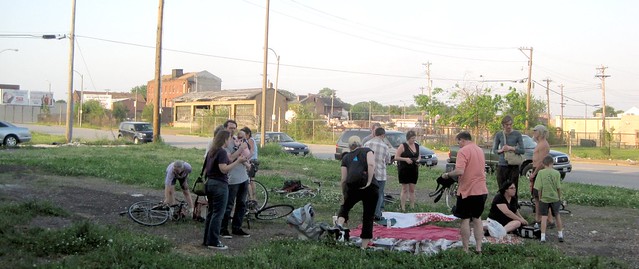
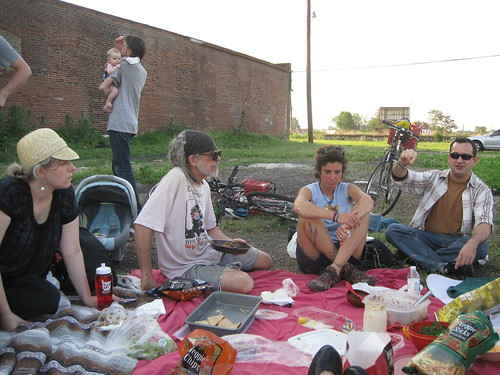
This Monday, the Chautauqua Art Lab started its second day with a Public Reclamation Picnic organized by Kara Clark Holland, who has a series of these events. The idea is simple and amazing: transforming an underutilized space into part of the public realm through joyful activity.
Monday’s location was the vacant lot at the northwest corner of North 14th Street and Cass Avenues in St. Louis Place. The parcel is owned by the Land Reutilization Authority and adjacent to a building owned by Northside Regeneration LLC.
Perhaps LRA should consider picnic fees as a revenue stream, as with its garden lease program. In some neighborhoods, vacant lots are closer than parks and offer large grassy areas for spreading out. With permanent uses likely years out, these lots can be utilized by the community today through picnics, gardening, sports and other short-term uses.
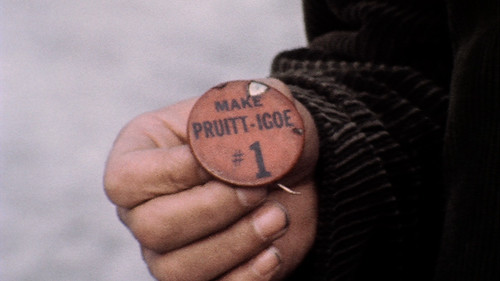
Make Pruitt-Igoe #1. The button’s message had an obvious irony by the time that a reporter held it to a camera in 1968. Yet as the new documentary The Pruitt-Igoe Myth makes clear, the fate of Pruitt-Igoe was intertwined with the fate of St. Louis. Few would have scorned a “Make St. Louis #1” button although its message in the 1960s would have been as naive as the wish for the 33 towers of Pruitt-Igoe.
The Pruitt-Igoe Myth plots the rise and fall of Pruitt-Igoe against a larger context of change in St. Louis. The film is particularly poignant in making clear that for the entire life span of Pruitt-Igoe, St. Louis was shrinking rapidly. Built at a higher population density than the DeSoto-Carr neighborhood they replaced, Pruitt-Igoe’s towers were built on the notion that the city would being growing, and that it would come to grips with the poverty of its residents.
Instead, St. Louis drained thousands of people and spent the 1950s and 1960s imposing a harsh and destructive spatial segregation on the region. If Pruitt-Igoe had a chance to be #1, it was a long shot. Besides, St. Louis itself didn’t fare much better.
This week The Pruitt-Igoe Myth screens at 7:00 p.m. Wednesday, May 11 and at noon on Saturday, May 14 at the Tivoli Theater. Tickets are $10. The directors and former Pruitt-Igoe resident Sylvester Brown, Jr. will take questions after each screening.
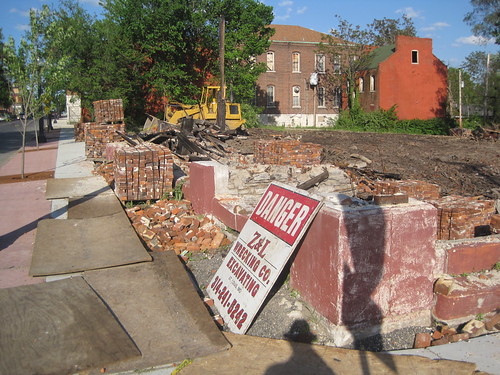
The former front of the Nord St. Louis Turnverein along Salisbury Avenue.
Architectural historians often stop their work when a building reaches its sure death. Without a chance at preservation, an already-decrepit building is just a historic shell. Articles written, consulting fees paid, photos taken — what is left to do? Plenty. As a building is lost through neglect and later demolition, its body is battered until a flood of historic memory is released. Perhaps a vacant building means even more to a community during its demolition. The cleared site serves as an empty signifier — signifying many things to many people. One of those things may actually get built.
So the Nord St. Louis Turnverein’s rapid demolition last week under the capable hands of Z & L Wrecking was an instructive moment in local architectural history. The rapidity of demolition, the cleaning of brick and the removal of all complete traces of building in one week is an accomplishment unmatched in execution and intensity by the work of any architect or builder.
Looking across site toward 20th Street.
In just one week, Z & L Wrecking removed a building that had occupied the site starting in 1870. The northern half of the site had not been unbuilt for 141 years. The southern half across the alley had been the site of a building for 113 years. The rapid liquidation of so much material and civic memory was a quiet symphony of demolition, or perhaps an unrecorded dirge.
1922-24 Cherokee Street
Saturday May 14, 9 am – 4 pm ($5 admission from 9 – 10)
Sunday May 15, noon – 4: bag sale!
The collection has grown so large that it will be filling not one but two storefronts on Cherokee Street’s Antique Row. Donations can be made at the Chatillon-DeMenil House Wednesday through Saturdaybetween the hours of 10 am – 2 pm. The Chatillon-DeMenil House has operated as a museum for more than 40 years, interpreting the lives of the Chatillon and DeMenil families, their extraordinary home, and their impact on local history and national developments. For more information visit www.demenil.org or call (314) 771-5828. The House is located at 3352 DeMenil Place at Chwerokee Street, just off Interstate 55.
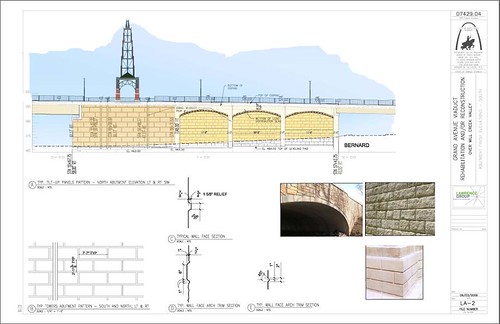
Rendering of new Grand Avenue viaduct from the Board of Public Service.
The new Grand Avenue viaduct over the Mill Creek Valley will be a decent and well-built piece of infrastructure. Replacing a streamlined structure from 1959, the new viaduct skips over its mid-century predecessor to appropriate elements of the original Grand Avenue viaduct. Or does it?