Categories
Housing Mid-Century Modern North St. Louis Pruitt Igoe

Standing By Yamasaki

by Michael R. Allen

On April 24, after a tornado struck Lambert Airport, the New York Times published the article “Struggling St. Louis Airport Takes a Shot to the Chin, but Recovers.” While many St. Louisans quibbled over the symbolic image of the city encapsulated in the adjective “struggling” (applied to only the airport), I found a less immediate semiotic matter of interest. Namely, the article was accompanied by a striking color photograph of Lambert Airport’s iconic main terminal (1956) in the background behind architect Gyo Obata, who directed the project for the firm Hellmuth, Yamasaki & Leinweber. Obata is the last living link to the firm and its renowned principal Minoru Yamasaki, and his presence in the photograph of a boarded-up, weather-beaten terminal conveys strong pride in its design and concern for its future.

In Camera Lucida Roland Barthes writes about the punctum, that part of a photograph’s meaning “that pierces the viewer.” The punctum is subjective, and may diverge from any obvious or intended symbolism in an image. In that New York Times photograph, showing the architect’s watch over a damaged part of Yamasaki’s modernist legacy, I quickly noticed my punctum, a place not represented directly in the photograph but so immediately present in my mind: Pruitt-Igoe.
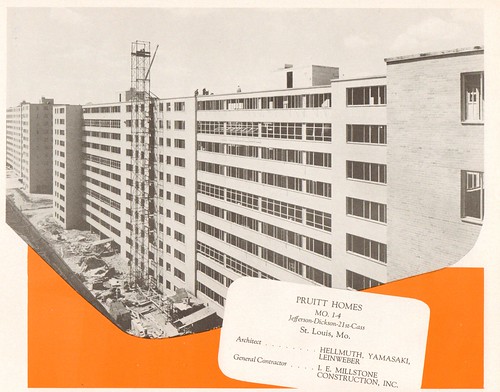
Image of the Pruitt Homes under construction from the 1955 catalog of the Stephen Gorman Bricklaying Company, which was the masonry contractor for the project. Courtesy of the St. Louis Building Arts Foundation.
Categories
Events

Ladue Estates House Tour Next Saturday

The National Trust for Historic Preservation has declared that May is Historic Preservation Month, and this year’s theme is “Celebrating America’s Treasures.” St. Louis is ready to celebrate, and here is one of this month’s first events!

Modern STL is proud to team with the Trustees of Ladue Estates to bring you the first ever Open House and Walking Tour of the first-ever Missouri mid-century modern neighborhood on the National Register of Historic Places! Four houses will be open for your enjoyment. At 11am, noon and 1 pm, take a guided tour of the homes on West Ladue Estates Drive presented by residents Lea Ann Baker (the heroine who spent 3 years completing the National Register application) and architect David Connally.

Saturday, May 7, 2011
10 am – 2 pm
Ladue Estates, Creve Coeur MO 63141
$10 admission – $5 for Modern StL members

Details and directions here.

Categories
Demolition Hyde Park North St. Louis

Nord St. Louis Turnverein Almost Gone

Here’s the view looking southwest from 20th and Salisbury today. The north and south gymnasiums of the Nord St. Louis Turnverein are down to the foundation walls, with only the center section that bridges the alley still standing tall.

Categories
Hyde Park North St. Louis

Ike and Tina at the Turnverein

After demolition of the Nord St. Louis Turnverein started this week, our intern Christian Frommelt was re-watching a clip of well-known Club Imperial dancer Teddy Cole and noticed that he gives a little advertisement for an event at the Turnverein (then called auf Englisch North St. Louis Turner Hall) with Ike and Tina Turner. He says it around 2:45.

Categories
Demolition Hyde Park North St. Louis

Demolition Finally Comes to the Nord St. Louis Turnverein

by Michael R. Allen

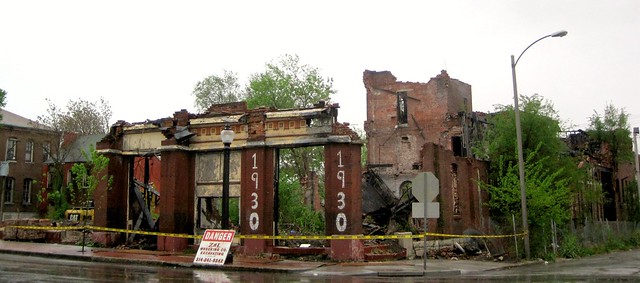
Looking southeast from 20th and Salisbury.

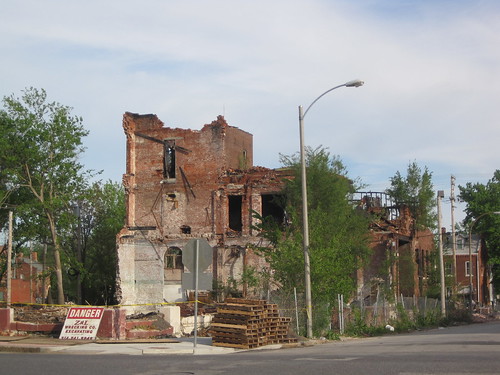
Yesterday a crew from Z & L Wrecking started taking down the ruinous northern portion of the Nord St. Louis Turnverein. This was deja vu to those who recalled the day when Z & L arrived to take down the buildings after the devastating fire on July 6, 2006 that destroyed the northern section. This time, the failing structural state led to the Building Division’s issuance of an emergency demolition permit on March 29, 2011.

The same view nearly five years ago in February 2006.

Developer Peter George stopped demolition and valiantly tried to find financing to rebuild the Hyde Park landmark. With the southern gymnasium addition of 1898 largely intact, rebuilding seemed like a reasonable path. Five years later, an imbalance of time and money has led to a more conservative approach.  George came along late in the life of the building, purchasing it after the fire.

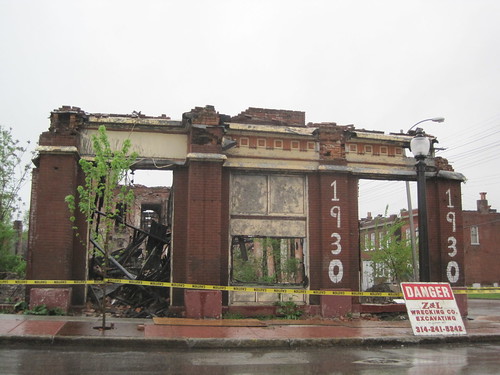
The remaining section of the front elevation.

The fateful decisions came earlier when the remaining Turners rejected the membership applications of a contingent of new members (including many leaders of Metropolis) in 1999, and when the group sold the buildings to a future felon named Doug Hartmann in 2004. Even before the fire on July 5, 2006, heavy winds had destroyed the roof of the older north building on April 2, 2006. The loss of a building can take time, and the loss of a community anchor can tragically drag out for years.

Categories
East St. Louis, Illinois

New Book Commemorates East St. Louis’ 150th Anniversary

How is it that a city that has been labeled “the most distressed small in city in America” has also been home to some of the most amazing artists and talents in American life? And despite devastating population and job losses, how is it that East St. Louis has manifested such community resiliency and resolve? The Making of an All-America City: East St. Louis at 150 examines these paradoxes as it chronicles the rich history of this so-called failed industrial suburb. A collection of fifteen essays and one prose poem, The Making of an All-America City explores East St. Louis’ life as a river city, its complex experience with race, its challenges of deindustrialization, and the political choices that it has made from a wide range of perspectives.
Edited by prominent regional historian Mark Abbott, Harris-Stowe State University, The Making of an All-America City is a must-read for anyone who is interested in this fascinating city and what it says about America. This book is the first in the East St. Louis Sesquicentennial Series from Southern Illinois University Edwardsville, which aims to examine the city’s influence, document and preserve its history, and provide meaningful reference for historians to come. The book is available for purchase through Virginia Publishing at www.stl-books.com and soon should be available in area book stores.

The book includes a chapter by Preservation Research Office Director Michael R. Allen entitled “The Second Skyline: Downtown East St. Louis’ Unique Architecture.” Last week, Allen joined fellow authors Debra Moore, Billie Turner and Andrew Theising on St. Louis Public Radio’s “St. Louis on The Air” with host Don Marsh. The authors discussed their chapters and the future of St. Louis’ urban neighbor to the east. You can listen to that program here.

Categories
Industrial Buildings North St. Louis Preservation Board Riverfront

Preservation Board Considering Procter & Gamble Demolition Monday

by Michael R. Allen

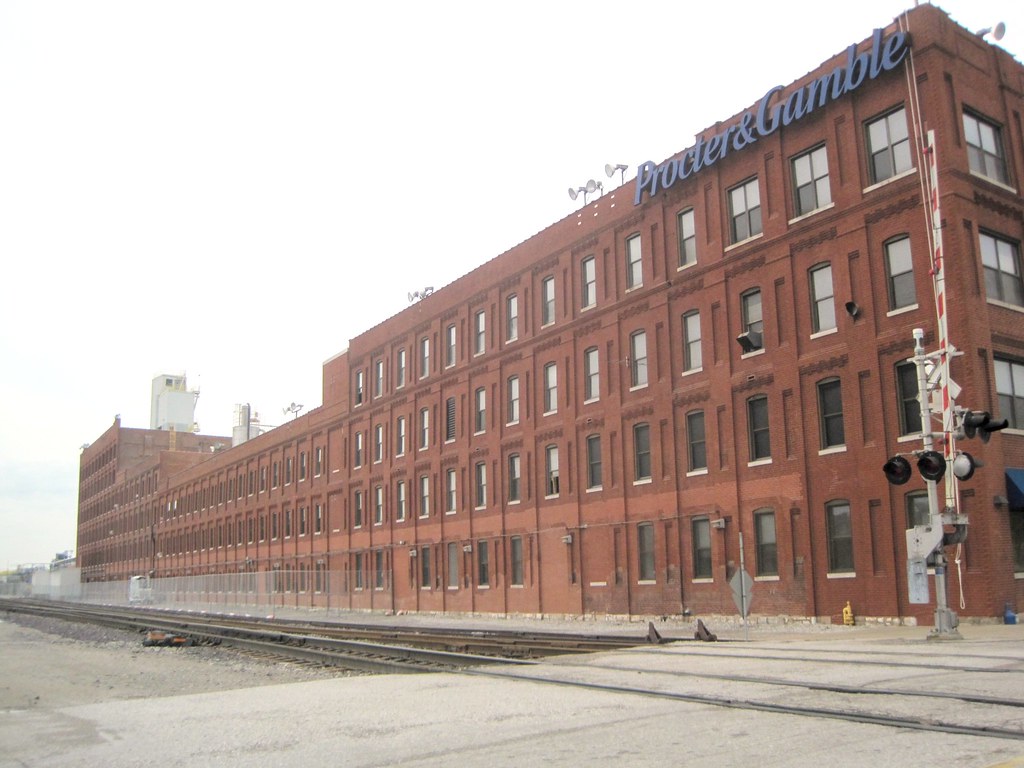
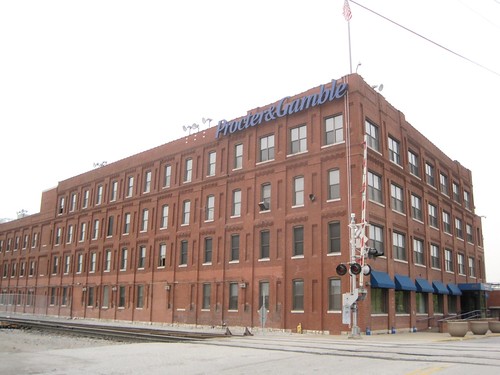
The west elevation of the massive Procter & Gamble plant.

On Monday, the Preservation Board will consider an application by Procter & Gamble to demolish 16 buildings at its landmark north riverfront plant (official address, 169 East Grand Avenue). There are no immediate plans for reuse of the cleared land, but Procter & Gamble claims that it needs a “shovel ready” site for expansion. (“Shovel ready” gets thrown about a lot, but not often is the phrase applied to creating vacant land.) Cultural Resources Office Director Betsy Bradley is recommending approval of the application; read more in the meeting agenda.

This section would be left standing.

The demolition plan does not affect the southernmost building in the long, multi-height row of buildings that give the plant its recognizable form on the city skyline. This portion, which meets Grand Avenue at the sidewalk, is in use as offices and will stay in use. The rest of the buildings are already being gutted, with many windows removed. Even earlier today demolition workers were loading scrap metal dumpsters. According to Bradley’s report, the plant was built between 1903 and 1924 as the William Waltke & Company Soap Factory.

UPDATE: The Preservation Board approved all of the demolition application by a vote of 3-2. Members David Visintainer and Anthony Robinson voted “aye,” and members Mike Killeen and Melanie Fathman voted “nay.” Chairman Richard Callow cast a tie-breaking “aye” vote.

Categories
North St. Louis O'Fallon

Ash Pit, Adelaide Avenue

by Michael R. Allen

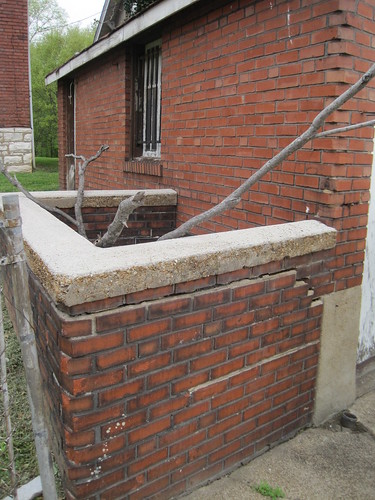
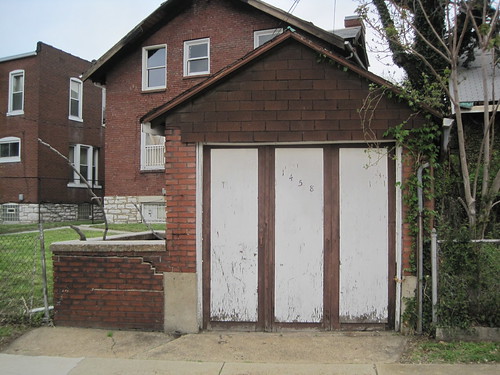
Amid our ongoing architectural survey of the city’s O’Fallon neighborhood, we came across an amazing ash pit adjacent to the garage behind the house at 1458 Adelaide Avenue. Due to the convergence of Adelaide and Warne avenues, the garage actually faces Warne across the street from the Mt. Grace Convent, better known as the home of the “Pink Sisters”.

Ash pits were a common part of the residential landscapes of the 19th and early 20th century city. These boxes, sometimes open on the alley-facing or rear side, contained the ash created by residents’ burning their trash and cleaning their fireplaces of coal ash. Smoke regulations passed in 1940 by the Board of Aldermen essentially ended residential trash burning and the use of cheap, soft coal for household fuel. Thus, the ash pit was no longer used and many have disappeared from the city’s alleys. Some, like the one here, remain. This one is particularly well-built in red brick matching the garage as well as concrete coping.  (A side note: Check out the neat corner bond on the garage itself; the rear wall follows the diagonal street, so the garage does not have square corners at Warne.)

Categories
Brick Theft JeffVanderLou North St. Louis

Depletion, Bacon Street

by Michael R. Allen

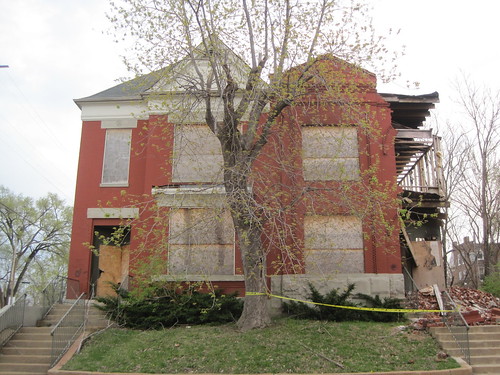
Two pairs of houses had stood on the east side of Bacon Street just south of North Market Street since before the turn of the last century. Now, three of the four are reduced to ruins by brick thieves in St. Louis’ ongoing brick theft crisis, removing more of the JeffVanderLou neighborhood’s unique architectural character and housing units that were occupied until just three years ago. Some count three buildings lost, and shrug, while others count these among over 100 lost to brick theft across north St. Louis in the last decade, and wonder when it will end.

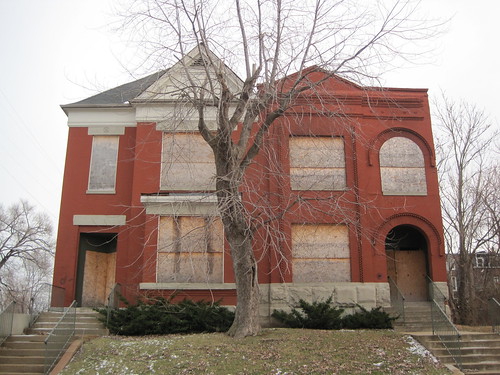
1920 and 1924 Bacon Street

These unusual houses were both built in 1897 by the same builder.  Unusual for the surrounding area of JeffvanderLou, the houses share a party wall.  However their front elevations show differences in execution of essentially two identical (but flipped) same floorplans.  The northern house, at 1924 Bacon Street, uses flat limestone lintels and a triangular pediment that put it in the Greek Revival.  The other house employs rounded arches with ornamental label courses as well as a cornice of ornamental brick,traits that put it in the Romanesque Revival that was very popular in St. Louis during the 1890s.

The houses at 1920 and 1924 Bacon Street in December 2009.
There is significant damage to 1920 Bacon Street in April 2011.
Categories
Events

Talk: “The Pleasure of the Landscape”

The Pleasure of the Landscape: Placemaking and Identity in the St. Louis Place Neighborhood
Thursday, April 28, 2011, 2-3 p.m.
Lewis Room, Library Basement
Fontbonne University

Michael R. Allen offers a critical examination of efforts to reframe the identity of the St. Louis Place neighborhood on the city’s near north side. St. Louis Place lost over 50% of its built environment between 1960 and 2010, but it retains sections of nearly untouched historic quality. The polarities of the landscape are frightening to some, sublime to others and reality to all. The current challenge is how to preserve and interpret what remains with joy and hope.