Categories
Lewis Place North St. Louis Severe Weather

Two Weeks Later, Lewis Place Still Suffering from Storm Damage

by Michael R. Allen

Today we are two weeks away from the day when a severe squall line moved through St. Louis, but for some people that is not a lot of time. On the north side, several neighborhoods are still dealing with widespread property damage and the looming uncertainty of whether homes will remain homes. Some owners lack insurance, while others may have policies with deductibles above the costs of repairing damage. Those costs may still be prohibitive for elderly and poor residents.

Yesterday this blog showed scenes from the Ville (see “Ville Area Still Recovering from New Year’s Eve Storm”). Today let us turn our attention to the Lewis Place neighborhood to the southwest of the Ville, where damage to the historic buildings there is even more widespread. Lewis Place has made it through the ravages of demolition, abandonment and disinvestment and has been on the upswing in recent years. Disaster was the last thing Lewis Place needed.

On Sunday, Lewis Place Historical Preservation, Inc. President Pam Talley showed myself and Lynn Josse the damage that compels our assistance — and yours. What we saw demands St. Louis’ full attention.
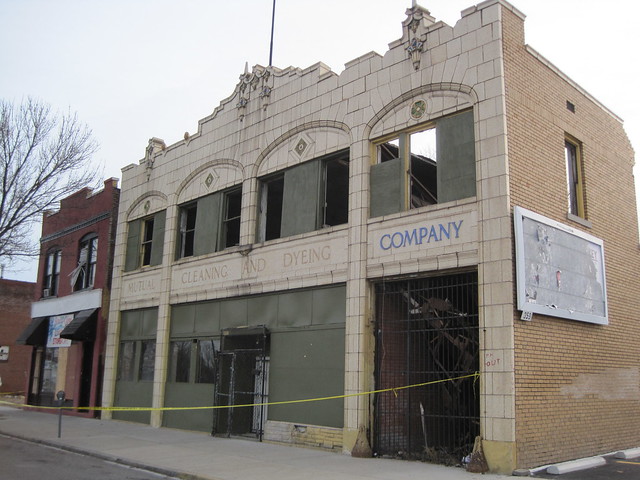
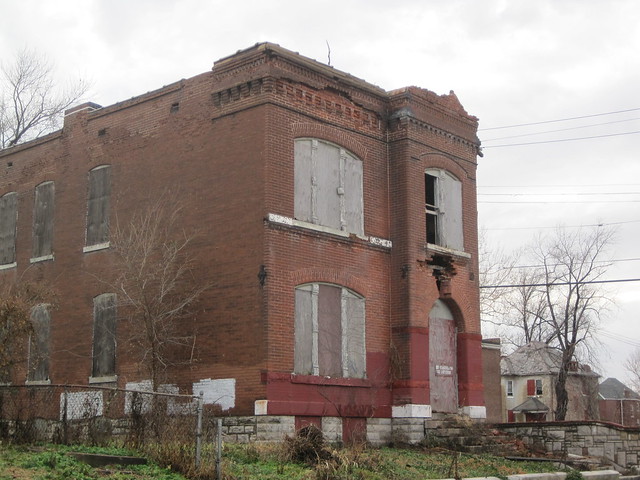
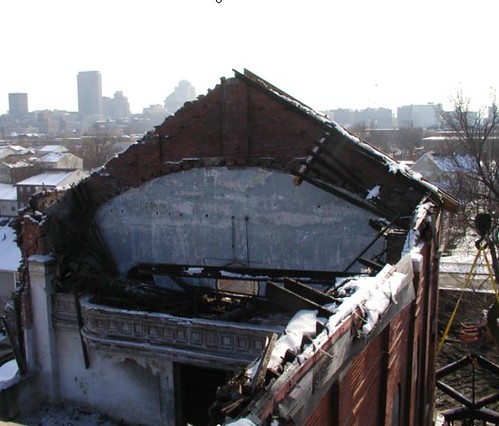
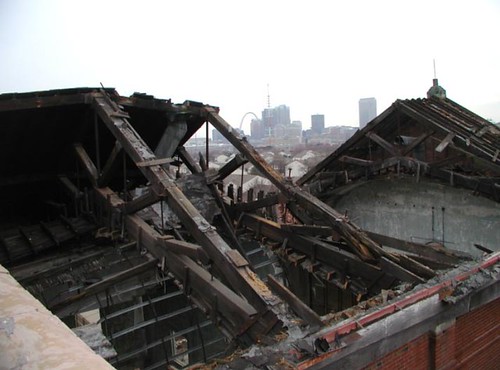
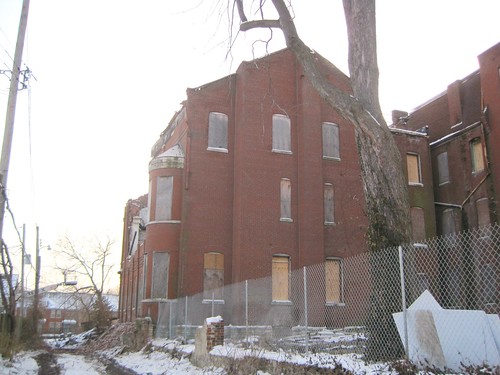
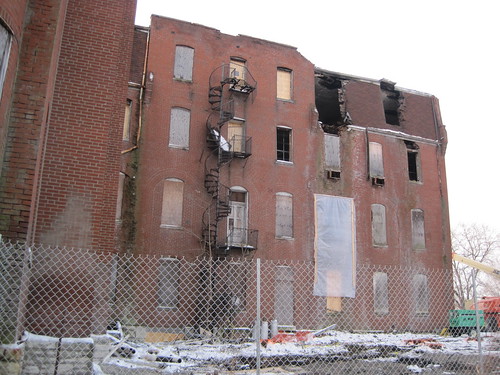
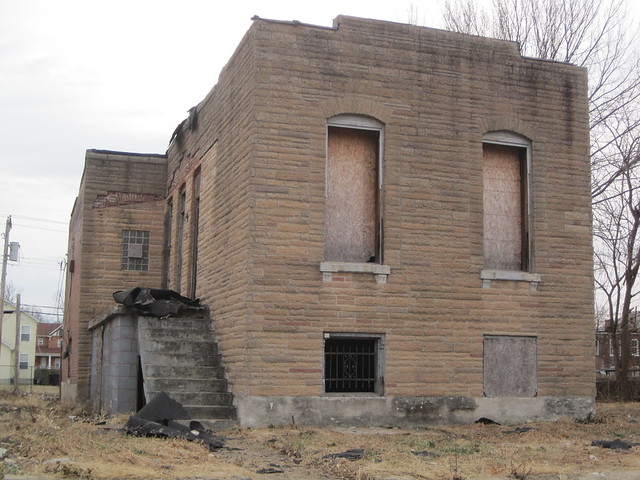
The storm pummeled the rear of the ornate former dry cleaning plant at 4536-38 Dr. Martin Luther King Drive.

Just one block south of the apartment building at Deer and Aldine avenues that suffered a collapse is an ornate two-story, terra-cotta clad building on Dr. Martin Luther King Drive. The former dry cleaning plant, with its baroque facade, is little more than a front wall after New Year’s Eve.  The one story rear wing collapsed completely and much of the two-story front section fell in on itself.  Demolition of the privately-owned vacant building is next, no doubt, but the front elevation ought to be salvaged.
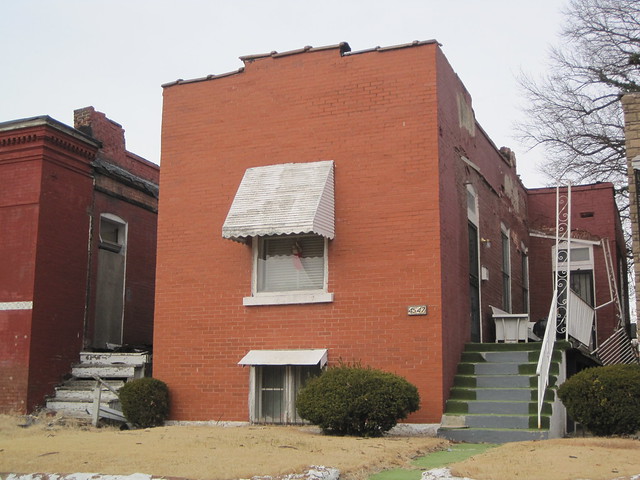
The metal porch at right was destroyed on this house in the 4500 block of Evans Avenue.
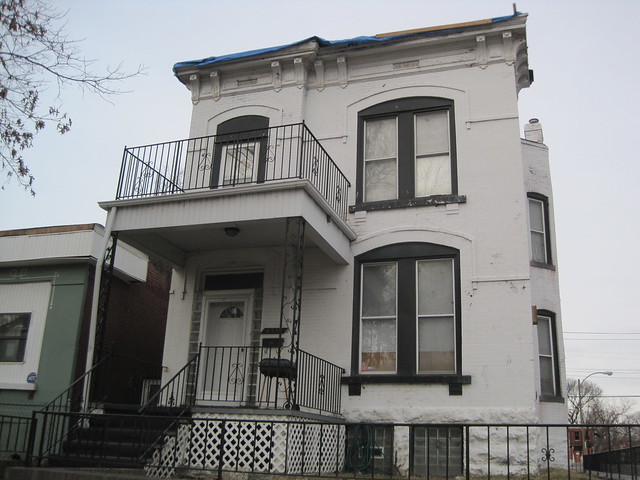
A blue tarp is keeping water out of the house at Evans and Deer avenues, which lost parts of its rolled asphalt roof.

One block south, damage is intense in the 4500 and 4600 blocks of Evans Avenue. Few houses escaped broken windows, many lost or small large parts of their roof and some even lost their wooden or metal porches.
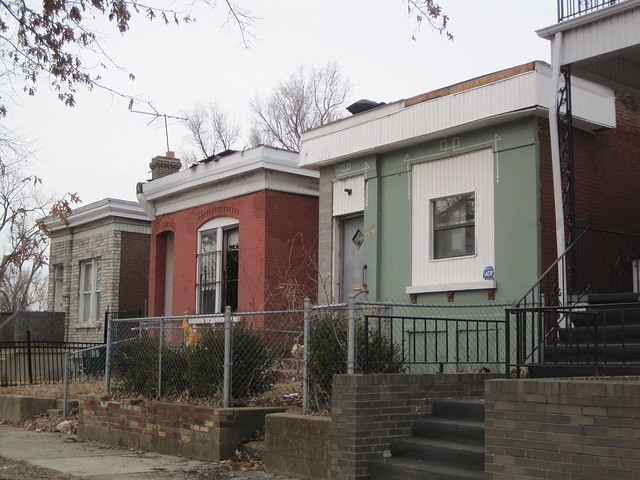
These three houses on Evans Avenue have missing roofing and broken windows.
This house on Evans Avenue is being rehabilitated. The roof was blown off and new windows destroyed in the storm.

Lewis Place storm damage was not limited to historic buildings. New houses on Page Boulevard lost siding and shingles and suffered broken windows. However, like most neighborhoods in north city, Lewis Place’s housing stock is mostly composed of historic buildings. That means most damage affects older homes that are more difficult to insure adequately and that already have maintenance problems that often drive up repair costs.
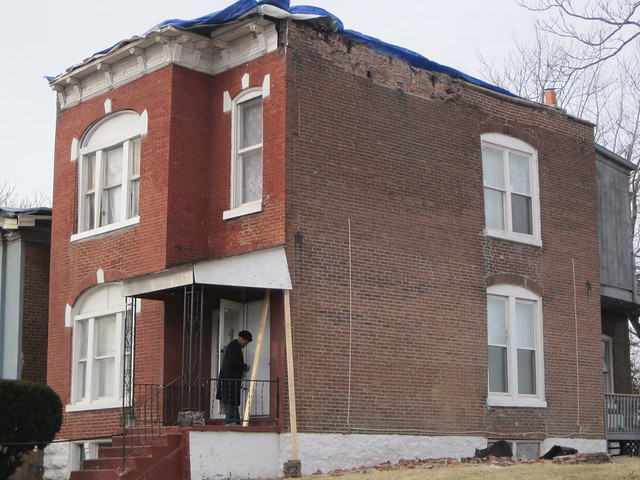
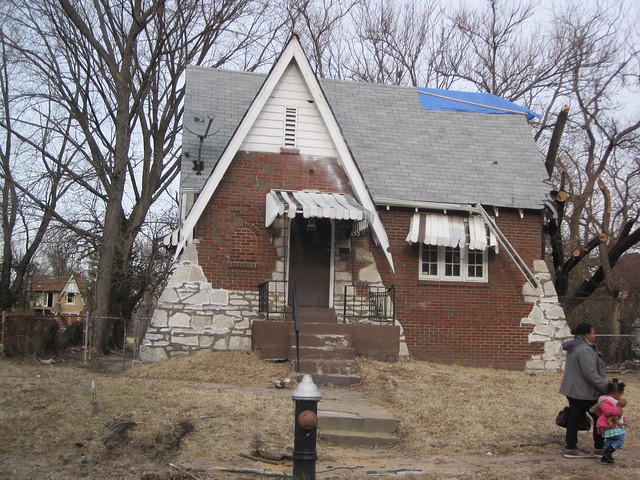
This house in the 4500 block of Enright Avenue was hit hard by the storm on December 31. Last weekend the owner was working diligently to make repairs ahead of the snow that fell Monday.

We saw damage on streets throughout Lewis Place, including Vernon Avenue, Newberry Terrace, McMillan Avenue, Kensington Place and Enright Avenue. Pam reported that the city’s Forestry Division — usually not a timely factor in Lewis Place events — swept in quickly after the storm and worked throughout New Year’s weekend to clean up the large amount of tree debris generated by the storm. Still, such debris was piled everywhere. Most of all, at every turn we saw boarded windows, asphalt roofing material on the grounds, brick bats from chimneys and parapets, sagging porches, maimed fences and signs that something terrible had happened. Simply, we were tracking the path of a disaster.
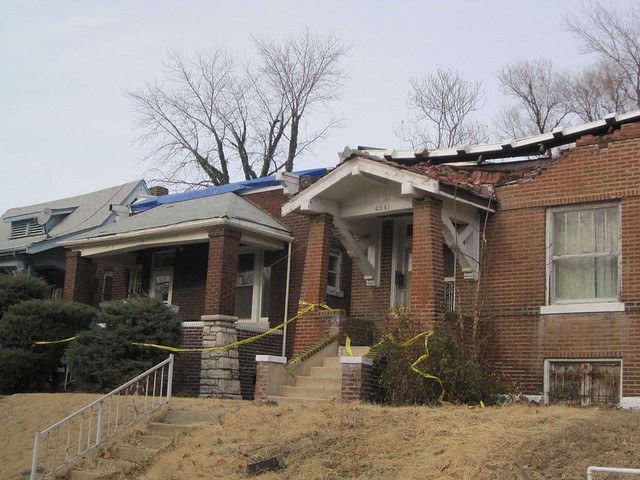
These houses in the 4500 block of Lewis Place was hit hard by the storm on December 31.

When Pam took us to Lewis Place itself, our hearts sunk. The houses that were so essential to the civil rights struggle that made what we now call St. Louis possible stood with yellow caution tape in front. Some had collapsed front parapet walls. Others had boarded up windows, missing roofing and — in one particularly unnerving instance — a frozen waterfall under a window on a vacant house. Even #10 Lewis Place was ailing with its front porch collapsed. Dr. Robert and Fredda Witherspoon, who in the 1940s organized fair-skinned African-Americans to purchase homes on Lewis Place to break down restrictive covenants, called this house home for decades.

The front porch is damaged at #10 Lewis Place.

Pam told us that the Building Division rushed in after the storm, and had condemned houses the day of the storm. This is standard operating procedure following a disaster, because unsafe buildings must be vacated, but it still seemed insensitive to residents. Lewis Place Historical Preservation raised the money to hire a structural engineer for one resident who is being threatened with condemnation and eviction. Others face potential fines for code violations due to storm damage. This is a sad state for a street that has been a National Register of Historic Places historic district since 1980 and whose residents care deeply about both their neighborhood’s past and future.

At least six house son the north side of the 4500 block of Lewis Place have extensive damage, including masonry failure.

While the Building and Forestry divisions of the city treated the storm in Lewis Place like a disaster, other entities have not been so swift. While state officials and mayoral chief of staff Jeff Rainford visited the day after the storm, government assistance has not arrived yet. Pam says that the Salvation Army took eight days to send volunteers. Still Pam has not let the lack of response down — she has secured tarps, blankets and other items for needy residents. By the snow fall on Monday, only three houses with roof damage lacked tarp protection. Pam and her neighbors are used to doing things for themselves, and really are quite good at it. Still, they can’t do it alone — nor should they.
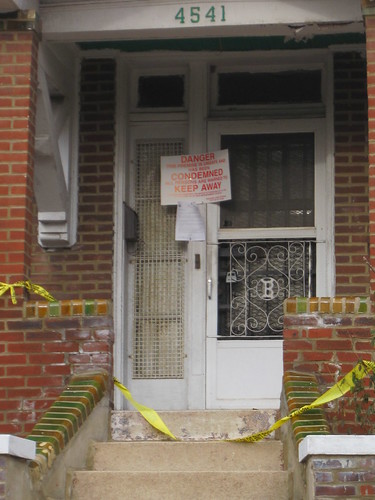
The bungalow at 4541 Lewis Place is condemned after its front parapet wall collapsed.

What You Can Do

Lewis Place needs our help! This historic neighborhood is part of our collective heritage, and we need to shoulder it through this rough moment. Consider helping by making a donation.

Assistance for the residents — a high percentage of them senior citizens — is welcome. Items needed are:
• Food items, both perishable and non-perishable, water, juice
• Blankets, toiletries such as toothpaste, tissue, mouthwash and soap
• Clothing such as gloves, caps, scarves, socks and underwear
• Trash bags

Donations can be made at Centennial Christian Church, 4950 Fountain Avenue, St. Louis 63108 between 9 a.m. – 2 p.m. The contact at the church is Cheryl Poynter at 314.367.1818.

Financial donations are needed, too, to assist homeowners with repairs and rebuilding. Checks can be made out to Lewis Place Historical Preservation, 3920 Lindell Blvd., Suite 206, St. Louis, MO 63108, and Attention Pam Talley. For information about how you can help, contact Talley at 314.535.1354.
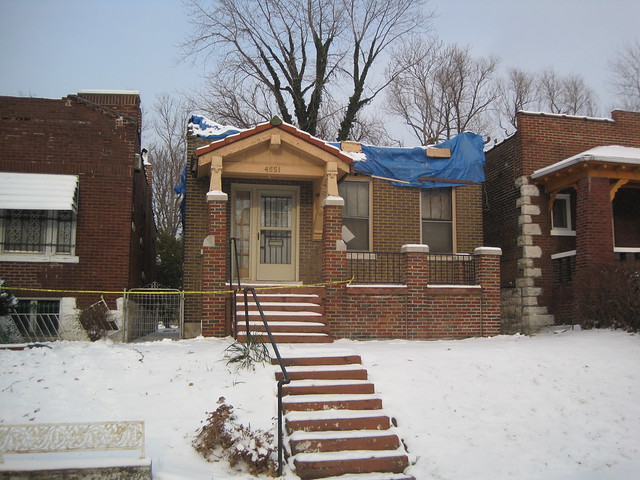
This week's snow compounded problems. This is 4551 Lewis Place.
Categories
Events

“Lines of Beauty” Exhibit Continues Through January

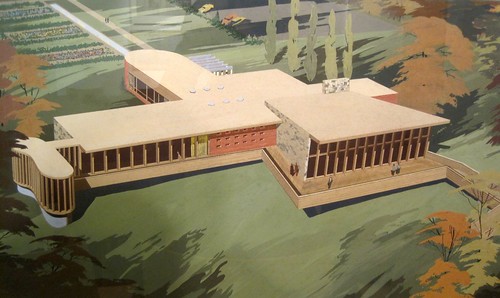
Teamsters Retreat in Peveley, Missouri by Isadore Shank.

Landmarks Association of St. Louis continues its “Lines of Beauty: Original Renderings by St. Louis Architects” exhibit through the end of the month. The exhibit is displayed at the Carolyn Hewes Toft Gallery at Architecture St. Louis, located at 911 Washington Avenue, Suite 170. Gallery hours are 9:00 a.m. – 5:00 p.m., Monday through Friday.

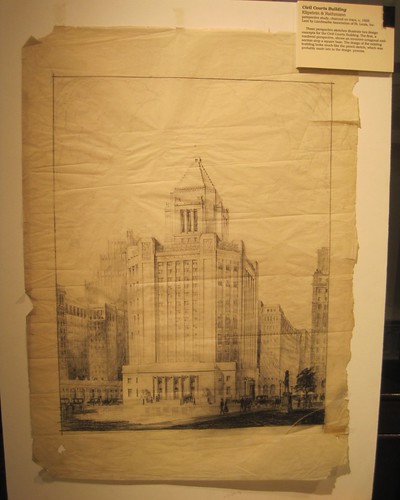
Early Klipstein & Rathmann design for the Civil Courts.

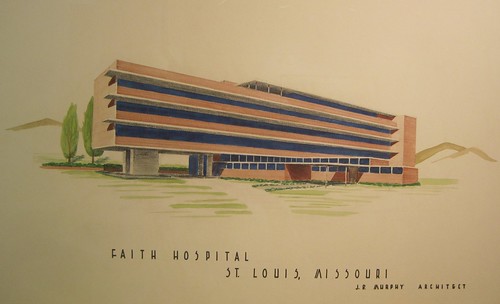
The exhibit features extensive selections from the private collection of Kyrle Boldt III as well as items from the collections of Landmarks Association and modernist architect Isadore Shank’s sons. “Lines of Beauty” is the most extensive recent exhibition of historic renderings by St. Louis architects, and showcases numerous drawings of work in St. Louis, St. Charles, Peoria, Cairo, Alton and other places in the region.

Faith Hospital rendering by Joseph D. Murphy.

Architects represented include a range of twentieth century designers, including John L. Wees, Helfensteller, Hirsch & Watson and Kilpstein & Rathmann. The show has a particularly strong selection of mid-century modern designs by St. Louis’ most important designers, including William A. Bernoudy, Frederick Dunn, Shank, Joseph D. Murphy and Charles Eames. The three images here only hint at the breadth of the renderings displayed. Don’t miss this show.

Categories
LRA North St. Louis Severe Weather The Ville Urban Assets LLC

Ville Area Still Recovering from New Year’s Eve Storm

by Michael R. Allen

Severe storms that hit the city on December 31st have left lasting destruction in parts of north St. Louis. In the Ville and Greater Ville area, winds of over 70 miles per hour struck after noon and left blocks of houses with damage ranging from missing fascia cladding to entire collapses. Nearly two weeks later, building owners struggle to get damage repaired amid snowfall, cold weather and — in a few tragic cases — lack of insurance. And some of the buildings hit hard are owned by the city’s Land Reutilization Authority.

The storms on December 31 tracked just east of the path of the devastating tornado that hit St. Louis on September 29, 1927 — a disaster that struck coincidentally at 1:00 p.m. during the week. Over 75 people perished then. Luckily, no one died in the city on New Year’s Eve. However the face of neighborhoods may be changed socially and physically as families are forced to leave their homes and neighborhood landmarks are demolished.

In the last decade, Ville has been hard hit by waves of demolition, arson, brick theft and disinvestment. The storm’s path sadly cuts through the heart of a fragile neighborhood. Some solace can be taken in the fact that not only did the storm just barely avoid Dick Gregory Place — where a $9.5 million redevelopment is taking place — but also did not disrupt work. Workers worked through the storm inside of the 15 historic and two new buildings that comprise the project.

Here are some images of the damage that struck the Ville.

This multi-family building in the 1800 block of North Taylor Avenue at lost most of its roof.
A tree fell on this house in the 4500 block of Cote Brilliante Avenue.
This vacant LRA-owned residential building at 4596 Garfield Avenue suffered some masonry damage.
Damage was concentrated in the east end 4500 block of Garfield Avenue. The building at left had been hit by brick thieves before the storm but suffered a collapse during the storm. The occupied house next door suffered severe damage to the front parapet, showing that the wind blew at both north and south facing elevations.
The north elevation of a vacant apartment building at the southwest corner of Aldine and Deer avenues collapsed. The building is owned by shadowy speculator Urban Assets LLC.
Categories
James Clemens House North St. Louis Northside Regeneration St. Louis Place

James Clemens, Jr. House Stabilization Underway

by Michael R. Allen

At long last, there has been some stabilization work underway the James Clemens, Jr. House. In the last two months, crews working for Northside Regeneration LLC have removed debris, removed all asbestos, lead and PCBs and undertaken some structural stabilization work. This project unfortunately timed with the year-end announcement that Northside Regeneration’s buyer could not close on purchasing the Missouri Housing Development Commission (MHDC)-issued tax-exempt bonds for the Clemens House. Those bonds were available through stimulus funding and could not carry over to 2011.

The James Clemens, Jr. House could remain at square one — except that the work done now advances it beyond its starting point nearly six years ago when Paul J. McKee Jr.’s Blairmont Associates LLC purchased the historic building. Now, McKee and his partner Robert Wood have invested money into the property, and the condition has started to improve. What comes next is uncertain, but McKee and Wood vow to pursue financing in 2011. Unfortunately that will mean waiting until September to re-apply for MHDC financing.

The most stunning part of the work done to date is the removal of the roof on the wing of the chapel wing, which was built by the Sisters of St. Joseph in 1896.  Not only has most of the roof structure been removed, but also five bays of the wall itself above the first floor are now removed as well.  Of course, since a collapse in May 2008, three bays had already collapsed.

The sight of the Clemens House lawn littered with parts of the massive trusses, laden with impressive historic hardware, sent this author looking for answers as to the methodology of the stabilization work.  Lafser & Associates is the consulting firm working on historic preservation issues for Northside Regeneration. Fred Lafser, president of the company, described the work to this author recently.

“Large roof trusses, saturated with water and frozen, weighing 4 tons each, had fallen against the east wall, taking a portion of the roof and wall with them. In recent weeks, the pressure had caused a portion of the east wall on the second floor to separate 12 inches from the south (façade) wall,” said Lafser. “A number of other trusses were likely to fall in the next few weeks due to the expansion during the freezing and thawing cycles.”

According to Lafser, removal of the trusses safely was extremely difficult. The trusses has to be cut out from distances and staged slowly to prevent damage to the rest of the building. Unfortunately the removal of the trusses is the only planned work on the chapel until full financing is in place. The developers are committed to making emergency repairs, however.

Fred Lafser sent photographs that show the chapel work from the interior.  The first photograph  shows that the bowing of the western wall of the chapel is also advanced.  Removal of the trusses will prevent sudden collapse.  Still, part of the wall will have to be dismantled and rebuilt later.

Photograph provided by Lafser & Associates.

Other work performed now included insertion of sistering structural members at weak columns and joists and complete board-up of openings.  The photograph below shows that the rear (north) elevation of the chapel remains sound.

The eastern elevation of the dormitory wing has long had masonry issues.  The dormitory wing itself is a hybrid building, with its original two-story western portion being the Clemens House’s servants wing.  The top two floors and the eastern section were built as dormitory for the Sisters of St. Joseph in 1887, two years after they purchased the property for use as a convent.  The dormitory originally had a two-story gallery porch on the east, set into the wall inside of massive segmental arched openings.  These openings are now infilled with brick.  The wall has some weak spots addressed by the stabilization work.

While the James Clemens, Jr. House is not fully stabilized after this recent work spree, it is definitely in a safer condition than it has been in over a decade. Northside Regeneration is now the first party to spend money on stabilizing the Clemens House since the Universal Vietnamese Buddhist Association abandoned their work in 2004 — a fact that few would have predicted back when talk of “Blairmont” first surfaced. Full rehabilitation also seemed a remote prospect then, but now it seems a logical next step.

Rendering provided by Robert Wood Realty.
Categories
People

Participating in the Next American Vanguard

by Michael R. Allen

One of last year’s highlights for me was participating in the Next American Vanguard conference organized by Next American City magazine. The event was not a typical conference — participants applied and were selected by the magazine, with only 32 selections. While the two-day event in May had an agenda, it was more like a high-charged advanced seminar in urban revitalization than a session-by-session conference.  I was honored to follow our own Jeff and Randy Vines, 2009 alums, as the next St. Louisan to participate.

From Next American City's website.

Here is a description from Next American City:

Each year Next American City chooses more than 30 outstanding young leaders from around the country to join together for a two-day conference. Called Next American Vanguard, the group and the conference are dedicated to understanding American cities and strategizing ways of improving them. The class of 2010 represents fields ranging from arts to transportation to climate change and historic preservation.

What this summary cannot include is the off-the-wall levels of passion, knowledge and sharing that participants brought. All of us participants no doubt spend much time at events with practitioners in our fields, but rarely do we have access to a range of peers from diverse fields working in urban policy from an equally diverse range of cities.

Group conversations on those two days combined insights from people working in public design with those of educational reform advocates, and those from Chicago and Detroit with those from Fargo and Portland, Maine. (Aside: You’d be surprised at how many participants already had a St. Louis connection!) This perspective-building will make us all better at what we do in the loci of both practice and place. We should strive to keep this connection to the ideas and practices of other cities going, because we don’t necessarily get that on a regular basis in smaller cities.

I had just enough time to start getting to know my amazing fellow participants, but since meeting everyone I have continued conversations by phone, email and in person. While we may never all meet up again like we did in May, we have intertwined 32 networks of ideas, people and places — and the world is a better place for that. In just a few months in Detroit, the 2011 Next American Vanguard “class” will do the same. The circle of committed young people working for renewing America’s cities is widening right now, and it is exciting to be a part of it!

The current Next American City is now available online and includes profiles of six of the 2010 class members, including myself. Check it out: “Better Cities? They’re On It”. I encourage young St. Louisans to put in for the 2011 conference to represent our city and to feel the joy and inspiration of being connected to the larger national movement for smart urban policy.

Categories
Historic Preservation

Historic Preservation Input Needed Now for LEED Changes

From Mike Jackson, FAIA, Illinois Historic Preservation Agency

The process for changing the U.S. Green Building Council LEED Rating Systems is now open for public comments. The comment period ends on Jan 14, 2011 so act fast. The majority of comments will come from the design, manufacturing and building communities so it is extremely important for the preservation community make its voice heard. In many ways, the preservation community is the only voice for building re-use as a green approach. The comments below will help you address the credit topics that seem most critical to the discussion of historic resources and the benefits of building re-use. If you only have a limited amount of time, please comment on the credits about building re-use and materials. Both of these areas will strengthen the viability of historic rehabilitation as a green action. Ideally, you should take the time to look at the whole LEED rating system drafts and comment on other areas within your areas of expertise. Also keep in mind that there are separate comment areas for different LEED rating systems that broadly cover buildings, homes and neighborhoods. You can end up making the same comment several different times so that they are applied to individual ratings systems as well as the pilot credits.

Categories
Benton Park Historic Preservation South St. Louis

Ongoing Work at the Chatillon-DeMenil House

by Michael R. Allen

The Chatillon-DeMenil House, south St. Louis’ oldest house museum located at Cherokee Street and DeMenil Place, recently completed total replacement of its 44-year-old roof.  Even fully-restored buildings need maintenance, and the Chatillon-DeMenil House the existing standing-seam metal roof roof dated to a 1966 restoration and was failing.  Repairs were also needed for the porch columns on the rear of the house facing DeMenil House.  But work had to start at the top, where water enters.

After successful fundraising, the Chatillon-DeMenil House Foundation had the roof replaced this fall. The replacement is a very bright red roof of standing-seam metal. (In a standing-seam metal roof, vertical pieces of metal are joined with raised seams.)  The new roof is faithful to the type of roof put on the house in the late 19th century, after its original wooden shingles were removed.

The Chatillon-DeMenil House is actually the expanded farmhouse of hunter and guide Henri Chatillon, built in 1848.  Dr. Nicholas DeMenil had the symmetrical Greek Revival style front section with its massive columned portico built between 1861 and 1863 (see illustration above).   Architect Henry Pitcher designed the expansion. Currently the house is interpreted as the DeMenil residence with furnishings appropriate to the late 19th century, but its hybrid history is evident and connects the house to many historical events of 19th century St. Louis and the American West.

With the roof again water-tight, the Chatillon-DeMenil House is ready for additional repairs and restoration this year.  The house is closed for January, but tours will resume next month.  Meantime, the Chatillon-DeMenil Foundation continues to raise money for repairs and accept memberships (the basic membership is only $40).  For more information, visit the Foundation’s website at www.demenil.org.

Categories
DALATC James Clemens House North St. Louis Northside Regeneration

McKee’s Open Letter on the Future of Northside Regeneration

by Michael R. Allen

Before the end of 2010, the Missouri Department of Economic Development awarded $8 million in Distressed Areas Land Assemblage Tax Credits (DALATC) to Paul J. McKee, Jr.’s Northside Regeneration LLC. Because of a St. Louis Circuit Court ruling, Northside Regeneration’s redevelopment ordinances currently are invalid pending either refinement addressing the ruling or successful appeal.

DED included the first-ever clawback for the DALATC that requires Northside Regeneration LLC to return the full amount within 30 days of a final court judgment upholding the circuit court ruling. DALATC has no clawback provision, a flaw noticed by many observers when the credits were considered by the Missouri General Assembly in 2007.

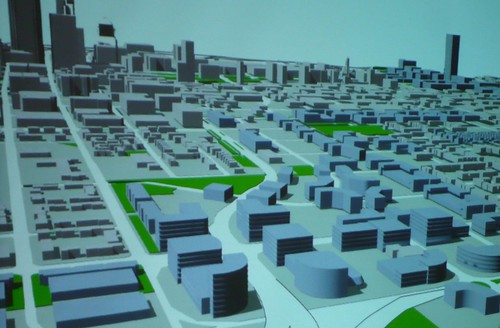
In May 2009 at a public meeting, McEagle showed this rendering of the Northside Regeneration project looking southwest toward downtown from Cass Avenue and 13th Street.

With the fate of Northside Regeneration questioned, this Wednesday McKee himself published an open letter to “the people of St. Louis” entitled “A Perspective for the Year 2011.” The St. Louis Business Journal posted that letter here.

Of special interest to readers of this blog is this passage about the James Clemens, Jr. House:

Now in 2011, the structure has been stabilized and our Team along with MHDC will revisit our
original request and restart the renovation. McEagle made a commitment to the people of the
Northside and to the historic preservationists that we will renovate, and reuse the historic and
reinvent salvageable structures in the Northside area. We will stand tall and meet our commitments
even when unforeseen problems occur.

The delay in starting The Clemens House has nothing to do with the approval process for the balance
of the Northside Regeneration. The Northside Regeneration approval process will be finalized in
specific redevelopment agreements with the City, currently under consideration.

In an itemized list of projects underway is the “demolition and environmental cleanup of over 187 buildings” as well as recycling of demolition materials suggesting interest in deconstruction. Other projects mentioned are historic rehabilitation of an unnamed school building for a charter school and rehabilitation of another unnamed historic building for biotech companies.

Categories
North St. Louis Pruitt Igoe

Coming Soon: “The Pruitt-Igoe Myth”

Trailer – The Pruitt-Igoe Myth: an Urban History from the Pruitt-Igoe Myth on Vimeo.

The trailer for the excellent forthcoming documentary The Pruitt-Igoe Myth by Chad Friedrichs is now available. The premiere takes place during the Oxford (Mississippi) Film Festival February 11-13, 2011. A local premiere has not been scheduled but will take place sometime in the new year.

Categories
Art

Call For Submissions: Sustainability and the Built Environment of the St. Louis Region

From the Architecture Section of the St. Louis Artists’ Guild:

Sustainability and the Built Environment of the St. Louis Region is an examination of where we stand, as a culture of consumption, and where we may be headed in the future. Focus on sustainability efforts and opportunities of the St. Louis regional built environment. Seek examples of work illustrating the biggest consumers and the best conservationists. The artist’s or designer‘s statement should explain the societal impact of the submission’s subject matter.

Artists, designers, architects, creators and design firms are invited to submit work in various media (including photography, three dimensional design, slides, video/film/digital, drawings, etc.) and are encouraged to consider many aspects of the theme.

Selected/appropriate works may have the benefit of research assistance for compiling statistical data demonstrating the impact on the planet and society, provided by the Electrical and Computer Science Department of Saint Louis University’s Park College.

This exhibition is juried by Chris Jordan.

Opening: Friday, November 11, 2011 – 6:00pm – 8:00pm
Admission: Free and Open to the Public
Juror: Chris Jordan

More information and the prospectus is online here.