Categories
Central West End Historic Preservation Mid-Century Modern Preservation Board

Friends of the San Luis Seek Demolition Halt, Right to Appeal

by Michael R. Allen


From the Friends of the San Luis (of which I am now President):

FRIENDS OF THE SAN LUIS SEEK DEMOLITION HALT, RIGHT TO APPEAL PRESERVATION BOARD ACTION

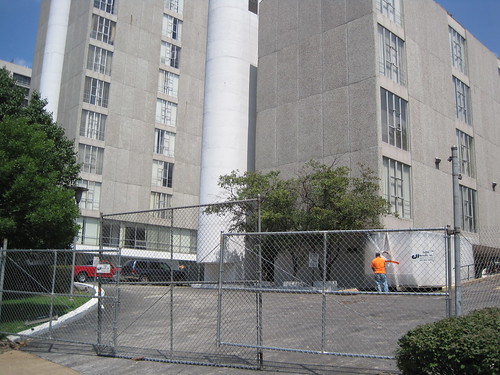
On July 17, the Friends of the San Luis, Inc. filed a petition in Circuit Court to obtain a temporary injunction that would prohibit the Archdiocese of St. Louis from proceeding with any demolition work at the San Luis Apartments until our organization has exhausted its legal appeal of the approval of the demolition permit. While we do not have a final judgment, Judge Robert Dierker, Jr. has denied our motion for a temporary restraining order. The Building Division issued a demolition permit on Monday, July 20, and preliminary demolition work is now underway.

Our mission is to preserve the San Luis Apartments, and at this eleventh hour we press onward with that basic mission but also a larger one. After the Preservation Board granted preliminary approval to the demolition by a narrow vote, we intended to appeal that decision through our right under the city’s preservation ordinance. We think that the Preservation Board’s action was made through incorrect application of the law. Furthermore, we think that that the Cultural Resources Office report on the issue misled citizens and Preservation Board members through imprecise legal reasoning that made it unclear what laws were in play. Since the Preservation Board acts only to enforce city ordinances, without clarity of which laws are being enforced there is no due process.

Under the preservation ordinance, however, we have only the right to appeal an approved demolition permit. We filed the injunction petition to ensure that we were still fighting for an actual building rather than a rubble pile. Unfortunately, Judge Dierker is not stopping demolition as well as challenging our legal standing to bring forth an appeal of the Preservation Board decision. Thus begins our larger cause.

Our preservation ordinance allows an aggrieved party to bring forth an appeal. The preservation ordinance was passed by the Board of Aldermen for the benefit of the entire city, and its stakeholders are all citizens who share the duty of protecting the city’s heritage. The law enjoins us to become stewards of our architectural heritage, and the Friends of the San Luis gladly step forward to answer that call.

We contend that citizen right to appeal the decision of the Preservation Board is a fundamental part of due process and essential to the enforcement of the preservation review ordinance. Without the right to appeal, citizen participation has severely limited impact. Citizens must have the right to act when they feel that the preservation review ordinance has been violated by its own custodians. The right to appeal is a basic legal principle, and it must be part of St. Louis’ preservation law.

While we hold out weary hope of preserving the San Luis, we must assert the right of the citizen to bring forth an appeal under preservation law. We believe that future efforts will benefit from legal protection of that right, and that its fundamental sanctity is worth pursuing no matter what happens to the San Luis.

###
Categories
Architecture Events Mid-Century Modern St. Louis County

A Weekend of Twentieth Century Architecture Ahead

First, Landmarks Association of St. Louis brings an exciting Architecture Weekend:

Architecture Weekend Lecture: Modern Religious Architecture in St. Louis
Date: Friday, July 24 at Noon
Location: Architecture St. Louis, 911 Washington Avenue #170

Esley Hamilton, Preservation Historian for the St. Louis County Department of Parks and Recreation, will provide an overview of the influence of the modern movement on religious architecture across the St. Louis region. Hamilton’s illustrated lecture will cover examples of modernist church design from the city and county in the 20th century. Places of worship designed by Hellmuth, Obata & Kassebaum, Nagel & Dunn, Joseph Murphy and other architects of St. Louis’ modern era will be included.

Architecture Weekend Tour: Two Modern Churches in Kirkwood
Date: Saturday, July 25 from 10:00 a.m. – noon.
Location: Start at First Presbyterian Church, 100 East Adams in Kirkwood

Suburban Kirkwood is blessed with several notable examples of mid-century modern religious architecture. On Saturday, two of Kirkwood’s most splendid modern churches will open their doors for us. We’ll start with a guided tour at First Presbyterian Church (1956-7, Fisher & Campbell), 100 East Adams. After that, make the short walk or drive to the Kirkwood United Methodist Church (1964, Schmidt, Perlsee & Black), which will be open for self-guided tours. On your way out of town, you may wish to pass by Grace Episcopal Church, 514 E. Argonne (1964, Frederick Dunn) or St. Peter’s Catholic Church, 237 W. Argonne (1955, Joseph Murphy), Kirkwood’s other modern churches.

Then, a new group has its first meeting:

St. Louis Arts and Crafts Society Open House
Sunday, July 26 from 2:00 p.m. – 5:00 p.m.
700 Bellerive Boulevard in south St. Louis

Are you interested in St. Louis architecture from 1900 to 1940? Do you describe your home as Arts and Crafts, Craftsman, Mission, Bungalow or Prairie? Does your vocabulary include: exposed rafters, corbels, mortised & tenoned, pergola, Inglenook and thru-tenon-keyed? St. Louis has a rich stock of Arts and Crafts architecture that is often overlooked.

Please join us if you are interested in becoming a member of the St. Louis Arts and Crafts Society. Bring pictures of your home or furniture to discuss with other enthusiasts. FOR more information, call Patrice at 314-412-1382 OR e-mail at rjppwp@charter.net

Categories
North St. Louis Northside Regeneration St. Louis Place

Forestry Division Hard at Work in St. Louis Place

by Michael R. Allen

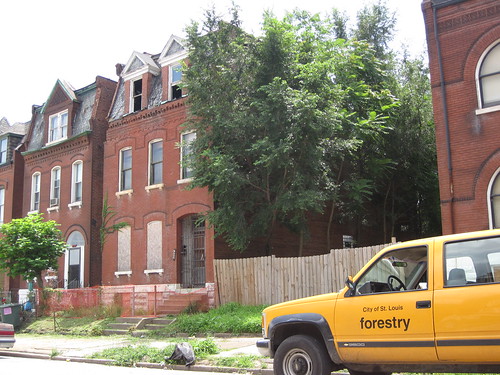
A worker from the city Forestry Division was out today cutting weeds in front of the house locates at 2004 North Market Street in St. Louis Place. That vacant historic house and the lot to the west are owned by N & G Ventures LC, a holding company controlled by McEagle Properties.

Last summer, McEagle hired Marvin Steele to coordinate maintenance on its inventory of around 1,000 vacant properties in north St. Louis. Steele set up a new company, Urban Solutions, to handle the maintenance work, placed signs around JeffVanderLou and St. Louis Place with his company’s hot-line number (946-7333) and promised to handle citizen complaints within 48 hours. After a big initial push to get work done last summer and fall, Urban Solutions seems to have withered like a weed doused with RoundUp.

McEagle and Steele’s actions came after intense complaints from north side residents about McEagle’s inaction on maintenance and reliance on city government services to handle citizen complaints. Also, in August 2007, the Missouri General Assembly revised the Distressed Areas Land Assemblage Tax Credit Act before passage to forbid use of the credit to cover payments to municipal government for remediation of code violations like high weeds and unboarded windows.

At a public meeting on May 21, McEagle disclosed that the company has spent $1.4 million to date on maintenance of north side holdings. At the same meeting, McEagle revealed that some sections of its proposed “NorthSide” project may not be developed until after 2016 or later, sparking renewed concerns about long-term maintenance problems.

Meanwhile, residents continue to deal with the high weeds and unboarded boards the way that they always have: by calling the Citizens’ Service Bureau, which dispatches the resources of city government. City government fronts the bill, and McEagle pays the city. The city collects a mark-up fee, sure. Yet the cycle is not comforting to residents who have to wait for city codes to be broken and their blocks to look bad before they can get action. These people have every right to be skeptical that McEagle deserves a $400 million tax increment financing package with city backing as well as development rights to an area the developer can’t seem to keep under control.

If the developer and City Hall want to make the deal look better to residents, making the properties look better is a great step. If Urban Solutions cannot handle the job, McEagle should hire a company that can do the job with diligence. Look at the house in the photograph above. Here’s the needed work:

– cut down the trees and woody growth along the side wall
– board up the third floor (at least) and second floor windows
– install temporary plastic cutter trough and elbow on front elevation

Perhaps McEagle considers the installation of temporary guttering to be more than maintenance, but it is needed to keep the house standing. The other items are basic, and would take less than a half-day. (Really, cutting overgrowth and boarding windows are among the first skills a rehabber learns.)

Since maintenance costs incurred privately are covered by the DALATC, then there is no reason at all for McEagle not to spend the necessary money to address maintenance needs. With a project timeline extending to 2030, good maintenance will be needed for a long time — and the sooner it starts, the better. Forestry can’t do it all.

Categories
Illinois Mid-Century Modern Southern Illinois

Trenton City Hall

by Michael R. Allen

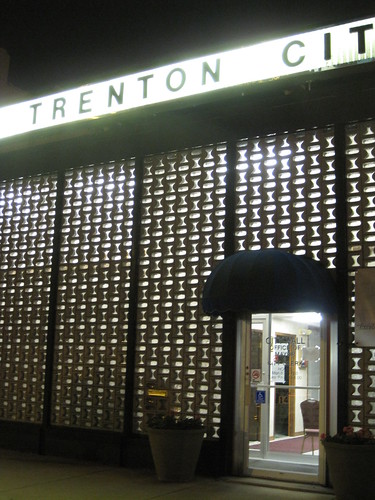
A night ride back from the Clinton County Fair in Carlyle, Illinois took us through Trenton, Illinois over the weekend. Trenton is a small town with a small City Hall, but their City Hall is no cookie-cutter box or faux colonial meeting hall. No, Trenton has a cool modernist building that was probably inexpensive to build — again, small town with small city hall probably has small budget — but is a delight to behold.

The entire front wall consists of patterned glass blocks (specifically, the Intaglio Glass Wall Unit) laid in between black-painted steel piers. these glass blocks are laid in a neat pattern. At center is a simple, common metal door with a delightfully curved handle. Across the top is the name of the building on a backlit plastic board (paging Robert Venturi). While the plastic board is a little out of synch with the simple, smart design below, the composition works. Trenton’s leaders settled on distilling the importance of municipal government into as direct an architectural statement as possible.

While many towns across Illinois opt for allusions to classical architecture, or headquarter their government in plain-ugly, workable buildings, Trenton chose modern. Oh, I hope that their future leaders recognize and cherish the small wonder of City Hall!

Categories
Demolition Historic Preservation Industrial Buildings North St. Louis Riverfront

Old Armour Company Warehouse Lost

by Michael R. Allen

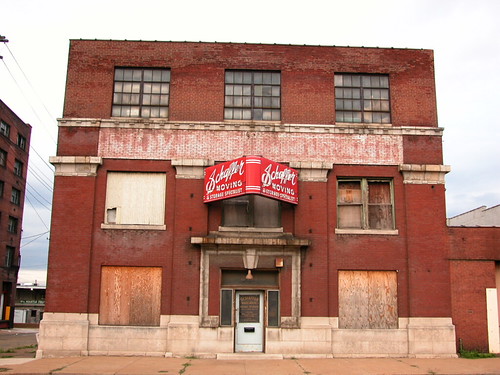
The Schaeffer Moving Company had long occupied the three-story building at 2422 North Broadway, and its red enameled sign (once ablaze through neon tubing) was a familiar site to those who work and live around the area. The steel-framed building actually began its life around the turn of the century as a two-story distribution warehouse for meat-packing giant the Armour Company. The third floor was added in 1911.

The side elevation facing Benton Street (now legally vacated) was an impressive run of steel-sash windows. After the moving company vacated the building about a decade ago, the possibility for reuse easily was apparent.

Instead of reuse, however, the holding company that owns the large row of warehouses to the north (2508 N. Broadway LLC) opted to demolish the old building this month. With the street now vacated, that company can assemble a large parking lot for those buildings.

Since the old Armour building lies in the Fifth Ward, there is no preservation review that might have prevented this senseless loss. The Fifth Ward is one of eight wards out of 28 that does not participate in the city’s preservation review program. (More here.)

Hence, this is what the building looked like yesterday afternoon. Gone. Soon, the ruinous Armour Packing Plant in East St. Louis will also fall, and we will have few tangible traces to our city’s crucial role in the development of the company that turned meatpacking into a science. Yet we will have a few more places to park our cars — not bad, eh?

Categories
Central West End Historic Preservation Mid-Century Modern

St. Louis Housing Authority Building to Be Replaced by CVS or Tower?

by Michael R. Allen

Word is circulating that the St. Louis Housing Authority is considering selling its headquarters building at 4100 Lindell Boulevard to a group of investors who seek to demolish it and build a CVS Pharmacy to compete with the nearby Walgreens. The St. Louis Housing Authority’s three-story modern building began life in 1956 as the St. Louis office of the Sperry-Rand Corporation. The architect was then-fledgling Hellmuth Obata & Kassabaum. The Sperry-Rand Building is derived from International Style principles, especially the neutral colors, the recessed floors, the concrete piers, wide large windows and the applied outer metal bars. While not as accomplished as the firm’s later National Register-listed Plaza Square Apartments, this is a fine building and a subtle component of the group of modern buildings on Lindell Boulevard west of Grand Avenue. Its loss, especially at the hands of a public entity, would be a blow to the already-threatened modern landscape of Lindell Boulevard.

UPDATE: A reader sent me a note to state that there has also been discussion about replacing the building with a taller residential building.

Categories
Historic Preservation North St. Louis Old North Rehabbing

Old North Offering Six Rehab Opportunities

by Michael R. Allen

New houses adjacent to a historic house on the 1300 block of North Market in Old North.

Old North’s North Market Place development, started in 2005, focused on constructing new houses like the ones shown here alongside historic buildings rehabilitated for apartments. The Old North St. Louis Restoration Group and its development partner, the Regional Housing and Community Development Alliance, reserved some historic homes in the project area for private investment. Some of those houses and others are now offered for sale to qualified buyers. Those that don’t sell immediately as-is will be stabilized and then offered for sale. From Karen Heet, Real Estate Coordinator for the Old North St. Louis Restoration Group:

The Old North St. Louis Restoration Group is a not-for-profit community development corporation whose mission is to revitalize the physical and social dimensions of the Old North St. Louis neighborhood in a manner that respects the community’s historic, cultural, and urban character.

ONSLRG is in possession of six buildings available for purchase and renovation. All six buildings will be offered in a first round of RFPs in their current condition, with a deadline of August 14, 2009 for proposal submissions. If there is no suitable offer for a building, ONSLRG will pay for the stabilization of the building and then offer the building in a second round of RFPs at a purchase price that reflects ONSLRG’s additional costs for stabilization.

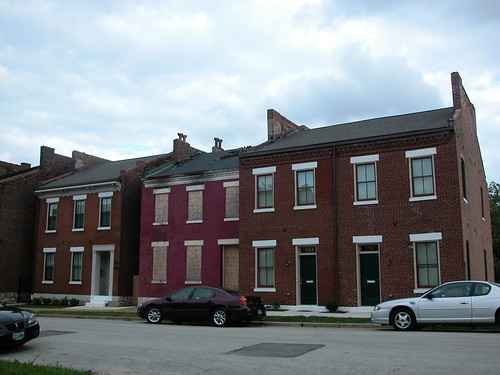
One of the houses offered for sale is 1312 Warren Street, shown at center surrounded by fully-rehabbed buildings.

ONSLRG is seeking to increase home-ownership in the neighborhood, so preference will be given to proposals from:

* a developer who will rehab the building and sell to an owner-occupant( s), OR
* an owner-occupant who purchases a building and completes the renovations.

Of special interest will be the applicant’s residential rehab experience, the proposed timeframe for the completion of the project, and the applicant’s understanding of and commitment to compliance with standards for historic restoration.

All buildings are in the Murphy-Blair National Historic District and therefore may qualify for Historic Tax Credits. All buildings are in the N Florissant/N Market/Hadley/ Warren Redevelopment Area and are therefore eligible for property tax abatement. Selected buyers will be encouraged to apply for historic tax credits, property tax abatement, and Neighborhood Preservation Tax Credits.

All proposed construction is expected to be consistent with applicable neighborhood plans and city building codes.

Upon selection, the applicant will have a 3-month option period in which time all construction documents and financing must be finalized prior to the scheduling of a closing date. Construction documents must be sealed by a licensed architect.

ONSLRG will retain an 18-month Right of Re-entry on the property after closing, meaning that if substantial completion has not taken place in 18 months from the date of closing, ONSLRG has the right to take back the property, paying the buyer for any materials and labor for which invoices can be produced.

Please see the attached document for the proposal format and information on the buildings.

Categories
Midtown Storefront Addition

Storefront Additions: The Bars of Laclede Avenue

by Michael R. Allen

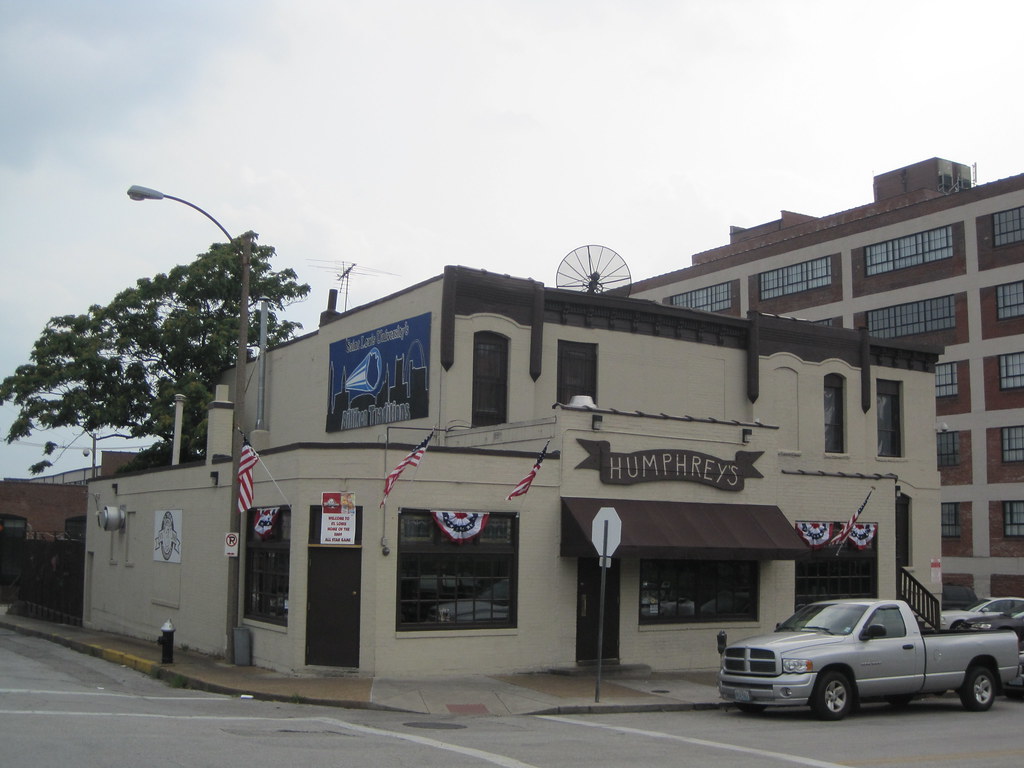
Where do thirsty Billikens go? Why, they are likely to head to a storefront addition on Laclede Avenue. Both of the street’s off-campus bars are located in former nineteenth century residences that were converted to commercial use in the twentieth century.

The venerable bar Humphrey’s at the southwest corner of Laclede and Spring Avenue has been around since 1976. The building housing the bar dates first to 1891, when the two-story row of flats were built. While some of the window openings are bricked in or altered, and the building is covered in a stark paint scheme, the building’s Romanesque cornice is fully intact. The wide commercial addition with its chamfered (architecture speak for “angled”) corner entrance dates to 1939. The first tenants in the storefront were Oscay McCoy, confectioner, at the corner, and Vernal Ragsdale, barber, at the next door.

One block west at 3818 Laclede Street is the Laclede Street Bar and Grill, an establishment that is not as old as Humphrey’s. Neither is the building, since the house dates to 1895 with a back addition for the Ortleb Machinery Company built in 1947. The storefront and side additions, however, are not as old as they look. The additions date to 1968, when the building opened as Caleco’s bar. This storefront addition has always served university students.

Categories
Media North St. Louis Northside Regeneration

NorthSide Discussions

by Michael R. Allen

McEagle Properties made an unprecedented and commendable move for a developer: the company launched an interactive discussion board for its “NorthSide” project. The idea was that rather than hear rumors about the project, citizens could get their questions and concerns answered directly and publicly by the developer.

As someone who complained for years that McEagle was avoiding all public engagement, I was pleased. Of course, not everyone concerned about the project spends time online, but many of the most vocal critics do. The discussion board is at least a start at dialogue.

However, so far the discussion board has generated a scant 12 posts, and questions and comments directed at McEagle going back to July 7 have been left unanswered by McEagle.

Meanwhile, the discussion board of the newly-organized North Side Community Benefits Alliance has been home of much discussion among many different people. There have been 56 posts, and the threads read like conversations.

Of course, most conversation is happening offline — at City Hall, block parties, neighborhood meetings, non-profit board meetings and even at the neighborhood saloon. McEagle has certainly generated a lot of discussion, but little of it has turned up online.

Categories
Demolition Granite City, Illinois Illinois Metro East

More Demolition in Downtown Granite City

by Michael R. Allen

Last year, the building at 1310 Niedringhaus Avenue in downtown Granite City burned. The neighbor at 1308 Niedringhaus (at right above) suffered some damage, but nothing that compromised its structural integrity.

Here’s a look at those two buildings three years ago, seen at right below:
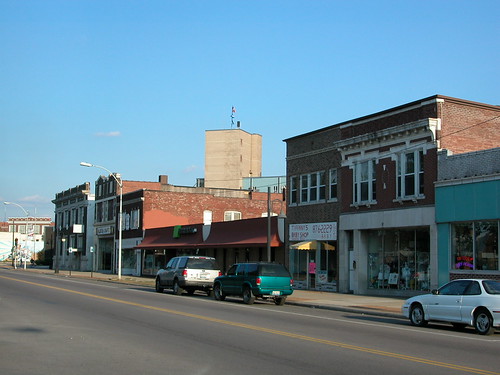
One can see that these buildings were part of an uninterrupted row of downtown buildings with storefront retail activity. Such blocks are few and far between in Granite City these days. Now there is one less, because the government of Granite City successfully pushed to have both the buildings at 1308 and 1310 Niedringhaus Avenue demolished. Today, the site is a gaping hole in the street wall.

Like many municipalities in the St. Louis area, Granite City lacks a local preservation ordinance that would establish a citizen review commission for demolitions — and the ability to seek federal grants for preservation planning. Such an ordinance would enable Granite City to become a Certified Local Government under federal rules, a status enjoyed by Belleville, Collinsville, Alton and Edwardsville. (Read more about Illinois’ Certified Local Government program here.) If Granite City had a preservation ordinance, the city might have a shot at stopping the steady spate of demolitions that have been eroding the downtown area in the past decade.