Categories
Downtown Infrastructure North St. Louis Northside Regeneration Planning

City Hall Asking Right Questions about McEagle Project

by Michael R. Allen

Friday’s St. Louis Business Journal carried two stories on McEagle’s NorthSide project that quoted Deputy Mayor Barbara Geisman and Mayoral Chief of Staff Jeff Rainford. (Articles are available online only to subscribers.) The primary article, “Will Paul McKee and City hall bond?” dealt with the developer’s request that the city guarantee via general revenue half of the $410 million in tax increment financing bonds sought. From the comments in the article, it sounds like City Hall is not ready to roll over on the request.

Rainford says that Mayor Francis Slay is skeptical on the city backing the bonds, and that Slay will only do so under “extraordinary circumstances.” Rainford acknowledged ongoing negotiations between the mayor’s office and McEagle, but the article did not elaborate on what “extraordinary circumstances” would be.

Deputy Mayor Geisman went further, stating that the city doesn’t know enough about the project yet to consider a request for general revenue backing. The article ends with a frank — and encouraging — quote from Geisman: “Lots of people ask for lots of things; it doesn’t mean they’re going to get it.”

While there is much to admire in the scope of McEagle’s vision as it has been laid out, the TIF request is abrupt and based on unsubstantiated financial information. The size of the request alone raises questions, but the push for city backing is premature. As the Business Journal article notes, the only three times when the city backed TIF bonds — St. Louis Marketplace, the convention hotel and Pyramid’s acquisition of One City Center — the city has ended up on the hook for failed or troubled development projects. McEagle has yet to demonstrate that its project would be any different.

I am heartened that City Hall has shifted gears from largely favorable comments to on-point comments. Hopefully this indicates a stance of tough bargaining, because a city that is eliminating jobs and implementing furloughs cannot afford to throw the treasury open for an untested vision.

That said, the second article, “McKee eyes land swap with MoDot for first phase,” showed some of the possibilities of the McEagle development. McEagle wants to eliminate the 22nd street ramps and use that site for new office development, and it seems that City Hall favors that approach. Readers know how much I want City Hall to support eliminating needless highway components, so I am glad that Geisman seems positive about removal of some of the most useless highway infrastructure in the region.

I have little to complain about the 22nd Street part of the McEagle vision: it removes useless and divisive infrastructure, adds density, does not affect any houses, businesses or historic buildings and it could result in a termination of the visually-challenged Gateway Mall other than a chain link fence. McEagle wants this to be the first phase — why not separate this area out into its own redevelopment area with its own enabling legislation?

One major problem with the McEagle project has been the lack of public-side planning. If city government was vigilant about setting and enforcing urban planning goals, the McEagle project would conform to those objectives and not be as problematic as it has been. Barring real planning, City Hall ought to use its powers to make sense of the project for the benefit of the city. Beyond the TIF deal, City Hall should look at the possibility of breaking the project down into smaller redevelopment areas, creating real historic preservation planning and placing the promises unveiled on May 21 into an actual contract between the city and the developer. A good deal is possible, and City Hall is at the center of that.

Categories
Media North St. Louis Northside Regeneration

McEagle Releases First Video on "NorthSide"


The McEagle NorthSide vide channel can be found here.

Categories
Historic Preservation Housing Planning

Taxes and Urban Rot

by W. Philip Cotton, Jr.

The following essay by W. Philip Cotton, Jr. appeared in the volume “Laclede’s Landing” Area, published by Landmarks Association of St. Louis in 1968. When I first unexpectedly found this essay tucked in a booklet on Laclede’s Landing, I was impressed by Phil’s astute observations on taxation policy and its relationship to preservation of historic neighborhoods. In 1968, in the era of wide admiration of singular works of architecture, this line of preservationist thought was truly progressive. Phil’s words on the use of government incentives are prescient. Yesterday, at a memorial service, we celebrated Phil’s work and contributions. I wish to again state that his legacy is worth the consideration of today’s preservationists. — Michael R. Allen

Wrong methods of taxation are a fundamental cause of urban decay. One might ask what taxes have to do with landmarks? For landmarks thought of in the narrow sense of isolated buildings the question is not so significant, but for landmarks of the urban environment, districts and sections which are the essence of a great city, taxes are highly significant. It is necessary, at times, to go beyond the confines of a specific concern or interest to get at fundamental components or problems.

The first sentence above states that “wrong methods” of taxation are a root cause of decay and slums in cities. The principle word is “methods.” The amount of taxes is not necessarily the determining function, but, rather, the way they are raised profoundly affects the state of health of the city. The old tax on windows in England had an obvious effect on the number of windows in a building. It is easy to picture that this method of raising the necessary revenue had at some point a deleterious effect on public health, as many habitations would be without sufficient light and air.

Our present policies of taxing land and improvements (with the greater portion derived from improvements) have recognizable effects: slums are the most profitable housing investments, not because of any inherent attractiveness of slums but because of tax policies. For letting buildings decay one is rewarded with lower taxes; on the other hand, improvements are penalized with higher taxes. Decay spreads faster than we can treat its symptoms, which we usually do with one or more government programs. There is little chance of fundamental improvement or reform from within our government; it can come only from an aroused citizenry which is aware of the fundamentals of cause-and-effect economics as distinguished from social-reform economics.

Another great obstacle in the way of fundamental reform of taxation is the implicit belief in the Eleventh Commandment, “Thou shalt not rock the boat.” — even if by rocking, the boat be saved from sinking. For many this is a greater imperative than the other ten.

As long as slums provide a higher economic return on investment than well maintained housing, the various government appeasement offerings serve only to reward the slum owners and temporarily pacify slum inhabitants. “More than fifty years ago Lloyd George warned the British Parliament that ‘low rent public housing bills will never be effective until you tackle the taxation of land values.'”* In 1960 the Mayor’s Special Committee on Housing in New York City reported, “The seemingly unstoppable spread of slums has confronted the great cities of the nation with chronic financial crisis … The $2 billion public housing program has not made any appreciable dent in the number of slum dwellings … No amount of code enforcement … will be able to keep pace with slum formation until and unless the profit is taken out of slums by taxation.”*

The idea of taxing land values and not taxing improvements is neither new nor untested theory. Where it has been fairly tried it has produced effects which can readily be observed and evaluated. Brisbane, Australia has not had taxes on improvements since 1896; it taxes only the unimproved value of the land. Colin Clarke, economist at Oxford University, who lived in Australia for twenty years writes of Brisbane that it is “the only great city in the world without a slum.”*

The restraining effects of taxes on improvement in St. Louis are so great that to stimulate major new construction in the city it is necessary to use the Missouri Redevelopment Act making it possible to give a near exemption from property taxes for a decade or two. This subsidy at the expense of all other property owners (and taxpayers in general) is necessary to attract new investment in improvements. Why not give, in effect, a subsidy to all who improve and maintain their properties by untaxing improvements and taxing only the value of the site location which is created by public improvement and population rather than giving the subsidy to a few?
Private enterprise cannot solve the housing problem and other problems of the urban environment as long as the profit motive is harnessed backwards. Until there are financial incentives for improving and maintaining property and thus, in effect, penalties for decay and rot, there is no hope for substantial improvement.

The fundamental answer to the problem is not charity without tax reform. Winston Churchill writes, “…a friend of mine was telling me the other day that, in the parish of Southwark, about 350 pounds a year was given away in doles of bread by charitable people in connection with one of the churches. As a consequence of this charity, the competition for small houses and single-room tenements is so great that rents are considerably higher in the parish! All goes back to the land, and the land owner is enabled to absorb to himself a share of almost every public and private benefit, however pitiful those benefits might be.” So the rot was then and so it will remain until we stop subsidizing slums and penalizing well maintained property by out ill-conceived tax policies.”

* “Taxes and the Death of Cities” by Perry Prentice. Architectural Forum, November 1965.

Categories
Central West End DeVille Motor Hotel Historic Preservation Mid-Century Modern Preservation Board

Testimony on the DeVille Motor Hotel (San Luis Apartments)

by Michael R. Allen

Here is my testimony from Monday’s Preservation Board consideration of the preliminary review of the Archdiocese’s application to demolish the DeVille Motor Hotel (San Luis Apartments) at 4483 Lindell Boulevard and build a surface parking lot in its place.

The Board approved the application by a vote of 3-2, with Board members Richard Callow, David Richardson (who is Missouri adviser to the National Trust for Historic Preservation) and Alderwoman Phyllis Young voting yes and members Melanie Fathman and Anthony Robinson voting no.

RELEVANT ORDINANCES

In regard to the legal standards that bind the Preservation Board’s decision today, I think that members will find the ordinances quite clear: the Archdiocese’s plan meets neither the standards established by the Central West End Historic District ordinance nor the demolition review criteria in the city’s preservation review ordinance. The Board should deny both parts of the proposal and uphold our city’s preservation laws. The Preservation Board has no legal authority to make decisions based on the institutional parking requirements of the Archdiocese or Rosati-Kain, but only on the explicit criteria of the two applicable ordinances.

While the Central West End Local Historic District standards do not expressly forbid the construction of surface parking lots in the district, they are only allowed in areas with commercial zoning (zoned F or H). The DeVille parcel is zoned E (Multiple Family Residential), which is governed by the residential standards of the local district.

Even with a zoning change for this parcel, the parking lot proposal does not meet the commercial standards of the district, which I quote:

All off-street parking shall be located behind or to the side of commercial structures. Where visible from the street, screening with visually opaque landscaping or 5′ minimum high masonry or concrete wall shall be necessary.

The current proposal fails to meet this provision because the parking lot will occupy the entire parcel, not adjacent to a building, but rather in the plain view of two streets, an alley and even from the sidewalk a great distance to the east. While the proposed screening may meet the standards, the standards disallow construction of a parking lot that is not adjacent to a building. The proposed parking lot requires a variance from the standards that I think is unwarranted.

Furthermore, the district standards explicitly safeguard the architectural characteristics of block faces. Again I quote the standards:

Developers, therefore, shall demonstrate compliance with exiting scale, size and proportion… Visual compliance shall be judged on massing and detail in addition to size and scale.

The parking lot does not meet the “visual compliance” standard established here. The current face of this block is a symmetrical arrangement, with the large Cathedral and DeVille buildings serving as book ends on either side of the Chancery. While the architectural character is varied, the urban forms that give the block face harmony are dependent on the balance of large, taller buildings on each corner. The parking lot removes one of those buildings, creating an imbalance that clearly does not maintain existing scale, size or proportion. Plus, the stark exposure of the alley and utilities from Lindell will create a visual problem for pedestrians.

Note that Central West End residents have successfully blocked development projects in the past by filing lawsuits to uphold enforcement of these standards. These standards enjoy widespread and passionate support in the neighborhood, not simply because they enshrine common values but because they are an effective and clear legal tool for protecting the urban character of the neighborhood.

Beyond the local district standards, the current proposal also fails to meet the standard criteria of the preservation ordinance. (I will not address financial hardship, which is clearly not at issue in this matter.)

A. Redevelopment Plans

There is no approved or proposed formal redevelopment plan for the DeVille site.

B. Architectural Quality

The DeVille Motor Hotel is eligible for the National Register of Historic Places for its local architectural significance. (More on that in a moment.) Under the Preservation ordinance’s definition, the DeVille is thus a High Merit structure. (“High Merit”partly is defined as “deserving of consideration for single site historic or Landmark Site designation.”)

This criteria is one of the primary reasons why the Board has authority to deny the demolition of the DeVille. Under the preservation review ordinance, the Board must act to protect all Merit and High Merit structures . The State Historic Preservation Office’s statement of eligibility for single-site listing is cause for treating the DeVille as a High merit structure at the present moment.

C. Condition

The DeVille building obviously requires repairs common to buildings of its age, but it is sound under the ordinance and apparently safe enough that the Archdiocese maintained it as a residential building until 2007.

D. Neighborhood Effect and Reuse Potential

The Central West End Association and many neighborhood residents have offered the opinion that the surface parking lot has an adverse neighborhood impact.

As for reuse potential, we have only a report prepared by the architectural firm hired to design the parking lot. There has been no independent analysis of reuse potential. However, given the successful rehabilitation of the Hotel Indigo to the west and the former Days Inn downtown, reuse potential of mid-century motels for original or adapted uses now has been demonstrated in the city.

E. Urban Design.

The preservation ordinance reiterates the principles of the Central West End local historic district ordinance regarding integrity of block face as well as the impact on “significant character important to a district, street, block or intersection.” Clearly, the proposal is detrimental to its block face, but also it is detrimental in a larger architectural context along Lindell Boulevard. This brings me to the issue of National Register of Historic Places eligibility.

ELIGIBILITY FOR NATIONAL REGISTER

Because of the DeVille’s unique architectural quality as well as its contributing role to a significant group of Modern buildings on Lindell Boulevard, the State Historic Preservation office has determined that the DeVille is eligible for inclusion in the National Register of Historic Places. Not only do we have that hopeful determination, but also on May 1 the Keeper of the National Register listed Lindell’s other mid-century motel: the Bel Air Motel at 4630 Lindell, built between 1958-1961 and beautifully rehabilitated as the Hotel Indigo. (The Preservation Board approved the Bel Air nomination last year.)

Also, in the past two years, I have written or co-written two other successful National Register nominations of mid-century buildings in the city built within the past 50 years — the Plaza Square Apartments downtown and the Nooter Corporation Building at 1400 S. Third Street. In these cases, the opinions of the State Historic Preservation Office and the Keeper of the National Register were aligned: if the buildings were eligible for the National Register at all, waiting until the “50 year mark” to pursue listing was unnecessary and arbitrary. In fact, at a 2007 workshop hosted by the Missouri State Historic Preservation Office, National Park Service historian Dan Vivian relayed to Missouri preparers of nominations that the practice of waiting for a property to reach 50 years of age before listing was based on myth and not actual Park service policy. Vivian urged us to nominate eligible buildings in accordance with National Register Criterion Consideration G — a consideration that ensures that buildings less than 50 years old have attained exceptional significance worthy of inclusion in the Register.

Our knowledge of the eligibility of modern buildings has grown over the past three years, and the Bel Air Motel nomination allowed greater exploration of a context in which the DeVille plays a major role. As part of the Bel Air nomination, Karen Baxter and I conducted a survey of the mid-century modern resources of Lindell between Grand Avenue and Kingshighway. Lindell long was the main connection between downtown St. Louis and Clayton, and attracted commercial development as the city resumed developing itself after the slowdown of the Great Depression and World War II era. The aging mansions offered large lots well-suited for new commercial buildings.

In the Lindell survey area, 36 buildings were constructed and two others were re-clad in a building boom between 1945 and 1977. Of these, 34 were built in the styles of the Modern movement. Only one of these buildings has been demolished. The range of design quality, height, material use and stylistic influences is wide among these buildings, yet they have an indelible impact on Lindell. In my opinion, one can say that modern commercial architecture is as much a part of the definitive character of Lindell as is the earlier revival-style residential architecture.

Historically, the unique Mid-Century Modern grouping on Lindell is by far the city’s most significant Modern commercial development. The development of Mid-Century Modern architecture on Lindell Boulevard precedes major downtown urban renewal projects that also used the style (including the iconic Gateway Arch and Busch Stadium). Lindell’s modern buildings demonstrate that St. Louis after World War II was a city deftly remaking itself through bold modern buildings. The concentration includes very significant buildings to the development of Modern Movement architecture in St. Louis. Three of these buildings even achieved early recognition through inclusion in the 1967 edition of George McCue’s The Building Art in St. Louis.

Not surprising, however, is the finding that most of the modern buildings on Lindell were designed by local architects or draftsman, many of little renown. There are strong supporting buildings and a few obvious architectural stars, like the Archdiocesan Chancery, the Lindell Terrace, the Engineers Club and the DeVille, designed by Charles Colbert of New Orleans (1963). Four of the modern buildings have out-of-town architects, but of those four, only Colbert has what can plainly be called a national reputation among architectural historians. While the Bel Air Motel is a fine building that merits National Register listing, the DeVille has greater significance through its more original design, form and massing as well as its association with Charles Colbert.

Demolition of the DeVille would result in the removal of one of Lindell’s finest modern buildings, a clear negative urban design impact on one of the city’s most prominent thoroughfares. So far, the only lost mid-century building on Lindell has been the Cinerama at 4218 Lindell. On Lindell, we have an unparalled nearly-intact document of our city’s triumphant attempt to reclaim its future amid declining fortunes and suburban growth. Ironically, these buildings took the place of others that we all now recognize as worthy of preservation. Proposed demolition of the DeVille raises the issue of whether we are about to embark upon renewing the unsustainable cycle of demolition and replacement that this city infamously embraced in the late 20th century.

The Preservation Board can break the cycle by upholding the laws we developed in response to the demolition cycle that once plagued our city. Members should deny the proposed parking lot and demolition of the DeVille Motor Hotel since each action certainly fails to meet the criteria of the ordinances under which today’s action will be taken.

Categories
Central West End Demolition DeVille Motor Hotel Mid-Century Modern North St. Louis Preservation Board

Preservation Board Grants Preliminary Approval DeVille, North Grand Demolitions

by Michael R. Allen

Last night, the Preservation Board voted 3-2 to grant preliminary approval of a surface parking lot and demolition of the San Luis Apartments (formerly the DeVille Motor Hotel). I’m on my way out of town today so I will offer thoughts when I return. For now, I should point out that five out of nine Preservation Board members were present, while 20 citizens testified against demolition. While this ration is unusual, it shows the discrepancy between citizen interest and Preservation Board member interest in one of biggest urban design matters this year.

Alderwoman Lyda Krewson (D-28th) tipped the balance by coming out in favor of approval at the end of the meeting. Her remarks were a roller coaster ride of what side she would take, but when she came back to the issue of Archdiocese parking needs (politically germane, but beyond the legal scope of the ordinances governing Preservation Board action) hearts sank. Frankly, she might have done better for herself had she not spoken at all instead of aligning herself with the surface lot plan that even she admits is not appropriate for that corner.

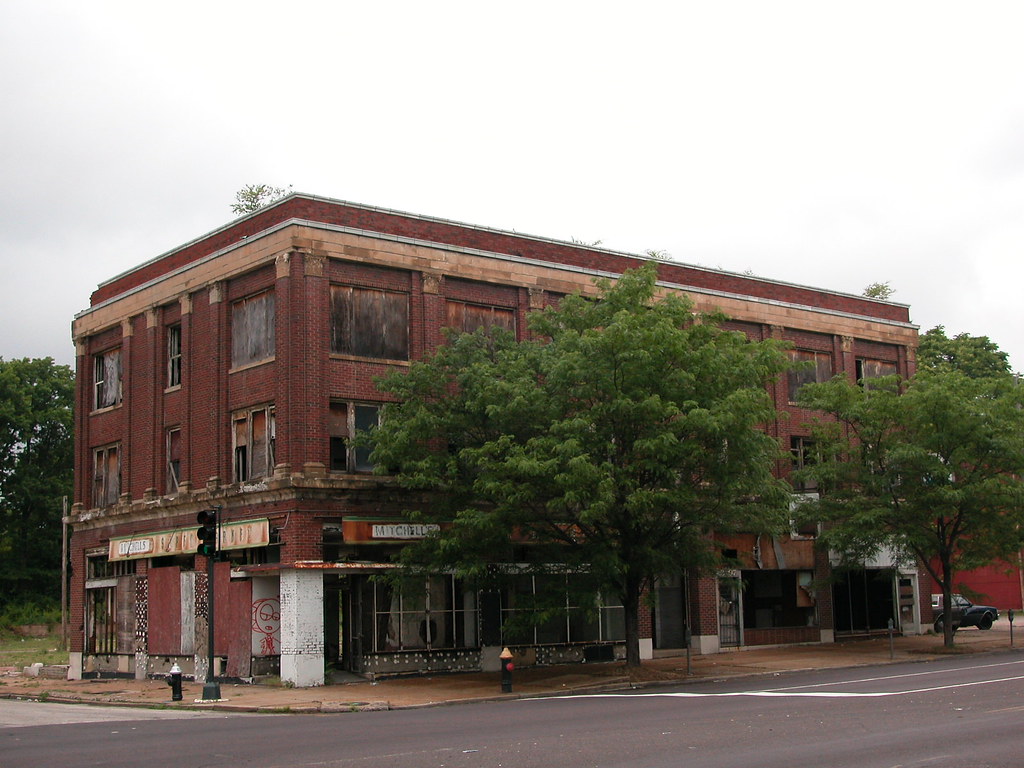
While my colleagues will be writing about the DeVille over the next few days, I want to point out that another demolition was approved by the Preservation Board yesterday in a questionable manner. When I arrived at the Board meeting, I found preliminary review of the demolition of the commercial building at 3501-9 North Grand Avenue was on the agenda. This matter did not appear on the agenda posted online a week before the meeting, nor did it appear in any special notice sent within 24 hours of the start of the meeting.

The public, including residents of the area around the building (intersection of Grand and Hebert), would never have known this matter was on the Board agenda. Most people probably still don’t.

Alderman Freeman Bosley, Sr. (D-3rd), often a preservation-minded alderman, had the item placed on the agenda and was the official applicant. However, building owner Darryl Mitchell appeared to announce that he had already applied for a demolition permit and that he was the applicant. The Preservation Board changed the record to reflect this testimony, which may or may not be allowed under Preservation Board procedures.

Perhaps this matter is irrelevant given that the Board granted preliminary approval 4-0 and only two people from an audience of more than 40 testified, but I think the procedure followed was wrong. If an actual demolition permit was on the table, then it cannot be considered as a preliminary review. The Cultural Resources Office staff had not reviewed the permit yet, so the matter certainly was not an appeal.

Since this was a preliminary review, the Board can bring the matter back and give the demolition permit its appropriately-announced legal hearing. I hope that the Board does so.

Categories
Media North St. Louis Northside Regeneration

McEagle North Side Project in the News

Local:

Developer Paul McKee pushes city, state officials to grab stimulus funds – Bill Lambrecht, St. Louis Post-Dispatch, June 21.

And national:

The New Neighborhood – Miriam Moynihan, The Architect’s Newspaper, June 18.

Categories
Central West End DeVille Motor Hotel Historic Preservation Mid-Century Modern

Daily DeVille #5

Architect Charles Colbert imparted to the DeVille Motor Hotel the geometric exuberance of the most interesting American modernism. There are many fine modern buildings on Lindell Boulevard that are derivative of the International Style, but there are a few truly original compositions. The DeVille is one of them.

Categories
Central West End Parking Planning

One of the Central West End’s Parking Lots

by Michael R. Allen

The 1.48-acre parking lot on the southeast corner of Euclid and Delmar is a great reason not to allow construction of another parking lot in the Central West End.

In the late 1970s, the non-profit Union-Sarah West Economic Development Corporation demolished a row of vacant commercial buildings here to build the lot under the guise that the parking lot was necessary to serve the renovated Euclid Plaza Building. Today, the lot sits vacant. Not only is the lot closed off to public use, it is never used at all. The parking lot is weedy and blocked off. The Roberts Companies have proposed new construction on the site, but nothing is current in the works.

While the fate of this lot and the fate of any lot built by the St. Louis Archdiocese cannot be compared — the Archdiocese will be a good steward of a new parking lot, I am sure — this lot raises a planning question. Does a neighborhood with so many underutilized surface parking lots at prime corners need another?

Categories
Academy Neighborhood Demolition North St. Louis Old North Preservation Board

Planning Commission Overturns Two Preservation Board Decisions

by Michael R. Allen

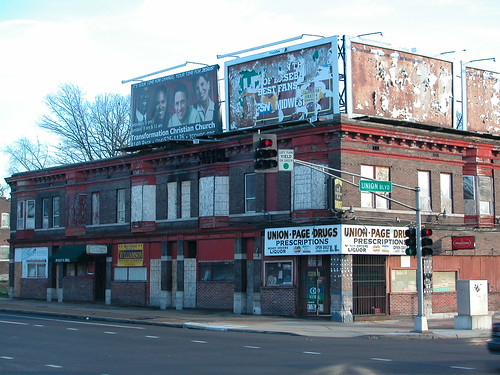
On June 3, the Planning Commission unanimously adopted a resolution to grant demolition of the corner commercial building at 5286-98 Page Boulevard if owner Berean Seventh Day Adventist Church met several conditions. Those conditions are completion of permit-appropriate construction drawings for the proposed surface parking lot within 30 days and securing of construction financing within 90 days. If those dates are not met, the permit stands denied and the church will have to appeal the denial to the St. Louis Circuit Court.

How did the demolition permit end up at the Planning Commission, and why would that body approve demolition for a parking lot? In January 2008, the Preservation Board upheld Cultural Resources Office staff denial of the demolition permit by a vote of 5-2. Per city preservation law, Berean appealed this decision to the Planning Commission. The next step in the appeals process would be court. The Planning Commission has authority to review and “modify” decisions of the Preservation Board, which is what the June 3 decision is considered. (Note that the Planning Commission does not typically solicit or accept citizen testimony, although the public may attend its meetings.)

At the behest of the Planning Commission, the Berean church worked with Dale Ruthsatz at the St. Louis Development Corporation to improve the original plan for a parking lot. The new plan calls for “green” features such as permeable paving and landscaping. Parking entrances have been moved off of Page and Union and onto the alley, so that pedestrians on these streets won’t be bothered by traffic. Eventually, the church wants to build a community center on the site. Planning Commission members expressed the sentiment that they wanted to exercise leverage over the parking lot design rather than let the matter go to court where the city might lose its case and its design review.

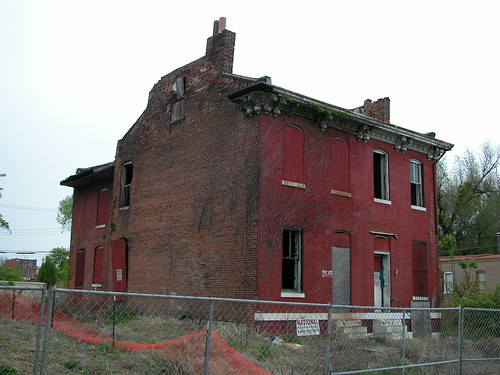
Back in April, the Planning Commission also overturned — or, rather, modified — the Preservation Board decision on a certain house at 2619-21 Hadley Street. The back story is slightly complicated. Suffice to say that the Haven of Grace, a shelter for homeless pregnant women, wanted the old house gone — after it had resolved to rehabilitate it in order to secure a demolition permit for another historic building.

The Haven of Grace pursued demolition relentlessly. After the Preservation Board in August 2008 reaffirmed its original decision, the organization appealed to the Planning Commission. The legal strategy of the Haven of Grace was effective enough to lead to the Planning Commission’s vote to overturn the Preservation Board decision, but not enough to do so without penalty. The Planning Commission stipulated that the Haven of Grace must pay $25,000 to city that will be used for building stabilization by the Cultural Resources Office.

While there are few chances for the city to secure $25,000 for stabilization, the Planning Commission action may be a dangerous precedent. My hope is that it is an isolated instance of such a questionable outcome. It’s certainly better than a victory for demolition with no trade-off.

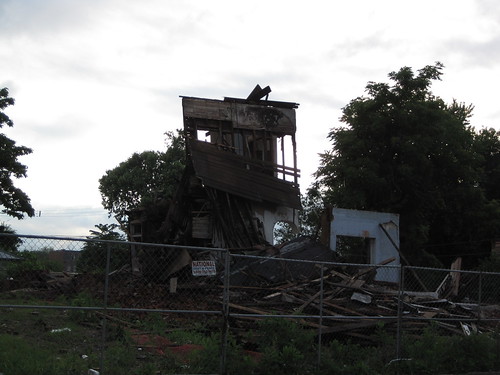
The house on Hadley Street is now gone. Watching the demolition, it was clear to me that the house was in much better condition that I had assumed. The floors looked sturdy, original millwork abounded and even the plaster walls looked to be in fair condition. An expenditure of $25,000 could have mothballed this house for better days.

The Planning Commission’s compromises demonstrate the flaws in our current system or preservation review and planning. In fairness to the Planning Commission, the city lacks progressive ordinances here. I understand the inclination toward meting out compromise rather than take matter into lengthy circuit court battles. However, if the Preservation Board’s decisions on these matters were made fairly and by wide margins of voting members, they should be upheld on appeal.

The Planning Commission should not feel trapped. The Preservation Board should not be rendered powerless because an applicant (or elected official) has the money and time to make things difficult for the city. We need better design ordinances and city agencies empowered to do more than just say “no.” Ultimately, we need a better framework in which to make planning decisions.

Categories
Central West End DeVille Motor Hotel Historic Preservation Mid-Century Modern

Daily DeVille #4

Cultural Resources Office Director Kathleen Shea has now posted her recommendation to the Preservation Board for the demolition of the former DeVille Motor Hotel and its replacement by a parking lot. Shea seems ambivalent about the Archdiocese’s proposal. Meanwhile, opposition to the demolition grows.

Since the DeVille’s architect was Charles Colbert of New Orleans, the New Orleans architectural community is stirred up. The Board of Directors of the New Orleans chapter of the American Institute of Architects sent a plea to the St. Louis Preservation Board. The National Trust for Historic Preservation is also opposed. Long engaged in the struggle, Landmarks Association of St. Louis sent a note to members this week urging them to send letters to the Preservation Board and Alderwoman Lyda Krewson (D-28th).

Fliers are circulating around the Central West End with information about the demolition. Many Central West End residents oppose the demolition, while many also simply object to the proposal that a prominent corner in the city’s poster neighborhood for urban living be occupied by a parking lot.