Categories
DALATC Kansas City Missouri Missouri Legislature Northside Regeneration Public Policy

Bill Would Lower Acreage Requirements for Distressed Areas Tax Credit

by Michael R. Allen

Missouri State Senator Yvonne Wilson (D-9th), who represents Kansas City, has filed SB 814, a bill that would decrease the size of a project eligible under Missouri’s Distressed Areas Land Assemblage Tax Credit (DALATC). Wilson’s bill would set the minimum project size at 40 acres, with an applicant required to own only 30 of those acres. The credit now requires projects to be 75 acres and applicants to own a minimum of 50 acres.

While there are numerous structural flaws with DALATC, and while 40 acres is still a fairly disruptive project size for urban areas, Wilson’s proposal is a step in the right direction.

Perhaps not coincidentally, reforming the DALATC is one of the planks in the 2008 Missouri Public Policy Agenda for the Greater Kansas City Chamber of Commerce.

Categories
Historic Preservation North St. Louis SLPS South St. Louis

SLPS Proposes Eight More School Closings

by Michael R. Allen

The St. Louis Public Schools will be closing eight additional school buildings and reopening two, pending a vote by the appointed transitional school board and public input.

The schools proposed by district staff for closure are Mitchell School, 955 Arcade Avenue; Gundlach School, 2931 Arlington Avenue; Lyon School, 7417 Vermont Avenue; Mark Twain School, 5316 Ruskin Avenue; Meramec School, 2745 Meramec Street; Shenandoah School, 3412 Shenandoah Avenue; and Simmons School, 4318 St. Louis Avenue. The closures are evenly split between south and north city.

Carver School, 3325 Bell Avenue in north city, and Roe School, 1921 Prather Avenue in south city, would reopen.

This comes on the heels of last year’s round of five closures, which has left several historic school buildings vacant. The district has yet to market some of the closed schools from last year’s round. Hopefully the district will develop a policy for swift disposition of closed schools that includes provisions for timely reuse as well as preservation. The district would do well to seek National Register of Historic Places designation for any closed school not already listed, so that the buildings are “tax credit ready” at the time of sale. While the district may elect to retain several buildings for future use, it already possesses a long roster of vacant buildings and needs to continue to be mindful of the impact of school closings on neighborhoods.

Categories
Art Demolition Salvage St. Louis County

Name Made from Place

by Michael R. Allen

Janet Zweig’s If You Lived Here You Would Be Home, a new public art project in Maplewood funded by Arts in Transit, rewards repeated viewings — even at high speeds. The work consists of two sculptures that spell “Maplewood” on each side of the MetroLink overpass bridge on Manchester Road. On the west side, which people face heading into Maplewood, the word is spelled forwards, but on the other side it’s spelled backwards. Motorists leaving Maplewood might catch a glimpse of the word spelled forwards in their rear-view mirror. In her project description (which includes many excellent photographs), Zweig announces her intention regarding this effect: “hey can read the word on the other side of the overpass in their rear-view mirrors, as if seeing an illusionistic image of Maplewood’s past.”

There are other ways that the art work conjures Maplewood’s past. The typeface used is borrowed from the long-shuttered Maplewood Theater’s sign. Like a theater marquee, the letters of the sign are outlined in light at night, a great decision. The materials used to comprise each sign, not especially evident on a drive-by visit, are bits from two historic homes demolished in 2006. The idea of having the place name literally created by pieces of the lost past is profound, and need not be smothered by my analysis. Go drive, walk and stand by Zweig’s work, and then think about it.

Categories
Historic Preservation Illinois Metro East Southern Illinois

Venice Public School Campus Disappears

by Michael R. Allen


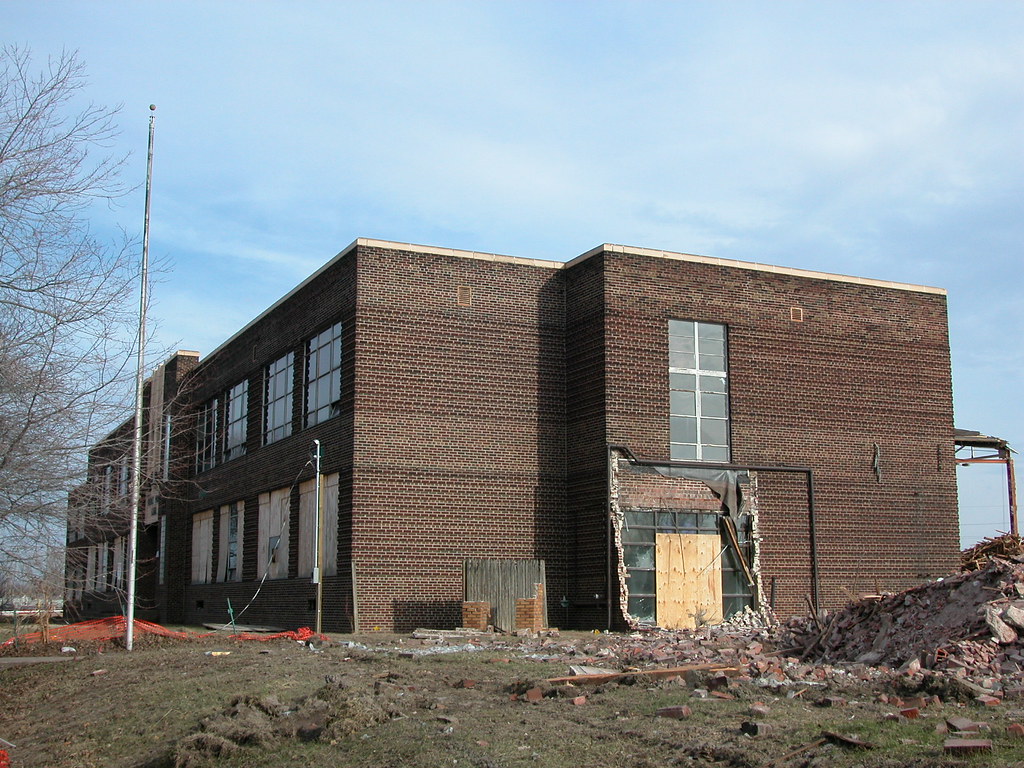
The Metro East city of Venice is continuing to demolish its historic public school campus. The 1917 Venice High School has been gone for a month now, while the adjacent 1938 addition partly remains. Once the Tri-Cities of Granite City, Madison and Venice were thriving cities with populations of workers in the numerous steel mills and metal fabrication shops of the area. Things have been different for awhile now, and Venice’s population hovers at about 2,500.

Still, the section of Broadway where the public schools buildings stood features many well-kept homes on whose lawns children play. With a moribund downtown and few noteworthy employers, though, Venice’s chief assets may be its location and its stock of small frame homes. The city has a lot of potential.


The demolition of the schools, though, erase some of that potential. The buildings are among a handful of historic landmarks. These were solid buildings with adaptive reuse potential, standing right off of the newly-reopened McKinley Bridge. New use may have been just a few years away.
As of last weekend, when I took these photos, the 1938 addition retained its basic form enough to demonstrate how pointless its loss is. The building features a restrained art deco program of ornament, executed in polychromatic geometry that is gorgeous. The basic body of the building is unadorned machine-raked brick in different shades of brown and red. The bow-truss gymnasium at rear relieves the boxiness of the school building, providing some variation in the form.

Alas, by now the building is further diminished and reuse is a lost dream. Like its earlier neighbor, the building departs the real world to live only in the fickle realm of public memory.

As the Metro East adapts to its post-industrial and decentralized life — a process that will continue and accelerate once the new Mississippi River Bridge is built — we will continue to watch such losses. Without economic hope, there will be no concerted effort at cultural resource planning in the Tri-Cities or East St. Louis. Time is money, after all, and planning takes a lot of time. And money. What incentives exist in the Metro East for careful planning and historic preservation? Few, so long as Illinois remains one of those states without a historic rehabilitation tax credit.

(Kudos to 52nd City, Curious Feet, St. Louis Patina and Metropolitan Rural for covering the Venice High School demolition earlier.)

Categories
Uncategorized

Monday’s Preservation Board Meeting In Review

On the Landmarks Association website: Summary of Decisions by the Preservation Board: January 7, 2008

Categories
Academy Neighborhood Historic Preservation North St. Louis Preservation Board

Fate of Building at Page and Union Deferred Again

by Michael R. Allen


At Monday’s meeting of the St. Louis Preservation Board, the Board voted 3-2 to defer consideration of an appeal of the staff denial of a demolition permit for the building at 5286-92 Page Boulevard. The applicant is the Berean Seventh Day Adventist Church; background on the permit can be found in a post that I made in November. While the November meeting of the Board that considered the matter was packed with congregation members, this month only attorneys William Kuehling and Robert Kinney from Polsinelli Shalton Flanigan Suelthaus appeared to present the church’s case — and yet another rendering of a supposed new building that will replace the existing building (but for which no funds or construction blueprints exist).

Voting to defer the matter were Anthony Robinson, who wanted to hear from the Academy Neighborhood neighborhood association on the proposed new building, Mary Johnson and Alderman Terry Kennedy. Voting against deferral were Mike Killeen and David Richardson. Consideration of the new building is not germane to the Preservation Board’s consideration, which legally applies only to the demolition itself. The building is not located in a local historic district with design guidelines. Instead, it is part of a national historic district where the Board can review demolition permits alone.

Among those who testified in opposition to the demolition was historian Lynn Josse, who wrote the National Register nomination for the Mount Cabanne-Raymond Place Historic District in which this building is a contributing resource and visual anchor. Her words appear here:

By way of background: In 2000, the City of St. Louis funded a National Register nomination in order to protect the Mount Cabanne/Raymond Place Historic District and to encourage the reuse of its valuable historic buildings. The district is listed not only for its architectural merit, which is obvious in this building, but as an example of a compact walkable neighborhood with a distinctly Orthodox Jewish character. The congregation of the B’Nai Amoona synagogue at Academy and Vernon had to live within walking distance of where they worshipped because of Sabbath restrictions, so there was a higher than average concentration of Jewish households and businesses. In most ways though, the neighborhood was like other streetcar neighborhoods of the time. Raymond Place had most of the amenities families needed for daily life within easy walking distance. The building that you’re considering today, by the 1920s was the home of grocery stores, drug stores, a medical office, and a delicatessen – all of which would be vital to the daily life of the neighborhood.

In a district like Mount Cabanne-Raymond Place, it is all too easy to allow the commercial edges to erode and slip away. In this district, we’ve lost at least one of the commercial buildings on Delmar since the listing in 2002. But historically, it is the commercial buildings like this one that made the residential life in the center of the neighborhood possible. Raymond Place boasts a really great collection of architecturally interesting houses, but without the context provided by important commercial buildings like this one, it is just that: a collection of dwellings. Cities are more than that; they are a complex system of people and jobs and transit and housing and recreation and institutions and services and retail. We are doing a good job encouraging reuse of housing, but the neighborhood doesn’t make historic sense and may be less sustainable in the future if you allow the destruction of the small-scale retail spaces that historically have connected people.

Part of what the ordinance directs you to consider is the contribution to the streetscape. This building is the streetscape. For over a hundred years it has defined the corner of Page and Union. Its loss would cause a major gap at the northwest corner of the historic district. Replacing this building with a surface parking lot would be a terrible disservice to the neighborhood. It’s a bad use of land and a terrible waste of an important building that should, according to all of your legal criteria, be preserved.

Categories
DALATC North St. Louis Northside Regeneration Public Policy

McKee’s Holding Companies May Be Preparing for Tax Credits

by Michael R. Allen

There may be movement afoot on the part of developer Paul J. McKee, Jr. to get ready for an application for Missouri’s Distressed Areas Land Assemblage Tax Credit. On October 26, four holding companies owning land in north St. Louis — Blairmont Associates, VHS Partners, Noble Development Company and N & G Ventures — each filed deeds of trust covering all property purchases made before 2006, when McKee’s holding companies began filing individual deeds of trust for each property.

Each company’s deed is for the same amount, $3 million and granted by the Corn Belt Bank & Trust Company of Pittsfield, Illinois. Two years ago, Corn Belt granted a loan of $2.8 million to McKee’s Allston Alliance for the purchase of the vacant Cass Avenue Schnucks store.

Each company’s deed was signed by Paul J. McKee, Jr. in capacity as manager of the other limited liability companies that act as sole members of the holding companies. Blairmont Associates’s sole member is BMA Partners, VHS Partners’ is Vashon Developers, Noble Development Company’s is NDC Venturers and N & G Ventures’ is NGV Partners.

Under the terms of the Distressed Areas Land Assemblage Tax Credit Act, a land assembler is eligible for up to 50 percent of the purchase costs of land. At the maximum eligible amount, these recent deeds of trust would entitle McKee’s companies to $6 million in tax credits.

Categories
People South St. Louis

Another Chance to Help Make the Marti Frumhoff Memorial Garden Reality

by Michael R. Allen

Christian Herman, author of the delightful St. Louis Brick blog, is the visible shepherd of the plan to build the Marti Frumhoff Memorial Garden. Christian continues to raise funds and awareness for this important memorial to Marti Frumhoff, one of the city’s biggest champions who unexpectedly passed away last May.

Christian’s latest effort is an online auction of books to benefit the garden project; check it out here. Right now, there are some cool cookbooks and even some cooking accessories up for grabs. Bid now, and keep checking back for new books to be added. Out-of-print art and gardening books will be auctioned in the next few weeks.

Categories
Downtown Historic Preservation North St. Louis Preservation Board

Preservation Board Meets Monday, Demolition Permits on Page and Olive Return

by Michael R. Allen

Since the St. Louis Preservation Board did not have a physical meeting last month, this month it will meet twice. The first meeting is Monday, January 7 at 4:00 p.m.

Two of the agenda items are repeats of demolition permits:

– 5286 Page Boulevard. The Berean Seventh Day Adventists’ appeal of staff denial of a demolition permit for this two-story commercial building was continued due to the church’s presentation of new evidence in November. The Board continued the hearing of the appeal in order to afford Board members and Cultural Resources Office staff more time to review the evidence. (Read more here.) Staff still recommends upholding the denial. The church has no good case for removing the last historic building at the important intersection of Page and Union — a building structurally sound and listed as a contributing part of a National Register historic district.

– 2217-19 Olive Street. The owners of this building want to demolish it for a parking lot. The two-story commercial building is a contributing part of the newly-listed National Register district called the Olive and Locust Historic Business District. In September 2007, the Preservation Board unanimously rejected the appeal of a staff denial of a demolition permit. (Read more here.) Now the matter is back as a “New Application” because the applicant is not the owner but the Building Division, which claims that building is in danger of collapse. Swayed by the evidence, the Cultural Resources Office is recommending approval of the demolition permit.

The agenda begins with three preliminary reviews of new construction in the Benton Park and Lafayette Square local historic districts.

The meeting takes place on the 12th floor of the Locust Building, 1015 Locust Street downtown. Testimony may be submitted in writing via email to Adonna Buford at BufordA@stlouicity.com.

Categories
Abandonment Art Metro East

Take a Trip With Cindy Tower

by Michael R. Allen

Those who frequently haunt abandoned places around St. Louis may have run into painter Cindy Tower, a dynamo who paints scenes from abandoned places — on site, not from photographs! This video shows here in action.