Categories
People

Participating in the Next American Vanguard

by Michael R. Allen

One of last year’s highlights for me was participating in the Next American Vanguard conference organized by Next American City magazine. The event was not a typical conference — participants applied and were selected by the magazine, with only 32 selections. While the two-day event in May had an agenda, it was more like a high-charged advanced seminar in urban revitalization than a session-by-session conference.  I was honored to follow our own Jeff and Randy Vines, 2009 alums, as the next St. Louisan to participate.

From Next American City's website.

Here is a description from Next American City:

Each year Next American City chooses more than 30 outstanding young leaders from around the country to join together for a two-day conference. Called Next American Vanguard, the group and the conference are dedicated to understanding American cities and strategizing ways of improving them. The class of 2010 represents fields ranging from arts to transportation to climate change and historic preservation.

What this summary cannot include is the off-the-wall levels of passion, knowledge and sharing that participants brought. All of us participants no doubt spend much time at events with practitioners in our fields, but rarely do we have access to a range of peers from diverse fields working in urban policy from an equally diverse range of cities.

Group conversations on those two days combined insights from people working in public design with those of educational reform advocates, and those from Chicago and Detroit with those from Fargo and Portland, Maine. (Aside: You’d be surprised at how many participants already had a St. Louis connection!) This perspective-building will make us all better at what we do in the loci of both practice and place. We should strive to keep this connection to the ideas and practices of other cities going, because we don’t necessarily get that on a regular basis in smaller cities.

I had just enough time to start getting to know my amazing fellow participants, but since meeting everyone I have continued conversations by phone, email and in person. While we may never all meet up again like we did in May, we have intertwined 32 networks of ideas, people and places — and the world is a better place for that. In just a few months in Detroit, the 2011 Next American Vanguard “class” will do the same. The circle of committed young people working for renewing America’s cities is widening right now, and it is exciting to be a part of it!

The current Next American City is now available online and includes profiles of six of the 2010 class members, including myself. Check it out: “Better Cities? They’re On It”. I encourage young St. Louisans to put in for the 2011 conference to represent our city and to feel the joy and inspiration of being connected to the larger national movement for smart urban policy.

Categories
Historic Preservation

Historic Preservation Input Needed Now for LEED Changes

From Mike Jackson, FAIA, Illinois Historic Preservation Agency

The process for changing the U.S. Green Building Council LEED Rating Systems is now open for public comments. The comment period ends on Jan 14, 2011 so act fast. The majority of comments will come from the design, manufacturing and building communities so it is extremely important for the preservation community make its voice heard. In many ways, the preservation community is the only voice for building re-use as a green approach. The comments below will help you address the credit topics that seem most critical to the discussion of historic resources and the benefits of building re-use. If you only have a limited amount of time, please comment on the credits about building re-use and materials. Both of these areas will strengthen the viability of historic rehabilitation as a green action. Ideally, you should take the time to look at the whole LEED rating system drafts and comment on other areas within your areas of expertise. Also keep in mind that there are separate comment areas for different LEED rating systems that broadly cover buildings, homes and neighborhoods. You can end up making the same comment several different times so that they are applied to individual ratings systems as well as the pilot credits.

Categories
Benton Park Historic Preservation South St. Louis

Ongoing Work at the Chatillon-DeMenil House

by Michael R. Allen

The Chatillon-DeMenil House, south St. Louis’ oldest house museum located at Cherokee Street and DeMenil Place, recently completed total replacement of its 44-year-old roof.  Even fully-restored buildings need maintenance, and the Chatillon-DeMenil House the existing standing-seam metal roof roof dated to a 1966 restoration and was failing.  Repairs were also needed for the porch columns on the rear of the house facing DeMenil House.  But work had to start at the top, where water enters.

After successful fundraising, the Chatillon-DeMenil House Foundation had the roof replaced this fall. The replacement is a very bright red roof of standing-seam metal. (In a standing-seam metal roof, vertical pieces of metal are joined with raised seams.)  The new roof is faithful to the type of roof put on the house in the late 19th century, after its original wooden shingles were removed.

The Chatillon-DeMenil House is actually the expanded farmhouse of hunter and guide Henri Chatillon, built in 1848.  Dr. Nicholas DeMenil had the symmetrical Greek Revival style front section with its massive columned portico built between 1861 and 1863 (see illustration above).   Architect Henry Pitcher designed the expansion. Currently the house is interpreted as the DeMenil residence with furnishings appropriate to the late 19th century, but its hybrid history is evident and connects the house to many historical events of 19th century St. Louis and the American West.

With the roof again water-tight, the Chatillon-DeMenil House is ready for additional repairs and restoration this year.  The house is closed for January, but tours will resume next month.  Meantime, the Chatillon-DeMenil Foundation continues to raise money for repairs and accept memberships (the basic membership is only $40).  For more information, visit the Foundation’s website at www.demenil.org.

Categories
DALATC James Clemens House North St. Louis Northside Regeneration

McKee’s Open Letter on the Future of Northside Regeneration

by Michael R. Allen

Before the end of 2010, the Missouri Department of Economic Development awarded $8 million in Distressed Areas Land Assemblage Tax Credits (DALATC) to Paul J. McKee, Jr.’s Northside Regeneration LLC. Because of a St. Louis Circuit Court ruling, Northside Regeneration’s redevelopment ordinances currently are invalid pending either refinement addressing the ruling or successful appeal.

DED included the first-ever clawback for the DALATC that requires Northside Regeneration LLC to return the full amount within 30 days of a final court judgment upholding the circuit court ruling. DALATC has no clawback provision, a flaw noticed by many observers when the credits were considered by the Missouri General Assembly in 2007.

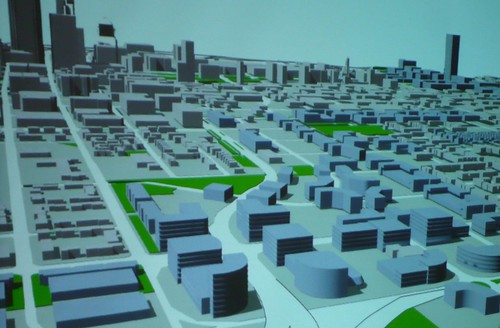
In May 2009 at a public meeting, McEagle showed this rendering of the Northside Regeneration project looking southwest toward downtown from Cass Avenue and 13th Street.

With the fate of Northside Regeneration questioned, this Wednesday McKee himself published an open letter to “the people of St. Louis” entitled “A Perspective for the Year 2011.” The St. Louis Business Journal posted that letter here.

Of special interest to readers of this blog is this passage about the James Clemens, Jr. House:

Now in 2011, the structure has been stabilized and our Team along with MHDC will revisit our
original request and restart the renovation. McEagle made a commitment to the people of the
Northside and to the historic preservationists that we will renovate, and reuse the historic and
reinvent salvageable structures in the Northside area. We will stand tall and meet our commitments
even when unforeseen problems occur.

The delay in starting The Clemens House has nothing to do with the approval process for the balance
of the Northside Regeneration. The Northside Regeneration approval process will be finalized in
specific redevelopment agreements with the City, currently under consideration.

In an itemized list of projects underway is the “demolition and environmental cleanup of over 187 buildings” as well as recycling of demolition materials suggesting interest in deconstruction. Other projects mentioned are historic rehabilitation of an unnamed school building for a charter school and rehabilitation of another unnamed historic building for biotech companies.

Categories
North St. Louis Pruitt Igoe

Coming Soon: “The Pruitt-Igoe Myth”

Trailer – The Pruitt-Igoe Myth: an Urban History from the Pruitt-Igoe Myth on Vimeo.

The trailer for the excellent forthcoming documentary The Pruitt-Igoe Myth by Chad Friedrichs is now available. The premiere takes place during the Oxford (Mississippi) Film Festival February 11-13, 2011. A local premiere has not been scheduled but will take place sometime in the new year.

Categories
Art

Call For Submissions: Sustainability and the Built Environment of the St. Louis Region

From the Architecture Section of the St. Louis Artists’ Guild:

Sustainability and the Built Environment of the St. Louis Region is an examination of where we stand, as a culture of consumption, and where we may be headed in the future. Focus on sustainability efforts and opportunities of the St. Louis regional built environment. Seek examples of work illustrating the biggest consumers and the best conservationists. The artist’s or designer‘s statement should explain the societal impact of the submission’s subject matter.

Artists, designers, architects, creators and design firms are invited to submit work in various media (including photography, three dimensional design, slides, video/film/digital, drawings, etc.) and are encouraged to consider many aspects of the theme.

Selected/appropriate works may have the benefit of research assistance for compiling statistical data demonstrating the impact on the planet and society, provided by the Electrical and Computer Science Department of Saint Louis University’s Park College.

This exhibition is juried by Chris Jordan.

Opening: Friday, November 11, 2011 – 6:00pm – 8:00pm
Admission: Free and Open to the Public
Juror: Chris Jordan

More information and the prospectus is online here.

Categories
Collapse Historic Preservation South St. Louis Tower Grove East

Holding Down the Corner

by Michael R. Allen

Perhaps the most precious architectural resources in our neighborhoods are corner buildings. When the ends of a block are vacant, a street’s urban character takes a huge hit. Empty corners signify distress and disuse. Corner buildings in full use show the world the lifeblood of an urban area, and in vacancy at least carry the promise of renewal to come. If the corner building is commercial the potential is particularly rich: there could be a place of commerce, a generator of city revenues and a point of presence that dampens crime.

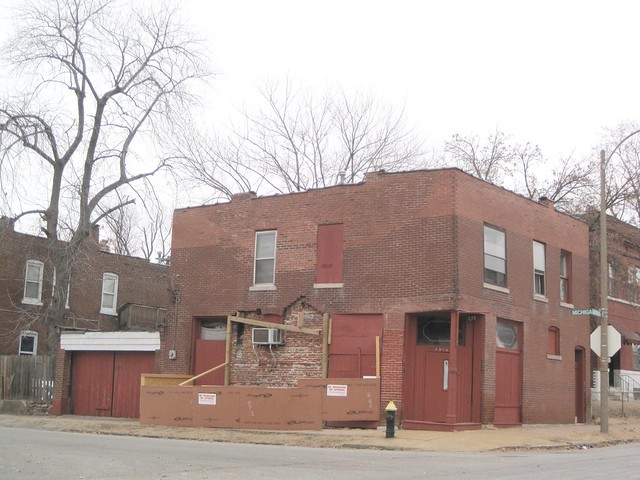
To cut to the chase, I have been concerned about the corner commercial building at the northeast corner of Michigan and Arsenal streets for some time now. The building, which dates to 1905, has lost some of its character through relaying of the upper part.  Consequently it is a bit plain, but still sturdy, well-built and suited for a corner store. When I first moved to Tower Grove East last year, the building was already vacant. City records show that the building has been listed as vacant since 2008. Not good.

Then, this summer, the outer wythe of brick on the first floor collapsed.  On July 26, the Building Division condemned the building for demolition.  The only action taken then by owner, Yee Real Estate LLC of Chesterfield, was to prop up the remaining part of the wythe with lumber.  Again, not good.  Tower Grove East is a great neighborhood because it has lost so few buildings, and has few empty corners.  That should not change.

Some relief came this week when Yee Real Estate LLC applied for a building permit on December 29 for stabilization work to rebuild the collapsed masonry.  Hopefully the job is done well and soon, and the building is put back to use.


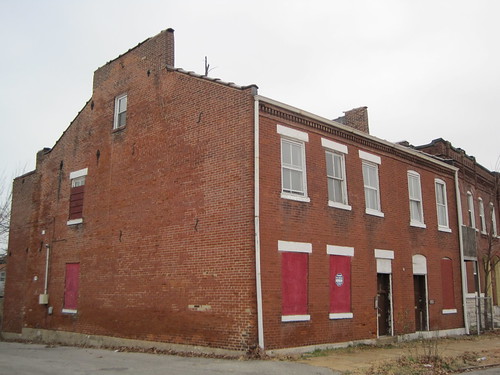
Attention developers: Just across the street at to the east, the residential building at 3114-16 Arsenal Street remains vacant and for sale. Built in two sections, the building has a dentillated brick cornice and, on the east, flat stone lintels.  These are signs that this building precedes much of the surrounding city fabric.  Indeed the eastern half of the building appears to be a building seen in Compton and Dry’s 1875 Pictorial St. Louis.

Nearby Grant School at 3009 Pennsylvania Avenue would not be completed until 1893.

Categories
Art

Seeing St. Louis in the Work of Joe Jones

by Michael R. Allen

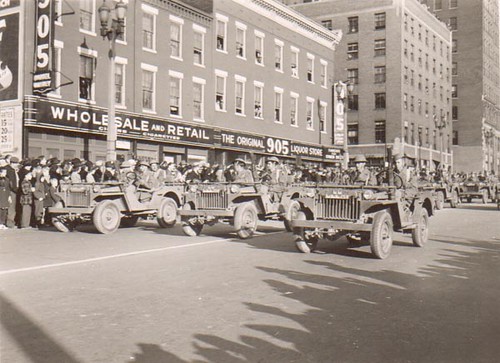
Joe Jones' mural "Riverfront" was displayed in the 905 Liquor Store at 8th and Market streets. Photograph from the Preservation Research Office Collection.

Today the St. Louis Beacon kindly published my commentary, “Seeing St. Louis in the work of Joe Jones”. Give it a read, and then get to the St. Louis Art Museum’s exhibit “Joe Jones: Painter of the American Scene” before it ends on January 2.

Categories
PRO Collection South St. Louis Tower Grove East

Snow Day on Gravois, c. 1960

Photograph from the Preservation Research Office Collection.

This photograph dates to around 1960 and shows a woman walking north on the west side of snow-covered Gravois Boulevard just north of Cherokee Street. In the background, faintly, the neon-lit blade sign of F.W. Clemens Supply Company can be seen — a sign that remains to this day. Clemens still sells bulk materials like mortar, cement, gravel, minus and sand to contractors and enterprising individuals.

Categories
Demolition Downtown PRO Collection

Live Better Electrically

by Michael R. Allen

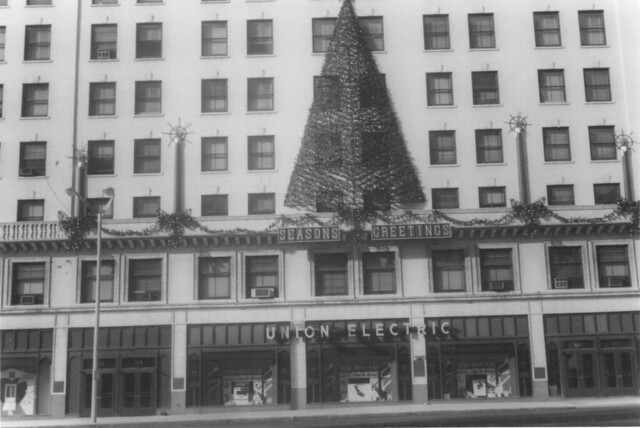
One of the photographs in our recent acquisition of over 200 amateur photographs of St. Louis shows the Union Electric Building at 315 N. 12th Street (now Tucker Boulevard) decked out with holiday decorations. The photograph is undated but comes from the middle or later 1950s. There was plenty to see the rest of the year

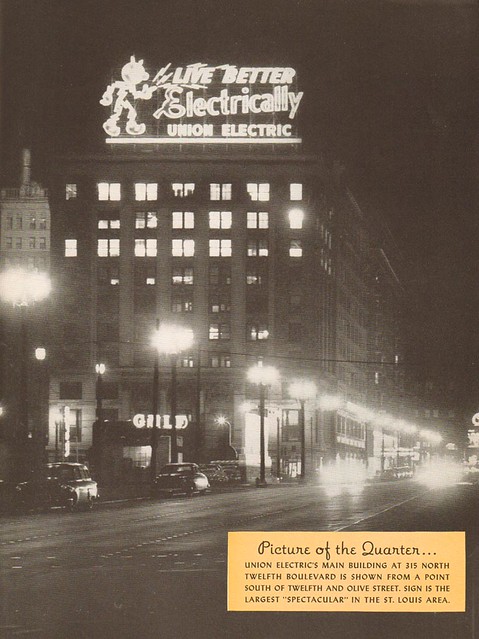
In the 1950s, Union Electric’s headquarters was decorated year-round with an impressive neon-tube sign mounted on a rooftop structure. By 1953, Union Electric had purchased the adjacent St. Louis Star-Times building to the south. The image above comes from the Summer 1953 issue of Union Electric Quarterly and shows the sign atop the Star-Times building.

Both the St. Louis Star-Times and Union Electric buildings were demolished in the early 1980s and the site (on the same block as Christ Church Cathedral) is now occupied by a tiny U.S. Bank branch building and more asphalt. There are no illuminated holiday decorations, no neon signs and no sign that great buildings ever occupied the site.