Categories
Fox Park Local Historic District South St. Louis

Interview: Why Residents Want the Fox Park Local Historic District Expanded

by Michael R. Allen

On Monday the Preservation Board granted preliminary approval to a proposed expansion of the Fox Park Local Historic District (local historic districts explained here) in south city. The proposal was strongly supported by the Fox Park Neighborhood Association. The Preservation Board considers local historic district petitions twice on an advisory basis before they are introduced in ordinance form at the St. Louis Board of Aldermen, where the Housing Urban Development and Zoning Committee again holds a public hearing.

After preliminary approval this week, I interviewed Fox Park Neighborhood Association President Ian Simmons about the ins and outs of the proposal.
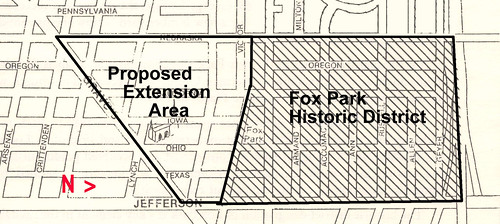
The proposed boundaries of the expanded Fox Park Local Historic District. Courtesy of the Fox Park Neighborhood Association.

Why do people in Fox Park want to expand the local historic district?

Ian Simmons: We want a cohesive neighborhood. All of the homes in our neighborhood are basically of the same stock and are all equally part of Fox Park, so there is no good reason why they should not be part of the district. Neighbors, who have lived in Fox Park for longer than I, have seen tremendous growth and prosperity enrich the neighborhood, but at a far greater pace and scale in the northern half that is within the historic district. We believe that distinction is related to the presence of historic standards guiding rehabilitation and restoration, as well as, of course, the availability of historic tax credits. While the expansion of the local historic district will not directly make those tax credits available (that will take a National Historic Register nomination), there is a danger that, in the absence of historic standards in the proposed expansion area, we may lose our historic structures, features, and value.
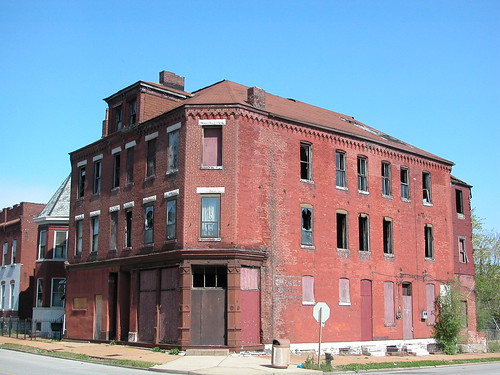
This landmark corner commercial building at the northwest corner of Magnolia and California is inside of the district expansion.

What outreach has the Fox Park Neighborhood Association done to build support for the expansion?

Simmons: During the early stages of this process, I reached out to just about every neighbor I knew or ran into that lived in the proposed expansion area and asked them if they would support the initiative; everyone was positive and enthusiastic about the idea. Once our Board formed an ad hoc committee to handle the exploration and initial steps, we added some of those supporters to our committee, and also reached out to and obtained the support of the DeSales Housing Corporation (which owns and/or manages over ten percent of the homes in the expansion area). Then we reached out to our elected officials about writing the petition. At the request and direction of Alderwoman Kacie Starr Triplett, we held three informal community meetings to reach and inform the neighbors that we had not run into, who are not members of the Association, and/or who do not attend Association meetings.

These meetings were prior to the drafting of any petition, and were held on different days and different times, so as to allow neighbors who wanted to attend the opportunity. We mailed postcard notices to all the recorded owners of the properties in the proposed expansion area. I also wrote about the meetings and the proposed expansion in our spring newsletter, a copy of which was posted on the doorstep of every home in our neighborhood weeks before the first meeting. The meetings gave the neighbors a chance to have their questions answered about how the expansion would affect them, and to express any opposition. Besides at the one which was held during our March Association Meeting, attendance at the community meeting was lighter than expected, but supportive — there was no showing of opposition.

This lovely residential row is on the north side of Russell Boulevard just east of California Avenue within the existing local historic district.

Can you talk a little bit about the boundaries and why the current boundaries are proposed?

Simmons: The route we are taking expands the boundaries of an existing district. This approach was chosen instead of creating a new district next to the existing one. For the same rationale as described above, we felt it would be better to have the same historic standards apply throughout the whole neighborhood. Also, this way, if we want to change our standards, we only have to change one ordinance. So, the boundaries of the expanded district will be Highway 44 (to the North), Nebraska Avenue (to the West), Jefferson Avenue (to the East), and Gravois Ave. (to the South). Those boundaries are proposed because they are also the boundaries of the Fox Park neighborhood. The expanded district basically moves the existing Southern boundary from the alley South of Shenandoah Avenue and Victor Street, to Gravois.

What, if anything, are you changing in the existing standards? Have you found that some of those standards are now out-dated?

Simmons: At this time, no changes are proposed to the existing standards; if signed into law, they would apply as they stand now to the proposed extension area. The only instance of “out-dated” standards, which was identified by one of our Board members, is that the existing standards do not allow the use of “green” roofing materials. It is possible that changes to the standards may be made at a later date, once the district is extended; of course, any changes would come at the request of neighbors, and only after much discussion and input from them.

If you could advise another neighborhood looking to enact a local historic district ordinance, what would you say?

Simmons: Don’t be discouraged and don’t give up! If the membership is supportive, the neighborhood association has a few people who are willing to step up, do a little footwork, and be patient, and the alderperson(s) in the proposed district are hard-working and in favor, it can be done! Even if rejected the first time, or the steps along the way take what seems like forever, at least the conversation has been started and you have moved this important process forward.
Categories
James Clemens House Metal Theft North St. Louis St. Louis Place

Have You Seen These Interior Pediments?

by Michael R. Allen

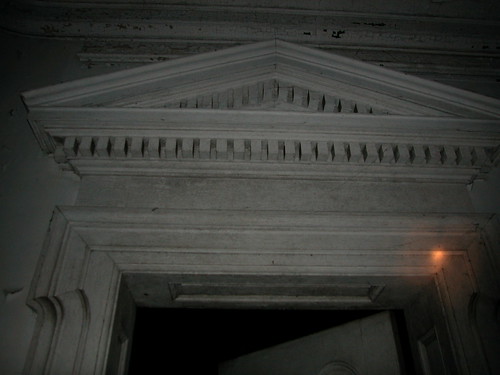
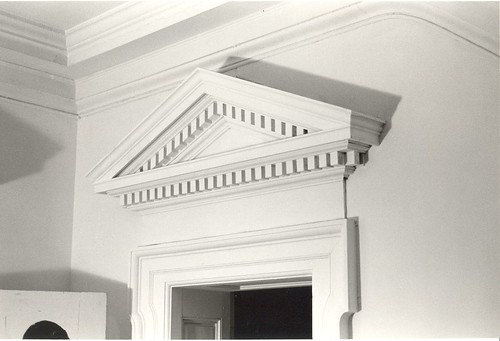
Photograph by Landmarks Association of St. Louis, 1982.

Have you seen this lovely dentillated pediment? It once was the crown of a door casing inside of the first floor hall of the James Clemens, Jr. House at 1849 Cass Avenue in St. Louis.

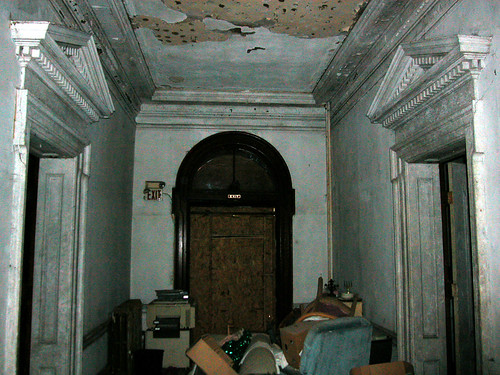
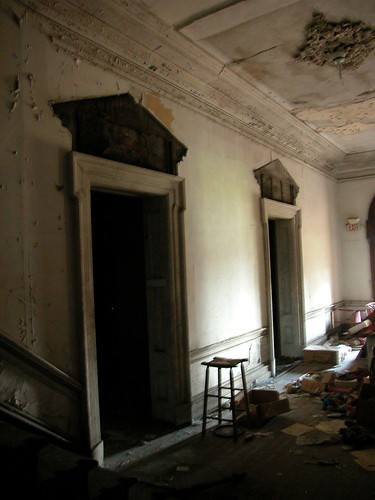
The four pediments from the center hall door openings are now missing, as these photographs show.


However, the pediments were in place in the following photographs taken by this author on May 13, 2007.

If you have any information about these stolen pediments, please drop a line. Architects at Klitzing Welsch (314-772-8073) are looking for them. It’s urgent, too — they are preparing plans for rehabilitation and need them back! Even one would be very helpful.

Categories
DeVille Motor Hotel Events

Soulard Stable Hootenanny Boosts Preservation Efforts

by Michael R. Allen

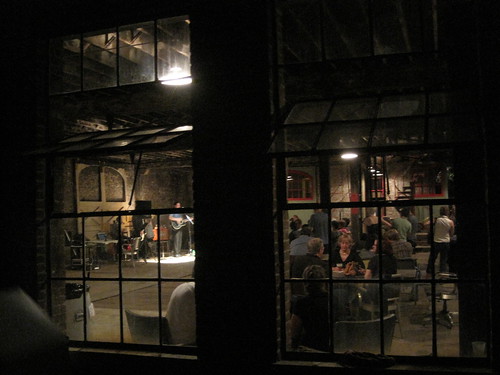
Last night’s historic preservation benefit, the Anti-Wrecking Ball’s Soulard Stable Hootenanny, was a success — at least judging from the money raised and the good time had by all. There’s something about rock ‘n’ roll, red brick and the early summer heat that makes a warehouse party just plain logical.

The show’s proceeds were split evenly between the Friends of the San Luis’ remaining legal costs and the St. Louis Building Arts Foundation’s capital campaign for its conservatory in Sauget, Illinois.

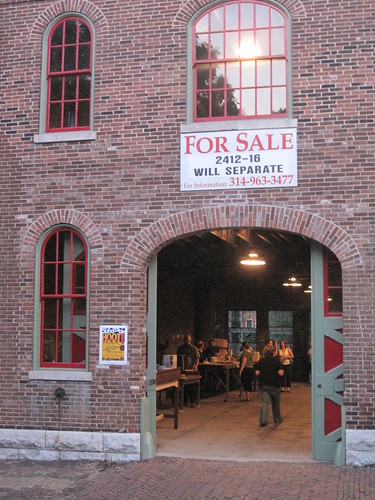
The event was held at the Foundation’s former warehouse in Soulard. Most people had never been inside of the historic former livery stable and its amazing space. The space, it turns out, was the perfect setting for a show.

One of the highlights of the evening was Bill Streeter’s unveiling of the trailer for Brick by Chance and Fortune — I can’t wait to see more!

The Union Electric, pictured above, Leadville and Pretty Little Empire rocked the house. These bands gave the gig their all. The brick and wood of the stable made the sound echo loud and clear throughout the building.

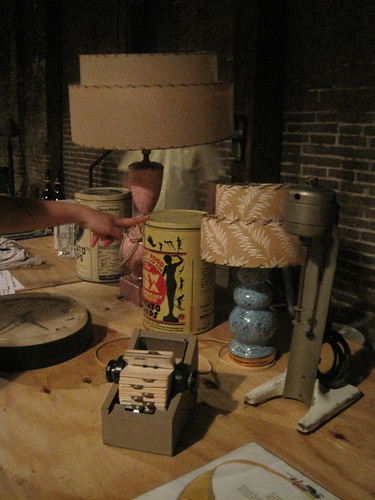
Galen Gondolfi and Dabney Frake donated a wide array of mid-century items for the raffle, which also included prizes from STL Style, St. Louis Cinemas and Schlafly. (And, yes, the pink lamp went first with winner’s choice!)


Who says preservation isn’t fun?

Bill Streeter has more photographs here.

Categories
Demolition Downtown

St. Louis Centre Skybridge Coming Down

by Michael R. Allen

At about 5:05 p.m., wreckers from Environmental Operations Incorporated made first contact between the wrecking ball and the Washington Avenue skybridge between the old St. Louis Centre mall and the former Stix, Baer and Fuller building. Wreckers used the ball to knock out some glass for a few minutes, but stopped short of inflicting major damage. Heavy wrecking has already begun, with the roof already removed before today’s ceremonial demolition.

Long forgotten, it seems, are the proclamations of urban renewal made in 1985 when St. Louis Centre opened. In a 1985 Fortune article on St. Louis’ supposed rebound, Edmund Faltermeyer wrote:

Amid great hoopla — appearances by Bob Hope and child actor Ricky Schroder and thousands of balloons — the glittering $150-million St. Louis Centre opened in August after 16 years of gestation. It is the largest enclosed downtown shopping mall in the U.S., with 1.4 million square feet.

At least Ricky Schroeder is still around.

Categories
Downtown

Scenes from Downtown, 1988 and 1989

by Michael R. Allen

Here are photographs of downtown St. Louis taken in 1988 and 1989 by Philip Schroth (1913-2001). Schroth’s son David kindly shared these with me. Philip Schroth captured downtown at a period of both grit and active street life, reminding us that downtown before recent redevelopment efforts was far from dead.

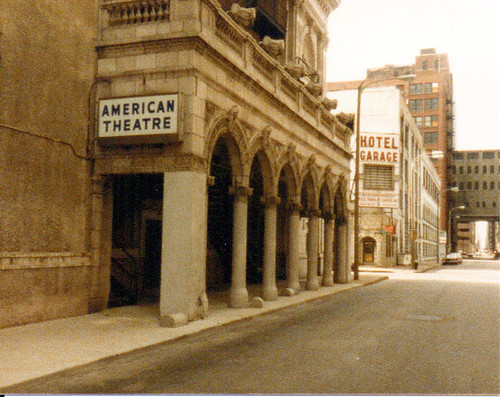
Here is a view looking west down St. Charles Avenue from east of Ninth Street. The loggia of the Orpheum Theater — then named the American — is at left. The Roberts Brothers just completed restoration of the loggia. The view forward shows the old Statler Hotel garage in the foreground and on of the Merchandise Mart bridges in the background. Both are now gone, and St. Charles no longer runs between Ninth and Tenth streets because that is where the Renaissance Grand Hotel parking garage, completed in 2003, stands. The legendary Jimmie’s restaurant was in a small building wedged between the Statler garage and Ninth Street.

Here is the A. Amitin Bookshop at 711 Washington Avenue. The store would move by the end of 1989 to 1205 Washington Avenue in the Lesser-Goldman Building. In 2003, the store closed and eventually the Lesser-Goldman Building was rehabilitated for condominiums dubbed the “Bogen.” Ironically, most of the retail spaces are vacant.

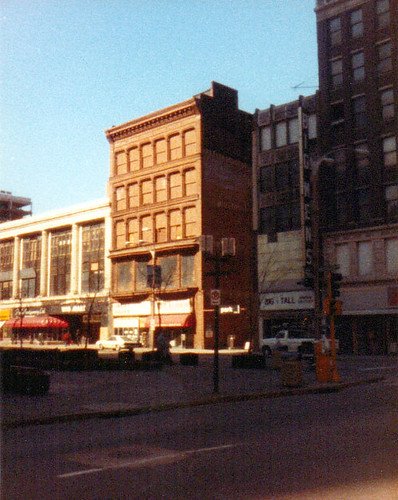
Here are two shots of the 700 block of Washington, which would be demolished one year later to make way for the new entrance to the America’s Center. The building at left is the lobby of the old Loew’s State Theater. None of the storefronts in sight here are vacant.

These old buildings were underutilized, certainly, with upper floors vacant or used for storage. Still, the first floors offered cheap rents to small retailers whose likes are all but extinct in today’s downtown.

Categories
Demolition Downtown

View from St. Louis Centre’s Washington Avenue Skybridge, 1988

by Michael R. Allen

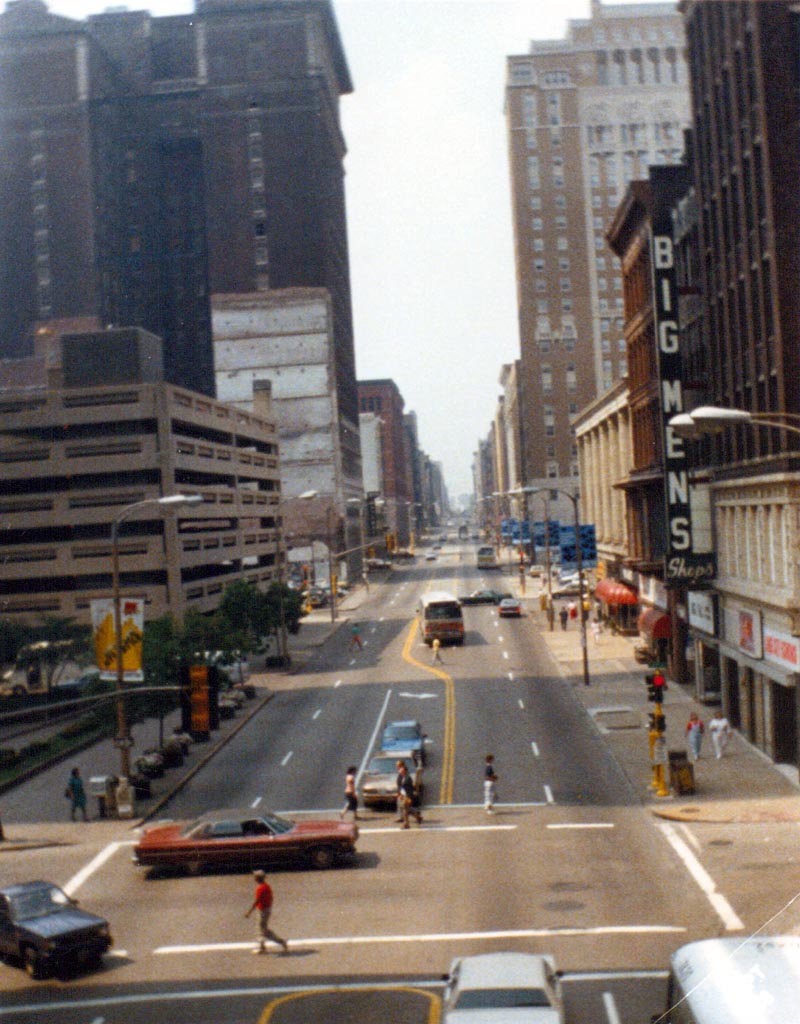
Reader David Schroth sent me this photographs taken by his father, Philip Schroth, on September 1, 1988. The photograph was taken from the Washington Avenue skybridge at St. Louis Centre, and shows a Washington west of Seventh street before the Convention Center expansion and hotel were built.

The skybridge is under demolition now, and will receive the first blow of the wrecking ball on Friday at 5:00 p.m. (or, 5:10 p.m. so that television news can pick it up live).

Categories
Events

Sneak Peak at St. Louis Brick Film Saturday

This Just In: Bill Streeter will be screening a two-minute clip from his anticipated upcoming film Brick by Chance and Fortune this Saturday at the “Anti-Wrecking Ball: Soulard Stable Hootenanny.”

Streeter’s film will examine the history of brick in St. Louis as well as what happens to brick buildings in their lifespans.

More information about the event here.

What: Anti-Wrecking Ball: Soulard Stable Hootenanny
Where: Stahl Stable, 2412 Menard Street
When: 8:00 p.m. this Saturday, May 22
Cost: $10 benefits the Friends of the San Luis and the St. Louis Building Arts Foundation

Categories
Historic Preservation Missouri St. Louis County

Fairfax House, Rock Hill Presbyterian Church, Route 66 Bridge Make Statewide Endangered List

This week, Missouri Preservation announced its 2010 Most Endangered Properties list. St. Louis area listings are the Route 66 Bridge over the Meramec River as well as the adjacent Fairfax House and Rock Hill Presbyterian Church in Rock Hill.

Rock Hill Presbyterian Church is in urgent need of a preservation plan. From Missouri Preservation’s announcement:

After being moved several times because of increasing commercial and residential development, the Fairfax House has ended up on another former Marshall property. In February 2010, it was discovered that the Giddings-Lovejoy Presbytery was seeking to sell the Rock Hill Presbyterian Church, presenting a threat to the historic church building and an additional threat to Fairfax House. This property is now situated at the intersection of two busy St. Louis county roads. It is a target for commercial development as the City of Rock Hill, which does its own zoning and has no current historic preservation ordinance, has zoned this property “commercial.”

Categories
Demolition Historic Preservation North St. Louis The Ville

Some Frame Houses in the Ville

by Michael R. Allen

The Ville has lost plenty of buildings in the last fifty years, but remarkably many frame houses remain from early development. Still, the frame houses don’t last long when abandoned. The photograph above shows three similar frame houses in the 2500 block of Whittier (across from the old Homer G. Phillips Hospital) back in 2004.

The house at 2420 Whittier dated to 1885 and was built by James Chadwick, an active developer in what was then known as Elleardsville. This house was for sale in 2004. The original clapboard siding was still in place under later asbestos tile siding. Now it is a burned out pile of building debris. The fire revealed that the original wooden shingles were still present under layers of newer roofing!

The only house remaining from the group of three that I photographed in 2004 is the house in the middle at 2518 Whittier. The date of construction is unknown, but it was probably built around 1885 too. In 1906, it was moved to this site. Today it is well-kept (although the original siding is either missing or covered) and occupied. The house at 2518 Whittier is included in an architectural survey of the Ville neighborhood conducted by Lynn Josse and myself under the supervision of the city’s Cultural Resources Office.

Categories
James Clemens House North St. Louis Northside Regeneration St. Louis Place

A (Legitimate) Look Inside of the Clemens House

by Michael R. Allen

On Sunday, Landmarks Association of St. Louis wrapped up its annual Preservation Week with a tour of the James Clemens, Jr. House at 1849 Cass Avenue in St. Louis Place. That’s right — Landmarks offered a tour of a vacant building! While there have been many “before” tours of historic St. Louis buildings, none has offered a look at such an early phase of a rehabilitation project.

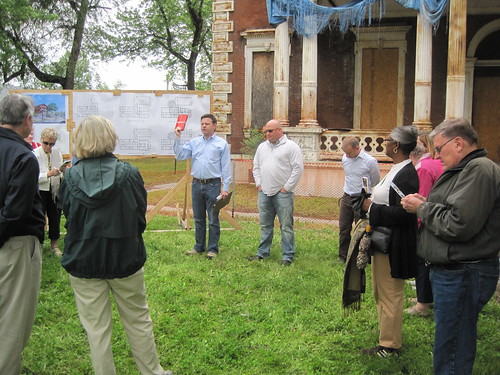
Landmarks Association Executive Director Jeff Mansell welcomes the crowd along with Dan Holak of Robert Wood Realty and David Lorentz of Klitzing Welsh.

Developers Robert Wood Realty and McEagle along with architects Klitzing Welsh Associates bravely threw open the door (okay, unscrewed the plywood) to the James Clemens House to the public for Landmarks. There was a small charge, a limited number of tour spots and a mandatory liability waiver, but all of those were necessary to make the tour work. Hopefully it can be offered again!

The developers started the tour by explaining the redevelopment plan, which calls for senior apartments in the mansion, dormitory and first floor of the chapel with an educational use in the chapel space. Nothing has been firmed up about the chapel use yet, but the original volume of the space will be restored for the first time in generations. The use of the chapel will allow for public access to the grounds, which will be opened up by removing the brick wall (built in 1887 and somewhat removed now) and building an iron fence similar to the original long lost fence on Cass Avenue. The Clemens House complex will again be easy to locate, and will open up a relationship with its neighborhood once more.

The apartment use precludes public access to the mansion and its lavish interior, and will entail some tricky accommodations like kitchenettes and bathrooms in the first floor parlors. (The dormitory is a perfect fit.) However, the project will follow the Secretary of the Interior’s standards for historic rehabilitation, and all original fabric will be retained. The extensive cast iron work will be refurbished and missing parts replicated (albeit probably in a fiberglass-based casts). I have yet to thoroughly study the details of the rehabilitation, and will continue to observe.

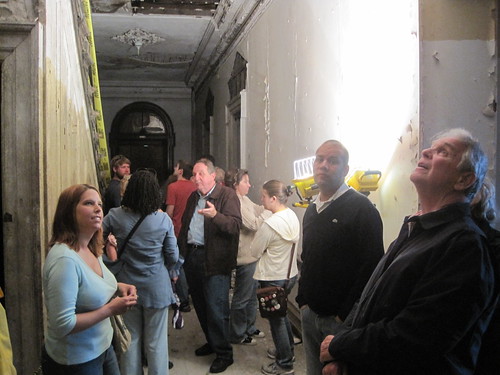
The tour offered a very limited view inside. Visitors entered at the rear of the dormitory and proceeded about fifteen feet from the front door. Structural problems in the partly-collapsed chapel and the house itself precluded further adventure. Still, what was open was lit up brightly than ever. This photographer was able to re-do some old clandestine photography!

Paul J. McKee, Jr. was prominent in the group, and was freely talking with guests. There is a long road ahead for the developer’s Northside Regeneration project, and many unanswered questions. (This post is not about them.) Yet the one certain fact is that McKee is starting the project with rescuing the James Clemens House, and that has become the early symbol of the project. It’s easy to point out how much this move benefits McKee — but easy to guess that it’s not necessarily the first move he wanted to make.

The truth is that those who benefit the most from the rehabilitation of the Clemens House, however, are residents of surrounding St. Louis Place who have long suffered from the abandonment in the heart of a largely stable area. Oh — and everyone who wants St. Louis to have an indelible, storied historic character benefits from saving this city’s most architecturally significant pre-Civil War mansion. There are eternal essences that make this city what it is, and their defense should be more fiercely and continually waged than momentary battles. After all, brick walls last longer than fleeting political maneuvers.


As an aside, Landmarks Association of St. Louis is at its best when it offers the community the chance to directly interact with historic architecture in unexpected ways. While its board has spent considerable time, effort and money on the Architecture St. Louis space downtown, the organization’s most unique strength remains the ability to forge connections out in the places where we live. Kudos to current Executive Director Jeff Mansell for doing just that with this tour!