Categories
Historic Preservation North St. Louis Northside Regeneration

Next Step for NorthSide

by Michael R. Allen

I have a column in today’s St. Louis American: “Holding McKee to his preservation promises”.

After last night’s TIF Commission vote to recommend approval of tax increment financing for the first two phases of the NorthSide, we’re moving on to legislation at the Board of Aldermen. Last night provided a show of the discontent that remains, as well as the uncertainty of financing a project as vast as NorthSide. I would say those with serious ideas for the redevelopment ordinances ahead have a great chance at being heard and making change. These are not just ordinances for Paul J. McKee, Jr. — these are ordinances for citizens of the north side, the affected neighborhoods, and for our entire city. They must reflect all of the associated aspirations for transformation.

Categories
North St. Louis Northside Regeneration Old North

More From McKee on Historic Preservation

by Michael R. Allen

At a public meeting at Ames Elementary School last night in Old North St. Louis, Paul J. McKee, Jr. again discussed historic preservation for the NorthSide project.

Notable was a new figure for the number of legacy properties McEagle plans to rehabilitate. In a YouTube video on the developer’s website, McKee stated that 60 historic buildings would be preserved. Last night, he said that number could be as high as 85. He also stated that the Landmarks Association of St. Louis (my former employer) would receive a copy of that list. Will Landmarks, city preservation officials and neighborhood leaders also be able to shape that list?

McKee had told the St. Post-Dispatch that he planned to rehabilitate the Mullanphy Emigrant Home, which is owned by the Old North St. Louis Restoration Group and targeted to be converted into a hostel by the Gateway Chapter of Hosteling International. Last night, he said simply that he would help the Restoration Group with the project if possible.

Another major concern for Old North was addressed: the fate of over 60 properties in that neighborhood owned by McKee’s companies but excluded from the boundaries of the NorthSide project. Board members of the Restoration Group asked what plans the developer has to sell those properties and prevent further deterioration to buildings.

McKee’s answer was vague: “Once we get through the development process with the city we get the [Distressed Areas Land Assemblage tax] credits approved by the state…I’ll be happy in the first quarter to sit down and dialogue about that with you.”

What if McKee does not get the credits? “You’ll be dealing with somebody other than me,” he said.

Demolition will move rapidly after city approval of a redevelopment agreement, if McKee’s plans hold true. McKee told the crowd that “within 18 months, anything that’s going to be wrecked is going to be wrecked.” According to the developer, half-destroyed houses like those this blog frequently covers cannot be demolished now due to state brownfield laws.

(I was unable to attend Monday’s meeting, so this report is derived from videos posted by Doug Duckworth on Random Talk.)

Categories
Flounder House Historic Preservation JeffVanderLou North St. Louis Northside Regeneration

Snapshots from JeffVanderLou

by Michael R. Allen

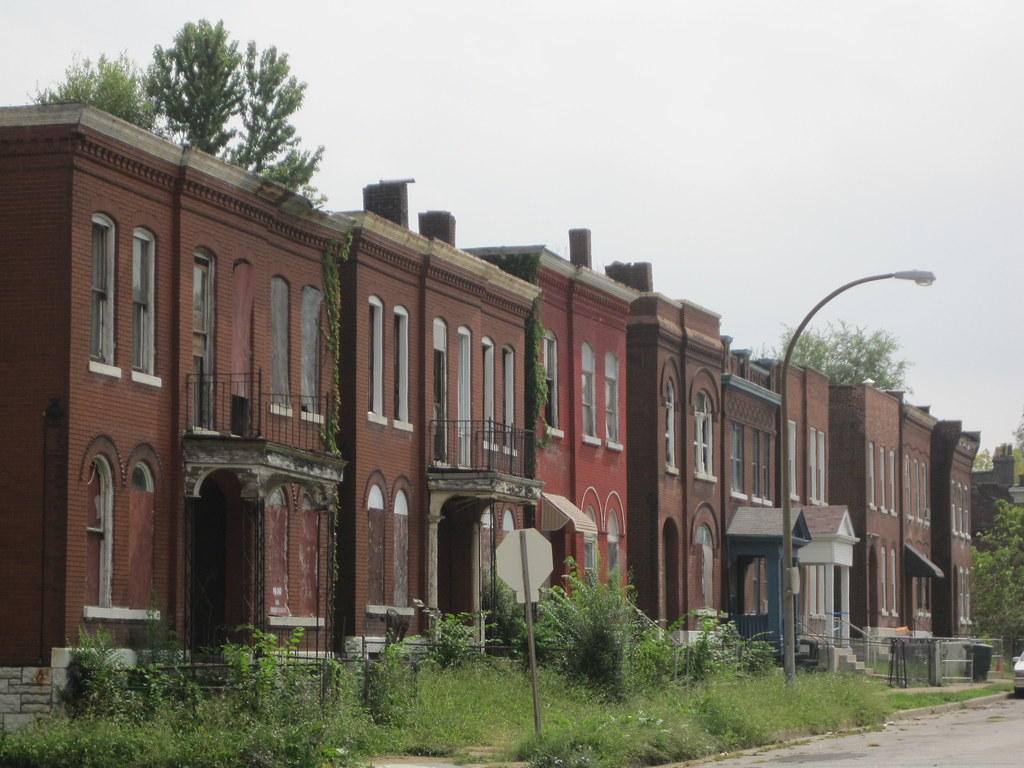
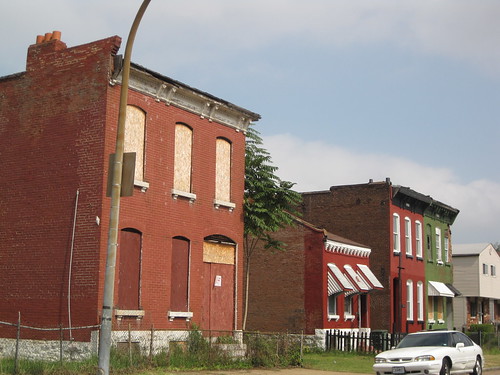
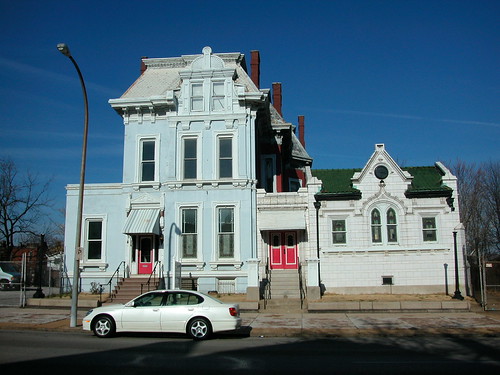
I have been working on an architectural survey in JeffVanderLou (details to come) and wanted to share some images from the area just west of Parnell and north of Cass avenues. This is a neat urban pocket filled with historic buildings dating from 1870 – 1910 that is located in the fourth phase of the proposed NorthSide project. There is the abandonment and building loss typical of this neighborhood, JeffVanderLou, but the level of historic integrity remaining is actually strong. A historic district is certainly possible here.

The image above shows one of the most splendid rows in the area: the 1700-1800 block of Leffingwell Avenue, just south of North Market. This intact street wall faces Yeatman Park (which, by the way, happens to have excellent tennis courts). Of course, this photograph shows that the four of the eight buildings at the left are vacant. However, only one of these buildings is owned by a holding company controlled by McEagle Properties LLC. Three are owned by the city’s Land Reutilization Authority (and likely to be purchased by McEagle) and the corner unit of the corner building is owned by one Hillmon Bonds.

This image cuts against the stereotype that the NorthSide area is an urban prairie with a few decrepit houses here and there. This is a block of historic homes comparable to blocks found across the city, with as many houses occupied as vacant. Every time I am on this block, people are around tending to their yards or cars. While the fates of the four vacant houses concerns this architectural historian, those fates concern the residents and owners of the remaining four buildings even more.

Take away half of this row, and what is left is diminished. The quality of life on this block would be much improved if the vacant houses were again occupied by families. The difference between a fully occupied row of historic homes facing a lovely city park and a group of isolated survivors ringed by vacant lots could not be more stark.

There is a flounder-style house at 2627 Howard Street. Flounders are indigenous to St. Louis, Philadelphia and Alexandria, Virginia, and feature a roof slope (sometimes hipped) that runs from one side of the building to the other. The origin is unknown and the prevalence unaccounted for. All we know is that these are a precious American architectural resource. This one is owned by Dodier Investors LLC, a McEagle holding company.

The rest of this block of Howard is the typical mix of vacant and occupied for the neighborhood. This photographs shows a typical density of remaining historic resources — too dense to ignore. Second from left is a one-story flounder house that is occupied. Once again, we see that historic preservation planning in the NorthSide project is crucial. Preservation here is preservation of the livability of whole city blocks.

Categories
JeffVanderLou North St. Louis Northside Regeneration

McEagle Rubble Piles in JeffVanderLou

by Michael R. Allen

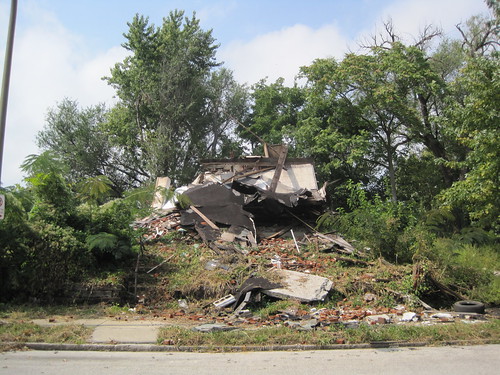
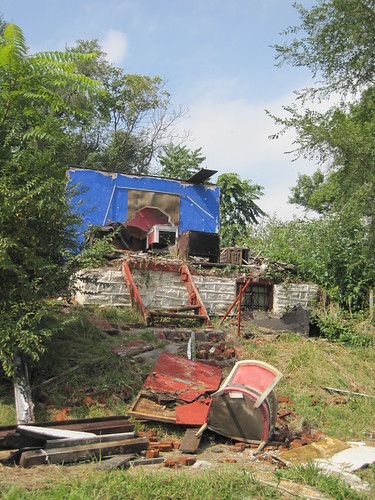
All three of these buildings in the JeffVanderLou neighborhood are owned by McEagle Properties-controlled holding companies and were destroyed by brick thieves this year or last. The rubble piles remain, one almost mockingly surrounded by cheap plastic construction fencing. Those residents of JeffVanderLou considering whether or not the owner’s NorthSide project is a good deal for their neighborhood have this evidence to consider. What else? Residents can learn more at Wednesday’s meeting of the Tax Increment Financing (TIF) Commission, at which the NorthSide project will be considered for a $399 million public TIF subsidy.

The records of these properties show that two were not vacant very long before being destroyed, and that residents had tried to get the vulnerable buildings secured to prevent what happened. The two destroyed houses on Laflin are just a half-block north of Vashon High School. Many students walk this street before and after school, passing unsecured and dangerous rubble in open foundations. The present conditions violate city public safety laws.

Address: 2526 Bacon Street
Owner: VHS Partners LLC
Citizens Service Bureau Calls for Unsecured Vacant Building: 12/18/2006, 9/22/2006
Considered Vacant by Building Division: 2001 – present

Address: 1831 Laflin Street
Owner: MLK 3000 LLC
Citizens Service Bureau Calls for Unsecured Vacant Building: 10/10/2007
Considered Vacant by Building Division: 1989-1996; Since 2009 (re-occupied 1996)

Address: 1909 Laflin Street
Owner: VHS Partners LLC
Citizens Service Bureau Calls for Unsecured Vacant Building: None recorded
Considered Vacant by Building Division: Since 2009

Don’t get the wrong idea — most of JeffVanderLou does not look like this. Most buildings are occupied and there are always children playing in the streets as well as adult pedestrians. That’s why these open foundations are such a big problem. Hopefully we don’t have to wait until the developer has state tax credits in hand to get these nuisances cleaned up.

Categories
North St. Louis Northside Regeneration

Post-Dispatch Gets it Wrong on NorthSide

by Michael R. Allen

Today’s St. Louis Post-Dispatch carries an editorial on Paul J. McKee Jr.’s NorthSide project (“Next 90 days could set North St. Louis’ direction for decades”).

Among reasonable suggestions and enthusiasm for the potential of NorthSide, the editorial’s main purpose seems to be making the case that the city of St. Louis, pension crisis be damned, should guarantee some of the tax increment financing for NorthSide, and that McEagle should be given eminent domain latitude:

Financial guarantees from the city and the use of eminent domain are “hot-button” issues with the public, and for good reason. But there is every reason to think they can be resolved in ways that both impress potential investors with a prudent city commitment and protect the public.

Well, the Post-Dispatch has it wrong here. The absence of a city guarantee is the work of the office of Mayor Francis Slay, who is not exactly an opponent of the NorthSide project. The restriction on eminent domain that will likely be in the redevelopment agreement comes from Alderwoman April Ford-Griffin (D-5th) and her colleagues involved in discussions with the developer. Again, Ford-Griffin is a supporter of the project. Ford-Griffin’s ward comprises 80% of the proposed project area, and her constituents are up in arms about eminent domain. McKee says that he only wants 20 parcels through eminent domain anyway, although the developer has not provided a list. Disallowing broad condemnation rights on this project — which may take over 30 years to complete — makes sense. Life has to go on for residents while McKee is working on the Downtown West and Mississippi River Bridge landing phases of his project.

If public officials who support the project have placed limits on the public financing and eminent domain use for NorthSide, that’s for good reason.

Categories
North St. Louis Old North St. Louis Place

Rehabbers Club Tour Old North, St. Louis Place Tomorrow

The former Leidner Chapel, 2223 St. Louis Avenue.

Rehabbers Club Tour of Old North and St. Louis Place
Saturday, September 19, 2009
9:30 a.m.
Meet at 3001 Rauschenbach

ReVitalize St. Louis’ September Rehabbers Club will feature north St. Louis neighborhoods. There is a rich history and continued strength in these neighborhoods. We’ll explore St. Louis Place and Old North.

We will gather at 3001 Rauschenbach Ave. This 3-story home was built in the late 1800’s by a tobacco merchant. Over the years it was used for institutional purposes
(halfway house for boys, pregnant single women, etc). Its current owner has been restoring the home back to its original grandeur. There are 4 marble fireplaces on the first floor along and near all of the original woodwork and pocket doors are intact.

Next we’ll head over to 2223 St. Louis Ave. This for-sale-property is a rehab opportunity. While the main house was built in 1879, the building was expanded in 1921 by the Henry Leidner Undertaking Company. Over the years it has been the Victory Baptist Church and then the Bible Way Church. Bible Way moved out in 2006 and is looking for a rehabber to purchase the building. Reverend Harsley will lead a tour of the structure and provide additional historical information as well as spec’s on the sale of the building.

One stop is a historical review of the James Clemens Mansion located at 1849 Cass Ave.
Michael Allen, an architectural historian and blogger for Ecology of Absence will share the history of the mansion and discuss its current state.

Just added to the tour is a full-rehabbed house at 1411 Hebert Street in Old North, currently up for sale.

We look forward to seeing you on Saturday morning. Call Scott McIntosh, ReVitalize St. Louis Programming Chair at 314-719-6507 with questions.

Categories
North St. Louis Northside Regeneration

McEagle Explains TIF Request in YouTube Video


McEagle takes to YouTube again to explain the NorthSide tax increment financing request (TIF).

Categories
North St. Louis Northside Regeneration

Trojan Horse?: St. Louis Public Radio Examines NorthSide This Week

by Michael R. Allen

Today, St. Louis Public Radio aired the third story in its four-part series on the NorthSide project. Today’s story by Matt Sepic carefully looks at community concerns about eminent domain and relocation. Part of the story deals with the Trojan Ironworks, an active family-owned maker of steel beams and metal other building components, located in St. Louis Place. McEagle Properties’ Chairman Paul J. McKee, Jr. told an audience of north side residents assembled at Central Baptist Church on May 21 that he would not relocated a single job out of north St. Louis, but would bring many thousands more. Trojan may not have the resources to survive relocation. Sounds like the developer and the small iron works are on the same page.

The entire St. Louis Public Radio series is available online here.

Categories
North St. Louis Northside Regeneration

Revised NorthSide TIF Redevelopment Plan Online

The 55-page tax increment financing redevelopment plan for the NorthSide project is online courtesy of the St. Louis Post-Dispatch. Read it here.

Categories
Historic Preservation James Clemens House North St. Louis Northside Regeneration St. Louis Place

Clemens House Wall Collapse Highlights Continuing Neglect

by Michael R. Allen

Over a week ago, gaping hole appeared in the front yard wall at the James Clemens, Jr. House (1849 Cass Avenue in St. Louis Place). The cause of the collapse was structural failure, but the hole and its resulting brick debris attracted a truck load of thieves warded away by vigilant neighbors. Since the wall’s partial collapse, the hole has attracted photographer, a television news crew, concerned neighbors and property owners, thieves and — not surprising — no maintenance crews from Clemens House owner McEagle properties.

The wall remains breached, and the brick bats piled behind the breach right where they fell. When McEagle’s representatives talk about saving the Clemens House, what do they mean? A June draft of the revised tax increment financing (TIF) application for the NorthSide project showed an $8.6 million budget for rehabilitation of the Clemens House — in the project’s second phase with no item for repairs in the first phase — with 100% of the funds to come from TIF funds (at least prior to historic tac credit reimbursement).

While the final TIF application due out tomorrow may not include that line item, the draft idea is discouraging. What if the TIF does not pass the Board of Aldermen, or what if it passes without city backing and McEagle cannot monetize the TIF? The most pressing point is that there is no indication that structural issues like this fence failure or last year’s chapel wall and roof collapse will be abated before TIF funds are available.

This photograph of the wall that I took before the collapse shows the massive inward bow of the wall. The wall’s weight load was shifted askew. Additionally, the wall is tuckpointed incorrectly with a hard mortar, which forces moisture weeping through the bricks instead of the mortar joints. Over times, the bricks in the bow have split due to shifted weight load’s resulting stress, and have been weakened by the hard mortar. A collapse was building.

Of course, this is not the first part of the wall to fall. The limestone return of wall on the east is missing, all of the way through the corner at Cass Avenue.

There is also a partly-collapsed section in front of the chapel at this end. This section collapsed in 2005.
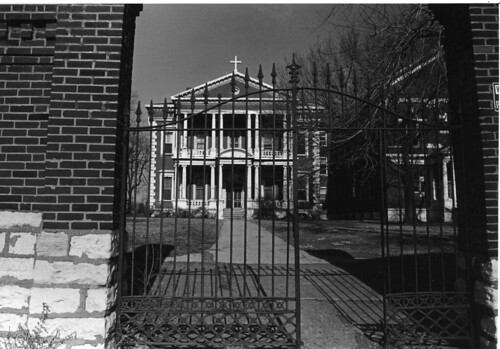
A central feature of the wall was the wrought iron gates, crudely removed by a thief after the Berean Missionary Baptist Association vacated the Clemens House in 2000. This photograph comes from the Landmarks Association of St. Louis and dates to 1980.
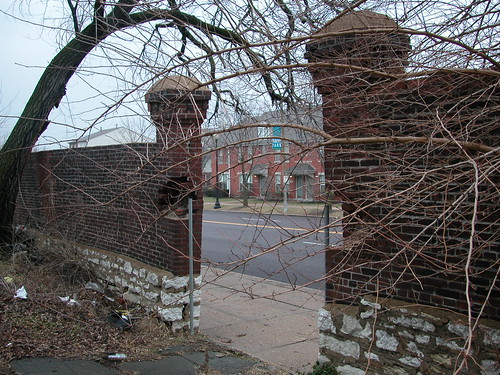
Here’s the reverse view in early 2008, showing the damage to the wall caused by hasty removal. My guess is that the thieves tied each gate to a pick-up truck, and pulled them off by accelerating. Perhaps the gates were mangled in the process and ended up in the scrap yard instead of the salvage shop. (Any dealer who accepted and then sold these gates deserves prison time, by the way.)
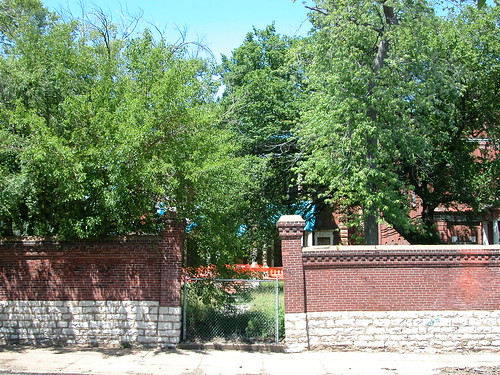
So now the Clemens House sits behind an unstable, damaged high brick wall missing its iron gates.
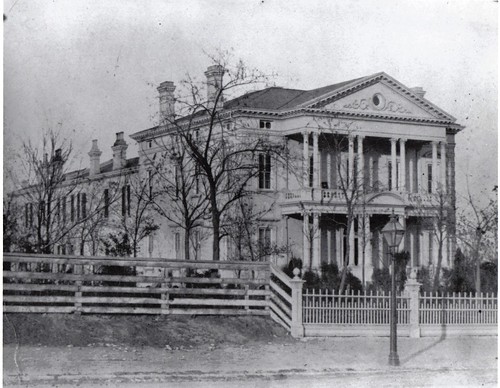
Once upon a time, back in 1860 when this silver albumen print was made, the mansion sat behind an elegant iron fence. The iron fence was low and afforded great views of the majestic house. The fence ended at the wooden fencing that surrounded the rest of the Clemens estate.

Preservation of the Clemens House need not retain the later brick wall, which suffers disrepair and obscured views of the house and its later chapel addition. One possible plan would be demolition of the later brick wall and replication of the original iron fence, would would reconnect the Clemens House to the Cass Avenue streetscape and surroudning neighborhood.

However, the fence plan would have to be made as part of a total preservation plan for the site that would take into account use of historic tax credit programs that come with review guidelines that may necessitate retention of the existing wall. To date, there has been no preservation plan produced for the Clemens House — no historic structures report, no structural assessment, nothing. Until McEagle produces a plan, the brick wall needs to be stabilized. The breaches should be closed, and the wall should be braced. If the wall comes down, that act should be planned.

For now, the gaping hole stands as naked testament to the lack of planning for the future of the Clemens House. I want the house to be saved, and I want McEagle to make preservation a priority that is not tied to the outcome of the TIF financing. The Clemens House remains one of the city’s most important 19th century buildings, and its fate truly is of regional concern. McEagle should fix the wall and then work on a serious preservation plan with stabilization work occurring in the first phase of the NorthSide project. Can you imagine a better good will gesture than prompt maintenance and early stabilization? Once stabilized, as the Mullanphy Emigrant Home demonstrates, a building will buy significant time for reuse planning. No preservationist that I know is hollering for McEagle to reopen a fully-restored Clemens House immediately. We just want to make sure than no part of it — including the chapel, which is not far gone despite visible damage — falls down.