Categories
Housing North St. Louis Vandeventer

Romanesque Revival Flats From the Gilded Age

by Michael R. Allen

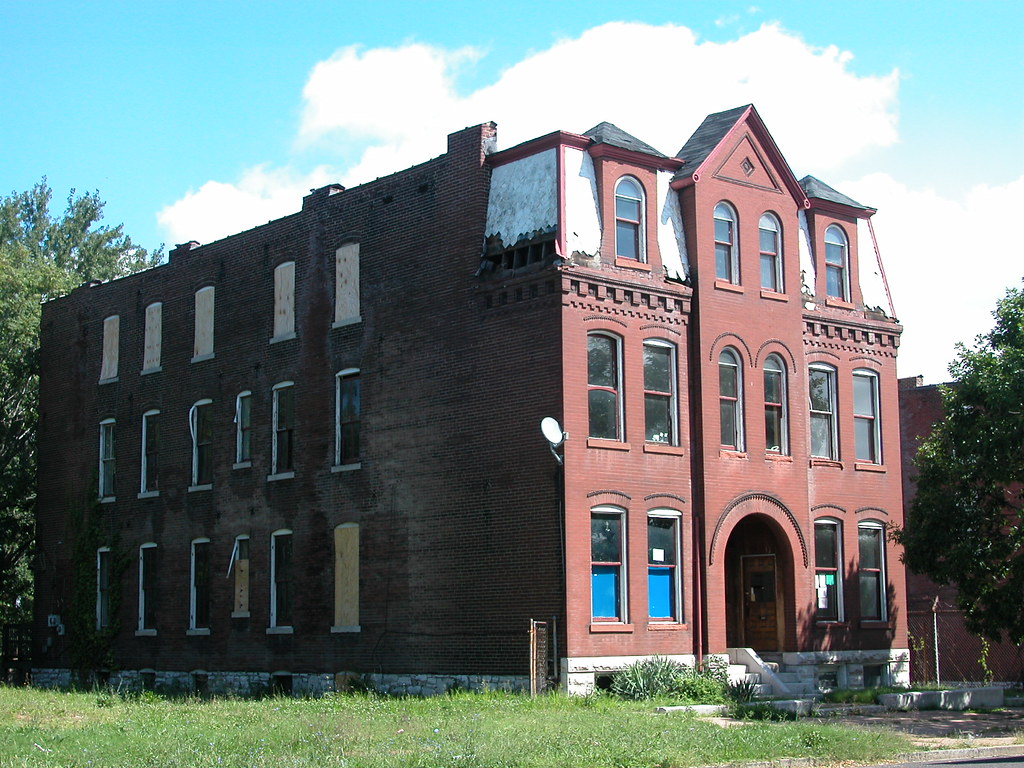
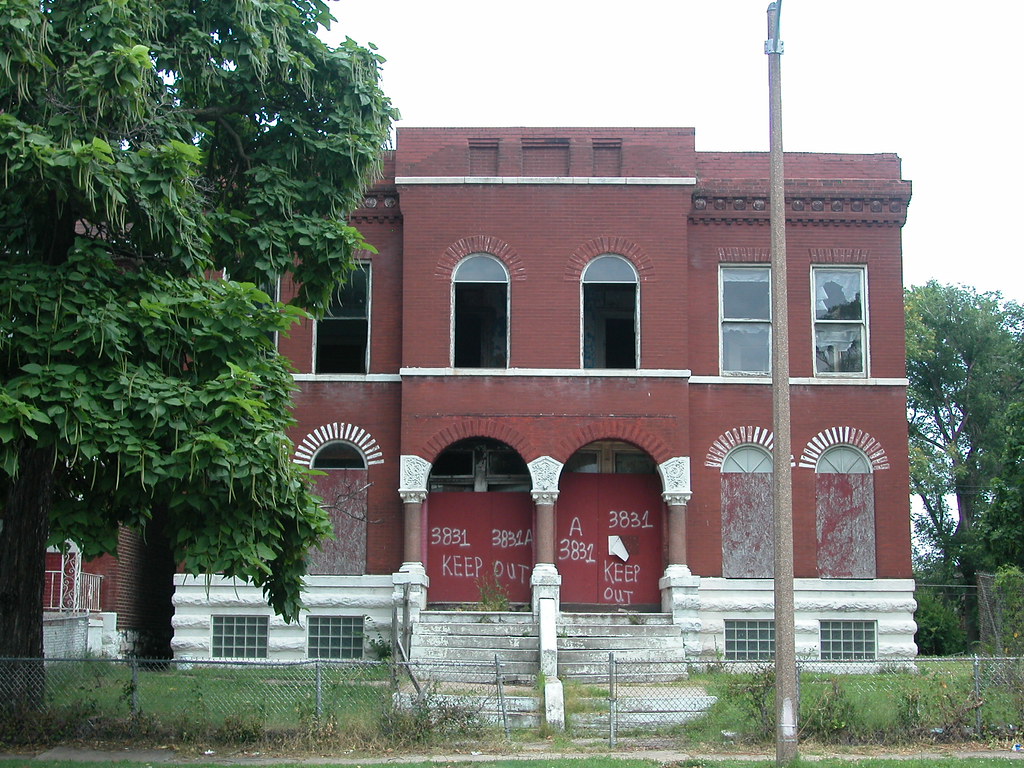
Each time I travel west of on Page Boulevard, I keep an eye out for the double set of flats at 3831 Page. Although vacant for the past five years or more, the building always brings a smile to my face. In a city full of distinguished examples of many popular architectural revival styles, this Romanesque Revival building may not be the showiest or most significant, but it sure sticks in my mind. For one thing, the entrance is grandiose — polished Missouri granite columns rise from a rusticated white limestone foundation to support carved limestone voussoirs. The voussoirs buttress standard Roman arches of machine-pressed brick. The columns are extravagant on entrances that lead to double doors, signifying that this building houses four middle-class families, not one wealthy one. Beyond the impressive effect created by having Roman arches on all first floor window openings — and the striking but inappropriate alteration of white-painted bricks in each arch — the flat-roofed building possesses stock traits.

Yet this building is a great example of the triumph of machine processes in common stock architecture. That rusticated limestone base was cut to “rough” perfection by machine tools. the granite columns polished by machine. The bricks were pressed by a press. Even the carved limestone work is the result of pneumatic chisels, guided by craftsmen but powered by steam. After all, this house dates to a September 18, 1893 building permit reporting a construction cost of $8,000. Mighty St. Louis had already built the Wainwright Building and Union Station, and its craftsmen were deft with new technology. Its residents were full of wealth and the swagger to proclaim the growing city’s greatness through every brick laid around town. In the 1890s, the house at 3831 Page was one of a multitude demonstrating the superior industrial and architectural imagination of the river city in the American Gilded Age.

The pedigree of this house also shows the westward creep of the city. Its developer, Charles Schockemiller, was residing at 2228 Biddle near the Kerry Patch. The contractor, Hemminghaus and Vollmer, had offices at 1417 Destrehan in Hyde Park. The architect, German-born Gerhard Becker, maintained an office at 1017 Chestnut Street and was noted for designing factories on the near north side like the Eckhoff factory in present-day Old North and the Standard Stamping Company building on North Broadway. All German names, and all tied to points east but plotting the westward development that would fill the city’s boundaries with a plethora of magnificent houses, tenements and even factories.

Categories
Historic Preservation Housing Mid-Century Modern North St. Louis Northside Regeneration St. Louis Place

Lemonade: A Remade Section 235 House

by Michael R. Allen

A row of Section 235 Houses on North Market Street west of 25th Street in St. Louis Place.

The 1968 federal Housing Act created the Section 235 Program administered by the new Department of Housing and Urban Development (HUD). The Section 235 Program enabled many Americans to become homeowners through its generous assistance: HUD made interest payments to lenders on behalf of homeowners in the program to effective reduce their monthly loan interest. The amount paid was based on the borrower’s income. In the 1970s, when interest rates were often above 10%, this program’s need was clear. The authors of Section 235 intended the program to move low-income residents as well as federal subsidy away from mass housing projects and into neighborhoods and suburbs. Of course, the lofty dreams trickled down into something less idealistic.

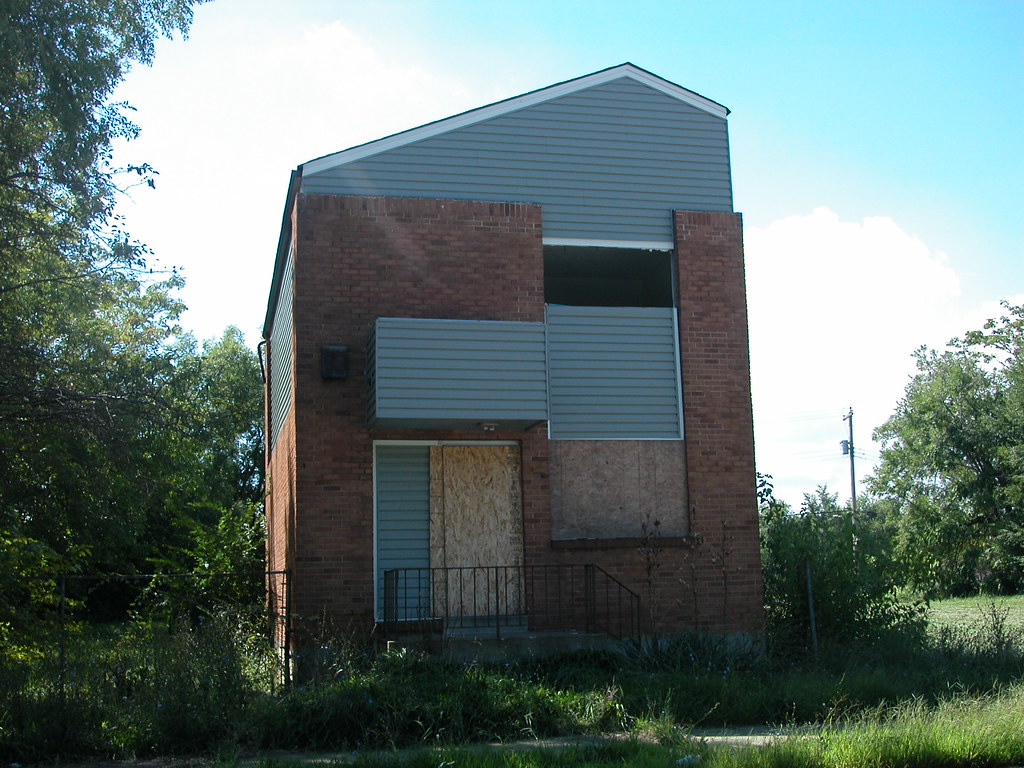
In reality, the program was a boon to lenders and builders but less freeing to participants. Section 235 mostly shuffled people around decaying neighborhoods, and its implementation was rarely coordinated with other programs to stabilize these places. In St. Louis, the use of the program was extensive in the 1970s and created several distinct forms spread across north St. Louis and parts of the near south side. One of these is the ubiquitous “Section 235 House,” a two-story platform-framed house with a low-pitched front gable and a second floor that overhangs the first.

There are variations on cladding, but the St. Louis Section 235 Houses mostly resemble each other. The St. Louis Section 235 House mostly interjected intself out of context, alongside historic homes that dwarfed and mocked the banal newcomers. What could have been very modern was often festooned with mock shutters, brick veneer on the first floor (improbably holding up an overhang) and other architectural absurdity. The homes set back too far from the street and from each other to mimic the truly urban forms of the St. Louis vernacular, and tended to stick out as proverbially sore thumbs.

The Section 235 House at 2322 Montgomery.

Meanwhile, other, better-off St. Louisans stayed in the city by moving into Modern Movement high-rise towers designed by “name” firms. Still, owners of the Sction 235 Houses often cast their own designs on the houses, leaving us with a legacy of rebellion against the planned form. One of the best examples stands at 2322 Montgomery Avenue in St. Louis Place. Built in 1971 and now vacant, the house barely registers as a Section 235 House. The overhangs were elminated, the gabled roof removed and rebuilt as an asymmetrical modern roof, and the front clad in a tasteful brick. Someone made this house his or her own, and the result is quite lovely. unfortunately the house, which city records show as owned by Larmer LC, stands vacant. While the house might be out of place in St. Louis Place, it sits on a block that has lost architectural consistency. Preservation seems wise and, to this writer, desirable.

Categories
Historic Preservation North St. Louis Planning St. Louis Place

Big Picture View

by Michael R. Allen

This view is one of mt favorites in St. Louis Place. the view west toward St. Liborius church from Florissant Avenue is framed on the north side of Monroe Street by a row of lovely brick vernacular houses. I framed this shot to exclude the more troubling context across the street: empty lots, with vinyl-clad houses to the west. However, even in a broader view the beauty of this row, shining through decay of two of the buildings, and the church overpowers the unsightly surroundings.

However, the view is a fragile thing. The three-story Italianate style corner building built in 1876, an imposing building that is one of Florissant’s last corner anchors here, has suffered intense roof damage. Three years ago, the building retained a rusty but intact standing-seem metal roof. This was perhaps the last such roof in St. Louis Place or Old North, even though the metal roofs used to be common on buildings of many roof types. Then, in July 2006, heavy winds vitually peeled the roof back and removed a lot of the sheathing. The owner, a limited liability holding company called KGA Properties LLC, draped blue tarps across the hole. The tarps themselves were destroyed in a few months, and the building’s interior remains unprotected. What damage is transpiring would probably break a heart.

What is KGA Properties? This is a north side LLC name that is not part of any blogger litany. Well, the LLC’s registered agent is Delores Gunn, director of the St. Louis County Department of Health. Redevelopment efforts are stalled.

Next door to the west, a classic side-entrance, three-bay house at 1507 Monroe Street is owned by Paul McKee’s VHS Partners. People do know that three-letter LLC. Next door to the west is an owner-occupied home; beyond that, where Monroe bends, is a double house that is privately owned. We can see what those owners want to do with their historic homes — keep them occupied and maintained. The plans of their neighboring corporations remain uncertain. I’m sure that the owners of the occupied houses sigh each time they pass by the empty buildings next door.

The near north side is full of pockets like this one, with amazing historic architecture, some abandoned, surrounded by vacant land and new buildings. It’s the urban patchwork quilt few want to mend due to the difficulty of repair. Owner occupants hang on hoping for the best, while developers might also be hanging on in a different way, waiting for a political process in which redevelopment can happen. If the homeowners and the developers are both to be happy, we need leadership that represents the best interests of the near north side and its future to open the dialogue that will lead to redevelopment. Private interests get discussed a lot when people talk about the near north side, but what about the public interest?

There is more than just the future of individual owners and buildings at stake. After all, each of the buildings in the first photograph are privately owned, but they compose a lovely urban view free and accessible to all. Each homeowner is part of a neighborhood made of many people. Step back, and there is a big picture view of the near north side. I hope that our political leaders see it.

Categories
Historic Preservation North St. Louis Old North Rehabbing

One Year in the Life of a House on North 14th Street

by Michael R. Allen


The house at 2817 N. 14th Street in October 2007.


The house at 2817 N. 14th Street in October 2008.

One year can make or break the life of a historic building. Fortunately, for the mid-19th century house at 2817 N. 14th Street in Old North St. Louis, the last year has made the house — or remade it, to be more exact. One year ago, the building was a mess — the roof structure was sinking, so much of the building had collapsed inside of itself that access was impossible and wooden bracing was erected against the front wall.

Today, the building has been rehabilitated as part of the Crown Square redevelopment project and is receiving finishing touches to prepare for its new residents. Of course, along the way there were the complications one would expect with such a decrepit building. During masonry repair, the house suffered a large collapse that caused many neighbors to worry if rehabilitation would continue. The collapse turned out to be all in a day’s work for general contractor E.M. Harris Construction Company and the development partnership of the Old North St. Louis Restoration Group and the Regional Housing and Community Development Alliance. The house was rebuilt to original exterior appearance, using all of the original brick that survived the collapse and years of decay. What was one of the worst-looking buildings on 14th Street is now one of the best!

Categories
Historic Preservation Housing North St. Louis The Ville

Buildings on Dick Gregory Place, Martin Luther King Drive Slated for Rehabe

by Michael R. Allen

MayorSlay.com reports good news from the Ville that has been rumored for awhile: rehabilitation of several buildings on Dick Gregory Place and Martin Luther King Drive by the Ville Neighborhood Housing Corporation, Northside Community Housing and the power-house Regional Housing and Community Development Alliance. The project will create 40 affordable rental residential units. Since Missouri Housing Development Commission application is pending, the good news won’t be great news for awhile. However, the prospect alone is welcome in the Ville, where preservation is a thorny question. Kudos to the parties named here and Alderman Sam Moore (D-4th), who had to suffer a You Paid For It slam for his willingness to help this project move forward.

Categories
Historic Preservation North St. Louis St. Louis Place

1913 St. Louis Avenue: A Preservation Challenge

by Michael R. Allen

Here’s the lovely Romanesque Revival building at 1913 St. Louis Avenue in St. Louis Place. Built in 1892 and reasonably well-kept over the years, the building took a turn for the worse this year: foreclosure. The private owner could not keep up with payments on a Department of Housing and Urban Development-backed loan, so HUD foreclosed. The tenants moved out. The front doors were busted in. Aluminum storm windows walked off. The front gutter disappeared, pulling slate tiles with it. Interior items disappeared.

Every step of the way was painful to observe. The stately old six-flat
had all of its original parts — slate mansard roof, wooden doors and windows and tin gutters. I’m sure that the now-pillaged systems needed upgrading, but the building was almost exemplary in the level of care bestowed on it.

Now, what would have been a straightforward rehab for an investor or owner-occupant has become a complicated mess. The building is huge, damaged and located on a stretch of St. Louis Avenue that needs considerable redevelopment. Unfortunately, the house lies just north of the present Clemens House-Columbia Brewery Historic District, meaning the extensive work needed to repair the house is not automatically eligible for state and federal historic rehab tax credits. The bright side is that extending the district boundary would not be impossible, but such work easily adds $5,000 in professional fees to the cost of rehabilitation.

At this point, given the condition of the building and the credit crunch, 1913 St. Louis Avenue is a project beyond the means of small developers. HUD had it listed for sale, but the listing is now gone. I doubt that many people would have even considered it right now.

How do we safeguard this building for better economic times? There is no other building like this one in St. Louis Place, and its condition hardly merits even contemplation of demolition. Rehabilitation is the right thing to do. Who will do it?

(For more information about this block, see “Passage of a Block Face: 1900 St. Louis Avenue, North Face,” May 5, 2008.)

Categories
Historic Preservation Mullanphy Emigrant Home North St. Louis Old North

Mullanphy Emigrant Home Stabilized for Winter

by Michael R. Allen

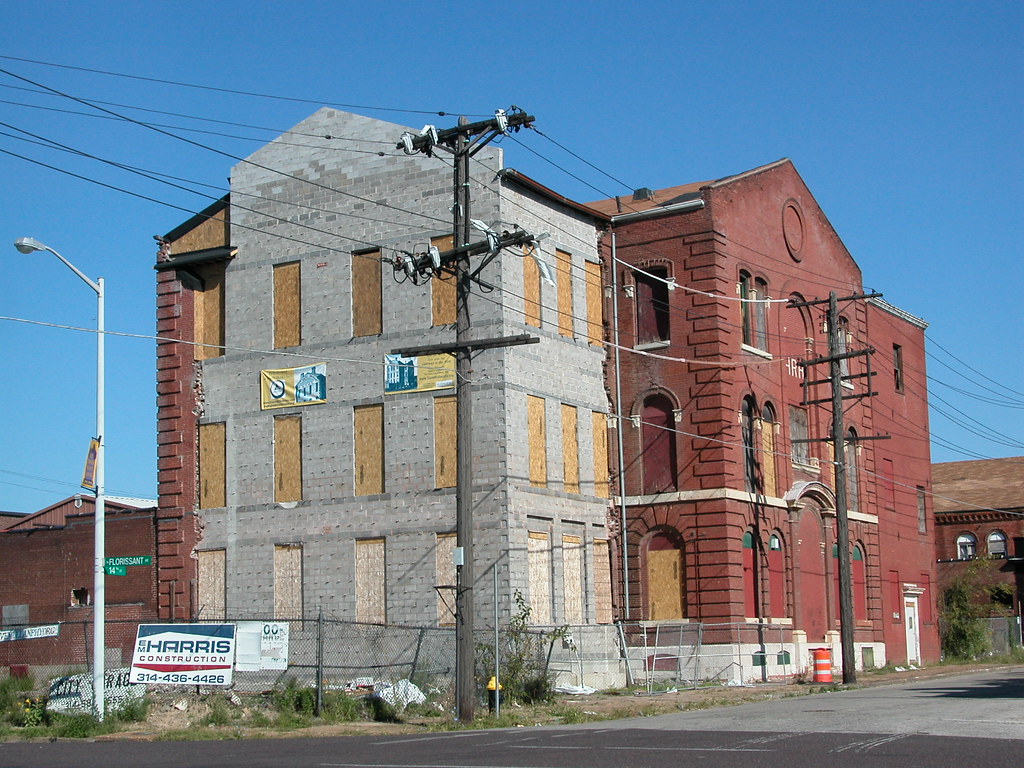
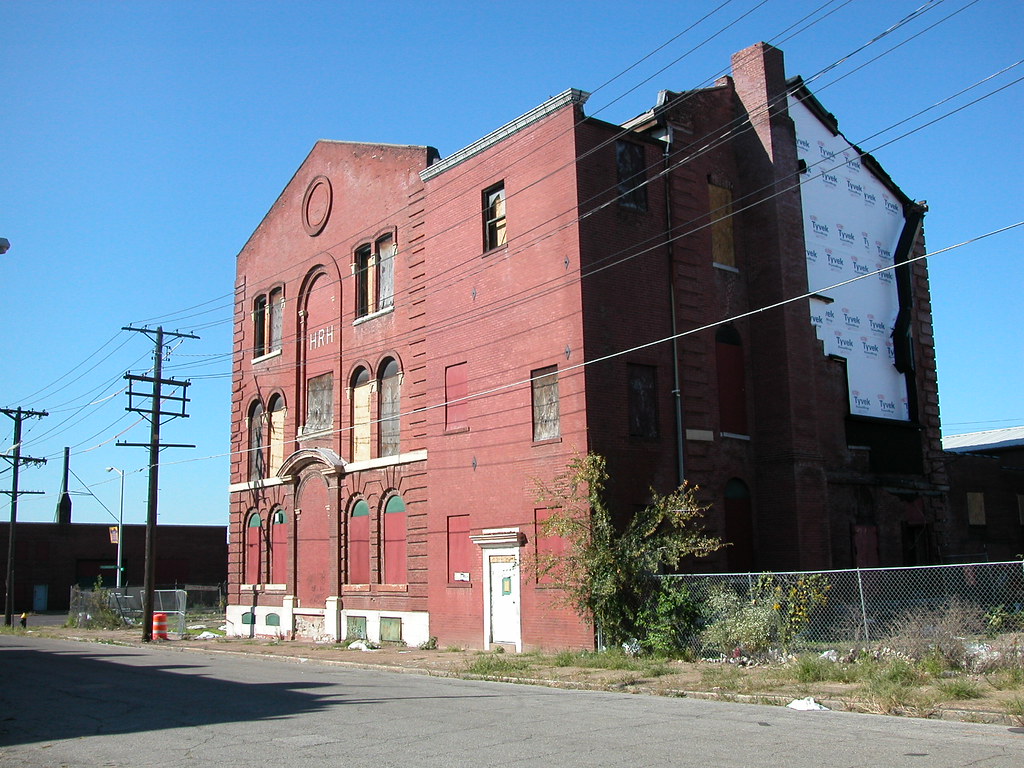
The Old North St. Louis Restoration Group recent appropriated funds to complete the enclosure of the Mullanphy Emigrant Home at 1609 N. 14th Street. Although the work did not include further masonry work, the scope resulted in a total air- and weather-tight condition for the building. The Emigrant Home has not been sealed up since the first damaging storm struck it in April 2006.

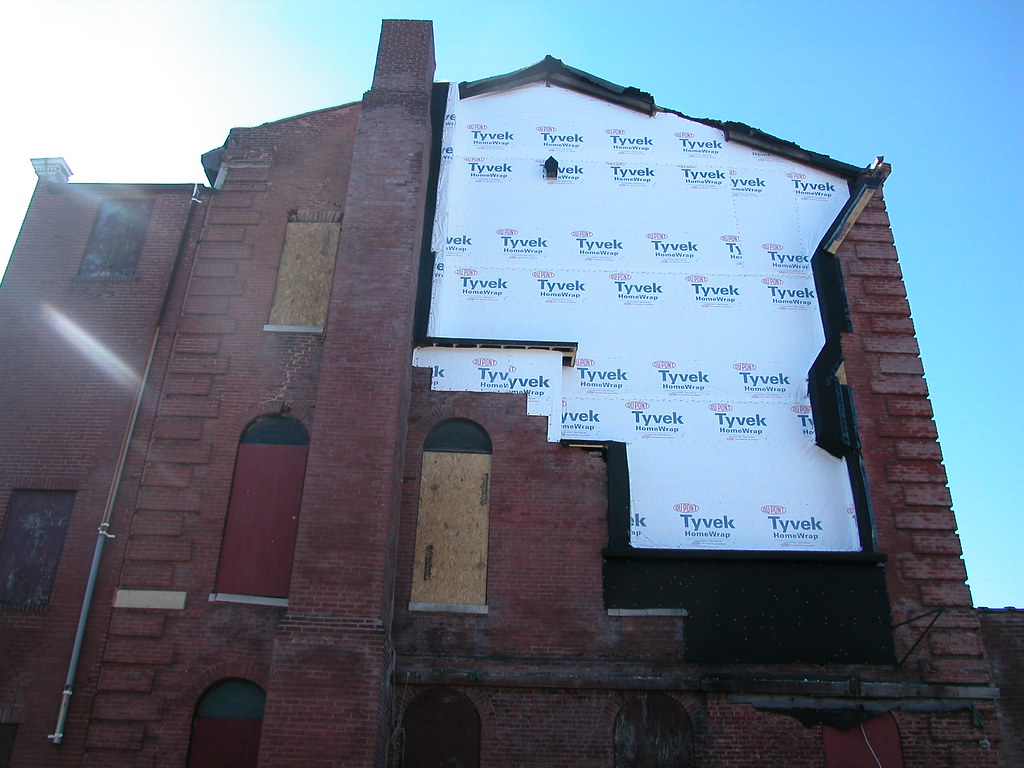
Workers from E.M. Harris Construction Company boarded all of the building’s window openings, covered the gap between the new south wall and the existing roof, sealed the opening at the top corner of the south wall and sealed the giant hole on the north wall. Since funds for masonry work on the north wall don’t exist yet, a more modest plan was needed. E.M. Harris essentially boarded up the whole opening with framing, plywood and Tyvek wrap. This work included construction of watersheds over existing sections of the north wall, keeping them dry.

Now the Mullanphy Emigrant Home is fully sealed before winter — what a relief! In the current state, the building is stable as it awaits further repairs. Old North has demonstrated that a big building can be sealed up long before funds for major masonry repair are available. Obviously, the materials used are not as sturdy as actual brick and block, but they will ensure the building’s survival. Such stabilization could be implemented on other endangered buildings, including the James Clemens, Jr. House, Carr School and the Fourth Baptist Church.

Categories
North St. Louis Northside Regeneration

Mayor Slay States Principles for Near North Side Redevelopment

by Michael R. Allen

Per St. Louis Patina, here is part of a letter from St. Louis Mayor Francis Slay to Alderwoman April Ford-Griffin (D-5th) that Ford-Griffin read at a rally held Saturday at Sts. Teresa and Bridget Roman Catholic Church:

I strongly support more private investment in the 5th ward as long as it creates quality jobs and improves the quality of life for the people who live in the 5th ward.

Any development must reflect the ward’s diversity. It would be beneficial if it includes both affordable housing and market rate housing.

Any major redevelopment plan will not go forward until and unless there is public input, which includes open dialogue among the developers, the residents and elected officials.

I will not support eminent domain for owner occupied properties.

I will not support a redevelopment plan that does not have community support expressed through the community’s elected representatives.

I will oppose Old North St. Louis being part of a major redevelopment plan unless the residents want to be included.

My administration will not sell LRA holdings as part of a major redevelopment plan unless the community supports the plan through their elected representatives.

Anyone who owns property in the 5th ward must take care of it by meeting codes to ensure public safety and health.

The mayor’s words echo statements by Develop With Dignity, Neighbors for Social Justice, Alderwoman Ford-Griffin, leaders of the Old North St. Louis Restoration Group, urbanist bloggers and even Paul McKee. There now seems to be consensus on some basic parts of redevelopment of the near north side neighborhoods that have attracted so much attention in the past three years. I’m amazed at how many different parties are saying similar things. Of course, the next step is figuring out details of redevelopment and moving past sweeping statements. We have come a long way in the process but there is a long way to go. Hopefully, Slay’s letter indicates that city government is ready to show leadership in facilitating the dialogue needed to move things forward.

Categories
Abandonment Historic Preservation North St. Louis Old North

North 13th Street and the Future

by Michael R. Allen

Look at the west face of the 2900 block of North 13th Street in Old North in April 2005. While only one building was occupied, we had a solid, uninterrupted row of historic buildings running from Sullivan Avenue north to Hebert Street. I took this photograph while house hunting, and looked at it frequently to confirm that my decision to purchase a house on Sullivan across the street from Fourth Baptist Church (right at the corner) was a good one. Some would have run away from the prospect of living in close proximity to an unhealthy row, no matter how beautiful its individual buildings were. I was intrigued by the possibility of glorious renewal.

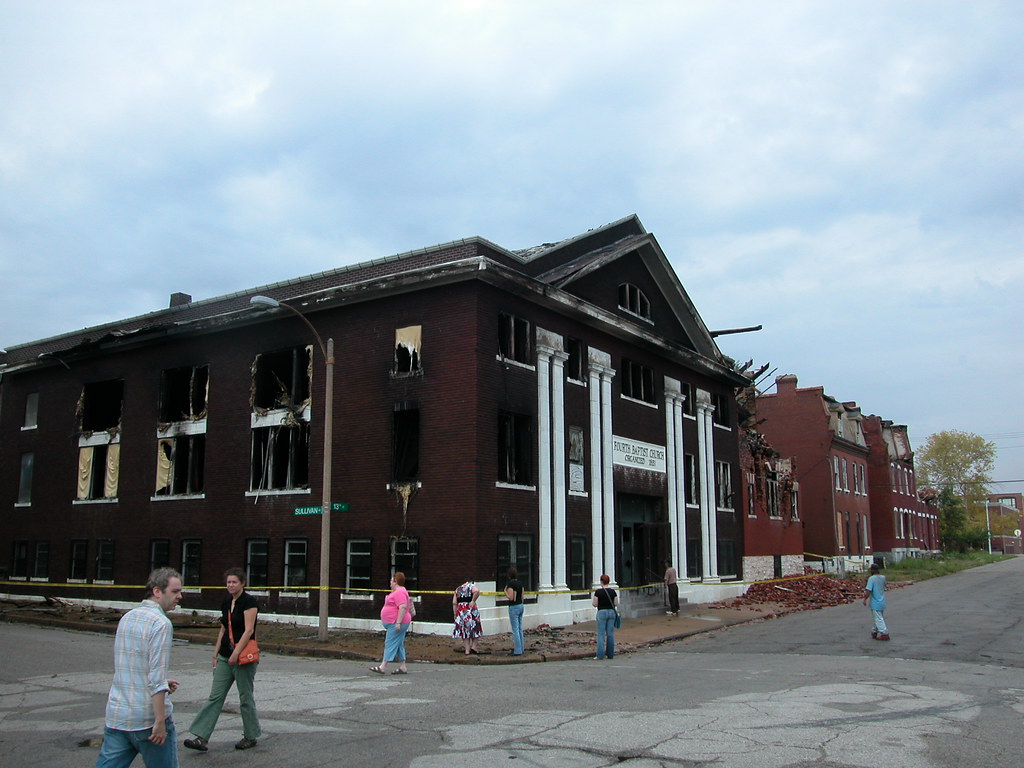
That possibility has closed in the three years since I took the photograph. The building show in the first photograph at right is unchanged, but the west side of the street barely resembles even its scarred former self. Fourth Baptist Church burned on September 20, 2008, and shows severe damage. The four-flat north of the church and its annex was occupied in April 2005 but now is vacant and boarded. Someone stole its cast iron fence a few weeks ago. Beyond that house is the row of city-owned buildings that were hit by partial roof collapse in February 2008 and devastating fire in July 2008. I think that the south side of the row is savable, but the north end is past the point where its salvage is likely. (I do think that its ruined brick walls could become part of new construction.) Past the row, the old Dummitt’s Confectionery building disappeared right after I took this photograph.

The worst case scenario for the west face of this block is loss of all but the four-flat next door to the church. What a strange landscape that would be, but one joining the legions of such obscene wounds throughout Old North, St. Louis Place, JeffVanderLou, The Ville and other north side neighborhoods. No block of mostly-vacant buildings is immune. Possibility is latent in all of the city’s historic architecture, but its realization is not. Realization takes an effort unlike any ever seen in St. Louis before.

Old North is blessed to have residents committed to healing the wounds and a community development corporation that has already healed a few. Many north side residents strive to emulate that energy in their neighborhoods. But the 2900 block of North 13th Street shows us the limits of even the most boundless energy when that energy does not have access to massive capital.

My whole sense of place is changing as the built world across the street from my front door disappears. I still see possibility, but I also sense limits more strongly. Everyone in Old North has lost some part of what defines their place in the world, and some long-time residents barely know what Old North is these days. Yes, neighborhoods are collections of people, but without buildings people have nowhere to live, work, worship or shop. And they leave — along with their money.

Things seem relatively better now only because we lost so much of our near north neighborhoods in the past fifty years. Losing more is unacceptable, and we need to step up our efforts to safeguard what is left — and build back the places for human life that we have lost. Look at what happened to one block, and think about how that process has repeated itself on blocks across the north side for over a half-century. We have lost buildings, people, blocks and entire neighborhoods. In the process, we have let half of the city become the biggest development challenge in the region, and made its resource-deprived residents nearly second-class St. Louisans. Our cultural attitudes and political system enshrine the deprivation of north St. Louis.

When do we make it stop?

Categories
Events JeffVanderLou North St. Louis Northside Regeneration St. Louis Place

Neighbors for Social Justice Hosts Rally and March on Saturday

From Neighbors for Social Justice:

September 26, 2008
Contact: Sheila Rendon 621-6002 or neighborsforsj@aol.com

FOR IMMEDIATE RELEASE

Neighbors for Social Justice continue to call Paul McKee and Mayor Slay to account. On Saturday October 4th 10 a.m. to 1 p.m. near Northside residents will march and rally. The march begins at Sts. Teresa and Bridget’s Catholic Church on North Market and Grand continuing East to N. Market and N. Florissant for rally and speakers.

Speakers include Alderpersons April Ford Griffin, Sheila Rendon and other community representatives.

Neighbors for Justice is comprised of residents from the 5th and 19th Wards. We want Paul McKee and Mayor Francis Slay to end the disrespect they have shown our community. We call for a moratorium on any sales to Paul McKee. As neighborhood residents we want a voice in any development plans for our community. As his constituents, we want Mayor Slay to publicly meet with us and support our efforts.