Categories
Demolition JeffVanderLou North St. Louis Northside Regeneration

We’re Losing the Intersection of Glasgow and St. Louis

by Michael R. Allen

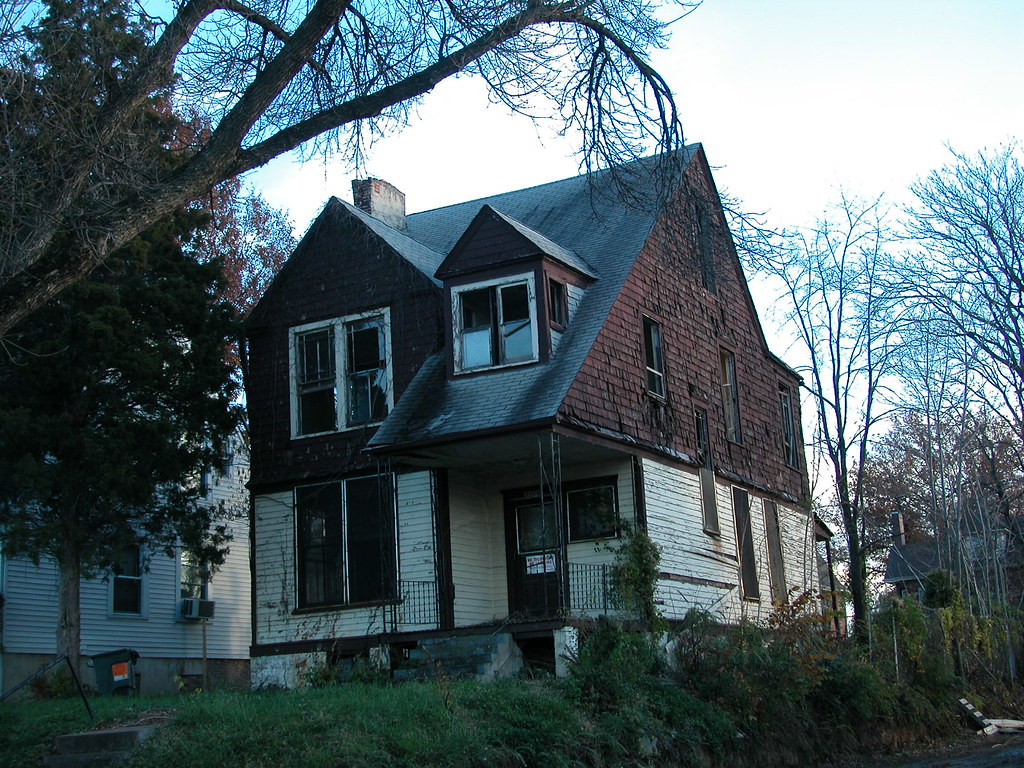
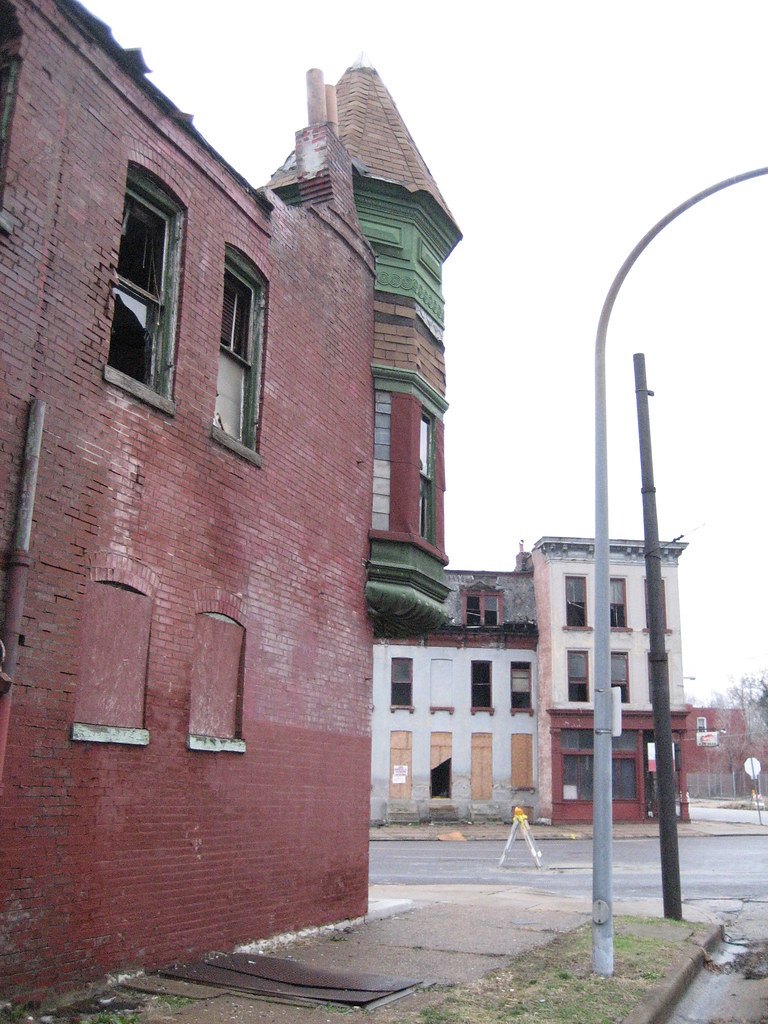
The lovely urban setting shown here (in a photograph contributed by Anthony Coffin) will soon not exist. Shown here, looking south, are the northeast and southeast corners of the intersection of Glasgow and St. Louis Avenues in the city’s JeffVanderLou and Lindell Park neighborhoods. The west corners are occupied by historic houses, creating a contrast that is visually arresting without being jarring. The east corners are marked by these commercial buildings — the iconic, turreted flatiron and the imposing three-story stone-faced mass across the street (subject of a July 2007 blog entry of mine).
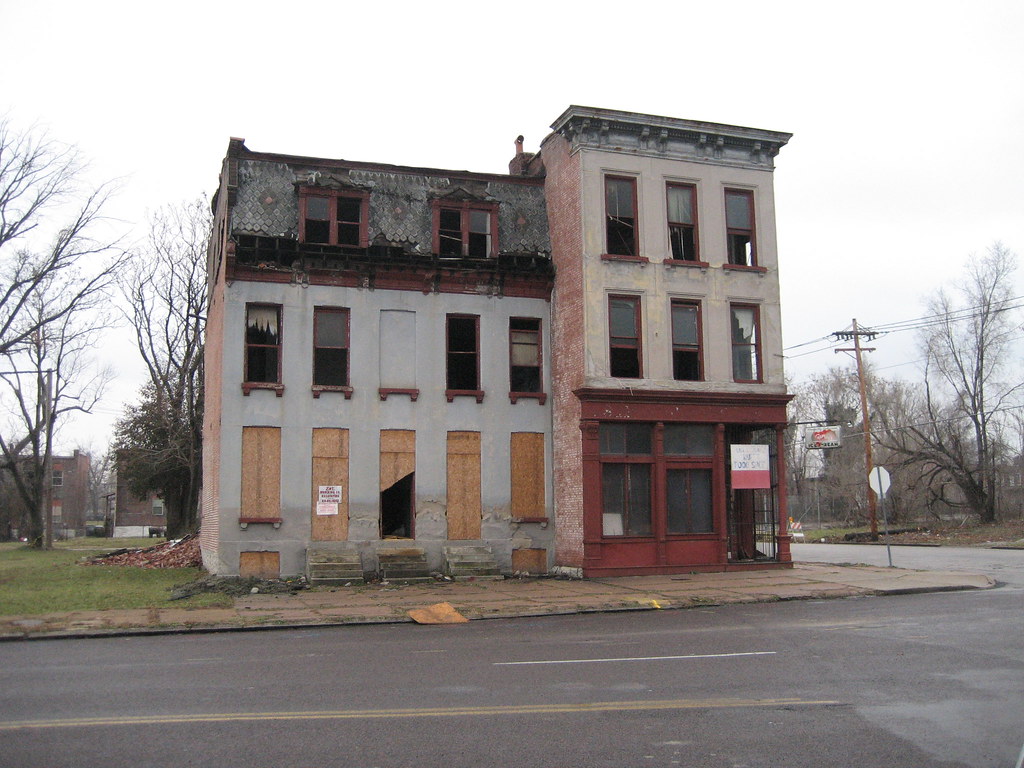
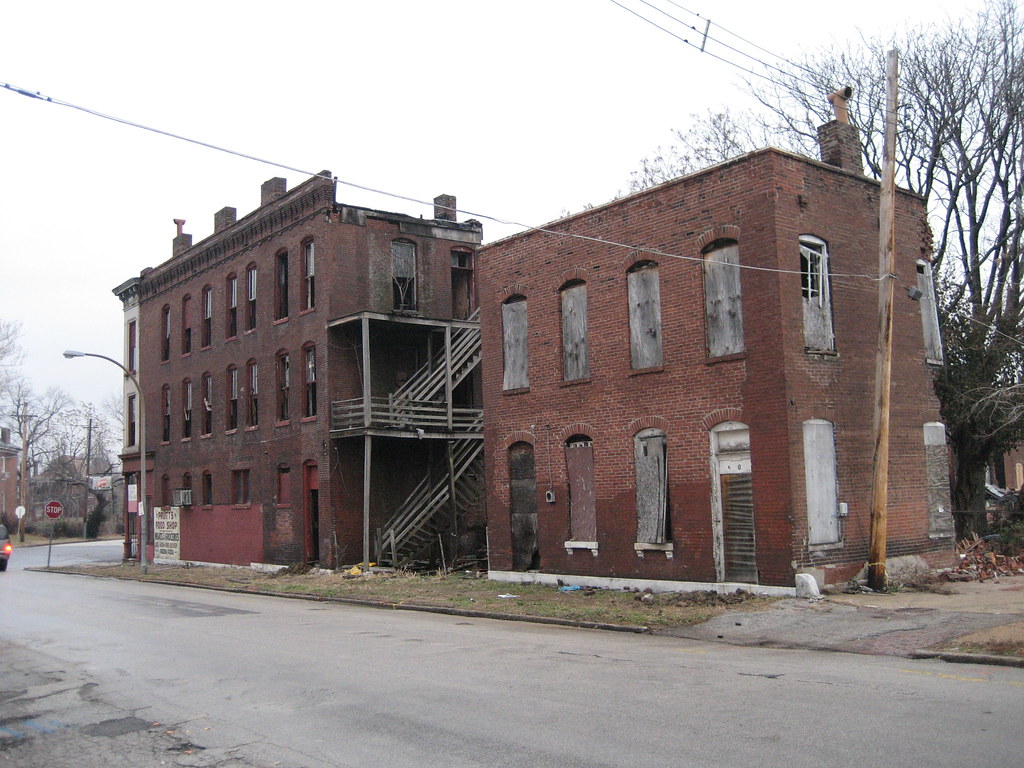
Adjacent to the three-story storefront building is an elegant stone-faced tenement building with mansard roof. Behind the storefront building is a flat-roofed two-story alley house — a vestige of the neighborhoods’ historic density. The group is a complementary group of particularly refined examples of old-school St. Louis vernacular forms. Across the street, the flatiron building is almost unparalleled among surviving commercial buildings in north St. Louis. Both the shape and the metal-clad turret (with surviving detail!) are singular. While beautiful in itself, the corner building is dramatized by the fact that it bookends a largely intact row of residences. Whoever designed the corner building understood how to finesse the dynamics of its lot shape and location.

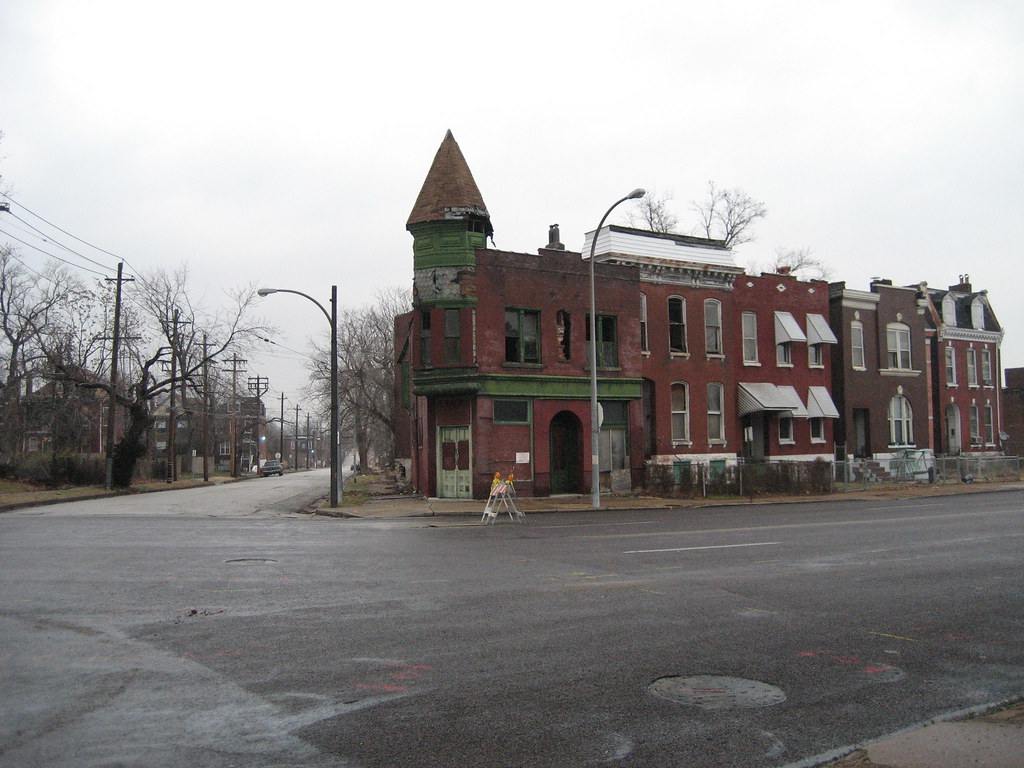
Obviously, the corner and the neighborhood have seen better days. Three out of the four corners here are vacant and owned by holding companies controlled by Paul J. McKee, Jr. After McKee bought these buildings, trouble set in. Last year, knowing that the consequences in north city are low, brick rustlers ravaged the alley house and tenement on the southwest corner. Perhaps the bricks went to a larger brick yard just a few blocks away; perhaps they went to the county. We can be sure that the bricks have long left the city and the state, and that the buildings have since suffered partial collapses.
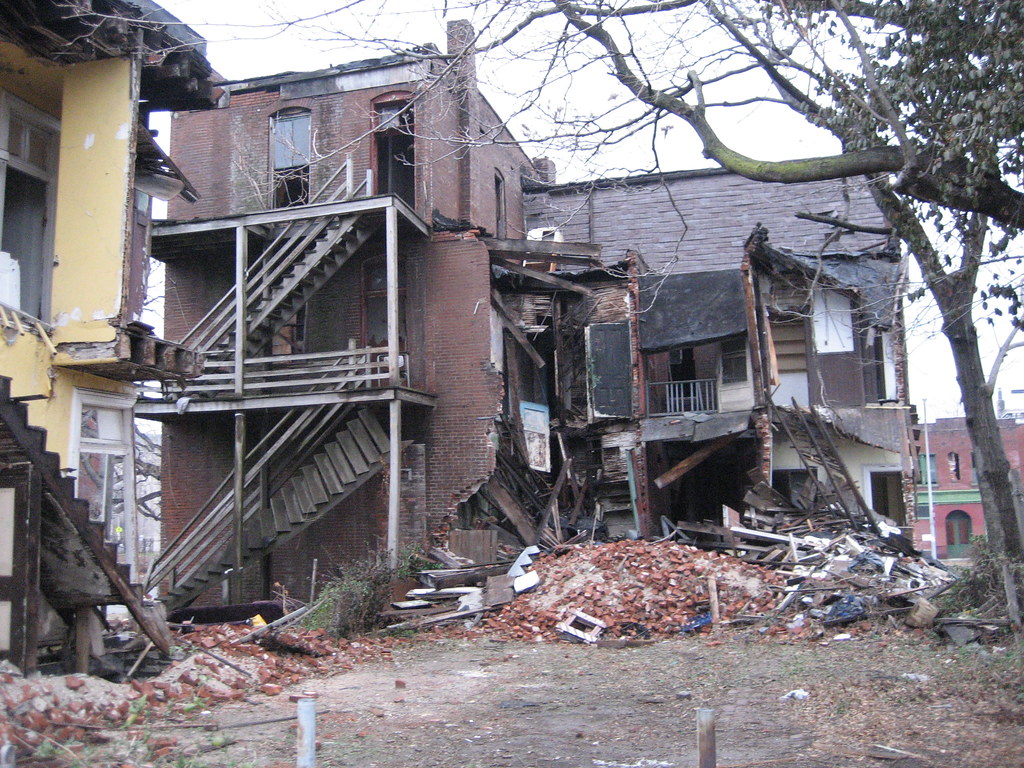
On December 21, the city’s Building Division ordered emergency demolition of the tenement, alley house and storefront at the southeast corner. On December 26, the Building Division ordered demolition of the flatiron and the attached city-owned house to its east. One can see that the tenement was severely damaged and that the alley house was indeed in danger of collapse. But the emergency situation of the two storefront buildings seems to be that they are near the other buildings and the Building Division needs more buildings to demolish.

Sure, the flatiron building has some brick spalling evident, mostly on its St. Louis Avenue elevation where thieves stole decorative brick awhile ago. But where are the public safety issues with it and the other commercial building? Did inspectors go inside of these buildings and find hidden conditions necessitating demolition? Or are we seeing the careless attitude that continues to render north side residents second-class citizens when it comes to historic preservation?

Looking at the details of these fine buildings is heartbreaking. The flatiron’s storefront, with corner entrance to store and punctuating brick arched entrance to the stairs, is odd. The metalwork on the turret shows sharp detail over 100 years after fabrication and painting. The slight height difference between the other commercial building and tenement along with the tenement’s setback accentuates the corner building perfectly. Intact wooden cornice details on this pair draw the eye upward. One could spend hours looking at these buildings — and must do so soon. These photographs date to last week; the alley house is completely gone as of this writing. Your tax dollars are, as they say, at work.

Here are links to the demolition permits:
2845 St. Louis Avenue (flatiron)
2854 St. Louis Avenue (tenement)
2858 St. Louis Avenue (commercial building and alley house)

(All photographs by Anthony Coffin; more here.)

Categories
Historic Preservation North St. Louis SLPS South St. Louis

SLPS Proposes Eight More School Closings

by Michael R. Allen

The St. Louis Public Schools will be closing eight additional school buildings and reopening two, pending a vote by the appointed transitional school board and public input.

The schools proposed by district staff for closure are Mitchell School, 955 Arcade Avenue; Gundlach School, 2931 Arlington Avenue; Lyon School, 7417 Vermont Avenue; Mark Twain School, 5316 Ruskin Avenue; Meramec School, 2745 Meramec Street; Shenandoah School, 3412 Shenandoah Avenue; and Simmons School, 4318 St. Louis Avenue. The closures are evenly split between south and north city.

Carver School, 3325 Bell Avenue in north city, and Roe School, 1921 Prather Avenue in south city, would reopen.

This comes on the heels of last year’s round of five closures, which has left several historic school buildings vacant. The district has yet to market some of the closed schools from last year’s round. Hopefully the district will develop a policy for swift disposition of closed schools that includes provisions for timely reuse as well as preservation. The district would do well to seek National Register of Historic Places designation for any closed school not already listed, so that the buildings are “tax credit ready” at the time of sale. While the district may elect to retain several buildings for future use, it already possesses a long roster of vacant buildings and needs to continue to be mindful of the impact of school closings on neighborhoods.

Categories
Academy Neighborhood Historic Preservation North St. Louis Preservation Board

Fate of Building at Page and Union Deferred Again

by Michael R. Allen


At Monday’s meeting of the St. Louis Preservation Board, the Board voted 3-2 to defer consideration of an appeal of the staff denial of a demolition permit for the building at 5286-92 Page Boulevard. The applicant is the Berean Seventh Day Adventist Church; background on the permit can be found in a post that I made in November. While the November meeting of the Board that considered the matter was packed with congregation members, this month only attorneys William Kuehling and Robert Kinney from Polsinelli Shalton Flanigan Suelthaus appeared to present the church’s case — and yet another rendering of a supposed new building that will replace the existing building (but for which no funds or construction blueprints exist).

Voting to defer the matter were Anthony Robinson, who wanted to hear from the Academy Neighborhood neighborhood association on the proposed new building, Mary Johnson and Alderman Terry Kennedy. Voting against deferral were Mike Killeen and David Richardson. Consideration of the new building is not germane to the Preservation Board’s consideration, which legally applies only to the demolition itself. The building is not located in a local historic district with design guidelines. Instead, it is part of a national historic district where the Board can review demolition permits alone.

Among those who testified in opposition to the demolition was historian Lynn Josse, who wrote the National Register nomination for the Mount Cabanne-Raymond Place Historic District in which this building is a contributing resource and visual anchor. Her words appear here:

By way of background: In 2000, the City of St. Louis funded a National Register nomination in order to protect the Mount Cabanne/Raymond Place Historic District and to encourage the reuse of its valuable historic buildings. The district is listed not only for its architectural merit, which is obvious in this building, but as an example of a compact walkable neighborhood with a distinctly Orthodox Jewish character. The congregation of the B’Nai Amoona synagogue at Academy and Vernon had to live within walking distance of where they worshipped because of Sabbath restrictions, so there was a higher than average concentration of Jewish households and businesses. In most ways though, the neighborhood was like other streetcar neighborhoods of the time. Raymond Place had most of the amenities families needed for daily life within easy walking distance. The building that you’re considering today, by the 1920s was the home of grocery stores, drug stores, a medical office, and a delicatessen – all of which would be vital to the daily life of the neighborhood.

In a district like Mount Cabanne-Raymond Place, it is all too easy to allow the commercial edges to erode and slip away. In this district, we’ve lost at least one of the commercial buildings on Delmar since the listing in 2002. But historically, it is the commercial buildings like this one that made the residential life in the center of the neighborhood possible. Raymond Place boasts a really great collection of architecturally interesting houses, but without the context provided by important commercial buildings like this one, it is just that: a collection of dwellings. Cities are more than that; they are a complex system of people and jobs and transit and housing and recreation and institutions and services and retail. We are doing a good job encouraging reuse of housing, but the neighborhood doesn’t make historic sense and may be less sustainable in the future if you allow the destruction of the small-scale retail spaces that historically have connected people.

Part of what the ordinance directs you to consider is the contribution to the streetscape. This building is the streetscape. For over a hundred years it has defined the corner of Page and Union. Its loss would cause a major gap at the northwest corner of the historic district. Replacing this building with a surface parking lot would be a terrible disservice to the neighborhood. It’s a bad use of land and a terrible waste of an important building that should, according to all of your legal criteria, be preserved.

Categories
DALATC North St. Louis Northside Regeneration Public Policy

McKee’s Holding Companies May Be Preparing for Tax Credits

by Michael R. Allen

There may be movement afoot on the part of developer Paul J. McKee, Jr. to get ready for an application for Missouri’s Distressed Areas Land Assemblage Tax Credit. On October 26, four holding companies owning land in north St. Louis — Blairmont Associates, VHS Partners, Noble Development Company and N & G Ventures — each filed deeds of trust covering all property purchases made before 2006, when McKee’s holding companies began filing individual deeds of trust for each property.

Each company’s deed is for the same amount, $3 million and granted by the Corn Belt Bank & Trust Company of Pittsfield, Illinois. Two years ago, Corn Belt granted a loan of $2.8 million to McKee’s Allston Alliance for the purchase of the vacant Cass Avenue Schnucks store.

Each company’s deed was signed by Paul J. McKee, Jr. in capacity as manager of the other limited liability companies that act as sole members of the holding companies. Blairmont Associates’s sole member is BMA Partners, VHS Partners’ is Vashon Developers, Noble Development Company’s is NDC Venturers and N & G Ventures’ is NGV Partners.

Under the terms of the Distressed Areas Land Assemblage Tax Credit Act, a land assembler is eligible for up to 50 percent of the purchase costs of land. At the maximum eligible amount, these recent deeds of trust would entitle McKee’s companies to $6 million in tax credits.

Categories
Downtown Historic Preservation North St. Louis Preservation Board

Preservation Board Meets Monday, Demolition Permits on Page and Olive Return

by Michael R. Allen

Since the St. Louis Preservation Board did not have a physical meeting last month, this month it will meet twice. The first meeting is Monday, January 7 at 4:00 p.m.

Two of the agenda items are repeats of demolition permits:

– 5286 Page Boulevard. The Berean Seventh Day Adventists’ appeal of staff denial of a demolition permit for this two-story commercial building was continued due to the church’s presentation of new evidence in November. The Board continued the hearing of the appeal in order to afford Board members and Cultural Resources Office staff more time to review the evidence. (Read more here.) Staff still recommends upholding the denial. The church has no good case for removing the last historic building at the important intersection of Page and Union — a building structurally sound and listed as a contributing part of a National Register historic district.

– 2217-19 Olive Street. The owners of this building want to demolish it for a parking lot. The two-story commercial building is a contributing part of the newly-listed National Register district called the Olive and Locust Historic Business District. In September 2007, the Preservation Board unanimously rejected the appeal of a staff denial of a demolition permit. (Read more here.) Now the matter is back as a “New Application” because the applicant is not the owner but the Building Division, which claims that building is in danger of collapse. Swayed by the evidence, the Cultural Resources Office is recommending approval of the demolition permit.

The agenda begins with three preliminary reviews of new construction in the Benton Park and Lafayette Square local historic districts.

The meeting takes place on the 12th floor of the Locust Building, 1015 Locust Street downtown. Testimony may be submitted in writing via email to Adonna Buford at BufordA@stlouicity.com.

Categories
Architecture Events North St. Louis Wells-Goodfellow

Hewlett Students Present Their Projects Tomorrow

by Michael R. Allen

Each year, freshman students in professor Bob Hansman’s Hewlett City Seminar at the Washington University School of Architecture trek to the Wellston Loop area of north St. Louis. Amid some of the city’s most intense urban decay, the students learn from observing conditions, listening to residents and studying the history of the area’s decline. Then they devise design interventions that could transform the community, channeling residents’ desires into plans for the future. This is one of the best two-way streets in town. The freshman, many from other places where conditions like those of north St. Louis are rare, are exposed to a whole new world. Residents of the community are in turn exposed to an urban design perspective their political leaders often disregard.

This fall’s program is over, and the students will present the models and plans they have created this semester. The presentation is tomorrow, Saturday December 8, at Friendly Temple, 5540 Dr. Martin Luther King Drive, from 1:00 – 5:00 p.m. The event is open to the public.

Categories
Historic Preservation LRA North St. Louis Preservation Board West End

Preservation Board Spares House on Bartmer

by Michael R. Allen

At its monthly meeting on Monday, the St. Louis Preservation Board wisely voted 5-2 against the demolition of a Shingle Style frame house at 5594 Bartmer Avenue in the city’s West End neighborhood. The house was built in 1898 and while not the most exquisite example of the Shingle Style in the city (that may be on nearby Cabanne Place) is one of probably less than two dozen remaining homes in the style. The demolition was proposed as a preliminary review, with no actual permit under consideration. Preliminary review is often used by potential applicants and staff of the Cultural Resources Office (CRO) to gauge Board opinion without beginning formal application process.

In this case, Alderman Frank Williamson (D-26th) brought the matter to CRO two months ago, citing citizen complaints about the condition of the home. The house has been vacant since at least 1998 and is owned by the city’s Land Reutilization Authority. The house is located outside of any national historic district where tax credits would be able to be used in its rehabilitation. However, the 5400 and 5500 blocks of Bartmer show an unusual collection of large historic homes with consistent deep setbacks and early 20th century period styles. Blocks to the west also show consistency. There is no doubt that some historic district on Bartmer is possible.

Two months ago, CRO staff presented the matter to the Preservation Board, which elected to defer consideration for 60 days while staff prepared a thorough report on the building’s condition and reuse potential. Ald. Williamson appeared at the first meeting and said that he wanted to tell the citizens something was going to happen, although demolition was not the only outcome he would accept.

CRO staff prepared a report that covers issues of condition, historic integrity and potential market value. Among other conclusions, the repprt showed that not only is the house “sound” under the definition established by the Preservation Review ordinance, it retains almost all of its original architectural features inside! Staff strongly recommends preservation of the house. Meanwhile, Ald. Williamson decided to support demolition. Two citizens sent letters of opposition, including blogger Douglas Duckworth (read his letter here). On Monday, the Board heard testimony against the demolition from myself and in favor from Myron Jefferson, who is building a new house at 5596 Bartmer to the west. Jefferson stated that he would not have built his house if he had known the house next door was not going to be torn down.

According to CRO Director Kathleen Shea, the LRA has agreed to make the house at 5594 Bartmer a priority for its limited marketing efforts. Apparently LRA will not seek its demolition until it has drawn attention to potential buyers. While the gesture is small, it’s the most that LRA can do — and more than usual. Ald. Williamson might want to coordinate with LRA in finding a creative future for the house.

Board Member Mary Johnson told the Board that the board would impede the “development project” of “developer” Jefferson unfairly if it voted down the demolition. Johnson cited Joe Edwards’ Moonshine Hotel project in the Delmar Loop as an example where the Board allowed demolition of a historic building, the Ronald Jones Funeral Chapel, for a development project. Edwards is demolishing the chapel but reconstructing its front and some of its side elevations as part of the hotel project.

Board Member David Richardson retorted that Jefferson was not the owner of the property next door. Jefferson does not seek to purchase the house at 5594 Bartmer and was not the applicant for demolition. In making the motion to accept staff recommendation, Board Member Anthony Robinson explained that builders can’t control vacant property when building a new house. Robinson said that when he built his residence, his block had five vacant houses and six vacant lots. All of the houses have been rehabbed and all but one of the lots built upon since Robinson finished his house a few years ago.

Voting in support of the CRO staff recommendation authored by Director Kathleen Shea were Melanie Fathman, John Burse, Robinson, Mike Killeen and Richardson. Voting against were Johnson and Ald. Terry Kennedy (D-18th). Chairman Richard Callow abstained from voting.

Categories
Academy Neighborhood Central West End Demolition Historic Preservation Hyde Park Local Historic District North St. Louis Preservation Board South St. Louis West End

Preview of Monday’s Preservation Board Agenda

by Michael R. Allen

The St. Louis Preservation Board meets Monday at 4:00 p.m. at the offices of the Planning and Urban Design Agency on the twelfth floor of 1015 Locust Street. Meetings typically last three hours.

Here are some highlights from the agenda:

Preliminary Reviews

5594 Bartmer Avenue: The proposed demolition of a beautiful and rare Shingle Style house appeared on the Preservation Board agenda two months ago and was deferred pending study of the reuse potential by the staff of the Cultural Resources Office. Staff has written an excellent report on the building condition and reuse feasibility based on a thorough site visit; read that here. Staff recommends denial of the permit and exploration of a National Historic District for Bartmer Avenue. This house and its neighbors fall outside of any historic districts that would enable the use of historic rehabilitation tax credits.

2300 Newhouse Avenue: The proposed new construction of six frame homes with attached garages in the western edge of Hyde Park manages to add yet another absurd faux historic design to the architecturally mongrelized neighborhood. Here we have brick fronts with shaped parapets imitating 20th century buildings that can be found in Hyde Park, but there is a twist: the parapets are actually gable ends on a front-gabled building! The sides and rear show the pitched roof and reveal the illusion the front barely conceals. Furthermore, the developer includes attached garages and has not submitted a site plan showing setbacks. Staff recommends denial as proposed.

Appeals of Staff Denials

5286 Page Avenue: The appeal of staff denial of a demolition permit for the two-story commercial building at the southeast corner of Page and Union has been on the agenda for months, always being continued at the request of the owners. Another continuance is possible. The building is a contributing resource to the Mount Cabanne/Raymond Place National Historic District and the last remaining commercial building at a prominent intersection degraded by a Walgreens across the street. Staff urges upholding their denial.

4218 Maryland: The unlawful alterations made to this house transformed it in disturbing ways: rebuilt bizarre porch, new cheap door and sidelights that don’t even fit the opening, alteration of brick pattern and color on front elevation and removal of two front bay windows and replacement with flat openings. Yikes! Staff recommends upholding their denial.

Appeal of Preservation Board Denial

2013-15 Park Avenue: The builder of infill housing in Lafayette Square wants to amend earlier plans to face the side elevations with brick and instead face them with vinyl siding. Staff recommends upholding their denial of this request, and wisely so. Here we have strong neighborhood support for a strict local historic district ordinance that expressly prohibits sided primary and secondary elevations. One expects Lafayette Square to be the last local district where vinyl siding should be approved; the neighborhood is both bellwether and inspiration for the power of local district ordinances to shape attractive neighborhoods. (The Lafayette Square standards can also be an example of the the blind spots of such ordinances, but not regarding the use of vinyl siding.)

Categories
North St. Louis Northside Regeneration

LLCs and LCs Linked to McKee Change Agents

by Michael R. Allen

On October 24, several companies linked to developer Paul J. McKee’s north St. Louis real estate project switched registered agents.

Holding companies Babcock Resources LLC, Blairmont Associates LC, Dodier Investors LLC, MLK 3000 LLC, N & G Ventures LC, Noble Development Company LLC, PATH Enterprise Company LLC, Sheridan Place LC and VHS Partners LLC switched from anonymous third-party agency through CT Corporation System to PEM Agency Corporation (whose own registered agent is Glenn Mitchell, Director of Property for McEagle).

Holding company Allston Alliance LC switched agents to PEM Agency Corporation from developer John Steffen.

Three companies used for loans to the holding companies, Salvador Equity Management LLC, Rice Capital Group LLC and Parkburg Fund LC also switched agents from CT Corporation System to PEM Agency Corporation.

Categories
North St. Louis Old North

Old North St. Louis Restoration Group Receives $200,000 Bank of America Award

by Michael R. Allen

Last week, the Bank of America Charitable Foundation awarded the Old North St. Louis Restoration Group (ONSLRG) $200,000 grant at its fourth annual Neighborhood Excellence Initiative awards. The Restoration Group will use the money to renovate its new office and meeting space in the 14th Street Mall Redevelopment Area and to purchase properties that play strategic roles in stabilizing sections of the neighborhood. These are pressing needs for the group as it begins to operate as a high-profile community development corporation that handles a huge workload.

Currently, the ONSLRG staff does an amazing amount of work with only three full-time staffers operating out of modest rented space. The momentum that ONSLRG has created is impressive, but demanding — the harder the organization works, the more people inside and outside of the neighborhood want assistance with development, nuisance properties and community matters. This award gives ONSLRG capacity to keep up with accelerating interest in Old North.