Categories
Abandonment JeffVanderLou land use North St. Louis Pruitt Igoe St. Louis Place

The Churches of Pruitt-Igoe

by Michael R. Allen

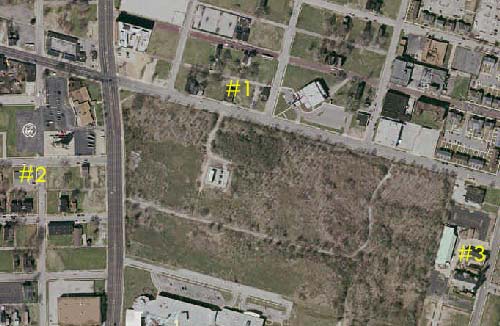
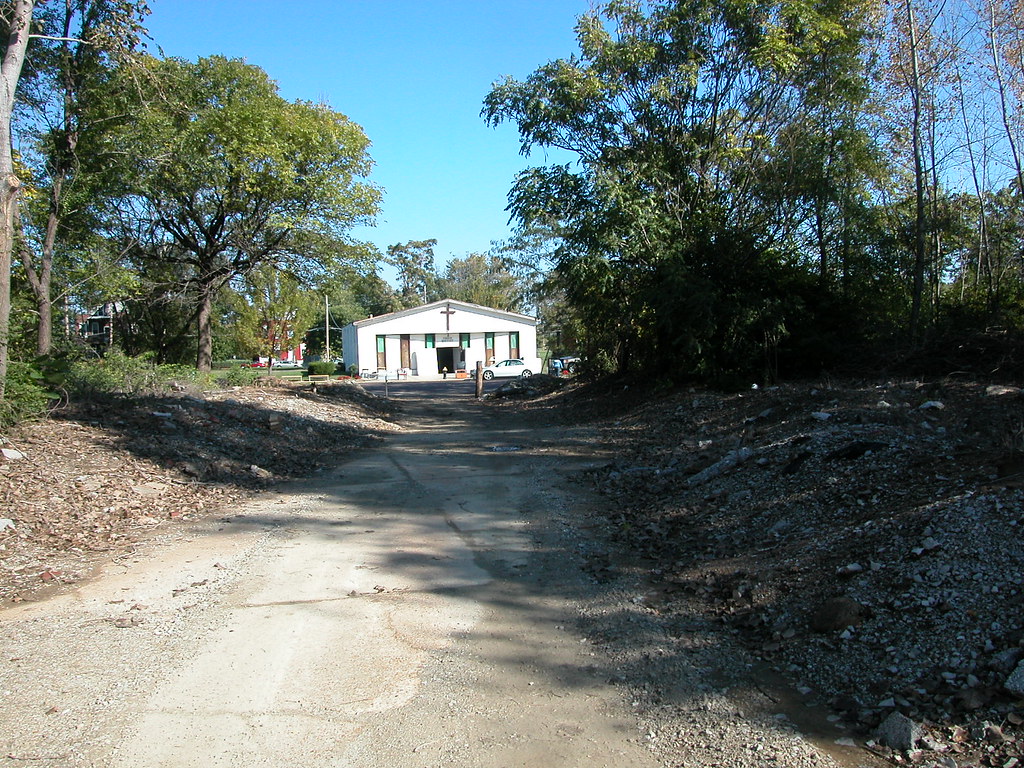
In the center of the Pruitt-Igoe Nature Preserve, also known as the undeveloped section of the site of the Pruitt and Igoe housing projects, there is is a central east-west access road running from Jefferson Avenue east, then bending north to Cass Avenue. Another northern spur also leads to Cass. The odd thing is that each view outward down the main path and the view outward down the northern spur are closed by churches, marked on this aerial photograph from the Geo St. Louis website.


Church #1 is True Grace Baptist Church, a storefront-style worship space at 2319 Cass Avenue.


Church #2 is actually one block west from the Pruitt-Igoe site, but there are no intervening buildings to block the view. This is Zion Temple Missionary Baptist Church at 2700 Thomas Avenue.


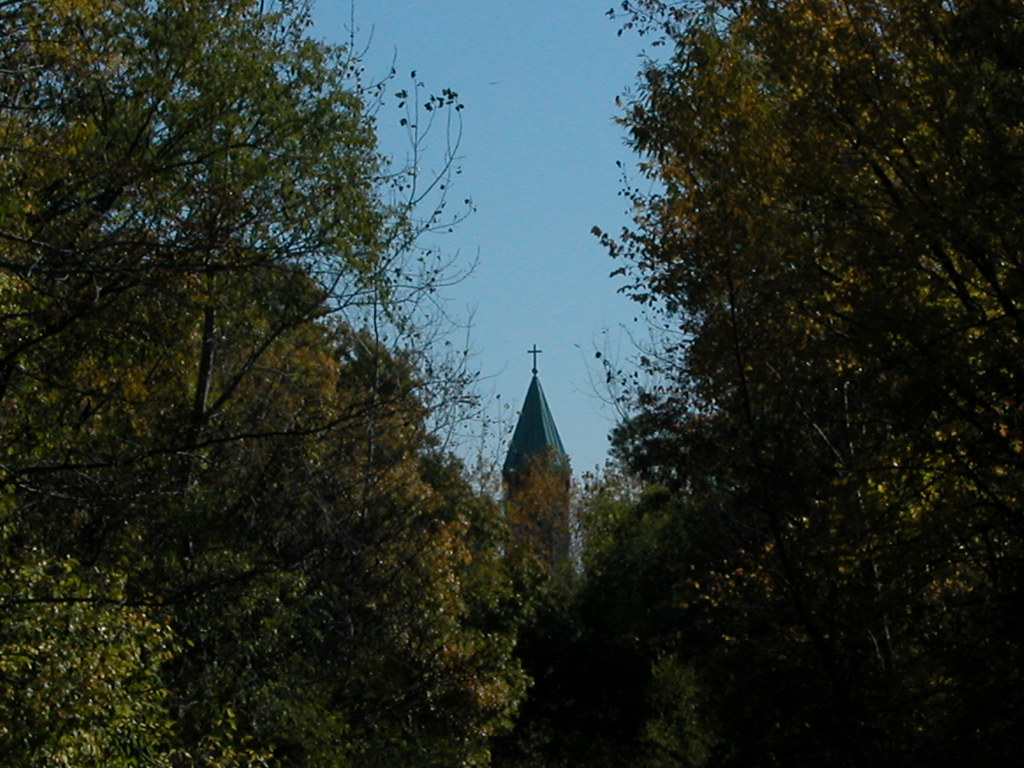
Church #3 is the famous St. Stanislaus Kostka Church at 1413 N. 20th Street, which pre-dates the construction of Pruitt-Igoe by over a half-century.

The other northern-leading path’s view terminates at the rear of the Mullanphy Tenement, visible across the parking lot of the Absorene Company.

The Pruitt-Igoe grounds hold both the history of the failed but once proud housing projects as well as years of dumped debris. The layers of fill and remains have not stopped healthy vegetation, and much of the site resembles a nature preserve. the access roads, which are largely clear, gives the site’s wild state a sense of intention. The presence of the three churches closing the long views down these paths adds serenity to the scene. The churches’ presence on the margins of the Pruitt-Igoe site call to mind the notion of redemption. In its current state, the Pruitt Igoe site seems to have cleansed its historical wounds and reconciled with nature. The site’s current ecological state is wholly new and supportive of new life. Has this tortured land met its redemption?

UPDATE: Reader Bill Michalski sent me a still frame from the film Koyaanisqatsi, where True Grace Baptist Church is evident in footage taken in 1972.

Categories
Housing North St. Louis Vandeventer

Romanesque Revival Flats From the Gilded Age

by Michael R. Allen

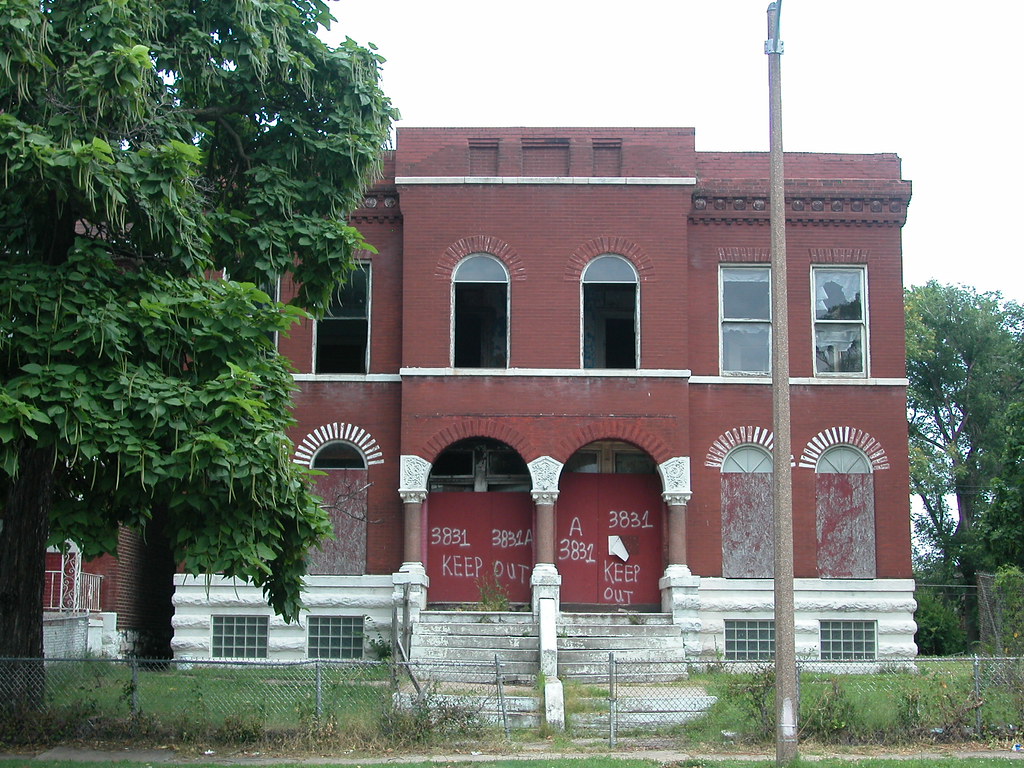
Each time I travel west of on Page Boulevard, I keep an eye out for the double set of flats at 3831 Page. Although vacant for the past five years or more, the building always brings a smile to my face. In a city full of distinguished examples of many popular architectural revival styles, this Romanesque Revival building may not be the showiest or most significant, but it sure sticks in my mind. For one thing, the entrance is grandiose — polished Missouri granite columns rise from a rusticated white limestone foundation to support carved limestone voussoirs. The voussoirs buttress standard Roman arches of machine-pressed brick. The columns are extravagant on entrances that lead to double doors, signifying that this building houses four middle-class families, not one wealthy one. Beyond the impressive effect created by having Roman arches on all first floor window openings — and the striking but inappropriate alteration of white-painted bricks in each arch — the flat-roofed building possesses stock traits.

Yet this building is a great example of the triumph of machine processes in common stock architecture. That rusticated limestone base was cut to “rough” perfection by machine tools. the granite columns polished by machine. The bricks were pressed by a press. Even the carved limestone work is the result of pneumatic chisels, guided by craftsmen but powered by steam. After all, this house dates to a September 18, 1893 building permit reporting a construction cost of $8,000. Mighty St. Louis had already built the Wainwright Building and Union Station, and its craftsmen were deft with new technology. Its residents were full of wealth and the swagger to proclaim the growing city’s greatness through every brick laid around town. In the 1890s, the house at 3831 Page was one of a multitude demonstrating the superior industrial and architectural imagination of the river city in the American Gilded Age.

The pedigree of this house also shows the westward creep of the city. Its developer, Charles Schockemiller, was residing at 2228 Biddle near the Kerry Patch. The contractor, Hemminghaus and Vollmer, had offices at 1417 Destrehan in Hyde Park. The architect, German-born Gerhard Becker, maintained an office at 1017 Chestnut Street and was noted for designing factories on the near north side like the Eckhoff factory in present-day Old North and the Standard Stamping Company building on North Broadway. All German names, and all tied to points east but plotting the westward development that would fill the city’s boundaries with a plethora of magnificent houses, tenements and even factories.

Categories
Architecture Downtown Housing

Roberts Tower Rising Downtown

by Michael R. Allen

On one hand, we have what could be the start of a major economic recession. On the other hand, we have the first high-rise residential building in 40 years currently rising downtown. On one hand — there is no other hand! We are left with an encouraging contradiction: as the economic news consistently drags us down, the Roberts Tower rises up from the ground on Eighth Street, tempting us to likewise raise our hopes to the sky.

Many developers talked about building new downtown residential buildings. Famously, we had the SkyHouse project on Washington, Daniel Libeskind renderings of Bottle District condominium towers, homes overlooking the baseball game at Ballpark Village, Park Pacific and Port St. Louis. Not one of these projects is under construction. Some are gone forever, in ways that are depressing. For instance, Park Pacific’s undulating Tucker Boulevard face won’t get built, while a plain0jane parking garage will be.

Amid the general atmosphere of hype of the last five years, we’ve had out-of-towners (SkyHouse, Ballpark Village) tempt us with the siren call of tall residential buildings downtown. Whoever did not get a tingle of excitement when hearing about the sundry proposals has never entered Chicago, New York or any other high-rise metropolis and been swept away by the tempting poetry of a sense skyline. We all fell for the idea that St. Louis was soon poised to proclaim its renewal as a great place to live through a boom of skyline construction.

Again, such a thrilling vision is far from reality. However, two tall buildings are reality — the Four Seasons Hotel at Lumiere Place, completed, and the residential Roberts Tower, under construction. The Roberts Brothers took three years to break ground, and may very well have slid the way of the other also-rans, but they broke ground this year on a $70 million 25-story modern high-rise residential building.

The design is sleek, but not showy (at least, now that the giant letters spelling “ROBERTS” don’t appear in renderings). The steel building fits into a small spot between the Mayfair Hotel and the Old Post Office Plaza, creating a narrow body whose main articulation is a sweeping glass south wall. The other walls are to be cast concrete, and the ground floor will open onto the sidewalk and plaza with a restaurant space. The building is solidly in good taste, unlike the Four Seasons.

The Roberts Tower design is also smart. The developers are seeking Gold LEED certification, and plan on many green technologies. From the south wall’s ample glazing to recycled materials going into the walls, carpets and counters, the building is ecologically progressive. The technologies used have not been used on such a scale in the city before.

With 55 units on the fourth through 25th floors — the lower floors will be conference and fitness space shared with the Mayfair — the building won’t put a glut of new units on the market. I have no idea how sales are going for the units, or how closely the finished building will resemble the rendering prominently displayed on the site. I do know that the Roberts Tower is a great idea and its construction could not come at a better time.

Categories
Downtown Green Space JNEM

National Park Service Retirees Oppose Preliminary Plan to "Privatize" Portion of St. Louis Gateway Arch Site

Former NPS Leaders Object to Turning Over Portion of Historic Site to Danforth Foundation; Parallel Drawn Between Private Invasions of St. Louis Arch and Valley Forge NPS Sites.

TUCSON, AZ. – October 22, 2008 – The preliminary plan outlined yesterday by the National Park Service (NPS) to allow significant changes to the ground and site for the historic “Gateway Arch” in St. Louis is being opposed by the 675-member Coalition of National Park Service Retirees (CNPSR).

In objecting to the NPS plans, CNPSR officials said that the proposed changes to the Gateway Arch site is “a thinly veiled effort to have a significant portion of the memorial’s grounds transferred from NPS jurisdiction and programs to a private institution, the Danforth Foundation.”

The Jefferson National Expansion Memorial (JNEM) is the official name for the Arch and surrounding landscaped grounds, which are administered by the NPS. The JNEM complex is a designated National Historic Landmark and one of the 391 units in the National Park System. In recent months, CNPSR has raised the alarm about private efforts to encroach on and undercut another major U.S. NPS site: Valley Forge in Pennsylvania.

CNPSR Executive Council Member Don Castleberry said: “First we saw the attempt to ‘privatize’ a portion of Valley Forge and now the target is the the Gateway Arch in St. Louis. We have to draw a line now and say that national parks are not up for sale. Eero Saarinen’s iconic design, which is one of America’s most recognized and admired monumental features, attracts over 250,000 visitors annually. The surrounding grounds are planned to complement and provide for the backdrop for the monumental Gateway Arch. They are in integral part of the design and should not be
turned over to a private entity.”

Castleberry is a former regional director, Midwest Region, NPS. For more than eight years, he had management oversight over JNEM.

The proposed changes to the Gateway Arch site are an outgrowth of a general management planning process, with public input, evaluating a range of five different development proposals for the future management of the JNEM site.

On October 21, 2008, the NPS announced its preferred alternative, which includes an innocuous sounding plan for “heritage education and visitor amenities”, and proposes a design competition to “revitalize the memorial grounds, expand interpretation, education opportunities and visitor amenities.”

Castleberry said: “In fact, what this would mean is the construction of a new, large building on the grounds. It would be completely inconsistent with the original Gateway Arch site design, and would conflict with the purpose of the grounds as backdrop to the arch. The existing NPS visitor center/museum is purposely placed underground to avoid conflicting with the original plan. If local interests wish to be helpful in promoting the Arch and not their own agendas, they might consider assisting NPS to make improvements to the existing museum and programs.”

CNPSR officials said they have no concern with minor changes that are consistent with the original look and feel of the National Historic Site. One possible change would be to improve connections with the surrounding community, including the addition of covered crossings over Interstate 55.

Even though a “preferred alternative” plan has been selected by the Department of Interior, the process will continue for some time, with completion not expected until 2009. CNPSR urges citizens interested in protecting the integrity of this national monument, to oppose (1) inappropriate development on the Arch Grounds and (2) any transferring of jurisdiction from the NPS to a private organization.

ABOUT CNPSR

The 675 members of the Coalition of National Park Service Retirees are all former employees of the National Park Service with a combined 20,000 years of stewardship of America’ most precious natural and cultural resources. In their personal lives, CNPSR members reflect the broad spectrum of political affiliations. CNPSR members now strive to apply their credibility and integrity as they speak out for national park solutions that uphold law and apply sound science. The Coalition counts among its members: former national park directors and deputy directors, regional directors, superintendents, rangers and other career professionals who devoted an average of nearly 30 years each to protecting and interpreting America’s national parks on behalf of the public. For more information, visit the CNPSR Web site at
http://www.npsretirees.org.

Categories
Downtown Green Space JNEM

National Parks Conservation Association Concerned about Potential Development on Grounds of National Historic Landmark in St. Louis

FOR IMMEDIATE RELEASE
October 21, 2008

Lynn McClure, Midwest Regional Director
National Parks Conservation Association
P: 312. 263.0111, Cell: 312.343.7216

“Visitors to the iconic Gateway Arch in St. Louis would benefit from improved services and a revitalized Museum of Westward Expansion. But the National Parks Conservation Association is concerned after reviewing the

Categories
Historic Preservation Housing Mid-Century Modern North St. Louis Northside Regeneration St. Louis Place

Lemonade: A Remade Section 235 House

by Michael R. Allen

A row of Section 235 Houses on North Market Street west of 25th Street in St. Louis Place.

The 1968 federal Housing Act created the Section 235 Program administered by the new Department of Housing and Urban Development (HUD). The Section 235 Program enabled many Americans to become homeowners through its generous assistance: HUD made interest payments to lenders on behalf of homeowners in the program to effective reduce their monthly loan interest. The amount paid was based on the borrower’s income. In the 1970s, when interest rates were often above 10%, this program’s need was clear. The authors of Section 235 intended the program to move low-income residents as well as federal subsidy away from mass housing projects and into neighborhoods and suburbs. Of course, the lofty dreams trickled down into something less idealistic.

In reality, the program was a boon to lenders and builders but less freeing to participants. Section 235 mostly shuffled people around decaying neighborhoods, and its implementation was rarely coordinated with other programs to stabilize these places. In St. Louis, the use of the program was extensive in the 1970s and created several distinct forms spread across north St. Louis and parts of the near south side. One of these is the ubiquitous “Section 235 House,” a two-story platform-framed house with a low-pitched front gable and a second floor that overhangs the first.

There are variations on cladding, but the St. Louis Section 235 Houses mostly resemble each other. The St. Louis Section 235 House mostly interjected intself out of context, alongside historic homes that dwarfed and mocked the banal newcomers. What could have been very modern was often festooned with mock shutters, brick veneer on the first floor (improbably holding up an overhang) and other architectural absurdity. The homes set back too far from the street and from each other to mimic the truly urban forms of the St. Louis vernacular, and tended to stick out as proverbially sore thumbs.

The Section 235 House at 2322 Montgomery.

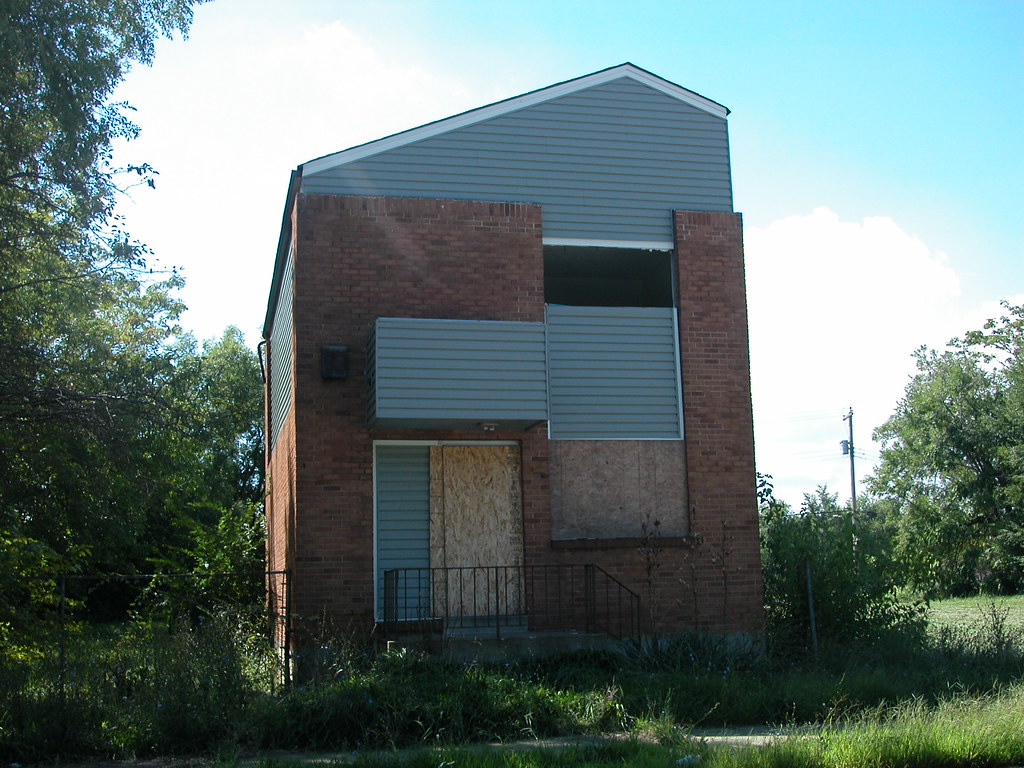
Meanwhile, other, better-off St. Louisans stayed in the city by moving into Modern Movement high-rise towers designed by “name” firms. Still, owners of the Sction 235 Houses often cast their own designs on the houses, leaving us with a legacy of rebellion against the planned form. One of the best examples stands at 2322 Montgomery Avenue in St. Louis Place. Built in 1971 and now vacant, the house barely registers as a Section 235 House. The overhangs were elminated, the gabled roof removed and rebuilt as an asymmetrical modern roof, and the front clad in a tasteful brick. Someone made this house his or her own, and the result is quite lovely. unfortunately the house, which city records show as owned by Larmer LC, stands vacant. While the house might be out of place in St. Louis Place, it sits on a block that has lost architectural consistency. Preservation seems wise and, to this writer, desirable.

Categories
Downtown Green Space JNEM

NPS Expected to Announce Preferred Alternatives for Arch Grounds Today

by Michael R. Allen

The National Park Service is expected to release its preferred alternatives for the Jefferson National Expansion Memorial Management Plan today. Will the NPS enshrine the wishes of the Danforth Foundation, or look beyond the top-down plan for a true vision of the total potential of the Arch grounds? Will NPS consent to some development of the grounds? Will NPS look to an expansive plan for connecting the grounds to downtown, or endorse the drop-in-the-bucket, overpriced “lid” idea? Will the NPS act will diligence as in its role as the defender of a National Historic Landmark? We shall soon find out.

In the meantime, read the excellent article on the Cultural Landscape Foundation website, Jefferson National Expansion: Kiley’s Iconic Memorial Landscape at Risk!” by Lynn McClure and Alan Spears.

Categories
Historic Preservation Metal Theft Salvage

St. Louis Building Arts Foundation Robbed

by Michael R. Allen

Writing in The Platform blog over at the Post-Dispatch, Eddie Roth breaks the terrible news that thieves stole over 1,500 pounds of historic bronze and brass hardware from the St. Louis Building Arts Foundation this week. The article includes some photographs of stolen items.

Please help return these important items to their rightful home, for the public benefit of all and not the private benefit of thieves and dealers. While the thieves make the initial profit, we all know that some dealers make a lot more by fencing stolen property. Keep your eyes open.

Categories
Historic Preservation Industrial Buildings Riverfront

The McPheeters Warehouses: A Total Loss for the City

by Michael R. Allen

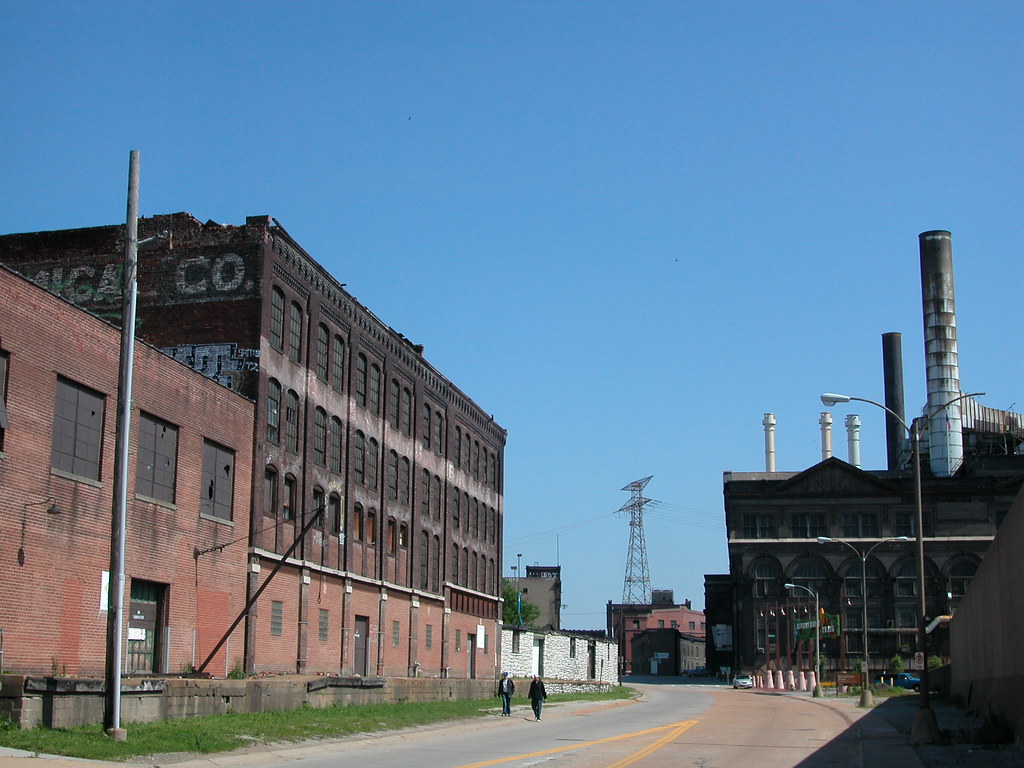
Looking north on Lewis Street, May 2008.
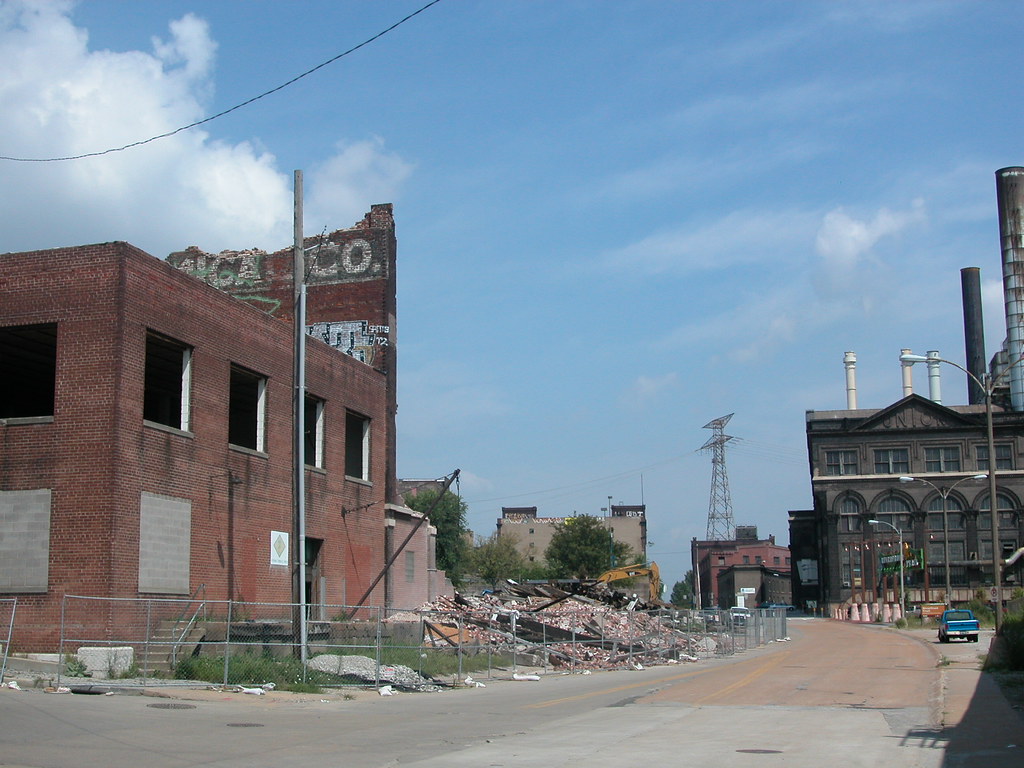
Looking north on Lewis Street, August 2008.
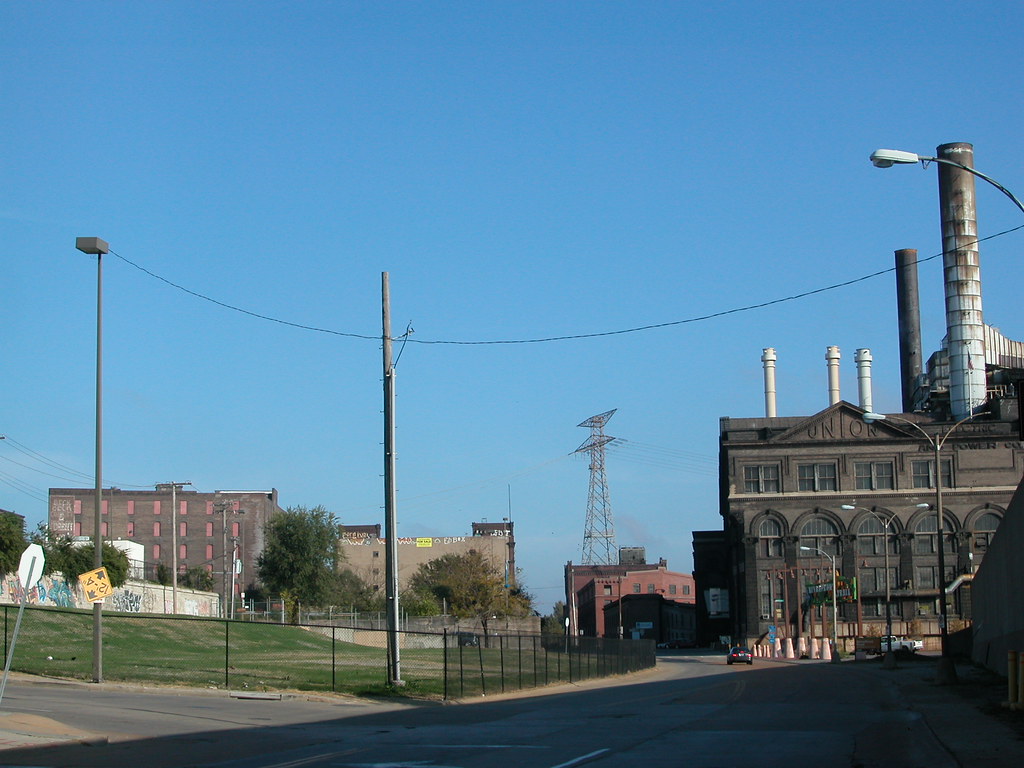
Looking north on Lewis Street, October 2008.

I have pushed off writing further on the now-demolished McPheeters warehouses on Lewis Street just because doing so seemed fruitless. After all, there is no way to return the important lost buildings, and little point in aggressively emphasizing the obvious — that the demolition of the warehouses was probably city government’s biggest preservation failure of 2008.

However, the more that I think about the fine original warehouse, with its adaptable mill method body, or the one-story cold storage building whose true historic significance will never be fully established, I am upset. I think about what the site looks like now, which is worse even from the perspective of the most city-fearing casino patron. I think about what we learned during the demolition: that the central 1881 building was actually built onto the city’s bluff, using a natural limestone wall as part of its foundation (and the source of major water leaching into the building’s timber beams, causing the west wall collapse). I think about how we could have learned from the cold storage building and figured out much about St. Louis shipping, brewing, packing and other industries. We can still learn, of course, but without physical evidence it’s hard. We have lost a lot, and gained nothing.

The Land Clearance for Redevelopment Authority wrecked the buildings with public funds, but the instigator was Pinnacle Entertainment, owners of the adjacent Lumiere Place casino complex. At the city’s Preservation Board, St. Louis Development Corporation Deputy Director Otis Williams — a man with a very difficult job, mind you — told the Board that Pinnacle feared loss of revenue without enhancement of its surroundings. The old buildings, missing roof and wall sections, had to go in the name of economic development.

Specious as this case may be on the face, there was truth inside of it. City government ought to take measures within its powers to stabilize the surroundings of businesses and homeowners who have made significant investments. In this case, LCRA was the owner of the McPheeters warehouses, and held the duty to improve the buildings.

However, there is short-term enhancement and there is long-term enhancement. Charged with the public good, rather than merely carrying out the wishes of private parties, city government has the power to challenge economic logic when it serves a singular interest and when its execution would deprive broader economic and cultural benefit. In the case of the McPheeters warehouses, rehabilitation of the buildings would have been the greater good, and demolition the lowest. All that demolition did was provide instant gratification to a large and stable company that had already made its primary investment.

In this case, city government should have taken Pinnacle’s demand and raised it. LCRA could have spent comparable funds to demolition cost and used them to stabilize the western wall of the center warehouse, which had partly collapsed, and made some roof repairs to the rest of the complex. I doubt that the budget would have accomplished total stabilization, but it would have effectively mothballed them and prevented their loss.

Preservation would have been helpful to the developers and non-profit organizations that are trying to spark development in the North Riverfront Historic District. Preservation would have enhanced the scenic ride from the Arch grounds to the start of the north riverfront trail. Preservation would have allowed people to some day live or work right on the river, near downtown, the trail and even Lumiere Place. Preservation would have bridged the visual gap between Laclede’s Landing and the North Riverfront Historic District, abating the impact of Lumiere Place by making it seem less disruptive. Preservation would have kept the second-nature of building materials and embodied energy in place for eventual re-use. As we know, energy and materials are valuable through growing scarcity, and their conservation is both ecologically sound and economically smart.

Obviously, Pinnacle wanted short-term satisfaction for Lumiere Place managers and guests. City government could have balanced that desire with one encompassing the desires of others, the need to safeguard the city’s cultural resources and the need to enhance and spur future investment as well as safeguarding existing investment. In other words, city government could have brought planning into the discussion. Instead, it capitulated to one company’s short term desire, forever removing a development opportunity for other developers or even that company itself.

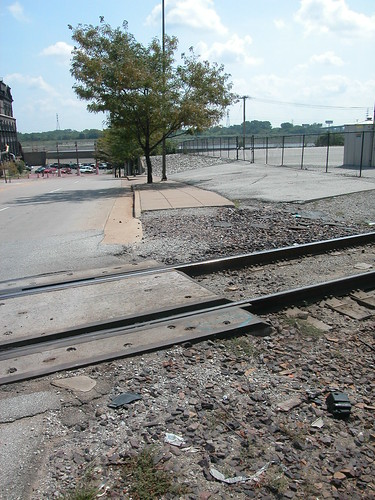
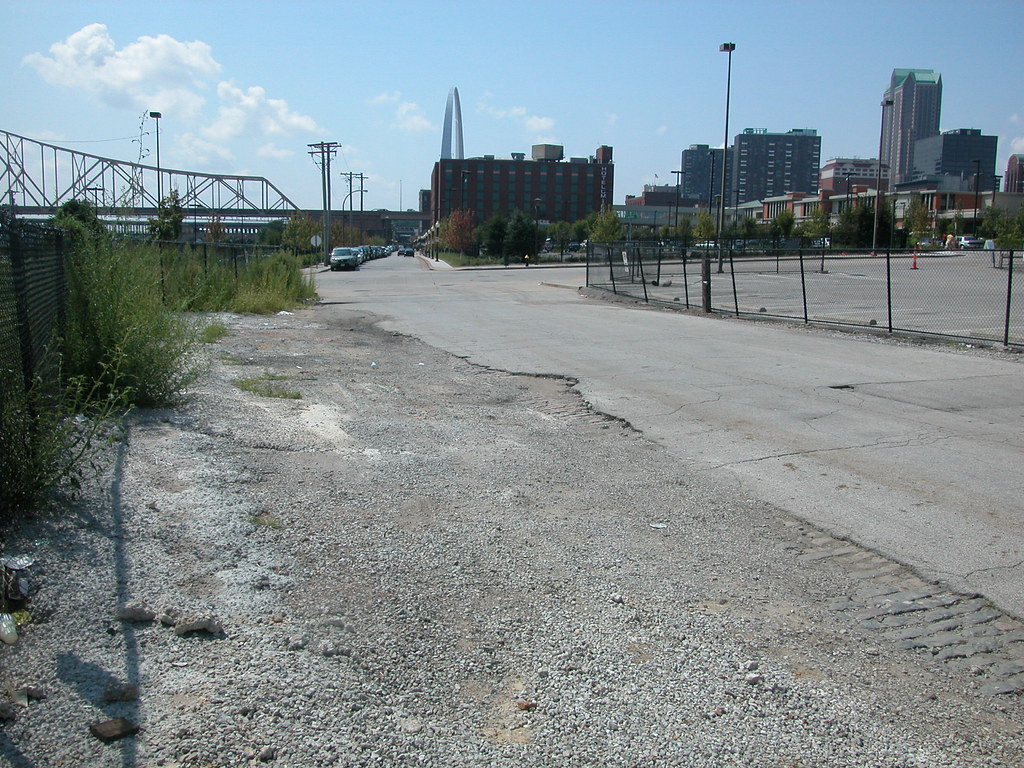
The photos below, taken during demolition, show that even the short-term effect of the demolition is not gain. While the buildings are gone, the sidewalks and streets around them are broken up, uneven and unsightly. Sidewalk and street repair here would bring public benefit, and do far more to make people think that the area is safe and healthy than demolition. I fail to see how any one’s long-term desires were met by LCRA’s decision to demolish the McPheeters warehouses.
Categories
Historic Preservation North St. Louis Planning St. Louis Place

Big Picture View

by Michael R. Allen

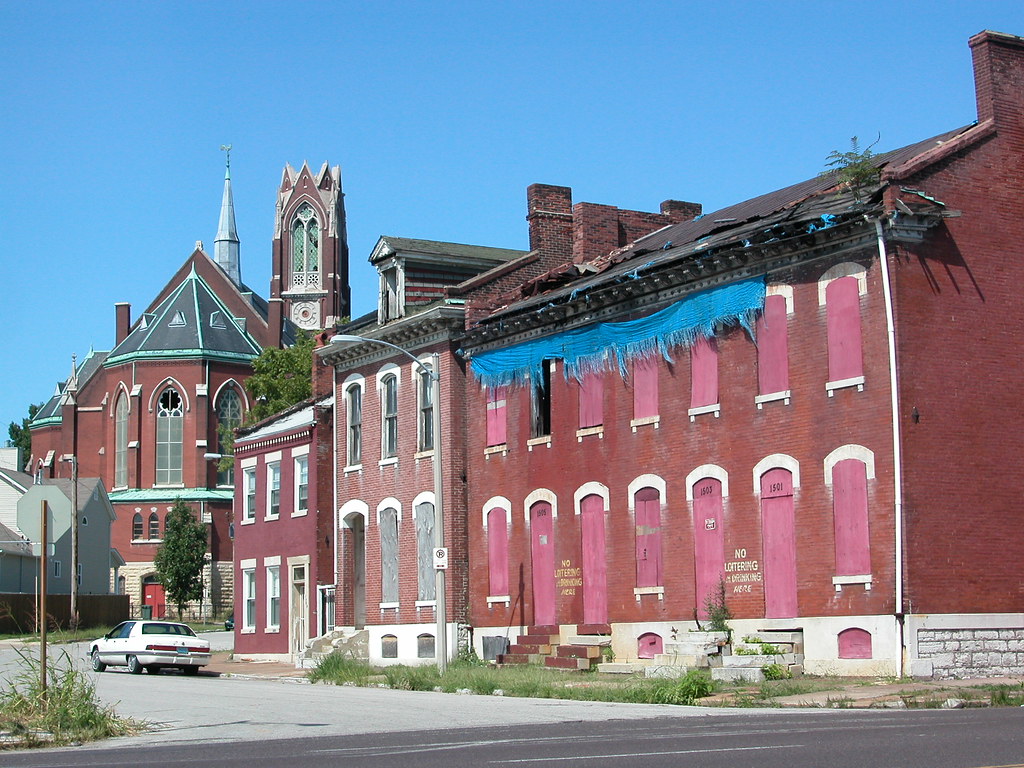
This view is one of mt favorites in St. Louis Place. the view west toward St. Liborius church from Florissant Avenue is framed on the north side of Monroe Street by a row of lovely brick vernacular houses. I framed this shot to exclude the more troubling context across the street: empty lots, with vinyl-clad houses to the west. However, even in a broader view the beauty of this row, shining through decay of two of the buildings, and the church overpowers the unsightly surroundings.

However, the view is a fragile thing. The three-story Italianate style corner building built in 1876, an imposing building that is one of Florissant’s last corner anchors here, has suffered intense roof damage. Three years ago, the building retained a rusty but intact standing-seem metal roof. This was perhaps the last such roof in St. Louis Place or Old North, even though the metal roofs used to be common on buildings of many roof types. Then, in July 2006, heavy winds vitually peeled the roof back and removed a lot of the sheathing. The owner, a limited liability holding company called KGA Properties LLC, draped blue tarps across the hole. The tarps themselves were destroyed in a few months, and the building’s interior remains unprotected. What damage is transpiring would probably break a heart.

What is KGA Properties? This is a north side LLC name that is not part of any blogger litany. Well, the LLC’s registered agent is Delores Gunn, director of the St. Louis County Department of Health. Redevelopment efforts are stalled.

Next door to the west, a classic side-entrance, three-bay house at 1507 Monroe Street is owned by Paul McKee’s VHS Partners. People do know that three-letter LLC. Next door to the west is an owner-occupied home; beyond that, where Monroe bends, is a double house that is privately owned. We can see what those owners want to do with their historic homes — keep them occupied and maintained. The plans of their neighboring corporations remain uncertain. I’m sure that the owners of the occupied houses sigh each time they pass by the empty buildings next door.

The near north side is full of pockets like this one, with amazing historic architecture, some abandoned, surrounded by vacant land and new buildings. It’s the urban patchwork quilt few want to mend due to the difficulty of repair. Owner occupants hang on hoping for the best, while developers might also be hanging on in a different way, waiting for a political process in which redevelopment can happen. If the homeowners and the developers are both to be happy, we need leadership that represents the best interests of the near north side and its future to open the dialogue that will lead to redevelopment. Private interests get discussed a lot when people talk about the near north side, but what about the public interest?

There is more than just the future of individual owners and buildings at stake. After all, each of the buildings in the first photograph are privately owned, but they compose a lovely urban view free and accessible to all. Each homeowner is part of a neighborhood made of many people. Step back, and there is a big picture view of the near north side. I hope that our political leaders see it.