Categories
St. Louis County Urbanism

The Shady Oak Theater and the Big Box

by Michael R. Allen

Photograph by Lynn Josse.

Wreckers started taking down the shuttered one-screen Shady Oak Theater at 7630 Forsyth Boulevard. While not dazzling, the Colonial Revival building was a handsome building. Built in 1933 and designed by architects Frederick Dunn and Campbell Alden Scott, the theater was a reminder of the genteel character that Clayton once possessed. The theater’s small scale was once part and parcel of the residential suburb’s architectural character, but in the past twenty years was an antidote to the giantism and automobile storage worship that has befell Clayton.

On November 2, the St. Louis Post-Dispatch ran a story on the demolition that quoted Thomas Stern, president of Solon Gershman, the company that is wrecking the theater for surface parking. According to Stern, “[n]ow if you don’t have 16 screens it doesn’t make sense to run a movie theater. It has more value to us now for parking in the intermediate term.”

In light of current economic circumstances, Stern’s first statement is as baffling as it is illuminating. Even at the height of our recent credit glut, theater operators in the region’s urban core had backed away from the super-sized multi-plex in favor of theaters of six screens or less. A one-screen move house is perfect for an urban area like downtown Clayton, where a residential population lies within an easy walk and land for a larger theater would be difficult to assemble.

With credit slow, I doubt that even the most exurban reaches of the St. Louis area will see a new 16-screen theater in the next few years. However, smaller movie houses with less overhead and closer to dense populations (especially wealthy populations like in Clayton) should do well. Stern’s comment suggests an uncritical embrace of large scale development — the attitude that has eroded Clayton’s charm, killed off the Shady Oak and damaged our economy. While there are signs that attitude has lost much of its momentum, there is also the possibility that the economic crisis has only momentarily slowed down the pace of the big box culture. Let’s hope that the big box is headed for the destruction that it has wrought on urban areas.
Categories
Historic Preservation South St. Louis

Sugar Loaf Mound for Sale

by Michael R. Allen

Mound City’s only remaining prehistoric mound is now for sale. Sugar Loaf Mound, a burial mound older than 1,000 years, is located on the side of the Mississippi River aside I-55 near the South Broadway exit. Readers probably know the visible small white house on the hill at that location. The hill is only the most obvious part of the mound, which is larger than it appears. The house and the mound are now listed for $400,000. Realtor Leigh Maibes of Circa Properties has started a blog on the mound, its history and the sale. Check out the blog, Sugar Loaf Mound Saint Louis. The curious can also visit the site this weekend at an open house:

The Sugar Loaf Mound House will be open this Sunday November 9, 2008 from 1-4 pm. Please feel free to stop by even if you are just a curiosity seeker. I will be on hand to answer any questions that you may have about the property and house. Please park on the side of the road opposite from the house if at all possible. Hopefully, it will be a lovely day and we will have tons of fun.

The house is located at 4420 Ohio St. Saint Louis, MO 63111 near highway 55 and Broadway. Please feel free to post questions here!

The sale raises the issue of stewardship. For over 50 years, the mound has been owned by the family that lives in the house. The family has left the mound alone, preserving what is left. Now that the family is selling the property, there is the opportunity for a preservation plan for the city’s most historic structure. Tourists love the “very old” Old Courthouse and Old Cathedral, and Cahokia Mounds in Illinois has the prestige of being a United Nations World Heritage Site. Imagine the potential for Sugar Loaf Mound as a protected public site with a solid interpretive center. Mound City could have the chance to celebrate its ancient roots, and take pride in a landmark unlike any other in the city.

Categories
Downtown Historic Boats Missouri Riverfront

A is Not for the Admiral

by Michael R. Allen

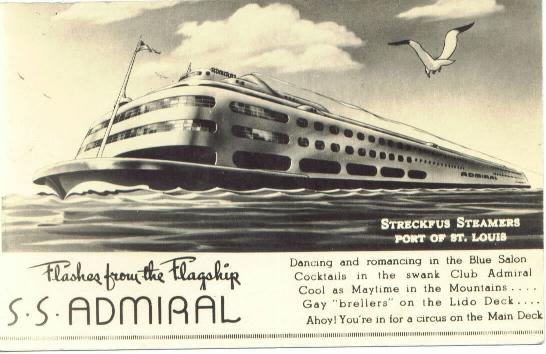
While Missouri Proposition A is not directly about historic preservation, there is a preservation-related consequence: the shuttering of the S.S. Admiral on the St. Louis riverfront. First built in 1907 and rebuilt to jazz-age standards in 1940, the beleaguered Art Moderne boat has lost its engine and much of its original interior, but it retains sophisticated, cool lines on the exterior. Of course, the body of the S.S. Admiral is hidden behind an ugly floating structure on the riverfront side, placing the only clear view from the river channel.

Currently, Pinnacle Entertainment owns both the Admiral and Lumiere Place uphill. Pinnacle’s ownership prevents local competition as well as provides a close place where patrons can continue gambling after reaching loss limits at Lumiere. It’s a bad system, and I am not arguing that Pinnacle should continue it.

Personally, I support allowing people to decide what to do with their own money. That support extends both to gamblers looking to lay some money down at a casino as well as casino operators looking to open new casinos. Proposition A doesn’t allow for a free market in casinos. Rather, it acts as a form of protectionism for current operators. The proposition would lift Missouri’s loss limits — the last left in the nation, but would also limit Missouri’s casino licenses to 13. Currently, there are 12 licenses and Pinnacle Entertainment is seeking to secure one for a new casino in Lemay. Obviously, Proposition A is a windfall for Pinnacle and other operators, and a roadblock to competition. I hope that the measure fails and a smarter, competition-oriented policy is adopted. After all, if gamblers will be pouring more money into casinos, they deserve choices.

Back to the Admiral: If Proposition A passes, Pinnacle won’t need the old boat. Dan Lee, head of Pinnacle, told the St. Louis Post-Dispatch in September that he might move the boat to a new city location temporarily, but eventually ditch it for a new facility that would assume the Admiral’s license. Should that course of events happen, no other operator will be able to buy the Admiral and obtain a gaming license. Any use for the Admiral that does not include gambling probably will fail. Stripped of so many other things, the Admiral has survived. Stripped of a gaming license, the boat won’t have much of a future. The threat to the Admiral is not a good reason to vote against Proposition A, but it will be a consequence of its passage.

Categories
Historic Preservation JeffVanderLou North St. Louis

Looking at the 2800 Block of St. Louis Avenue

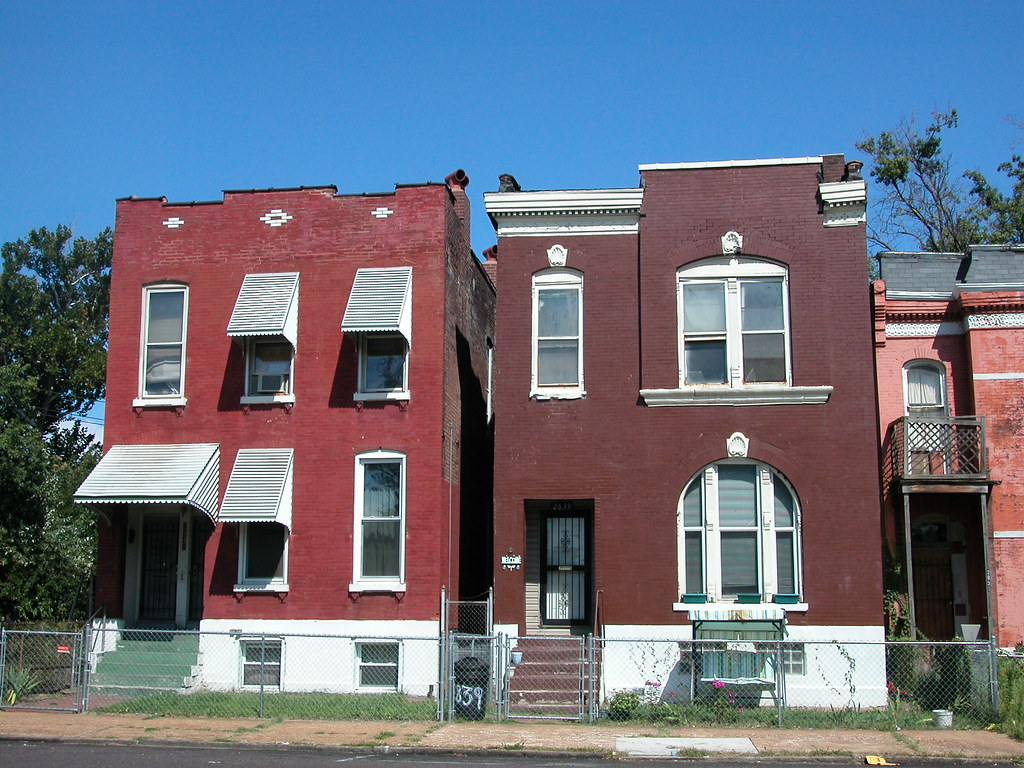
Behold the remaining homes of the north face of the 2800 block of St. Louis Avenue, between Leffingwell and Glasgow. This photograph suggests a block of density and varied residential architecture. Unfortunately, this photograph lies by omission.

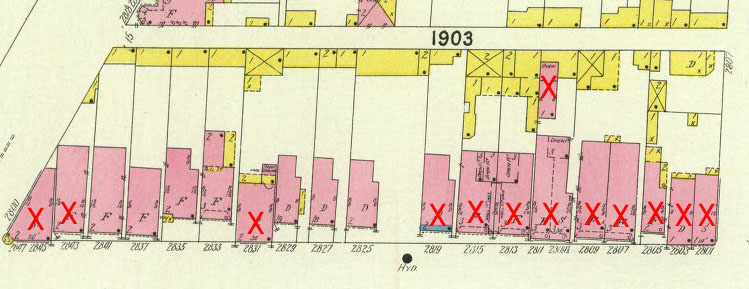
The realistic view is offered through this altered shot of the 1909 Sanborn fire insurance map page for the block. I have placed a red “x” over each demolished building. As you can see, most of the block’s fabric is long gone. Seven historic buildings remain.


That number was nine at the start of 2008, before the city wrecked the westernmost two buildings. (See We’re Losing the Intersection of Glasgow and St. Louis”, January 16, 2008.) The wedge-shaped western building was a two story storefront building with an amazing corner turret. The demolition of the westernmost buildings came at the same time as three buildings across the street were demolished. The city’s Building Division’s over-eager Demolition Division pursued mass demolition, taking down five buildings because one had suffered damage from brick rustlers. Companies controlled by developer Paul J. McKee, Jr. owned four of the five buildings. The loss was visually devastating, but a look at the Sanborn map shows that a lot of other buildings were lost before those without any fanfare. And the fact remains that what is left is not insignificant or unworthy of conservation.


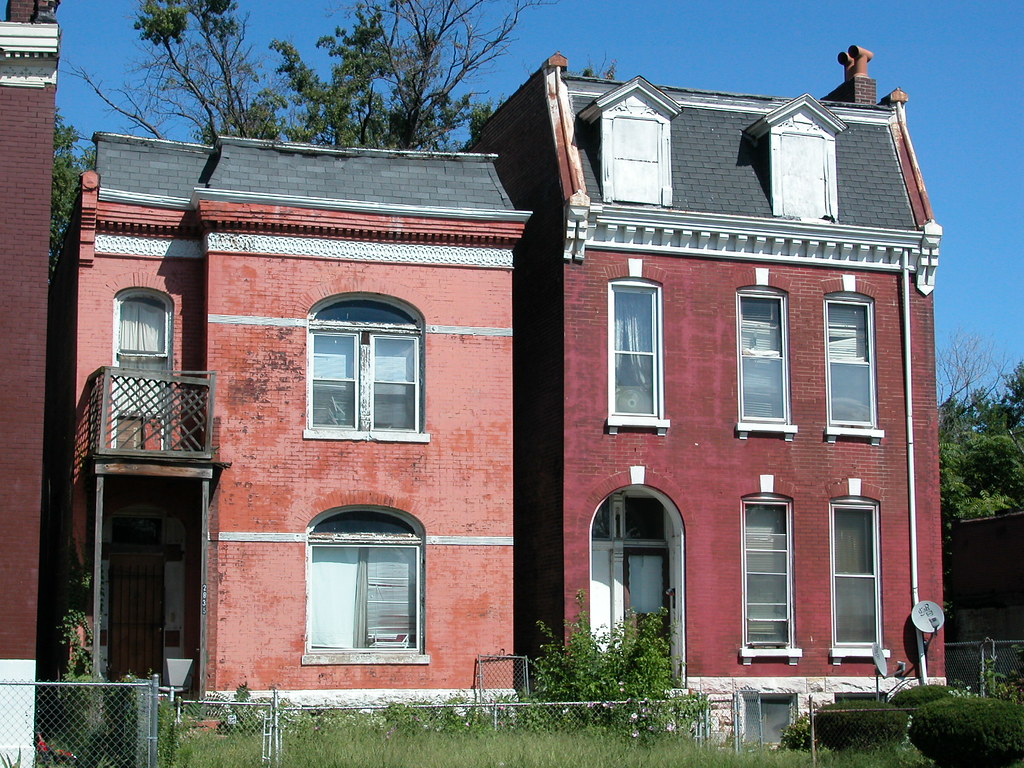
The four two-story homes are all accentuated by varying street setbacks. All are painted, but still show the full force of late 19th century St. Louis machine-pressed brick facades with limestone dressing. Despite different styles, sizes and placement, the homes all have doorways on the westernmost side of the first floor. At the east (right here), 2833 St. Louis Avenue is a strong example of the Second Empire style, with a Roman arch entrance dating it to the early 1890s. Next door, at 2835, is a lovely Italianate home with a low mansard roof rising above a cornice of patterned ornamental brick. The composition of the home is echoed somewhat in the next house to the west, at 2837, although eclecticism has freer hand. The westernmost of the group, at 2841, has a stepped front parapet that likely is not original. These houses started as single-family homes, but were later divided, un-divided and re-divided again.

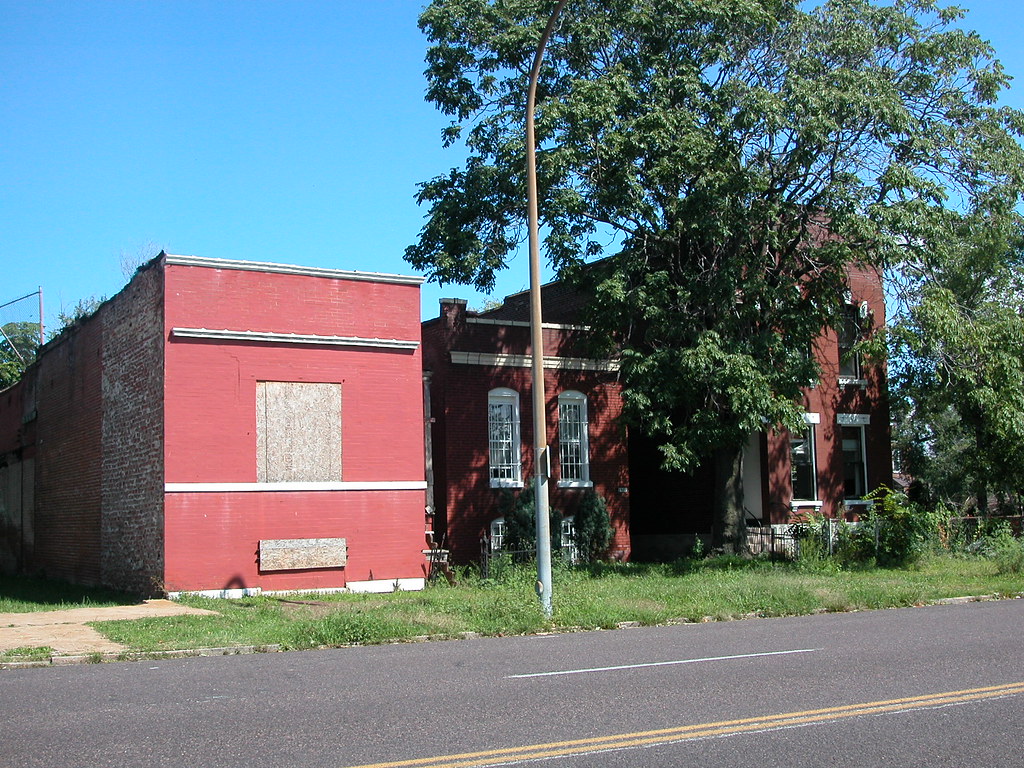
The eastern three houses show even more diversity of height, style and setback. There are two one-story side-entrance houses, with the boarded western one (2829, owned by N & G Ventures LC) having a front addition that extended it out to the sidewalk. The easternmost house (2825, owned by Larmer LC), is more typical of the block’s once-prevalent two-story homes. The house has a stepped front parapet and side entrance. The flat limestone arches are striking. Again, all three started as single-family homes. The one-story homes show us that the homeowners in the late 19th century here were of diverse means. The family that could build the Second Empire town home lived smack-dab, next-door to the family that built a three-room one-story shotgun and later saved up enough to expand it one room forward.

The arrangement and condition of these seven homes compel preservation and residential infill on this block face. Despite loss and abandonment, the homes are a fine group that gives a forlorn stretch of St. Louis Avenue needed urban character. To the immediate west of Glasgow on the north face begins the dense, intact residential neighborhood of Lindell Park. Lindell Park’s homes are different than those on the 2800 block of St. Louis. The prevalent styles are later, lots are wider and homes are set further back. North of the 2800 block of St. Louis, homes are smaller, with one and one-and-a-half story homes dominant. This section of St. Louis Avenue shows an attempt to carry the architectural majesty of the section of St. Louis Avenue between Jefferson and Parnell — once known as “Millionaire’s Row” — westward to Grand. Little survives, but what does shows a section of St. Louis Avenue far less segregated than the celebrated section to the east. Just as Millionaire’s Row tells an important story, so do these houses. Like the first photograph shown here, north St. Louis without this part of St. Louis Avenue tells a lie through omission.

Categories
Historic Preservation Louis Sullivan North St. Louis

Virtual Tour of the Restored Wainwright Tomb

The St. Louis Beacon has produced a slide show on the restoration of the Wainwright Tomb in Bellefontaine Cemetery. The inimitable Robert Duffy narrates gorgeous images from Gary R. Tetley showing the interior and exterior of the revitalized mausoleum. The slideshow is available here.

Categories
Architecture Downtown Streets

Locust Street Canyon

by Michael R. Allen

The view east from 11th Street of Locust Street in downtown St. Louis is encouraging. The differentiation of building heights, materials and styles gives the scene a truly urban complexity. Changes are in store as the Roberts Brothers prepare to rehabilitate two buildings (913 & 917 Locust) and demolish two buildings (921 & 923 Locust) in this scene. On the site of the demolished buildings will rise an addition to 917 Locust that will be part of a Hotel Indigo. How will their new building fit in this scene?

Categories
Fire JeffVanderLou North St. Louis Northside Regeneration St. Louis Place

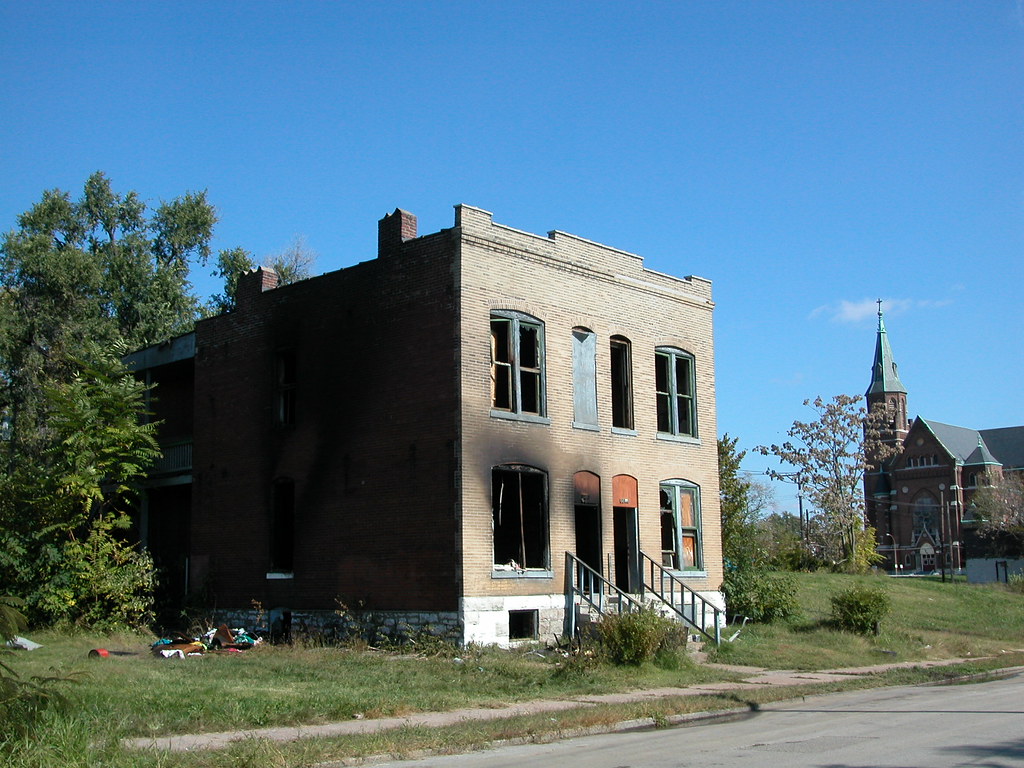
Fire Strikes House in JeffVanderLou

by Michael R. Allen

Built St. Louis literally reported a fire at a house at 2621 Sullivan Avenue in JeffVanderLou. The house is owned by a holding company controlled by developer Paul J. McKee, Jr. The fire struck on Friday evening, but by Saturday morning things were calm on this completely-vacant block. This is the last remaining building on either side of this block, and has been vacant since early 2008. Under a prior owner, the building was in pretty rough condition. the second floor was completely vacant, and only the west unit on the first floor was occupied. Late in the summer, there was fire that was confined to that last occupied unit.

The good news is that, despite two fires and neglectful ownership, the masonry building is still able to be salvaged. The brick walls are sound, and the fire damage has not led to any floor or roof collapses. While much of the floors and some of the joists need replacement, this building is not beyond repair. Swift board-up of all openings is in order.

Hopefully, the fire is not an indication of the return of the arsonist behind a May wave of fires in eastern JeffVanderLou and western St. Louis Place. Some will lay blame rhetorically for the fire on McKee’s ownership, but we all know that the real cause is a criminal person or persons deliberately setting fires. Law enforcement efforts are not aided by innuendo or sloganeering, but by solid information that will lead to arrest. (Efforts to involve residents in planning the future of these neighborhoods are not aided by careless innuendo, either.) As of yet, those behind the May arsons have not been charged, although many have been questioned. If you have any information, call the St. Louis Metropolitan Police Department.

Categories
Historic Preservation North St. Louis Old North Preservation Board

Neglect by Neglect

by Michael R. Allen

In August, the St. Louis Preservation Board voted 4-1 to uphold staff denial of a demolition permit for the Italianate house at 2619-21 Hadley Street in Old North. Haven of Grace, the non-profit owner, had previously pledged to rehabilitate the house in exchange for Board and neighborhood support for demolition of a house at 2605 Hadley. Neighbors held up their end of the bargain, but after inaction the Haven applied for a demolition permit for 2619-21 Hadley in April 2008.

After the Preservation Board’s action in August, little has transpired on Hadley Street. The Haven of Grace apparently dismissed Executive Director Diane Berry, who made the public pledge for rehabilitation that garnered support for the compromise. Haven of Grace has not stabilized the building, boarded open windows or even so much as cut down a single one of the many over-six-feet-tall weeds growing around the site. By the fall, the weeds became a neighborhood eyesore.

The Preservation Board deemed the house at 2619-21 Hadley Street to be sound, despite some masonry damage, and found that its rehabilitation would not be cost-prohibitive. Obviously, the tall weeds challenge those findings by emphasizing the home’s vacancy. However, the weeds are an affront to the Haven’s own clients and neighborhood residents in the vicinity. At the Preservation Board meeting, Haven representatives tried to claim that the house was too unsound for a worker to travel within 20 feet. That’s a false claim, and regardless does not excuse the Haven from keeping the property up to municipal codes as the future of the house is meted out. Old North residents welcome the Haven of Grace and most of us are quite stunned by its board’s recent behavior regarding this house. One thing is clear: there will be no solution without dialogue.

Categories
Chicago Historic Preservation Louis Sullivan

Sullivan Discovery in Chicago Provides Consolation

by Michael R. Allen

There is great news from Chicago for admirers of the work of architect Louis Sullivan: a storefront recently uncovered on Wabash Avenue has been identified as Sullivan’s work. The indefatigable Tim Samuelson found proof that the one-story cast iron front unearthed during renovation of the block containing the former Carson Pirie Scott department store building (under renovation and being renamed the Sullivan Center) was the work of the prarie master, and not an imitation of his hand.

The elegant, if small, work’s discovery brings some consolation after tragic fires at three Sullivan-designed buildings in 2006, 150 anniversary of the architect’s birth: Pilgrim Baptist Church, left a stone shell, the Wirt Dexter Building, demolished and the Harvey House, also demolished. Sullivan’s vacation cottage in Ocean Springs, Mississippi, designed in collaboration with Frank Lloyd Wright, was severly damaged by Hurricane Katrina in 2005 and his Peoples Savings Bank in Cedar Rapids, Iowa was underwater during this summer’s flooding.

The storefront discovery comes at the same time as another bit of good Sullivan news: the completion in October of a thorough restoration of the Wainwright Tomb in Bellefontaine Cemetery in St. Louis, documented by Landmarks Association here.

Categories
Historic Preservation Missouri People

Missouri Preservation Hires Bill Hart as Field Representative


From Missouri Preservation:

Missouri Preservation is proud to announce that William (Bill) Hart has been hired as its first full-time Field Representative. William brings over fifteen years of hands-on preservation experience to his role as Field Representative. William received his Bachelor of Science degree in Historic Preservation from Southeast Missouri State University in Cape Girardeau, Missouri and graduated from the Savannah College of Art and Design in Savannah, Georgia with a Master of Arts Degree in Architectural History. William became active in neighborhood preservation issues when he moved to St. Louis in the late 1970s. Through his neighborhood association, he helped to establish a not-for-profit housing corporation to deal with vacant historic buildings. In the 1980s, he worked with Market Preservation, a group which opposed massive demolition of historic buildings in the heart of the downtown. William has restored several historic buildings on his own, and eventually started his own company as a developer and general contractor, specializing in historic buildings. While working as a developer, he received awards from the Dutchtown South Community Corporation, the Home Builders Association of Saint Louis, and the St. Louis Landmarks Association. He has a special interest in documenting vanishing roadside architecture and the preservation of barns and farm buildings in Missouri. William is a native of Perryville, Missouri and currently resides in Saint Louis in the City’s Benton Park Neighborhood.

William will expand the vital outreach services provided by Missouri Preservation and the National Trust for Historic Preservation to communities across the state. As an Official Statewide Partner of the National Trust and Missouri’s statewide historic preservation advocacy and education organization, Missouri Preservation provides information, technical, and strategic advocacy services to empower citizens with the tools needed to preserve their historic resources. William will represent both organizations to provide guidance on a variety of subjects including preservation techniques and approaches, fundraising, organizational development, community relations and politics, community development, and the availability of preservation resources.

The Field Representative position has been funded by a $125,000 challenge grant from the National Trust for Historic Preservation. Entitled Partners in the Field, this matching grant had the specific purpose of providing three years of dedicated funding to expand our outreach by hiring a full-time Field Representative. Missouri Preservation recently completed the fundraising for its $125,000 match. We would like to thank our generous donors for making the expansion of our mission-driven services possible: Great Southern Bank, HBD Construction, Inc., Huebert Builders, Inc., Edward Jones, William T. Kemper Foundation, McGowan Brother Development, Raming Distributions, Inc., Renaissance Development Associates, The Roberts Companies, Stark Wilson Duncan Architects, Inc., and Stupp Bros. Bridge & Iron Co. Foundation.
We are pleased to welcome William to our staff and look forward to the expansion of our field service program. If you have a question about an historic place in your community, please contact the Missouri Preservation office at 573-443-5946. Contact information for William Hart will be listed on our website at www.preservemo.org.

Missouri Preservation, known formally as Missouri Alliance for Historic Preservation, is Missouri’s only statewide non-profit organization dedicated to promoting, supporting, and coordinating historic preservation activities throughout Missouri.