Categories
Agriculture Iowa land use

Land Use and Flooding

by Michael R. Allen

From “Iowa flooding could be man’s fault, experts say” (Washington Post):

Between 2007 and 2008, farmers took 106,000 acres of Iowa land out of the Conservation Reserve Program, which pays farmers to keep farmland uncultivated, according to Lyle Asell, a special assistant for agriculture and environment with the state’s Department of Natural Resources (DNR). That land, if left untouched, probably would have been covered with perennial grasses with deep roots that help absorb water.

Categories
Demolition Historic Preservation LCRA Riverfront

Casino Claims Historic North Riverfront Warehouses

by Michael R. Allen


Nestled between two prominent landmarks, the glitzy new Lumiere Place casino complex and the venerable Ashley Street Power House, stands a group of warehouse buildings. These aren’t the most iconic buildings — certainly not amid such strong competition. Still, the street wall presence of three buildings on Leonor K. Sullivan Drive between Carr and Biddle ties together disparate sections of riverfront fabric.

That presence is about to disappear. In May, the city’s Preservation Board voted 3 to 2, approving demolition of the buildings. While the applicant was the city government, Lumiere Place owner Pinnacle Casinos was a forceful advocate for razing the historic warehouses.

The warehouses in question comprise a wide four-story brick building built in 1881, a modern addition to the south from 1946 and a long one-story stone building to the north built in 1883. The grouping is a little peculiar, but there’s a reason for the strange appearance.

Thomas McPheeters was on his way to becoming one of the West’s biggest storage magnates when he built the four-story center building in 1881. That building was used for warehousing dry goods, and its looks are not out of the ordinary for industrial St. Louis. Yet its northern neighbor is an odd one-story stone-faced building built by McPheeters in 1883. Early fire insurance maps state that this building was lined with cast iron, suggesting that this was a primitive cold storage warehouse. McPheeters continued to develop cold storage facilities, and in 1900 and 1901 built much larger brick cold storage warehouses a few blocks north of his earlier building. Eventually McPheeters’ company sold the earlier buildings to the Thompson Chemical Company, which added the south building in 1946 and used the buildings for production.

Concerning the immediate surroundings, many remaining buildings were wrecked for Lumiere Place but an impressive pocket to the north contains large buildings, including the Ashley Street and Laclede power houses and McPheeters’ later buildings. These buildings comprise the North Riverfront Historic District National Register of Historic Places, listed in 2002 in response to renewed interest in developing the area.

Unfortunately, the old McPheeters buildings were not able to be included because a 2001 fire (and demolition) at the old Belcher Sugar Refinery left the old McPheeters buildings too far from the district to qualify. Yet the buildings could still be listed on the National Register of Historic Places, making historic rehabilitation tax credits available.

Unfortunately, that prospect will not come. The city’s Land Clearance for Redevelopment Authority (LCRA) purchased the buildings in 2003. LCRA’s name says it all – the agency exists to clear land for new projects like Lumiere Place. However, the original Lumiere Place redevelopment plan didn’t include the fine old warehouses, leaving open the possibility of reuse.

All three buildings are sound, and the city’s Cultural Resources Office has advised that none have conditions of unsoundness established under the city’s preservation review ordinance. Still, there are challenges here — but none even as big as building a multi-million dollar, state-of-the-art casino. The middle warehouse has lost a section of one wall, exposing part of the wooden post and beam structure. The roof is missing in places. These are the conditions one expects for vacant property of this age, and conditions that have become standard fare for St. Louis tax-credit-savvy developers.

Although I cannot profess much respect for the execution of the Lumiere Place architecture and site plan, I was hopeful that its presence would not be a huge intrusion into the historic fabric of our riverfront. While the casino is visually at odds with surrounding architecture, and its construction entailed demolition of historic fabric, its location is ideal for connecting Laclede’s Landing to the industrial buildings to the north. Pinnacle repeatedly discusses a second phase of Lumiere Place that will create much-needed housing on the riverfront.

Pinnacle could have made as bold of a move as it did with its new casino and included historic rehabilitation in its plans. Connecting the new development with the historic context would be cool and smart, demonstrating Pinnacle’s commitment to transcending the usual. Also, utilizing historic rehabilitation tax credit and unusual buildings would offer additional financing tools and create something more special than a new building. The bonus would be the impact of helping to draw development up into the North Riverfront Historic District.

Pinnacle and city development officials have touted Lumiere Place as a catalyst for spreading investment across the riverfront areas north of the Eads Bridge. The vision of a vibrant riverfront with residential space certainly is compelling. Then, at the Preservation Board we heard from St. Louis Development Corporation Deputy Director Otis Williams, who told us that Lumiere Place wanted the McPheeters warehouses torn down because their appearance was supposedly hurting casino revenue. There’s a mighty large gap between the promises of spreading investment and the self-contained concerns conveyed through Williams.

That’s a gap big enough to swallow three fine buildings, but hopefully not the larger vision of revitalizing this section of riverfront by sensitively connecting the fabric of Laclede’s Landing and the North Riverfront Historic District.

This article first appeared in the Vital Voice on June 13, 2008.

Categories
Central West End Historic Preservation Mid-Century Modern

San Luis Gets Website, Spot on Most Endangered List

by Michael R. Allen

There’s a new website called “Save the San Luis” — referring to the threatened San Luis Apartments at Lindell and Taylor in the Central West End — located at NoParkingLotonLindell.com.

Also, last weekend at its annual membership meeting, Landmarks Association announced that the San Luis was one of the additions to this year’s Eleven Most Endangered Places list.

Categories
Abandonment Demolition Flounder House Historic Preservation North St. Louis St. Louis Place

Two Blocks of Florissant Avenue in 1985

by Michael R. Allen

While demolition permit numbers show that the peak decade for material building loss in the Old North St. Louis and St. Louis Place neighborhoods was 1970-1980, a substantial slower loss has transpired since then. The cumulative result is that streetscapes recognizable as urban places twenty-five years ago now form desolate landscapes lacking architectural definition.

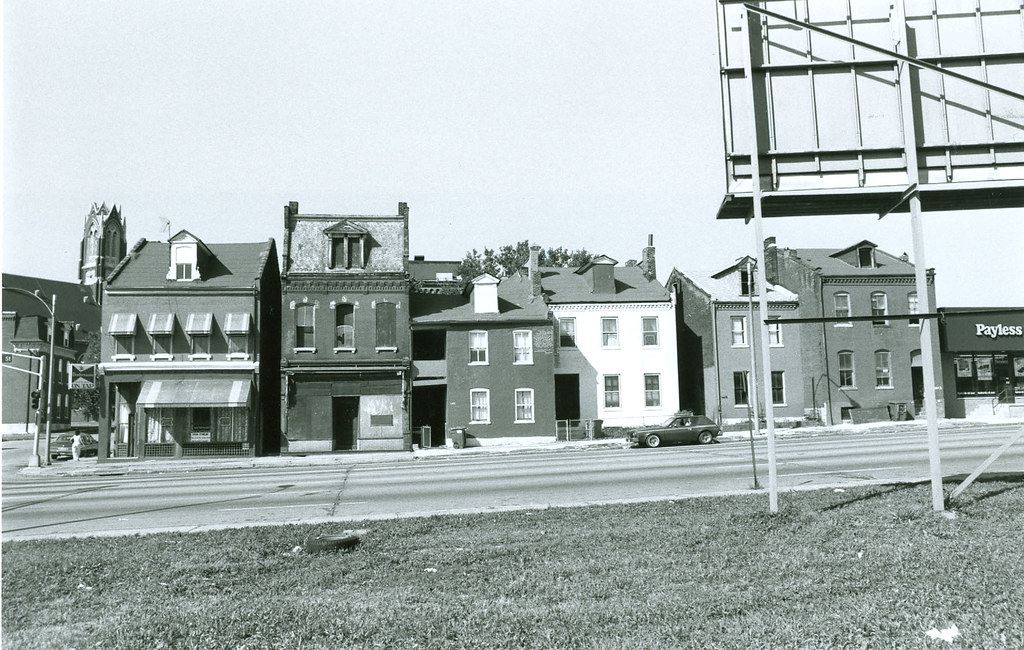
Two photographs of the west side of Florissant Avenue in 1985 taken by Mary M. Stiritz for Landmarks Association of St. Louis depict the absurd reality that in the near past, the eastern edge of St. Louis Place was marked by the familiar nineteenth century vernacular masonry buildings that typify other sections to this day.

Nowadays, Florissant Avenue is a confused corridor notable for its many vacant lots and the needless wide expanse of roadway that awaits MetroLink expansion. This area was once a vital part of a beautiful neighborhood. In 1985, Landmarks was preparing a survey leading to expansion of the Clemens House-Columbia Brewery Historic District; sufficient physical stock existed here to allow major expansion of a national historic district. Today, further expansion remains a fantasy at best due to continued loss.

Behold the northwest corner of Warren Street and Florissant Avenue, today a sun-scorched vacant lot:

While the architectural context is visibly diminished, the important corner site is occupied by a building that becomes a landmark heralding the site as one for human comfort and exchange. As we rebuild St. Louis Place, we should ensure we have good corners, and not drive-through lanes, curb cuts and fences where the marks of human settlement should be.

The second photograph shows the block of Florissant between North Market Street on the south and Benton Street on the north:

Here was a hybrid row of commercial and residential buildings, all brick but differing somewhat on setback, height and style. There are a few side-gabled buildings, with a mansard-roofed store second in from the corner adjacent to a flounder house with a generous side gallery porch. Dormers abound. There’s even a modern Payless Shoe Store at the right of the image. This is a resolutely urban group, friendly to the pedestrian and attractive to the eye.

All of these buildings are now gone.

Categories
Demolition Historic Preservation Midtown

Locust Street Building Demolished

by Michael R. Allen


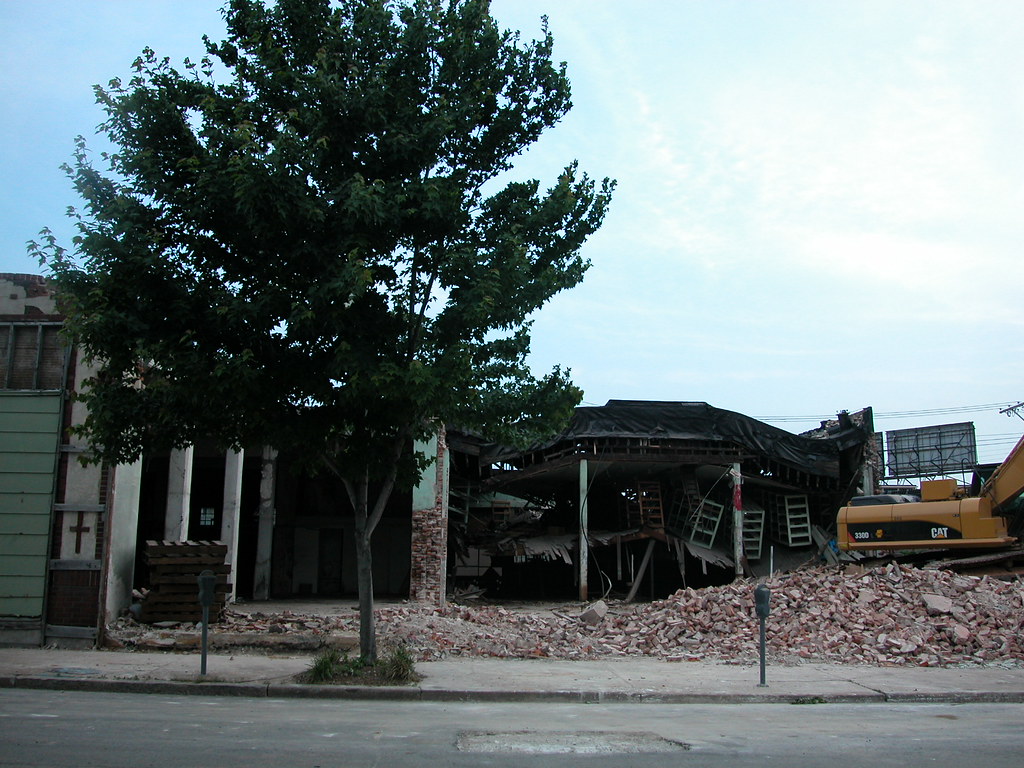
A few people have asked me about the current demolition of a building at 3126 Locust Street in the Locust Business District just east of Compton Avenue.

The building being demolished unfortunately could not be included in a recent Locust Street Automobile Row Historic District extension due to heavy alterations. While remaining sections of the building show a Spanish Revival facade of stucco and brick, the building was clad in metal paneling until very recently. The installation of the panels damaged the facade, and the owner — Scott Pohlman, who developed the residential building next door to the east — elected to demolish the building and build a new residential structure on the site.

In 1888, this was the site of the new First Christian Church building. The present building sections date to 1913 and 1919. A 1919 city directory shows Gill Piston Ring Company and Standard Roller Bearing as tenants. The tenant listing is not surprising; “Automobile Row” on Locus included perhaps more parts manufacturers and distributors than automobile dealers and distributors. Companies like these made St. Louis the “Second Detroit” (almost first).

While 3126 Locust may have been salvaged, and I think it could have been, at least there is a redevelopment plan leading to a beneficial trade-off. There have been too many parking lots added in recent years, especially by St. Louis University — which makes no secret that parking, not development, is its end goal.

Categories
Downtown

Bowling Museum Leaving St. Louis

by Michael R. Allen

KMOX is reporting that the International Bowling Museum and Hall of Fame is leaving St. Louis by the end of this year for a new home in Arlington, Texas. The attraction was the only part of Ballpark Village that could not be characterized as an eyesore. Its departure out of the development quagmire there is no surprise, but its move out of St. Louis is a stunning blow to a city that once took its bowling seriously. There’s something sad about losing any national museum — especially since we have so few. Meanwhile the only regulation-sized bowling lanes that remain open within the city limits are operated by churches.

Categories
Media North St. Louis Northside Regeneration Planning

City Hall Meeting Opens Dialogue Between Near North Residents and Officials

by Michael R. Allen

On Wednesday’s near north side group Neighbors for Social Justice met at City Hall with Mayoral Chief of Staff Jeff Rainford, Building Commissioner Frank Oswald, City Counselor Nuisance Property Attorney Matt Moak and Urban Solution President Marvin Steele. (McEagle Properties hired Urban Solution to implement a maintenance program for its over 700 properties in north St. Louis.) The long-sought meeting was productive if only the start of dialogue with city officials on how to shape the McKee project.

The meeting has spurred media coverage, where details can be found (my commentary can be found in the Pub Def videos):

North side residents continue to question McKee plan (KWMU)

Developer Paul McKee Topic of City Hall Meeting (KMOX)

Is Paul McKee dropping his plans for Old North? (Pub Def)

More Accounts of Blairmont Meeting (Pub Def)

Categories
Mayor Slay North St. Louis Northside Regeneration Planning

Develop With Dignity

by Michael R. Allen

The rancorous discussion about development on the near north side of St. Louis seems without end. Often, we residents seem stuck between a rock (current conditions, which we do need to overcome) and a hard place (Paul McKee’s clandestine plans). Yet there is a better path than the status quo, which almost everyone will admit is not leading to enough development to transform our area, or a totally privatized plan, which could wipe out large parts of what we call home.

Develop With Dignity is a coalition working to achieve a balanced vision. The group of north side churches, organizations, businesses and individuals have offered a clear set of positive principles for guiding future development:

1. Engage area residents and their elected officials in formulating a redevelopment plan.

2. No use of eminent domain on owner occupied property.

3. Maintain current properties so they do not become a nuisance or a danger to the community.

4. Every consideration must be given to developing diverse communities.

These are simple and direct statements of what residents expect in future development. The principles cut through the mess of what McKee does or does not have planned with a platform for development that does not displace. we will have many heated discussions about the scope and form of new development, but we first need to set base standards for process.

At a community meeting last night, Alderwoman April Ford-Griffin (D-5th) stated that she endorses these principles. Many organizations have already signed on, from Sts. Teresa and Bridget Parish to North Grand Neighborhood Services to St. Louis Crisis Nursery. Here is a working coalition for consensus-based decision-making. Some residents who have met privately with Paul McKee have reported that even he has been favorable to the principles, although he has not signed on. What if he did? Or what if Mayor Francis Slay signed on? What kind of dialog about development could we then start?

Please consider signing on yourself: www.developwithdignity.org

Categories
DALATC Demolition North St. Louis Northside Regeneration Old North

Old North Building Owned by McKee Demolished

by Michael R. Allen

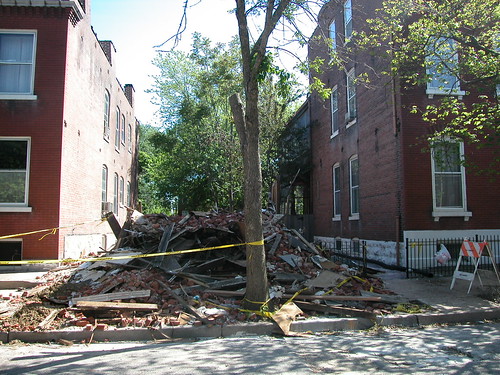
The house at 1412 Sullivan Avenue in Old North St. Louis fell to wreckers last month. The building was already badly deteriorated when Paul McKee’s holding company Babcock Resources LLC purchased the property at a sheriff’s sale in October 2007. (See “McKee Purchases Building on Stable Block in Old North”, October 25, 2007.)

Complaints from some neighbors over bricks falling from the parapet wall led to Building Division action. No, not stabilization or a nuisance property suit, but “emergency” demolition, via an order issued on April 16 by Demolition Supervisor Sheila Livers.

The 1400 block of Sullivan Avenue has only seen one demolition since the start of the twentieth century. The block of Hebert Street to the north has seen none (although it has three McKee-owned buildings on it now), making it the only fully intact block in Old North. Still, this block of Sullivan came in closely behind, with a strong sense of historic character and committed residents.

Obviously, McKee cannot tear down the rest of the block. Mayor Francis Slay would be crazy to approve eminent domain use in Old North, where he has attended several house fundraisers for his campaigns. McKee’s interest in this property stems from its ability to help him qualify for acreage requirements under the Distressed Areas Land Assemblage Tax Credit as well as to have further political leverage in Old North. The building was inconsequential to his plan — but vital to the sense of place of those who look out of their windows and now see a pile of brick bats.

Would it have hurt McKee to have put a new roof on the building and done some brick work? Those expenses would have qualified as maintenance costs under the same tax credit that covers demolition. Promises to do better with maintenance are meaningless in the face of demolition by neglect.

For residents of Old North, amid a $35 million rehabilitation project that will reopen 14th street and rebuild 28 buildings, this is a small blow. We’re on a roll. Still, that makes this loss so much more senseless.

Categories
Historic Preservation North St. Louis St. Louis Place

Cass Avenue Bank Building Survives

by Michael R. Allen


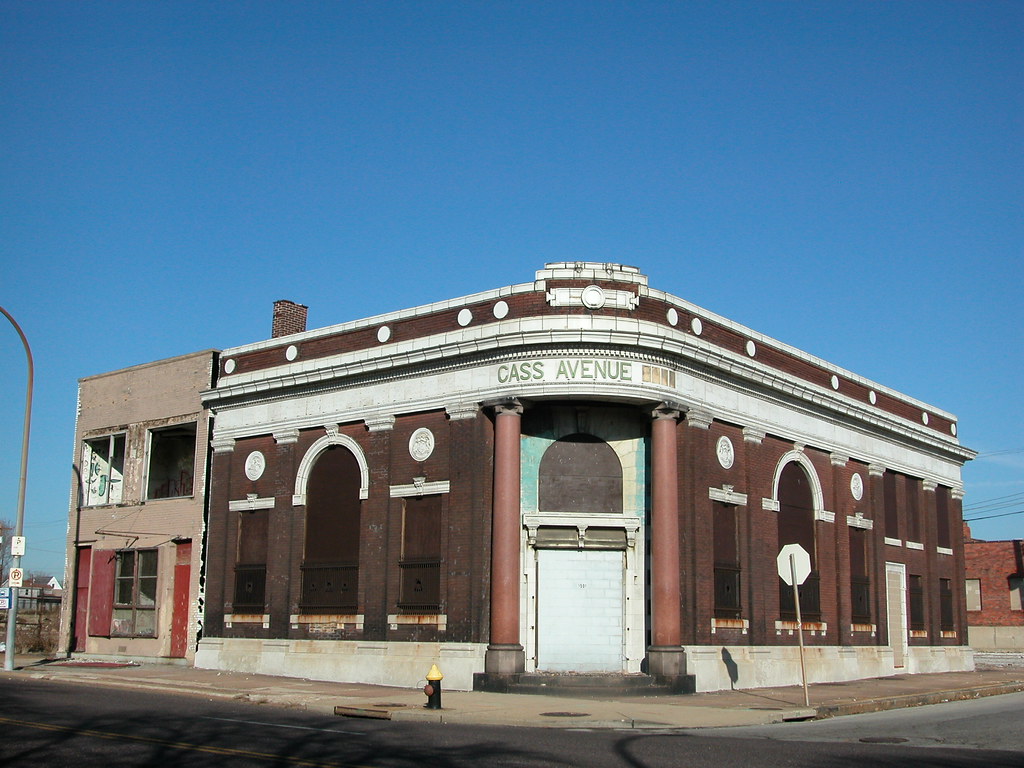
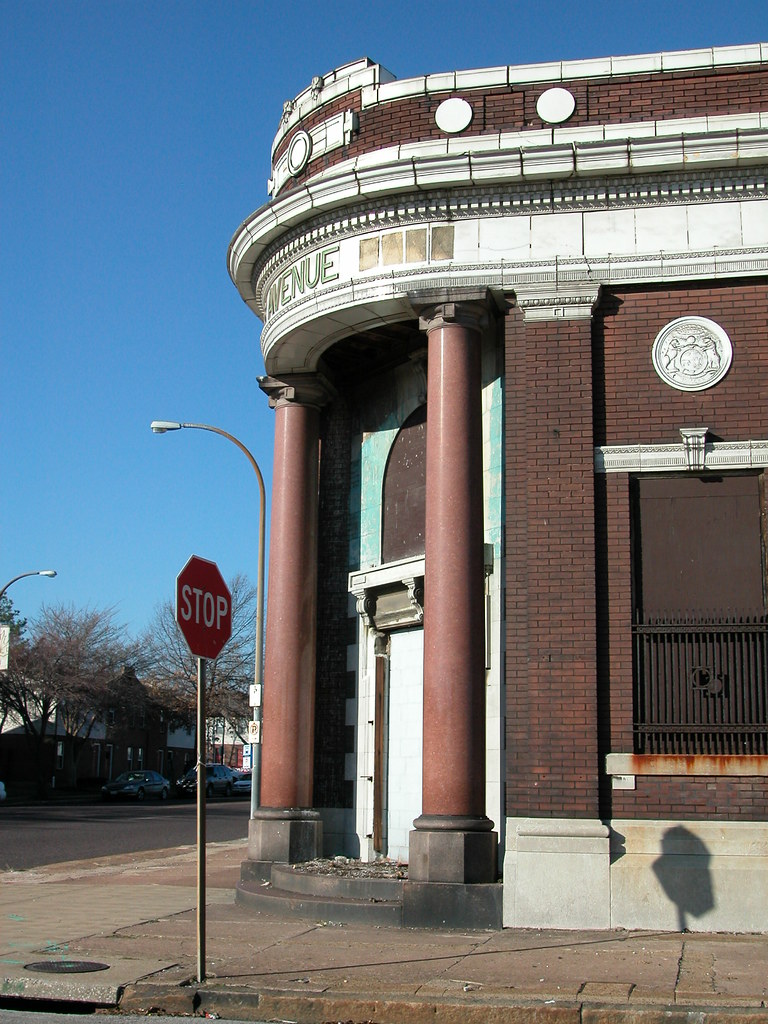
The Cass Avenue Bank building has improbably survived the destruction that has erased most traces of the Cass Avenue commercial district. Now held by trustee Marilyn Kocher, the building seems to be used for storage although the city Building Division considers it a vacant building. Yet while its graceful lines are broken by filled-in window and door openings, the building is pretty stable. There is not the typical decay one finds with a vacant building on the near north side. Note what a difference a thorough mothballing makes: roll-up doors, steel grates and fully-boarded openings present a formidable front to trespassers.

The Classical Revival bank building dates to a $15,000 building permit taken out by Cass Avenue Bank on February 24, 1914. The architectural firm chosen was the short-lived partnership of Wedemeyer & Stiegmeyer, while Bothe-Welsch Construction Company as contractor. As a life-long resident of north St. Louis, William Wedemeyer was no stranger to the area — or to neighborhood anchors. Wedemeyer’s career includes other banks, including the now-demolished Northwestern Savings Bank at St. Louis and Florissant avenues and the still-standing Lindell Trust Company at Grand and St. Louis avenues. Wedemeyer also designed the 1923 alterations to St. Stanislaus Kostka School, which is almost fully demolished as of this writing.

Of all of Wedemeyer’s work, though, the Cass Avenue Bank reminds me most of the Casa Loma Ballroom, built in 1926 but severely damaged by fire and rebuilt in 1940. Although the skin and insides were replaced, the form was not. Where the Casa Loma presents its curved corner to the intersection of Cherokee and Iowa Streets, it echoes this earlier work.

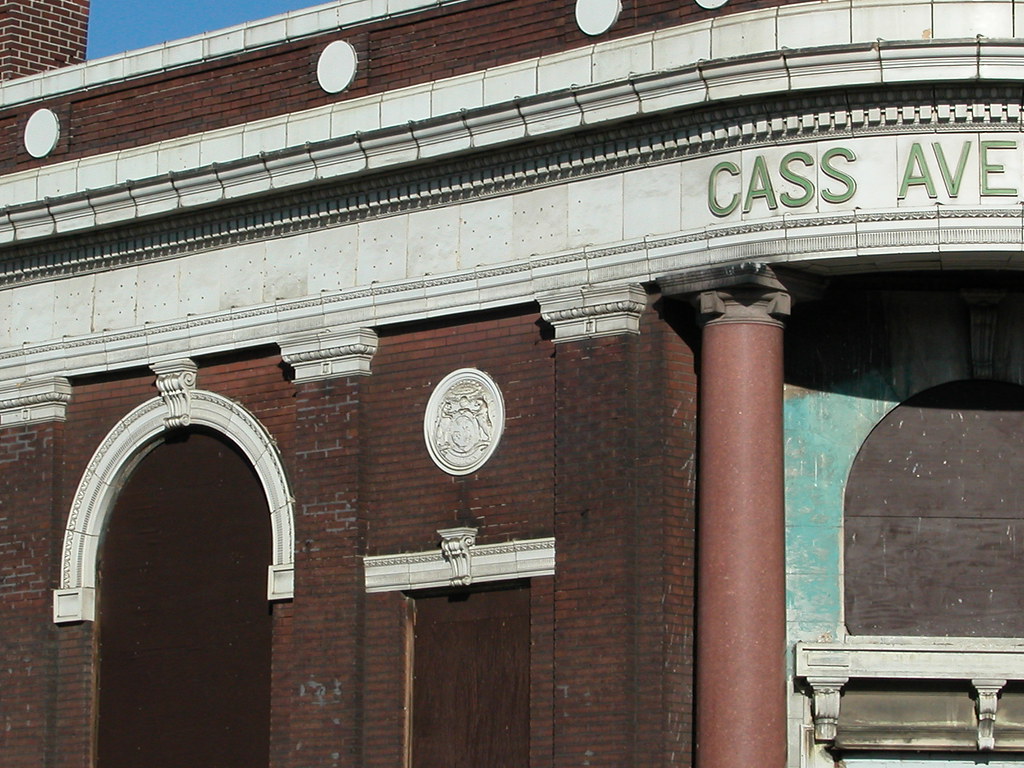
Here, the brick body of the bank breaks for a recessed chamfered entrance that is flanked by smooth polished granite columns. Above, the white terra cotta cornice forms a curve that hangs over the entrance. The effect isn’t architecturally rare, but it sure is wonderful. Rather than break the street line with a lawn or set back, the bank announces its presence with a commanding cut-off corner that allows for elegant entrance without breaking the street walls on either Cass or 15th Street. The word “urbane” exists for such architectural gestures.

The rest of the building matches the corner, too, with the striking contrast between the oh-so-white terra cotta and dark brick. There are medallions bearing the bank emblem as well as the common seal of the City of St. Louis. The terra cotta side entrance on 15th Street is quietly elegant as well.

Next door, a storefront building owned by the Land also built in 1915 carries the roof line but bears the result of a 1950 re-facing. This building was first a shop and later a club owned by another nearby bank, Pulaski Savings and Loan (read about the recent loss of its home here). In 1927, Cass Avenue Bank moved eastward to the large majestic building at Florissant and Cass now used as the Greyhound Station. The city was growing fast right before the Depression, and banks were at the forefront. The United States Postal Service occupied the building at 15th and Cass for many years, but it’s been vacant since the 1980s.

Across the street from the old bank building are the O’Fallon Place apartments. Yet much of the rest of this area, especially to the north and east, has been wrecked. First, starting right before World War II and going through the 1960s, trucking companies bought up large parts of this area for cheap, knocking down shops and tenements for transfer facilities and yards. Then the trucking companies moved out, and their facilities started coming down.

It’s clear this stretch of Cass Avenue is due for redevelopment. The new Mississippi River Bridge will have its major off-ramp into downtown come out onto Cass just east of Florissant Avenue. The street is bound to get a new life, and hopefully one that is as healthy as the one it once had.

Consideration should be given to survivors like the two Cass Bank buildings, each of which is eligible for listing in the National Register of Historic Places. They are building blocks for new mixed-use development — reminders of the past that can be part of the future of this great street.


(More information: Built St. Louis)