
From where will you be watching the downtown fireworks tonight?
 Preservation Research Office
From where will you be watching the downtown fireworks tonight?
by Michael R. Allen
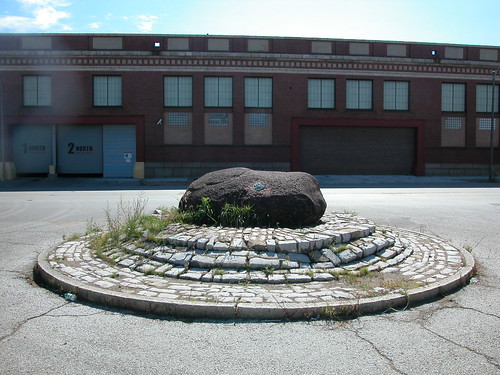
Perhaps you have seen the rough granite stone ceremoniously placed in the limestone ring at the intersection where Howard, Broadway and Seventh streets meet on the north riverfront. Know what it is? This stone once held a plaque — later stolen, perhaps to be scrapped at the metal yards up the street — commemorating the famous prehistoric Big Mound. The Big Mound stood one block north at the northeast corner of Broadway and Mound Street until 1869, when it was removed to make way for industrial construction. The iconic Big Mound was 30 feet tall and 150 feet wide, and plainly visible from the Mississippi River. That mound and others helped conjure our city’s nickname of “Mound City.”
The new Mississippi River Bridge will not impact the site of this marker, but it will claim the site of the old mound. Federal funds ensure that archaeological mitigation work will be done, so we may have a chance at making discoveries about the mound. Meanwhile, the Mounds Heritage Trail Route will connect the north riverfront mounds with those in East St. Louis and at Cahokia Mounds. That project will include permanent markers. perhaps the plaque will return.
by Michael R. Allen
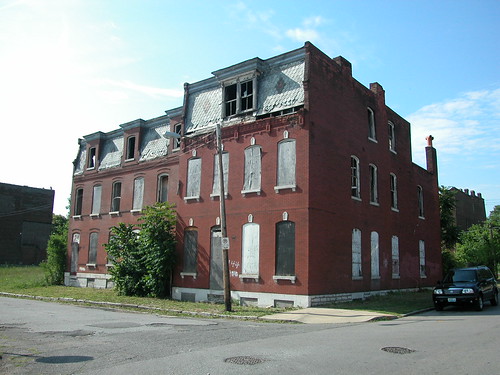 In March, I wrote about the tragic loss of an entire block of buildings in St. Louis Place due to brick rustling. Many of the houses on the 1900 block of Wright Street between Florissant Avenue and North 20th Street were owned by Paul J. McKee, Jr., but three were owned by others. (See “Brick Rustlers Decimate Wright Street Block,” March 26, 2008.) Two buildings comprising a magnificent row had been the property of DHP Investments, the failed company led by Doug Hartmann that left over 120 historic city buildings in various states of abandonment, including the landmark Nord St. Louis Turnverein. Hartmann’s buildings here were imposing three-story buildings with elegant masonry details, mansard roofs punctuated by squared dormers and even intact cast iron balconies.
Missing from my earlier coverages was mention of a row that stood across the alley on Dodier Street until this February. The two buildings at 1944-50 Dodier Street were not as exotic as their neighbors to the south, but they were every much as responsible for creating the sense of place for the neighborhood. The best part of these two buildings was their relationship: the eastern tenement building was wide and set back from the street, while its conjoined neighbor with commercial space came right up to the sidewalks on both Dodier and 20th streets. This pair beautifully demonstrated the order or urban space as it recedes from the public sphere to the semi-private. Here, the public was that which is immediate to the right-of-way, while the semi-private was removed just enough to mark the boundary between residents and passers-by. Both buildings were completely urban.
The details were also lovely. The tenement’s brick dormers pack a punch not found in the small belt courses and elegant but typical stone sills. Next door, a corbelled cornice, central dormer and vivid stone keystones give a plain brick wall pizazz. The details are common for vernacular buildings of the 1880s and 1890s, when these were built. While the rarity of such buildings and their details makes them more precious, their historic commonality provides the real significance. There was a time when such finesse was a matter of course even in working class housing.
Alas, these buildings fell into the hands of the city’s Land Reutilization Authority by the 1970s, and were vacant for awhile before Victor Casine (whose ownership of another building recently was profiled in the Vital Voice) purchased them in 1982. Casine promised rehabilitation, but did little other than allow further deterioration. The city’s Building Division reported the buildings as vacant for every year that Casine owned them. Numerous citations led to one suit filed by the city against Casine. Casine himself sued the city in 1989 for supposedly damaging the property when the Forestry Division mowed the overgrowth Casine did not trim himself.
After three years in which Casine did not pay outstanding liens and taxes on the property, the Sheriff auctioned the houses in 2003. This time was on the cusp of McKee’s purchasing, and so the buildings found no bidder. The Land Reutilization Authority took title once more, and after the rear walls collapsed was granted emergency demolition by the Building Division in January 2008. And so it goes. Those new to following land speculation and demolition in St. Louis Place should know that the tragedy is not new and has never been closer to real solutions as it is now. A long time ago, buildings bit the dust without so much as a photograph taken and owners let property decay without a call to the alderman, let alone protests at City Hall. Now, there is relatively wide attention on the future of the neighborhood. From that attention could come action.
by Michael R. Allen
The staff of Trailnet’s Healthy and Active Communities Initiative have been blogging away for the last two years. Not reading their work? You should be. The blog provides fresh and insightful information you don’t get in many urban issues blogs — writings about the history of food prices, developments in biodiesel, the problems with the abundance of corn in our diets and so forth. Just as autocentric urban planning is very unhealthy, so is an economic system that keeps nutritious foods off of the shelves of inner city groceries. Trailnet’s staff keep pointing out how these two problems are related, and how the future of every urban area depends on more than just bricks and mortar.
by Michael R. Allen
In their May 8 statement on their conclusions about what should be done to improve the Arch grounds, Memorial Drive and the downtown riverfront, Walter Metcalfe, Peter Raven and Robert Archibald laid out an agenda for year-round attractions and a new museum on the grounds, a lid over I-70, increased number of visitors to the Arch grounds, an international design competition and a 2015 deadline for the goals. Some of those goals are laudable and consensus-builders, like improving access and attendance. Others, like the museum plan and the semantics of “attractions,” are quite controversial.
To this end, the trio of mayoral-appointed advisers suggested establishing “a regional not-for-profit trust should be organized to raise funds for, operate
and maintain the new destination attraction.”
Although the National Park Service’s public comment period on the Arch grounds had not yet commenced, on June 11, Metcalfe, Archibald and Raven incorporated the Jefferson National Expansion Memorial Trust. Incorporation documents (available here) state the goals of the corporation as those stated in the May 8 letter. The corporation’s directors are exclusively the three advisers; the Danforth Foundation has no representation.
by Michael R. Allen
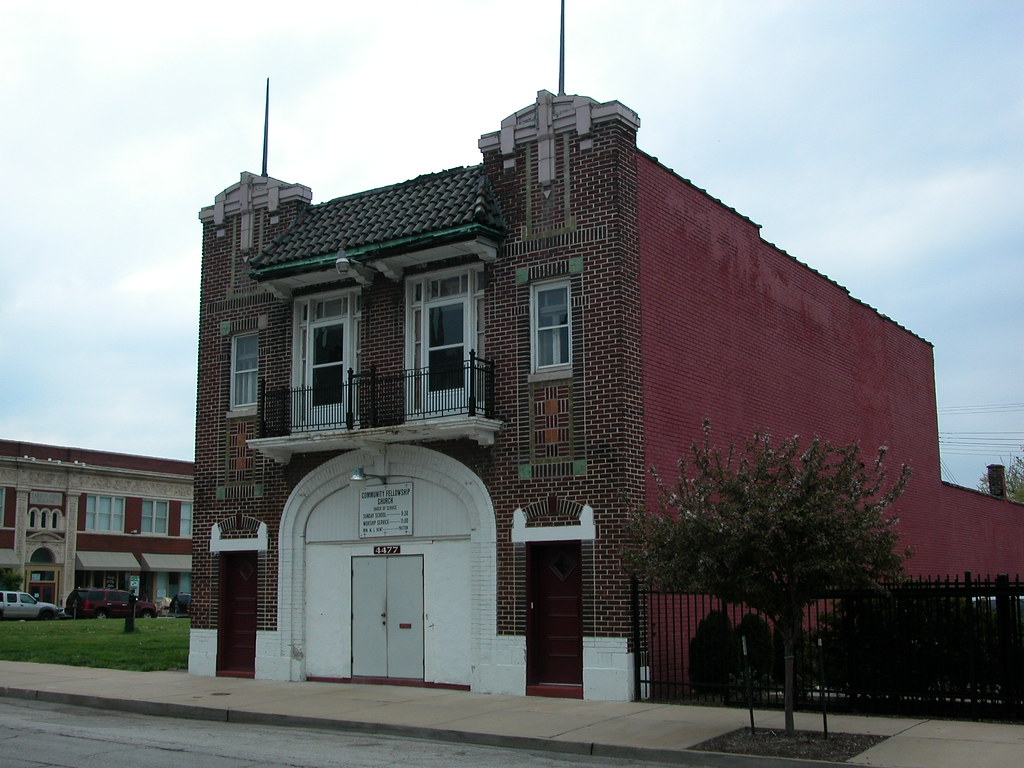
The graceful commercial building at 4477 Olive Street in the Central West End may be getting a reprieve. In April, the Preservation Board voted to defer for two months an application for demolition from the Youth Technology Education Center (YTEC) and the owner, Community Baptist Church. (See “Same Old Story?”, April 25.) At that meeting, representatives of the Central West End Association Planning and Development Committee testified against the application and agreed to meet with church pastor Willie Kent to see if a compromise was possible. The board was swayed by the spirit of negotiation, and unanimously voted to provide time for more talk.
As a bit of background, the section of Olive Street where 4477 Olive is located was excluded for the original boundaries of the Central West End Historic District due to ward boundaries. Subsequently, that end of the Central West End has been isolated — even physically, through barriers at Newstead and other places — from the neighborhood at large. Recent developments have led to a renewal and expansion of the historic district boundaries (which still cut across ward lines) to include the commercial district. Still, there is friction along ward lines between stakeholders in the different sections of the Central West End.
Most of that friction may come from lack of communication. With Kent, YTEC representatives and Central West End Association leaders at the table, a compromise that would preserve the building (most likely) or at least its front elevation is in the works. Things are going so well that YTEC sent the city’s Cultural Resources Office a memo asking that the matter be removed from the Preservation Board’s June agenda.
Due to procedural rules, however, the board had to take some action. At Monday’s meeting, the board voted unanimously to defer the matter indefinitely. Let’s hope the dialog between stakeholders is fruitful and that the lovely building is preserved while YTEC’s expansion occurs. When the demolition application surfaced, few would have predicted the matter would have been anything but another senseless case of parties talking past each other. Then again, common ground comes from common values — and all of these parties believe in the revitalization of Olive Street.
The 2008 Greening the Heartland conference is over. Yesterday marked the end of the three-day conference on sustainable practices in Midwestern architecture and urban design, held at America’s Center in St. Louis.
Yet the conference still exists, at least online. A crack team of local bloggers documented the conference experience through videos, interviews with conference organizers, photographs of events, posts about green success stories and so forth. Thanks to their efforts, those who couldn’t fly across the country or pay the registration fee can immerse themselves in the conference online. (No gasoline for travel or paper for printing required!)
Read the blog here.
From the National Park Service:
Two open house style meetings will be held in St. Louis on June 25 and July 1 to give interested individuals and organizations an opportunity to learn about and comment on preliminary alternatives for the future management of the Gateway Arch and Old Courthouse (Jefferson National Expansion Memorial). The existing management plan has been in place since 1964 and is in need of updating; therefore, a General Management Plan (GMP) to help guide National Park Service (NPS) management of the memorial for the next 15-20 years will be developed from the preliminary alternatives over the course of the next 18-24 months. The two public meetings are scheduled for Wednesday, June 25, 5-8 p.m., in the Trolley Room of the Dennis and Judith Jones Visitor and Education Center (the historic Lindell Pavilion) in Forest Park; and Tuesday, July 1, 3-6:30 p.m., in the Old Courthouse, 11 North Fourth Street.
Preliminary alternatives have been developed by the NPS planning team, taking into consideration previous studies and plans developed by the NPS, the City of St. Louis, and other private and public organizations. These preliminary alternatives have their foundation in the purpose and significance of the Memorial as stated in the executive order that established the Memorial. The five alternatives identified to date are: Alternative 1, no action (provided as a baseline against which the other alternatives are assessed); Alternative 2, Connections; Alternative 3, Expanded Programming; Alternative 4, Portals; and Alternative 5, Park into the City.
“These preliminary alternatives will be refined and modified as the planning process continues,†said Tom Bradley, Superintendent of the Memorial, “then a preferred alternative will be identified. It may be an existing alternative, it may be a combination of alternatives, or it may incorporate new ideas brought to light during the open house meetings. The preferred alternative, then, will form the basis of the GMP for the Memorial.”
Requests to be added to the project mailing list should be sent by mail to Superintendent, Jefferson National Expansion Memorial, 11 North 4th Street, St. Louis, Missouri 63102; by telephone to 314-655-1600; or by e-mail. A newsletter will be issued within the next 30 days which will outline in greater detail the identified potential management options for public review and comment. Notification of subsequent public meetings will be made through local, regional, and national media; newsletters and public meeting schedules will also be published online at www.nps.gov/JEFF.
by Michael R. Allen
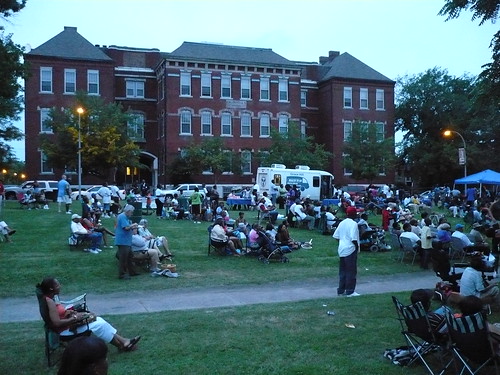
Headliner Kim Massie thrilled the large crowd at the Thursday kick-off of the Whitaker Foundation/Grace Hill Urban Evening Series at St. Louis Place Park in north St. Louis. Massie’s blues-oriented programs deviated for a crowd-pleasing cover of Gretchen Wilson’s “Redneck Woman,” showing that music can knock down any supposed cultural divide. Gene Dobbs Bradford & Blues Inquisition opened.
This is the year for the series at St. Louis Place. St. Louis Place, laid out in 1850, is one of the city’s oldest and most beautiful public parks. The music energized the neighborhood, with residents of Rauschenbach and 21st streets flanking the park hanging out on front stoops to get an earful of tunes.
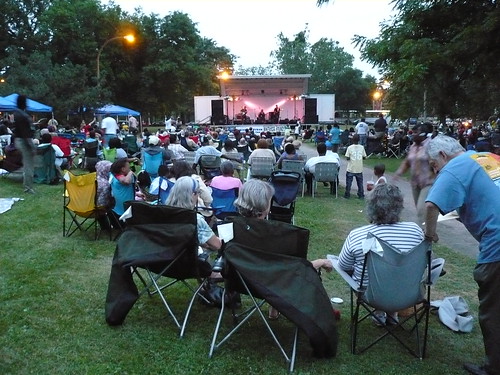 Concerts run each Thursday at 7:00 p.m. in St. Louis Place through July 24; full schedule here.
The joy of Thursday night came on the heels of national publicity for the neighborhood to the east, Old North St. Louis. The acclaimed conservation group the Natural Resources Defense Council’s blog featured a laudatory entry by its Kaid Benfield, director of the council’s Smart Growth program. Benfield’s post “Of the community, by the community, and for the community: the rebirth of Old North Saint Louis” celebrates the community-driven resurgence of downtown’s northern neighbor.
Meanwhile, the North City Farmers’ Market featuring produce from St. Louis Place’s New Roots Urban Farm, started on Saturday, June 7 and runs through October 25. Each Saturday from 9 a.m. until noon, people can purchase fresh food and enjoy cooking demonstrations at the intersection of 14th and St. Louis in Old North.
On top of all of this, the Mississippi River flooding has avoided the popular North Riverfront Trail, which remains open and accessible east of Old North.
Residents of the near north side are having a great summer — good music, the world’s coolest urban trail, a farmer’s market and awesome music usher in a pleasant season.
(Photographs by Lynn Josse.)
by Michael R. Allen
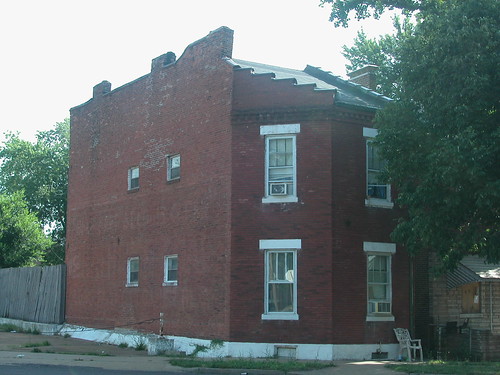
One of the most unique buildings in Old North St. Louis is the house at the northeast corner of Florissant Avenue and Dodier Street (numbered 1917 Dodier). Florissant runs diagonally across Dodier, which conforms to the street grid laid out in the 1850 East Union Addition. Of course, the house shows us that Florissant is diagonal with its chamfered corner parallel to that street.
So many details make this house unlike any other. Obviously, the corner and its treatment — a stepped parapet against a side-gabled roof — is singular. There is the concealed side entrance. Then there is the pleasant fact that the dentillated cornice continues across the chamfered corner, a move that provides wide, commercial Florissant with the same decorum as quite, residential Dodier. The formal elevations of the house are faced with a firm pressed brick that was not available until the 1880s, but the windows are topped with flat limestone lintels in a much earlier fashion. This house is strange in the coolest way!