by Michael R. Allen
My latest KWMU commentary celebrates the conversion of the former Days Inn at Tucker & Washington into the Washington Avenue Apartments. Transcript and audio is online here.
 Preservation Research Office
by Michael R. Allen
My latest KWMU commentary celebrates the conversion of the former Days Inn at Tucker & Washington into the Washington Avenue Apartments. Transcript and audio is online here.
by Michael R. Allen
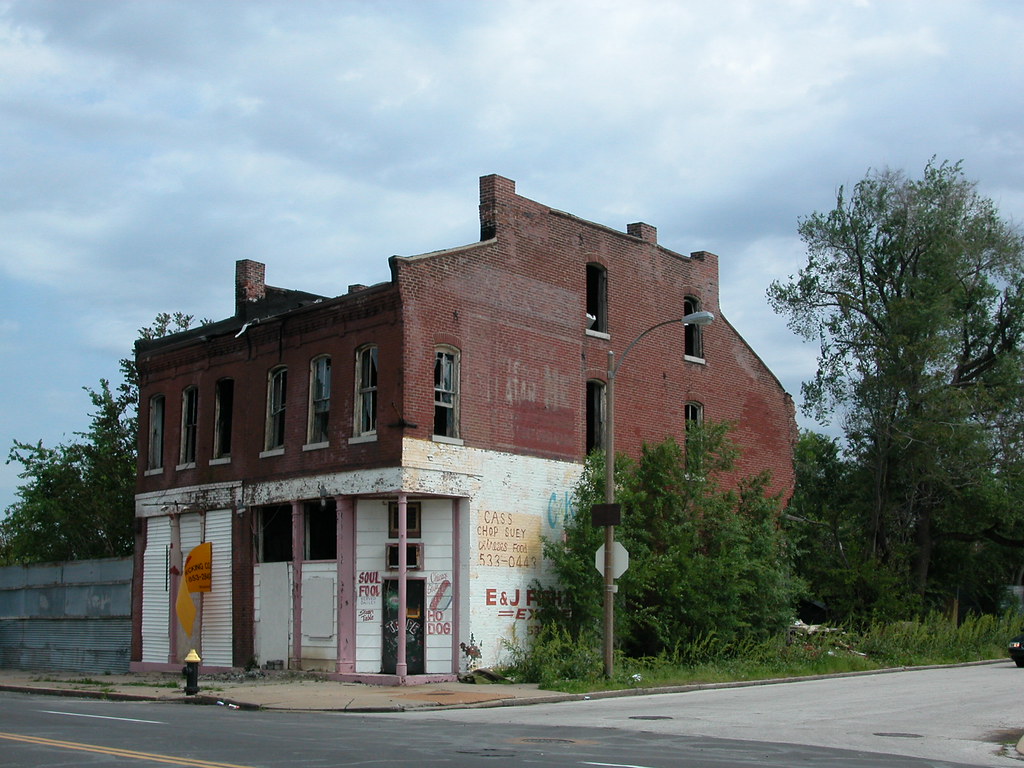
This corner storefront and at 2742 Cass Avenue in JeffVanderLou was one of the properties recently purchased by Larmer LC from the Cass Corporation for $739,000. Actually, these are two separate buildings. While Geo St. Louis dates the buildings to 1885, that’s probably wrong. Most of the Geo St. Louis building information comes from unreliable city records, not building permits. Likely, these buildings are earlier and the storefronts added later.
Across the city in the post-Civil War era, many builders built tenement housing over commercial space like this on streets in “suburban” areas away from the central city. Some streets were main thoroughfares and shifted to commercial uses. When those changes came, building owners would often reconfigure tenement buildings with ground-floor commercial uses by putting a cast iron storefront in place of the brick wall on the first floor. That’s what seems to be the case here. In other cases, storefronts were inserted in place of residential space.
The cast iron front allowed for greater glazed area than a heavy masonry wall; stores needed exposure of goods to the passers-by. This was long before automobile-clad consumers learned about goods through television and computers before heading to the local windowless big box.
Cast iron fronts are structural as well as decorative. The columns, poured into attractive classical forms, bear the weight distributed across the front by paired steel I-beams. Adding wide storefronts must have been interesting surgery!
DEVELOPMENT CHALLENGES AND REWARDS
Tuesday, May 13, 2008
7:00 p.m.
The Laurel Sales Office, 625 Washington Avenue
As part of Historic Preservation Week, ReVitalize St. Louis, the Rehabbers Club and Landmarks Association of St. Louis sponsor a panel including Jay Swoboda of EcoUrban Homes and Brady Capital and Stephen Acree of the the Regional Housing and Community Development Alliance, whose work has included many historic rehabilitation projects. Panelists will discuss their careers in St. Louis, the challenges they have faced and the current state of the city’s real estate market. Question and answer session to follow — bring your questions! Free.
UPDATE: Developer Will Liebermann, a developer who has done several projects on and around Cherokee Street, has joined the panel.
by Michael R. Allen
My latest “Inside the Metropolis” column for the Vital Voice is more timely than I imagined when I submitted it:
by Michael R. Allen
The title of this blog entry was the rallying cry of student protesters in Paris 40 years ago yesterday. (Read more about the events of May 1968 here.) What a wonderful exclamation — power not to institutions, leaders, groups of people or even the revolutionary movement. The students wanted all power for imagination — the faculty every human being shares, that allows for the envisioning of a new world.
Without imagination, we couldn’t think through changing our own circumstances. Now, granted that some people have mighty fine circumstances and probably don’t want to imagine a change in the world that may benefit others. The rest of us, though, need to have the power to envision our neighborhoods and own lives improved physically, economically and spiritually. In St. Louis, imagination fuels the work of my neighbors in Old North St. Louis as much as it keeps developers like Craig Heller going. Sometimes it’s not acknowledged, and rarely gets political play, but we need imagination to make this city a better place.
Without imagination, we are resigned to existing conditions. Without daring to envision a city that does not let half of its geographic area collapse — without daring to imagine a city where the antiquated 1916 charter (now a suicide pact) is overturned — without making plans to include every citizen, not just the best-bred and best-educated, in decision-making at all levels — without thinking that we can create standards for the quality of development that would ensure world-class results — we have a city that has long since accepted mediocrity through default.
Change without imagination is tantamount to continued loss of opportunities. We can’t let the technocrats plan our future through financing formulas. Without a vision — a dream — of what shape we want St. Louis to be in, we won’t be able to resist or even influence the people whose dull plans are despoiling the landscape that once was an international city.
The situation surrounding the near north side is one great example. There is plenty of imagination for what Old North, Hyde Park and other neighborhoods should look like, but how empowered is the vision? These areas are under attack through speculation, Big Dull Plans, political apathy, redlining and persistent political defeat. What people there need to do is proclaim their vision for their home — a vision easily defined to neighbors and strangers alike. Without dreams, no neighborhood can resist the infiltration of a Great Plan. Without a truly imaginative vision offered, the Great Plan may seem like a work of imagination. Maybe it is. But what mind imagines a decades of deprivation, building collapses, arson and poverty followed by wholesale clearance? That’s not the work of imagination — that what happens without it.
by Michael R. Allen
Although known Paul McKee companies stopped purchasing property in December, two new holding companies have been making purchases in the same part of north St. Louis where McKee is active.
Larmer LC has filed at least 22 sales deeds since January 10, and Union Martin LLC has filed five. Many of these sales represent bundles of properties for substantial amounts. In all, Larmer has reported over $2.5 million in sales this year while Union Martin has reported sales totalling around $924,000.
Larmer and Union Martin were both registered by third-party registrar CT Corporation System, but deeds reveal that Daniel D. Baier is manager of both companies. As we previously reported, Larmer’s tax bills go to a 2845 Keokuk Avenue, a building owned by F & B Properties LLC. F & B Properties’ organizers are Baier and former Crestwood Mayor Thomas E. Fagan. Union Martin’s tax bills go to the same address, although deeds list its address as 10658 Carroll Wood Way in St. Louis County.
Both companies were incorporated soon before the spending sprees began: Larmer on December 3, 2007 and Union Martin on December 15. Each company has its own accompanying shell lender. Larmer’s loans come from Hamill Company LC, incorporated on November 27, 2007, while Union Martin’s loans are from Stapleton Management LLC, incorporated on November 28, 2007.
by Michael R. Allen
Here’s a round up of photographs of some of the buildings in JeffVanderLou and St. Louis Place that were part of the eleven-building arson spree this weekend. All of these buildings were vacant at the time of the fires.
Barbara Manzara has published a map of the fires here.)

2633R Palm Avenue, owned by Cleo and Zerline Terntine
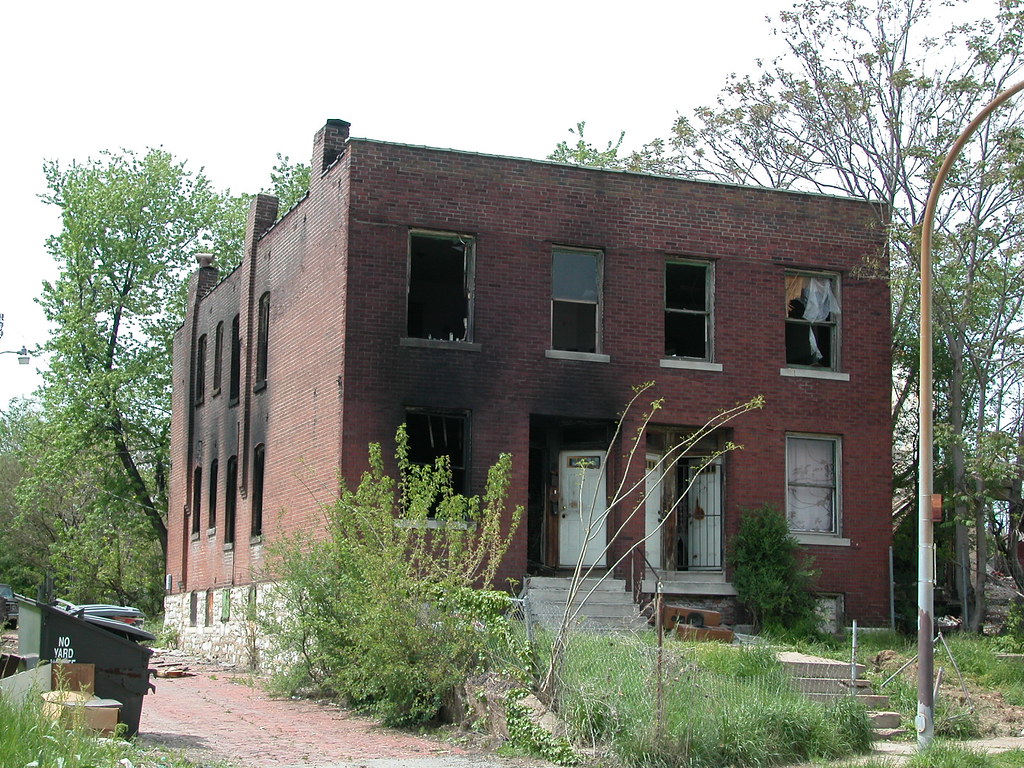
3015 Elliott Avenue, owned by Sheridan Place LC*

3114R Glasgow Avenue (actually faces Elliott), owned by MLK 3000 LLC*

2519 Sullivan Avenue (left), owned by Jesse and Davis Thomas, adjacent to brick-rsutled 2517 Sullivan Avenue, owned by Dodier Investors LC* (See earlier photo at Built St. Louis.)
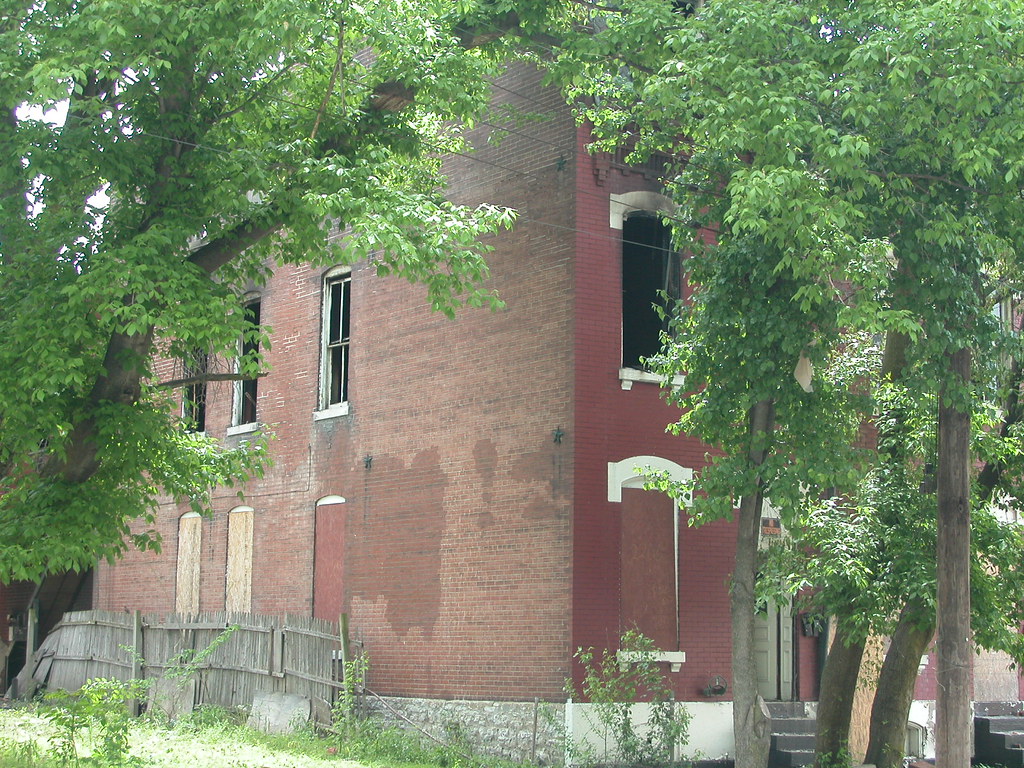
2206-10 Hebert Street, owned by Blairmont Associates LC* (Minimal fire damage; see earlier photo at Built St. Louis.)
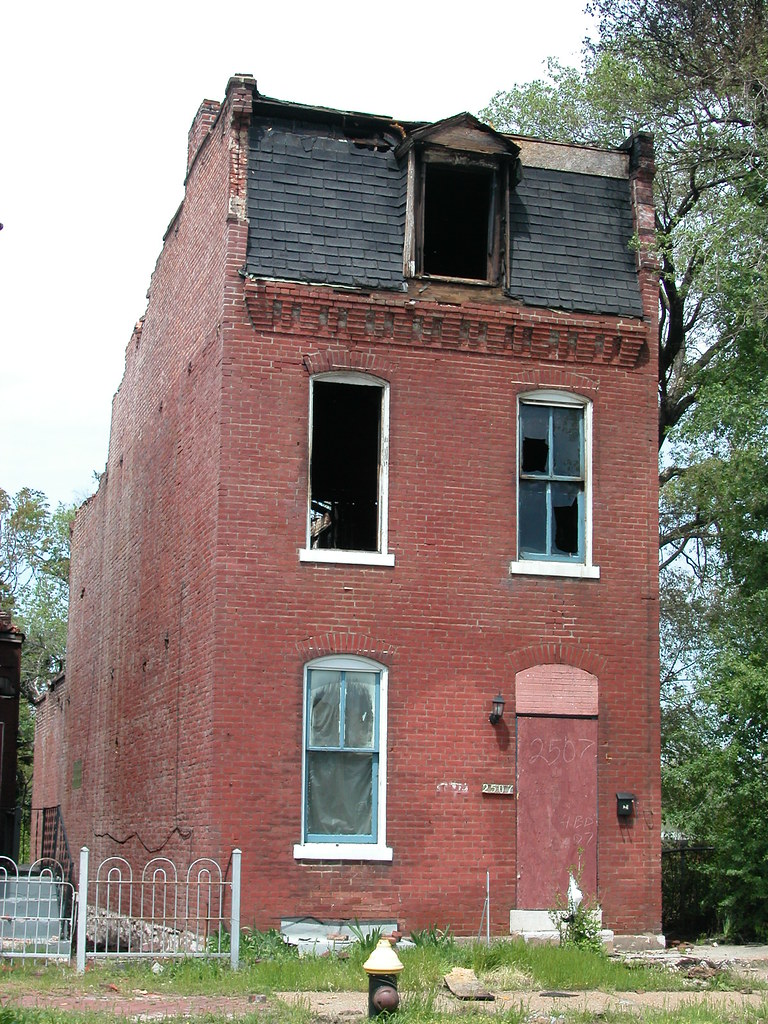
2507 Hebert Street, owned by Blairmont Associates LC* (See earlier photo at Built St. Louis.)
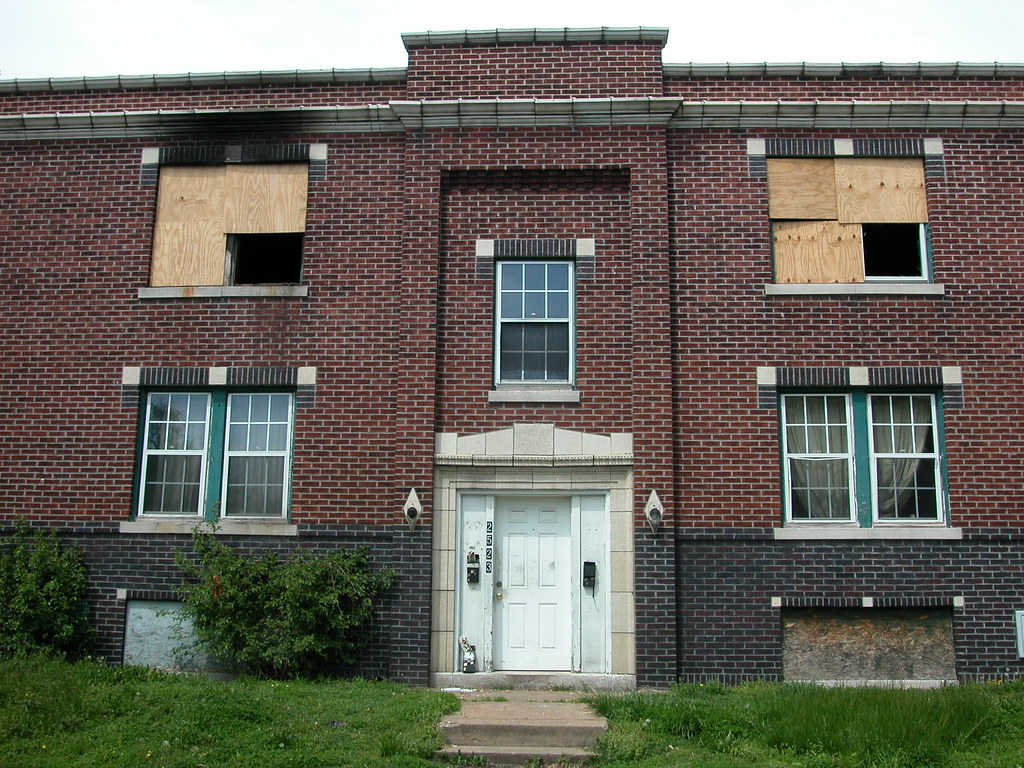
2523 Dodier Street, owned by Larmer LC (Minimal fire damage.)
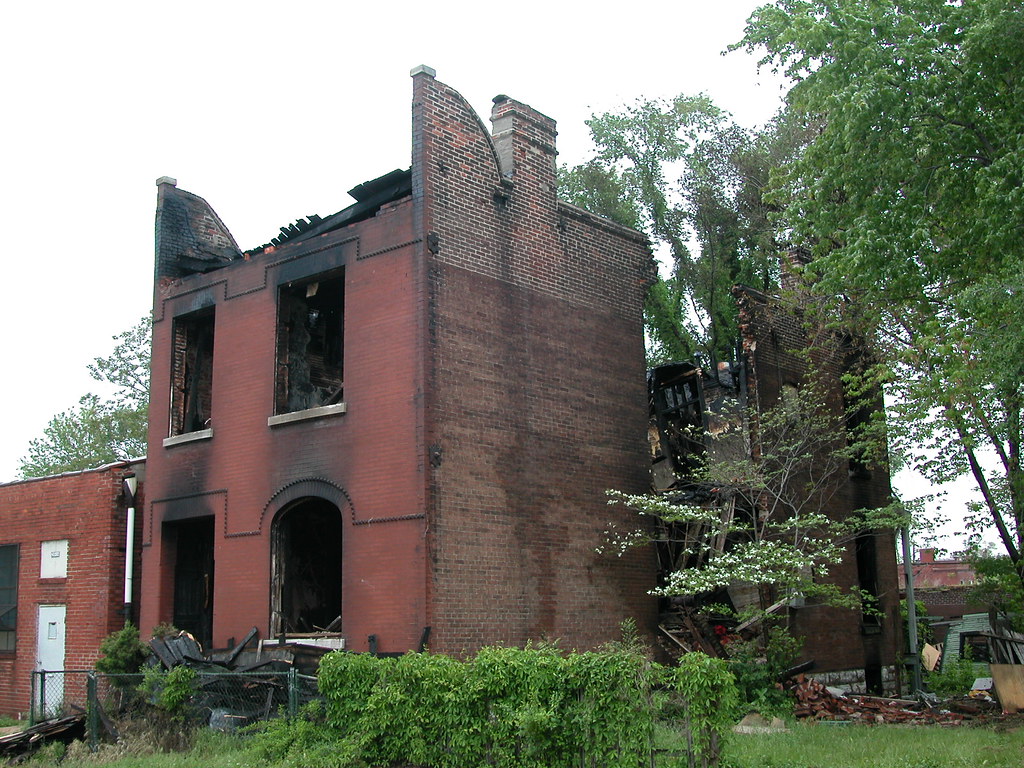
2547 Dodier Street, owned by Larmer LC

2566 Dodier Street, owned by Blairmont Associates LC*
A KMOX news story about the fires is online here.
*Denotes holding company tied to Paul J. McKee, Jr. (More here.)
Landmarks Association of St. Louis kicks off this year’s Preservation Week on Friday with a ribbon cutting at 3:30 p.m. LoftWorks’ Ludwig Lofts at 1004-6 Olive Street downtown. This event includes an open house until 6:00 p.m. From there, the week progresses with house tours in old North St. Louis, Skinker-DeBalivere and the Central West End; a walking tour in St. Louis Place led by yours truly; the Eleven Most Enhanced Places awards ceremony; bowling at Saratoga Lanes; a trivia night hosted by Patrick Murphy; a book sale to benefit the Chatillon-DeMenil House; and more.
I will feature some of the events here, but the full calendar is available on Landmarks’ website.
by Michael R. Allen
Following the trail from the recently-demolished house at 1951 St. Louis Avenue, let’s examine the rest of the block two years ago. Here were the thee buildings east of that house.
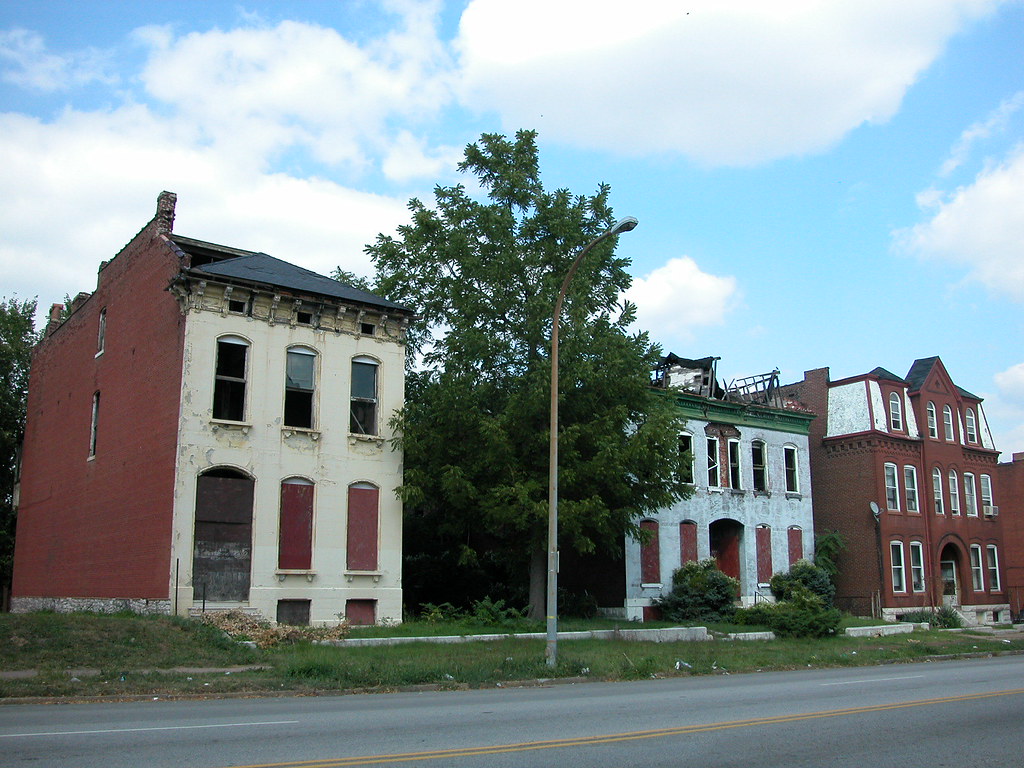 At the left, see a very stately Italianate single-family home. In the center is a brick tenement, with thew front wall painted and a likely mansard roof destroyed by fire; this building was razed in 2007. Both buildings were owned by the city’s Land Reutilization Authority. These represent common styles and forms for the 1880s. The building at the right is an apartment building that is occupied to this day. This building demonstrates the near north side architectural sensibility of the 1890s — the mansard roof form remains, but it is divided by a prominent brick dormer. The cornice is brick, not wood, and the entrance is formed by a generously wide Roman arch.
 |
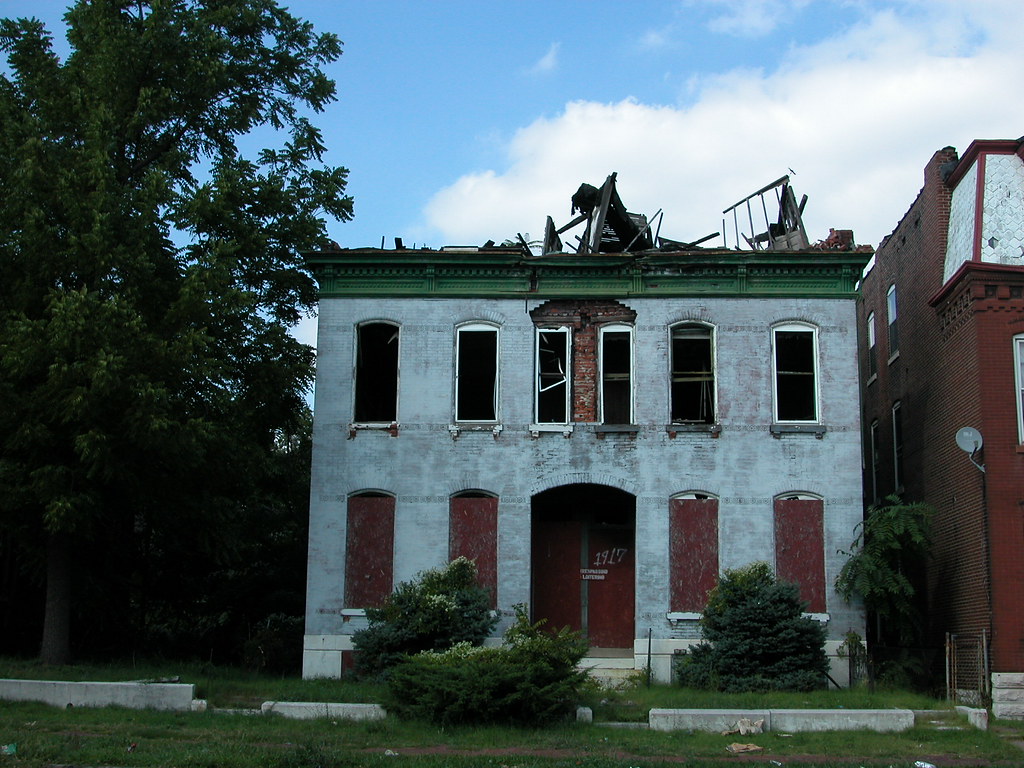 |
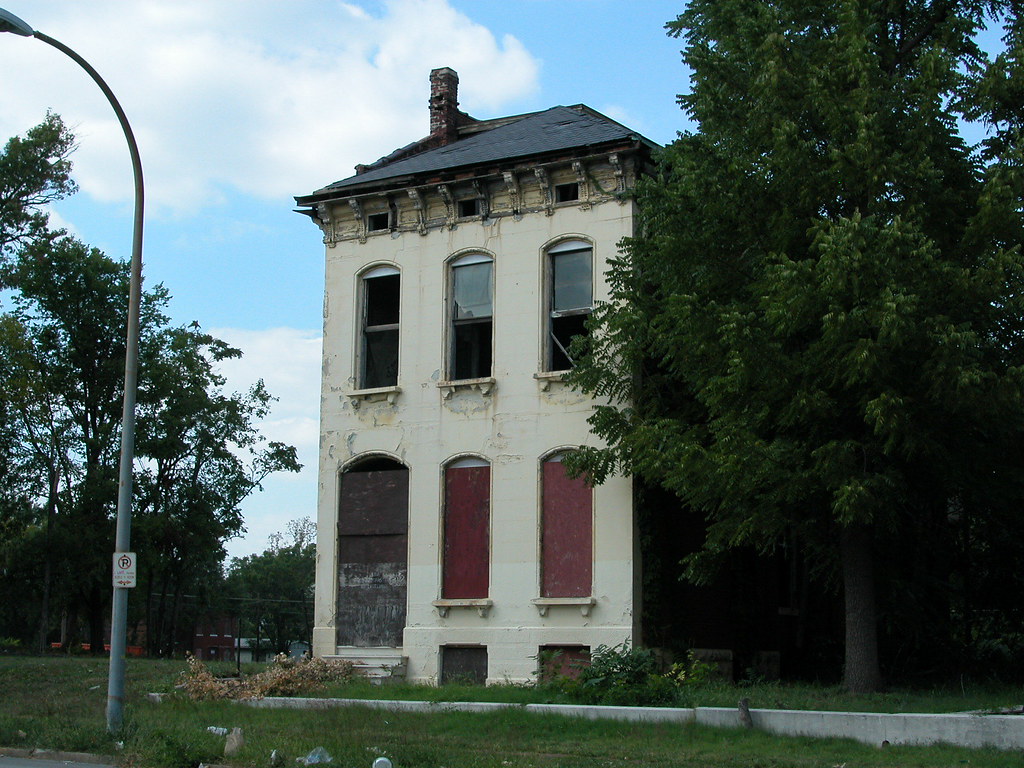
The Italianate home today stands vacant, and the east wall of the rear ell is starting to lose bricks fast.
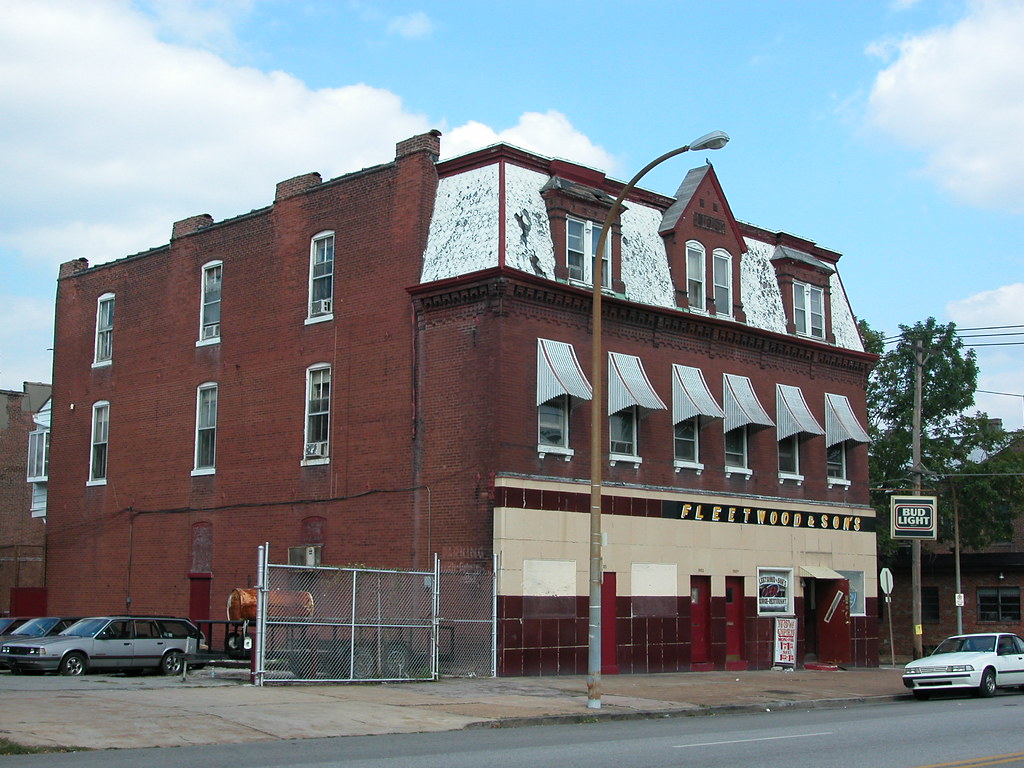
Anchoring the block faces eastern end is another 1890s building, a solid three-story storefront building housing Fleetwood and Son’s. Behind the sleek modern vitrolite facade is one of the north side’s coolest bars. (Warning: Fleetwood’s is a 30-and-over establishment, so young punks should hang elsewhere.)
A 1909 Sanborn fire insurance map shows eight buildings on this (north) side of the 1900 block of St. Louis Avenue. Three of these, long gone, were large buildings. Just west of Fleetwood’s stood the North Branch of the Young Men’s Christian Association. Between the house at the other corner and that Italianate house were St. Paul’s Methodist Episcopal Church and a large mansion enjoying a generous side yard between it and the church.
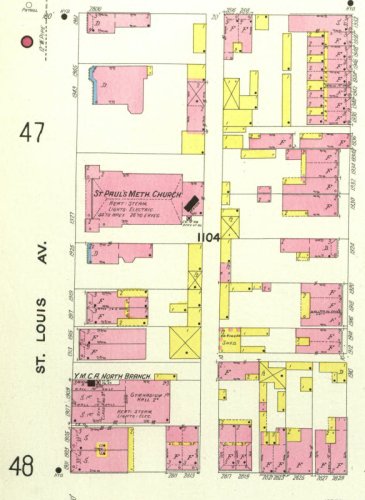
The 1964 Sanborn fire insurance map shows that the North Branch and the mansion were gone. The Romanesque Revival St. Paul’s, which had been built in 1902 and designed by Matthews & Clarke, survived until 1998 when it was senselessly demolished by its owner (LRA).
Last year, all of the remaining buildings on the north side of this block (across the alley) were decimated by brick thieves operating with rapacious precision. This spring, those damaged buildings came down. What does the future hold for this block?
The Italianate house seems destined for demolition next. (May that not be the case.) The apartment building and Fleetwood’s, though, are going to be around for a long time to come. What fills in around them is anyone’s guess. Will it be new homes or shops that express the sense of place that the fallen buildings did? That depends on what our sense of this place is when we building — or, more likely, the sense of who does the building and who delivers a vision for rebuilding St. Louis Place to that builder.
It’s easy to shudder at the prospect. After all, the current sense of St. Louis Place held by many is confused and beneath the dignity of the neighborhood’s generations of residents, past and present. Once a certain sense emerges, rebuilding will lead to a block face as engaged in the values of its age as this block face once was. Although we have seen tragic loss of this block, let us not neglect to lay out the blueprints for a rebuilding that will honor our heritage.
by Michael R. Allen
I had been waiting for the north side holding companies controlled by Paul McKee to make a move in 2008. Surely the lull of autumn would lead to spring purchases in this buyer’s market. None of the companies have made a single purchase since December.
However, a new company has been quite busy buying property in north city. Larmer LC, incorporated on December 3, 2007 by third-party registrars at the CT Corporation System, has purchased at least 45 properties in JeffVanderLou and St. Louis Place since its incorporation (see them all here). Readers may recall that CT Corporation System registered McKee’s holding companies before registration was transferred to McEagle Properties.
Larmer LC’s tax bills go to the address of 2854 Keokuk Avenue in south city, a building owned by F & B Properties LLC. That connection seems a coincidence. What may not be coincidental is that Larmer has started buying property after the other companies stopped.