Categories
Demolition Historic Preservation North St. Louis St. Louis Place

The House at 20th and St. Louis

by Michael R. Allen

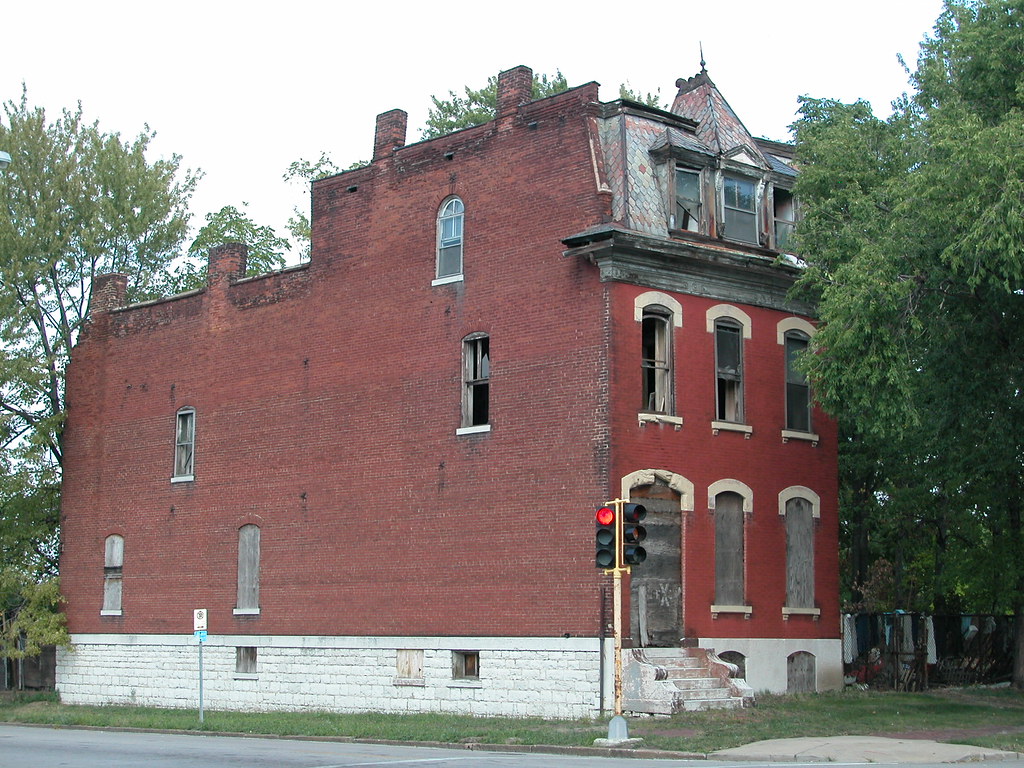
We shall never again see this beautiful house at the northeast corner of 20th Street and St. Louis Avenue in St. Louis Place, just north of the boundary of the Clemens House-Columbia Brewery National Historic District. Wreckers took down the house last week as part of a city demolition package. The house had fallen on hard times. Vacant for years, the house lost its roof through collapse and sections of the western wall were beginning to collapse inward. Its owner was an elderly man who lived in the ruins; he was apparently on a bus downtown to try to stop the demolition when the wreckers started their work. The home was mostly gone when he returned.

Nonetheless, the beauty shone through the devastation. This was one of the few early large corner houses on St. Louis Avenue. Notice the shallow setback from St. Louis Avenue and the lack of any setback at all from 20th Street. Originally a single-family home possessing the same grandeur of its peers on the avenue, the house is resolutely urban in character. St. Louis Place had an order of fine houses, and homes on St. Louis Avenue were more prosaic than the slightly more expensive ones that lined both sides of the St. Louis Place park. Hence this house balances the expression of wealth its owners intended with a conventional placement of the home typical of the street. No one could have expected seclusion on a main thoroughfare.

What was most striking about the home was its intact features. Although derelict, the house was never painted and kept its wooden windows, the cornice, dormer, slate shingles and even its roof cresting. The eclectic mix of Second Empire and Italianate features was restrained by the purity of expression typical of its time (likely the early 1880s). The front wall was brick, the lintels simple stone arches. There was little pretense despite its stylistic impurity.

Standing vacant, the home was almost frozen in time. While the home remained immobile, the forces of water, gravity and time moved forward against the house.
Categories
Chicago Infrastructure Streets

STOP

by Michael R. Allen

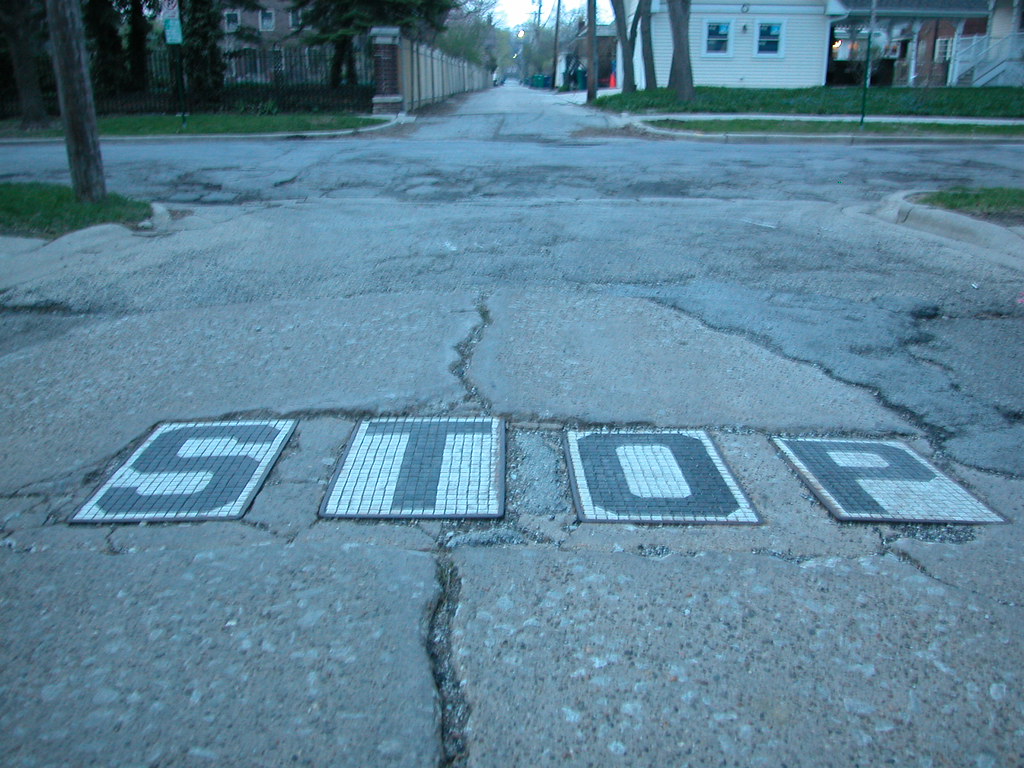
This neat feature alerts drivers in an alley headed north toward Ontario Street between Linden and Euclid avenues in Oak Park, Illinois. Embedded tiles form a sturdy, enduring stop sign.

Categories
Central West End Demolition Flounder House Historic Preservation North St. Louis Preservation Board South St. Louis The Ville Tower Grove East

Preservation Board Approves Flounder House Demolition, Denies Demolition in The Ville

by Michael R. Allen

Here’s a quick report of some actions at yesterday’s St. Louis Preservation Board meeting.

2915 Minnesota Avenue: Preliminary approval for demolition of flounder house granted 4-2. Terry Kennedy, Mary Johnson, David Richardson and Anthony Robinson in favor; Melanie Fathman and Mike Killeen opposed.

4477 Olive Street: Unanimously deferred until the July meeting to provide more time to explore alternatives.

4568 St. Ferdinand Avenue: Demolition permit denied 4-3. Killeen, Fathman, Robinson and Richard Callow in favor of motion to deny; Johnson, Kennedy and Richardson opposed.

Categories
Downtown

Downtown’s Retail Needs

by Michael R. Allen

An article in today’s Post-Dispatch (“Retailers say downtown area will catch on”) includes this puzzling spin:

Although more retail shops are opening their doors, merchants are concerned that most of the businesses currently under construction are not the type of unique specialty stores that would boost downtown’s image as an eclectic, artsy shopping area.

That’s strange because the biggest complaint I hear from downtown workers and residents alike is that there are not enough regular plain old businesses to meet daily needs. There is no office supply store downtown. No pharmacy. No donut shop. No general new book store.

Not sure what merchants want, but other people using downtown want it to function as a place where necessities can be procured without driving to Hampton Avenue or further west. Most people buy an imported vase once a year, if that. Everyone needs paper clips, a toothbrush or a quick meal more frequently.

I’m glad that downtown is a retail destination, but I’m disappointed that its retail options don’t meet the needs of many of its daily users. While workaday shops don’t make for the most exciting ribbon cuttings, they make a sustainable neighborhood.

Categories
Demolition Flounder House Historic Preservation Housing Preservation Board South St. Louis Tower Grove East

Fate of Flounder House on Monday’s Preservation Board Agenda

by Michael R. Allen

On Monday, the Preservation Board will determine the fate of this old city-owned flounder house at 2915 Minnesota Avenue in Tower Grove East. The 710-square-foot home lies outside of the boundaries of the Tower Grove Heights Historic District, making it ineligible for rehab tax credits without landmark designation. Clearly, the building is eligible in its own right — there are fewer than 30 flounder houses left in the city, and the building type is indigenous. Alderwoman Kacie Starr Triplett (D-6th) is seeking demolition, while the Tower Grove East Neighborhood Association strongly opposes demolition. Triplett’s application was deferred by the Board two months ago to provide the Cultural Resources Office (CRO) time to develop a pro forma showing that rehabilitation is feasible.

Working with developer Will Libermann, who recently rehabbed a flounder house at 3330 Missouri Avenue in Benton Park, CRO has arrived at an impressively economical budget; see its report here. Liebermann’s plan would restore the derelict home to former beauty while creating badly-needed affordable fully-rehabbed, historically-sensitive housing. (His other flounder sold for $125,000.) With the neighborhood behind preservation, there should be a clear outcome but Triplett remains stridently in favor of demolition.

Should the Preservation Board approve demolition, there would be yet another decision creating a housing gap between upper-income residents who can afford fully-rehabbed historically-sensitive homes and lower-income residents who largely cannot. Here is the rare opportunity to cut against the gap. While the home is smaller than your average multi-family conversion, it is a great size for a single person or a childless couple.

The Preservation Board meets Monday, April 28 at 4:00 p.m. in the 12th floor conference room at 1015 Locust Street downtown. See the full agenda here.

Categories
Central West End Demolition Historic Preservation Preservation Board

Same Old Story?

by Michael R. Allen

Same old story: the owner of the lovely building at 4477 Olive Street pictured here is applying for a demolition permit. The city’s Preservation Board will consider the demolition on preliminary review at its regular meeting on Monday; the city’s Cultural Resources Office is recommending that the board deny the application.

Next-door neighbor Youth Technology Education Center wants to demolish the building immediately for green space, but anticipates eventual expansion. (Again, same old story.) While Alderman Terry Kennedy (D-18th) supports demolition in deference to the center’s laudable accomplishments, the Central West End Association is opposed to the demolition.

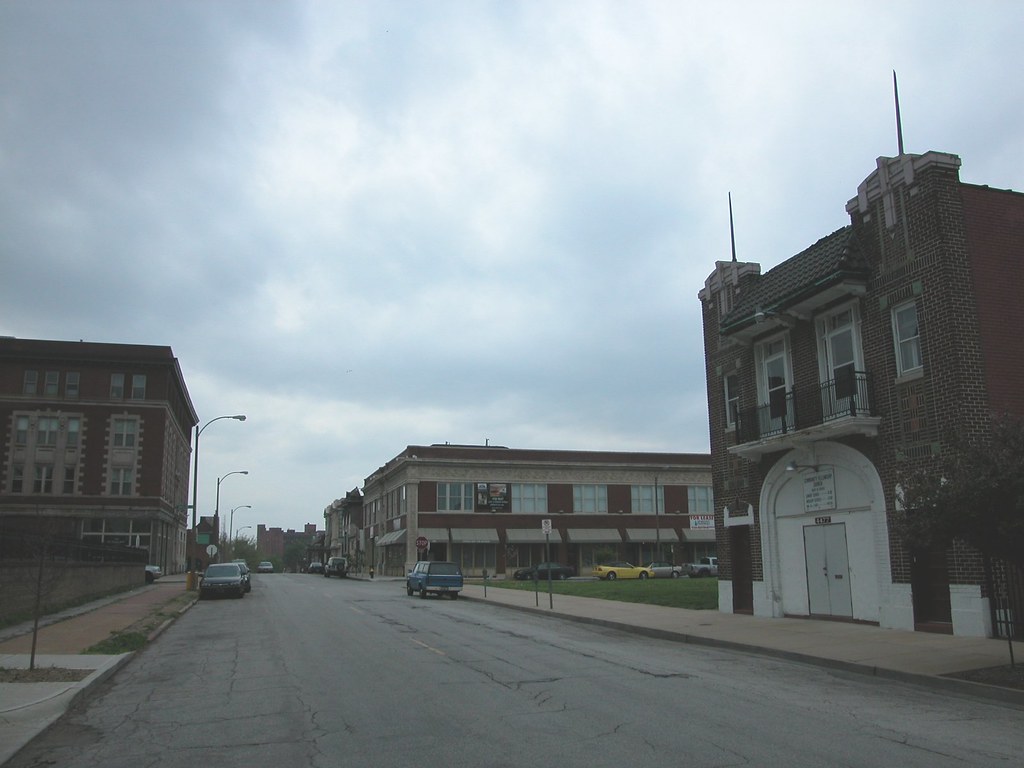
The Craftsman style storefront building was built in 1917 and designed by architect Edward H.A. Volkmann, who designed several other buildings in this vicinity. Several unusual elements, like the finials atop the raised parapet sections, the balcony and the former arched center display window have led to all sorts of guesses about the building’s origin. One story had the building as a fire station. The truth is a bit more mundane — the building was built for the St. Louis Cleaning Company and used as by the clothing cleaners at least through the 1930s. Cleaners were an important new business type in the early twentieth century, catering to the city’s newly-mobile middle and upper classes. The Central West End has several old cleaners’ buildings, with the most resplendent being the Anderson Laundry on Washington Boulevard west of Euclid.

Last year, the commercial district on Olive Street between Pendleton and Walton was added to the city’s Central West End Historic District. With historic rehabilitation tax credits now available, the street is being remarkably transformed. Before that, Central West End Builders had already obtained National Register of Historic Places designation for and rehabbed the Lister Building, Taylor-Olive Building and Eugene Field School (directly across the street) around the intersection of Taylor and Olive. (The following photograph shows the Lister and Taylor-Olive buildings’ proximity to the building at 4477 Olive.)

Apparently there is a developer interested in rehabbing the building, which until recently was used as storefront church. (Same old story, huh?) In the last two years, developers have rehabbed or are rehabbing almost all of the other buildings on this block, and there is even new construction including the Center. Good things aren’t just coming — they are here, and this finely-detailed building should be a part of them.

The Preservation Board meets Monday at 4:00 p.m. in the 12th floor conference room at 1015 Locust Street downtown. The full meeting agenda is available here.

Categories
Churches Demolition Historic Preservation North St. Louis

Demolition of St. Stanislaus Kostka School Underway

by Michael R. Allen

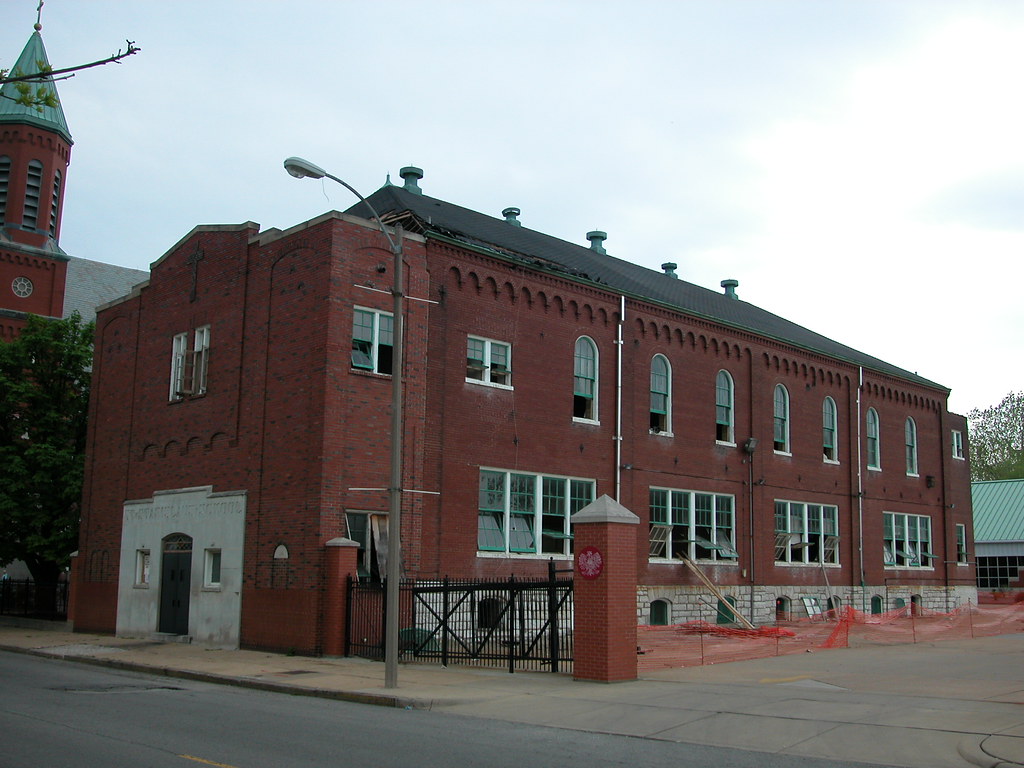
Demolition of the St. Stanislaus Kostka School at 1413 N. 20th Street is now underway (see “St. Stanislaus Kostka School Deserves a Reprieve,” April 6). Aalco Wrecking is the demolition contractor and Bruce Gerrie has salvage rights.

Categories
Central West End DeVille Motor Hotel Historic Preservation Mid-Century Modern

DeVille Motor Hotel in the News This Week

by Michael R. Allen

Today’s “Inside the Metropolis” column in the Vital Voice features a guest writer, my colleague Lindsey Derrington. Lindsey has written an eloquent and impassioned plea: “Recoup DeVille Motor Hotel: No Need to Demolish Historic Building”. The article is a perfect summary of why we can’t afford to lose the DeVille Motor Hotel (a.k.a. San Luis Apartments).

Earlier this week, Preservation Online also covered the issue; read that article here.

Categories
Architects Green Space Missouri National Register

Springfield’s Park Central Square Contested

by Michael R. Allen

The Springfield News-Leader reports on the issues surrounding Park Central Square in downtown Springfield, Missouri. Supposedly designed by famed landscape architect Lawrence Halprin but remodeled in the the years since its 1969 construction, the park is at the center of a dispute between city government.  The city wants to redesign the park and preservationists want to restore the original design. The original design, however, is also contested — some claim Halprin was not the architect of the plan that actually was built.

Because the city is using federal funding for their redesign, a section 106 review has been triggered. Section 106 reviews, mandated by the 1966 federal Historic Preservation Act, are administered by the State Historic Preservation Office (SHPO) and serve the purpose of determining whether sites impacted by federal spending are eligible for listing on the National Register of Historic Places. SHPO’s ruling here could determine what the park will end up looking like. If SHPO determines the park is eligible for listing, and advocates for its preservation can get it listed on the National Register, the city’s plans could be derailed.

Categories
Events Historic Preservation Media

Your Community’s History, Your Community’s Future: Free Workshops

Lynn Josse, Andrew Hurley, Esley Hamilton, Andrew Weil, Kris Zapalac and Michael Allen will be presenters at two upcoming free neighborhood history workshops described below.

This morning, St. Louis on the Air featured a discussion about neighborhood history with host Don Marsh, Lynn Josse, Andrew Weil and myself. Listen to that show here.


Your Community’s History, Your Community’s Future

Join your neighbors to learn about tools to explore the history of your neighborhood, and how to use that history to strengthen your community. Local experts will share their experiences in using neighborhood history to promote involvement and investment in St. Louis communities. The workshop will include a discussion of successful history projects developed by St. Louis area communities, resources available to research your neighborhood’s history, and government programs and incentives to encourage preservation. Neighborhood history workshops will be offered on two dates, with slightly different information targeted towards residents of St. Louis City and St. Louis County. These workshops are free and open to the public. For more information, call (314) 516-4748 or e-mail lubischerk@umsl.edu

To download a flyer visit this page.

St. Louis City
Tuesday, April 29, 2008
6:30-9:00 p.m.
St. Louis Public Library Carpenter Branch (3309 S. Grand Ave.)

St. Louis County
Thursday, May 8, 2008
6:30-9:00p.m.
126 J.C. Penney Conference Center, University of Missouri–St. Louis (One
University Blvd.)

Neighborhood History Workshops are sponsored by the Community Partnership Project of UM–St. Louis, working in cooperation with University of Missouri Extension, and by Landmarks Association of St. Louis Inc. This project is funded, in part, by the Urban Extension Program, a joint project of the University of Missouri Extension and the University of Missouri–St. Louis.