Categories
Churches Dutchtown Mid-Century Modern Preservation Board South St. Louis Uncategorized

Changes at Resurrection of Our Lord Church

by Michael R. Allen

On March 24, the Preservation Board of the City of St. Louis considered an application by the congregation of Resurrection of Our Lord Church to remove an original wall and construct a grotto. Designed by Murphy & Mackey and completed in 1954, Resurrection of Our Lord Church became a City Landmark in 1976. The City Landmark status allowed the Preservation Board to review the proposal to remove the wall; otherwise there would be no legal protection. The Board voted to defer the matter pending consultation with a registered architect. I submitted the following testimony in my capacity as Assistant Director of Landmarks Association of St. Louis:

In Murphy & Mackey’s design for Resurrection of Our Lord Church, both building and site plan are integrated elements. The architects undertook a total design of the lot so that each element is an intentional part of the church, and cannot be removed and altered without causing alteration to the total composition. The wall running along the courtyard demarks the courtyard entrance space from the private and less formal realm on the other side. The presence of the wall heightens the religious experience of entering the church with a mind cleared of worldly concerns.

The City Landmark protection extends to the entire design. While placement of the grotto on the site is an intrusion on the original design, it is both reversible and a reasonable concession to the current congregation’s right to use the property.

However, removal of the wall would be a permanent disfiguring of the landmark design. The Preservation Board should not allow removal of the wall. The staff recommendation is a fair compromise.

Categories
Architecture Columbus Square Demolition Housing Mid-Century Modern Pruitt Igoe

Cochran Gardens Demolition Nearing Completion

by Michael R. Allen

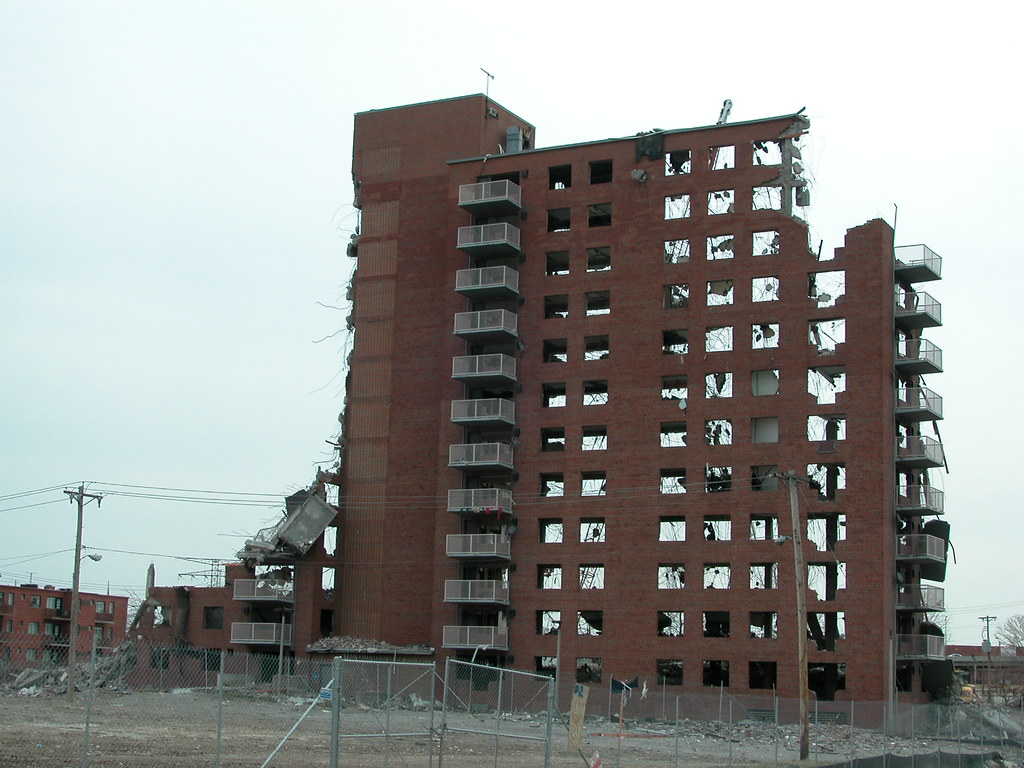
Demolition work at the Cochran Gardens housing complex north of downtown is nearing completion. After demolition of three low-rise buildings, wreckers are working to finish demolition of one of the two tall buildings at the former public housing complex.


Completed in 1953 and designed by architectural firm Hellmuth, Yamasaki & Leinweber, Cochran Gardens was the first project built by the St. Louis Housing Authority that made use of high-rise buildings. However, the complex balanced three tall buildings with low-rise buildings. Cochran included twelve buildings, and six were six stories each, two were seven stories, and four were twelve stories. Nevertheless, Cochran Gardens set the stage for the Pruitt, Igoe, Darst, Webbe, Vaughn and Blumeyer housing complexes that were composed exclusively of tall buildings. In time, all of these projects have been cleared and redeveloped, most using the federal HOPE VI program.


Cochran Gardens will retain its second tower, transformed in 1980 into elderly housing. That tower will remain as the first and last tall public housing building in St. Louis.

Categories
Demolition Midtown

SLU Demolished Wagner House Last Week

by Michael R. Allen

As of last Friday, the two-story Italianate house at 3438 Dr. Samuel Shepard Drive in Midtown, known as the Wagner House, was gone.

Here’s the time line of the demolition:

February 29: St. Louis University closes on the sale of the house.

February 29: St. Louis University applies for demolition permit.

March 4: Building Division approved demolition permit. Since the house stands outside of the Midtown National Historic District and within the Nineteenth Ward, which has no preservation review, the city’s Cultural Resources Office did not get to review the permit.

March 12: Workers begin removing interior fixtures and millwork.

March 17: Demolition of the house begins.

March 21: Demolition complete.

Read more at Vanishing STL: SLU Strikes Again! Destroying the Wagner House at 3438 Samuel Shepard.

Categories
Abandonment Demolition Historic Preservation LRA

Just Couldn’t Make It

by Michael R. Allen

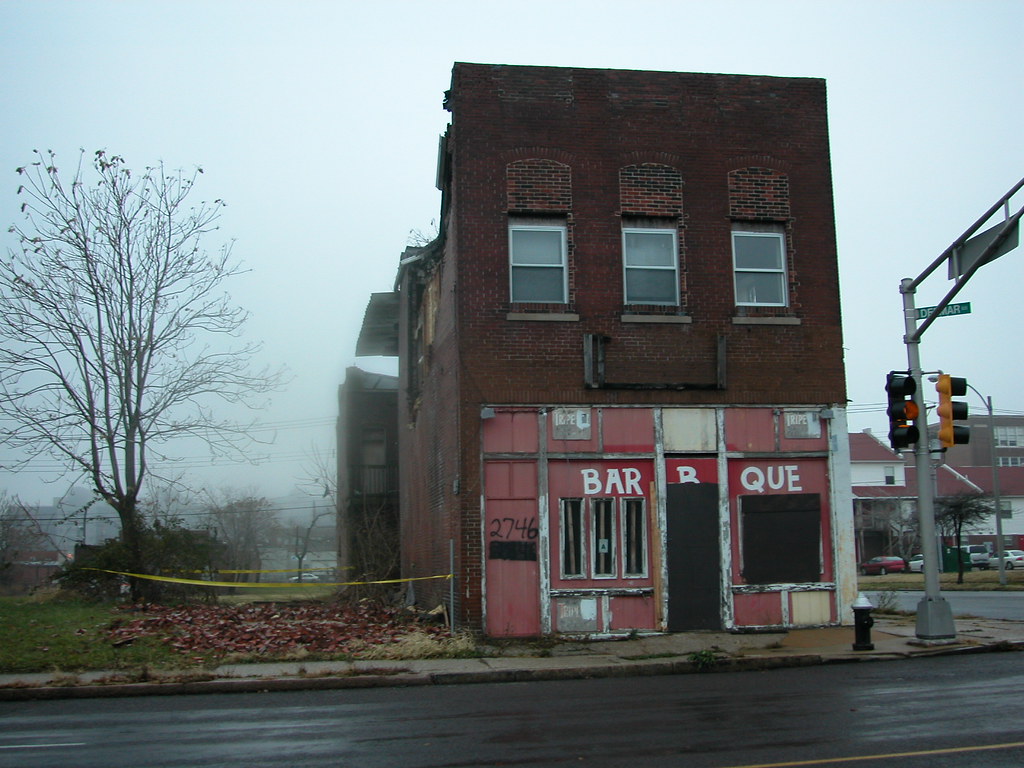
Until last month, this modest storefront building stood at the southeast corner of Delmar and Leffingwell avenues. According to city building permits, the building dates to 1881 and was originally four stories tall. Looking carefully at the building, I detected evidence of infill of the third floor sills and window openings just below the parapet wall, which lacks a creasing course. The shortened height and partly-filled windows are obvious, marring the building’s appearance. Still, handsome details like the iron storefront and arched side windows remained evident.

Once part of a robust, dense urban neighborhood just north of Mill Creek Valley, the building and an alley house behind it fell into the hands of the city’s Land Reutilization Authority. All of its neighbors were gone. Across Leffingwell stands a large housing project, while adjacent to the east is a lot owned by N & G Ventures LC, a holding company controlled by Paul McKee. South of here is the hulking campus of Wachovia Securities, formerly A.G. Edwards & Sons. Any semblance of the historic walking neighborhood in which this building played a commercial role was long gone. The city itself lost the mometum needed to keep even diminished buildings in use.

Befitting, the building’s east wall partly collapsed in December. On February 6, the Building Division approved a demolition permit and wrecking commenced. The neighborhood could have used a corner anchor, even as one small representation of its old form. Yet the building just couldn’t make it. Besides, would the time have ever come again for this lopped-off old building?

Categories
Architecture Central West End Historic Preservation Local Historic District Mid-Century Modern

Next Step: Parking Lot?

by Michael R. Allen

I vowed to not describe the building replacing the Doctors Building at Euclid and West Pine, but here I go. Given the impending possibility that the San Luis Apartments building will be demolished, the demise of the Doctors Building is telling. The mid-century modern design of the Doctors Building was poorly appreciated, and news of its replacement through construction of two 30-story towers was welcome news to many people.

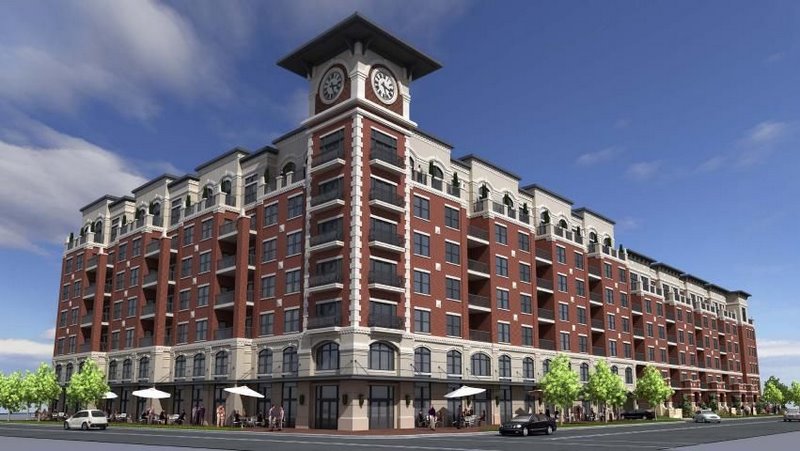
Yet the towers will never be built. The Mills Group couldn’t make the financing work for its grand plan. Demolition proceeded, and the substitute plan emerged. What we have here is a building completely out of its league. Unable to compete with the fine architecture of the Central West End, this building’s design resigns itself to mediocrity. Rather than try to be fresh, the architects employed the same design tricks keeping the St. Charles County metroplex building on up. There’s the base of stone veneer (that is stone, right?), the dark brick above, the mangled quotations from other styles.

There are pointless differentiations of the wall plane through setback, despite the fact that both Euclid and West Pine are fairly straight at this intersection and both have decent pedestrian traffic. In fact, the rendering suggests that the building’s west wall actually steps away from the street. While dramatic in the exaggerated corner perspective drawing, such a move is hardly appropriate to the street wall of Euclid.

At the top, the building’s wall goes white in some attempt to imitate stone. Oddly, there is no cornice. Rather, the walls recess to create private balconies. The pedestrian’s eye, however, may be diverted to the prominent corner clock tower, rising a full story above the roof. Instead of selecting an elegant human-scaled clock integrated with the building, the architects have stuck this over sized timepiece on top. Perhaps the goal is to smother the building’s flaws in the manner restaurants heap grated cheese atop bowls of wilted iceberg lettuce. Trouble is, people will be looking at this building from the ground level — not from a spot inside of an invisible Forest Park Hotel. People will spend more time looking at whatever stone will clad the base than at the clock.

I know that I should count my blessings — the Doctors Building’s obscene parking lot will be subsumed by an actual building and there won’t be a giant vacant lot for years. I suppose that under some circumstances I could lull myself into thinking these blessings outweigh all other concerns. After all, that line of acceptance is doing well for St. Charles County.

Yet I can’t fool myself. The building replacing the Doctors Building is downright inappropriate for any historic neighborhood in the city. This building is an affront to the dignified architecture of the Central West End, and its construction shows a carelessness that could erode decades of hard-achieved acceptance of high standards there. Such a climate benefits the Archdiocese’s short-term plan to level the San Luis without any planned construction. Do we want to find out what the step is from bad building at Euclid and West Pine to a new parking lot on Lindell?

The worst step following this blunder would be loss of another large building for an even lower use — a parking lot. The Central West End never attracted a lot of mid-century architecture, but what it got fits into the context with grace — unlike some of our contemporary structures. What happened at the Doctors Building should not be the start of backtracking on design standards in the Central West End, but a rallying point for their assertion.

Categories
Architecture Central West End DeVille Motor Hotel Historic Preservation Mid-Century Modern

Landmarks Statement on San Luis Apartments

The Board of Directors of Landmarks Association has issued a statement supporting rehabilitation of the former DeVille Motor Hotel (San Luis Apartments). Read it here.

Categories
Rehabbing

Rehabbing: To Do or Not to Do It Yourself

by Michael R. Allen

One of the first rules of rehabbing is that everything takes twice as long and twice as much money as estimated – on a good day. That’s if the homeowner hires everything out. For the do-it-yourselfer, twice as long can easily become fives times as long. Yet just as eating outdoors in the springtime makes food taste better, doing it yourself can make the rehab so much more enjoyable.

Still, doing it yourself is no easy decision, and there’s no shame in deciding against it. I am a do-it-yourselfer who made the hard decision over two years ago. I chose to buy and rehab a three-story brick home in Old North St. Louis. The house was built in 1885 and retains much of its original woodwork, the original slate mansard roof and even some original windows. Better still, it was occupied when I bought it. The systems – plumbing and electrical – weren’t the ancient ones you read about but modern ones installed in the 1980s. Now I see the appearance as deceptively intact. The systems needed countless little repairs. A whole intact two-story historic wall was historically dangerous and needed to be demolished and rebuilt. And so forth.

Some days I think rehabbing the house is the best choice I’ve ever made, because I have learned a lot about my own abilities and have directly intervened to renew historic architecture. The direct connection between myself and historic preservation feels much better than attendance at public hearings and blog entries.

Other days, I count the missed parties, weeknights at the bar with friends, weekend afternoons at the park, weddings, parties, art openings and live music shows from the past two and half years. I think about lazy days I could have had, bike rides and reading. Then I look around the house and see the progress. Okay. It’s worth it. I’ve got one whole floor fully rehabbed, and the other two moving along. I have had parties at the house. I can walk barefoot in most parts!

Still, the path to this stage has been difficult and I urge potential rehabbers to think carefully. Here are some of the considerations that I pondered before choosing to rehab:

Children. First: I don’t have children. I can’t imagine trying to do what I did as a parent. (For one thing, I would never have lived in the lead-filled, messy house.)

Cost. One of the strongest motivating factors in choosing to do work myself was cost. I simply could not afford to hire out anything I could do for myself. Necessity became the mother of invention. Later, the demanding schedule of the rehab loan and several pay raises made it possible to hire work out. Now I can say that if someone is hesitating to pay someone to do work, err on the side of bringing in a professional. A dollar spent on labor is a dollar toward less stress and project management. For some projects, it would have been cheaper to do all the work myself but impossible to manage other projects I hired out. Management is key to good results.

Other Costs. Can you give up fun times for awhile? Can you lay that book aside and never get back to it? I struggled with giving up recreational pursuits, but decided ultimately that cost was worth getting work done. Then, after getting through major work, my pace shifted to a more leisurely one. Still, many people I know would go crazy living with so much responsibility. Coming home from work to work can be frustrating. If it would drive you nuts, don’t do it.

Time. Throughout my rehabbing, I have worked a 40-hour-a-week job. That means I have rehabbed on weekends, evenings and vacation days taken for rehabbing. This schedule has been brutal at times, but necessary. The schedule means having to constantly be energetic, and learning to pace oneself. Do-it-yourself and a full-time job are a rough match – workable, but not enjoyable.

Ability. I certainly had some rehabbing skills before I bought my house. I had done drywall, plaster, plumbing, carpentry and demolition work for friends and for a previous job. I would never have decided to rehab the house myself if I didn’t think I had already demonstrated some aptitude with at least one major area of home improvement. A more deciding factor, however, was assessing my ability to manage the project. Could I juggle rehab financing, my own work schedule, bidding, scheduling contractors, dealing with the Building Division and other matters without causing more trouble than I found at the house? I decided that I could, and time has proven me right – or close enough. Being handy helps, but being organized prevents problems.

Comfort. Since I could not afford off-site housing, and also wanted to avoid the possibility of robbery, I decided to live in the house during rehab work. Many people don’t do this, and still perform much of the rehab work themselves. That’s a good option, but not one within many people’s means. Choosing to live in the rehab project means choosing to live with constant dust, choosing to live in one room, choosing to live with constant problems, choosing to live with one’s shoes one except in bed, choosing to possibly live in winter with only plywood for a wall (as I had to do last year), and choosing to live in a manner you may not be used to. The fringe benefit is that any progress with the rehab will seem like a great leap forward.

This article first appeared in the March 2008 issue of The Vital Voice.

Categories
Art Events

Obscure Postcards

Obscure Postcards presents local photographers Brett Beckemeyer and Alan Palmer with photographs from around the world. Themes focusing on urban formation, urban decay, and the built environment unite a variety of photographic vantage points ranging from the photojournalistic to the abstract. Bangkok, Chicago, Montreal, Tokyo, and Quebec are among the cities represented in the respective works.

Opening reception will be held Friday, March 14th from 7-10 p.m. at the Fort Gondo Compound for the Arts @ 3151 Cherokee Street.

Categories
Downtown Events

Rehabbers’ Club Offers Peeks Inside the Dorsa and Laurel Projects

The Rehabbers’ Club meets Saturday morning for a free tour of two of Pyramid’s latest downtown projects.

When: Saturday, March 15 from 9:00 a.m. to 12:00 p.m.
Where: Meet at Breve Espresso, 417 North 10th Street
Who: Everyone
Contact: Claralyn Bollinger 314-604-1570

The tour will assemble at Breve Espresso and then at 9:30 a.m. will depart to the first stop, the Dorsa Lofts, located at 1007-1015 Washington Avenue. Paul Hohmann, project architect, will lead the tour. Paul will show the entrance, parts of the original Dorsa Dress Company and Fashion Salon, as well as a loft/condo display (one of 52) and an under-construction penthouse unit (one of 8).

From there, the tour moves east to 625 Washington Avenue to visit The Laurel, presently being developed in the old Stix, Baer & Fuller department store. Here Paul will give people a behind-the-scenes look at this huge mixed-use development that will encompass 72 condos, a mid-size hotel, apartments and first-floor retail.

Categories
Media North St. Louis

Congressional Field Hearing Examines North St. Louis

by Michael R. Allen

I covered Saturday’s congressional field hearing for the St. Louis American.

The story is in today’s edition: Congressional hearing spotlights moving from‘Team Four’ to North Side development