Categories
Abandonment Churches Historic Preservation North St. Louis Old North

Fourth Baptist Church Secured

by Michael R. Allen

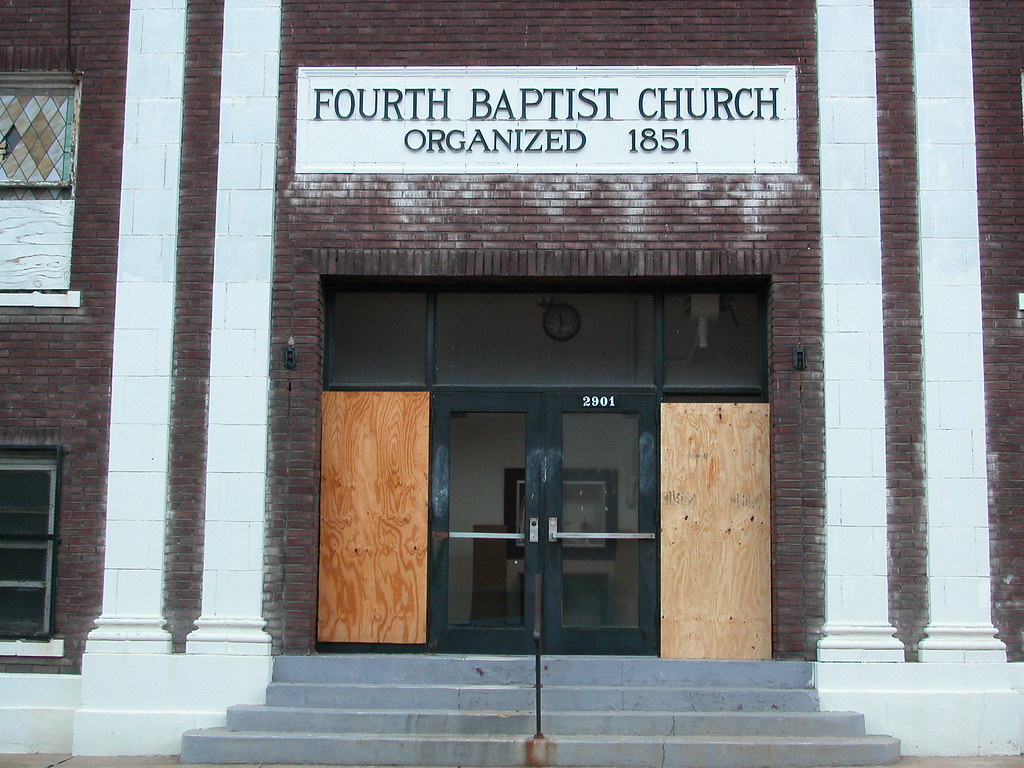
In the midst of discussion on this blog about a partly un-boarded broken window on the vacant Fourth Baptist Church at 13th and Sullivan in Old North St. Louis, a new board went up (at right in the photo above). This simple act will prevent vandalism and trespass on the building, ensuring its survival as it awaits reuse.

Categories
Events North St. Louis Northside Regeneration

Meeting on McKee, North Side Development Tomorrow Night

Someone left this announcement in the comments section:

neigborhood meeting
Sts Teresa & Bridget Church
3636 N Grand
March 12 2008
7pm
Discuss what is happening on the northside and what you/we/I can do about it. This is a call out to all near north side residents. Let your voice be heard. The future is now. All are welcome. See you there. Topics include but are not limited to

Paul McKee
LRA
Team Four
Future Development of the North Side

Alderwoman April Ford-Griffin will be in attendance with information of future devlopment.

Categories
Abandonment Churches Illinois land use Urbanism

Kaskaskia Remains

by Michael R. Allen

The villages of Dozaville (once Goshen) and Kaskaskia, Illinois remain as vestiges of settlement on Kaskasia Island. Dozaville is a complete ghost town, at least officially — it has been legally dissolved for decades. Kaskaskia remains incorporated, although with less than a dozen residents in four households within its boundaries has no real need for civil government. Kaskaskia is one of those places that has achieved zero population growth according to the US Census — a bizarre stasis for a town once of great importance.

Although part of Randolph County in Illinois, the island is west of the Mississippi and accessible only via a bridge from St., Mary’s, Missouri. A shallow channel barely recognizable as a river separates St. Mary’s from the island, suggesting that the land nearly is part of Missouri. On maps, the land seems fully engulfed by Missouri. Most maps don’t even note the channel with water, but merely include a political boundary line. Kaskaskia seems an improbable location for Illinois’s first state capital. Now remote, plagued by low land that constantly floods, and insular, Kaskaskia was once a vital part of early French settlement of the Mississippi River valley. The island was once an attached Illinois peninsula.

In 1673, Louis Joliet and Father Jacques Marquette claimed the Mississippi River valley in this area. In 1675, Marquette visited the site of Kaskaskia and established the mission of the Immaculate Conception. The mission became a church, and the settlement around the mission grew into a village with fur trading and farming as prevalent economic activities. In 1703, Kaskaskia was founded as the second village of European settlers in Illinois. By 1752, the population stood at a relatively robust number of 671 residents.

At the advent of the French and Indian War in 1756, French townspeople built Fort Kaskaskia on a hill east of the town, now across the Mississippi River. Residents destroyed the fort to prevent it from falling into British control when the British won. Many residents fled to Ste. Genevieve after the war. Later, the British built Fort Gage in Kaskaskia but lost the fort to Revolutionary General George Rogers Clark in 1778.

Kaskaskia became Illinois territorial capital in 1804. In 1818, the newly-created State of Illinois chose to retain Kaskaskia for the first state capital, although for only two years. The Emigrant’s Guide of 1818 states that there were 150 houses standing in the village. Growth would not arrive, however, as the village quickly lost the capital to more centrally-located Vandalia. One notable event happened after the loss of the capital: the establishment of the convent and school for the female school Visitation Academy in 1833.

However, the biggest blows to the village’s fortune came with terrible floods in 1844 and 1881. Located at a narrow spot between the Kaskaskia and Mississippi Rivers, the site was vulnerable to the Mississippi’s eastward shift. Eventually, that river pushed over the narrow neck of the peninsula to create the present island. The first flood caused great population loss, and the second flood created the river channel that made the land around Kaskaskia into an island. During the period between the floods, Visitation Academy relocated to the city of St. Louis in 1844. After an 1893 flood, the town relocated to its present location.

In 1993, flood waters again submerged the island and caused residents to flee. Nowadays, the population of Kaskaskia is about 9 and the population of the island is about 93 people. Kaskaskia still retains its street grid, which carves out blocks punctuated by the few remaining buildings.

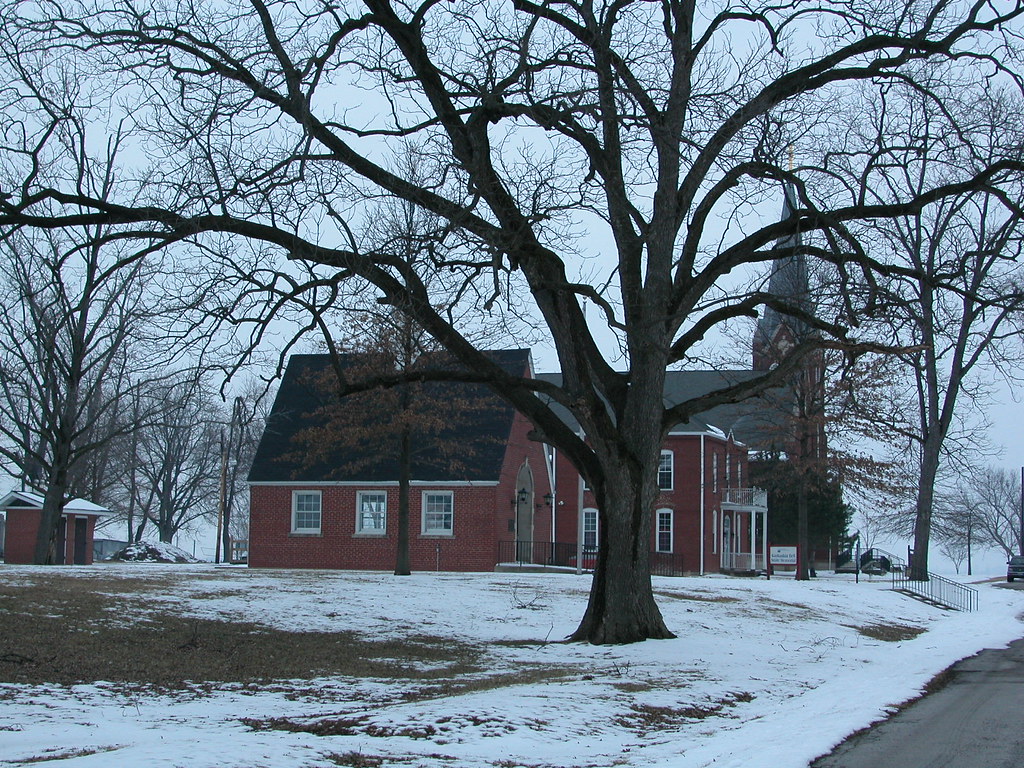
One of those remaining buildings is the Church of the Immaculate Conception, built in 1882 and moved to its current site in 1894 after the devastating 1893 flood. A church founded by Marquette now meets only on Saturday afternoons — strangely diminished in human size but awesome in the length of its existence. The brick building has managed to survive several floods with its Gothic Revival architecture intact.


A long-time parishioner is profiled in the article found here.

A newer building is the home of the church’s historic bell, gifted by the King of France in 1741 and known as the “Liberty Bell of the West” since the townspeople rang it on July 4, 1778 to celebrate liberation from British rule.

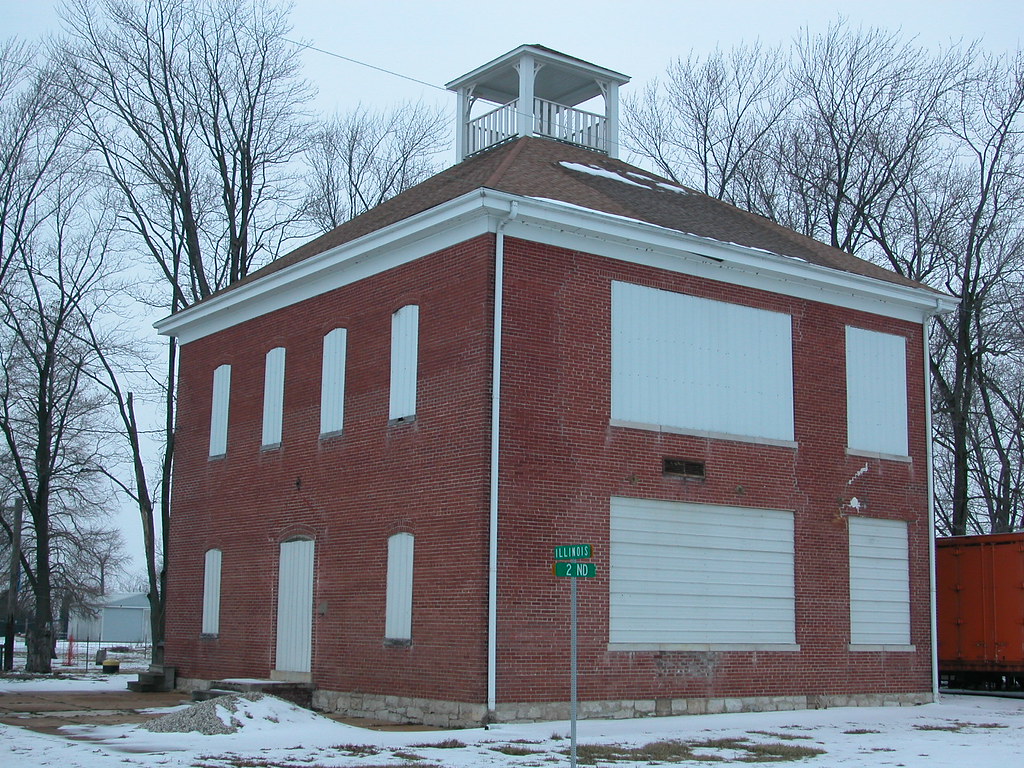
The old school house is interesting, although badly damaged by flooding and alterations to its fenestration. Boarded up, the brick building is missing much of its interior structure although it has gained a new roof since the 1993 flood. Reuse seems unlikely, although someone is performing enough continued maintenance to ensure survival of the old building.
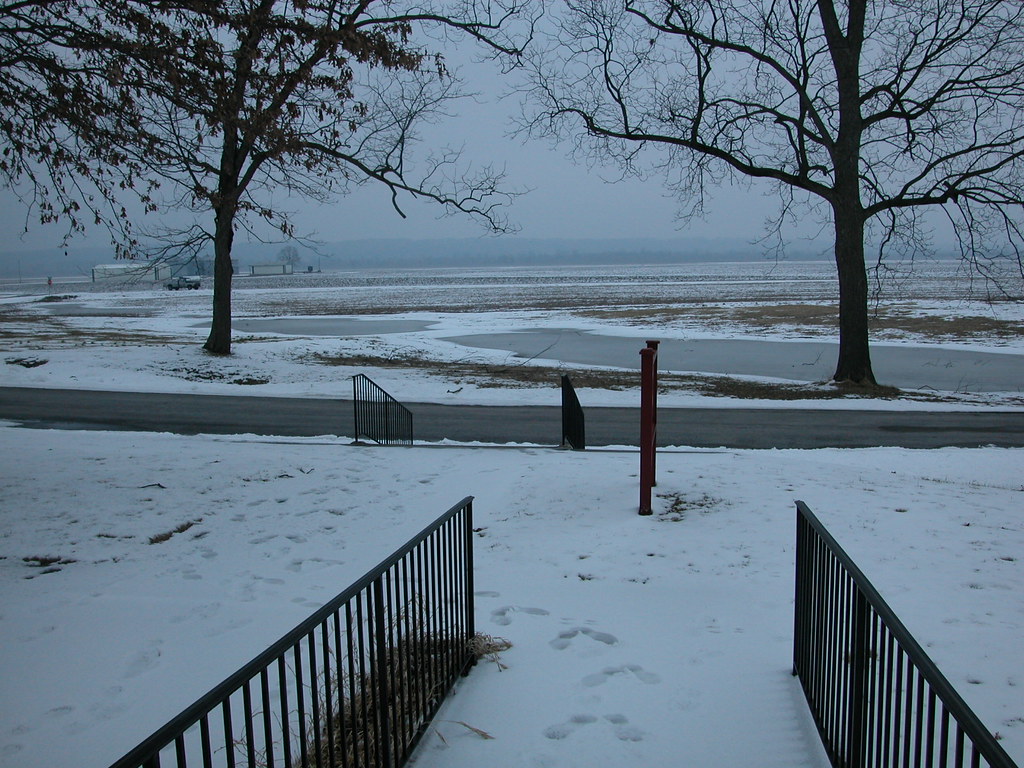
A few frame and brick homes comprise the rest of Kaskaskia. The wide sight lines of the island ensure views of the church spire and school house framed by expanses of fields. Settlement has come full circle for Kaskaskia, but somehow it endures.

Categories
Art Events South St. Louis

The Prohibition Revue Next Sunday at the DeMenil House

Ever wanted to see Craig Schmid perform in a play about prohibition of alcohol?

Next Sunday, you’ll get your chance when the Chatillon-DeMenil House Foundation presents a radio-style reading of The Prohibition Revue written by sisters NiNi Harris and Sheila Harris. Alderman Schmid, Bill Hart, Lois Waninger, Bob Officer, this blog’s Michael Allen and others will be reading the parts of the people who shaped the prohibition episode, from early temperance days to ultimate repeal. The story combines the words of citizens, businessmen and officials with the lyrics of both “dry” and “wet” songs. Expect singing!

When: Sunday, March 16 at 2:30 p.m.

Where: Chatillon-DeMenil House, 3352 DeMenil Place

The play reading is free and open to the public. For more information, call 314-771-5828.

Categories
Downtown Infrastructure North St. Louis Streets Transportation

Time is Right for Making Changes to New Mississippi River Bridge

by Michael R. Allen

On February 28, outgoing Missouri Governor Matt Blunt announced that Illinois and Missouri had reached a final agreement for construction of the new Mississippi River Bridge. While actual construction remains a few years away, the agreement brings back to the forefront concerns about the bridge’s impact on the urban fabric of north St. Louis.

While officials long ago shelved a highly destructive initial bridge concept that included a local traffic connector from the bridge to 14th street, the current plan leaves much to be desired. There are many problems

Clearance. The bridge plan still entails clearance of historic buildings and existing business. While the path of the bridge itself is actually one of the least invasive paths possible, the affiliated roadway projects will entail demolition of dozens of buildings. Particularly troubling is the plan to wipe out all of the buildings remaining on the east side of 10th Street north of Hempstead Street. There are many occupied buildings and houses in that stretch. Most important, the part of Old North St. Louis east of I-70 is integral to connecting Old North to the emerging North Broadway corridor.

Bridge planners are more concerned with traffic efficiency than creating infrastructure that respects settlement patterns. While I-70 has some maddening issues related to placing exit ramps in odd spots due to existing buildings, those issues are small concessions to reality. Reality is that cities are what bind people together, and highways are but a means to that bind. Reconfiguring the St. Louis Avenue interchange is economically profligate; the plan entails spending millions on a road project with no economic return. Reconnecting Old North and North Broadway will cost less and maintain an existing building stock with the potential for high real estate values.

A corollary is that the presence of highway noise and pollution lowers real estate values. Why on earth political leaders would want to champion anything that lowers real estate values amid a recession is beyond my comprehension.

Connectivity. The plan still entails closure of north-south streets like 10th Street. Northside residents use these streets to get downtown. Closing the connections will stall pedestrians and add time to drivers’ commutes. Closing the connections could isolate Old North from downtown. There is natural synergy between Old North and downtown, but there are physical impediments caused by a belt of vacant land, industrial uses and monolithic public housing complexes. The bridge exploits that belt, and tightens it.

Short-Sightedness. The new bridge does not address the terrible congestion caused by the poor configuration of ramps on the Poplar Street Bridge. Would the bridge even be needed if the Poplar Street’s problems were fixed? No.

The bridge plan does not include any allowance for public transit. There is no space on the bridge for a street car line. That’s going to seem silly in 25 years when our automobile lifestyle will be in crisis. Oh, well — at least we can still walk across the bridge then.

Avoidance. The bridge path funnels I-70 traffic out of East St. Louis and away from downtown St. Louis. This path is a boon to people wanting to live in far-off Illinois suburbs like Highland but work in St. Louis or St. Charles counties. Sure, long-distance traffic will be well-served by a new bridge, but so will exurb-to-exurb commuters.

The bridge itself seems every bit a done deal. But are the details cast in concrete? No. There is still space to mitigate the bridge’s impact on the urban fabric of the near north side. Since almost every change for the better involves reducing the project cost, changes are not only logical but prudent. In the wake of the agreement, it’s time to make the best of the bridge.

Categories
Architecture Historic Preservation Illinois Peoria

Concrete Block Flatiron in Peoria Gone

by Michael R. Allen

When I went to Peoria over the weekend, this building was gone. (This photograph dates to June 2005.) The commercial building stood on Martin Luther King Boulevard just east of Western Avenue, on the south side of the street. Several characteristics were remarkable:

– The building was built entirely of concrete block made to look like rusticated limestone.

– The building formed a flatiron shape even though it did not sit on a flatiron lot. The shape was necessitated instead by topography. Behind the building, the land dropped off so severely that the flatiron was about all that could be built on this site. as the raised sidewalk suggests, things aren’t so great on the other side.

I liked this building because it defied the odds. This site is not “buildable” by contemporary standards; it may not have been even back in the early twentieth century when the building was built. Yet someone wanted to develop this lot, probably spurred on by Peoria’s density. When a city has a strong downtown, people build anywhere they can get in and around that downtown. Even odd lots get built out. Contrast that with today’s American urban environments, where many developers won’t even build on lots 25 feet wide by 120 feet deep. Once, land was scarce and building space abundant — now the formula is inverted. It seems that along with abdundant building space went abundant civic pride. People who don’t value land and make the most of its scarcity don’t build — or steward — great cities.

No doubt the little concrete flatiron fell prey to our perverse size mentality. People probably considered it too small for commercial use, and lacking the “yard” needed for residential. The building went empty and then it was demolished. I’ll bet that the lot remains vacant forever.

Categories
Architecture Chicago Historic Preservation Illinois

Under the Layers

by Michael R. Allen

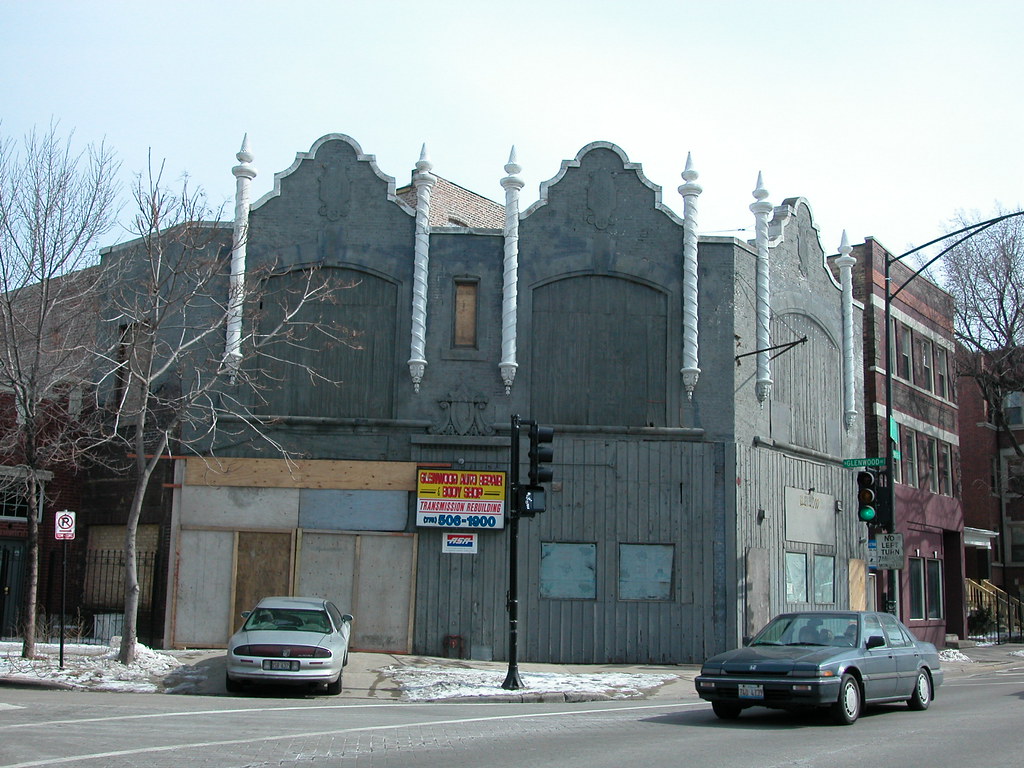
While driving on Ridge Avenue in Chicago over the weekend, I spotted this building. Look at it! We have a Spanish Revival gem hiding out under wooden siding and a coating of gray paint. I like how the owners painted the braided terra cotta finials white to make them stand out. Apparently, the building is in use by an automobile repair shop. Perhaps some day the owner will take off the siding and strip the paint to reveal the full glory of the building. For now, though, the building’s soul still manages to whisper through the layers.

Categories
Abandonment Architecture North St. Louis Northside Regeneration Old North

How Not to Board Up a Broken Window

by Michael R. Allen

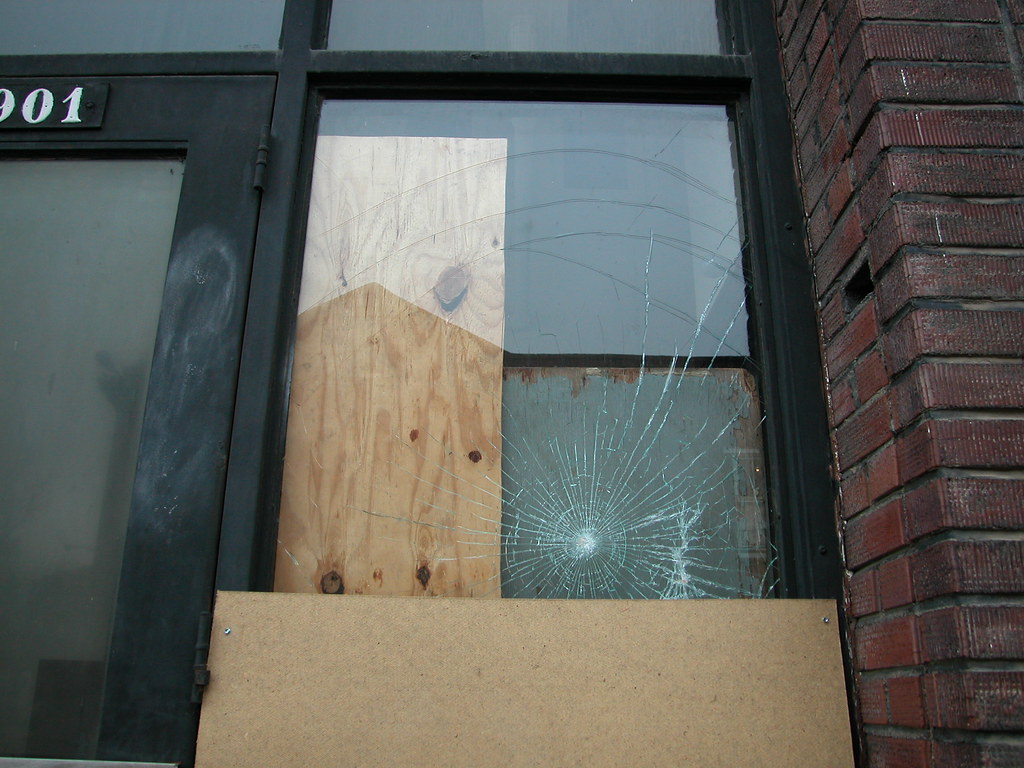
Here is the entrance to the Fourth Baptist Church at 13th and Sullivan in Old North St. Louis. You can see that someone has broken the window at right, and that someone has very poorly attempted to board over the damage. Hint: If the broken area still shows, you haven’t boarded over the damage.

In August 2007, someone threw a rock at the window and caused the spider-web-like broken lines. Neighbors tried to get the owner, a nearly-defunct congregation, to board up the broken window. I cut my hand taping the damage to stabilize the glass. Several Citizens’ Service Bureau complaints led to the congregation’s finally boarding up the broken glass. Then, this December, the other side of the doorway gets the same treatment — from vandal and owner. Neighbors still haven’t seen a full repair.

The church building itself is an important landmark, and deserves better treatment. The congregation does not have the funds to maintain the building; they vacated in 2002. Meanwhile, the building has become a nuisance to neighbors as the congregation refuses to commit to selling and won’t make even small efforts to stay abreast of vandalism.  Hopefully Fourth Baptist will board up the broken window and sell their church to someone who will invest in the future of the church and the neighborhood.

Categories
DALATC Illinois landbanking Public Policy Southern Illinois

Illinois Seeks to Get in on the Distressed Areas Land Assemblage Tax Credit Action

by Michael R. Allen

On February 14, Illinois State Representative Jay C. Hoffman (D-112th), introduced a bill in the Illinois General Assembly to create a Distressed Area Land Assemblage Tax Credit for Illinois. The bill, HB 5153, takes verbatim the enacted text of the Missouri Distressed Areas Land Assemblage Tax Credit Act.

Hoffman represents a district that includes the Metro East cities of Collinsville, Edwardsville, Maryville and Fairview Heights.

Categories
Architecture Central West End Demolition Historic Preservation Mid-Century Modern

The Doctors Building: An Obituary

by Michael R. Allen

Streamlined and sleek, sophisticated and subtle – these are attributes of the Doctors Building at the northeast corner or Euclid and West Pine. The Modern Movement medical office building has offered a hint of space age glamor to the Central West End for nearly fifty years. Nestled among elegant Renaissance Revival apartment buildings, art deco storefronts and minimalist contemporary condominium buildings, the modernist tower provided just the right balance to the mix of jazz age architecture. Think of the Doctors Building as a minor bop number in a sea of buildings that span a range of jazz period from ragtime to tonal. The Doctors Building is that smooth, modern breakthrough that plays back to its predecessors without upstaging them and that teaches its successors a thing or two.

Too bad that’s all ending before our eyes. The Doctors Building is under demolition as I type. I wish I could report that the proposed replacement is worth the urbane environment of the Central West End, but that simply is not the case. We’re discarding modern jazz for contemporary pop drivel.

We are losing a building that is almost a time capsule from our recent past. Some would assert that the 1950s was an age of conservatism, forced conformity or destructive Cold War politics, but that view neglects to account for the cultural production of the era. How did the Beats, jazz music, streamlined industrial design and modernist architecture fit into the rubric of Joseph McCarthy and Leave It To Beaver? The answer is “not well.” More surely, the arts that persisted in the 1950s were cool and subversive of other tendencies. Artists were taking the tools of regimentation — the straight line, the machine — and turning them into expressive instruments. The best work of the 1950s plays on the tension between conformity and rebellion.


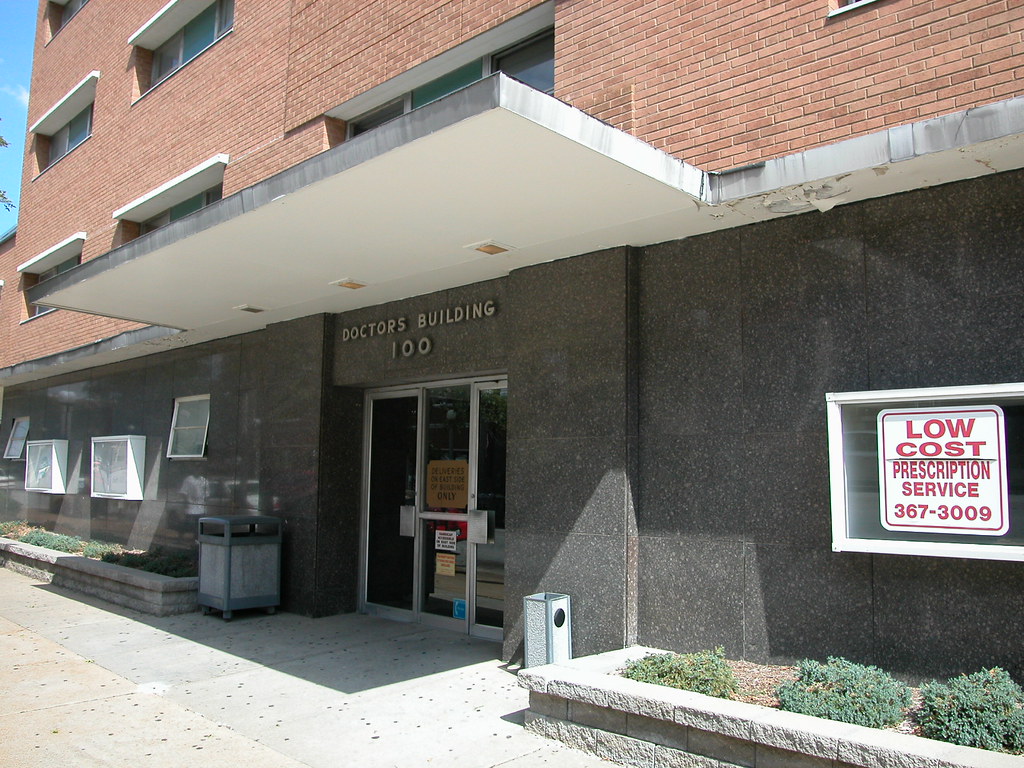
The Doctors Building straddles that fine line itself. After all, this is a medical office building — a tool of discipline and science. Yet the envelope is almost sensual — warm orange brick, window groups punctuated by aqua aluminum panels, a shiny granite base with quintessentially modern anodized aluminum details including an upward-curved canopy. Each elevation of the building is different, and on the east side wide projecting bands of brick that wrap the corners makes the wall plane sculptural. The pattern runs down the center of the Euclid Avenue elevation, marking the entrance. The tall form of the building gives way to two-story sections on the east and north, providing contrasting elements at different scales.


Of course, however attractive, the Doctors Building is no master work. It’s a minor modernist accomplishment that benefits greatly from its context. As the only tall mid-century building on Euclid, the building stands out in ways it might not had further development occurred in the 1950s and 1960s. The building avoids the swagger of Miles Davis or Thelonious Monk, falling into the background. It’s a really cool but not very showy B-side from an artist no one remembers no matter how many times they hear the name.

The building permit for the building is dated January 1955, with cost of the 11-story building estimated at $900,000. The architect was a little-known designer named Paul Valenti, who taught in the School of Architecture at Washington University from the 1940s into the 1960s. This author knows of no other work by Valenti, and has searched mostly in vain to glean biographical details. The two-story section on Euclid dates to a permit issued in July 1955; Wells and Wells, Inc. is listed as engineer on this section as well as the tower. The two-story section to the east corresponds to a permit issued in August 1961; E. Donald Goret was the architect. Erstwhile Millstone Corporation was the developer and builder of the building and its additions.


The building originally had that one distinguishing mid-century flaw: adjacent parking as part of the building design. The original adjacent small surface lot on West Pine took on its own life and grew as the owners tore down a few houses to make an unsightly large lot that inadvertently created a wonderful view in which one can see both the Doctors Building and that 1929 art deco landmark, the Park Plaza Hotel.

With the huge parking lot, the Doctors Building site proved irresistible to developers during the recent hyperactive swing in the market. The Mills Group proposed demolishing the elegant building and replacing it with twin 30-story towers of ridiculous bulk and exaggerated detail. Jazz would have been replaced with buildings that reminded me of overwrought sappy love ballads. Then the market downturn set in and the project fell apart. Unfortunately, another plan emerged – demolish the building and replace it with a shorter new building. The new building is best left without description — its designers’ strained attempts at referencing historic details like quoins and a clock tower would only be remarkable if not already tried on thousands of suburban branch banks around the country. Alas, we lose the Doctors Building for something that doesn’t even forge a relationship with the Central West End. Sophistication falls to smugness. A minor pleasure gives way to a minor travesty. Hopefully the jazzy architecture around the new building will be enough to drown out the intrusion.