
Categories
“We Knead Your Dough”
 Preservation Research Office
by Lindsey Derrington
This article is adapted from a National Register of Historic Places Eligibility Assessment that the Preservation Research Office submitted to the Missouri State Historic Preservation Office. The response from the State Historic Preservation Office is emphatic: “What a waste it would be if this lovely schoolhouse were to be demolished. Hodgen Elementary School is clearly eligible for listing in the National Register of Historic Places under Criterion C for Architecture, and may be eligible under Criterion A for Education as well,” states the response dated March 23, 2011.

History of Hodgen School
Hodgen Elementary School is located on the southeast corner of Henrietta and California Streets in the Eads Park neighborhood of St. Louis’ Gate District, bounded by Jefferson and South Grand avenues to the east and west and Chouteau Avenue and Interstate 44 to the north and south. Characterized by middle class row houses and multiple-family flats, this area developed in the early 1880s and 1890s as part of the Compton Hill District, today known as the Compton Heights and Fox Park neighborhoods.
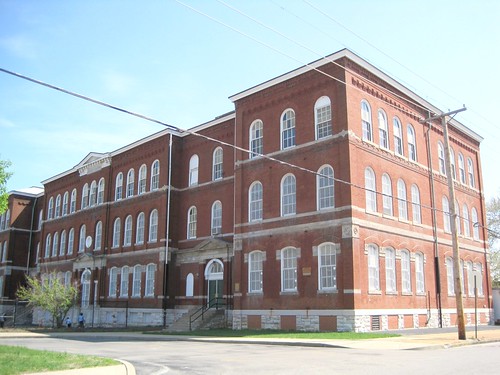
Plans for Hodgen Elementary were drawn during the summer of 1883 at the behest of local residents to accommodate the rapidly-growing area’s needs. Otto Wilhelmi, elected Architect and Superintendent of Repairs by the city’s school board earlier that year, was responsible for its design. Hodgen was his first, if not only, design for a new school building for the district, and was named for nationally-renowned surgeon and educator Dr. John Thompson Hodgen who had died in 1882.
Hodgen Elementary was completed for $32,330 in mid-1884. It stood three stories tall with a full basement and contained fourteen rooms, each with access to four large windows to provide students with the maximum amount of light. The school was well-received by the school board and the community. Soon the neighborhood’s burgeoning population necessitated a six room addition that added three bays to both the school’s east and west facades. H. William Kirchner, who had served as school board architect during the term prior to Wilhelmi’s and was elected again in 1886, designed the addition. His brother August H. Kirchner served as school board architect from 1893 to 1897 and in 1894 designed another three-story addition to Hodgen to bring it to its present appearance. This addition added a four bay wing to the building’s east façade and a three bay wing to its west façade at a cost of $15,000. William B. Ittner almost certainly oversaw $103,948 worth of alterations to the school in 1909, though the nature of this work is unknown.
by Michael R. Allen
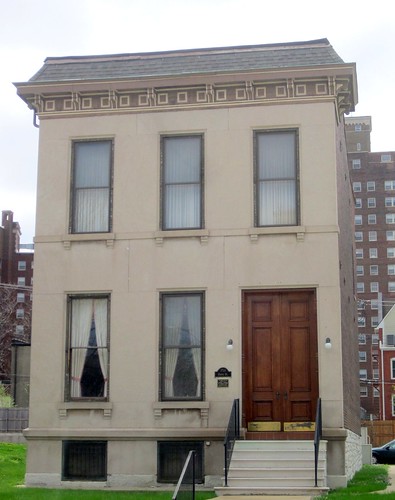
The William Cuthbert Jones House, located at 3724 Olive Street, is a rare example of a 19th century town house that not only survived the decline of Midtown but has also retained substantially its historic character with few alterations. The limestone-faced two-story brick house in the Italianate style was designed by architect Jerome Bibb Legg in 1886 for William Cuthbert Jones, a prominent attorney and criminal court judge.
The house is a good representative example of both Legg’s many client-driven house designs and of the sort of residences that were built on Olive Street in the 1880s. Compared to larger houses on more prominent streets in the Midtown neighborhood, houses on Olive were relatively smaller and less ornate. The house is also noteworthy as one of a handful of extant local works by Legg, who took on much work elsewhere.

Modern STL and the Architecture Section of the St. Louis Artists’ Guild present a free lecture, “Building With Bernoudy.”
The story of working with and adding to a William Bernoudy-designed house becomes a lesson of “complexity and contradiction in architecture” on a very local and personal level. Builder and designer Richard Reilly will share the story of renovating and updating the 1953 Simms House (located at #3 Sumac Lane in Ladue) with his drawings and photos of the project.
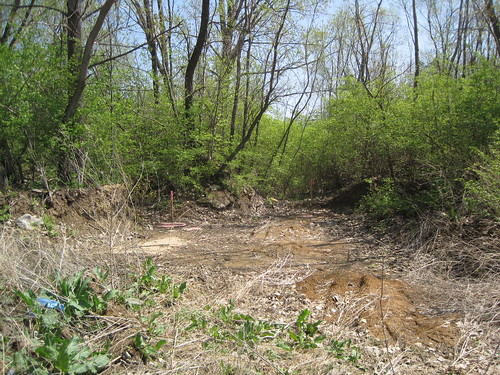
This afternoon I gave a tour of the Pruitt-Igoe site to a group of bicyclists en route to see The Pruitt-Igoe Myth. Myth meets reality, big time, on the 33 wooded vacant acres of the site. Here are few scenes. – M.R.A.

by Michael R. Allen
On March 31, the Environmental Protection Agency (EPA) released an Action Memorandum for the cleanup of the Carter Carburetor plant at St. Louis and Grand avenues in JeffVanderLou. This action surprised residents of surrounding neighborhoods, who had hoped for more time to understand the science behind the cleanup methods. In February, after the close of the public comment period for the action, the EPA provided a citizens’ group with a Technical Assistance Services for Communities (TASC) consultant who is still in the process of getting answers for the citizens.
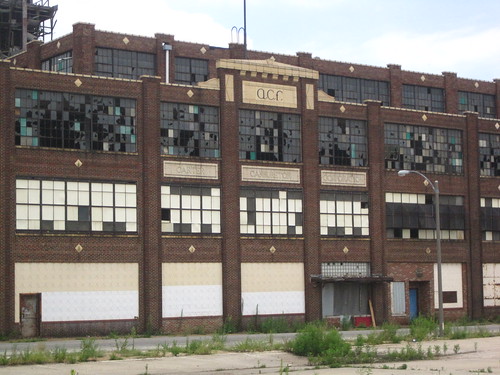
Among the questions is whether the Carter Carburetor building should be demolished. The EPA’s preferred alternative of total demolition has become the action proposed in the action memorandum:
The Carter Building, Inc. (CBI) Building – The action for this area is demolition and off-site disposal. After completing the remediation of asbestos-containing material, the CBI building will be demolished and building materials disposed based on PCB concentrations.
This action uses federal funding and will trigger a Section 106 review under the National Historic Preservation Act, since the Carter Carburetor plant is likely to be eligible for National Register of Historic Places listing. The less-significant Willco Plastics building could be retained, however:
The Willco Building – Because PCB contamination in the Willco Building is relatively low, a thorough cleaning may be sufficient. If the cleaning does not reduce the contamination to below acceptable levels, the first and second floor slabs would be partially removed and replaced.
The owners of the Carter Carburetor building want to retain it and reuse it. At issue is whether heavy PCB contamination can be removed successfully from the building. Concrete floor slabs will have to be replaced, according to the EPA, but that still leaves upright and vertical concrete structural components that cannot be removed and replaced. The EPA states that these would have to be coated with epoxy that would need 5-year maintenance in order to be safe for workday exposure.
One question posed to the TASC consultant is whether such epoxy coating has ever been done on the scale of Carter Carburetor, and whether it can be effective. Also unknown, because PCB contamination usually leads to demolition, is whether there are other methods for remediation than those the EPA has offered. Anyone know of any case studies?
by Michael R. Allen
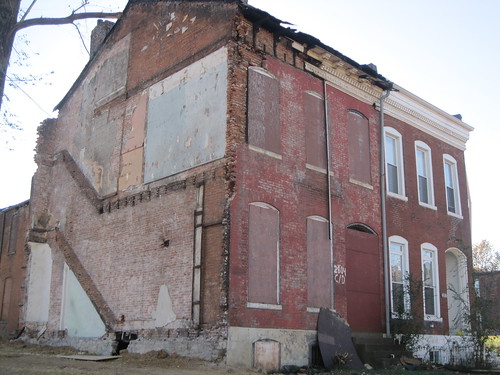
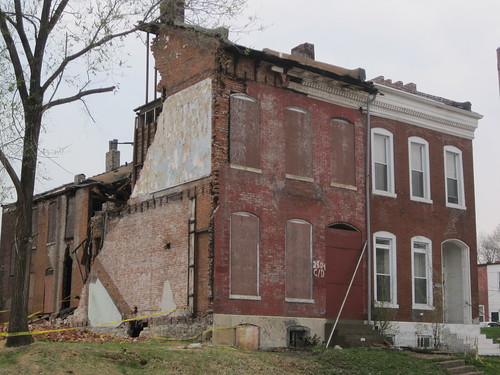
As I feared, the row house at 2804 Lafayette Avenue was destabilized by last year’s demolition of its party-wall neighbor and has substantially collapsed. (See “Two for One on Lafayette Avenue”, November 16, 2010.) The forthcoming demolition will leave just one of three connected dwellings standing — hopefully in sound condition.
From Landmarks Illinois
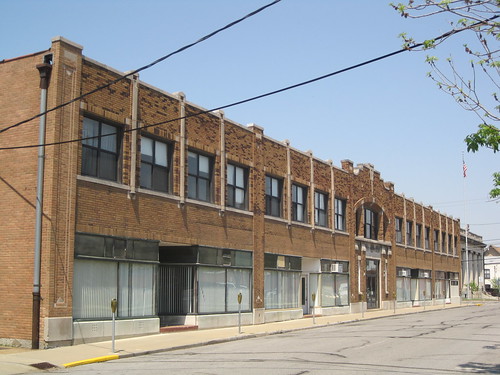
Wednesday, April 6, 2011, Springfield, Ill.—The Belleville Turner Hall, 15 N. First St. in Belleville (St. Clair County), was named to Landmarks Illinois’ annual “Ten Most Endangered Historic Places” list, which was announced today at a press conference in the State Capitol.
“At the time of its construction, this was one of the largest private gyms in the U.S.,” said Jim Peters, President of Landmarks Illinois. “We hope that the publicity generated by this “10 Most” listing will spark a new use for this important building.”
Landmarks Illinois, the state’s leading voice for historic preservation, listed nine other endangered historic properties on its annual list which focuses attention on sites throughout Illinois threatened by deterioration, lack of maintenance, insufficient funds, or inappropriate development.
The Belleville Turner Hall, with Art Deco and Gothic ornamentation, was constructed by the German community in 1923-24 as a social and civic center. Its primary purpose was a venue for physical fitness and educational programs for the community. Owned by the City of Belleville since 2006 and vacant, the building is in need of a new use and immediate repairs. A grassroots organization has offered to raise funds for repairs and to develop a plan for converting the building into a visual and performing arts center, but the City has not expressed interest.
More information at www.landmarks.org.
Thursday, April 7 · 7:30pm – 10:00pm
The Sanctuary: 21st Ward Community Center
4449 Red Bud Ave
The 21st Ward contains some of St. Louis’s most beautiful neighborhoods and green spaces. Not content to watch these treasures slip into decline, the ward’s leadership, from Alderman Antonio French to dedicated staffers and neighborhood residents, has been hard at work to make it a better place to live, work, and visit. From new walking trails in lush O’Fallon Park, to a partnership with Rebuilding Together St. Louis for a Block-by-Block Initiative that sees one historic block renovated and cleaned up at a time, the 21st Ward has no shortage of initiatives that the rest of the city’s 27 Wards could and should be watching and learning from.
City Affair is proud to announce that Alderman Antonio French, State Representative Jamilah Nasheed and Preservation Research Office Director Michael Allen will present us with an overview of the tremendous activity and forward momentum in the 21st Ward. All of this will take place in the ward’s planned community center–an historic church recently rescued from vacancy.
Doors open at 7:00 PM, event begins at 7:30.
NextSTL sent questionnaires to aldermanic candidates in the St. Louis general election on Tuesday, April 7. Among the questions posed is one of interest to readers of this blog: Do you support city-wide historic preservation review?
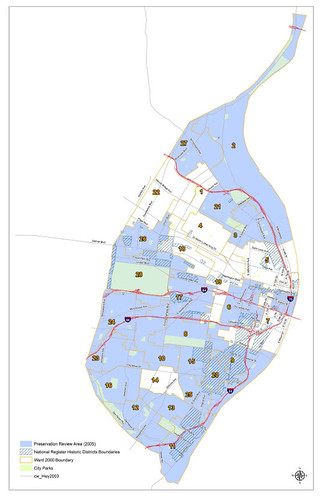
Since the adoption of a new historic preservation ordinance in 1999, the city’s Cultural Resources Office has not had the power to review and deny demolition permits across the city, but only in wards whose aldermen choose to participate. Currently 20 of the city’s 28 aldermen participate — a number boosted by Alderman Antonio French’s placement of the 21st Ward in review upon his election in 2009.
Here are the answers from candidates who chose to respond.
Jesse Irwin, Republican, 10th Ward: “I don’t know enough about this to make a worthwhile comment. I’m for keeping everything worth keeping and building green everywhere else.”
Craig Schmid, Democrat, 20th Ward:”Yes, but individual communities must have a say in this. I sought to include my ward in preservation review and to obtain historic district designations.”
Scott Ogilvie, Independent, 24th Ward: “I believe there is strong support for keeping the 24th Ward in the Preservation District. The historic quality of our neighborhoods is one of our greatest strengths as a City, and we need to ensure that when demolition takes place, a new project of equal or greater value is replacing what is being removed. The fact that much of North St. Louis is not in the Preservation District has led to some senseless demolition of historic buildings of a type that are unlikely to be replaced. I would like to see stronger protection of existing structures and fewer demolitions — but we need to make sure there is support for expanding the Preservation District into new Wards.”
If any other candidates want to answer the question, send a note to us at michael@preservationresearch.com and we will post the response.