Categories
Brick Theft Historic Preservation North St. Louis Northside Regeneration St. Louis Place Theft

A Hebert Street Story

by Michael R. Allen

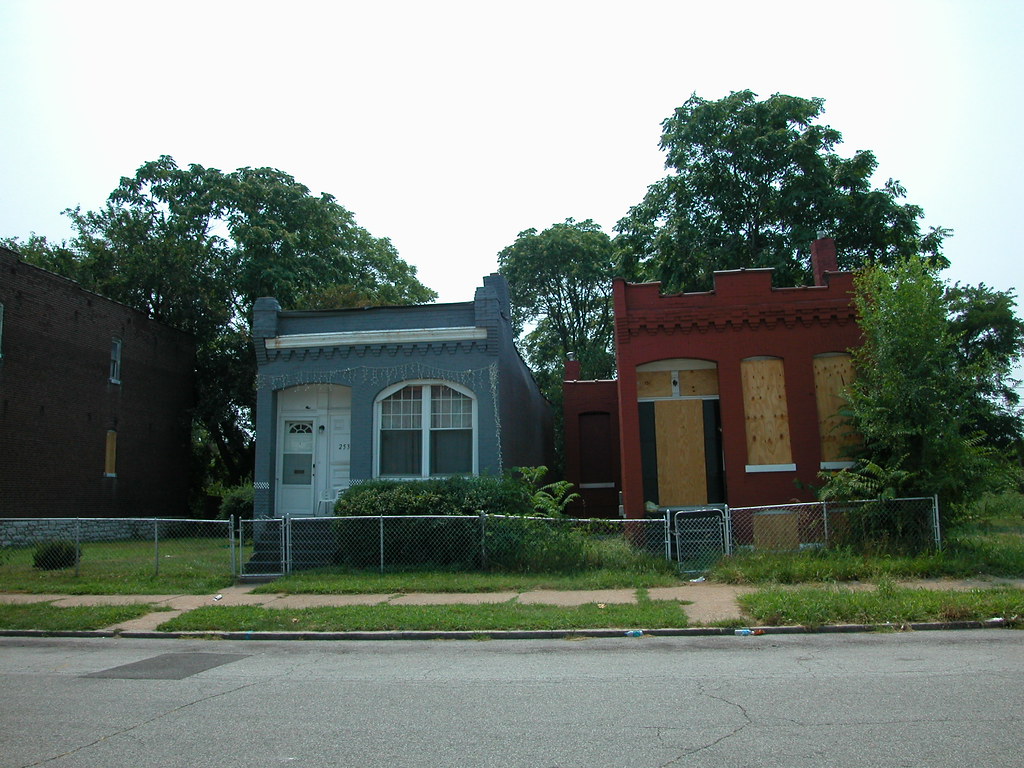
Our story starts in the heat of the summer, 2007. Two one-story shotgun houses sit on a block of Hebert Street between 25th Street and Parnell in St. Louis Place. Both houses have sat side by side since 1895, when they were built. On the left, 2530 Hebert Street is occupied by a family. On the right, 2532 Hebert is boarded up and has been owned by a holding company called N & G Ventures since December 2005. The overgrowth is evident, with tall woody growth and mosquitoes presenting a nuisance to the family next door.
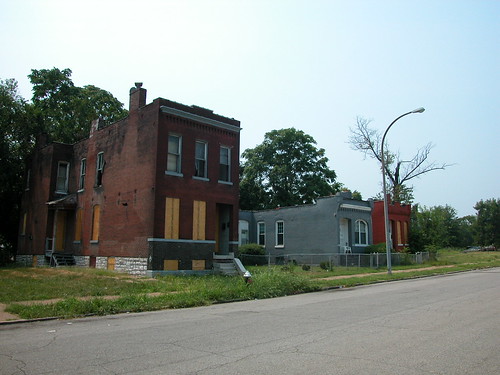
Draw back for a bigger picture, and we see that the two-story house to the east of the occupied house is also vacant and boarded. A company called MLK 3000 purchased that house in March 2007, requiring that its owner evict the tenants before the sale closed. We see that other buildings have fallen vacant and been demolished on this block, leaving vacant lots in varying degrees of maintenance.

The family living at 2530 Hebert Street have lived through tough times that got worse. In 2007, the identity of the holding company owner became public knowledge. McEagle Properties was buying land and buildings in north St. Louis for a large development. Details of the plan were unknown.

In May 2008, a string of arson hit this area of St. Louis Place. Ten vacant buildings went up in flames within a three day period. Police arrested a suspect who was released uncharged. No one has been charged with the arson. However, off the record officers say that the arsons were connected to the brick theft that has plagued north St. Louis for years and has escalated in St. Louis Place since 2006.

Perhaps it is not surprising that our family on Hebert Street sold their home to a McEagle holding company, Union Marin, in July 2008, for $75,000. Who else would have paid the family that much to relieve them of living on what had become a desolate block? They could have sold directly to McEagle for a decent price, or to one of the middle-man speculators who would have paid them $50,000 and sold to McEagle at $75,000.

Let’s move forward a year and see what happened to the houses on Hebert Street.
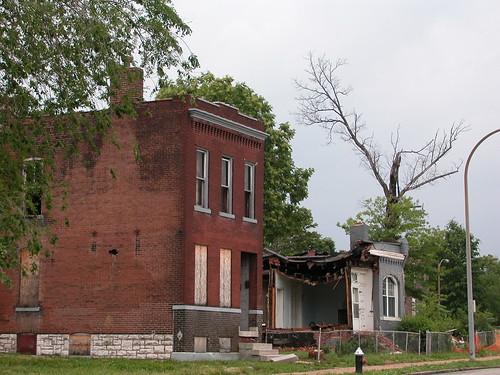

Ah, the brick thieves struck the fine little homes! On May 25, 2009, not only was 2532 Hebert Street reduced to a foundation, but the house that had been occupied less than a year earlier was down to three walls. That’s what happens when there are no eyes and ears on a block to watch out for criminals.
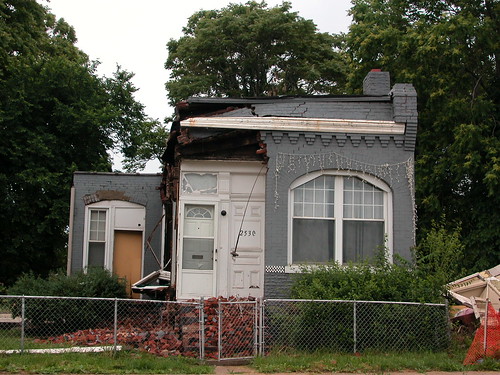
The brick thieves have been striking this area for years, often taking their bricks to nearby dealers around 25th and University streets. The thieves work in broad daylight and on weekends, and yet few ever get caught by police.
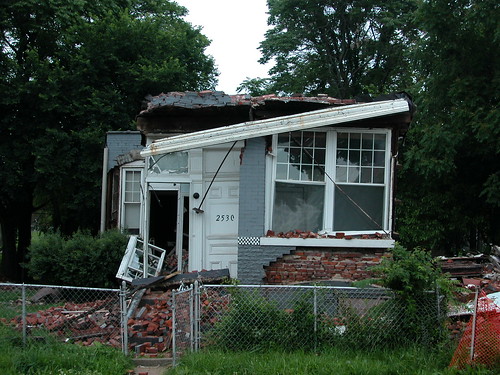
No matter — this week the house at 2530 Hebert Street is down to fewer than two full walls. The scene is garish, with the well-painted front doors and their decorative surrounds leading into a wrecked home. The water runs in the basement, where a washing machine can be seen. The sagging floors are ready to collapse any day now.
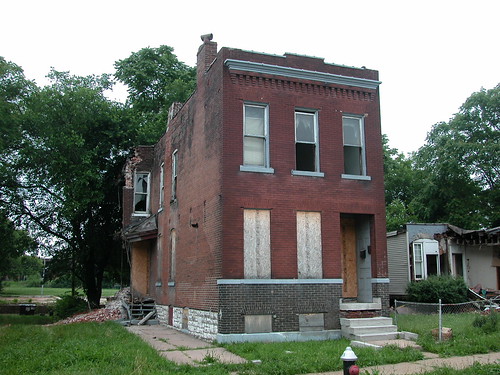
Next door, the formerly-solid two-story house has now been hit. The thieves have struck this house since May 25, because there was no damage evident then. What sort of city lets this sort of crime happen so brazenly? That’s a question for another story.

Perhaps none of this matters at all: on the slides that McEagle showed at a meeting on May 21, this block was part of a large “employment center” where many extant historic buildings were replaced by large new ones. If the city assents to this plan through a redevelopment ordinance, many other buildings will disappear. However, the shocking and illegal campaign of brick theft is not a fair or civilized way to prepare the development area.

I hope that our story ends with the arrest and conviction of the thieves who destroyed the house son Hebert as well as the dealers who fence brick knowing the illicit source. In fact, a happy end would have the larger penalties assessed against those who profit the most from brick theft — not the poor guys with pick axes, but the people who sell the brick out of town to build the McMansions of the Sun Belt. Then, we would have an open conversation about historic preservation and the McEagle project, reach consensus, watch a great project get built and all would live happily ever after.
Categories
Downtown I-70 Removal Infrastructure North St. Louis Northside Regeneration Planning

Six Ways to Remove a Freeway — How About Seven?

by Michael R. Allen

Six Case Studies in Freeway Removal is a an excellent overview of successful efforts to eliminate interstate highways in urban areas that created barriers. While there are examples from large cities like San Francisco, Toronto and Vancouver where one might expect progressive government, there are also studies from Milwaukee and Chattanooga where advocates for reconnecting the urban fabric faced greater odds.

There are constant themes in each project profiled in Six Case Studies in Freeway Removal: beautification and functionality were major goals of cities that removed freeways or freeway sections, spillover traffic was absorbed without major new congestion and freeway removal almost always lead to higher property values. St. Louis leaders contemplating the mess at the western edge of the Gateway Arch grounds ought to consider the findings of this study, and commission one aimed at the particular local problem that I-70 poses.


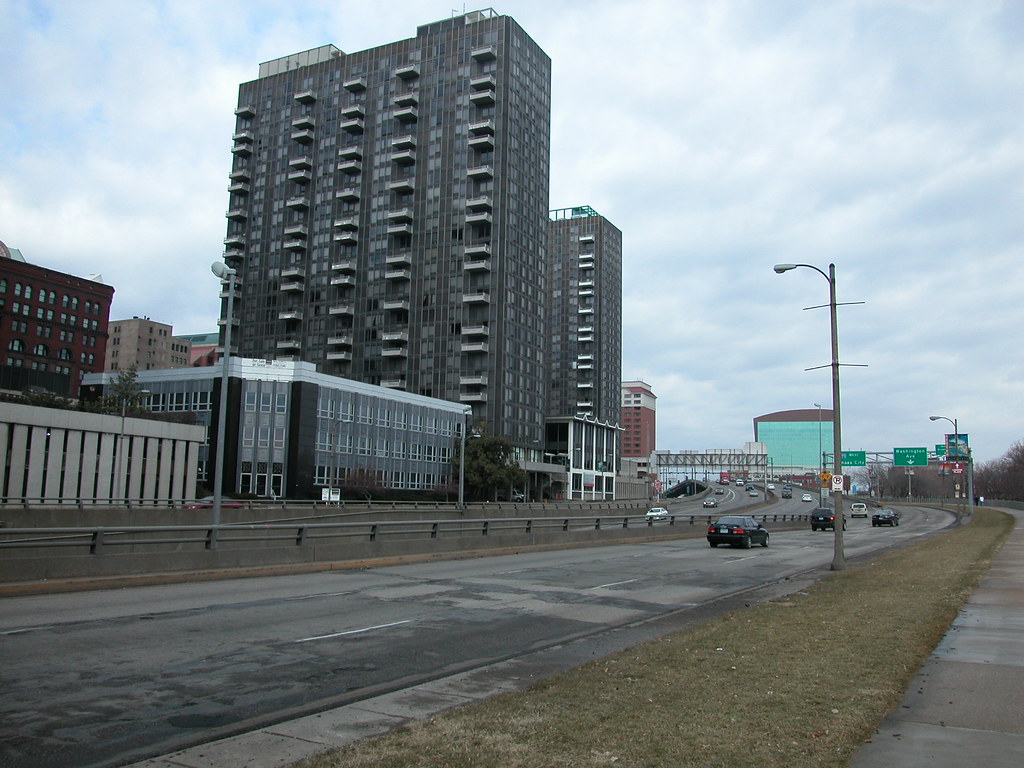
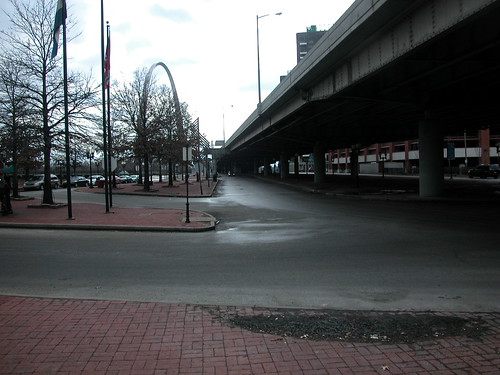
One of my first reactions to the case studies from other cities is that the I-70 problem is not that big. Taking the logical dimension of removal from the Poplar Street Bridge on the south to Cass Avenue on the north, one sees that we don’t have as long or as vital a stretch of highway as other cities removed. What we will have in a few years, after the new river bridge opens, is a redundant second section of an interstate highway that disrupts the connection between downtown and the riverfront.

Is St. Louis ready to join the ranks of the cities that have found the leadership needed to think big? A few months ago, I might have been pessimistic. Now, I see that City Hall and many leaders are willing to take a major urban planning risk with McEagle Properties’ NorthSide project. Putting aside the details of NorthSide, that project takes a leap of faith — the scope is vast, the cost great and the potential for changing the central city tremendous. Part of the project even involves removing interstate highway infrastructure, the 22nd Street ramps connecting to Interstate 64. The project aims to capture southbound I-70 exit traffic and send it onto Tucker Boulevard, not eastward toward Memorial Drive. That flow could lessen traffic volume on the old I-70 and Memorial Drive.

Is there a connection between NorthSide and removal of I-70 downtown? Not yeat, but there is a binding tendency in each project: big-picture economic development planning. While NorthSide’s proponent is its developer, proponents of removing I-70 are citizens who see tremendous development opportunity along a human-scaled street. The removal of I-70 would weave the riverfront back into downtown, and it would create acres of land ripe for transformative downtown development. Like NorthSide, the process could take decades, but the results would be redevelopment on a scale beyond our wildest dreams. Add in the Chouteau Greenway project, and in thirty years Downtown could be ringed not by bleak interstate, asphalt parking and towing lots and vacant buildings but by connections to exciting new projects and renewed old neighborhoods.

Other cities took the leap of faith needed to set this level of vision into motion. Will St. Louis?

Categories
Central West End DeVille Motor Hotel Historic Preservation Mid-Century Modern Motels

Realizing the Potential of a Mid-Century Motel

by Michael R. Allen

On May 1, the National Park Service listed a mid-century motel on Lindell Boulevard in the National Register of Historic Places. This recognition went not to the much-celebrated, threatened DeVille Motor Hotel, but to its predecessor one block west, the former Bel Air Motel at 4630 Lindell Boulevard.

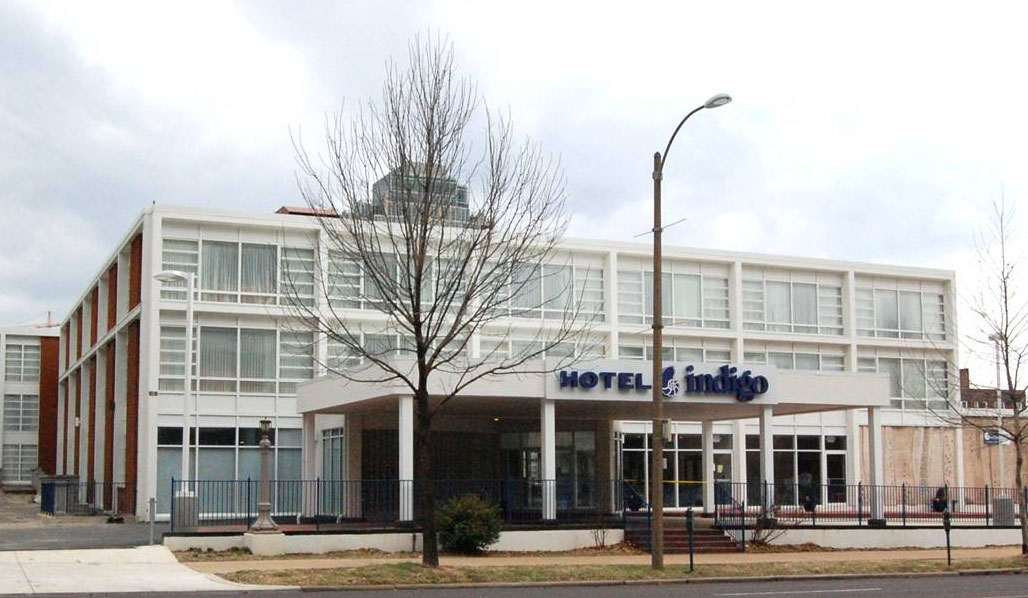
Along with the National Register listing, the Bel Air has received a $9 million renovation by the Roberts Companies and rebranding as the Hotel Indigo. Although not yet open, the spiffed-up modern motel has attracted a lot of positive attention. Central West End residents can’t believe their eyes when they look at what was recently a run-down Best Western. Others have taken notice, too: last month, Landmarks Association of St. Louis bestowed upon the Roberts brothers one of the Most Enhanced Sites awards, further recognizing the mid-century renovation.

The motel’s streamline frame has been cleaned and repainted a crisp white (the previous colors were black and pink), the obnoxious canopy rebuilt in a manner sympathetic with the motel’s design and the interior updated. All in all, the Hotel Indigo is a shining, clean, cool testament to the power of imagination and rehabilitation. The place hasn’t looked this great since opening day in 1958!

That opening day was a big event itself, since the Bel Air was the city’s first motel. The motel (short for “motor hotel”) style of lodging dated back to California in 1925. Motels before World War II tended to be “motor courts” like the celebrated Coral Court where rooms had separate exterior entrances and often private garages facing out on a court or central driveway. In St. Louis, a few of these courts were built in St. Louis County and in Illinois on Route 66. The city had its large, fine hotels with lodging, dinner and dancing all under one roof.

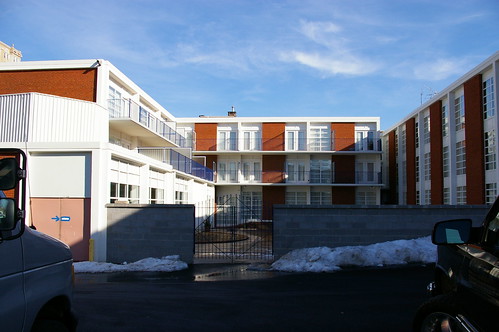
Developer Norman K. Probstein thought that the modern motel and the city hotel could be melded into a form new to St. Louis, the urban motel or motor lodge. In 1957, Probstein hired Wilburn McCormack to design a two-story motel for a site on Lindell. construction was underway that year. McCormack’s design was spare and used the principles of the International style. Rooms were accessed both by interior hallway. Some rooms have balconies facing a courtyard. Parking was underneath the motel. There was an outside swimming pool and an inside restaurant, expanded later in 1961. After opening, the Bel Air had so much business that Probstein added a third floor (designed by Russell, Schwarz, Mullgardt & Van Hoefen) in 1959 to bring the motel to a grand total of 198 rooms. Later, Probstein opened a downtown Bel Air East at Fourth and Washington (now the Hampton Inn), and dubbed the original Bel Air the “Bel Air West.”

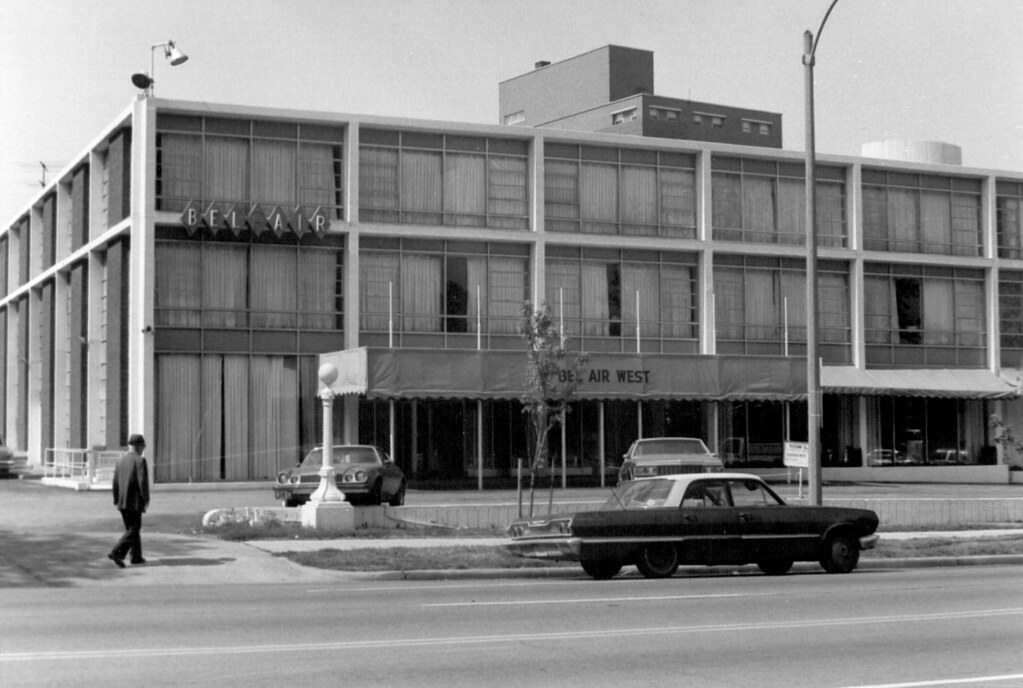
Here is what the Bel Air looked like in 1979, with the Doctors Building visible in the background:

Over the years, the motel’s luster was lost through changes in ownership, interior decoration and exterior painting and signage. The Bel Air lost more of its historic character than the DeVille Motor Hotel has, yet it retained more than enough beauty to attract the interest of a developer and get listed in the National Register of Historic Places. The Roberts Companies purchased the motel in 2007 and worked with Killeen Studio Architects to develop a thoughtful, respectful rehabilitation plan. Karen Bode Baxter, Tim Maloney and I wrote the National Register of Historic Places nomination.

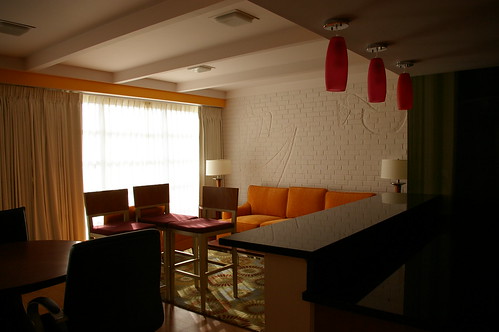
The exterior is back to near-original condition, with a few changes like the glass block entrance. Inside, where fewer details remained, the style is more contemporary than retro but a few historic elements can be found. One of the coolest features is the etched brick wall in a third floor suite:


One of the fundamental elements of the design of the Bel Air is the contrast between the white-painted concrete piers and caps and the red brick. The rehabilitation revives this stark and magnetic element on all sides. Here’s a look at the rear courtyard:

The renewed Bel Air Motel shows us that mid-century motels can be rehabilitated beautifully and that developers are interested in tackling these buildings. While many of the city’s modern motels are lost or reclad, those that are left could very well follow the path that the Roberts Companies has wonderfully shown us is possible.

(Contemporary photographs courtesy of the Roberts Companies.)

Categories
North St. Louis Northside Regeneration Urban Assets LLC

Post-Dispatch Covers Urban Assets Early, And Hopefully Often

Tim Logan has a good article on Urban Assets LLC in today’s St. Louis Post-Dispatch.

If only the daily paper had published a story like this when Blairmont Associates LC et al started buying…

Categories
Events North St. Louis Northside Regeneration

Community Benefits Agreement Discussed at NorthSide Meeting

by Michael R. Allen

Photograph by Jeff Vines.

Yesterday was the occasion of the latest City Affair, a monthly discussion forum on urban design issues. The discussion topic was the McEagle NorthSide project and how to build a consensus agenda for meaningful public involvement. The 42 people who attended included a cadre of Washington University students, residents of the project area, preservationists, architects and an editorial writer for the daily newspaper. Discussion was lively and thorough, focused largely on the problematic process through which the project’s ordinances are being proposed. People wished that the open discussion format would have been great for the May 21 meeting at Central Baptist, and many expressed concern that there will be no more chances to ask questions of McEagle team members or the aldermen in a public setting before there is a redevelopment ordinance drafted.

Most in attendance agreed that while the NorthSide project was not ideal as proposed, it’s not too late to create a role for public input that will make changes. Some expressed the sentiment that the scale of the project will doom it, or that the plans as presented by Mark Johnson of Civitas was a smokescreen for a larger north side project or commercial development. People talked about the benefits of form based zoning, preservation review, incremental sale of city-owned property to guarantee development occurs in each zone, and the need to create mechanisms for removing existing residents and businesses from the authority granted to the developer. The ideas of private transit and power districts as well as property assessments worried many people who attended, who thought that those are already functions of government. There was discussion of development inequity between north St. Louis and the rest of the city, and how much north St. Louis needs the amount of investment that McEagle proposes.

The meeting concluded with discussion of the merits of crafting a form-based zoning code and a community benefits agreement (CBA) to ensure high-quality development and a contract between all stakeholders in the project. The idea of a CBA, which could be inclusive of the goals of diverse stakeholders (including McEagle), gained a lot of positive feedback.

A CBA an expansion of the St. Louis Post-Dispatch‘s idea of an advisory council for the project. It would also place all of the promises made by Paul J. McKee, Jr. and his team at the May 21 meeting into a real agreement between the developer and the project’s many stakeholders. On May 21, McKee listed promises that included saving buildings that can be saved, keeping existing residents in their homes, not moving a single job out of the area, including minority-owned businesses in the project and building urban and respecting the street grid. While the audience at City Affair was critical of some aspects of the project, by and large people expressed support for these promises — a critical starting point for consensus.

Categories
Downtown Historic Preservation

Kiel Opera House Will Be Under Construction Again

by Michael R. Allen

Photograph of a scale plaster model of the Kiel Opera House, courtesy of the St. Louis Building Arts Foundation.

This morning, by a vote of 25-1 the St. Louis Board of Aldermen approved the redevelopment plan for the Kiel Opera House proposed by SCP Worldwide and McEagle Properties. This action green-lights a swift rehabilitation plan that will have the grand opera house reopened by Christmas 2010. While the redevelopment terms may not be ideal, they are an improvement over the years of city inaction and political hostility to the opera house.

The Kiel Opera House opened in April 1934 as Municipal Auditorium and Opera House. The Municipal Auditorium was a true people’s palace, designed to bring citizens in touch with art, music, culture and ideas. Designed by LaBeaume and Klein, the building combined classical formalism with modern, Art Deco sensibility — a perfect balance of restraint and exuberance that captured the spirit of a growing city. The later namesake, Mayor Henry Kiel, strongly backed the construction of a tremendous public resource forsaken by a later generation. However, construction came about through a bold financing move — inclusion in the $87 million series of bond issues voters approved in 1923. Construction was an extraordinary and visionary act by city government. (The full history is available in Lynn Josse’s excellent National Register of Historic Places nomination for Kiel.)

The current rehabilitation plan should not have been extraordinary or visionary, because essentially Dave Checketts is simply reopening a facility for its original purpose. How that reopening ever became a controversial move is unfathomable, and rooted in a pervasive local mercantilism. (Read more in Steve Sagarra’s “Personal Politics: Revitalization of the Kiel Opera House”.)

Sure, Checketts’ company and McEagle are putting up little of the total project cost of $73.5 million themselves, but the details of the financing are not surprising. The city will issue $29 million in bonds financed by the $1.5 million in entertainment taxes generated — a deal that the St. Louis Cardinals already enjoy. (If the owners fail to generate those tax revenues, they are on the hook for the annual amount.) The use of historic rehab tax credits on the project is conventional. All in all, the deal is not a big risk for the city, and it invests the city government in the future of a public asset that the city has stewarded poorly for the past eighteen years.

For nearly two decades, Kiel Opera House has sat empty for no good reason. The facility is actually in good shape, with the interior largely intact and few significant maintenance problems. Civic leadership has been completely lacking. Kiel for the Performing Arts, Russ Carter, “Kiel Man” Ed Golterman and other activists kept the faith for years as two mayoral administrations studied various plans to gut the opera house to the private benefit of other parties. In fact it has taken a relative newcomer to city politics, Dave Checketts, to force the city to do something with the old people’s palace. The tenacity of McEagle Properties — subject of much of my recent writing — is a good match for this project, and has certainly helped move the plan to reality.

It’s unfathomable that the issue of competition would even be a major deterrent to reopening the Kiel, and that the owners of the Fox Theater would demand and obtain concessions regarding show booking and other details. If St. Louis cannot support two great live performance venues, we might as well hang up our claim to being a major city. Who wants to live in a one-theater town?

At any rate, in honor of the redevelopment, I am posting construction photographs from 1932 courtesy of the St. Louis Building Arts Foundation.

Here’s a shot from April 1932 showing the cleared area and the beginning of construction:


Later in 1932, Mayor Victor J. Miller and others set the cornerstone at 14th and Market streets:


Construction of the foundation was progressing by the November date of the cornerstone laying. The following photographs show the temporary stands erected for viewing the ceremony:

Categories
Historic Preservation North St. Louis Northside Regeneration St. Louis Place

What Happens to Hopmann Cornice?

by Michael R. Allen

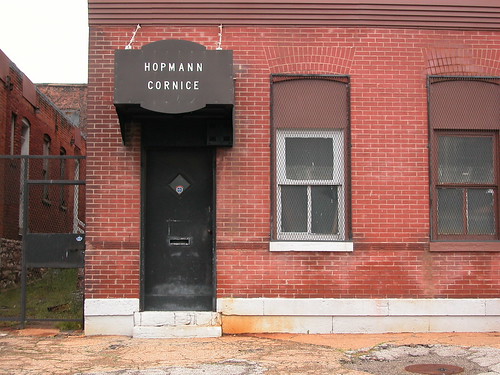
Hopmann Cornice is a family-owned business located at 2573 Benton Street in St. Louis Place, between Parnell and Jefferson. Hopmann Cornice has been manufacturing tin and copper cornices, gutters and downspouts since 1880, and has been housed in the larger building here since 1883 (the house to the west was subsumed into the operation later).

Hopmann is an inspiration — a company that has done the same thing for over 125 years, with few complaints from customers. Nowadays, a lot of Hopmann’s work is repair and replacement of historic cornices. Sometimes Hopmann ends up replicating and repairing its own historic work.

While Hopmann’s buildings aren’t historically perfect (note the metal siding covering the second floor as well as the boarded windows), the facility is serviceable, tidy and historically living. In many ways, the Hopmann buildings are more historically correct under continuous use than they would be with a fancy rehabilitation (which they do not require).

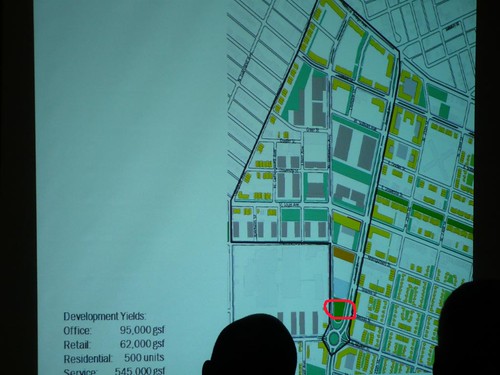
Of course, Hopmann’s buildings are far more likely to disappear than to be rehabilitated. Sensient to the west has bought out much of the land surrounding Hopmann for its large plant. Hopmann Cornice also is in the middle of McEagle’s NorthSide project, and more precisely is located in the southern end of one of the project’s planned industrial/commercial hubs. In fact, on the slide that McEagle showed at a meeting on May 21, this block of Benton Street is gone, and the Hopmann buildings along with it.

Hopmann’s building also appears on the TIF application for the project that McEagle submitted to the city last week. However, according to McEagle, that list contained some properties that they do not wish to purchase and they will resubmit the property list soon.

Perhaps McEagle has no use for the Hopmann Cornice land, and perhaps it won’t appear on the new list. Perhaps Hopmann Cornice will accept relocation. However, the project should defer to Hopmann and other long-time small businesses. These businesses are the existing job centers, generating work and city revenue. There is no need to displace good commercial stewards, and alderwomen April Ford-Griffin (D-5th) and Marlene Davis (D-19th) would do well to stand by these businesses. If they don’t want to be on the list of needed properties, they should not have to be. In the case of Hopmann, we have a business that is not only a stable long-time business but one that does unique and important work. If anything, McEagle may want to get Hopmann’s bids on the historic rehabilitation itemized in the sources and uses section of the TIF application. No one else will do the work quite like that!

Categories
Historic Boats Illinois National Historic Landmark Riverfront

Goldenrod Showboat Celebrates its Centennial

by Michael R. Allen

The day was beautiful, and our need for a trip away from the city strong. Looking for a destination, we settled on tracking down the Goldenrod Showboat on the Illinois River. After all, we are in the venerable entertainment vessel’s 100th year. Using directions from a friend sent last year after he stumbled upon it and Google Earth (which showed it a few miles from where it actually lies), we got a general idea of the location in Kampsville, Illinois and set out.

Of course, the Goldenrod now sits outside of its first Kampsville location. After not finding the boat on the town’s riverfront, we asked a couple walking down the road how to find it. The man knew where it was, gave directions and proceeded to offer the information that his aunt was a waitress and actress on the Goldenrod between 1945 and 1950. Even in this unlikely new home, the Goldenrod is part of a local’s family heritage — how ’bout that?

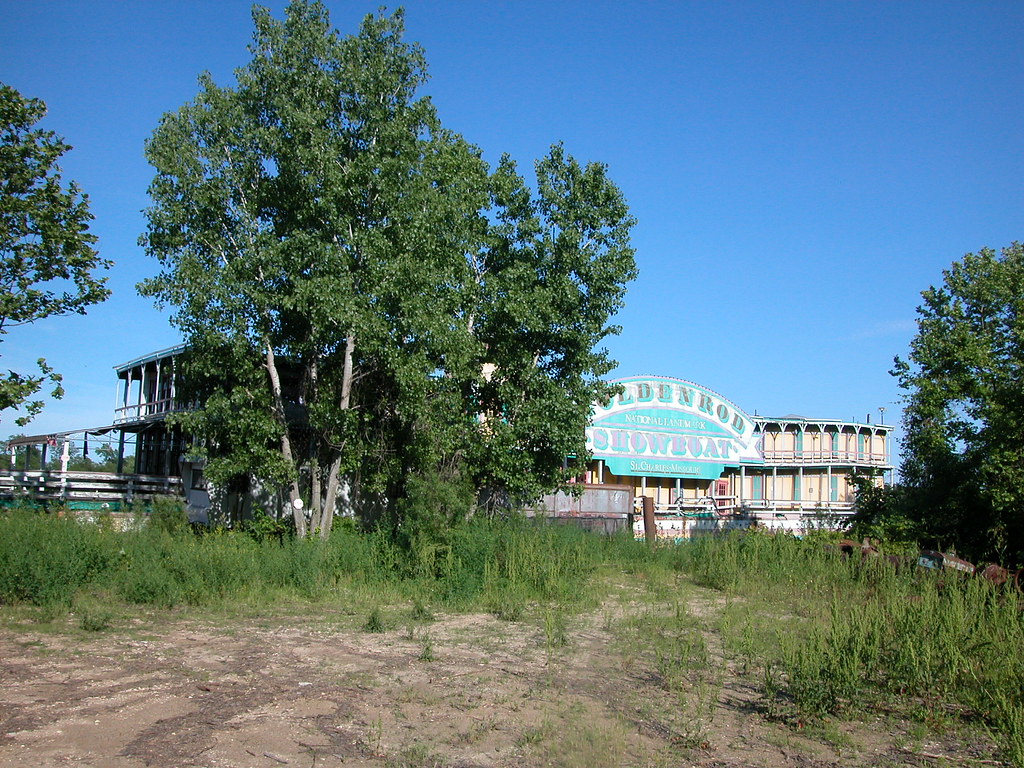
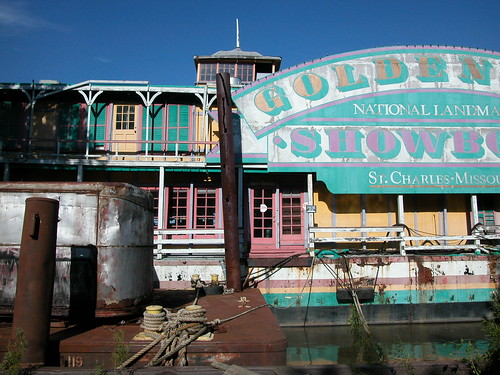
A few miles later, we spotted the Goldenrod moored to a barge on a section of overgrown riverfront. The boat was unmistakable, and the deterioration has not claimed much of its integrity. Everything is still there, down to the boat’s recent (and somewhat unattractive) paint scheme. The paint is peeling, the wood drying and in some places rotting. Yet the Goldenrod survives unharmed in its sleepy Illinois berth.

A few years ago, this outcome was far from likely. After its itinerant early years (more on those later), the show boat became a permanently-moored restaurant on the St. Louis riverfront. In 1990, the City of St. Charles, which had purchased the boat in 1988, moved it to the St. Charles riverfront. The restaurant closed in 2001, and in 2003 the city decided to sell the boat. The St. Charles City Council accpeted bids, and sold it to a company headed by John Schwarz. (The Council rejected Bob Cassilly’s bid to move it back to the St. Louis riverfront.) Schwarz moved the boat to Kampsville, after announcing plans to restore the vintage vessel.


However, in 2007, Randy Newingham and Shelia Prokuski, owners of the site where the boat was moored, sued Schwarz for unpaid mooring fees. In September 2007, Newingham threatened to sell all or part of the boat for scrap to cover his costs. One month later, a Calhoun County judge ordered an auction of the boat, and the court accepted Newingham and Prokuski’s lone $50,000 bid. However, by the end of the year the couple had reached and agreement to sell the Goldenrod back to John Schwarz. Schwarz moved the boat north. In 2008, however, Judge Richard Greenleaf declared that the proper court papers for the auction had not been filed, throwing the ownership in doubt. To date, the ownership has not been cleared.

Hence, the Goldenrod Showboat sits lonely on the side of Illinois Highway 100, and as summer sets in, disappears behind stands of grasses and the leaves of riverbank trees. The sturdy boat is crumbling, but not very rapidly. Asphalt roof paper provides cover for much of the deck area, and the boat is locked up tight. Hopefully, this is not how the Goldenrod will end its days, even if this sad state is how the boat will spend its centennial year.


The path from birth has been convoluted, but most of the Goldenrod’s days have been good ones. Pope Dock Company of Parkersburg, West Virginia built the boat in 1909 for businessman W.R. Markle. Originally, the boat was named Markle’s New Showboat. Built for entertainment, the boat would travel the Mississippi and Ohio rivers and stop at town where it would dock. Patrons would come aboard for a night of music, comedy and other live entertainment. According to most accounts, the boat was the last showboat built for the Mississippi and Ohio river circuits. At 200 feet long and 43 feet wide, the boat was one of the largest showboats ever built. The seating capacity was 1,400.

Markle lost the boat through foreclosure in 1913, and the next owner renamed the vessel the Goldenrod Showboat. In 1922, Captain Bill Menke purchased the boat and implemented a 12-month touring schedule. His tenure would be long and fruitful. Menke moored the boat at Aspinwall, Pennsylvania for two consecutive summers, 1930 and 1931. In summer 1937, Menke brought his show palace to St. Louis for repairs but ended up permanently mooring it here. According to “That Landmark on the River,” an article by Mary Duffe that appeared in the St. Louis Post-Dispatch on December 10, 1968, the boat hosted stars like Red Skelton, Monte Blue, Kathy Nolan, Major Bowes and others during Menke’s tenure. Menke reported that he had to ask patrons in southern towns to leave their firearms at the riverbank.

In 1963, Pierson and Franz purchased the Goldenrod Showboat. A few small fires led to major renovation, including a new steel hull. On Christmas Eve 1967, the National Park Service listed the Goldenrod Showboat as a National Historic Landmark, the highest federal distinction for a historic property. The National Historic Landmark nomination includes a short history of the boat, as well as the fact that the original hull is intact inside of the steel barge that now serves as the hull.

The National Historic Landmark nomination may be skimpy by today’s standards of historic documentation, but the nomination’s assertion of the great cultural significance of the Goldenrod remains true. This was one of the last and most lavish of the great river show boats, and it may be the only survivor of that type. Its future is important not only to St. Louis, its later home, but to the history of the 15 states the Goldenrod is known to have regularly visited between 1909 and 1937. The centennial of the boat should be a spur toward preservation. If the current owners (whoever they may be legally) cannot figure out how to bring the boat back to life, let’s find the person who can.

Categories
James Clemens House North St. Louis Northside Regeneration St. Louis Place

Clemens House in the News

Maria Altman, KWMU: “Future of pre-Civil War mansion rests with north side developer” (June 2)

Dale Singer, St. Louis Beacon: “Clemens mansion may find new life as museum, says developer McKee” (May 28)

Categories
North St. Louis Northside Regeneration

McEagle Applies for $410 Million TIF for NorthSide Project

On May 27, McEagle via Northside Regeneration LLC submitted its tax increment financing (TIF) application to the City of St. Louis. The requested amount of TIF is $410,000,000.

That application is online here.