Today Alderman Antonio French (D-21st) introduced Board Bill 78 to make his ward one of the preservation review districts governed by the city’s preservation ordinance. Preservation review allows the city’s Cultural Resources Office to review demolition permits in the ward and deny them based on the architectural merit and reuse potential criteria established by the ordinance.
The 21st ward is one of nine city wards that are not preservation review areas. Here is a map showing the distribution of wards that do not participate (in white):
This map shows that the area covered by the McEagle NorthSide project (mostly the 5th and 19th wards) is not included in preservation review. Neither is most of the north city swath in which Urban Assets and other holding companies are buying buildings and land.
A ward’s lack of preservation review enables demolition on a wide scale — not necessarily all at once, either. The conditions of many wards without preservation review have deteriorated through the loss of one building at a time for decades. Loss of buildings means loss of residents, loss of job and loss of a sense of community — adding up to conditions that make wards vulnerable for land-banking. Preservation review is not designed to keep every old building standing forever, but to create a mechanism for careful decision-making about the physical resources of our neighborhoods.
Alderman French has a great ward with a largely intact building stock. Placing the 21st ward under preservation review will help keep the 21st ward in good shape for generations to come. By making the move to place the ward under such review early in his tenure, French shows that he will be working to protect and strengthen the neighborhoods he already governs, rather than jockeying for the big development that can shatter communities.
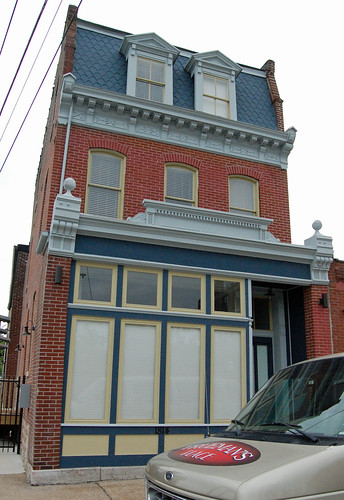
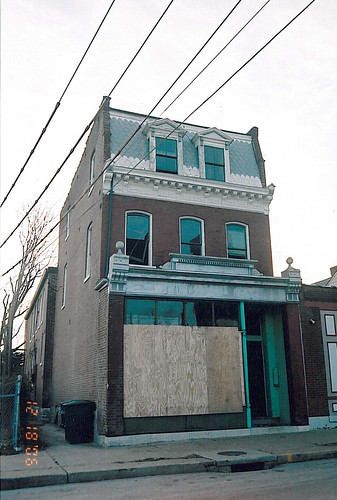
When Landmarks Association of St. Louis awarded its annual Most Enhanced Sites awards on may 15, it included the building at 1814 Sidney Street in Benton Park. Besides receiving a major overhaul and sensitive rehabilitation, the building sports a storefront addition! The house dates to 1884, with the addition built in 1912.
David Rothschild, Vice President of Rothschild Development, purchased the building in 2006 and embarked upon rehabilitation in 2007. With masonry and mansard roof restoration as well as storefront reconstruction, the building looks much better now. Perhaps other buidlings with storefront additions will follow.
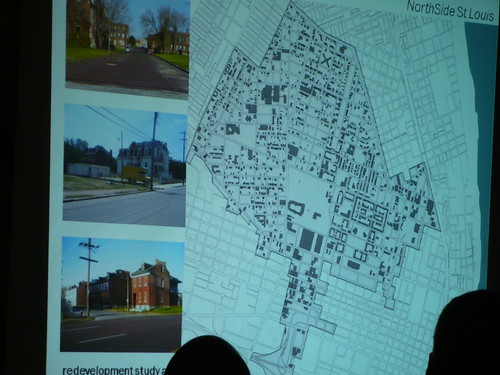
Pay careful attention to these two slides. The first slide shows existing buildings in gray:
The second shows buildings proposed for preservation in black. Planner Mark Johnson at Civitas calls these buildings “legacy properties.” The three buildings at left (a house on St. Louis Avenue, Greater Bible Way Church and Crown Candy Kitchen), strangely, are not owned by McEagle. Crown Candy Kitchen is not even included in the project area. There was no discussion of preservation strategy beyond the promise that every building that could be saved would be saved.
McKee and Johnson both talked about how the warehouses between Delmar and Martin Luther King, including the GPX building, should be demolished because they wall downtown off from north St. Louis.
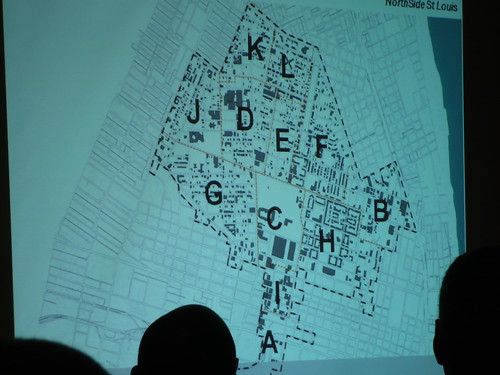
This slide shows the possible phasing of “NorthSide, ” from A (first) to L (last). This slide shows that the first projects will be “employment centers” on the vacated 22nd Street ramps west of Union Station and at the head of the new Mississippi River Bridge. McEagle estimates that the project could take as long as 15 years to reach the final phase — a conservative estimate, in my opinion.
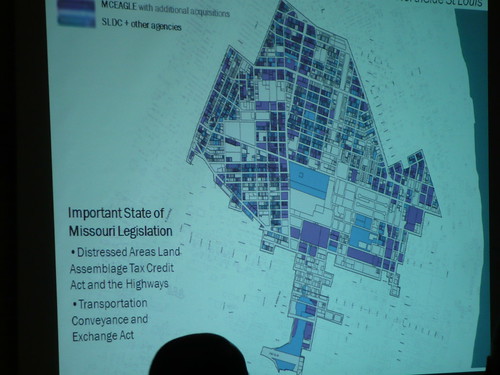
This slide shows ownership. McEagle holdings and proposed holdings (including currently-occupied homes and businesses and the Mullanphy Emigrant Home) are in purple, with public lands in blue. Paul J. McKee, Jr. promised that no property will be taken through eminent domain for any purpose other than creation of an employment center.
Reader Sara Collins shared with me her photographs of the slides shown by McEagle at last week’s public meeting at Central Baptist Church. I am sharing them to help readers who were not present get a better sense of the project scope.
This slide shows the ward boundaries and project outline:
This slide shows the proposed timeline for approval of tax increment financing and a redevelopment ordinance (a pretty fast track):
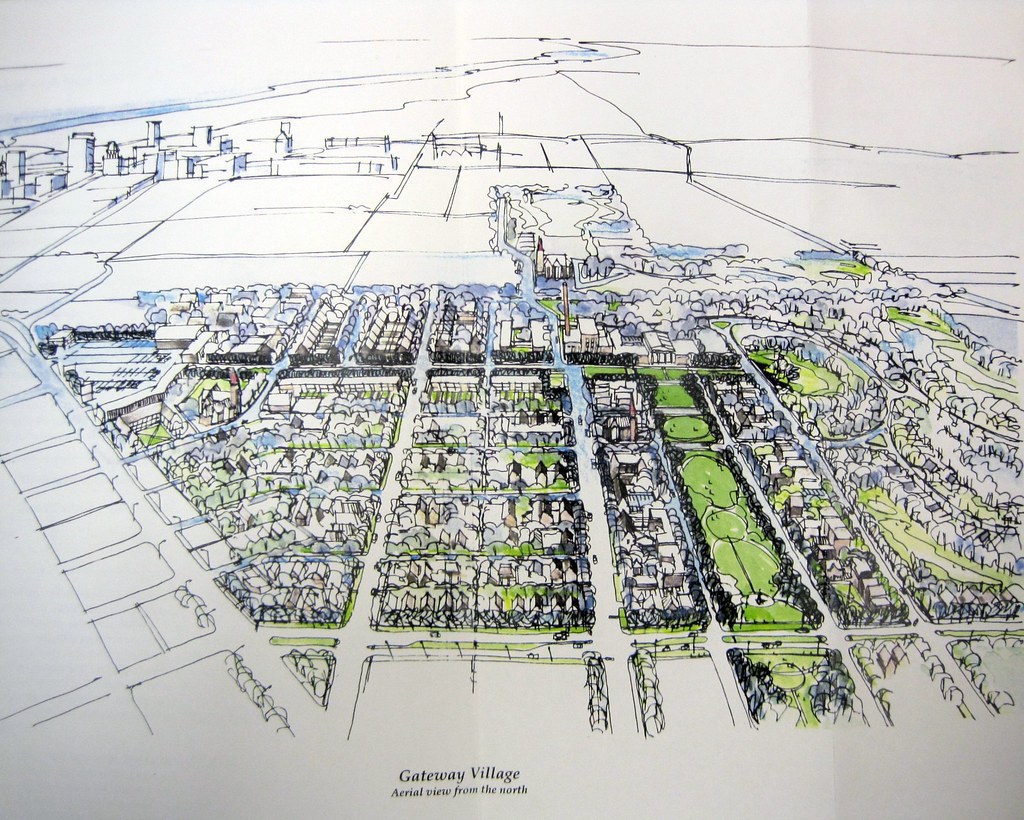
To some people, the current discussion about McEagle’s “NorthSide” project has roots in a project proposed for the same area 13 years ago: Gateway Village. Like “NorthSide,” Gateway Village involved a close relationship between a mayor and a private developer from outside of the city, proposed massive demolition, proposed eminent domain and large public subsidy. Unlike “NorthSide,” however, Gateway Village never moved close enough to reality to disrupt the section of St. Louis Place it would have wiped out.
Aerial rendering of Gateway Village from Mayor Bosley's 1996 application to HUD.
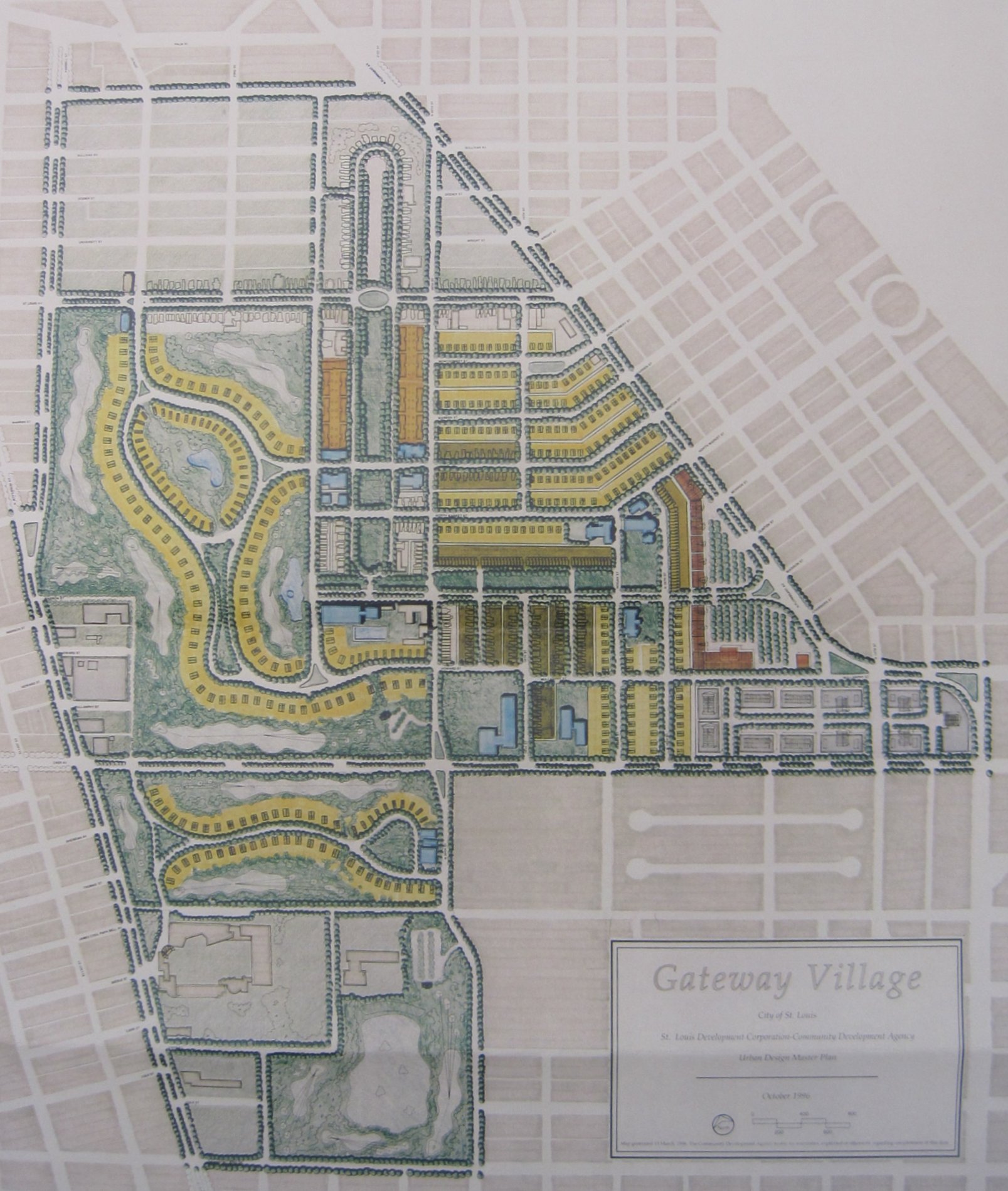
In 1996, Mayor Freeman Bosley, Jr. unveiled his grand plan for revitalizing north St. Louis: a 180-acre golf course and subdivision called Gateway Village that would use the Pruitt-Igoe site as well as the western part of St. Louis Place. The boundaries were Martin Luther King Drive on the south, 20th Street on the east, St. Louis Avenue on the north and Jefferson Avenue on the west. The plan called for building 781 new homes (priced out of range of most St. Louis Place residents) and a 9-hole golf course (designed by renowned designers Don Childs Associates) platted for very low density at odds with surrounding historic city fabric. Going against neighborhood sentiment in an area where he had tremendous political support, Bosley supported the acquisition of 209 residences and six businesses to clear the project site.
The developer behind the project, whose identity was unveiled after the first announcement, was Waycor Corporation of Detroit. Waycor’s president was Don Barden, a wealthy Detroit businessman who has since gone on to become a major casino owner. At the time, Barden was the owner of television stations who had never developed a project on the scale of Gateway Village. Also in 1996, the Federal Election Commission determined that Barden has co-signed an illegal loan to a Detroit Congresswoman.
Whatever his inexperience and lack of ties to St. Louis, Barden gained the confidence of Bosley, Jr. and Maureen McAvey, the director of the St. Louis Development Corporation. Unlike today, where McEagle is unveiling its own plans, in 1996 Bosley and McAvoy did the public relations work for the developer. In August 1996, McAvoy released a study by Don Childs Associates that predicted that Gateway Village would be feasible and successful. The city paid the architects $38,000 for a study that championed a project in which they had a financial interest.
The study predicted that Gateway Village would precipitate “a return to living in major metropolitan cities” and that it would “act as a catalyst to revitalize the area.” The Greater Pruitt Igoe Neighborhood Association, which is now defunct, rose up against the plan to safeguard the 209 homes sought for condemnation and demolition.
In October 1996, the city government requested a $8 million grant from the United States Department of Housing and Urban Development toward the project. The total project budget was $127.5 million, an amount fairly low for such a large area. The low cost was indicative of low density construction and low construction standards. Of course, $8 million was not the only handout sought by Waycor. Waycor wanted an additional $35 million in public financing. Waycor would not commit any of its own capital unless it could secure public money first — also different than the current situation.
The feasibility study commissioned by the city outlined the path toward development, with step one being “complete agreement with Waycor.” That step was removed after the St. Louis Post-Dispatch discovered that the city had commissioned a development feasibility study that not only recommended a certain developer but indicated that an agreement was already being created.
Site plan for Gateway Village from Mayor Bosley's 1996 application to HUD.
The Greater Pruitt Igoe Neighborhood Association sent a letter to HUD Secretary Henry Cisneros asking that he deny the $8 million grant request. Shirley Booker was one of the authors of the letter and very active in organizing St. Louis Place residents. Vernon Betts was one of a few St. Louis Place residents who gave favorable comments about Gateway Village to the press, but the majority of residents were opposed.
Bosley’s response to the Greater Pruitt Igoe Neighborhood Association’s letter is classic and timely: “It’s unfortunate that a small group now want to try and thwart the one thing that can work.” In development, there always seems to be “the one thing that can work” — what the person using that phrase wants to do.
An aldermanic election for the Fifth Ward, where the project was located, came in spring 1997. Veteran Alderwoman Mary Ross was retiring. In the race to succeed Ross, Democratic candidates April Ford-Griffin and Loretta Hall supported Gateway Village, and John Bratkowski was adamantly opposed. Ford-Griffin, whose support was for the project was not staunch, won the seat. At the mayoral level, Bosley lost the Democratic primary to Clarence Harmon.
Even before he took office, Harmon announced his plans to pull city government out of the Gateway Village project. On April 4, 1997, the Post-Dispatch published an article entitled “Harmon: ‘Dead Stop’ for Golf Course Plan,” that covered the mayor-elect’s opposition to a project that would lead to the dislocation of city residents. McAvey retorted that the project would bring the middle class back as well as retail for low-income residents.
Harmon’s move coincided with HUD’s denial of the city’s request for funding. Shirley Booker explained neighborhood opposition well. Residents wanted development, she said, “just not a golf course. We can’t keep existing with all this vacant land. The Lord didn’t mean for it to be like that. It’s a waste.”
McAvey clung to Gateway Village, though, telling the press that no one would be able to develop St. Louis Place without large public subsidy and amenities provided. Her tenure would end shortly thereafter. Ford-Griffin learned a few lessons from Gateway Village and spearheaded an often rocky but productive community-based planning process leading to the Fifth Ward Master Plan, published in 2000 although not fully adopted by the Board of Aldermen.
Harmon, of course, showed little leadership on development issues, but his decision to pull the plug on Gateway Village allowed for the kindling of small-scale development on the near north side. Many leaders, however, continued to bemoan the lack of a large scale plan for the area around Pruitt Igoe. Bosley, Jr. himself is now a backer of the McEagle project, seen occasionally accompanying Paul J. McKee, Jr. at meetings.
One of the problems with the Gateway Village debacle and the resulting Fifth Ward Master Plan is that there was no strong legislative result. The threat of a large-scale plan in the Fifth Ward remained because there were no basic protections against that mode of development. Zoning and land use recommendations were never implemented as law, historic districts and sites were not identified and listed in the National Register of Historic Places, and redevelopment zones that would have broken the ward into smaller pieces were not created. The Fifth Ward’s biggest problem in recent years is the large amount of vacant city-owned land — quite a big prize to lure developers. Without safeguards against large scale projects, the ward has been left vulnerable to the supersized visions that Gateway Village illustrated.
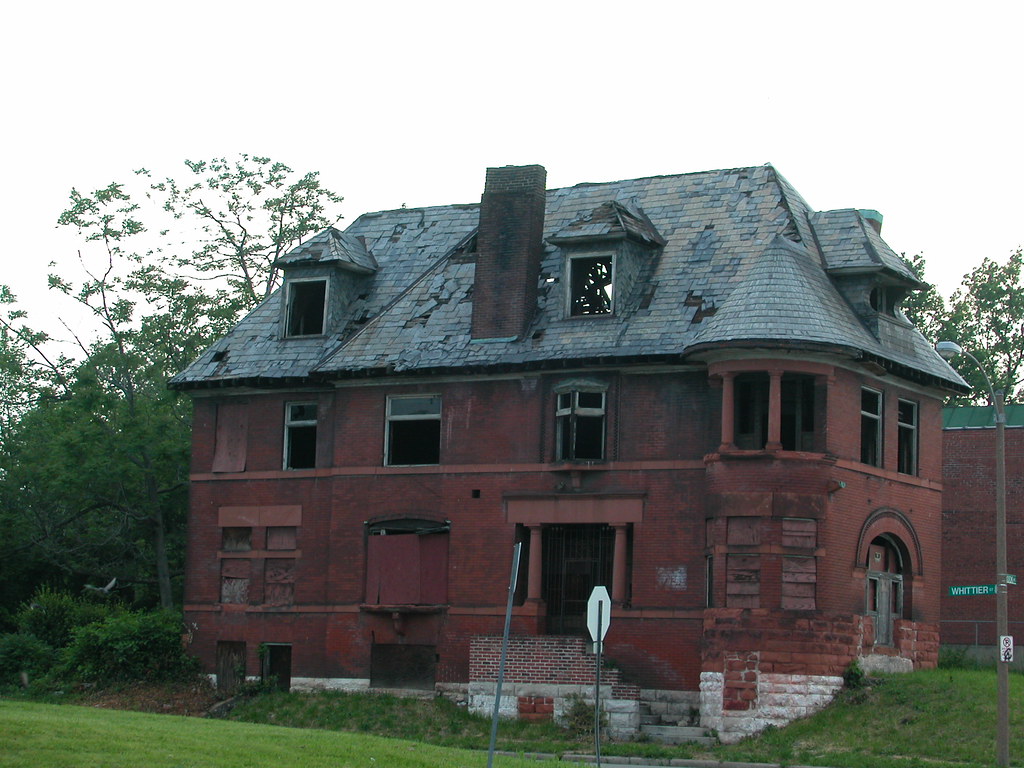
This magnificent house at 4200 Cook Avenue in the Vandeventer neighborhood attracts the awe of architectural enthusiast and neighborhood resident alike. Standing in the street and taking its photograph, several people commented to me that the house was a great one and hoped that I was there to buy it and repair it.
No dice, even if I wanted to. The house is owned by Urban Assets LLC, the new Harvey Noble-fronted holding company that is buying out north St. Louis. This is one of about 180 historic buildings that they have purchased since September 2008. Their purchase of the property is particularly disappointing because there once was a great plan to bring this house back to its former glory. All things pass, especially plans. Yet when the long-lived resources of a neighborhood pass, the chance for a sustainable future often goes with them.
The house dates to 1892, when Richardsonian Romanesque had architects under its sway. This house employs many Richardsonian tendencies, like the Roman arch window facing Cook Avenue, the bow-front facing Whittier Avenue and the snug fit into the urban lot. This is a splendid house that may very well disappear. Critics can retort that the house was already well on the way to disappearing, which is true, but they would miss the real problem: no one else will have the chance to pull the house back from the ravages of fate. No human presence will be found at this corner for an indefinite time — no eyes or ears directed at the street, no kindness directed at adjacent residents.
Th acquisition pattern of Urban Assets LLC is highly troubling from a preservation perspective, but the bigger threat is spreading the neighborhood social disintegration that the McEagle acquisitions accelerated into more densely populated parts of north St. Louis. If the problems that land banking entailed in JeffVanderLou and St. Louis Place are cause for alarm, the effect west of Grand Avenue could be much worse.
Aldermen whose wards are infected with Urban Assets’ property (1st, 3rd, 4th, 5th, 18th, 19th, 21st, 22nd, 26th) need to find out who is behind the purchasing and take the steps needed to safeguard their neighborhoods. This city doesn’t need another Blairmont — and I don’t mean in terms of political hoopla, but actual deleterious effect on the city’s people. Aldermanic leadership now can head off a potential development problem.
One of the greatest scenes in David Byrne’s film True Stories is the dinner scene in which Spalding Gray’s character illustrates his jobs-centered development using the food from the meal. Thanks to Keith Marquard for drawing the connection between this scene and current events.
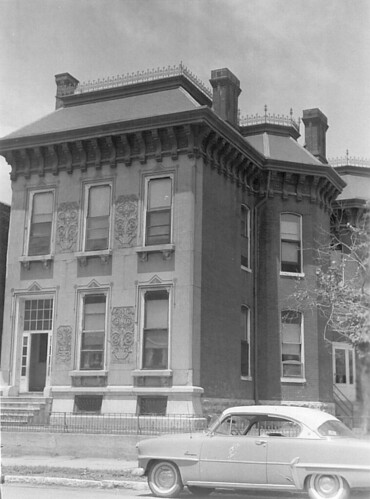
Dentist William J. Swekosky spent his lifetime taking photographs of St. Louis’ historic architecture. Often, Swekosky took photographs of doomed buildings, and his images are the only known remaining photographs. Swekosky’s work began in 1930 and continued until 1964, when he passed away.
Among his hundreds of photographs is the one shown here, of a fine Italianate town house at 2505 University Avenue in St. Louis Place. The house is noteworthy for the finely detailed stone front, elaborate continuous cornice and the “widow’s walk” cresting above the mansard roof. Like other buildings, this one fell not long after the dentist took its photograph around 1965. Today, the house site is occupied by a vacant Section 235 home owned by a McEagle holding company.