Categories
Downtown Green Space JNEM Media Parks

Post-Dispatch Editorializes on Arch Grounds

The St. Louis Post-Dispatch today editorializes on the discussion about the Arch grounds in an oddly-named article entitled “Top Shelf.” What’s most interesting is that alongside the Danforth plans the editorial discusses the merit of Rick Bonasch’s plan for remaking Memorial Drive, with nods to Steve Patterson and myself (at least in the online version). Once more, grassroots urbanism trickles up. Usually, the ideas get the nod without their source named.

The best part about the editorial is that while welcoming Danforth’s leadership it also calls for inclusion of different vision: “In short, there’s still time for sharp thinkers and innovative ideas. But they must get into the process. And they should be welcomed.”

We must be doing something right.

Categories
North St. Louis Northside Regeneration

New North Side Holding Companies Share Address With McEagle

On May 8, I reported on two new companies rapidly buying parcels in north St. Louis, Union Martin LLC and Larmer LC. While the companies are buying exclusively in the parts off St. Louis Place and JeffVanderLou where Paul McKee’s companies are buying, they are registered to F & B Properties, unconnected to McKee’s companies.

However, Mayor Francis Slay’s July quarterly campaign finance filing reports received contributions of $1,350.00 from both of these companies. The return address reported is 1001 Boardwalk Springs Place in O’Fallon, Missouri, which is the address of McKee’s McEagle Properties.

Categories
Historic Preservation North St. Louis Old North Rehabbing

The Phoenix, 14th Street


One of the most important local preservation success stories ever is unfolding at the present moment: the rescue and rehabilitation of 26 historic buildings around the 14th Street commercial district in the Old North St. Louis neighborhood. The $35 million project centers on two blocks of the commercial district closed to vehicular traffic in 1977 and redubbed the “14th Street Mall,” infamous as an urban ghost town after a majority of buildings fell vacant by the 1990s, with all but two vacant by 2005.
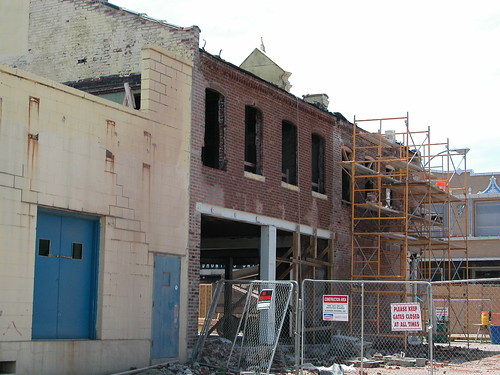
When I first started exploring the neighborhood, contemplating the purchase of a building, the 14th Street Mall was an eerie void in the heart of a rebounding neighborhood. Rehab activity was eroding the decayed quality of many blocks in the neighborhood, but not the two blocks closed to traffic. These blocks were the exception: blocks getting worse, losing vitality and sucking it away from surrounding blocks. No part of the neighborhood seemed to be as formidable a reminder of the neighborhood’s plight — or as valuable an asset.

For years, neighbors had been trying to revive the commercial district. Without the capacity to reopen the closed streets (14th and Montgomery) and tackle a large number of the buildings at once, the Old North St. Louis Restoration Group had little success at attracting development. A bid by an Atlanta developer to acquire the entire four-block mall area spurred a capacity-building partnership between the Restoration Group and the Regional Housing Community Development Alliance. The impossible became the actual. Acquisition began in 2004, and intricately-arranged financing was ready in fall 2007.

After I moved into Old North in 2005, I always spoke of the 14th Street project in the future tense. Even last summer, as the reality of the project seemed imminent, I noticed a reluctance in the neighborhood to speak about the project in the present tense. As if naming the project were a curse that would doom the ghostly landscape’s chances at revival, people remained cautious. Who could blame people?

Then, all of a sudden, at the end of September 2007, an army of contractors descended. Dozens of buildings were gutted, walls were rebuilt, fences erected and roofs removed. The whole tone of Old North changed – the dead center, 14th Street, was now the hot bed of neighborhood action. Like a phoenix, the heart of Old North began to rise. By spring 2008, a handful of historic buildings on Warren and Montgomery streets had been fully rehabbed and leased to new residents.


By the spring, the streets should be reopened and the rehabbed buildings will house 78 housing units and 6,000 square feet of retail space. The life will continue to grow. For now, even incomplete, the difference is life-affirming for this old neighborhood.


Categories
Architecture Historic Preservation Housing Old North

A Dying House on Clinton Street

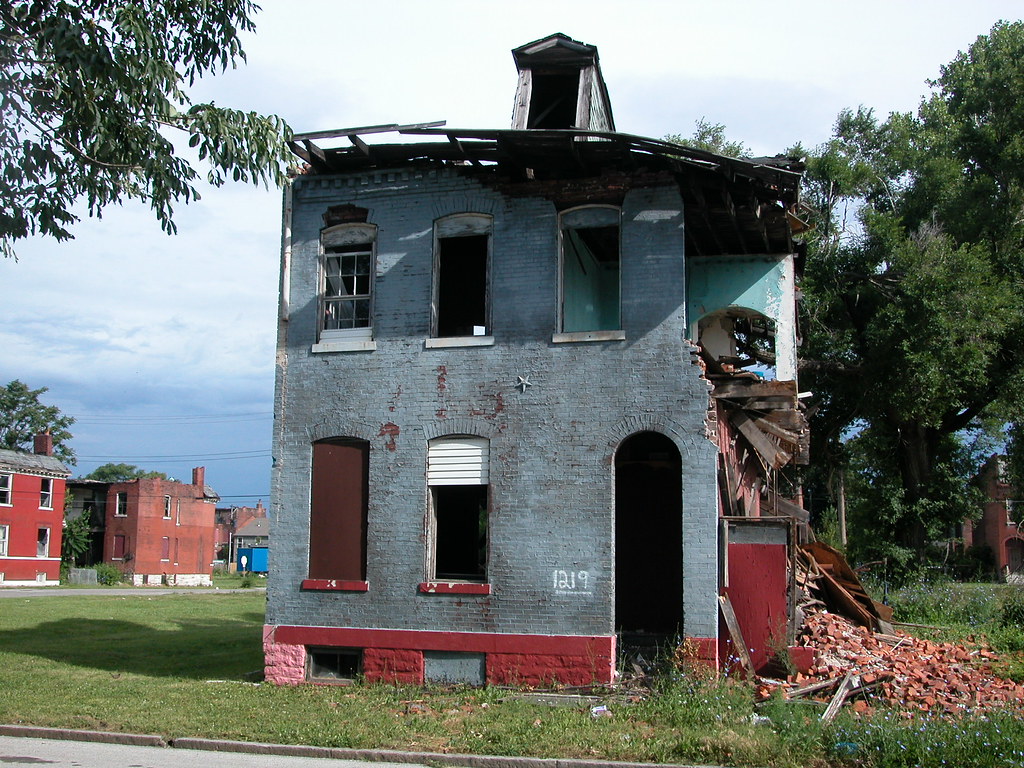
The poor old house at 1219 Clinton Street in Old North St. Louis may be headed toward the end of a long death cycle. The beautiful side-gabled brick house is one of those Federal or Greek Revival-inspired row houses that lines streets in Old North in the middle 19th century. Prior to the popularity of the Italianate and Second Empire styles in the 1870s, and with materials like tin not widely available for ornamental cornices, builders tended toward a restrained, elegant form. These houses had segmental arches or flat (sometimes arched) stone lintels over doors and windows. They were two stories with an attic in the roof. Cornices were usually simple dentillated rows or wooden boards with beading or other patterns. Mostly tenements, these houses had gallery porches in back with staircases leading to second floor flats. Amid dense blocks, with buildings attached, mouse holes opening to gangways were necessary to allow for the passage of residents to and from the streets.

Later, as the Italianate style hit the neighborhood, some builders built transitional buildings like this one. Here we have the restraint of the mid-19th century with Italianate touches like the rusticated limestone foundation and the Roman arches over the mouse hole and front door entrances. This house may date to the late 1870s or early 1880s, but it shares tendencies with homes built in the 1850s and 1890s. Furtermore, Old North has few buildings with intact mouse holes; the number may be around ten. This orphaned house tells us a lot about the stylistic evolution of vernacular architecture in Old North. Yet as the last surviving house on its block, its existence has been precious in recent years.


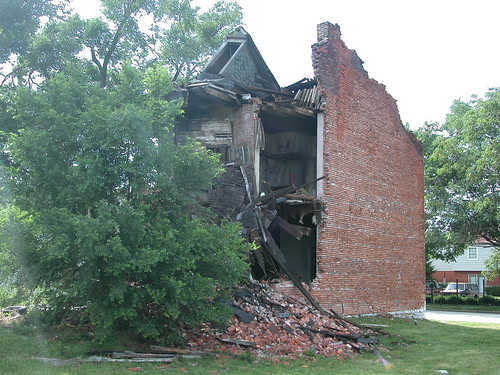
Battered by a major freak storm in July 2006, the house nonetheless improbably survived the next two years without further loss of walls. Sure, the house roof structure was essentially unsupported, and shifting gradually every month, but there was enough building material left to envision rebuilding. Definitely became maybe this June, when two storms led to devastating wall collapses, including all of the remaining east wall. Settling is fairly advanced with as much rain weight as has passed through the neighborhood this year.

Yet this advancd state of decay is a long time coming. The city Building Division listed the house as “vacant” since 1991. Sheila Bass, currently listed as owner of a house in the Academy neighborhood, owned the house for years before defaulting on real estate taxes; in 2005, the Land Reutilization Authority took title after there were no bids at a sheriff’s sale. (Oddly, none of Paul J. McKee Jr.’s agents bid on the house.) At that point, much damage had already been done. For many years, the house was accessible through the first floor windows, left unboarded and without both sashes. A peek inside in 2004 revealed partial joist failure in the front parlor.

Many factors take a proud old house to death, but none are as powerful as water and negligence. Any one of these factors over a long enough period of time is a death sentence for an old building.

Categories
Abandonment Grafitti South St. Louis

Thoughts on Ed Boxx

I don’t know if prolific tagger Ed Boxx (also known as Rexx Ram or Red Foxx) is really dead, or if he faked his death as a prank.

I don’t know who Ed Boxx really is, and I don’t think that I know anyone who has met him in person.

I have no idea what is meant by “Get Up, Get God.”

I don’t know how I feel about the artist’s use of historic buildings as tablets for his work. Actually, I do. I don’t like it. But I don’t like it a whole lot less than I don’t like property owners letting their buildings deteriorate to the extent where they don’t even try to clean up grafitti.

One thing that I know for certain is that this Ed Boxx piece on the dormitory buidling of St. Mary’s Infirmary captures my attention and admiration. The skyline drawing, the colors, the imitation of the building’s rooftop cross in the work — this is pretty deliberate work. I’d rather not see this work on this building, but that’s not the root problem. Not at all.

Categories
Historic Preservation Salvage St. Charles County

"Historical Building for Removal"

On CraigsList. The ad shows a photo of a small front-gabled frame building with shed-roofed addition. The location is New Melle, Missouri. The cost seems to be $1: “Good 100 year old lumber including wide plank floors for the cost of removal plus $1.”

Categories
Downtown Green Space JNEM Parks Planning Streets

Time to Revise Memorial Drive

In my latest commentary for KWMU, I join what is becoming a bandwagon call: “Time to Revise Memorial Drive”.

Kudos to Rick Bonasch, whose STL Rising blog post “The Case for a New Memorial Drive” served as my inspiration.

Categories
Architecture Downtown Historic Preservation

Gill Building Gets Its Due


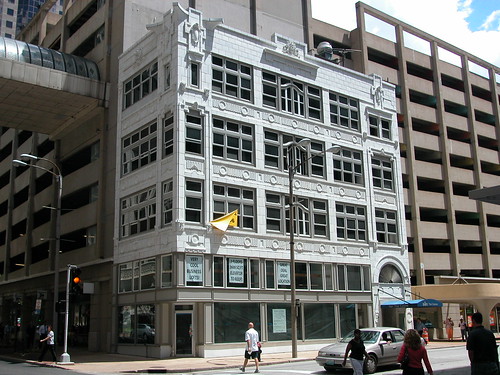
The fate of the diminutive Gill Building at the southeast corner of Seventh and Olive streets downtown has been in question in the past few years. Originally built in 1910 and designed by St. Louis architect and builder Moritz Eyssell (but previously attributed to Kansas City architect Louis Curtiss, whose Boley Block is almost certainly the inspiration for this design), the building was part of a grouping of white Winkle terra cotta-faced building on the 600 block of Olive Street. Across the street remains the massive Railway Exchange Building, but gone are the Tower Building, the Erker’s Building and one other commercial building that comprised the district. In 1978, these buildings were included in the National register of Historic Places as the Olive Street Terra Cotta Historic District. At that point, the massive Famous-Barr parking garage already dwarfed the Gill Building.


Jack Randall owned the Gill Building for years, maintaining an apartment on the upper floors. In 2002, May Department Stores abruptly closed Randall’s access to the fire escape in the parking garage (the only fire escape for the building, since the footprint doesn’t allow for an internal one) and started a protracted legal battle. Randall abandoned the building and put it up for sale. When May sold its assets to Federated Department Stores, I expected a new deal for the building — and that’s what came.

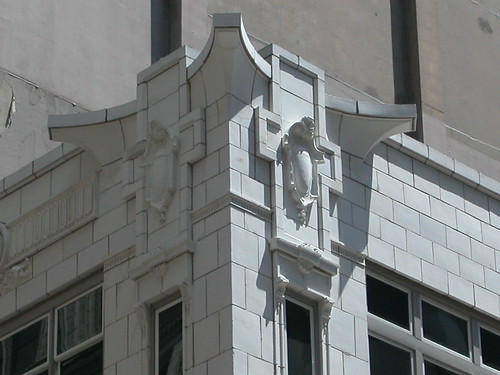
Mark Pitliangas, who has developed a specialty in rehabbing the narrow buildings of Olive Street (including the Eastman-Kodak Building), purchased the Gill Building earlier this year and has just completed a full exterior renovation. The white terra cotta glistens, the window sash and casements are painted and the first two floors (long since altered) are attractive. Interior work continues, with the lower floors slated for retail and the upper floors for offices. (Office and retail projects seem stable downtown amid fluctuating financing.)

The end result will be a consolation to those who have admired the graceful building. Delicate modernism — the curtain wall, the abstract ornament that avoids classicism — and the striking color create a building whose architectural power is greatly out of proportion with its small size. The Railway Exchange Building holds the eye, surely, but when you some upon this block the Gill Building gets the first glance.

Categories
Downtown Historic Preservation

Opportunity on Locust Street


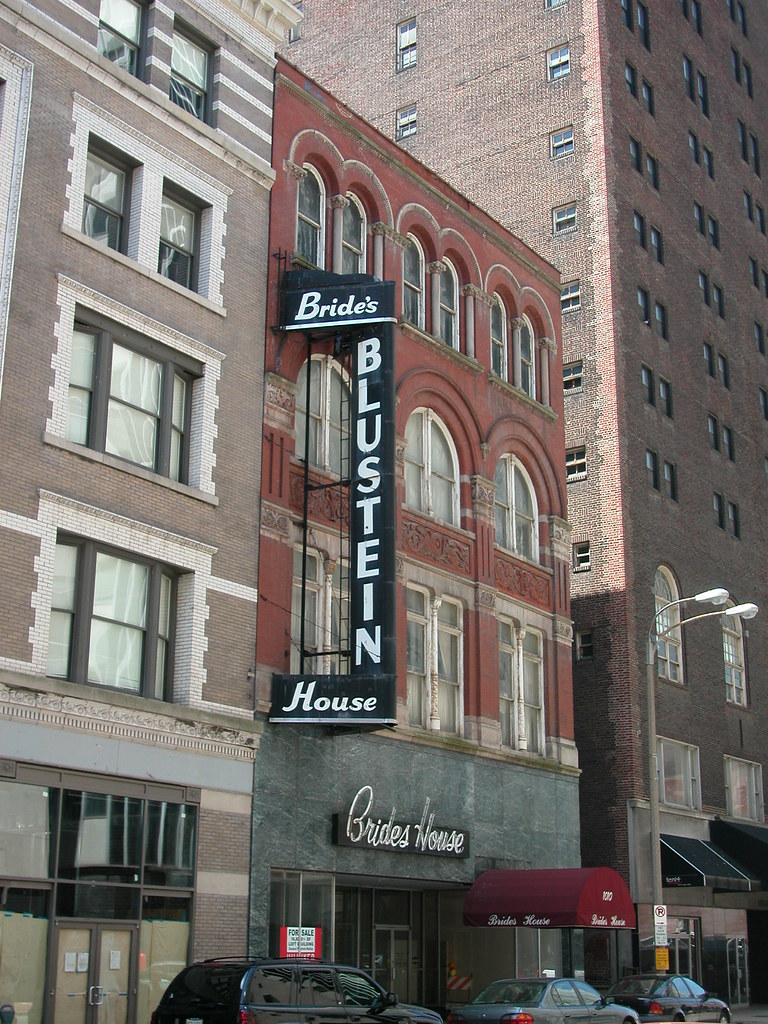
The building at 1008 Locust street that most recently housed Blustein’s Bridal Shop is for sale. Owned by Alverne Associates LC, which owns the beleaguered Alverne Building to the west, the building has been empty since 2004 when the bridal shop relocated to St. Charles. The commercial building is one of the last buildings in this part of downtown unclaimed by a serious developer. With its striking arcades, finely detailed terra cotta spandrels between the second and third floor and elegant contrasting stonework, the building is an outstanding composition in the Romanesque Revival style. The building dates to 1886, making it earlier than almost all of its neighbors and a virtual contemporary of the Old Post Office. Unfortunately, the building has never been listed in the National Register of Historic Places although it would have contributed to a downtown historic district axed in 1978.

Fortune has turned favorable for this block since 2004: Craig Heller’s LoftWorks completed rehabilitation of the Delany Building at 10th and Locust, and has just announced that Left Bank Books may soon occupy its ground floor; LoftWorks is wrapping up work at the Syndicate Trust Building, which will create retail activity one block east; the long-suffering Farm and Home Building across the street is slated to be rehabbed for office space by LoftWorks; the Roberts Brothers are mulling over plans for a Hotel Indigo one block east at 917 Locust. This building won’t sit on the market too long. Perhaps reuse of this building will spur a creative solution for the Alverne…

Categories
Historic Preservation Metro East

Barn Raising in Collinsville Starts Today

Starting today, the Timber Framers Guild will partner with the Collinsville Illinois Area Recreation District (CARD) and Trillium Dell Timberworks in a project to repair and re-assemble the historic 36′ x 85′ Gindler Barn at a TFG workshop running through July 19 at Willoughby Farm, Collinsville, Illinois.

The 19th century Gindler Barn was donated to CARD in 2007; it will be the second restored barn to be re-erected at Willoughby Farm. CARD oversees more than 400 acres of parkland and provides recreational programs and special events for the community. As part of this program, CARD purchased the 40-acre Willoughby Farm, a community fixture in the Collinsville area since the 1900s and one of the last significant tracts of open space along the Collinsville bluff line.

CARD plans to make Willoughby Farm into a living history farmstead and a real working Midwestern farm as it was in the 1920s to 1950s. Another goal is for visitors to gain appreciation for the outdoors while hiking or strolling on interpretive trails in the conservation area. The farm area is 10 acres and the conservation reserve area is 30 acres. Willoughby Farm will also demonstrate and promote sustainability practices of the era and how those same values can play a significant role in protecting the environmental investments of our present and future.

Willoughby Farm is located on a secluded hilltop farmstead 15 miles northeast of St. Louis.

More information is online here.