Categories
Central West End DeVille Motor Hotel Historic Preservation Mid-Century Modern

DeVille Motor Hotel in the News This Week

by Michael R. Allen

Today’s “Inside the Metropolis” column in the Vital Voice features a guest writer, my colleague Lindsey Derrington. Lindsey has written an eloquent and impassioned plea: “Recoup DeVille Motor Hotel: No Need to Demolish Historic Building”. The article is a perfect summary of why we can’t afford to lose the DeVille Motor Hotel (a.k.a. San Luis Apartments).

Earlier this week, Preservation Online also covered the issue; read that article here.

Categories
Architects Green Space Missouri National Register

Springfield’s Park Central Square Contested

by Michael R. Allen

The Springfield News-Leader reports on the issues surrounding Park Central Square in downtown Springfield, Missouri. Supposedly designed by famed landscape architect Lawrence Halprin but remodeled in the the years since its 1969 construction, the park is at the center of a dispute between city government.  The city wants to redesign the park and preservationists want to restore the original design. The original design, however, is also contested — some claim Halprin was not the architect of the plan that actually was built.

Because the city is using federal funding for their redesign, a section 106 review has been triggered. Section 106 reviews, mandated by the 1966 federal Historic Preservation Act, are administered by the State Historic Preservation Office (SHPO) and serve the purpose of determining whether sites impacted by federal spending are eligible for listing on the National Register of Historic Places. SHPO’s ruling here could determine what the park will end up looking like. If SHPO determines the park is eligible for listing, and advocates for its preservation can get it listed on the National Register, the city’s plans could be derailed.

Categories
Events Historic Preservation Media

Your Community’s History, Your Community’s Future: Free Workshops

Lynn Josse, Andrew Hurley, Esley Hamilton, Andrew Weil, Kris Zapalac and Michael Allen will be presenters at two upcoming free neighborhood history workshops described below.

This morning, St. Louis on the Air featured a discussion about neighborhood history with host Don Marsh, Lynn Josse, Andrew Weil and myself. Listen to that show here.


Your Community’s History, Your Community’s Future

Join your neighbors to learn about tools to explore the history of your neighborhood, and how to use that history to strengthen your community. Local experts will share their experiences in using neighborhood history to promote involvement and investment in St. Louis communities. The workshop will include a discussion of successful history projects developed by St. Louis area communities, resources available to research your neighborhood’s history, and government programs and incentives to encourage preservation. Neighborhood history workshops will be offered on two dates, with slightly different information targeted towards residents of St. Louis City and St. Louis County. These workshops are free and open to the public. For more information, call (314) 516-4748 or e-mail lubischerk@umsl.edu

To download a flyer visit this page.

St. Louis City
Tuesday, April 29, 2008
6:30-9:00 p.m.
St. Louis Public Library Carpenter Branch (3309 S. Grand Ave.)

St. Louis County
Thursday, May 8, 2008
6:30-9:00p.m.
126 J.C. Penney Conference Center, University of Missouri–St. Louis (One
University Blvd.)

Neighborhood History Workshops are sponsored by the Community Partnership Project of UM–St. Louis, working in cooperation with University of Missouri Extension, and by Landmarks Association of St. Louis Inc. This project is funded, in part, by the Urban Extension Program, a joint project of the University of Missouri Extension and the University of Missouri–St. Louis.

Categories
Media

Interviewed by Smith

by Michael R. Allen

Recently Steven Fitzpatrick Smith interviewed me for his MTV blog. (Steve is part of MTV’s “Street Team” covering the 2008 election in every state.) Read the interview here here.

Categories
Demolition Historic Preservation North St. Louis Old North Preservation Board

Haven of Grace Applies for Demolition Permit for House It Promised to Save

by Michael R. Allen

Haven of Grace has again applied for a demolition permit for the house at 2619-21 Hadley Street in the Old North St. Louis neighborhood. On April 9, the non-profit provider of housing for pregnant homeless women took out a demolition permit application to machine or hand wreck the venerable house that it has sought to demolish before.

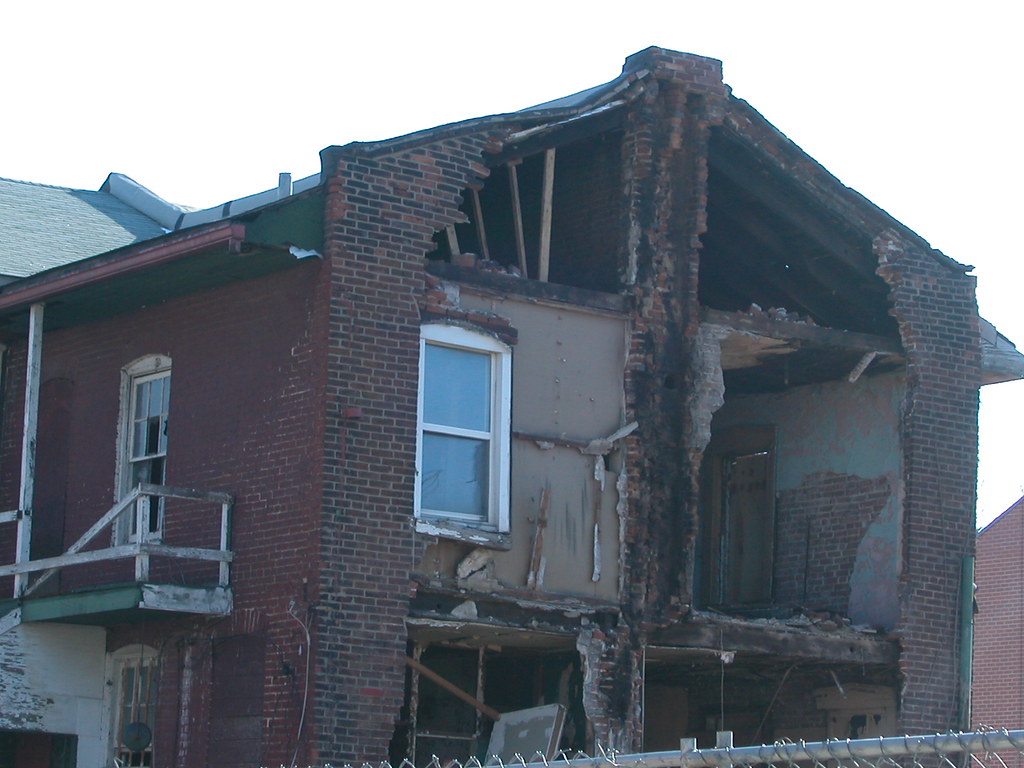
The rear wall of the 1880s-era Italianate house mysteriously collapsed in February, and Haven of Grace has neither stabilized the wall nor covered the opening created by the collapse. The collapsed wall is not load bearing, however, and the roof and other walls of the house are intact.

In February 2007, Haven of Grace proposed demolishing this house and another older house at 2605 Hadley Street. Haven of Grace wanted to build three new apartment buildings on the sites to expand their ability to offer intermediate-term housing. Since the houses were contributing resources to the Murphy-Blair National Historic District, the demolition permit applications went to the city’s Cultural Resources Office, which denied the permits. The Preservation Board considered the matter on appeal. The Old North St. Louis neighborhood was forced to contemplate a difficult balance between its heritage and one of its best neighbors. At the meeting hearing the appeal, Haven of Grace Executive Director Diane Berry and her architect Tom Cohen announced a compromise plan in which Haven of Grace would agree to mothball the house at 2619-21 Hadley if the board would grant the demolition application for 2605 Hadley. The board unanimously voted for the compromise proposal, and construction proceeded.

Neighbors noticed something strange this fall. Instead of three new buildings, only two were built. The house at 2619-21 Hadley was not mothballed, but left to sit. The new buildings were as sensitive to the neighborhood’s fabric as their renderings suggested, and neighbors were pleased both with the design and the density. Best of all, the buildings carried the street face on that side established by the vacant house at one corner and another occupied building at the other. With just one more new building and a rehabilitation of Haven of Grace’s old house, the block would be complete.
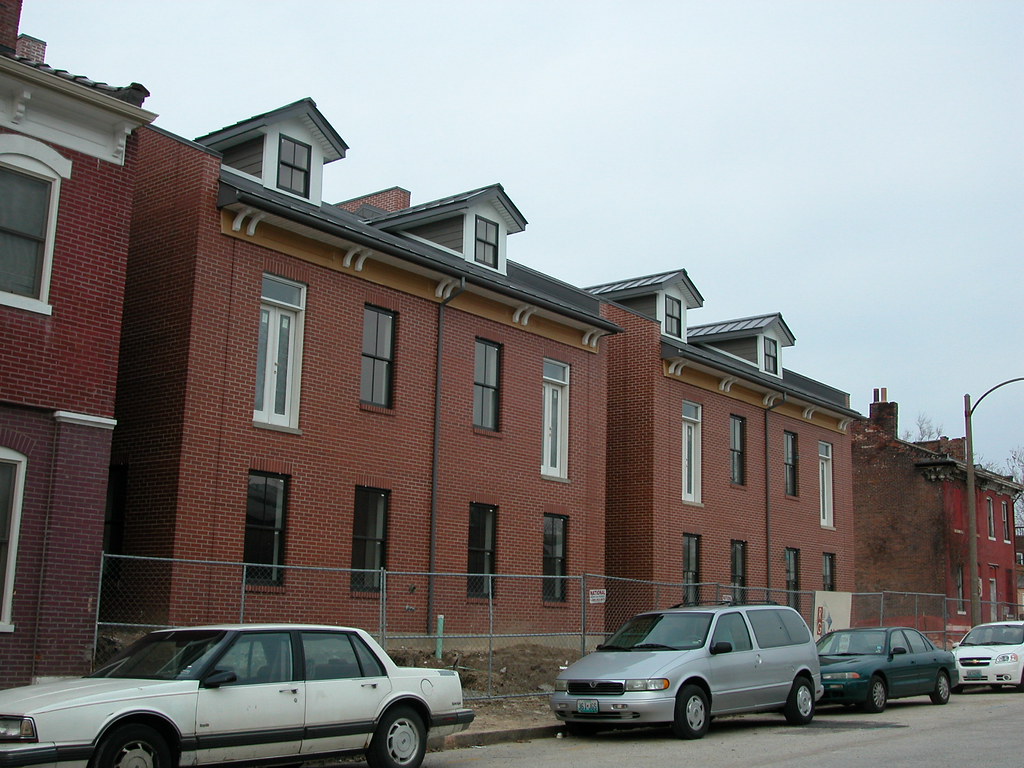
Alas, that scenario did not come to pass. Haven of Grace claims that the house is beyond rehabilitation. The third building is not under construction because the old house is viewed as a risk that could collapse onto or against the new building.

Haven of Grace decided to back away from its compromise proposal. This is despite rancorous discussion that led to Berry leaving the board of directors of the Old North St. Louis Restoration Group. This is despite soul-searching among the neighborhood’s committed preservationists, who had vowed never again on demolition only to be faced with a terrible choice. Most of these people went against their own principles out of respect for Haven of Grace, and either endorsed or condoned the demolition of the house at 2605 Hadley Street, which had not been as far gone as many buildings that have been saved in Old North.

Meanwhile, the house is in no immediate danger of collapse. Due to the Preservation Board denial of the permit last year, the matter will have to be appealed to the Circuit Court. If last year’s contest was exhausting, this one could be worse.

Is there any room for compromise this time? The only compromise would seem to be some situation in which haven of Grace would not be responsible for rehabbing the house but could also be assured that the house would be rehabbed in a timely manner. Unless Haven of Grace would sell the house, though, the matter is up to that organization — and its wishes are clear.

Categories
Architecture Central West End DeVille Motor Hotel Historic Preservation Media

DeVille Still Shines

by Michael R. Allen

My latest commentary for radio station KWMU aired this morning and is available in transcript form on the station website: DeVille Still Shines

Categories
Demolition Fountain Park North St. Louis Public Policy St. Louis Building Division

Emergency Demolition Orders Made to Suit?

by Michael R. Allen

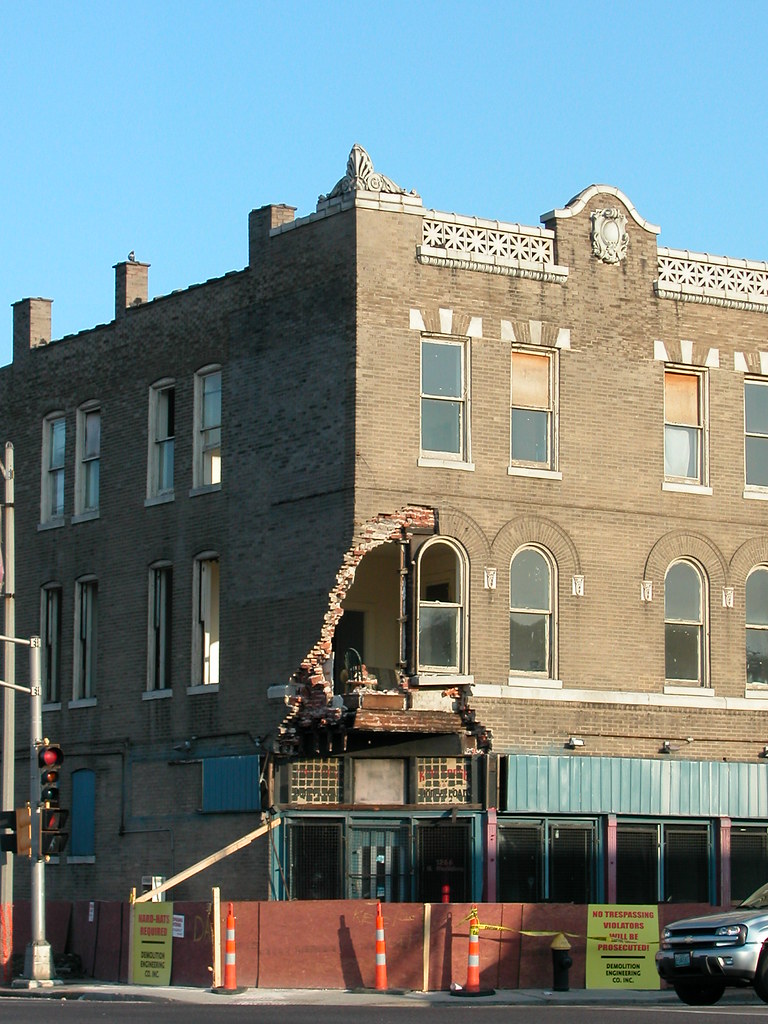
Last week I noted the demolition of the three-story commercial building at Page and Kingshighway in Fountain Park (see “Demolition Comes Twofold to Page Boulevard”). A driver struck the corner column on the first floor of the building, leaving the corner unsupported. Owner Roberts Brothers Properties did nothing to stabilize the corner, and eventually the building started collapsing at the corner. On March 21, the city’s Building Division issued and emergency demolition permit for the building — and two other freestanding buildings on the same parcel!

The emergency order includes two two-story commercial buildings that stand east of the condemned building. These buildings are vacant and also owned by Roberts Brothers Properties, but have no structural damage that would warrant emergency condemnation and demolition under the city’s building code.

The inclusion of these buildings in the demolition order brings to mind last year’s demolition of the entire Brecht Butcher Supply Company Buildings, owned by Paul J. McKee, Jr., despite the fact that only one of the three buildings suffered enough fire damage to warrant emergency condemnation. In that case, the three buildings shared party walls, so the Building Division’s action made a little more sense even if it was premature.

This time, the three buildings share no walls. There is absolutely no connection between the collapsing corner of the large building and the condition of the two neighboring buildings. Should we assume that the Building Division is willing to twist public safety laws to allow owners to clear sites for development? Or perhaps the Building Division has such prejudice for historic buildings that it cannot restrain itself faced with an opportunity to take down three buildings instead of one?

No matter what the intention, the result is that one city agency assigned to uphold public safety is thwarting any attempt to implement real preservation planning. Really, all three of the buildings at Page and Kingshighway could have been preserved. Even after the corner collapsed, the corner building was stable enough to repair. The Building Division could have ordered emergency stabilization. Although the Division can only spend money on emergency demolition, and not stabilization, perhaps it’s time we changed that, A temporary corner support — which one can buy at Home Depot and many homeowners could have installed — would have cost much, much less than demolition and given the neighborhood more time to explore the future of the building.

Our demolition process suffers from a lack of development vision. Without meaningful citywide preservation planning, each demolition decision is made without any legal guidance. The Building Division has discretionary power that prevents careful planning. Yet even if the Division wanted to step in and try to stabilize a building, it lacks enabling authority to do so. These issues need to be resolved. Currently, only an alderman can intervene in this process and force an outcome — and not always. We need to reform our demolition process through enactment of real comprehensive preservation planning legislation.

Categories
Chicago land use Urbanism

A Lonely Stand

by Michael R. Allen

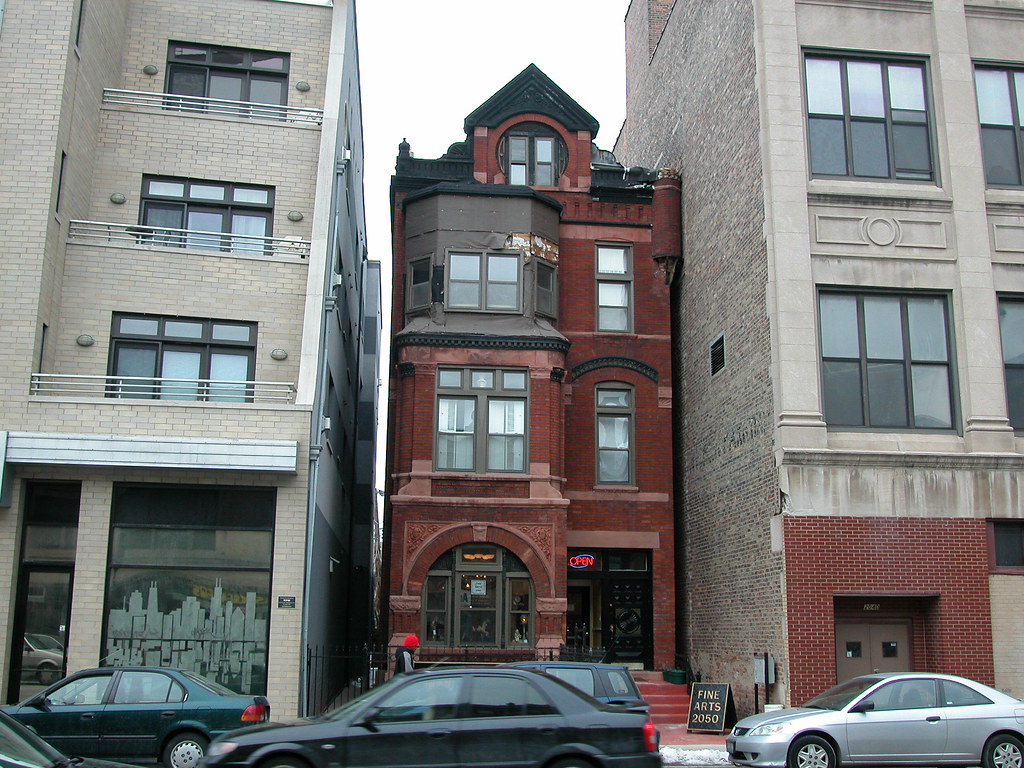
The future is always doubtful to that last historic house on a block in a neighborhood whose primary land use has changed. Neighborhoods just outside of the central business district of American cities that were residential walking neighborhoods typically lost their character in the twentieth century as commercial use crept outward. Large new buildings went up on main thoroughfares, followed by mixed use and apartment buildings on other streets. Old houses became rooming houses, offices and even small factories — until their narrow lots were added to adjacent lots to make sites for larger buildings. Secondary streets often kept much of the old housing stock, but the main streets emerged from second wave development looking more like downtown than ever.

On some blocks, like the one shown above on North Avenue just west of Milwaukee in Chicago, one will find the houses that survived the development waves. Some of these houses stand alone, adjacent to parking lots. Their futures are doubtful, since they stand apart from the historic context that would make their defense likely should a developer want to take the house and the adjacent lot and build a new building. In Chicago, tear-downs like that seem to happen weekly. The new construction is often an insipid four or five story building with street level retail and condominiums above, rendered in a bland minimalist style or a gaudy postmodernist mess.

Other survivors are more fortunate, like this old Romanesque Revival house. When the building to the right went up in the 1910s, the developer didn’t need, want or buy the house. When the building on the left went up, the same story. Neighbors came down, but not the erstwhile little house. The house slipped through both times. With such a small site, and the house being so close to the neighbors, one could guess that the house has escaped demolition. Then again, in urban real estate, nothing is ever certain.

There were years in recent memory when this stretch of North Avenue were devoid of much development interest, and then things changed rapidly. Even if the market is in downturn now, that won’t last forever. Some locations hold inherent value that survives the market’s cycles. Some buildings do too. Is this house one of those now, by virtue of its escape?

Categories
land use North St. Louis Urbanism

The Soil Fails

by Michael R. Allen

Curtis Eller came up with a song title and phrase so haunting to those of us who live in north St. Louis. “After the Soil Fails” is really a song about a vivid dream inhabited by historical figures like William Tecumseh Sherman, but its references to the imagined deaths of New Orleans and Philadelphia invoke the condition of emptying sections of St. Louis.

“One of these days the soil is going to give out,” warns Eller. While the causes of much of the loss of the built environment of north city is more economic, the landscapes left behind are devoid of any clues. To the innocent wanderer, perhaps it seems that the very land on which the city is built is dead. Just as bad soil kills crops, bad land could kill blocks or neighborhoods. The difference is that the infection of farm soil is real, while the infection of our city soil comes from within us, legitimate brown fields notwithstanding. City land is as good for city life as ever. Trouble is, city land’s healthful properties come not from its physical content but from how it’s labeled on maps and valued by builders. An ounce of soil from a lot in St. Louis Place could be as nutrient rich as any found in Clayton, but that has nothing to do with the value of the land it composes.

Hence, the best soil for farming in the region may be in places like the floodplains of St. Charles County, while the better soil for building could be the bedrock-pinned land of north city. We don’t seem to mind this absurdity as continue to build out irresponsibly. If soil affected our settlement patterns as it does planted crops, our soil would have failed awhile ago. Maybe it still will.

Categories
Demolition Historic Preservation National Register North St. Louis Preservation Board

Demolition Comes Twofold to Page Boulevard

by Michael R. Allen


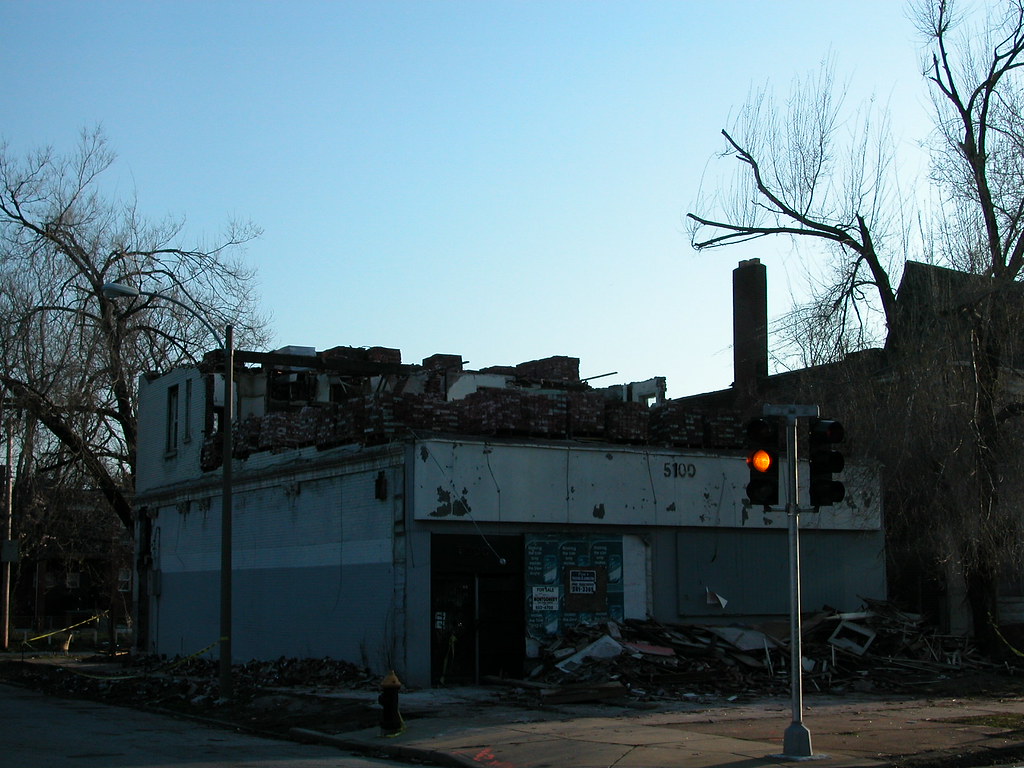
On March 19, the Building Division issued an emergency demolition order for the corner commercial building at 5100-02 Page Boulevard, owned by Rosie Love. Love had applied for a permit late last year, and the city’s Preservation Board denied her permit in February. The building is a contributing resource to the Mt. Cabanne-Raymond Place National Historic District, hence review by the Preservation Board. Apparently, the Preservation Board made the matter only a trifle harder for Love, an investor who owns properties across Missouri. Demolition is well underway.

Eastward, at the southeast corner of Page and Kingshighway, demolition will soon commence on a large three-story building owned by Roberts Brothers Properties. A motorist struck the corner column in the notched-out storeftont entrance, leaving the upper two floors unsupported. Rather than repair the damage, the owners let gravity do the work. Brick began falling last week, and now the Building Division has granted a demolition order. A wrecker’s signs adorn the plywood fence around the site, including sections in front of two adjacent buildings that have no structural damage.

More wealth drained from north St. Louis…