Categories
Architecture Central West End Historic Preservation Local Historic District Mid-Century Modern

Next Step: Parking Lot?

by Michael R. Allen

I vowed to not describe the building replacing the Doctors Building at Euclid and West Pine, but here I go. Given the impending possibility that the San Luis Apartments building will be demolished, the demise of the Doctors Building is telling. The mid-century modern design of the Doctors Building was poorly appreciated, and news of its replacement through construction of two 30-story towers was welcome news to many people.

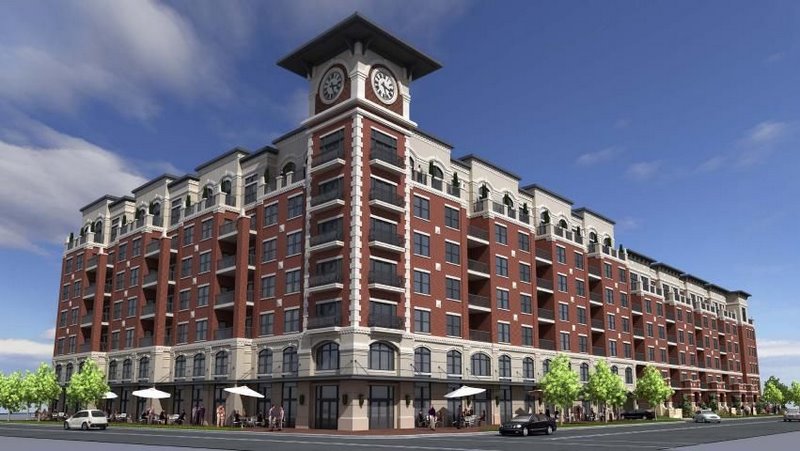
Yet the towers will never be built. The Mills Group couldn’t make the financing work for its grand plan. Demolition proceeded, and the substitute plan emerged. What we have here is a building completely out of its league. Unable to compete with the fine architecture of the Central West End, this building’s design resigns itself to mediocrity. Rather than try to be fresh, the architects employed the same design tricks keeping the St. Charles County metroplex building on up. There’s the base of stone veneer (that is stone, right?), the dark brick above, the mangled quotations from other styles.

There are pointless differentiations of the wall plane through setback, despite the fact that both Euclid and West Pine are fairly straight at this intersection and both have decent pedestrian traffic. In fact, the rendering suggests that the building’s west wall actually steps away from the street. While dramatic in the exaggerated corner perspective drawing, such a move is hardly appropriate to the street wall of Euclid.

At the top, the building’s wall goes white in some attempt to imitate stone. Oddly, there is no cornice. Rather, the walls recess to create private balconies. The pedestrian’s eye, however, may be diverted to the prominent corner clock tower, rising a full story above the roof. Instead of selecting an elegant human-scaled clock integrated with the building, the architects have stuck this over sized timepiece on top. Perhaps the goal is to smother the building’s flaws in the manner restaurants heap grated cheese atop bowls of wilted iceberg lettuce. Trouble is, people will be looking at this building from the ground level — not from a spot inside of an invisible Forest Park Hotel. People will spend more time looking at whatever stone will clad the base than at the clock.

I know that I should count my blessings — the Doctors Building’s obscene parking lot will be subsumed by an actual building and there won’t be a giant vacant lot for years. I suppose that under some circumstances I could lull myself into thinking these blessings outweigh all other concerns. After all, that line of acceptance is doing well for St. Charles County.

Yet I can’t fool myself. The building replacing the Doctors Building is downright inappropriate for any historic neighborhood in the city. This building is an affront to the dignified architecture of the Central West End, and its construction shows a carelessness that could erode decades of hard-achieved acceptance of high standards there. Such a climate benefits the Archdiocese’s short-term plan to level the San Luis without any planned construction. Do we want to find out what the step is from bad building at Euclid and West Pine to a new parking lot on Lindell?

The worst step following this blunder would be loss of another large building for an even lower use — a parking lot. The Central West End never attracted a lot of mid-century architecture, but what it got fits into the context with grace — unlike some of our contemporary structures. What happened at the Doctors Building should not be the start of backtracking on design standards in the Central West End, but a rallying point for their assertion.
Categories
Architecture Central West End DeVille Motor Hotel Historic Preservation Mid-Century Modern

Landmarks Statement on San Luis Apartments

The Board of Directors of Landmarks Association has issued a statement supporting rehabilitation of the former DeVille Motor Hotel (San Luis Apartments). Read it here.

Categories
Rehabbing

Rehabbing: To Do or Not to Do It Yourself

by Michael R. Allen

One of the first rules of rehabbing is that everything takes twice as long and twice as much money as estimated – on a good day. That’s if the homeowner hires everything out. For the do-it-yourselfer, twice as long can easily become fives times as long. Yet just as eating outdoors in the springtime makes food taste better, doing it yourself can make the rehab so much more enjoyable.

Still, doing it yourself is no easy decision, and there’s no shame in deciding against it. I am a do-it-yourselfer who made the hard decision over two years ago. I chose to buy and rehab a three-story brick home in Old North St. Louis. The house was built in 1885 and retains much of its original woodwork, the original slate mansard roof and even some original windows. Better still, it was occupied when I bought it. The systems – plumbing and electrical – weren’t the ancient ones you read about but modern ones installed in the 1980s. Now I see the appearance as deceptively intact. The systems needed countless little repairs. A whole intact two-story historic wall was historically dangerous and needed to be demolished and rebuilt. And so forth.

Some days I think rehabbing the house is the best choice I’ve ever made, because I have learned a lot about my own abilities and have directly intervened to renew historic architecture. The direct connection between myself and historic preservation feels much better than attendance at public hearings and blog entries.

Other days, I count the missed parties, weeknights at the bar with friends, weekend afternoons at the park, weddings, parties, art openings and live music shows from the past two and half years. I think about lazy days I could have had, bike rides and reading. Then I look around the house and see the progress. Okay. It’s worth it. I’ve got one whole floor fully rehabbed, and the other two moving along. I have had parties at the house. I can walk barefoot in most parts!

Still, the path to this stage has been difficult and I urge potential rehabbers to think carefully. Here are some of the considerations that I pondered before choosing to rehab:

Children. First: I don’t have children. I can’t imagine trying to do what I did as a parent. (For one thing, I would never have lived in the lead-filled, messy house.)

Cost. One of the strongest motivating factors in choosing to do work myself was cost. I simply could not afford to hire out anything I could do for myself. Necessity became the mother of invention. Later, the demanding schedule of the rehab loan and several pay raises made it possible to hire work out. Now I can say that if someone is hesitating to pay someone to do work, err on the side of bringing in a professional. A dollar spent on labor is a dollar toward less stress and project management. For some projects, it would have been cheaper to do all the work myself but impossible to manage other projects I hired out. Management is key to good results.

Other Costs. Can you give up fun times for awhile? Can you lay that book aside and never get back to it? I struggled with giving up recreational pursuits, but decided ultimately that cost was worth getting work done. Then, after getting through major work, my pace shifted to a more leisurely one. Still, many people I know would go crazy living with so much responsibility. Coming home from work to work can be frustrating. If it would drive you nuts, don’t do it.

Time. Throughout my rehabbing, I have worked a 40-hour-a-week job. That means I have rehabbed on weekends, evenings and vacation days taken for rehabbing. This schedule has been brutal at times, but necessary. The schedule means having to constantly be energetic, and learning to pace oneself. Do-it-yourself and a full-time job are a rough match – workable, but not enjoyable.

Ability. I certainly had some rehabbing skills before I bought my house. I had done drywall, plaster, plumbing, carpentry and demolition work for friends and for a previous job. I would never have decided to rehab the house myself if I didn’t think I had already demonstrated some aptitude with at least one major area of home improvement. A more deciding factor, however, was assessing my ability to manage the project. Could I juggle rehab financing, my own work schedule, bidding, scheduling contractors, dealing with the Building Division and other matters without causing more trouble than I found at the house? I decided that I could, and time has proven me right – or close enough. Being handy helps, but being organized prevents problems.

Comfort. Since I could not afford off-site housing, and also wanted to avoid the possibility of robbery, I decided to live in the house during rehab work. Many people don’t do this, and still perform much of the rehab work themselves. That’s a good option, but not one within many people’s means. Choosing to live in the rehab project means choosing to live with constant dust, choosing to live in one room, choosing to live with constant problems, choosing to live with one’s shoes one except in bed, choosing to possibly live in winter with only plywood for a wall (as I had to do last year), and choosing to live in a manner you may not be used to. The fringe benefit is that any progress with the rehab will seem like a great leap forward.

This article first appeared in the March 2008 issue of The Vital Voice.

Categories
Art Events

Obscure Postcards

Obscure Postcards presents local photographers Brett Beckemeyer and Alan Palmer with photographs from around the world. Themes focusing on urban formation, urban decay, and the built environment unite a variety of photographic vantage points ranging from the photojournalistic to the abstract. Bangkok, Chicago, Montreal, Tokyo, and Quebec are among the cities represented in the respective works.

Opening reception will be held Friday, March 14th from 7-10 p.m. at the Fort Gondo Compound for the Arts @ 3151 Cherokee Street.

Categories
Downtown Events

Rehabbers’ Club Offers Peeks Inside the Dorsa and Laurel Projects

The Rehabbers’ Club meets Saturday morning for a free tour of two of Pyramid’s latest downtown projects.

When: Saturday, March 15 from 9:00 a.m. to 12:00 p.m.
Where: Meet at Breve Espresso, 417 North 10th Street
Who: Everyone
Contact: Claralyn Bollinger 314-604-1570

The tour will assemble at Breve Espresso and then at 9:30 a.m. will depart to the first stop, the Dorsa Lofts, located at 1007-1015 Washington Avenue. Paul Hohmann, project architect, will lead the tour. Paul will show the entrance, parts of the original Dorsa Dress Company and Fashion Salon, as well as a loft/condo display (one of 52) and an under-construction penthouse unit (one of 8).

From there, the tour moves east to 625 Washington Avenue to visit The Laurel, presently being developed in the old Stix, Baer & Fuller department store. Here Paul will give people a behind-the-scenes look at this huge mixed-use development that will encompass 72 condos, a mid-size hotel, apartments and first-floor retail.

Categories
Media North St. Louis

Congressional Field Hearing Examines North St. Louis

by Michael R. Allen

I covered Saturday’s congressional field hearing for the St. Louis American.

The story is in today’s edition: Congressional hearing spotlights moving from‘Team Four’ to North Side development

Categories
Abandonment Churches Historic Preservation North St. Louis Old North

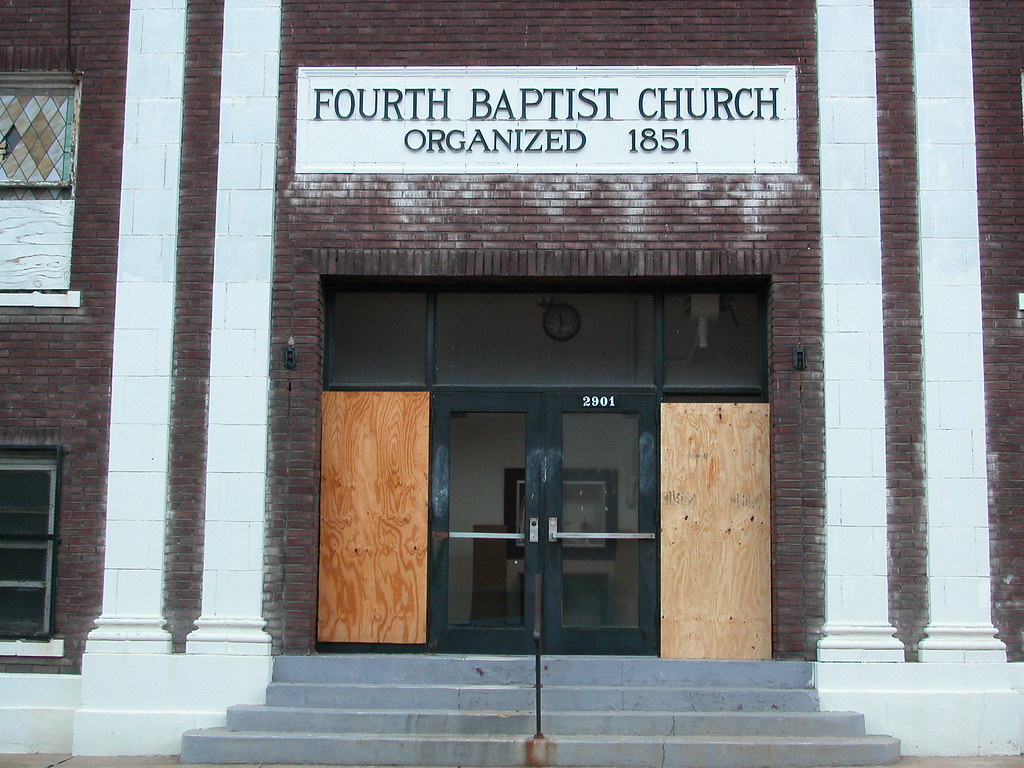
Fourth Baptist Church Secured

by Michael R. Allen

In the midst of discussion on this blog about a partly un-boarded broken window on the vacant Fourth Baptist Church at 13th and Sullivan in Old North St. Louis, a new board went up (at right in the photo above). This simple act will prevent vandalism and trespass on the building, ensuring its survival as it awaits reuse.

Categories
Events North St. Louis Northside Regeneration

Meeting on McKee, North Side Development Tomorrow Night

Someone left this announcement in the comments section:

neigborhood meeting
Sts Teresa & Bridget Church
3636 N Grand
March 12 2008
7pm
Discuss what is happening on the northside and what you/we/I can do about it. This is a call out to all near north side residents. Let your voice be heard. The future is now. All are welcome. See you there. Topics include but are not limited to

Paul McKee
LRA
Team Four
Future Development of the North Side

Alderwoman April Ford-Griffin will be in attendance with information of future devlopment.

Categories
Abandonment Churches Illinois land use Urbanism

Kaskaskia Remains

by Michael R. Allen

The villages of Dozaville (once Goshen) and Kaskaskia, Illinois remain as vestiges of settlement on Kaskasia Island. Dozaville is a complete ghost town, at least officially — it has been legally dissolved for decades. Kaskaskia remains incorporated, although with less than a dozen residents in four households within its boundaries has no real need for civil government. Kaskaskia is one of those places that has achieved zero population growth according to the US Census — a bizarre stasis for a town once of great importance.


Although part of Randolph County in Illinois, the island is west of the Mississippi and accessible only via a bridge from St., Mary’s, Missouri. A shallow channel barely recognizable as a river separates St. Mary’s from the island, suggesting that the land nearly is part of Missouri. On maps, the land seems fully engulfed by Missouri. Most maps don’t even note the channel with water, but merely include a political boundary line. Kaskaskia seems an improbable location for Illinois’s first state capital. Now remote, plagued by low land that constantly floods, and insular, Kaskaskia was once a vital part of early French settlement of the Mississippi River valley. The island was once an attached Illinois peninsula.

In 1673, Louis Joliet and Father Jacques Marquette claimed the Mississippi River valley in this area. In 1675, Marquette visited the site of Kaskaskia and established the mission of the Immaculate Conception. The mission became a church, and the settlement around the mission grew into a village with fur trading and farming as prevalent economic activities. In 1703, Kaskaskia was founded as the second village of European settlers in Illinois. By 1752, the population stood at a relatively robust number of 671 residents.

At the advent of the French and Indian War in 1756, French townspeople built Fort Kaskaskia on a hill east of the town, now across the Mississippi River. Residents destroyed the fort to prevent it from falling into British control when the British won. Many residents fled to Ste. Genevieve after the war. Later, the British built Fort Gage in Kaskaskia but lost the fort to Revolutionary General George Rogers Clark in 1778.

Kaskaskia became Illinois territorial capital in 1804. In 1818, the newly-created State of Illinois chose to retain Kaskaskia for the first state capital, although for only two years. The Emigrant’s Guide of 1818 states that there were 150 houses standing in the village. Growth would not arrive, however, as the village quickly lost the capital to more centrally-located Vandalia. One notable event happened after the loss of the capital: the establishment of the convent and school for the female school Visitation Academy in 1833.

However, the biggest blows to the village’s fortune came with terrible floods in 1844 and 1881. Located at a narrow spot between the Kaskaskia and Mississippi Rivers, the site was vulnerable to the Mississippi’s eastward shift. Eventually, that river pushed over the narrow neck of the peninsula to create the present island. The first flood caused great population loss, and the second flood created the river channel that made the land around Kaskaskia into an island. During the period between the floods, Visitation Academy relocated to the city of St. Louis in 1844. After an 1893 flood, the town relocated to its present location.

In 1993, flood waters again submerged the island and caused residents to flee. Nowadays, the population of Kaskaskia is about 9 and the population of the island is about 93 people. Kaskaskia still retains its street grid, which carves out blocks punctuated by the few remaining buildings.

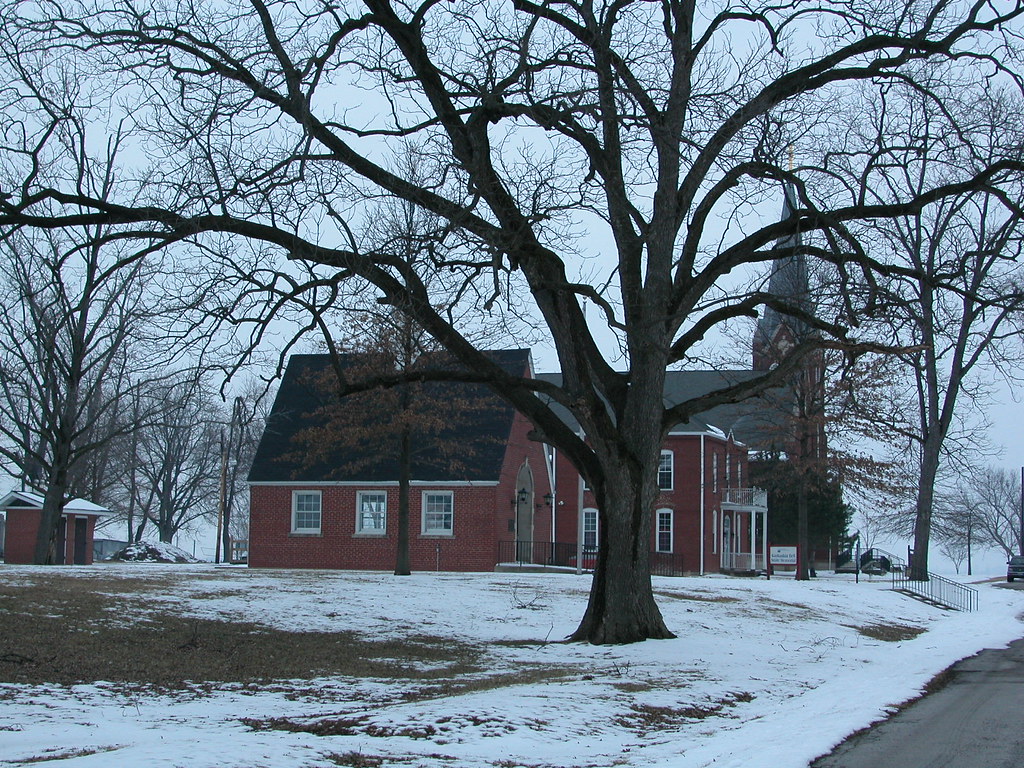
One of those remaining buildings is the Church of the Immaculate Conception, built in 1882 and moved to its current site in 1894 after the devastating 1893 flood. A church founded by Marquette now meets only on Saturday afternoons — strangely diminished in human size but awesome in the length of its existence. The brick building has managed to survive several floods with its Gothic Revival architecture intact.


A long-time parishioner is profiled in the article found here.

A newer building is the home of the church’s historic bell, gifted by the King of France in 1741 and known as the “Liberty Bell of the West” since the townspeople rang it on July 4, 1778 to celebrate liberation from British rule.

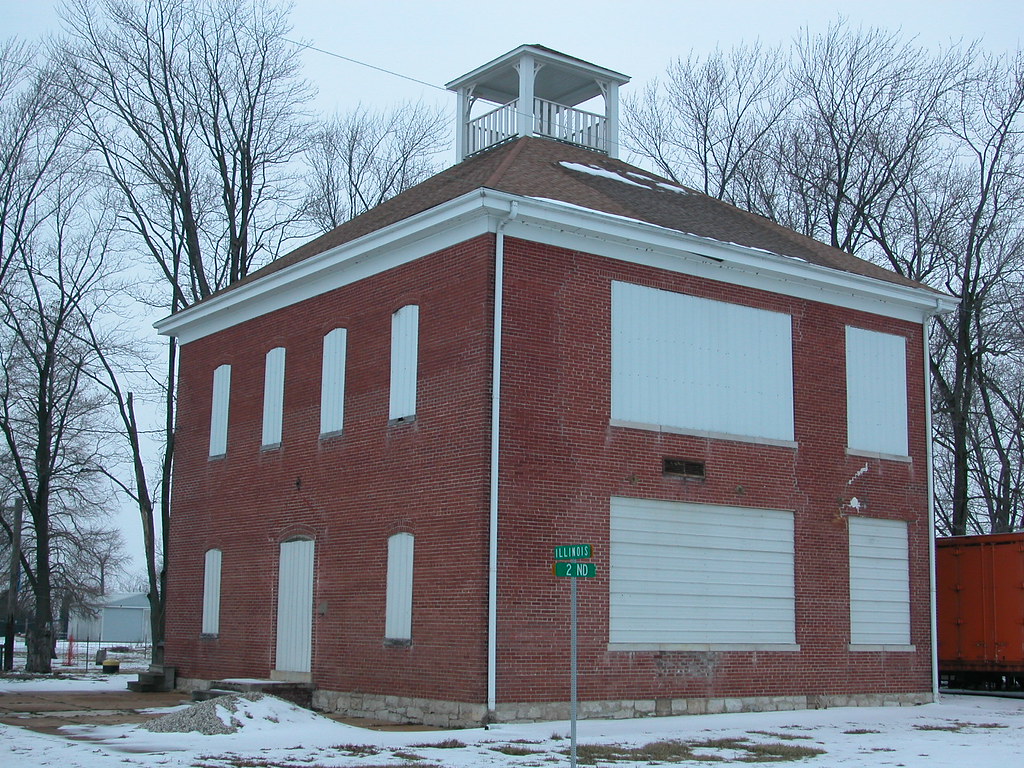
The old school house is interesting, although badly damaged by flooding and alterations to its fenestration. Boarded up, the brick building is missing much of its interior structure although it has gained a new roof since the 1993 flood. Reuse seems unlikely, although someone is performing enough continued maintenance to ensure survival of the old building.

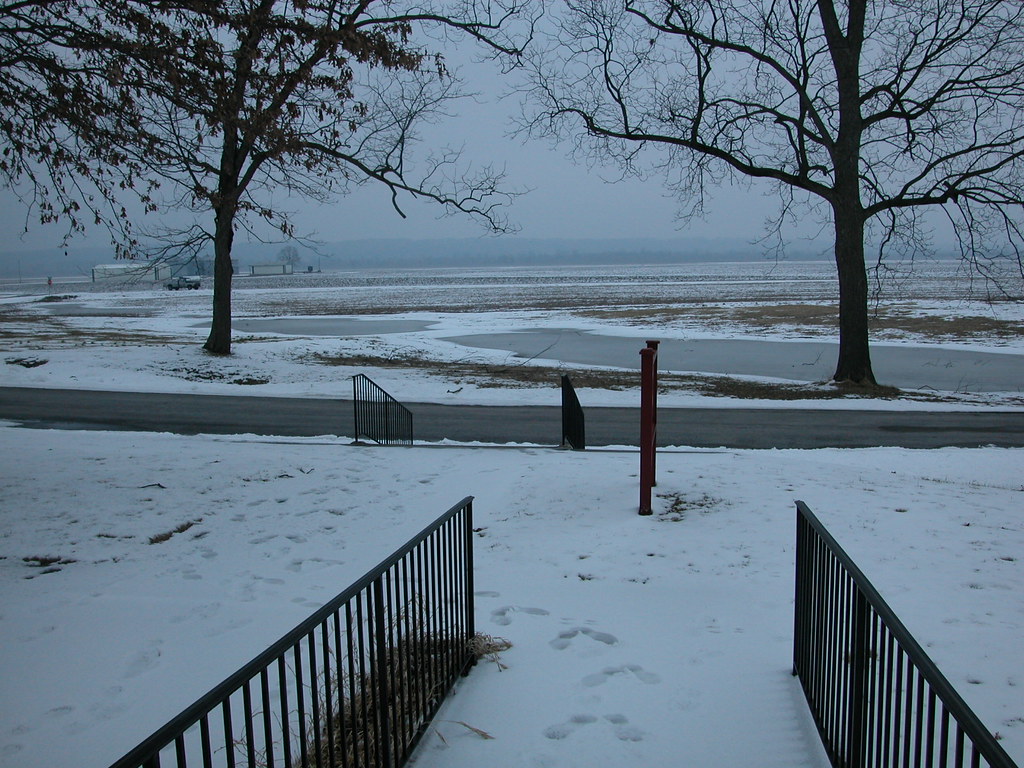
A few frame and brick homes comprise the rest of Kaskaskia. The wide sight lines of the island ensure views of the church spire and school house framed by expanses of fields. Settlement has come full circle for Kaskaskia, but somehow it endures.

Categories
Art Events South St. Louis

The Prohibition Revue Next Sunday at the DeMenil House

Ever wanted to see Craig Schmid perform in a play about prohibition of alcohol?

Next Sunday, you’ll get your chance when the Chatillon-DeMenil House Foundation presents a radio-style reading of The Prohibition Revue written by sisters NiNi Harris and Sheila Harris. Alderman Schmid, Bill Hart, Lois Waninger, Bob Officer, this blog’s Michael Allen and others will be reading the parts of the people who shaped the prohibition episode, from early temperance days to ultimate repeal. The story combines the words of citizens, businessmen and officials with the lyrics of both “dry” and “wet” songs. Expect singing!

When: Sunday, March 16 at 2:30 p.m.

Where: Chatillon-DeMenil House, 3352 DeMenil Place

The play reading is free and open to the public. For more information, call 314-771-5828.