Categories
People

Rollin Stanley Departing St. Louis

by Michael R. Allen

Rollin Stanley, Director of Planning and Urban Design for St. Louis, is leaving after six years on the job. More at MayorSlay.com and at Urban St. Louis. Apparently, Rollin is headed to a planning job in suburban Montgomery County, Maryland. Somehow, he kept the rumor mills quiet before breaking this news; there was no chatter preceding this announcement.

Categories
Architecture Media

Not Quite the Pinnacle

by Michael R. Allen

My latest commentary for radio station KWMU, a review of Lumiere Place, aired this morning. Transcript is available here.

Categories
Events

McGowan and Thomas Discuss Development Tonight

Tonight at St. Louis University, the Rehabbers’ Club concludes its annual series of “classes” with a panel discussion on development featuring Kevin McGowan of Blu Urban (formerly of McGowan Walsh) and Sean Thomas of the Old North St. Louis Restoration Group. This is a great chance to listen and talk to people on the cutting edge of revitalizing St. Louis city. Bring questions!

Date: Wed., Dec. 12th

Time: 7:00-8:30 p.m.

Location: St. Louis University’s Humanities Building, 3800 Lindell Boulevard, Room 142 [1st floor conference room]

Cost: $10 or join ReVitalize St. Louis (parent of the Rehabbers’ Club) at the $20 or above level, and get this class free. Payment by cash or check only.

Other information: Parking at the Moolah Theater garage across the street is only $1/hour.

Categories
Historic Preservation Mayor Slay

World Leadership Award Nice, Progress Made Great

by Michael R. Allen

Historic preservation has led to St. Louis winning a World Leadership Award in the category of housing. The award specifically recognizes the heroic efforts of St. Louisans in revitalizing vacant historic buildings. While Mayor Francis Slay and Planning Director Rollin Stanley went to the award ceremony in London to claim the award, it really belongs to everyone working to revitalize the city — residents, rehabbers, developers, preservationists, architects and, I suppose, politicians.

While there are definite reasons to be skeptical about the organization that grants the awards (Steve Patterson has those reasons covered), there is no doubt that the accomplishment is very real. According to Mayor Francis Slay, more than 20,000 housing units have been rehabbed in the city since 2000. The turnaround is dramatic, and the visible results in the city rewarding to generations (including mine) who lived through darker days. While the losses continue, and politicians and urban planners sometimes seem to be the last people to get the news that historic preservation and unique character are fueling our renewal, things haven’t been this good for old buildings in decades. We are making a lot of progress.

The roots of this resurgence go back to 1996 when a group of St. Louisans, with attorney Jerry Schlichter at the forefront, pushed to make historic preservation economically sensible. These folks successfully lobbied the Missouri General Assembly to enact the country’s most progressive state historic rehabilitation tax credit. This credit was a boon to St. Louis and the entire state. Preservation used to be the lonely battle of historians and neighborhood activists. Now it’s the common parlance of developers, realtors and bankers — the people who control the historic buildings. For over a decade, heartbreaks have been healed. Preservationists have gladly seen many of their gloomy predictions proven wrong.

The battles continue, of course. The playing field is different in many ways. Demolition is still a problem, and historic landmark status has become a double-edged sword that cuts historic buildings that won’t ever get it. North city likely will bleed buildings for the next two decades. But a preservationist now has some pretty impressive case examples of the viability of preservation. We don’t need an award to reap the benefits of changed political and economic circumstances, but it sure doesn’t hurt.

Categories
Architecture Signs South St. Louis

New Fleur de Lis Looks A Little Odd

by Michael R. Allen

A few weeks ago, the new St. Louis University Biolab building at Grand and Chouteau avenues gained an unfortunate appendage: a large fleur de lis atop the attached tower section. While the site plan for the building is abysmal, the building itself has many redeeming qualities. Overall, Cannon Design gave the building a restrained modern sensibility — within the constraints of St. Louis University’s constant use of architecture as branding. (Such practice mars both architecture and the brand, methinks.)

At night, the fleur de lis glows blue with neon light. It is a huge distraction from the building, and clashes severely. However, there is another problem with the symbolic flower. A friend and I noted that the center crest seems a bit low, and the wings — yes, those are wings –too wide.

Here is the sign at night:

Here is a common fleur de lis symbol:

Something seems wrong with the proportions. The sign is too short and too wide. Perhaps it emulates not our city’s symbol but a popular napkin folding shape:

The alternate meanings are many. The ascot could symbolize the laboratory’s formality, or maybe its adherence to the academic tradition of inquiry. The napkin symbolizes cleanliness, an important quality for a laboratory. Napkins also suggest that the laboratory is well suited to “clean up” in the field of biomedical research — a goal of local civic leaders. Of course, wings suggest flights of inspiration and the lofty goal of developing cures for human ailments.

Categories
Architecture Events North St. Louis Wells-Goodfellow

Hewlett Students Present Their Projects Tomorrow

by Michael R. Allen

Each year, freshman students in professor Bob Hansman’s Hewlett City Seminar at the Washington University School of Architecture trek to the Wellston Loop area of north St. Louis. Amid some of the city’s most intense urban decay, the students learn from observing conditions, listening to residents and studying the history of the area’s decline. Then they devise design interventions that could transform the community, channeling residents’ desires into plans for the future. This is one of the best two-way streets in town. The freshman, many from other places where conditions like those of north St. Louis are rare, are exposed to a whole new world. Residents of the community are in turn exposed to an urban design perspective their political leaders often disregard.

This fall’s program is over, and the students will present the models and plans they have created this semester. The presentation is tomorrow, Saturday December 8, at Friendly Temple, 5540 Dr. Martin Luther King Drive, from 1:00 – 5:00 p.m. The event is open to the public.

Categories
Documentation

CSB Records Again Freely Available Through Geo St. Louis

by Michael R. Allen

Citizens Service Bureau (CSB) complaints records again appear to the public on the Geo St. Louis website. Apparently, city government was strictly interpreting a newly-enacted Sunshine Act compliance ordinance sponsored by Alderman Craig Schmid (D-20th). The ordinance specifies ways in which citizens have access to public records, with an emphasis on expanding access through established city policy. (More discussion on the CSB part of the law here.) Schmid claimed his intention was to put the city into compliance with existing state laws on public records, not restrict citizen access to CSB information. Schmid opposed the city’s interpretation.

I noted on November 27 that the records had become password-protected.

Categories
Historic Preservation

Eleven Most Endangered Places Report Online

Landmarks Association of St. Louis has published its year-end report on the city’s Eleven Most Endangered Places. Read it here.

Categories
Central West End DeVille Motor Hotel Historic Preservation Mid-Century Modern

Modern Motor Hotel in Central West End Faces February Demolition

by Michael R. Allen

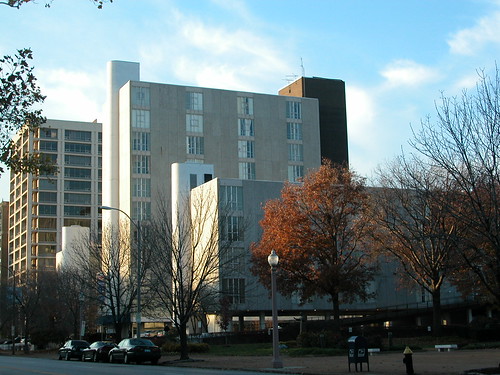
Here is the building now known as the San Luis Apartments, located at 4483 Lindell Boulevard in the Central West End. Just west of the Cathedral, the building is owned by the Archdiocese of St. Louis and used as apartments for the elderly. The Archdiocese plans to demolish the building in February for a surface parking lot despite no pressing problem with the apartments, which are generally loved by residents for their excellent location. Residents are being relocated to many different places, none of which is as transit accessible — an important criterion for older people who do not drive.

The news of the Archdiocese’s plan surprises many Central West End residents who are aghast at the idea of creating a surface parking lot facing well-traveled Lindell on the same block as the elegant Cathedral. Many are astounded that the Archdiocese would proceed to demolition without any plan for future development of the site, leaving a gaping hole for an indefinite period. The Central West End Association and Alderwoman Lyda Krewson (D-28th) have yet to make official statements on the proposed demolition. However, oppositional voices are stating to cry out. Last week, the West End Word ran a letter to the editor from STL Style‘s Randy Vines.
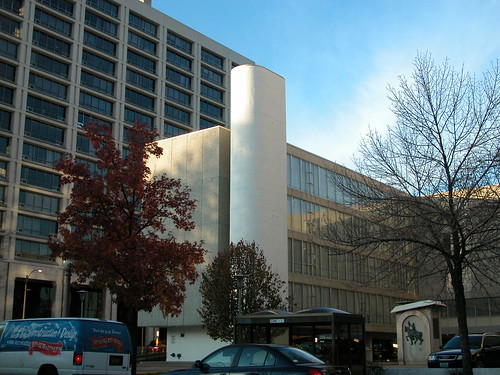
Real estate moguls Harold and Melvin Dubinsky working with Paul Kapelow took out a building permit for a motor hotel on September 25, 1961, with construction estimated at $2.75 million. New Orleans firm Colbert, Lowery, Hess & Bouderaux designed the curvilinear, E-shaped modernist hotel. On July 3, 1963 the hotel building was granted an occupancy permit and shortly afterward opened as the DeVille Motor Hotel. The hotel was part of a national boom in “motor hotels” located in urban areas. Hoteliers sought to revive urban markets by building multi-story hotels with ample covered parking on lower levels. Many had bars, including popular tiki lounges. These buildings employed modernist styles to symbolize their cleanliness and newness as well as their utility. One could park right in the hotel and avoid walking city streets carrying luggage — no doubt a concern in the dark days of American urbanism, and perhaps still. Designers are better at hiding the parking in today’s urban hotels, but the idea of integrated parking, lodging and dining remains the same.
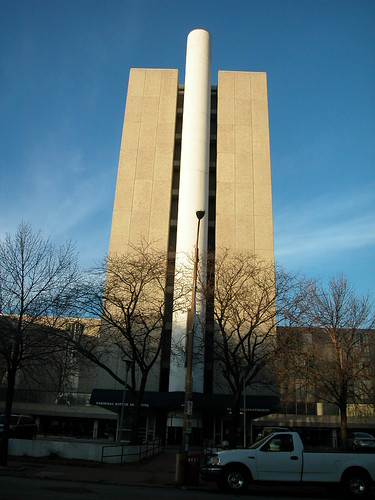
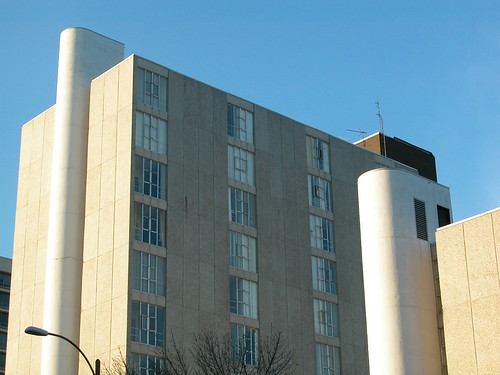
The design of the San Luis Apartments is strange and cool, if not cutting edge. The curved smooth white concrete towers cloak services while providing textural contrast to the aggregate body of each wing. The parking is recessed enough that it does not overpower the building; recessed walls on the first floor actually minimize its presence. The bays of aluminum-framed windows on the sides of the central, taller section and end of each wing are balanced by the ribbons on the inside walls of the wings. What could have been the tired bulk of a typical motor hotel — like the Howard Johnson by the airport — is relieved through division of the building into a series of forms of different height and footprint. This is no thoughtless slab. In fact, the modern lines interact quite well with the later and more accomplished Lindell Terrace (built in 1969 and designed by Hellmuth Obata Kassabaum) across Taylor Avenue to the west.

Unfortunately, due to recent age, the San Luis Apartments are not considered a contributing resource to the Central West End Historic District. Thus the building is not eligible for historic rehabilitation tax credits. However, the buidling is included within the boundaries of the Central West End Local Historic District so there is legally-mandated preservation review of the demolition.

Categories
Events Historic Preservation Public Policy

Historic Tax Credit Programs Class Tonight

Join ReVitalize St. Louis and the Rehabbers Club for our next highly informative Fall 2007 Rehabbers Club class:

Historic Tax Credit Programs

Wednesday, November 28, 2007
7:00-8:30 p.m.
Saint Louis University’s Humanities Building, 3800 Lindell
Boulevard, Room 142 (1st floor conference room)

This week’s expert speakers and presenters are Lynn Josse, Maureen McMillan and Melinda Stewart.

This week’s class will focus on:
– The relationship between the rehabber and the tax credit application preparer
– How to work with a preparer (do you need one?)
– Types of historic designation that do and don’t make your project eligible
– How to get that historic designation if you don’t already have it

After the initial presentation, extra time has been set aside for
your questions.

Fee for Individual Class: Only $10 each – and if you join ReVitalize St. Louis at the session ($20 level or above), you get that night’s class for free!

PARKING: Onstreet, metered parking is available along Lindell or Vandeventer or park in the Moolah Theatre garage behind 3821 Lindell. Garage parking is $1 per hour, but their gate is frequently open at the end of our classes. Garage tickets can be validated at the Moolah Theatre in exchange for a purchase at their bar or
concession stand. Do not park on SLU’s campus without a SLU permit; you will be ticketed!

PAYMENT: We accept checks and cash at the door; sorry no credit cards. The class fee is tax-deductible. Your support of these classes benefits ReVitalize St. Louis, a 501(c)3 not-for-profit organization, and its projects including the Rehabbers Club and the annual Big BIG Tour.