Categories
Architecture Gate District Housing South St. Louis

Vivienne on Lafayette Advances Infill Housing Design

by Michael R. Allen

The 2800 block of Lafayette Avenue, between California and Nebraska in the so-called Gate District, is a mixed bag of a street scape. Gone is the continuity of historic brick buildings. There are vacant buildings, heavily altered buildings (see last month’s post on 2831 Lafayette) and the graceful corner commercial building at the northeast corner of Nebraska and Lafayette that bears the colorful enamel sign board of the shuttered Garavaglia Market. Most notable, though, there are vacant lots.

This is the diminished state that has led developers to take other blocks in the Gate District and transform them into unrecognizable mixes of old buildings and large platform-framed homes that seem more appropriate to Wildwood than the near south side. Without any historic districts in the Gate District, there is neither incentive for historic rehabilitation work nor mandates for new construction. The area reflects its lack of any legal design framework. Fortunately, on the 2800 block of Lafayette, developer Cheryl Walker of Obasi Enterprises is taking vacant land and doing something that provides new market-rate homes while adding a new and compatible character to the neighborhood.
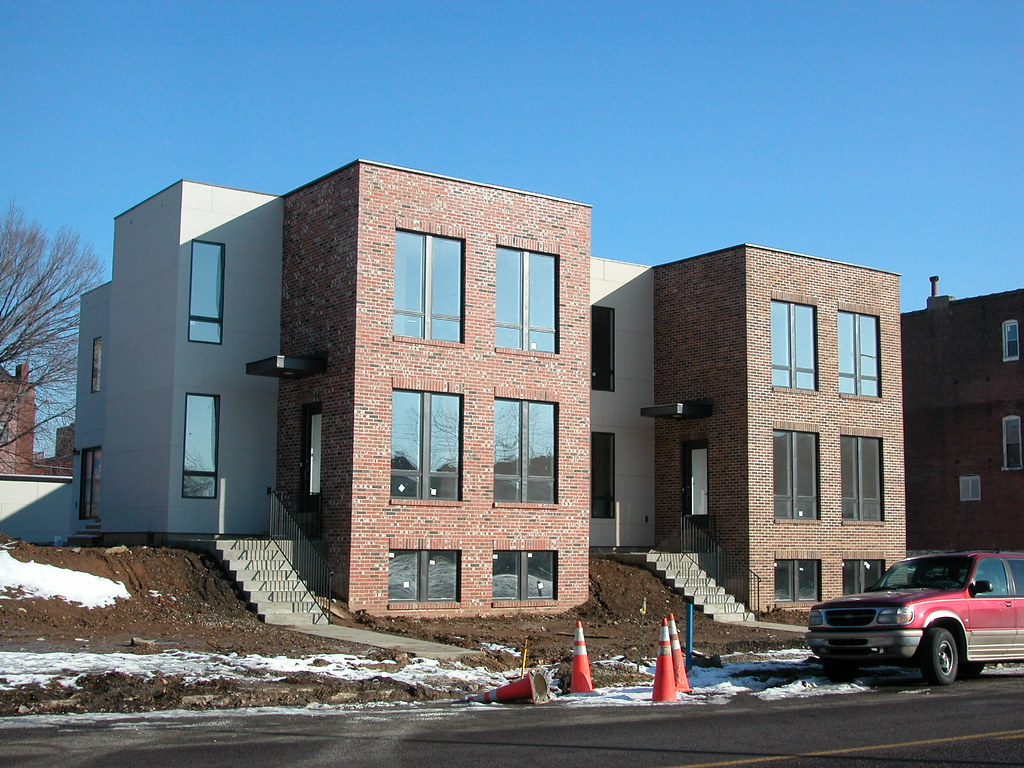

The project is called Vivienne on Lafayette, and it entails the construction of four adjacent homes. The two that are complete are show here. HKW Architects designed the homes; that firm has done extensive design work for Restoration St. Louis including the rehabilitation of the Moolah Theater building.

One is immediately struck by how different Vivienne is from its contemporaries. The houses actually look like original designs! There is absolutely no quotation of historic architectural styles here. Nor is there imitation of historic styles of cornices, brackets, balustrades, window sills or other building parts. The designers instead very earnestly engaged the project location and standard available materials to produce homes that are urban and attractive.

The front walls of these homes are brick, with some rowlock courses as sills and headers on each metal-framed window. The basements are high, which is one nod to historic tradition that make the homes taller than other new infill houses. The side walls are clad in stucco, indicative of the fact that these are not authentic masonry buildings. The builders could have used some sort of vinyl or board siding, but chose something more compatible with brick. The roofs are flat — something that minimizes the home volume and allows for potential greening.


The homes are not quite perfect in design; I think that a monotone brick color would have made each better, and that the stucco color is a bit bland. Some more play with masonry details could have added interest. The homes could be placed closer together. Still, such concerns are minor. The homes at Vivienne Place offer sorely-needed innovation in infill housing in St. Louis, where too often we have settled on worse than mediocre design that offers an unpleasant contrast with our excellent historic building stock.

In neighborhoods with challenging conditions, where historic fabric is spotty, homes like these make a lot of sense. They maintain the traditions of density and best use of widely available materials that typifies our neighborhoods without denying us the chance to leave our own mark in time.

Categories
Mid-Century Modern National Register St. Louis County The Ville

National Register News

Wagoner Place in the Ville is now listed on the National Register of Historic Places. More at MayorSlay.com here.

Meanwhile, Landmarks Association reports on its pending nominations of the Saratoga Lanes building in Maplewood and the Usonian Harry Hammerman House in Ladue. More here.

Categories
Demolition Grand Center LRA Midtown

Grand Center and the Central Apartments

by Michael R. Allen


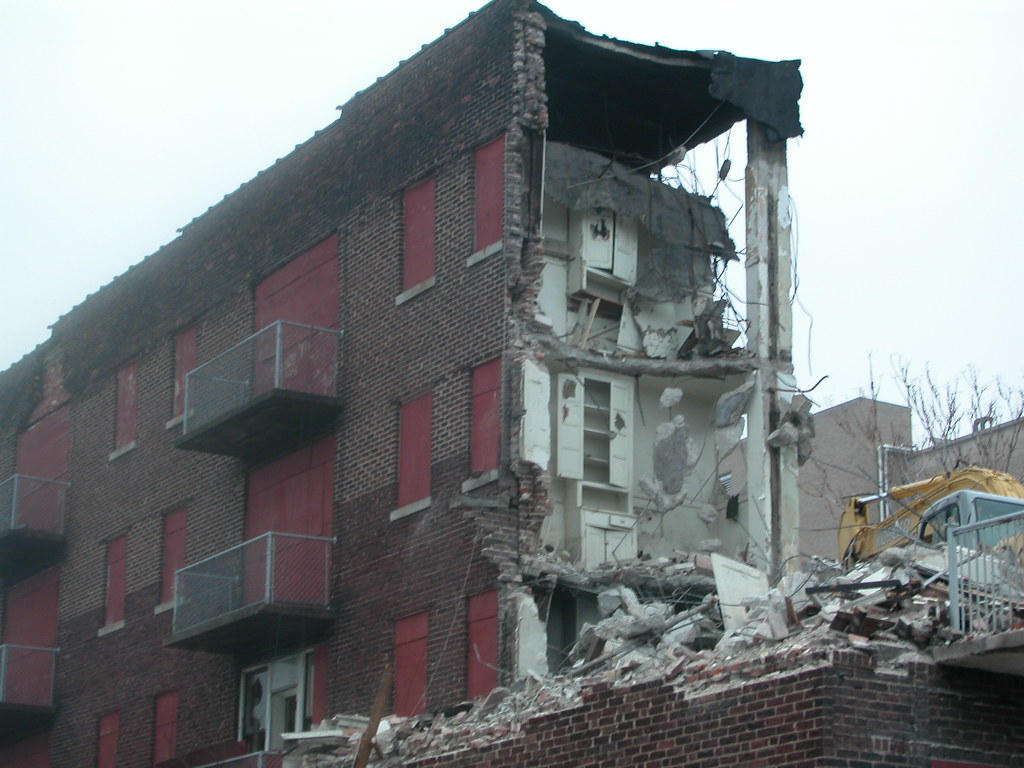
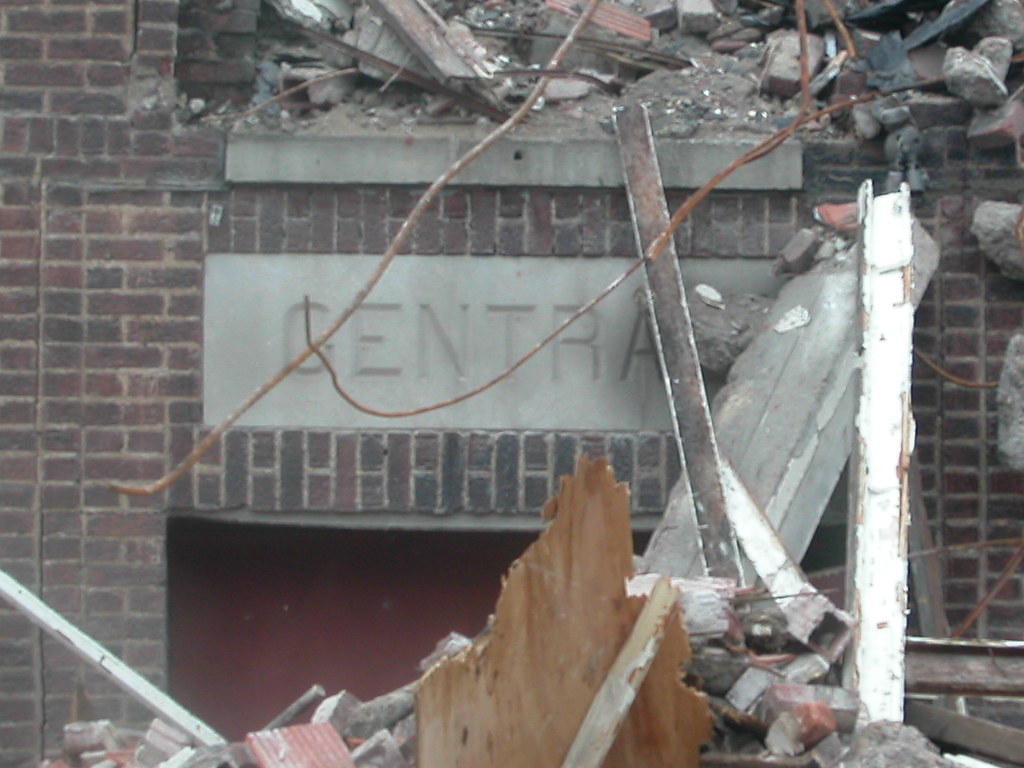
Demolition is nearly complete on the Central Apartments at 3727 Olive Street in Midtown, and there is still no answer to the big question: What were they thinking?

The better question seems to be: Were they thinking?

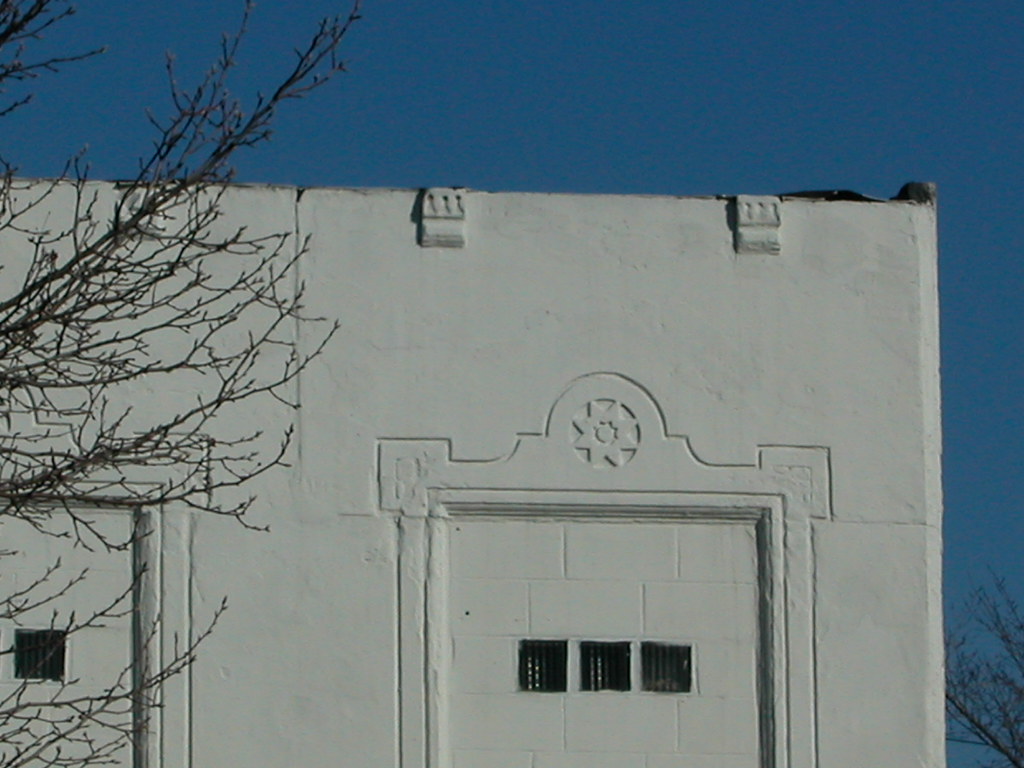
Central Apartments in 2005.

The graceful apartment building is the latest victim of the indecision of Grand Center, Inc., the redevelopment corporation charged with revitalizing the midtown area. While the Central Apartments has been owned by the city’s Land Reutilization Authority since 2001, its fate has been under the control of Grand Center. Since the apartment building fell empty in 2001 — it was partly occupied with storefront tenants up to the time of closing — Grand Center has failed to articulate a vision for its reuse or demolition. After languishing for several years boarded and deteriorating, the building fell to wreckers in December apparently at Grand Center’s request.

The Building Division considered the demolition an emergency, and some reports of brick loss on the west wall circulated. However, the brick loss was spalling of face brick, and the concrete structure of the building was as solid before wrecking began as it was when people were living there just six years prior.


Alas, the potential for reuse in December 2007 was perhaps greater than ever. Thanks to the work of Restoration St. Louis, Steve Trampe and other developers, there finally is an apartment housing market in Midtown. These developers have seen the obvious need for off-campus housing for St. Louis University students and have rehabbed large historic buildings for housing. Two blocks from the Spring Avenue mall entrance to the SLU campus, the Central Apartments had an obvious market.

While the 3700-3800 block of Olive Street has long lost any semblance of cohesive historic character, and lies outside of the Midtown National Historic District, the block retains a few buildings and many lots the could be developed. The William Cuthbert Jones House and the former Lindell Exchange (later Wolfner memorial library) on the south side of the block were recently listed on the National Register of Historic Places. Historic rehabilitation and new construction could transform that block from its current dullness.

Built in 1916, the Central Apartments possessed an elegant front elevation adorned in the Renaissance Revival style. With a sound structure, mostly solid masonry and largely intact interiors — revealed when exterior walls were knocked off of the building — the building was in good shape. The building could have provided the high-density urban housing one would assume is needed to make a thriving arts and entertainment district function as a real neighborhood.

Why Grand Center did not make rehabilitation of the building a priority is a mystery. Too often, such a senseless demolition is the result of deliberate bad planning. Here, it seems the result of no planning and no deliberation whatsoever.

Categories
Architecture East St. Louis, Illinois South St. Louis St. Louis County

Gift Basket

by Michael R. Allen

There are now official Board of Public Service plans for the Marti Frumhoff Memorial Garden, which will be the triangle at the intersection of Utah and Morganford. See the plans here.

Meanwhile, Steve Smith has posted his video of an August 2007 trip into the Spivey Building in downtown East St. Louis.

St. Louis Patina went in search of Edwin Lemp’s Cragwold estate.

Meanwhile, Lumiere Place opened in time for the holidays. Reviews by Urban St. Louis forum members start here.

Categories
Abandonment Architecture Gate District Historic Preservation South St. Louis Storefront Addition

Just Another Vacant Building?

by Michael R. Allen

I don’t think there is such a thing as an average run-of-the-mill vacant building in St. Louis. For instance, look at this building located at 2831 Lafayette Avenue:


On first glance, the yellow-toned plywood sheets and blue awning jump out from a nearly all-white building. Looking at the building longer, details emerge. Behind that projecting storefront is a different, older building. The building appears to be an old house. A close look brings out clues.

This two-story building has a pretty sandstone front; the large filled-in window openings must have been gorgeous when they were glazed. Underneath white paint and stucco repairs are fine carved details around the windows. The sunbursts centered over each window are impressive and typical of the finely detailed nineteenth century stone masonry we have in St. Louis. Right at the top are sill brackets, showing that the building once stood another story taller. The presence of such fine details, the use of sandstone and the style of the facade suggest a construction date in the 1880s. In fact, building permits show that this block face was built out with houses (mostly single-family and many with significant construction costs) between 1880 and 1895. There are three permits for three-story houses: in 1880, 1889 and 1894.

Owners added the storefront addition at 2831 Lafayette by the 1930s, although fire insurance maps show that the building retained its third story into the 1960s. The first floor of the building was in use a dry cleaners as soon as the storefront was finished. Apartments were above. Essentially, the building joined many others in the city located in well-to-do walking neighborhoods that changed dramatically in the early twentieth century as the upper and middle classes migrated west to quieter streets farther from downtown. The large houses of the migrating residents often were divided into rental housing or businesses; many were expanded, and altered and some were eventually demolished as new commercial uses moved into once-genteel neighborhoods. One under appreciated result of these changes was that population density increased. This building is a frank reminder of twentieth century changes in use and demographics on the near south side.

Deed research could clear up which one corresponds to this house. For now, I am glad to have given it a long look and learned that the old building tells an unexpected story. While the house has lost its third story and its original appearance, the remaining traces still provide beauty. There is no reason that future reuse of the building could not highlight the remaining traces and incorporate them into a new design. While the building is rendered ineligible for any landmark designation through loss of historic appearance, there are many futures for it beyond simply tearing it down.


All over our city are similar old houses — many with storefront additions, missing floors, mangled entrances and strange alterations. These are the buildings that cannot be considered contributing to historic districts but who still lend historic character to our streets. Historic rehabilitation tax credits will never be available for these buildings. Some would knock them over, because of the financial problems of rehabbing them without tax credits. Hopefully others will see that, however twisted or obscured, these buildings still have architectural potential — and still tell the stories of their construction and show the scars of changing use. This stretch of Lafayette Avenue gains far more character from 2831 Lafayette in its current state than from the new homes of the Gate District, or the Holiday Inn.

Categories
People

Rollin Stanley Departing St. Louis

by Michael R. Allen

Rollin Stanley, Director of Planning and Urban Design for St. Louis, is leaving after six years on the job. More at MayorSlay.com and at Urban St. Louis. Apparently, Rollin is headed to a planning job in suburban Montgomery County, Maryland. Somehow, he kept the rumor mills quiet before breaking this news; there was no chatter preceding this announcement.

Categories
Architecture Media

Not Quite the Pinnacle

by Michael R. Allen

My latest commentary for radio station KWMU, a review of Lumiere Place, aired this morning. Transcript is available here.

Categories
Events

McGowan and Thomas Discuss Development Tonight

Tonight at St. Louis University, the Rehabbers’ Club concludes its annual series of “classes” with a panel discussion on development featuring Kevin McGowan of Blu Urban (formerly of McGowan Walsh) and Sean Thomas of the Old North St. Louis Restoration Group. This is a great chance to listen and talk to people on the cutting edge of revitalizing St. Louis city. Bring questions!

Date: Wed., Dec. 12th

Time: 7:00-8:30 p.m.

Location: St. Louis University’s Humanities Building, 3800 Lindell Boulevard, Room 142 [1st floor conference room]

Cost: $10 or join ReVitalize St. Louis (parent of the Rehabbers’ Club) at the $20 or above level, and get this class free. Payment by cash or check only.

Other information: Parking at the Moolah Theater garage across the street is only $1/hour.

Categories
Historic Preservation Mayor Slay

World Leadership Award Nice, Progress Made Great

by Michael R. Allen

Historic preservation has led to St. Louis winning a World Leadership Award in the category of housing. The award specifically recognizes the heroic efforts of St. Louisans in revitalizing vacant historic buildings. While Mayor Francis Slay and Planning Director Rollin Stanley went to the award ceremony in London to claim the award, it really belongs to everyone working to revitalize the city — residents, rehabbers, developers, preservationists, architects and, I suppose, politicians.

While there are definite reasons to be skeptical about the organization that grants the awards (Steve Patterson has those reasons covered), there is no doubt that the accomplishment is very real. According to Mayor Francis Slay, more than 20,000 housing units have been rehabbed in the city since 2000. The turnaround is dramatic, and the visible results in the city rewarding to generations (including mine) who lived through darker days. While the losses continue, and politicians and urban planners sometimes seem to be the last people to get the news that historic preservation and unique character are fueling our renewal, things haven’t been this good for old buildings in decades. We are making a lot of progress.

The roots of this resurgence go back to 1996 when a group of St. Louisans, with attorney Jerry Schlichter at the forefront, pushed to make historic preservation economically sensible. These folks successfully lobbied the Missouri General Assembly to enact the country’s most progressive state historic rehabilitation tax credit. This credit was a boon to St. Louis and the entire state. Preservation used to be the lonely battle of historians and neighborhood activists. Now it’s the common parlance of developers, realtors and bankers — the people who control the historic buildings. For over a decade, heartbreaks have been healed. Preservationists have gladly seen many of their gloomy predictions proven wrong.

The battles continue, of course. The playing field is different in many ways. Demolition is still a problem, and historic landmark status has become a double-edged sword that cuts historic buildings that won’t ever get it. North city likely will bleed buildings for the next two decades. But a preservationist now has some pretty impressive case examples of the viability of preservation. We don’t need an award to reap the benefits of changed political and economic circumstances, but it sure doesn’t hurt.

Categories
Architecture Signs South St. Louis

New Fleur de Lis Looks A Little Odd

by Michael R. Allen

A few weeks ago, the new St. Louis University Biolab building at Grand and Chouteau avenues gained an unfortunate appendage: a large fleur de lis atop the attached tower section. While the site plan for the building is abysmal, the building itself has many redeeming qualities. Overall, Cannon Design gave the building a restrained modern sensibility — within the constraints of St. Louis University’s constant use of architecture as branding. (Such practice mars both architecture and the brand, methinks.)

At night, the fleur de lis glows blue with neon light. It is a huge distraction from the building, and clashes severely. However, there is another problem with the symbolic flower. A friend and I noted that the center crest seems a bit low, and the wings — yes, those are wings –too wide.

Here is the sign at night:

Here is a common fleur de lis symbol:

Something seems wrong with the proportions. The sign is too short and too wide. Perhaps it emulates not our city’s symbol but a popular napkin folding shape:

The alternate meanings are many. The ascot could symbolize the laboratory’s formality, or maybe its adherence to the academic tradition of inquiry. The napkin symbolizes cleanliness, an important quality for a laboratory. Napkins also suggest that the laboratory is well suited to “clean up” in the field of biomedical research — a goal of local civic leaders. Of course, wings suggest flights of inspiration and the lofty goal of developing cures for human ailments.