A few weeks ago Thomas Crone’s excellent The South Side of Luck posted a video of me talking about three south side buildings. Crone’s instructions: find “one that was interesting and safe; one that was interesting and undergoing some type of facelift; and one that was interesting and in danger of going away.”
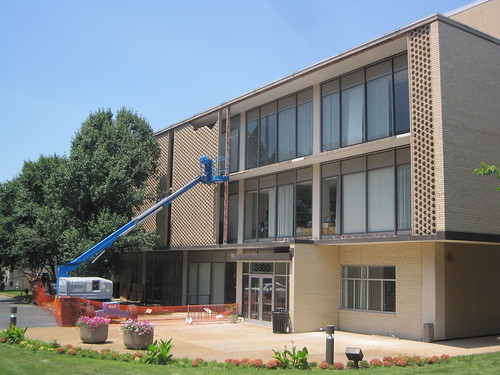
After some thought and elimination of dozens of possibilities — ranging from City Hospital to that little abandoned stone house at Steins and Water streets — I chose the Avalon Theater (in danger), the St. Louis Hills Office Center (“some type of facelift” indeed) and a minor Harris Armstrong commission at 3524 Gravois (interesting).
All I did was talk; Crone was producer, Brandon McLaughlin did the audio, and director Tyler DePerro filmed it all. Although we dodged gloomy weather that seems hard to believe on this 100-degree day, the shoot is a neat little document. Check it out. The get more tales — some also told through moving pictures — of the city’s south side over at The South Side of Luck.
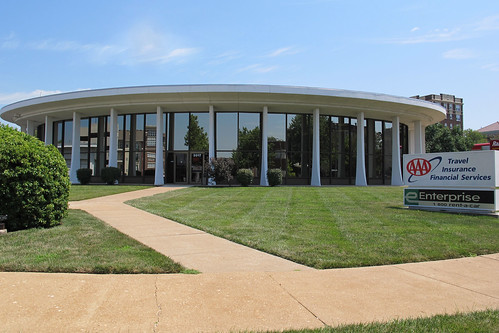
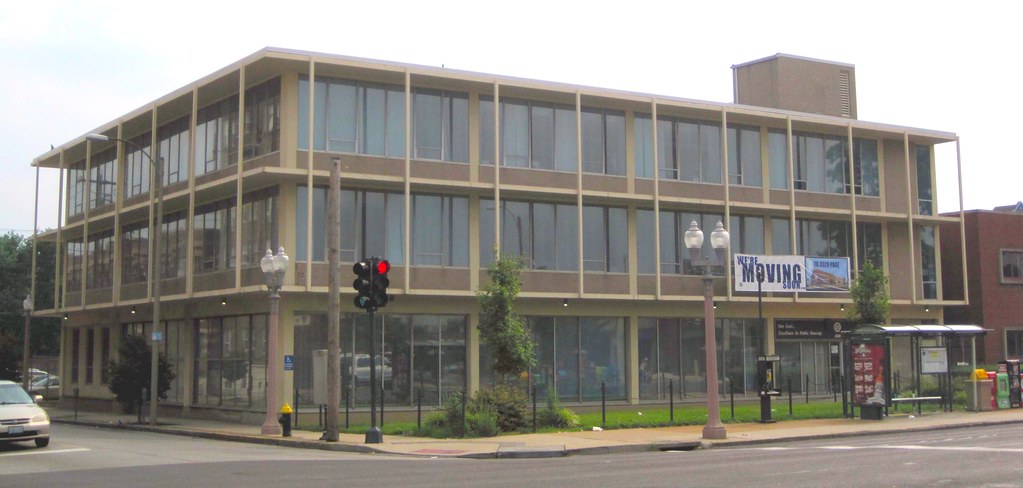
The AAA Building/ Photograph by Michaela Burwell-Taylor.
Alderman Terry Kennedy represents the 18th Ward that includes the AAA Building. Today he sent this statement.
I just want to correct some erroneous reporting recently made in the media. I do not support the demolition of the AAA building in the 18th ward located at Lindell near Vandeventer. Several news stories have reported this without ever speaking to me. I told CVS representatives, who are interested in establishing a store at this locations, that they must meet with our neighborhood association(s) close to this location, present their plans and receive their support before I can support the project. There are many aspects of the CVS proposal that I have concerns with but I am willing to be guided by the thoughts and ideas of the majority of our association members on this issue.
I have been willing to do those things that are consistent with already established planning for this portion of Lindell. This included the change of zoning of the Enterprise Leasing Office from “C” multi family to “H” commercial to be consistent with the other parcels owned by AAA and the other parcels on Lindell. This zoning change proposal was recommended by the City Planning Office and is also recommended in the Mayor’s Strategic Land Use Plan created over four years ago which I supported.
I welcome the interest CVS has in our area and think that there are benefits to having one of their stores in our community. However, before this can happen CVS must meet our residents vision for the area and address our concerns. Until then, I am open to discussing their ideas, giving advice and am willing to work with them where I can.
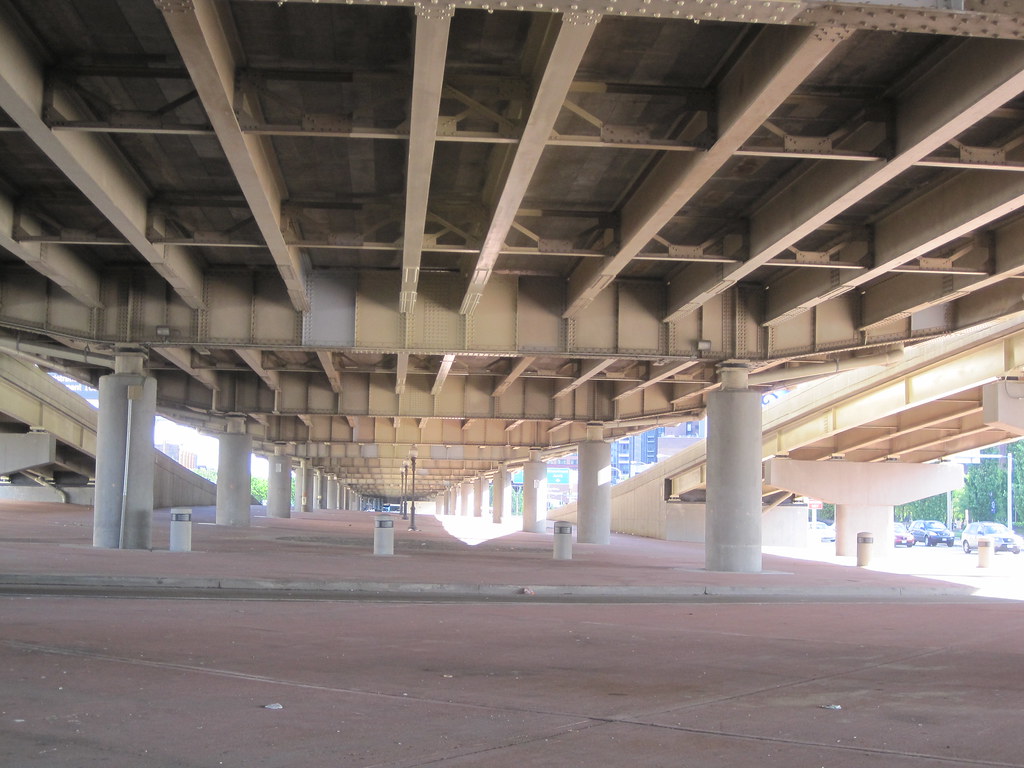
View south from Cole Street, looking under I-70's elevated section.
For the past tow years, the citizen group City to River has pushed for removal of I-70 through downtown St. Louis in order to better improve the connections between the city’s core and the riverfront around the Jefferson National Expansion Memorial. City to River’s practical and relatively affordable proposal is replacement of I-70 with an at-grade boulevard after the new Mississippi River Bridge opens in 2014. Then, I-70 will be carried away from the unsightly depressed and elevated lanes, which will get an inferior designation.
The boulevard plan won traction when the National Park Service’s General Management Plan for the Memorial included a very favorable mention of the boulevard idea. Then during the Framing a Modern Masterpiece competition, all five finalists ended up endorsing the proposal, with several explicitly drawing their own phased boulevard plans in their final competition proposals. Then the momentum came to a halt when the winner, Michael Van Valkenburgh Associates, got to work on creating a workable design. When that plan was unveiled on January 26 this year, the boulevard was nowhere to be found. City to River took a conciliatory tone, suggesting consensus that the boulevard was no longer a short-term goal for anyone.
Amid the reality that this city will be saddled with the ungainly mess of interstate that mars many a sight line downtown, yesterday City to River tweeted an idea that could make life with the highway a little less depressing.
Here’s the short story from Dezeen: A group in London called Assemle has built a cinema underneath a wharfside elevated highway (called a “flyover” in England). The project is called “Folly For Flyover” and lasts six weeks. The cinema’s entrance is made of reclaimed local brick supported by scaffolding in the shape of a historic row house. According to Dezeen: “Folly for a Flyover was assembled by a team of volunteers over the course of a month, using reclaimed and donated materials.”
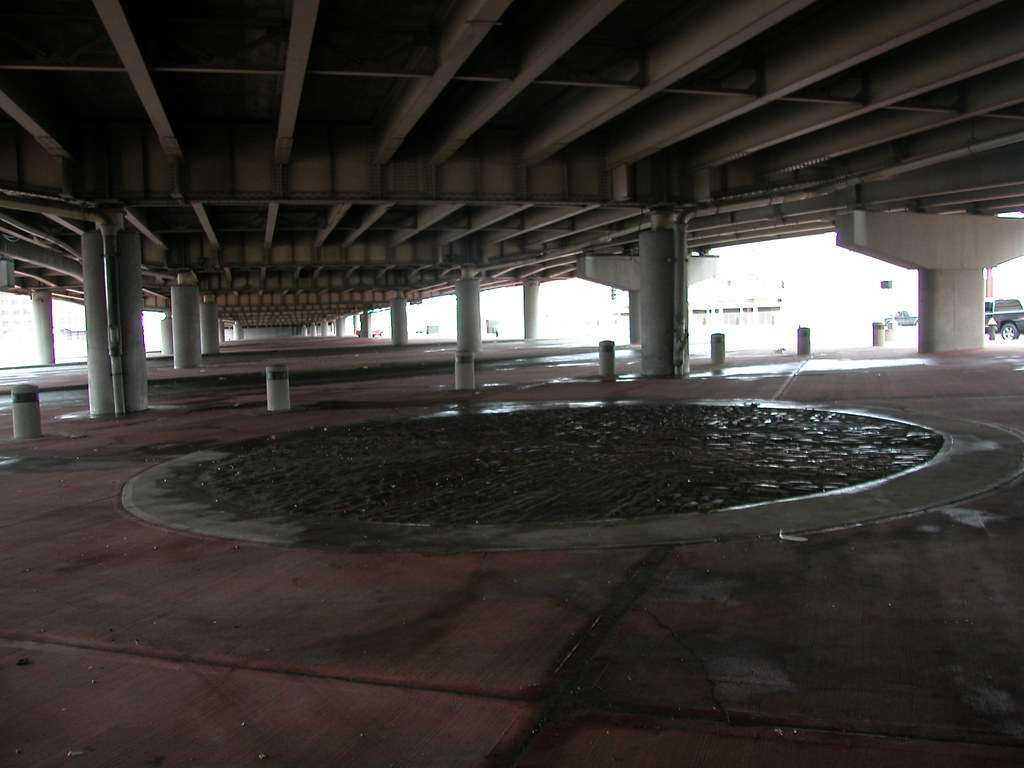
Some efforts have been made to "beautify" the area under the elevated lanes.
The architectural pun is clear and lovely: elevated highway construction took down many a historic building in previous decades, and demolition continues today (hence the available brick). Activating the otherwise-bleak space under the highway offers both a way to mitigate its dehumanizing form and the occasion to do a little teaching about the scale of materials and the impact of highways on cities.
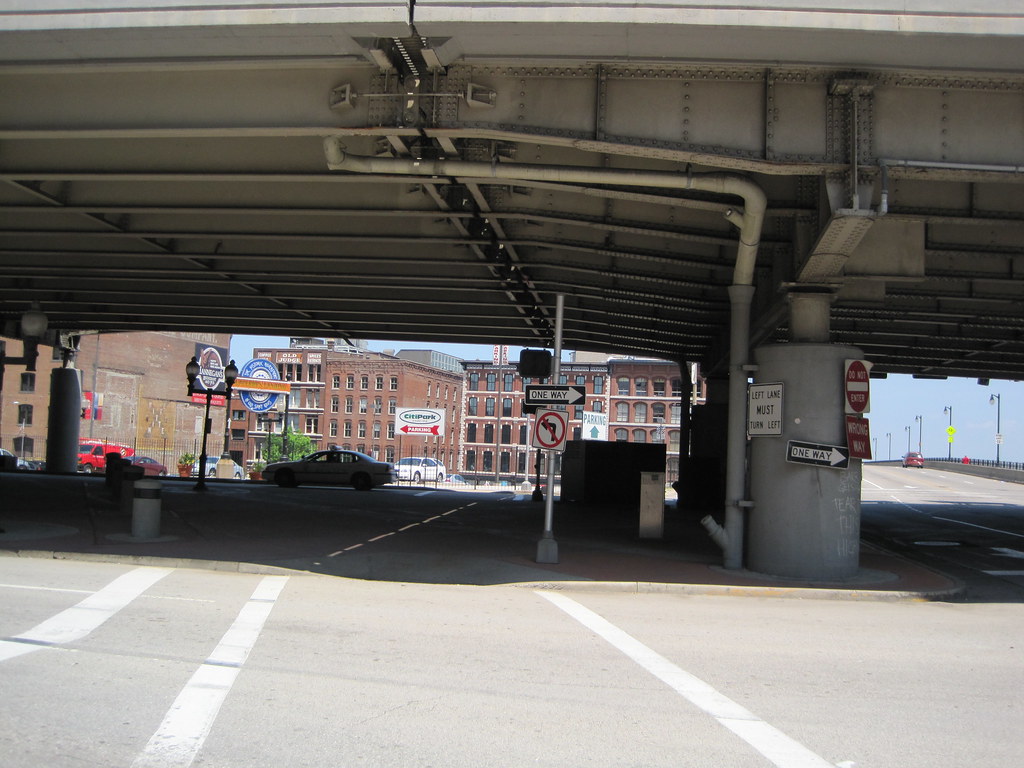
View east along Washington Avenue toward Laclede's Landing.
Can St. Louis try something similar? At present, even the three-block highway lid — which does nothing to offset the tragic landscape of the elevated lanes — included in Van Valkenburgh’s final plan will take years to build. Some temporary programming in our cavernous under-highway spaces downtown would make what could be a long wait for any changes to I-70 easier to bear.
The elevated structure itself is not the worst architecture in St. Louis, either. It is a utilitarian work of steel and concrete — there’s untapped visual potential that we should harness as long as it stands.
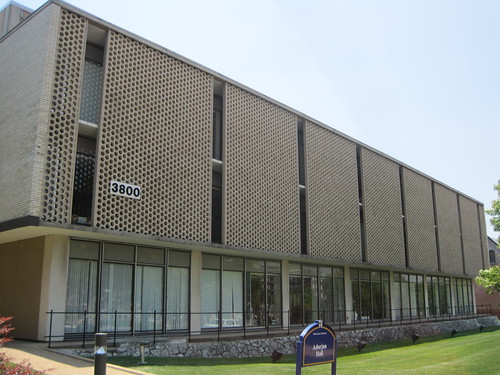
This week St. Louis University’s removal of the concrete block screens on the former IBM Building has visited the main elevation on Lindell Boulevard. Late in June, the university started removing the crucial architectural design feature on this early Hellmuth Obata & Kassabaum-designed office building, which dates to 1959 (see “SLU Picks Apart HOK”, July 1). Located at 3800 Lindell Boulevard and now called Adorjan Hall, the former IBM Building is part of a district of mid-century modern buildings built on Lindell Boulevard between 1945 and 1977.
The Lindell Boulevard modernism corridor includes Hellmuth Obata & Kassabaum’s earlier Sperry-Rand Building (1956) at Lindell and Sarah. That building has a similar modular plan to the IBM Building, with overhanging upper floors, clear-span window bays and very similar bay widths. Like the IBM Building, the Sperry-Rand Building gains its significance less from its own design than from its role in the larger Lindell Boulevard context. This plain, elegant International Style-inspired office block escaped the CVS demolition threat that has now taken aim at the W.A. Sarmiento-designed AAA Building at 3915 Lindell Boulevard (1976). Despite the drug store chain’s looking elsewhere, the fate of the Sperry-Rand Building is far from certain. Given the hatchet job being endured by the IBM Building, even preservation of the building could be a veiled threat.
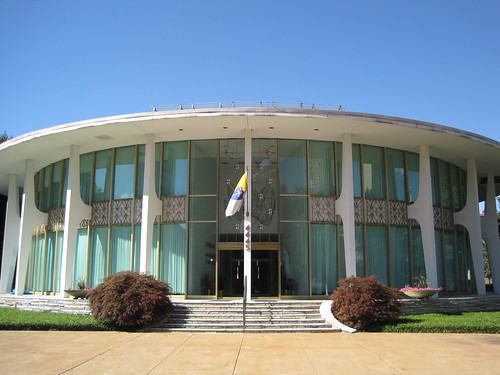
Lindell's show-stopper: The Chancery of the Archdiocese of St. Louis at 4445 Lindell, designed by W.A. Sarmiento and completed in 1962.
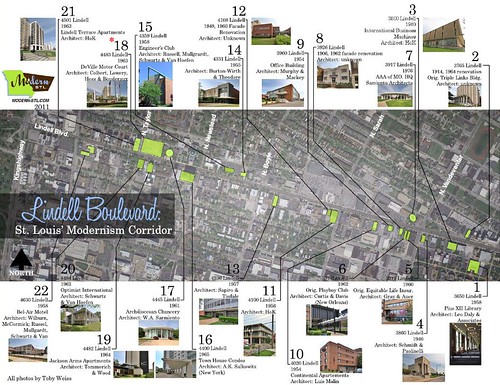
For years Toby Weiss and I have been giving tours of and writing about the unique concentration of mid-century modernism on Lindell Boulevard between Grand and Kingshighway. This significant concentration of modernism has sustained some losses and currently is enduring threats to both the IBM Building (1959, Hellmuth Obata & Kassabaum) and the AAA Building (1976, W.A. Sarmiento). However it remains the city’s strongest collection of non-residential mid-century modern design.
Modern STL, on whose board both Toby and I serve, has now published a beautiful two-page self guided tour of Lindell Boulevard that includes information about each of the street’s mid-century modern buildings as well as a brief essay that I wrote providing an overview of modernism on Lindell. Modern STL board member Neil Chace generously donated his talent to design the guide. Download it here and then go for a lovely walk down Lindell!
Yesterday the St. Louis Beacon published a great article providing an overview of Pruitt Igoe Now, an ideas competition for the site of the city’s largest housing projects. Here is the official announcement.
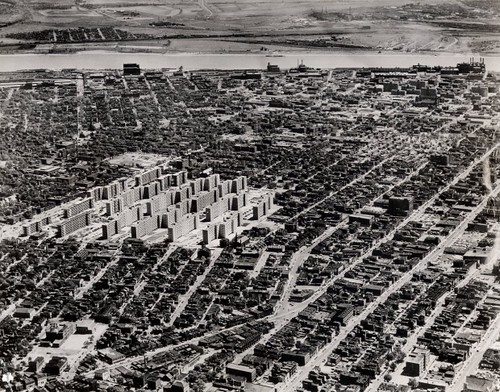
Pruitt-Igoe as part of the heart of St. Louis.
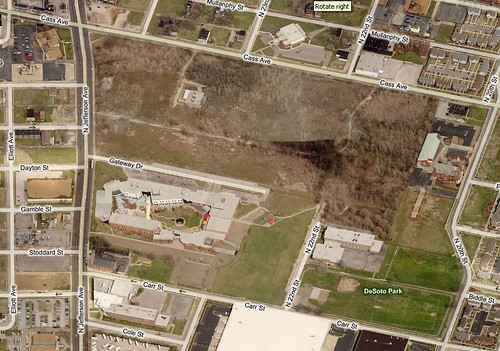
Pruitt Igoe Nowis an ideas competition launched by a non-profit organization of the same name, located in St. Louis, Missouri, USA. The subject is the 57-acre site of the long-mythologized Pruitt and Igoe housing projects — a site whose future is intertwined with emerging ideas about urban abandonment, the legacy of modernism, brownfield redevelopment and land use strategies for shrinking cities. This competition seeks the ideas of the creative community worldwide: we invite individuals and teams of professional, academic, and student architects, landscape architects, urban planners, designers, writers, historians, and artists of every discipline to re-imagine the site and the relationship between those acres to the rest of the city. The deadline for submissions in March 16, 2012. Submissions are accepted beginning now.
What now?
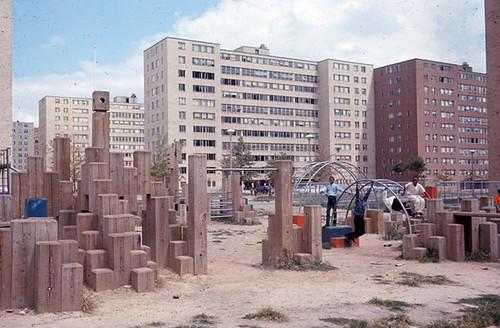
March 2012 will mark the 40th anniversary of the demolition of the first of the Pruitt-Igoe high-rises, designed by architects, Helmuth, Yamasaki and Leinweber, who have long been blamed for the troubled legacy of these towers–problems that are now known to be the result of complex political and economic circumstances. Although later maligned by historians, the Pruitt and Igoe housing projects were the embodiment of modern architectural ideals for public housing, and as powerfully symbolic of St. Louis’ urban renewal as the Gateway Arch would become. For forty years, the site of this complex has been largely untouched, and today the site is an overgrown brownfield forest. As countless other social housing projects across the country are torn down, and rebuilt in the idiom of new urbanism, the site of Pruitt-Igoe remains untouched. What is Pruitt-Igoe now? Can this site be liberated from a turbulent and mythologized past through re-imagination?
The Pruitt and Igoe homes comprised a neighborhood.
This call seeks bold ideas that re-invigorate the abandoned site: ideas from sources as diverse in media and background as possible. This competition imagines the site of Pruitt-Igoe as a frontier: the threshold between North St. Louis, which is showing signs of stabilization after decades of decline, and the new design for the Jefferson National Expansion Memorial by Michael Van Valkenburgh Associates.
Our jurors will select the first, second and third most inspiring proposals and award them $1,000, $750 and $500 respectively. A broad selection of entries will receive honorable mention and inclusion in an online gallery. In April 2012, a symposium on urban dwelling and creative intervention will be held at Portland State University; the advisory committee plans to curate all proposals, and exhibit these at the symposium. The advisory committee also plans to curate select competition submissions into a traveling exhibition that will tour beginning in Summer 2012, starting in St. Louis. The initial setting for display will be publicly accessible and either on or near the Pruitt-Igoe site itself.
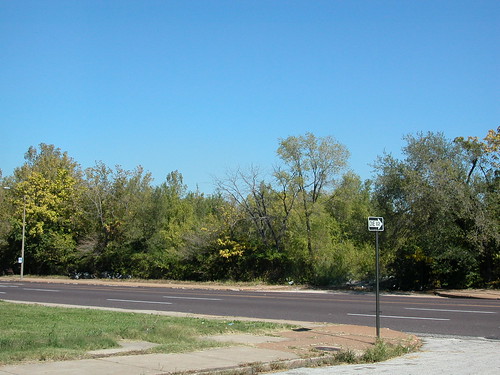
The Pruitt-Igoe site is now a forested island surrounded by neighborhoods.
The competition was created by P.R.O. Director Michael Allen and Nora Wendl, Assistant Professor of Design in the Department of Architecture at Portland State University. Advisors include writer and former Pruitt-Igoe resident Sylvester Brown, Jr., artist Theaster Gates, architect Karl Grice, former St. Louis Housing Authority Chairman Sal Martinez, The Pruitt Igoe Myth producer Paul Fehler, Washington University professor Eric Mumford, Alderwoman April Ford-Griffin and St. Louis Beacon Associate Editor Robert W. Duffy. Jurors will be announced August 1.
Throughout the process, community and stakeholder engagement is crucial. Pruitt Igoe Now doesn’t have a budget for public relations consultants, but it doesn’t have a protected corner office either. Please get in touch and make this a better experience for the city’s future. Leave comments here, email contact@pruittigoenow.org or call 314-920-5680.
Chain drug store giant CVS has a date this afternoon with the city’s Planning Commission. At today’s meeting, CVS will present plans to demolish the landmark mid-century modern AAA Building (1977, W.A. Sarmiento) on Lindell Boulevard for a new store. Read more at NextSTL.
Already Mayor Francis Slay — who was quick to take the Board of Aldermen to task over the demolition of the spaceship-like Phillips 66 station at Council Plaza — has posted a statement on his site sympathetic to preservation:
I believe that the loss of any distinctive element of our built environment must be justified by a new good at least its equal. It is not my current impression that the amenity of a new chain drug store within blocks of a couple of existing ones or the very ordinary design of the proposed building is such a good. I will, therefore, ask my office’s representative on the Planning Commission to cast a vote against the project today. And I urge the other members of the Commission to, at least, to consider doing the same until the developer has been more directly engaged.
This weekend, East St. Louis is celebrating its 150th anniversary with a two-day program of events. All events take place at the East St. Louis Higher Education Center, 601 James R. Thompson Boulevard in downtown East St. Louis.
The Ainad Temple (1923) at 615 St. Louis Avenue in East St. Louis was designed by William B. Ittner and Albert B. Frankel.
Friday, July 8, 2011: 11:00 a.m. to 1:00 p.m.
11:00 Building D Multi-Purpose Room
• Ceremony to mark the transition of the East St. Louis Action Research Project from the University of Illinois-Urbana/Champaign to Southern Illinois University Edwardsville; representatives from the two universities will review the history of the ESLARP program and the exciting plans for the future
12:00 Building D Multi-Purpose Room
• Brown Bag Lunch Program: Dr. Malcolm McLaughlin will be the featured speaker at this event, sponsored by the St. Louis Metropolitan Research Exchange. Dr. McLaughlin is a lecturer in American Studies at the University of East Anglia in England and is the author of Power, Community, and Racial Killing in East St. Louis, a study of the 1917 riot. Free parking in Lot E. The cafeteria in Building B will be open for lunch purchases.
Saturday, July 9, 2011: 9:00 a.m. to 2:00 p.m.
9:00 a.m.
• Family History Center (Building B Cafeteria, until 2:00): bring your elders and family photos to the Family History Center. SIUE students will record participants and their memorabilia on videotape for the University Archive and website. (Participants will be asked to sign a copyright release for the videotaping.)
• History Display Area (Building D Multi-Purpose Room, until 2:00): come visit the history display area for exhibits of East St. Louis’s industrial and cultural past. These include special displays by Eugene Redmond (poet laureate of the city), Howard Rambsy (director of the SIUE Black Studies Program), Reginald Petty (renowned local historian and author), and Edna Patterson-Petty (award winning artist, whose work is on display on the Higher Education Campus).
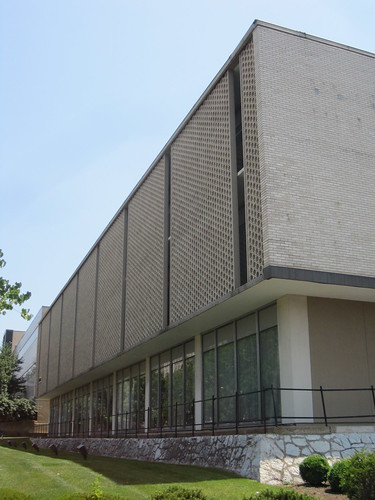
Every time I give a tour of the concentration of mid-century modern buildings along Lindell Boulevard between Grand and Kingshighway, I always stop at the former IBM Building at 3800 Lindell Boulevard. Built in 1959, the three-story building may have been a rather boring business box, but the designers at Hellmuth Obata & Kassabaum liberated the form.
What makes this building architecturally interesting as well as very practical is the cantilevered concrete block screens over the upper floors. The sectional screen reveals in each gap that the windows are nearly continuous behind — thus what seems like a very heavy building actually is light and airy inside, and screened from the sun out!
The screen is another demonstration that architects understood basic ideas about deflecting harsh sunlight and increasing energy efficiency long before they could win LEED points. The IBM Building isn’t “green” in today’s sense, of course, but it sure makes a smart move with the screens. This feature is sensitive rather than forceful, too: the screen’s overhang neatly matches the perimeter line of the battered, stone-faced pedestal on the Lindell Boulevard side. The rubble stone contrasts smartly with the modern, regulated masonry and concrete above.
Alas, today St. Louis University started removing the screen from the building. Now called Adorjan Hall, the building houses various humanities departments. Most of the upper floors is office space, occupied by professors and support staff who will now work against huge, unshielded clear glass windows. An energy-efficiency feature from 1959 is being removed in 2011, when we supposedly know better how to “green” our buildings.
This morning, in an unusual step, the Housing, Urban Development and Zoning Committee of the St. Louis Board of Aldermen held a spirited and divided discussion on a seemingly-routine redevelopment ordinance: Board Bills 118 and 199, pertaining to the ongoing redevelopment of Council Plaza by developers Rick Yackey and Bill Bruce. Board Bill 118 enabled a redevelopment plan approved by the Land Clearance for Redevelopment Authority that would entail demolition of the mid-century awesome former Phillips 66 gas station now used as a Del Taco restaurant. Board Bill 119 makes changes to the Council Plaza tax increment financing (TIF) that would allow TIF funds to cover demolition costs. Both passed, but Board Bill 118 made it out with only on a 5-2 vote.
Photograph by Rob Powers, builtstlouis.net.
I write that it was “only” a 5-2 vote because the split truly is unusual for the committee. Bigger fish have been fried by consensus or with minimal dissent. The CORTEX redevelopment ordinance that is responsible for the current demolition (without preservation review) of the bakery complex at Vandeventer and Forest Park? Passed by a unanimous vote in 2006. The enormous and contested Northside Regeneration project’s ordinance, now invalidated by a circuit court ruling? Passed with only one “nay” — Alderman Terry Kennedy — in 2009.