Readers are no doubt aware of the demolition threat to the former Phillips 66 station, now Del Taco, at Council Plaza. On Wednesday morning, the Housing, Urban Design and Zoning Committee of the Board of Aldermen will consider Board Bill 118, a redevelopment plan sponsored by Alderwoman Marlene Davis (D-19th) that would make the demolition plan into city law. The committee has the power to change the bill or vote against its release to the full Board of Aldermen.
Once passed out of committee, Board Bill 118 will have to have at least two more readings at the regular Friday sessions of the Board of Aldermen. Its defeat or amendment on the floor is only possible if a majority of the 28 aldermen — that would be 15 — stand up for the beloved Googie building. One possible amendment would be clarifying whether preservation review will still apply under the legislation. The current version contains language that seems to bind the city’s Cultural Resources Office to approve any demolition permit for the midtown spaceship.
Should a majority endorse Board Bill 118, the bill heads to Mayor Francis Slay for signature — or veto.
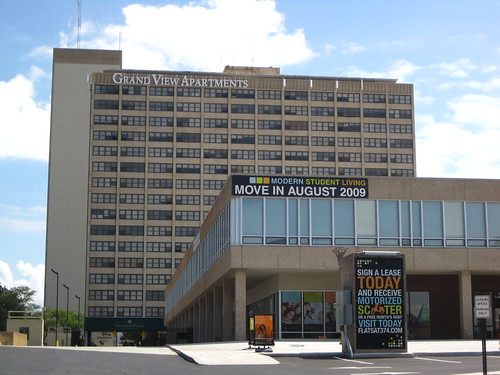
Council Plaza is located at 212-300 S. Grand Boulevard and consists of two residential towers, a two-story commercial building over covered parking and the space-age Phillips 66 service station that is now a Del Taco restaurant. These buildings were built between 1964 and 1968. In 2007, the National Park Service placed Council Plaza on the National Register of Historic Places as a historic district despite their relatively young age. The listing affirmed that Council Plaza had “exceptional significance” under National Register guidelines and could be listed ahead of its 50th birthday.
Lewis Place residents are cautiously optimistic following the announcement.
Today on the median of Lewis Place, St. Louis Mayor Francis Slay joined Alderman Terry Kennedy (D-18th), Lewis Place Historical Preservation President Pam Talley, Health and Human Services Director Bill Siedhoff and Preservation Research Office Director Michael Allen to announce that the city was close to putting together $1 million in home repair funds for uninsured Lewis Place homeowners affected by the tornado on December 31, 2010. (More of our coverage, including photographs showing the extent of damage, can be found here.)
After over six months, some much-needed relief will arrive if the Board of Estimate and Apportionmate approves matching $500,000 in state disaster aid funds with an equal match out of the city’s major projects allocation of Community Development Block Grant funds. MayorSlay.com has details of the program here. Mayor Slay, Comptroller Darlene Green and Alderman President Lewis Reed, the three members of the board, all support the package. While there are still issues faced by underinsured homeowners, today’s announcement signals that major relief is finally on the way.
In 1947, the City of St. Louis published as a guiding document a Comprehensive Plan that called for bringing the city’s land use and zoning codes up to then-modern standards. Among the recommendations of the plan were the clearance and rebuilding of several large, older sections of St. Louis, including most of the historic Soulard and Kosciusko districts just south of downtown. In 1951, the Board of Aldermen took a dramatic step toward large-scale urban renewal projects by creating the Land Clearance for Redevelopment Authority (LCRA) “to undertake the acquisition, relocation, demolition, and site improvements of the urban renewal areas. . . which needed Federal assistance.”
The C. Hager & Sons Hinge Company Buildinga at 139 Victor Street, listed in the National Register of Historic Places, are among the few buildings not demolished as part of the Kosciusko clearance project.
Governed by a five-person board appointed by the Mayor, LCRA became the means for a variety of ends in redevelopment. At the end of 1953, LCRA attracted a new Executive Director, Charles L. Farris, former Deputy Director of the Federal Slum Clearance and Urban Redevelopment program, Housing and Home Finance Agency, Washington D.C., Farris previously had been appointed by LCRA Board of Commissioners on the recommendation of new Mayor Raymond R. Tucker.
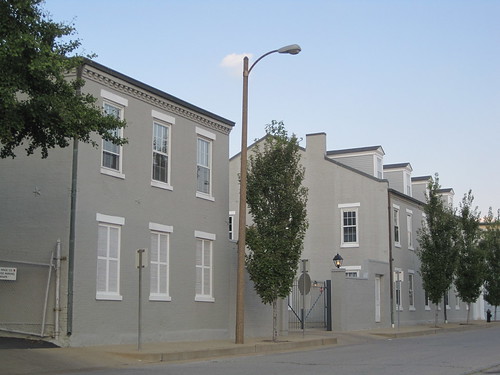
Kosciusko around Russell Boulevard with Broadway and the Soulard neighborhood at left. View is looking north.
Under Farris, LCRA moved rapidly to implement the redevelopment recommendations of the 1947 plan. One endeavor was the clearance of the Kosciusko district, which city planners envisioned as an appropriate district for industrial expansion. Kosciusko was a dense, somewhat-rundown assembly of 19th century brick commercial buildings and tenements as well as industrial facilities that had sprung up on the riverfront and expanded into the neighborhood. Kosciusko had many social and physical ties to the adjacent Soulard area, and, in fact, architecturally was greatly similar. Like Soulard, the 2,941 residents of Kosciusko were predominantly poor. The housing stock was substandard, and the industries were land-locked with little alternatives except moving out of the district.
My spring 2011 internship with the Preservation Research Office has allowed me to integrate academic interest with the simple desire to become a more dedicated member of the St. Louis community. Engaging with the type of work practiced by the PRO’s architectural historians has given me a rewarding experience not only in architectural history, but also in the deeper significance of historic preservation for the St. Louis community.
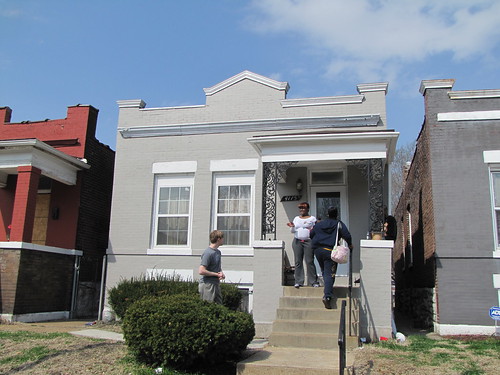
Christian Frommelt talks with O'Fallon residents on Turner Avenue.
Since February 2011 I have primarily worked on building permit research, architectural photography, and building descriptions for the P.R.O.’s large-scale architectural survey of the O’Fallon neighborhood. As a result of this survey project the neighborhood will be recognized by the National Register as a Historic Place by this time next year. My latest contribution to the O’Fallon survey project involved collecting oral histories provided by North St. Louis residents, an aspect of the project that unified a study of the built environment, a deeper understanding of social issues such as demographic shifts in St. Louis, and one woman’s personal experience at the forefront of a transitioning neighborhood in North St. Louis.
Mabel Jones, an enthusiastic citizen of the Penrose neighborhood, was the first to participate in an interview. She outlined her decision to move at age twenty from Whiteville, Tennessee to St. Louis, where she began working in a laundromat and later on the Near North Riverfront’s Produce Row. As she described her marriage and the upbringing of her five children, Mabel highlighted her ability to gradually move from cramped kitchenette apartments west of Downtown St. Louis during the late 1940s and early 1950s, to a new Pruitt and Igoe housing project in 1957, and, a year later, to the type of family home she had always admired in the Penrose neighborhood. Mabel detailed the make-up of her block as it quickly transitioned from a primarily white to primarily black block, and recounted the struggles, and also the pride, associated with being the first black family on a block of respectable single-family houses.
While I am thankful for having gained the ability to identify hipped dormers, quoins, and belvederes, my interactions with PRO staff, residents we met on O’Fallon streets, and community-minded enthusiasts like Mabel Jones, are what transcended the trudge of busy work which so explicitly marks many undergraduate internship experiences. My relationship with other people in St. Louis is what brought out-of-book research to life. As I have learned, the success of local preservationists and architectural historians lies not solely in a knowledge of and passion for St. Louis’ built environment, but also a steadfast recognition of the humanness in preserving our cityscapes. The fabric of the city does not consist merely of the architecture we admire from a distance, but of the people who inhabit St. Louis’ buildings, businesses, parks, and streets we all too frequently bypass.
Christian Frommelt was one of PRO’s interns from January through May 2011. He is the author of the blogMound City Stomp.
Please come on this Saturday’s Rehabbers Club tour as we visit two Works in Progress buildings in the Tower Grove East neighborhood.
9:30 a.m.: Tour site #1: 3434 Humphrey St. 63118
Patty Maher is the owner/developer of this all brick home that is for sale for $240,000. She is almost done rehabbing the building and has used green rehabbing techniques and state historic tax credits. The building recently won DeSales Community Housing Corporation’s “Gold Brick Award” in recognition of high quality work happening here.
This spacious home will have four bedrooms, three full bathrooms and an office. Universal design techniques have been applied on the first floor which includes a bathroom and bedroom. Come learn about the work the Patty has done to modernize this beautiful building.
10:30 a.m.: Tour site #2: 2945 Michigan Ave. 63118
David searched the city for almost two years to find a property that was roomy, in an emerging neighborhood and what he calls a “livable rehab”. Now, after fourteen months of living in the attic, three general contractors and lots of paint chips, David and Tiffany are still at it, behind pace, but on budget.
The home was built in 1892 as a multi-family residence. David and Tiffany moved stairways and doorways to combine the apartments into a single family home.
David and Tiffany have done their best to re-use and repurpose as much of the home as possible. They’ve drastically improved its energy efficiency by replacing all 22 windows, adding a tankless hot water heater, converting to natural gas, updating the electrical and water lines and will soon add a white painted roof.
Our friend and collaborator Andrew Raimist is leading the effort to raise funds for a very worthy summer arts program taking place in the fragile but beautiful Hyde Park neighborhood. In (en)visioning Hyde Park, students in 5th through 8th grade will be working to improve their Hyde Park neighborhood and documenting the progress using photography. Students will learn the basics of digital photography from image capture through editing, printing and publishing.
This effort will be lead by teaching artist Raimist with the generous support of other photographers, artists and educators. ReBuild Foundation is the major sponsor of this workshop as part of their Urban Expressions outreach mission.
This program takes place in collaboration with artist Theaster Gates’ CityStudioSTL’s rehabilitation of a vacant Hyde Park home to create a community gathering place.
A full-color book of the students’ photographs, drawings and writings will be professionally published. Each student will get their own copy to have in hand when school begins in the fall. This experience will enhance their educational achievement and self-confidence.
Grassroots support for this program will provide immeasurable benefits to the students, their families and their neighborhood. Your backing demonstrates widespread commitment to the underserved children of North St. Louis.
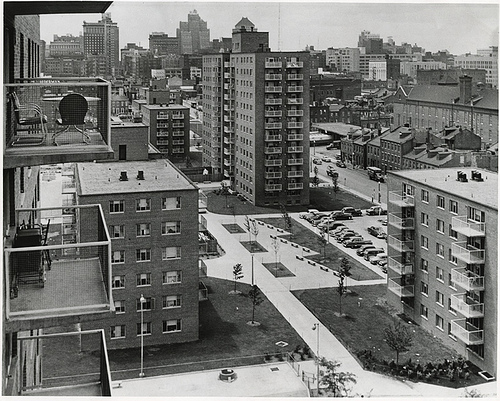
Cochran Gardens, designed by Hellmuth, Yamasaki & Leinweber and completed in 1953.
.
Architectural historians Michael Allen and Lynn Josse, both of Preservation Research Office, will provide an overview of the history and design of public housing in St. Louis city, from low-rise Carr Square Village in 1941 through the high-rise Arthur Blumeyer Homes in 1968. The talk will cover the contributions to local public housing architecture by major designers like Minoru Yamasaki, Gyo Obata, Joseph Murphy and others. With St. Louis’ two public towers both slated for demolition in the next two years, the talk will devote special attention to the development of high-rise housing forms and features at the Cochran Gardens and Pruitt-Igoe projects. Remaining public housing buildings at Carr Square and Clinton-Peabody have been heavily altered, meaning that the last intact buildings soon will fade to memory.
The Soulard Blues Band plays on the bandstand, summer 2010. Photograph by Tom Lampe.
Unfortunately, wood is both a common architectural material and highly combustible. These traits were apparent Wednesday when the beloved Carondelet Park bandstand, which was built after 1916, was destroyed by fire. All that remains of the bandstand are the concrete piers, ash and charred pieces of the historic structure. The bandstand was totally lost. Or was it?
The Parks Department is proposing that the structure quickly be replaced by a “fire resistant”†version of what was lost. The phrase “metal and fiberglass that looks like Victorian-style structures” even appeared in a St. Louis Post-Dispatch article this week, followed by the notion that other wooden structures in Carondelet Park be coated with fire-proofing.
Certainly, the way forward is a dual look at the past and the future, but the Parks Department is looking the wrong ways. For starters, the lost bandstand built in St. Louis’ fruitful City Beautiful period and fifteen years after Queen Victoria’s death is far from a “Victorian” structure. The bandstand was an elegant, purposeful and picturesque structure set deliberately into Carondelet Park’s romantic landscape. The landscape was developed starting in 1876 following principles of landscape architecture that were indeed Victorian, but the bandstand came in the era of City Beautiful park planning and was a monument to St. Louis’ early 20th century development of public amenities and park improvements following the publication of our first Comprehensive Plan in 1907.
Thus the bandstand married the ideals of its time with those of earlier era. That is exactly what its replacement should do. A good architect will be able to join the setting in Carondelet Park with the needs of a 21st century bandstand as well as the aspirations of St. Louis today. The Parks Department should be looking for that good architect instead of rushing to build a replacement structure that would be hasty and anachronistic. Few people’s depiction of the modern character of this city would include the words “fiberglass” or “Victorian.”
As for fire-proofing other wooden structures, that is a troubling proposal. Coated wood may not burn easily, but it will trap moisture that will lack a way out. The parks department might find that flash fires are not as expensive or common a problem as slow rot of wooden structures coated with inappropriate and impermeable materials. After all, the Carondelet Park bandstand – may it rest in peace – stood strong for over 90 years.
Starting tomorrow, St. Louisans have the chance to view large-format versions of the dazzling and poignant images of American City: St. Louis Architecture: Three Centuries of Classic Design. Written by Robert Sharoff and photographed by Bill Zbaren, the volume is the first lushly illustrated monograph on St. Louis architecture since….well, ever. One has to reach back to John Albury Bryan’s masterful Missouri’s Contribution to American Architecture (1928) to find a volume connected to St. Louis’ built past close to the scope, reverence and beauty of this one.
We will review the volume and the exhibition shortly, but meantime wish to extend the invitation to the exhibition at the Missouri Botanical Garden opening tomorrow evening. Details follow. While the book’s format offers many page-size images, the photographs in the exhibition will be lavishly scaled. Don’t miss the opportunity!