Yesterday, we conducted the first of several intensive photographic excursions needed for our survey of the O’Fallon neighborhood. By the time we are done with photography this month, we will have photographed an estimated 1,796 buildings in the area roughly bounded by Newstead/Pope avenue, O’Fallon Park, Warne Avenue, Fairground Park and Natural Bridge Avenue. Our work yesterday took us around the Plymouth Park subdivision just south of O’Fallon Park, where we walked Carter, Clarence, Holly, Red Bud, Harris, Fair and Rosalie avenues.
Next we will write a narrative description of each building. Simultaneous to all of this work, we are examining the city’s building permit records on microfilm to learn the date of construction, cost, designer, builder and original owner of each building. This is a tall order, but needed to create a National Register of Historic Places historic district for the entire O’Fallon neighborhood.
As we work, enjoy some of yesterday’s photographs.
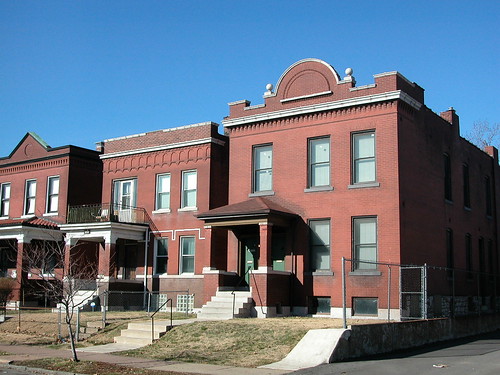
Corner two-part commercial building at Rosalie and Clarence avenues.The 4400 block of Harris Avenue.
The buildings found in the entire O’Fallon neighborhood and in O’Fallon Park should be an official historic district in early 2012. Over the next year, historians from the Preservation Research Office will be found in every part of the O’Fallon neighborhood and in archives all over town. They will be putting together the story of the neighborhood in order to nominate it to the National Register of Historic Places. Alderman Antonio French funded the project for The Acts Partnership in order to increase investment within the neighborhood by enabling property owners to benefit from historic preservation tax credits.
This work takes place at the same time that a similar project is taking place in Penrose, meaning that almost all of the 21st Ward could be included in historic districts in the next year. Currently, Holly Place — the 4500 block of Holly Avenue — is the only historic district in the ward.
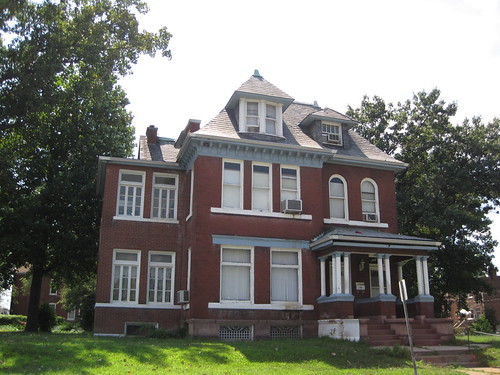
A house on Algernon Street facing O'Fallon Park.
“National Register historic districts lead to tremendous benefits for urban neighborhoods,” said team leader and Preservation Research Office Director Michael Allen. “They contribute to a sense of community pride, build identity, and can bring resources and investment.” Unlike local historic districts, the proposed National Register district will not involve any additional restrictions on properties — just benefits such as Missouri’s 25% historic rehabilitation tax credit.
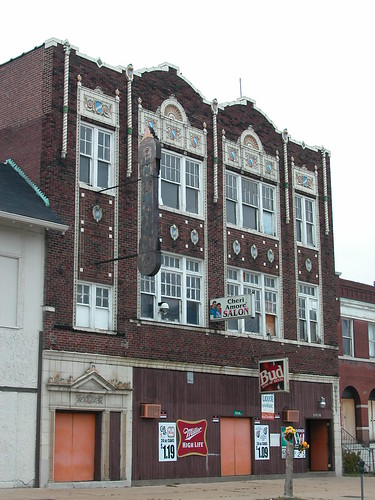
This three-story commercial building on Warne Avenue once housed an upstaird bowling alley.
The O’Fallon neighborhood has a long and interesting history. Subdivision development began as early as 1859 with the subdivision of the White family’s farm. Other major landholders in the area are now familiar names, including Shreve, Vandeventer, Carter, and of course O’Fallon. In 1875, the city purchased portions of John O’Fallon’s estate, dedicating 158 acres as O’Fallon Park in 1875. Amenities were added with the lake in the 1890s and the boat house in 1908.
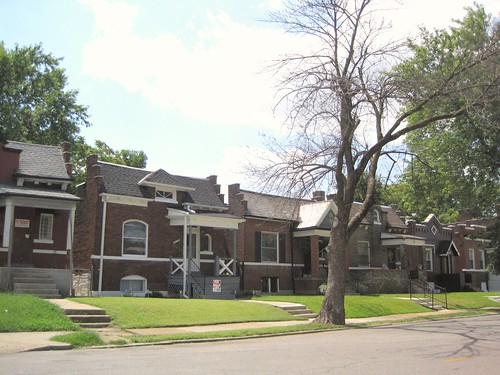
Houses on Carter Avenue.
The development of O’Fallon Park led to development of the area just south through the O’Fallon Heights, Plymouth Park and Wanstrath Place subdivisions. Early transit lines to the area were limited to parts of Natural Bridge in the 19th century. Streetcar service was later added on Florissant, Lee, Newstead and Fair/Harris avenues. These subdivisions generally were developed between 1890 and 1930 with buildings using prevalent locally-sourced materials like decorative and standard brick, limestone, and clay roof tile. Major buildings include the Boathouse in O’Fallon Park, Holy Rosary Church and Full Gospel Apostolic Church.
To be listed in the National Register of Historic Places, a neighborhood must have significant architecture or history. O’Fallon retains a consistent density and use of common building materials that unites the neighborhood. The entire process will take a little more than a year from project beginning in February to its end next spring.
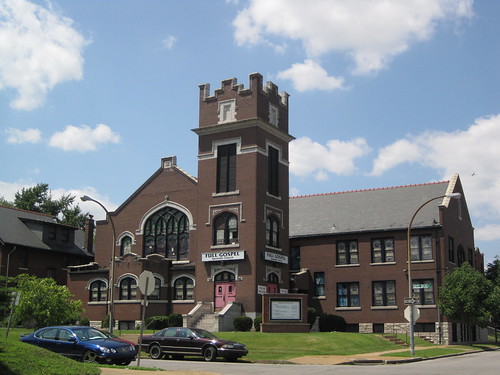
The Full Gospel Apostolic Church, built in 1913, at Rosalie and Red Bud avenues. Currently The Acts Partnership is raising funding to acquire the church for reuse as a community center.
Oral History Project
As part of the survey and historic district project, the Preservation Research Office is conducting interviews with O’Fallon residents. Our intern Christian Frommelt, a senior anthropology major at Washington University in St. Louis, has a special interest in oral history that we are utilizing this spring. The historians especially want to get stories from long-time residents. Since much of the neighborhood was built a long time ago, the team wants to make sure that current residents are also part of the recorded history of O’Fallon. Team members will collect residents’ stories about the neighborhood at the Acts Partnership office at 4202 Natural Bridge throughout the spring.
Avoiding a government shutdown, earlier this week Congress passed a two-week Continuing Resolution extending federal funding until March 18th. Addressing many lawmakers’ calls for spending cuts, the CR eliminates $4 billion in funding. Historic preservation programs were spared the “axe.”
Unfortunately lawmakers must still decide what to do about spending for the balance of FY 2011 and there is still widespread disagreement between legislators who want to see substantial cuts (such as the $61 billion proposed in House-passed H.R. 1), and those who want few or no additional cuts for the balance of the year — instead focusing on FY 2012.
As we have been reporting, the House CR (which the Senate immediately rejected), would have eliminated funding for the Save America’s Treasures (SAT) and Preserve America programs but spared funding for National Heritage Areas. It would also have made sweeping cuts to the Community Development Block Grant program, the National Endowment for the Arts and the National Endowment for the Humanities. It would also have made cuts to the Land and Water Conservation Fund.
At the same time lawmakers are trying to find a compromise to wrap-up FY 2011, hearings began this week on the President’s proposed FY 2012 budget — which recommends increasing funding for State and Tribal Historic Preservation Offices and eliminating funding for SAT and Preserve America and cutting funding for Heritage Areas in half. Yesterday, the House Committee on Natural Resources conducted a hearing on the President’s proposed budget with Interior Secretary Ken Salazar. In his testimony, Salazar mentioned the proposed cuts:
Examples of the tough decisions made in 2012 include terminating the $7.0 million Rural Fire Assistance program which is duplicative of other fire assistance grant programs managed by the Department of Homeland Security and Department of Agriculture. The National Park Service’s Save America’s Treasures and Preserve America programs are eliminated in 2012 to focus NPS resources on the highest priority park requirements. The NPS Heritage Partnership Programs are reduced by half to encourage self-sufficiency among well-established National Heritage Areas while continuing support for newer areas.
A central theme to his testimony was the America’s Great Outdoors initiative which he said “…can support a renewed and refreshed conservation vision by working in collaboration with [those] … who are working to protect the places that matter to them and by engaging people across the country in conservation and recreation.” The centerpiece of the AGO initiative is a call for full-funding ($900 million) for the Land and Water Conservation Fund. Several other hearings will be taking place next week.
Preservation Action opposes the proposed cuts in the President’s Budget as submitted, but supports the modest increases to State and Tribal Historic Preservation Officers. Next week, at Lobby Day, Preservation Action and its partners will be advocating for: $50 million for State Historic Preservation Officers; $11 million for Tribal Historic Preservation Officers; and $9 million for Save America’s Treasures and Preserve America. Recognizing the current budget climate, collectively this $70 million budget request is actually ten percent less than total program funding for FY 2008.
This year, the Old Courthouse Players follow the paths of three St. Louisans who journeyed to the West…
As always, NiNi and Sheila Harris have prepared a script taken straight from the words of the historical figures themselves. Figures with surprising St. Louis connection in the play include Buffalo Bill Cody, who met his future wife and city native Louisa Frederici in St. Louis’ Frenchtown district, to German-American Otto Barby, whose path to becoming an Oklahoma land baron began in south St. Louis.
Those with any doubts about the entertainment offered by a historical radio-style play should note that this will be the Old Courthouse Players’ first play to make use of sound effects. Perhaps also the players themselves will draw at least one person; the cast includes Michael Allen, Jennifer Clark, Doug Dunphy, Jennifer Halla, Joan Hempen, Annette Hudson, John Knoll, Bob Officer, Craig Schmid and Debbie Wheeler.
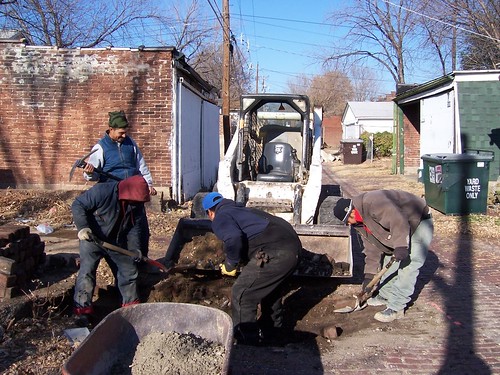
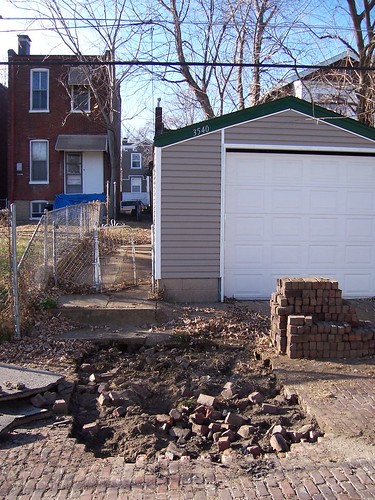
Recently I wrote about two lovely intact brick alleys in the St. Louis Place neighborhood on the north side (see “St. Louis Place: Sidewalk Plaques and Brick Alleys”, February 11). After publishing that post, I learned that there is a pilot program underway to restore 17 brick alleys in two of the city’s south side historic districts, the Gravois-Jefferson Historic Streetcar Suburb District and the Benton Park Historic District. Some work began in December in Gravois Park, and more will start when weather is consistently dry. Work will be completed by August 10, 2011.
A crew working in December 2010 on brick removal in the alley between the 3500 blocks of Louisana and Tennessee Avenues. Photograph by Eric Bothe.
When alderpeople put in requests for allocation of the city’s American Recovery and Reinvestment Act funds, Alderman Craig Schmid (D-20th) successfully applied for $975,000 to restore and retain historic brick alleys in the historic districts of his ward. The city’s Department of Streets stopped repairing brick alleys in 1978. Subsequently, many miles of brick alleys — which are durable, made from long-lasting brick, easy to repair and moderately water-permeable — have been paved over with asphalt that comes from a nonrenewable source, is not water permeable and is expensive and difficult to repair. Paved brick alleys typically have problems with settling that new paving only compounds. The city fills depressions in brick alleys that eventually sink again, and finds itself having to pave and repave alleys that could have simply been restored. Asphalt paving destroys the integrity of paver bricks, so that even when asphalt surface material is removed the alleys cannot be restored. The practice is unsustainable and expensive.
Removing bricks in the alley between the 3500 blocks of Louisiana and Tennessee avenues. Photograph by Eric Bothe.
Meanwhile, the city no longer repairs existing brick alleys. If residents don’t want asphalt, they won’t get any repairs. Also some aldermen use allocations of paving to pave brick alleys with no problems in order to avoid having to return allocations. Schmid has wanted to retain brick alleys for awhile, but could not use existing money to do so. The Department of Streets needs to change its brick alley policy. Meanwhile, the 20th Ward is the first to experiment with restoring brick alleys using a one-time grant of federal stimulus money.
The good news is that federal stimulus money is funding a small but significant project that implements a sustainable approach to retaining brick alley paving. The project fits the goals of the Obama administration in encouraging green practices through federal spending, but it still leaves permanent policy changes up to the city of St. Louis.
This Wednesday, join our own Lynn Josse as she discusses some of St. Louis’ recent historic districts over lunch at the Cafe DeMenil at the historic Chatillon-DeMenil House. Lynn’s illustrated talk kicks off the cafe’s series of lunch time lectures.
Place: Cafe DeMenil 3352 DeMenil Place St. Louis, MO 63118
Time: 11:00 am
Lunch Special for $6.95, plus full menu available. Reservations recommended
More Information: 314-771-5829
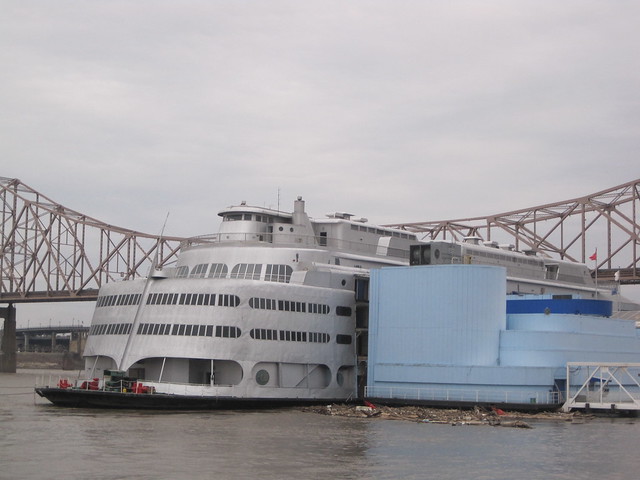
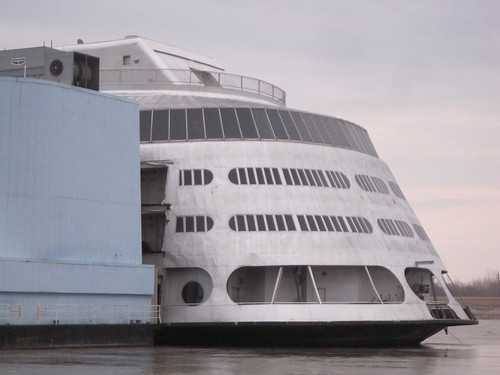
Soon the S.S. Admiral’s streamline, art moderne superstructure may be converted into cold hard cash at the going rates as high as $300 a ton. As soon as next week the old boat may be towed away to be picked apart by the skilled hands at the appropriately-named Cash’s Metal Recycling. So goes the 71-year run of the city’s finest floating pleasure palace.
Yet preservation circles are mostly silent on the death of one of the city’s most beloved mid-century icons. Perhaps the end of the boat has seemed like a foregone conclusion ever since its engines were removed in 1979. That act tore away the best reason to set foot upon the Admiral: being able to glide up, down and around the Mississippi River while dining, dancing, courting and sparking. The Admiral’s short life as a moored entertainment center was a bust, and its subsequent use as a casino was extended not through any great affection but by Missouri’s now-defunct loss limit law that sent Lumiere Place patrons over to keep their fix flowing. The Admiral’s once-dazzling interior had long been denuded of any of the swanky swagger of yesteryear. What was left was an artifact — a riverboat left without engines, dining room, band stand or dance floor.
Of course, the S.S. Admiral was not a hopeless cause, and wild imaginations conjured future worlds in which the Admiral was pulled onshore and reclaimed with artistic license. Yet no one imagined bidding fairly on the Admiral at auction in November — not a single party. There were no last-ditch “Save the Admiral” campaigns, a fact counterbalanced by the persistent and now well-organized effort to save the earlier Goldenrod Showboat.
The swell of nostalgia that saves Historic Things did not flood over the Admiral, which may have been too young and too much a part of the unpleasant present-day reality of gambling to be a fitting subject. The S.S. Admiral’s demise points to the need for continued advocacy for parts of our built past that are within our grasp. A building (or boat) young enough to be part of the lives of many people still living should be revered because it touches so many lives still being led.
Today’s release of the 2010 United States Census figures brings the bad news that St. Louis now officially has 319,294 residents. St. Louis has lost nearly eight percent of its official 2000 population of 348,189 people. The bad news factor has been amplified, of course, by the last few years’ worth of estimated Census counts that suggested today would bring confirmation of city population growth. Pundits and politicians now are revving up the engine of forecast, with perfect hindsight vision.
This writer has not reviewed enough of the data to make any pronouncements about what this means, but still has an observation to offer. St. Louis now has its lowest population since 1870, when the Census showed 310,864 residents. This was a 93% increase since 1860, when the city had 190,524 residents and was the nation’s eighth largest city. (Only New York and Philadelphia then had populations of more than 500,000 people.) Despite the ravages of the Civil War, the next decade showed continued explosive growth albeit at a slower pace than the previous ten years. In 1850, St. Louis had 77,860 residents, so the 1860 Census count represented an increase of over 106.5% increase. The prior two decades registered increases of 230% and 372% respectively. But those increases were made before St. Louis could rightly be called a city.
What happened in the next decade showed a continuation of impressive and explosive development in St. Louis. The city dedicated one of the nation’s largest parks, Forest Park, as well as O’Fallon and Carondelet Parks. Established parks including Lafayette Square and St. Louis Place received their first extensive improvements, making them as beautiful as any in the United States. Great breweries, factories and grain elevators rose all over the riverfront and industrial districts. The city’s first bridge over the Mississippi was opened in 1874, connected within a year by a massive double-arched tunnel to the railyards south of downtown and the new Union Depot. In 1875 the Merchants’ Exchange completed a massive, elegant new building at Third and Chestnut streets designed by Lee & Annan and containing a magnificent trading hall. Construction began in 1872 on a massive new post office and federal building designed by Alfred B. Mullet at Eighth and Olive streets. Tall office buildings, including George I. Barnett’s St. Louis Life Insurance Building of 1874 at Sixth and Locust streets, rose around downtown. Major churches in the Gothic Revival style rose around the city. Vandeventer Place was developed. New houses large and small went up everywhere, and additions were made to the city with great rapidity. In 1876, the city of st. Louis extended its physical boundary to the present limits, and many subdivisions made outside of the 1855 boundary started developing.
St. Louis in the 1870s was alive with the magnetic aura of purpose and grandeur. When the Census of 1880 was released, the population was recorded at 350,518, an increase of only 12.8% over 1870. The city fell from fourth to sixth largest in the United States. Did that number rouse boosters to issue warnings of impending decline or loss of position? Not at all. City leaders and even national observers continued to praise the mercantile prowess and architectural beauty of St. Louis. In 1884, William Bishop wrote Harper’s New Monthly Magazine that St. Louis could envision a glorious future as the center of the Mississippi Valley. Of course the city’s highest achievements were still ahead, and by 1900 it was again the fourth largest city in the nation. Still the 1880 Census indicated that national migration was trending away from St. Louis and other cities of the northeast and Midwest. Yet the city leaders of St. Louis pushed forward, regaining position, building population, changing the city charter, and — most importantly — making the city a better place through physical improvement and economic development. Surely in 2011 these remain options for St. Louis.
Last night Toby Weiss and I presented a talk on mid-century modern preservation and the new group Modern STL at the Alton Area Landmarks Association‘s monthly membership meeting. Here’s a clip of Toby discussing how the generation gap plays out in the rise of the movement to preserve modern architecture. – Michael R. Allen
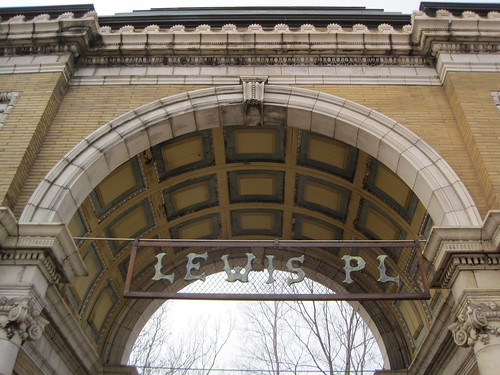
Detail of the Lewis Place gate at Taylor Avenue, designed by Barnett, Haynes & Barnett and completed in 1894.
St. Louis Rehabbers Club Tour of Lewis Place
Saturday, February 19, 2011
9:30 – 11:30 a.m.
Location: 4535 Lewis Place, St. Louis, MO 63113
The St. Louis Rehabbers Club will feature Lewis Place. The neighborhood is immediately north of the Central West End and was recently in the news for extensive tornado damage. Our tour will not only look at rehabs, but will also view the tornado damage to these historic properties.
Our first stop of the day is 4535 Lewis Place. The new home owner and rehabber has lots to show on the work completed. With a setback from the tornado, the property owner is eager to move forward on other projects around the house.
Next, we will move to #50 Lewis Place. This young family purchased her grandparents’ home several years ago and have done an excellent job fixing it up.
We’ll look at the damage on Enright and Newberry Terrace before visiting 4604 Newberry. This gentleman inherited this home almost two years after his 90 year old dad passed away. He has been working on this house since then and is happy to show his rehab progress.
Lastly, we’ll ride and view the damage on Page, Martin Luther King Dr, Aldine, Cote Brillian, and Evans. If time permits we will visit 4530 Evans. Work has been done on the living room, dining room and kitchen though it too sustained some tornado damage.
We look forward to seeing you on Saturday morning. Call Scott McIntosh, St. Louis Rehabbers Club Vice-President at 314-719-6507 with questions.
St. Louis Rehabbers Club tours are FREE and are open to anyone interested in the City of St. Louis. St. Louis Rehabbers Club is program of ReVitalize St. Louis, a registered 501c3 nonprofit organization. For more information, please visit www.rvstl.org.