Categories
Demolition Midtown

SLU Removes Another Locust Street Building

by Michael R. Allen

Perhaps it comes as little surprise that St. Louis University has now demolished the vacant building at 3227 Locust Street that it owned at the northeast corner of Locust and Leonard streets on Automobile Row in Midtown. After all, the hole in the roof of the one-story corner building had grown so large that Google’s satellite images made the damage clear. Residents of the loft units across the street had an ever closer, and more graphic, view.
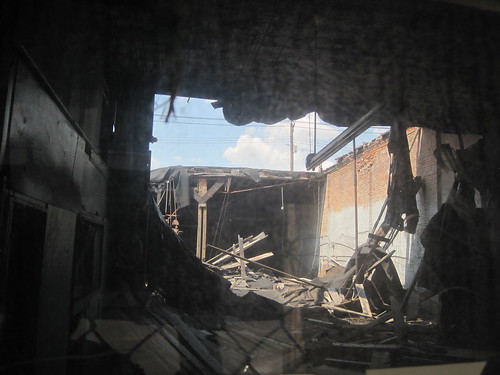
Looking inside of 3227 Locust Street through the front door's window, July 2010.

The hole in the roof is now a hole in the street wall at a corner intersection. Contrast the appearance of the corner in July 2010 with the appearance today:

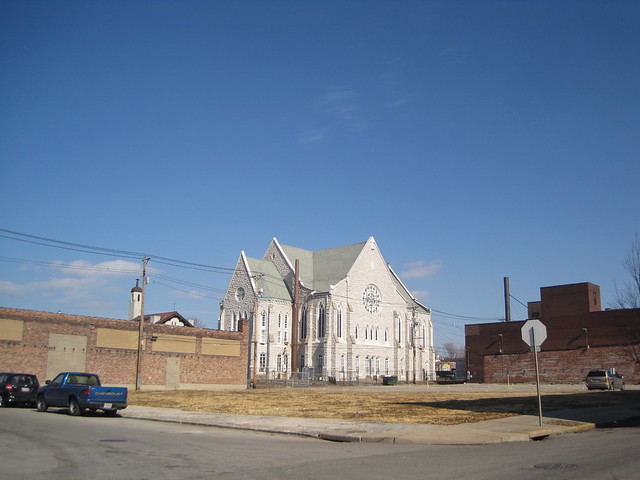
While undistinguished architecturally, the building defined a cross-street intersection and provided continuity between the more developed blocks of Locust east of Compton and the emerging development around the Moto Museum to the west. The visual gap between these two areas has grown, at a time when even the university had embraced rehabilitation of other buildings it owns on the block to the west. This lost building had a solid masonry body and needed only a new roof. It was a sturdy shell that could have been a turnkey retail or restaurant project. Now the corner development entails new construction, ratcheting the cost of making something happen there higher than the reach of post-bubble developers.


View Larger Map

A look at the map makes the impact of what otherwise might seem to be an insignificant building clear.
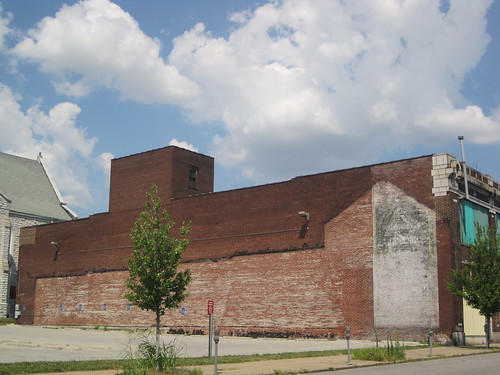
To the west, a parking lot and another corner building.

To the west of the building already was a parking lot, which could have provided interim parking for any user of the corner building. How likely is infill of this block within the next five years? How much more likely was reuse of the building at 3227 Locust Street?
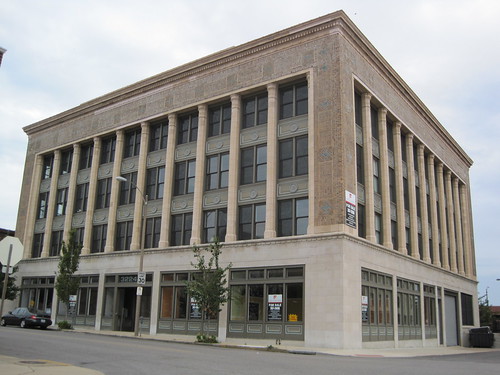
Across the street at 3224 Locust Street is the recently-rehabilitated Cadillac Building (1919; William A. Balch, architect)

    Amid the ebbs and flows of Locust Street’s emerging new life, there have been some amazing successes — the Automobile Row historic district designation, the new SLU-backed hotel project — as well as avoidable mistakes — the livery stable fiasco, the closure of Josephine Baker Avenue. This small demolition suggests that the area would benefit from demolition review, which it currently lacks. Most of the Locust Street business district is in the 19th ward, which is one of a handful of city wards whose aldermen opted not to have demolition review when the city passed its latest preservation ordinance in 1999. With so much vacant land whose fate is key to maintaining the urban character, a zoning overlay and local historic district ordinances could also be appropriate.

Categories
Art Events

Exhibition on Max Lazarus at the Sheldon

Max Lazarus: Trier / St. Louis / Denver — A Jewish Artist’s Fate
February 18 – May 7, 2011
Opening Friday, February 18 from 5:00 – 8:00 p.m.
The Sheldon Art Galleries

Organized by the Stadtmuseum Simeonstift, Trier, Germany, this exhibition traces the life and artistic development of the German-Jewish artist Max Lazarus (1892-1961) through over 50 paintings, lithographs and synagogue designs. An extraordinary colorist, Lazarus produced expressive works that included landscapes, portraits, and some politically charged subjects. Lazarus fled Germany in 1938, after being forced to work secretly in Germany during the rise of the Nazi party. He lived first in St. Louis, where he had a family, then moved to Denver, Colorado, where he contracted tuberculosis.

His early career is represented in the exhibition with a self-portrait, several Trier landscapes, and a number of prints. Scenes from his time in St. Louis, like views of the Old Courthouse, Grand Avenue and the United Hebrew Synagogue (now the Missouri History Museum Library and Research Center), as well as paintings that reflect the changing Denver cityscape in the 1940s and 50s, are also included. Lazarus’s story stands as an example of innumerable “disrupted biographies” that occurred during the rise of the Nazis to power. Lazarus’s life and career were disrupted twice: first by the Nazis and then by his health. He died in Denver, Colorado in 1961. A selection of Lazarus’s synagogue mural designs will be on view during this time in a separate exhibition in the Bernoudy Gallery of Architecture.

The exhibition is underwritten by the David S. Millstone Arts Foundation with additional support from Nancy and Kenneth Kranzberg, The Millstone Foundation, Gary and Sherry Wolff, Esley Hamilton and Angela M. Gonzales.

Categories
Academy Neighborhood Kingsway East Urban Assets LLC

Three More “Urban Assets”

by Michael R. Allen

In the fall, the “other” North St. Louis assemblage team picked up three more beautiful historic buildings at the Sheriff’s land tax auction. These companies are those represented by Eagle Realty Company and its agent Harvey Noble that include Urban Assets LLC, Prudent Investor LLC, Feasible Projects LLC, Diligent Properties LLC, Incentive Properties LLC and others (see “Private LRA in the Works Across North St. Louis?”, May 21, 2009). No ownership link is definite, but the companies are buying in the same wide swath of north city using the same real estate firm that handled acquisition for the Northside Regeneration LLC shell companies.

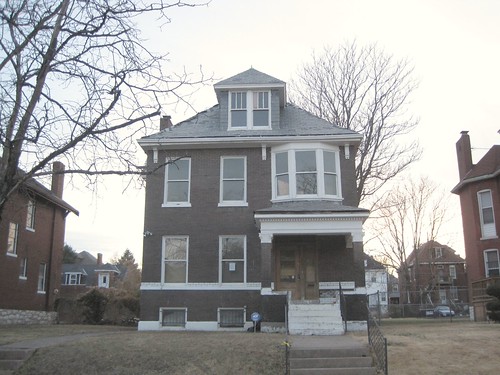
The building at 5172 Page Boulevard.

The multi-family building at 5172 Page Boulevard is located inside of the Mount Cabanne-Raymond Place Historic District in the Academy Neighborhood. The building is in the 26th Ward. Feasible Properties LLC purchased it for $3,000 at the auction held on September 21, 2010. Because the 26th ward has demolition review, and because the building is a contributing resource to a National Register of Historic Places historic district, the building has some demolition protection.

The house at 5134 Wells Avenue is at right in this photograph.

The two-flat at 5134 Wells Avenue is located on the very dense but increasingly vacant 5100 block of Wells Avenue. Feasible Projects LLC purchased the building for $2,878 at the Sheriff’s auction on September 21, 2010. The building is located in the 26th Ward. Because the 26th ward has demolition review, thanks to Alderman Frank Williamson (D-26th), the building has some demolition protection.

The house at 4946 Wabada Avenue.

The house at 4946 Wabada Avenue may be the saddest story of the three new purchases. This house was under rehabilitation, and the owner applied for a building permit after the sale to shell company Inventive Properties LLC. I suppose that party did not realize that its property taxes were unpaid for the three years prior to the auction. Incentive paid $4,500 at the Sheriff’s auction on September 21, 2010. This lovely single-family American Foursquare is the only vacant house on its block in the Kingsway East neighborhood of the 18th Ward. The 4900 block of Wabada is an immaculately maintained block — the sort of block where owners will utilize nuisance laws against a negligent owner. Unfortunately the house is not in a historic district and the 18th Ward lacks demolition review, so there is no protection against demolition of the house at 4946 Wabada Avenue.

The Eagle Realty-managed shell companies have not recorded any purchases since these three on September 21, 2010. Still, their holdings number nearly 300 parcels inclusive of over 90 historic buildings across the city’s 4th, 5th, 18th, 19th, 21st, 22nd and 26th wards. The parcels remain too spread out to add up to a real development plan, but too numerous to ignore.

Categories
Brick Theft JeffVanderLou North St. Louis Northside Regeneration

Brick Theft Before/After

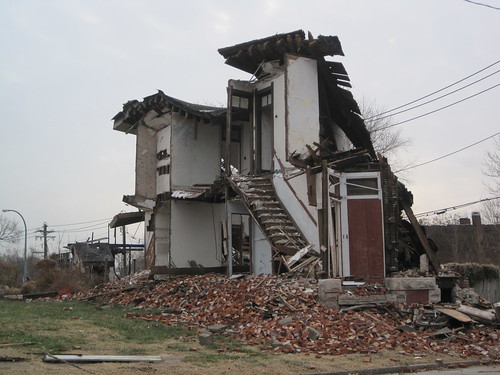
We recently gave Bill Streeter, director and producer of Brick By Chance and Fortune, some 60 before and after images of north St. Louis buildings struck by brick thieves since 2005. Our photographs illustrate perhaps as little as one third of the buildings in the city destroyed through theft in that period.

Here’s a sample. For the rest, you won’t wait long: Brick by Chance and Fortune will be released this spring.

The building at 3114 Glasgow Avenue in JeffVanderLou, May 2009. Owner: Northside Regeneration LLC.

The building at 3114 Glasgow Avenue, December 2010. The building has collapsed further but the wreckage remains.
Categories
Infrastructure North St. Louis St. Louis Place

St. Louis Place: Sidewalk Plaques and Brick Alleys

by Michael R. Allen

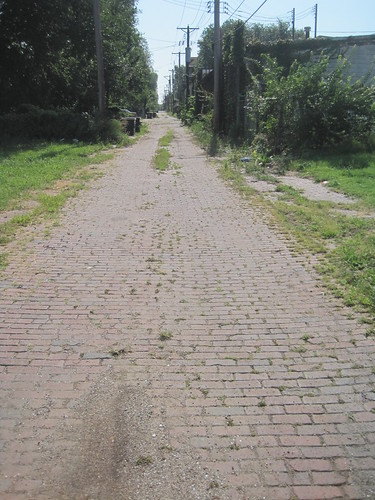
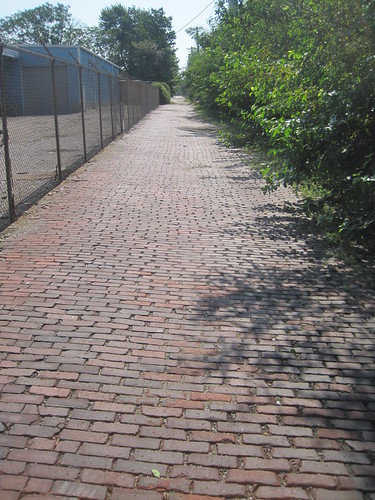
Strengthening the historic setting of the St. Louis Place neighborhood’s dense core, now nominated to the National Register of Historic Places as a historic district by the Preservation Research Office, are remaining parts of the built environment beyond buildings. There are several remaining brick alleys and historic granitoid sidewalks on and around St. Louis Avenue between 20th Street and Parnell Avenue.

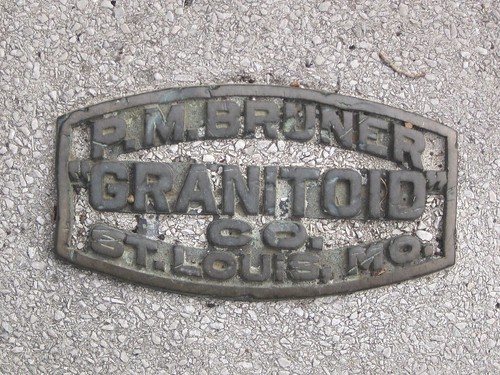
If the word “granitoid” is not familiar, the appearance probably is. Granitoid sidewalks included crushed aggregate rock in the cement to create a speckled walk with the surface appearance similar to granite. Granitoid paving dates to the 1890s and was common through the early part of the 20th century. Contractors often left a metal plaque embedded in the pavement to identify their work. St. Louis Place is fortunate to not only have these plaques left, but to have hundreds of feet of historic sidewalk paving largely in good repair.

A Frank J. Sullivan sidewalk plaque on St. Louis Avenue, with the date of paving.
A P.M. Bruner Granitoid sidewalk plaque on St. Louis Avenue.
The alley between University Street and St. Louis Avenue on the north and south, and 25th and Parnell on the east and west.
The alley between St. Louis Avenue and Montgomery Street on the north and south and 25th Street and Parnell Avenue on the east and west.
Categories
Preservation Board Schools SLPS

City Schools Exempt from Preservation Review

by Michael R. Allen

With the attention turned toward the St. Louis Public Schools’ proposal to demolish historic Hodgen School in the Gate District, several people have asked me about whether the demolition will be reviewed by the Cultural Resources Office or the Preservation Board. The answer, unfortunately, is “no.” The only review of any demolition permit for Hodgen — or any other historic city school — will take place at the Building Division, and it won’t involve any cultural considerations.

The city’s preservation ordinance states: “The provisions of this ordinance shall not apply to any Improvement or property owned or controlled by the Board of Directors of the St. Louis Public Library, the Board of Education, the state or the United States government, or formerly owned or controlled by the former Art Museum Board of Control.”

This provision was part of the version of the ordinance that the current ordinance superseded in 1999. Most local design or preservation review ordinances expressly state lack of authority over the property of higher levels of government. Many — but not all — do exclude the property of other districts or boards funded by special levies, so St. Louis’ ordinance is not particularly deficient in its lack of protection. The guiding principle in our ordinance is that review of the St. Louis Public Schools’ property could constitute an “unfunded mandate.” That theory seems reasonable when it comes to window and door regulations in local historic districts, and not as much when it comes to demolishing buildings that are neighborhood landmarks.

Of course, not all taxing districts and boards are exempt under the ordinance — the Zoo has had to have projects reviewed by the Cultural Resources Office in recent years, as has the Great Rivers Greenway District, Metro, Tower Grove Park and the Metropolitan Sewer District. At least one aldermanic candidate, Bradford Kessler running this year in the sixth ward, has proposed removing the Board of Education’s exemption from preservation review. Whether the Board of Education would consent to voluntary review or removal of its exemption as it pertains to demolition permits is uncertain, but either move would definitely benefit the city.

Categories
Events Mid-Century Modern

Tropicana Lanes 50th Anniversary Moved to March 15th

RESET!

Due to road conditions Modern STL has moved Tropicanniversary, the official 50th anniversary party for mid-century landmark Tropicana Lanes, to next month. The event was canceled due to inclement weather on February 2, and was rescheduled for tomorrow, but many people could not switch on short notice, so:

Tropicanniversary will now take place on Tuesday, March 15 from 6:00 – 9:00 p.m. at Tropicana Lanes, 7960 Clayton Road. The rest of the details remain the same.

Categories
Benton Park West Demolition LRA South St. Louis

Iowa Avenue House’s Days Are Numbered

by Michael R. Allen

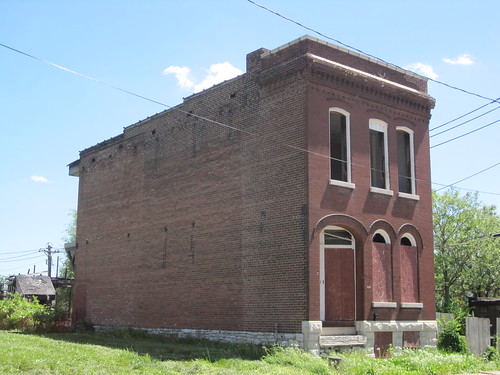
Last year, the Community Development Administration issued a “last chance” call for a proposal to rehabilitate the vacant house at 3244 Iowa Avenue in Benton Park West, owned by the city’s Land Reutilization Authority. (See “Last Chance for 3244 Iowa Street” from May 9, 2010.) A few weeks later, Landmarks Association of St. Louis placed the beleaguered building in its annual Most Endangered Places list.

The house at 3244 Iowa Avenue as it was in early May 2010.

Yet no one took the last chance, and January 12 the city applied for a demolition permit for the small house. Since the house is a contributing resource to the Gravois-Jefferson Historic Streetcar Suburb District, the permit will require approval from the Cultural Resources Office.

Categories
National Register North St. Louis St. Louis Place

St. Louis Place Nominated for Historic District Designation

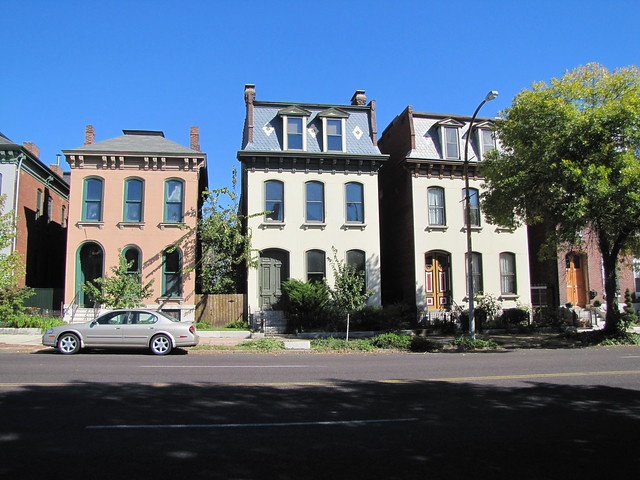
There are several stone-faced houses in the Second Empire and Italianate styles on the north side of the 2200 block of St. Louis Avenue.

In July, the Preservation Research Office embarked upon an architectural survey of the St. Louis Place neighborhood funded by Alderwoman April Ford-Griffin and overseen by Community Renewal and Development, Inc. By October, we selected boundaries for a historic district and began drafting a National Register of Historic Places nomination for a core area of the neighborhood. That nomination will be submitted to the Missouri State Historic Preservation Office on Monday.

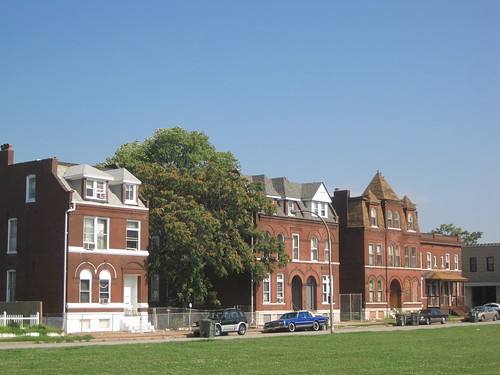
The west side of the 1800 block of Rauschenbach Avenue, facing St. Louis Place Park.
Until recectly home of the Youth and Family Center, the oldest section of the former Freie Gemeinde at 2930 N. 21st Street dates to 1869.

After submission, we will be sharing more of our research and findings here. For now, we are posting a handout we used at last night’s public meeting on the project. The document shows the boundaries and briefly explains the process and benefits of the historic district designation. That document is online here.

After the historic district nomination is completed, Preservation Research Office will be working with Alderwoman Ford-Griffin and Community Renewal and Development to develop a public history component to the project. We have learned a lot about the heritage of the neighborhood’s built and social environment that belongs to its people, and we will share what we know through publications, tours and events.

We Still Need Your Help

If you are a current or former resident or property owner in St. Louis Place, or just someone who has spent time there, you may have information that can aid us as we continue our work. Photographs, especially those taken before 2000, will help us. Your stories about your house, neighborhood businesses and churches and other aspects of St. Louis Place’s past are needed. If you want to share photographs or information with us, contact Michael Allen at michael@preservationresearch.com or 314-920-5680.

Categories
Best Practices Chicago Illinois

Chicago Mayoral Preservation Survey

by Michael R. Allen

Preservation organizations can be afraid of engaging electoral politics, but avoidance is not the best action. Leadership is needed on preservation policy, and it need not involve endorsement or direct participation in an election cycle.

Landmarks Illinois shows us the way with its just-released Chicago Mayoral Preservation Survey. The state-wide advocacy group posed direct questions on historic preservation, the Chicago landmark ordinance, recent past preservation, church landmark designation and sustainability to all candidates for mayor. Landmarks Illinois collected the results and published them, without comment, for all voters to see.