Categories
Events

“Collective Memory in St. Louis” Symposium Starts Thursday

Starting Thursday and running through Saturday, Fontbonne University hosts the symposium “Collective Memory in St. Louis: Recollection, Forgetting and the Common Good.” Registration for the symposium is $40 and is open to the public. More information is online here. Missouri Historical Society Director Robert Archibald delivers the keynote address Friday.

Several panels deal with built environment topics:

Public Space and the Problem of Solidarity (9:00 a.m., Friday)
• Kate Boudreau, Saint Louis University – “Fairgrounds Park: Foregrounding St. Louis’ Inequities”
• Michael Allen, Preservation Research Office – “Making Parks in the Central City: The Evolution of the Gateway Mall”
• William Rehg, SJ, Saint Louis University – “Memory and the Problem of Solidarity: How Can Cities Foster Allegiance?”
Moderated by Mary Beth Gallagher (Fontbonne University)

Visual Culture, Memory, and Identity (10:45 a.m., Friday)
• Adam Kloppe, Saint Louis University – “A Spectacle for the Eyes and Mind: The Photographs and Speeches of the Congress of Arts and Sciences, World’s Fair, 1904”
• Greg Ott, Fontbonne University – “Sorting Out the Detritus: Cindy Tower and the Discontiguous Sites of Art and Appreciation”
• Kris Runberg Smith, Lindenwood University – “St. Mark’s Windows: Reflections on 1930s Politics and Theology”
Moderated by Angie Dietz (Missouri History Museum)

Nineteenth Century Saint Louis (10:45 a.m., Friday)
• Kristen Anderson, Webster University – “We Bear No Hatred and No Bitterness Toward Our Former Foes: St. Louis Germans and the Memory of the Civil War”
• Kenneth Parker, Saint Louis University – “Archbishop Peter Kenrick and Collective Forgetfulness: Why a Leader at the First Vatican Council Faded from Local Memory”
• John J. Han, Missouri Baptist University – “Nineteenth-Century Saint Louis in Mark Twain’s Works”
Moderated by Thomas Finan (Saint Louis University, History)

Riots in Saint Louis (10:45 a.m., Friday)
• Luke Ritter, Saint Louis University – “American Vigilantes and Irish Gangs in St. Louis: The Know-Nothing Riot of 1854”
• Lou Robinson, Saint Louis University – “Forgetting to Remember: Memory and Commemoration of the East St. Louis Race Riot of July 2, 1917”
• Jeffrey T. Manuel and Samanthe Braswell, Southern Illinois University at Edwardsville – “The 1917 East Saint Louis Riot in Historical Memory”
Moderated by Harper Barnes (Author of Never Been a Time: The 1917 Race Riot That Sparked the Civil Rights Movement)

Urban Museum Collaborative Roundtable – “Discovering Untold Stories: Touchstones to a Changing Landscape” (9:00 a.m., Saturday)
•    Barbara Decker, Museum Consultant and project Director for the Urban Museum Collaborative
•    Lois Conley, The Griot Museum of Black History
•    Barbara Faupel, Eugene Field House Museum
•    Andrew Hahn, Campbell House Museum
Moderated by Caitlin McQuade

Memory and the Built Environment in Saint Louis (2:30, Saturday)
• Gregory Taylor, Fontbonne University – “Forgotten Monuments: Excavating a Corporate Past”
• Christina Mathena Carlson, Southern Illinois University at Edwardsville – “At the Intersection of History and Life: City Museum as Space for Historical Preservation and Urban Renewal”
• Frederick A. Hodes, Independent Scholar – “St. Louis Streets and Their Witness to the City’s Past”
Moderated by Jody Sowell (Missouri History Museum)
Categories
Alton, Illinois

Alton’s Grand Theater Gets Landmark Status

Last month we reported on the citizen effort to secure city landmark status for the Grand Theater on Alton.

Good news comes from Alton Area Landmarks Association President Terry Sharp:

The Historic Commission voted to give the Grand Theater local landmark status. The owner can appeal this decision to the city council. So far he has not taken action to do so. Having local landmark status is one step to save the exterior of the building.

A group of citizens is having meetings about saving the Grand Theater. Contact Bill McKenzie (463-0625) for more info.

Categories
Events

Tour of MHS Library and Research Center Tomorrow

This month the Rehabbers Club of ReVitalize St.Louis will visit the Missouri History Museum Library and Research Center for a guided tour! Research is a big part of any historically accurate rehab and the Library staff have agreed to give our group a window onto the many fantastic research resources available at its facility on Skinker, which is itself a one of St. Louis’ architectural treasures.

WHEN: Tour starts at 9:00am this Saturday October 16th.

WHERE: The Missouri History Museum Library and Research Center is located at 225 S. Skinker Blvd., across from the golf course in Forest Park. More info at: http://www.mohistory.org/lrc/your-visit/how-to-get-here/parking-transit

The number does not actually appear on the building. It is a yellow brick building with a double staircase in front and a domed roof. There are banners for the library on the light poles nearby.

PARKING: The Library and Research Center is two buildings – an old and a new. The library is in the old (north) building, and the parking lot is just to the south of the new storage building. There is also free parking on both sides of Skinker.

Our tour starts before regular museum hours, so after you park, come to the staff entrance, which is up the driveway between the old and new buildings. It’s the door on the right, under the blue awning. Just inside the door, there is a Security office. We will meet there at 9:00am.

Categories
Uncategorized

Six St. Louisans on Leadership

Metro’s Courtney Sloger is also working on KETC’s new Nine Voices project. Courtney has just posted “6 St. Louisans on Civic Leadership,” a video featuring young leaders discussing what it takes to move the city forward. Here’s the description:

I asked six young St. Louisans that I know are working for a better community, how do we cultivate civic leadership in St. Louis? Their answers were frank and honest, and challenged my own perceptions of leadership and the needs of St. Louis.

The six include Jennifer Allen, RJ Koscelniak, Brea McAnally, Randy Vines, Jay Swoboda and PRO’s Michael Allen.

Categories
Brick Theft

“Brick Thieves” Song

by Michael R. Allen

For Bill Streeter’s Brick by Chance and Fortune (slated for completion in December), our town’s inimitable Pokey LaFarge has crafted a song about brick thieves that is chilling, smart and catchy. Tap your toes and learn the sad story of St. Louis’ underground when you listen to the newly-released studio version of the song, which is simply entitled “Brick Thieves.”

“I tell you St. Louis, we ought to have had enough,” sings Pokey mournfully, and I am sure readers of this blog will agree.  If only the song were a plaintive elegy instead of a sober observation.

Categories
Events North St. Louis Riverfront

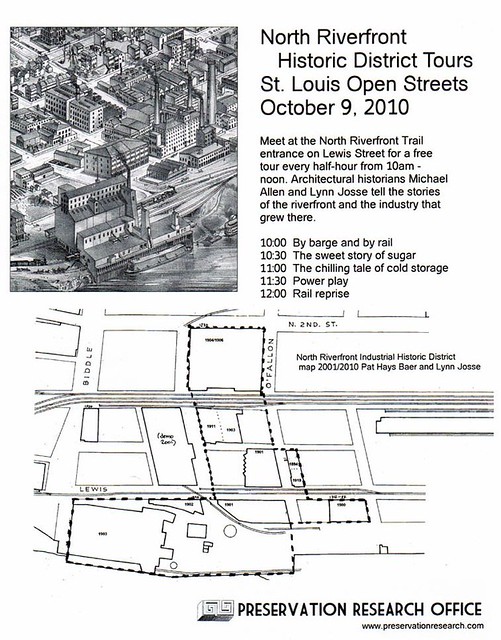
Reminder: North Riverfront Tour Tomorrow

Afterward, stick around for Artica: Artica invites you all to summon your muses, pack up your gear and gather once again for St. Louis’ most spectacular fab-dilly-iscious weekend of art, performance, music, ritual and creative revelry!

Saturday October 9th, 11:00am to Midnight
Sunday October 10th, Noon to 8:00pm
Location: The corner of Lewis and Dickson Streets on the North Riverfront

Categories
Alton, Illinois

Alton Historic House Tour on Sunday

The Alton Area Landmarks Association announces:

2010 Fall Historic House Tour
Sunday, October 10, 2010
Noon until 5;00 p.m.
$12.00 / Person

Tickets are on sale now at the Alton Visitors Center at Piasa and Broadway Streets. Sunday tickets will also be sold outside at 4th and Henry Streets and at the Hart House, 524 Belle Street. If you have any questions, call Terry Sharp at 463-5761. Looks like it is going to be a beautiful day.

Categories
South St. Louis Tower Grove East

New Tower Grove East Neighborhood Website

St. Louis’ Tower Grove East Neighborhood — where the Preservation Research Office currently is located — has a new website, built and designed by neighborhood resident Joe Millitzer.
Check it out at www.towergroveeast.org

Categories
Abandonment Storefront Addition Vandeventer

Fading on Delmar

by Michael R. Allen


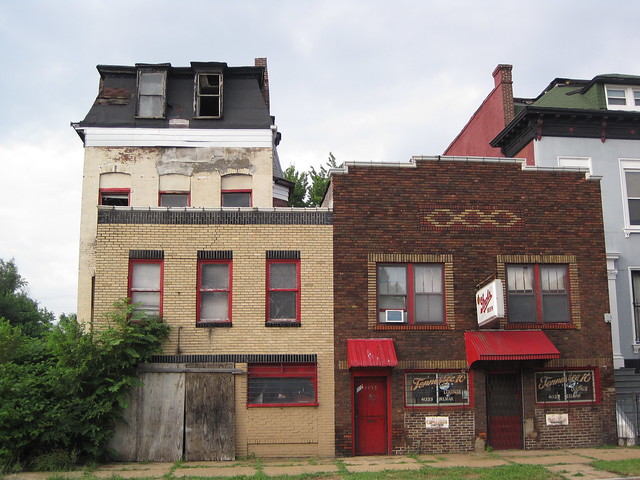
The storefront additions at 4035 (left) and 4033 (right) Delmar Boulevard in slightly better condition last year.

Last month, I reported that the large apartment building at 4011 Delmar Boulevard was on the market again. Down the block to the west, another story is unfolding — and I see an unhappy ending in the works. The elegant but abandoned town house at 4035 Delmar Boulevard, shown above, and its streamlined two-story storefront addition are in trouble.  (More information about the storefront additions on this block can be found in this post from last year.)

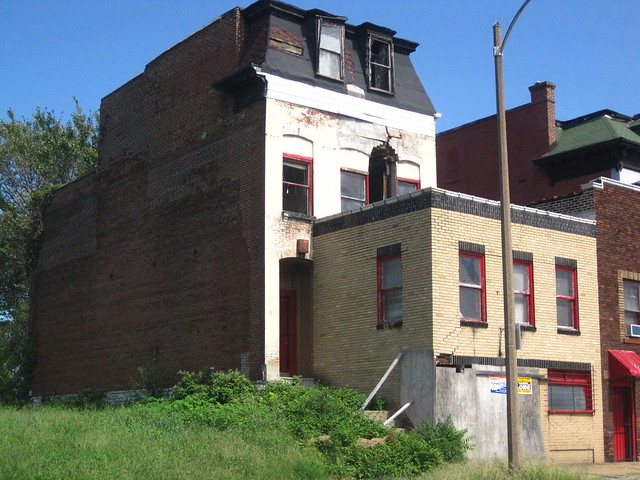
4035 Delmar Boulevard last month.

First, something — perhaps an automobile — smacked into the corner of the storefront addition.  The corner of that section is settling something fierce.  Now, there is gaping hole in the front of the house that continues to grow wider.

If the property was owned by the city, its demise would all but be assured.  However, property tax records show that the owners live in Israel.  Perhaps the owners are aware of the building’s condition, but there has been no indication borne out in repair.  No doubt that we will watch a slow death unfold — for shame.

Some readers may find the contrast between the faded beauty of the house and the modern lines of the storefront jarring.  Yet I see the simultaneous presence of two phases of the Vandeventer neighborhood’s life, and soon-to-be squandered potential for rebirth.

Categories
Downtown Louis Sullivan

The Good Fortune of the Chemical Building

by Michael R. Allen

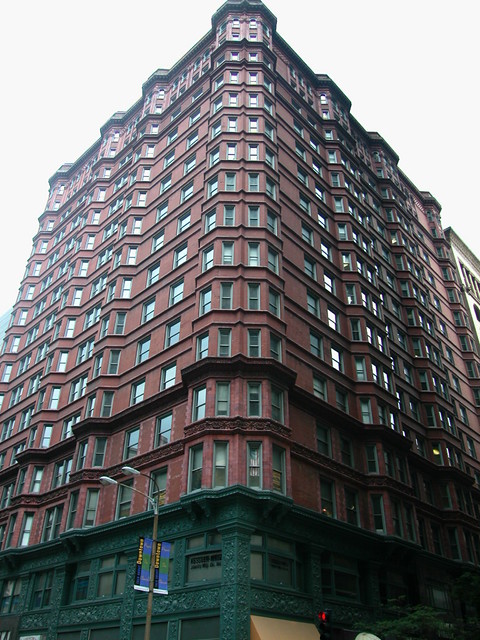
The Chemical Building in 2005.

Today’s news that the owners of the venerable Chemical Building at 8th and Olive streets have filed bankruptcy bring uncertainty to the future of their redevelopment plan. The welcome prospect that the name might not change to “Alexa” aside, the turn toward bankruptcy has some tongues wagging that downtown will have two big vacant buildings at the intersection for a long time. Diagonally across the intersection is the Arcade Building, now owned by a city agency after the Pyramid Companies declared bankruptcy and the building went to foreclosure auction.

Whether the molasses-slow market can absorb so much square footage of adaptively reused space is unknown. What is known is that taking a fully-occupied building like the Chemical and dumping all tenants before full financing is ready for rehabilitation is not a good idea (see also: Jefferson Arms). Had the developers waited, they might be waiting out the recession with a highly desirable low-rent refuge for small businesses.

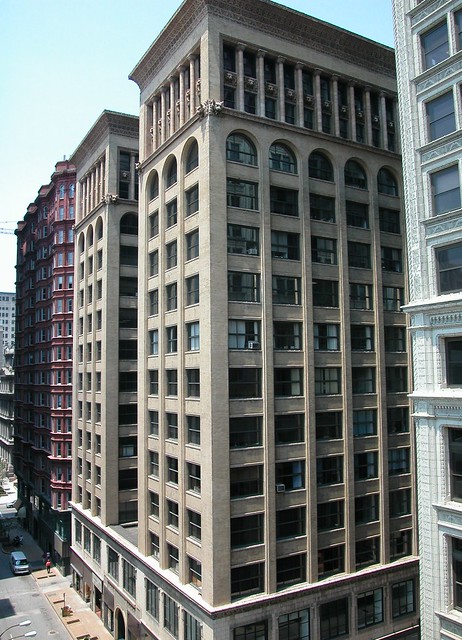
The Union Trust Building today.

No matter — the Chemical Building has an architectural history trump card that guarantees all is not lost. See, the as-built Chemical Building design by Boston-born Henry Ives Cobb triumphed over one by Chicago wunderkind Louis Sullivan. St. Louis was a remarkably receptive place for Louis Sullivan’s art, and the 700 block of Olive Street could have had side-by-side Sullivan. The Union Trust Building at 705 Olive had been completed in 1893, and its stunning round windows, exposed light well, terra cotta lions and monochromatic buff brick and terra cotta shaft all proudly brought Sullivan’s revolution to town. (The Wainwright Building of 1891 was no small achievement, but the local press took greater notice of the Union Trust.)

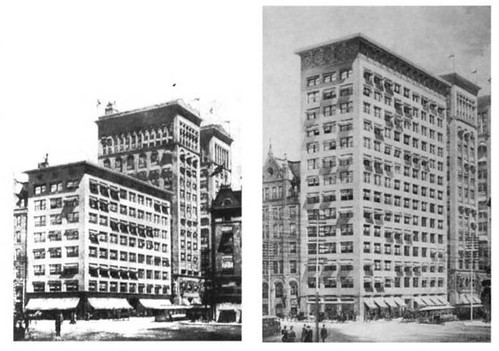
Two plans for the Chemical Building by Louis Sullivan, exhibited at the Third Annual Exposition of the St. Louis Chapter of the American Institute of Architects in 1895.

The Chemical National Bank planned a complementary, modern office building adjacent to the Union Trust. In 1894, the bank solicited the two proposals by Sullivan shown above. The difference between the two possible plans is primarily height; the gridded bodies are otherwise almost identical.  With wide double windows, large round windows at the attic and a large overhanging cornice, the proposed buildings would have been very striking for both the time and place.  However, their form certainly would have paled in comparison to the sheer genius of the Union Trust.  Sullivan may have wished to touch his masterpiece with a gentler neighbor.

Instead of a gentle lesser work by Sullivan, the Chemical National Bank directors chose a rather bold 17-story design by Cobb.  Cobb’s plan originally fronted only four bays on 8th Street, and was extended by five bays in 1903 from near-seamless plans by Mauran, Russell & Garden. Cobb’s building had a rather old-fashioned two-story cast iron base by Christopher & Simpson that was heavily ornamented in classically-derived foliated patterns.  However, the upper floors were built out in a monotone of brick and Winkle terra cotta.  The projecting trapezoidal bays, including a dramatic chamfered corner bay, emphasized the building’s height as much as the Union Trust’s piers.  Yet the horizontal band courses dampened the effect of the bays, and the fenestration between the projecting bays was far from expressive of the building’s structural grid.  The top two floors were clad in ornamented terra cotta.

Cobb tried to marry the Chicago School skyscraper with the nobility of traditional masonry ornament, and the result was panned in 1896 upon completion of the Chemical Building.  With Sullivan looming next door, comparison was inevitable — and unfavorable.  In 1896, an anonymous correspondent wrote in The Brickbuilder of the architect’s effort to express the Chemical Building: “He has left no quiet spot upon which we may rest the eye, and, although we may be awed by its great height, it lacks the simplicity and imposing grandeur of its neighbor, the Union Trust Building.”


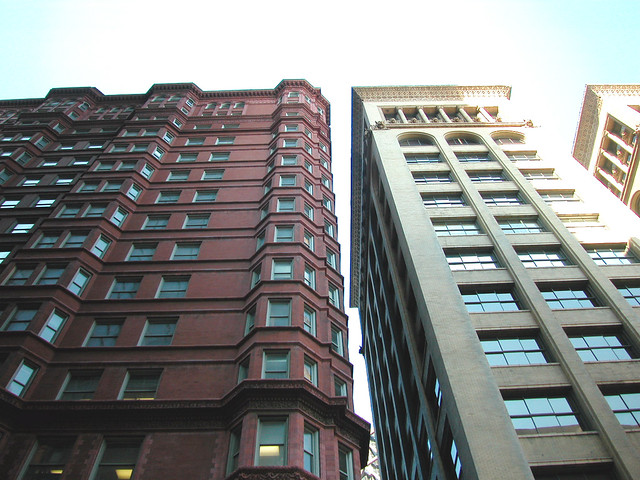
The Chemical Building and the Union Trust Building, monochromatic neighbors from the 1890s.

Today, that assessment of the Chemical Building seems hasty. While Cobb’s work largely exhibits few progressive tendencies in an age of innovation — although it includes Chicago’s elegant Newberry Library (1893) — the Chemical Building is the architect’s strongest commercial design. The reference to Chicago’s long lost Tacoma Building by Holabird & Roche (1886-9) is obvious, but not the source of the Chemical Building’s design inspiration. Cobb could easily have mimicked Sullivan or other better-regarded luminaries of the Chicago School, but he chose instead to offer his own vision.

The Chemical Building’s red monotone is impressive and striking, and draws the eye toward itself with as much force as the Union trust or Wainwright. The Chemical Building is a fitting neighbor to the mighty Union Trust, and holds its own with a rather different statement about the tall building’s artistic potential. Together, the two buildings in their contrasting tones show us a full range of architectural imagination in the late 19th century. The Chemical Building’s horizons contrast effectively with the Union Trust’s swaggering vertical elements, reminding us that a tall office building is also a stack of floors where people work.

One without the other would be an incomplete range and, had the Chemical National Bank chose Sullivan to complete the block face to his measure, two of the same would not so powerfully urge the eye to fix on two powerful, beautiful masses. There is no doubt that the Chemical Building has good fortune on its side.