Categories
Historic Boats Mid-Century Modern Riverfront

S.S. Admiral on the River in the 1940s

by Michael R. Allen


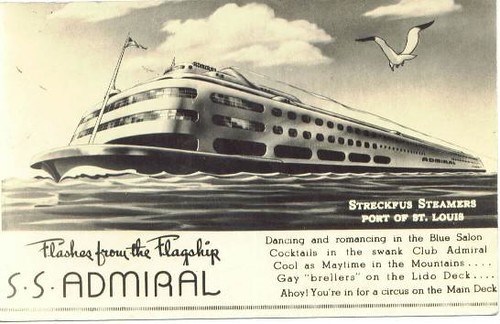
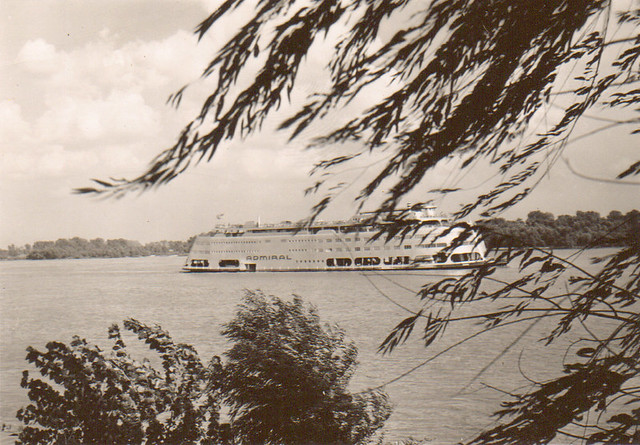
This photograph depicts the S.S. Admiral cruising the Mississippi River in the early 1940s, not long after its reconstruction.  Built first in 1907 as the S.S. Albatross, the rechristened Admiral had a capacity of 4,400 passengers and a palatial ball room on its five decks.  Streckfus Steamers commissioned fashion designer and illustrator Maizie Krebs to design the streamline, art deco-influenced superstructure.  Reconstruction cost $1 million and took place between 1938 and 1940. The Admiral has not cruised since its engines were removed in 1979.

Photograph from the Preservation Research Office Collection.

Categories
Historic Boats Mid-Century Modern Riverfront

S.S. Admiral Offered on eBay

Vintage postcard view of the Admiral, which was rebuilt as an art deco entertainment palace around 1940.

The S.S. Admiral is being offered for sale via an eBay auction. The “buy it now” and starting bid price are the same: $1.5 million.  Pinnacle sold the Admiral to a new owner handling the auction, which ends November 10.

The price — which is a suggestion — seems like a bargain, but there is a catch: after the sale, the Admiral will have to be moved from its site on the St. Louis riverfront.  The new owner will have to be ready to moor the vessel somewhere else.

Categories
Missouri Public Policy

Tax Credit Commission Subcommittee Report on the Historic Tax Credit

From the Coalition for Historic Preservation and Economic Development

The report contains the Subcommittee’s recommendations to the TCRC. Per the final report, the Sub-Committee’s methodology used to come to the report conclusions were as follows:

Over the course of its meetings, the Subcommittee collected and considered a significant amount of testimony, facts, assertations, and reports from economists, national organizations, DED, members of the development community, private and public leaders and the public themselves. The Subcommittee submits this Report in part as a response to the fifteen questions posed by the Co-Chairmen of the Commission in their memorandum to the commission dated September 16, 2010. The Subcommittee has also chosen to supplement its response to the Commission’s questions with specific recommendations to the commission for proposals to modify the program.

The HTC Subcommittee’s Final Report identified seven recommendations for the Tax Credit Review Commission to consider for its final report to the Governor.

1. The Annual Cap placed on the credit in 2009 to remain in place
2. Revision to HTC Carry back/Carry forward provisions
3. Revision to Deferred Developer Fee methodology
4. Reductions of Percentage of Credit when combined with LIHTC
5. Owner Occupied Cap reduction
6. Cost Certification Review – Create more efficiencies and quicker turnaround time
7. Program Efficiencies – work to clarify DED interpretations of the law and to direct issuance fee back to support the program

The Tax Credit Review Commission will be meeting November 5th in Jefferson City, MO to review all reports from the various Tax Credit Subcommittees. Once all reports have been reviewed by the TCRC they will draft their final report about all of Missouri’s Tax Credit Programs for Governor Nixon to review.

Categories
Columbus Square Midtown National Register North St. Louis Northside Regeneration

Cass Bank, Castle Ballroom Nominated to National Register

by Michael R. Allen

On Monday, the St. Louis Preservation Board approved two National Register of Historic Places nominations of historic buildings.

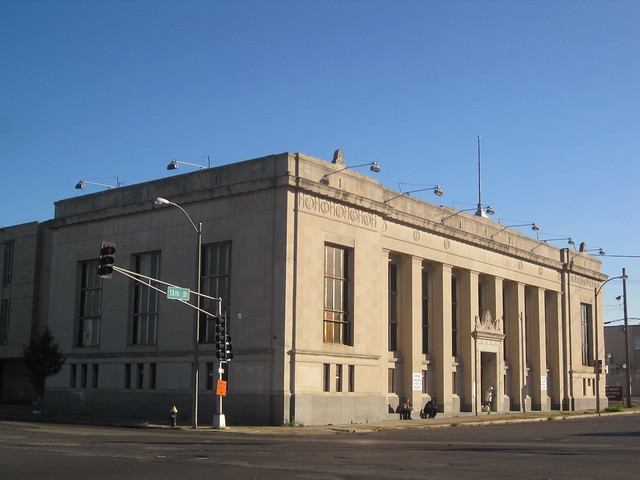
The first nomination is for the Cass Bank and Trust Company Building at 1450 N. 13th Street in the Columbus Square area. The building dates to 1927 and was designed by the prolific Bank Building and Equipment Company. In the last few years, after the departure of long-time tenant Greyhound Lines, the building has been vacant.  The neo-classical, Bedford limestone-clad building replaced the earlier Cass Avenue Bank building at 1501 Cass Avenue built in 1915 and designed by Wedmeyer & Stiegemeyer. One year after completion of the Cass Bank and Trust Company Building, the Chippewa Trust Company completed a similarly-styled two-story building at the southwest corner of Chippewa and Broadway streets also by the Bank Building and Equipment Company.

Melinda Winchester of Lafser & Associates wrote the nomination for Northside Regeneration LLC, but the building is owned by the city’s Land Reutilization Authority (LRA). The nomination states that Northside Regeneration has the building under contract.

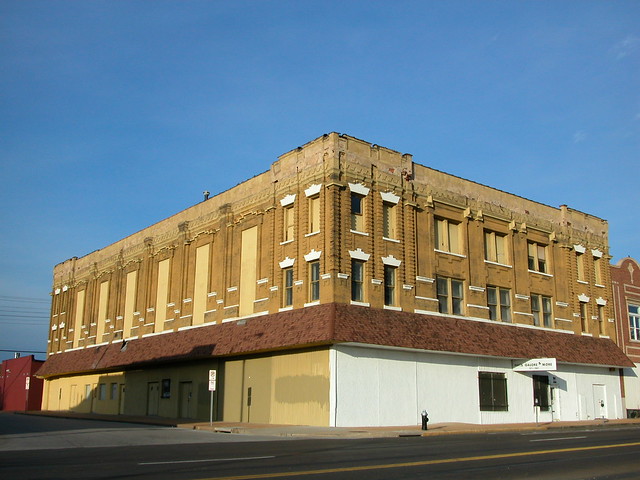
The second nomination is for the former Castle Ballroom at 2831-45 Olive Street in midtown. Prepared by PRO’s Lynn Josse, the nomination recognizes the social history of a building best known in recent years for its slather of goldenrod paint. The building was built in 1908 as Cave Hall, a dance hall that replaced popular Uhrig’s Cave when it was closed to build the Coliseum. Later it became the Castle Ballroom, which served African-Americans from the surrounding Mill Creek and Yeatman neighborhoods. When Mill Creek Valley was cleared up to the south side of Olive Street in the 1950s, the Castle Ballroom survived as one of the few remaining traces of the once-vibrant neighborhood.

As part of a Certified Local Government — a local government with a preservation ordinance certified by the State Historic Preservation Office — the board reviews National Register nominations and sends recommendations to the state Missouri Advisory Council on Historic Preservation (MOACHP). MOACHP will consider these nominations at a meeting on November 19, and forward approved nominations to the National Park Service for listing. The most extensive National Register nomination review takes place at the state level.

Categories
Historic Preservation Missouri

Missouri Preservation Honor Award Nominations Due November 11

From Missouri Preservation

Is there an exemplary preservationist in your area or a great historic project that has been completed in the past year? Do you know of a great book that has been published which promotes preservation of our built environment in Missouri? Make sure these contributions and achievements are publicly recognized by nominating them for a Preservation Honor Award.

Awards will be presented at the Capitol Rotunda in Jefferson City in March, 2011.

Past awards have recognized lifetime achievements of preservationists and projects which have run the gamut from historic filling stations to high-rise apartment buildings.

Download our nomination form by clicking here.

Categories
Historic Preservation Housing North St. Louis Old North

National Trust Honors Old North

by Michael R. Allen

In 1977, high of Model Cities euphoria, the City of St. Louis celebrated the new two-block 14th Street Mall in Old North St. Louis. Within two decades, the mall was bust and the twenty-odd buildings facing it were includes on Landmarks Association’s Most Endangered list. In 1998, the Old North St. Louis Restoration Group hosted a charrette to imagine the future of the old pedestrian mall. Some people thought the group was crazy to envision the two blocks returned to urban vitality, but they were proven wrong — over a decade later.

This Friday, the National Trust for Historic Preservation will present its National Trust/Department of Housing and Urban Development Secretary’s Award for Excellence in Historic Preservation to Old North St. Louis Restoration Group and the Regional Housing & Community Development Alliance for the reborn 14th Street area, called Crown Square Development . The project is one of 23 award winners to be honored by the National Trust next week during its 2010 National Preservation Conference in Austin, Texas.

Ah, the difference that 33 years has made is immeasurable. (The $35 million cost of physically reversing the mall’s impact on the built environment is a misleading figure that does not compensate hours of community brainstorming, vigilance and sweat equity.) The path of two blocks of a fragile near north neighborhood shows the pitfalls of urban planning trends and the power of collective action to turn around supposedly hopeless causes.
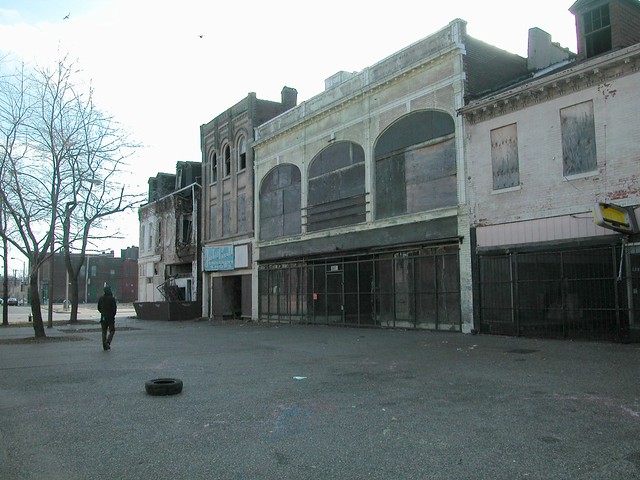
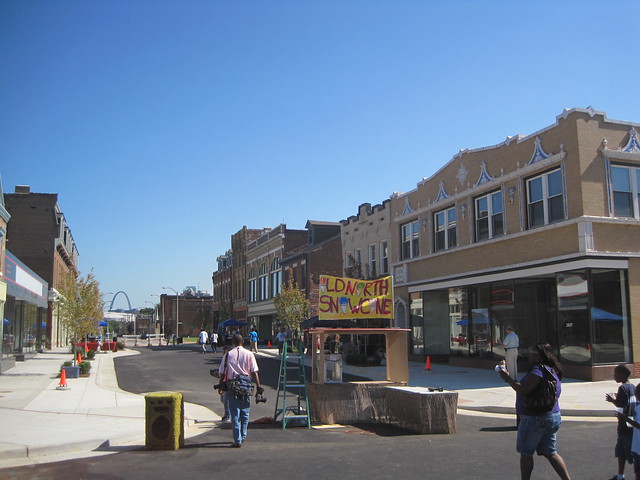
The west side of 14th Street between Montgomery and Benton Streets, December 2004 (top) and July 2010 (bottom).
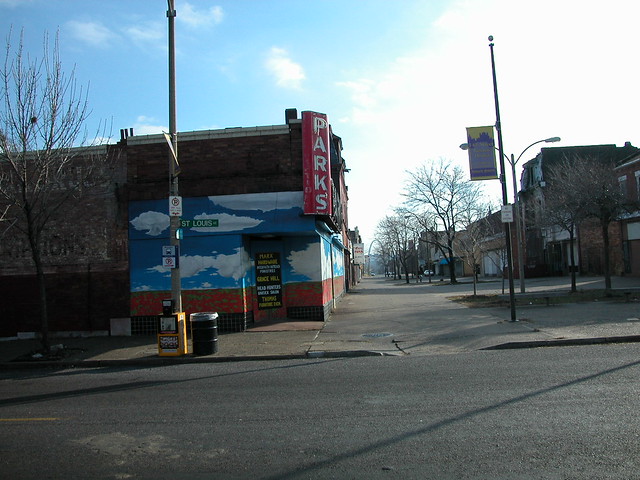
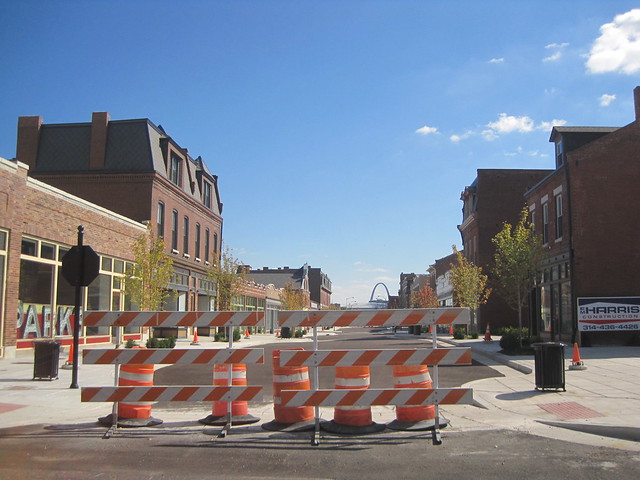
The view down 14th Street south from St. Louis Avenue in December 2004 (top) and July 2010 (bottom).
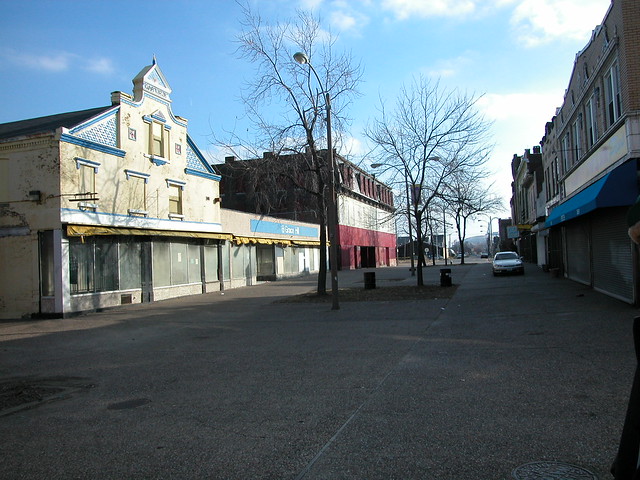
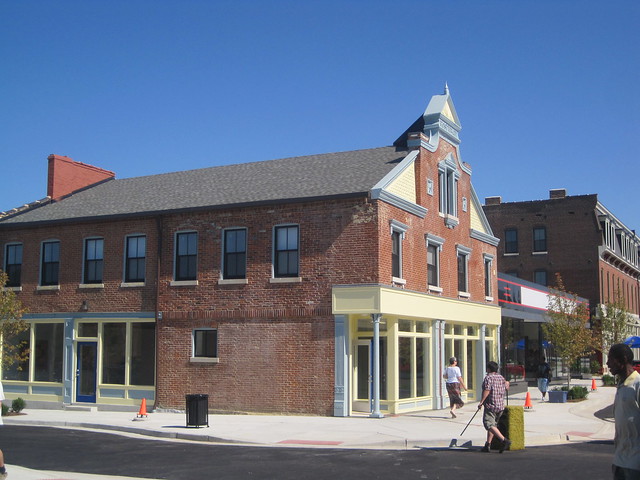
The view south down 14th Street from Montgomery Street in December 2004 (top) and July 2010 (bottom).

Some would say that bricks and mortar (and tax credits) alone don’t transform communities. In fact, I say that. The achievement with Crown Square to date is a miraculous preservation effort that safeguards historic buildings, reopens key streets, enhances the safety and appearance of Old North’s commercial center and provides new rental housing and commercial storefronts. Introducing 78 new housing units in a neighborhood can force a huge change, but toward a previous housing density that many current residents never knew. The social changes wrought by these physical transformations will be ongoing, and the outcome uncertain — but the pains mean that the neighborhood is growing once again.  For a neighborhood that had some 13,200 people sixty years ago and around 1,500 in 2000, growth is good.

For now, we can celebrate the effort of many long-time neighborhood residents who have never given up hope that two blocks of 14th Street would again be the center of neighborhood life.  This journey to restore the neighborhood commercial district began 33 years ago with a much different plan.  As impressive as the undoing of that plan is to see, even more impressive are the people who did not let the intervening years of abandonment deter their dreams and deeds.

Categories
Fire Shaw South St. Louis

The Lost Twin at Shaw and 39th

by Michael R. Allen

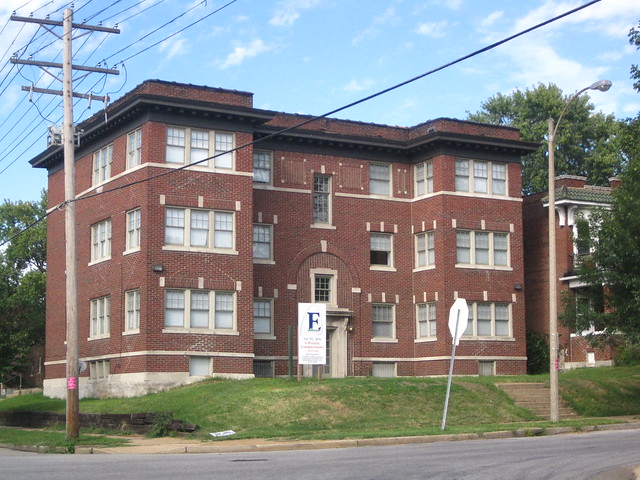
At the northeast corner of 39th and Shaw avenues stands a three story brick building at 3867 Shaw Avenue that has been fully rehabilitated.    The building sports newly-painted wooden replacement windows and a developer’s sign out front.  Where once its red-brown brick walls showed signs of the grime of age, now is is clean testament to a building’s redemption.

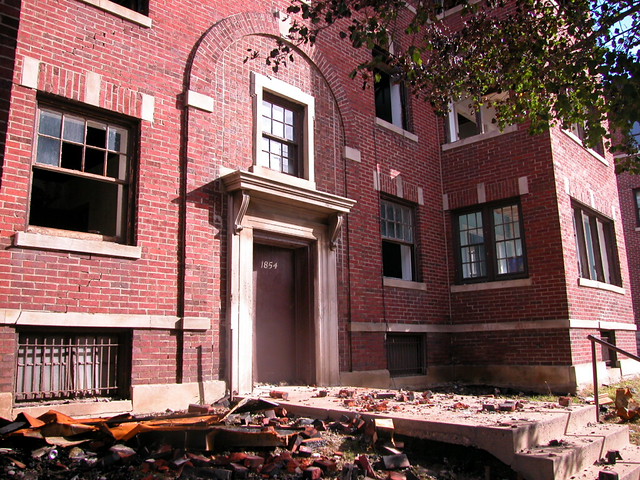
The building, which dates to 1914, is a handsome example of our city’s eclectic Craftsman vein of building and the concurrent rise of mass-produced building products.  The Hydraulic pressed brick, the machine-cut limestone that sparingly adorns the wall and the galvanized metal cornice with its perfectly stamped brackets all show the creative potential of machine age ingenuity.  The stone entrance set into jack-on-jack brick (brick laid corner to corner) within a round-top relieving arch is a particularly fine feature.

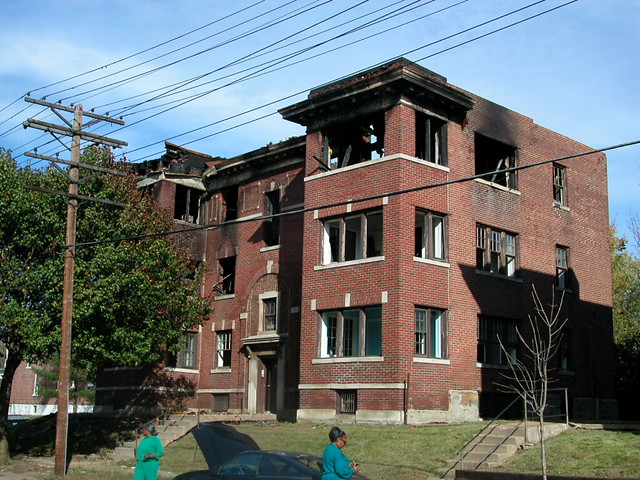
The building at 39th and Shaw also stands as the remainder of a set of perpendicular twins that doubled the density of the corner parcel. The twin neighbor of the same age met a horrible end just a few years ago yesterday. I took the photographs here on October 31, 2004.

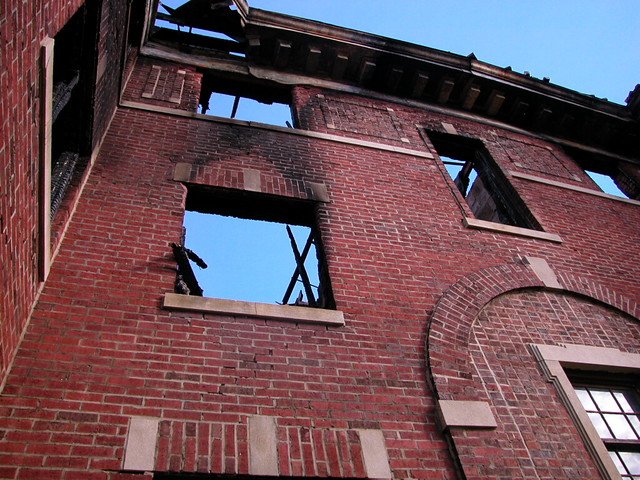
Between the hours of 3:00 and 4:00 a.m. on October 26, 2004, the St. Louis Fire Department responded to three alarms within a four-block radius. Three buildings — all owned then by the Garden District Commission — were ablaze: a two-flat in the 4000 block of Folsom Avenue, a house in the 4000 block of McRee Avenue and the three-story apartment building at 1854 South 39th Street. All would be demolished in subsequent months.

The twin neighbor was obviously damaged severely by the fire. Rescue would have been possible, but expensive since the roof and top floor had completely collapsed at the building’s north end.

Demolition of the apartment building at 1854 S. 39th Street took away one contributing resource from the Shaw Historic District as well as the existing residential density of the site. Perhaps some day the site will again give rise to a building. Mean time, the next door neighbor stands as a reborn twin separated at death.

Categories
North St. Louis Northside Regeneration

Northside Regeneration

by Michael R. Allen

Judge Robert Dierker Jr.’s decision to not allow a new trial in the Northside Regeneration case puts us no further behind than July 2, when the judge issued his ruling in the case that struck down the project’s redevelopment ordinances.  Then and now, it remains clear that the redevelopment ordinances need further legislative attendance.

After the ruling, Northside Regeneration attorney Paul Puricelli told Tim Logan of the St. Louis Post-Dispatch that the company might appeal.  The City Counselor’s office seems to favor an appeal.  But Puricelli also said “One of the things we’d be looking at is to enter into a project agreement with the city.”  That’s the track his client should take.

In recent weeks, rumors of settlement discussions in the case suggested a very unlikely end to a complaint made on the lack of transparency: a clandestine agreement among lawyers far from the residents affected by the outcome of the case.  Dierker’s ruling could preclude that outcome, which contradicts both the original plaintiff’s motivation and the need of residents to have binding protection against condemnation.  The “settlement” should be made openly through public ordinance.  I realize that wish is far too innocent for a process now in the hands of attorneys — but it is what the judge’s rulings compel.

Categories
Missouri

Missouri Preservation Searching for Executive Director

Missouri Preservation, Missouri’s statewide historic preservation advocacy organization, is searching for an Executive Director.  Criteria for the position are being developed, and the targeted hiring date is mid-February 2011.  Interested parties can contact Missouri Preservation at preservemo10@yahoo.com.

Categories
Gate District Preservation Board

Chouteau Buildings May Be Demolished

by Michael R. Allen

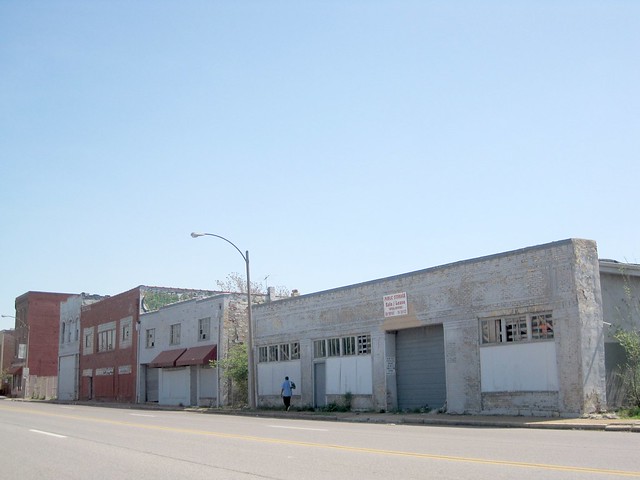
The Preservation Board of the City of St. Louis was set to again consider demolition of the row of commercial buildings at 2612-30 Chouteau Avenue (southwest of the intersection with Jefferson Avenue) at its meeting on Monday. The item was pulled from the agenda and will not be considered this month, but will likely return next month — perhaps with more support than before.

The buildings are owned by Crown Mart, Inc., which purchased them to prevent a competitor from opening a gas station on the site. Crown Mart plans to demolish them and replace them with a vacant lot.

The chief sin of these buildings may be the layers of unattractive, unmaintained paint that owners have applied over the years.  Underneath the paint is brick and, in the case of the building shown immediately above, cast iron and red sandstone.  Few ho have seen the city’s renaissance in recent years could doubt the reuse potential peeking out from under the battleship gray and bright red.

The buildings have found supporters, too — and a spot on the region’s preservation watch list.  After the Preservation Board unanimously denied demolition on preliminary review in April, the Landmarks Association of St. Louis placed the buildings on its Most Endangered Places list.