by Michael R. Allen
Last month, we visited Tulsa on what was planned as a vacation. Somehow we ended up often rising earlier and looking at more buildings per day than we ever do back home. These things happen, I suppose. I am just glad that our exploring led us to the inspiring Tulsa Foundation for Architecture (TFA; blog here). TFA is a small, young organization that has already built an array of program activities that would be daunting even for a more established organization. Founded by the Eastern Oklahoma chapter of the American Institute for Architects in 1995 — a mere fifteen years ago — TFA is a strong advocate for preservation, a force for education through tours and events, publisher of books, sponsor of “>Modern Tulsa convener of conferences and — most impressively — steward of a massive archive on Tulsa’s architectural history. Oh, and TFA collects architectural artifacts too!
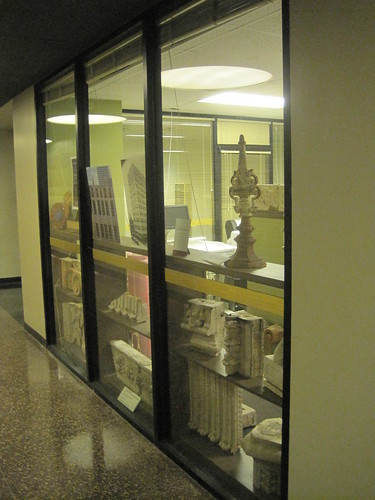
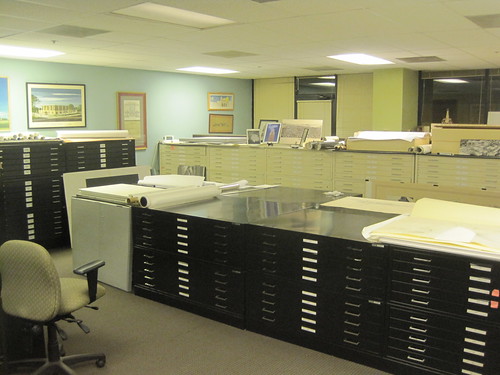
TFA’s office is in the basement of the Kennedy Building in downtown Tulsa. Archivist Derek Lee kindly guided us through our surprise visit one morning. The staff members’ two desks are in corners, with most of the space devoted to metal shelving and flat files housing some 35,000 drawings from major architectural firms’ offices. The windows to the corridor are filled with colorful artifacts, including polychomatic terra cotta with Art Deco motifs. It’s as if a smaller version of the St. Louis Building Arts Foundation and the Landmarks Association of St. Louis were joined together.
TFA’s mix is exciting and successful: the organization is buying a building that will increase space and, most importantly, visibility. Plus, the National Historic Records Advisory Bureau has proclaimed TFA as a model archival organization.
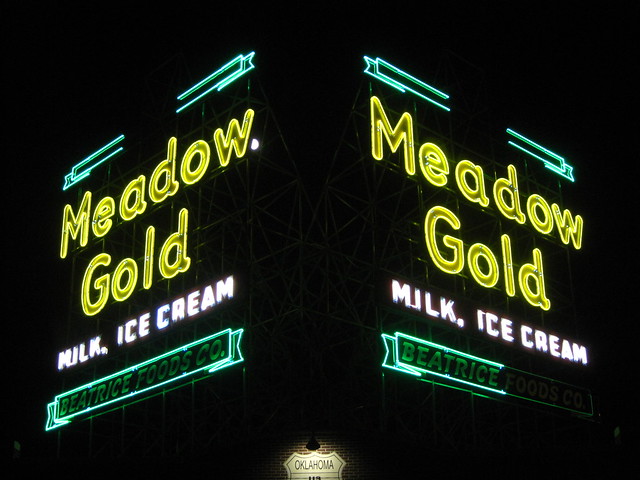
However, TFA’s biggest accomplishment stands outside of its office: the restored Meadow Gold sign on 11th Avenue, which was Route 66 in Tulsa. Located near downtown, the 1930s-era sign faced an uncertain future for many years. TFA obtained a grant for restoration from the National Park Service Route 66 Corridor in 2004, but the sign and the building atop which it sat were privately owned. When the owner planned demolition, TFA worked with the City of Tulsa to save and reconstruct the sign.
TFA’s work to actually save the sign accompanied a survey of 259 neon signs in the Tulsa area. This survey resulted in the just-published booklet Vintage Tulsa Neon Signs, a brief and colorful introduction to a threatened resource. This booklet joins TFA’s reprint of the exhaustive and lovely Tulsa Art Deco by Carol Newton Gambino and David Halpern as a powerful educational tool. We salute our busy colleagues in Tulsa and await good news of their future endeavors!
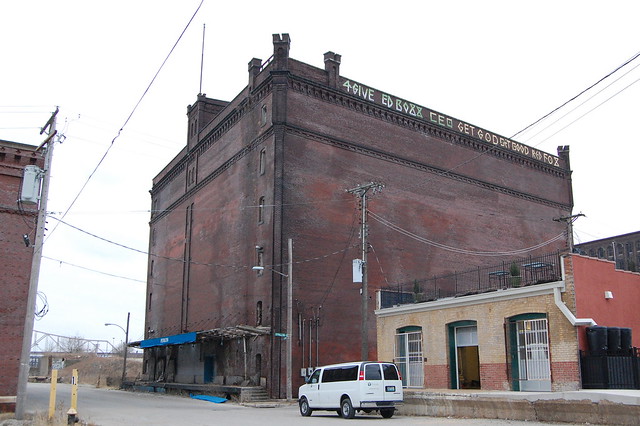 Tour starts near the St. Louis Cold Storage and Refrigeration Company Warehouse at Lewis & O’Fallon Streets (1901; Widmann, Walsh & Boisselier)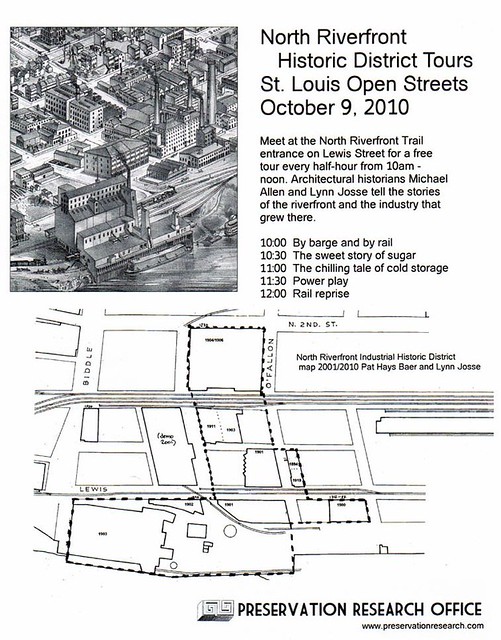
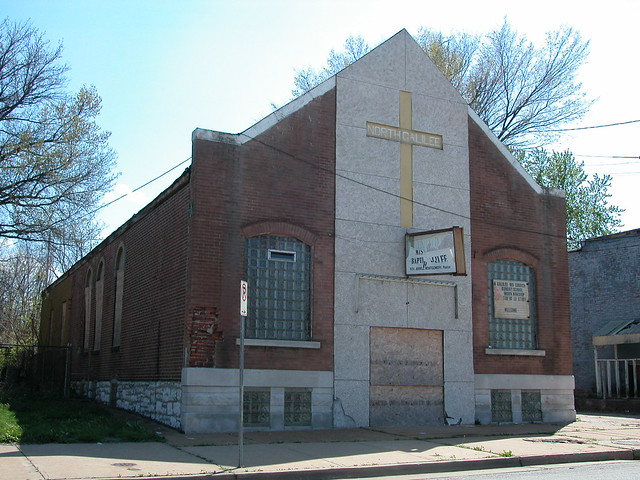 North Galilee Missionary Baptist Church, April 2009
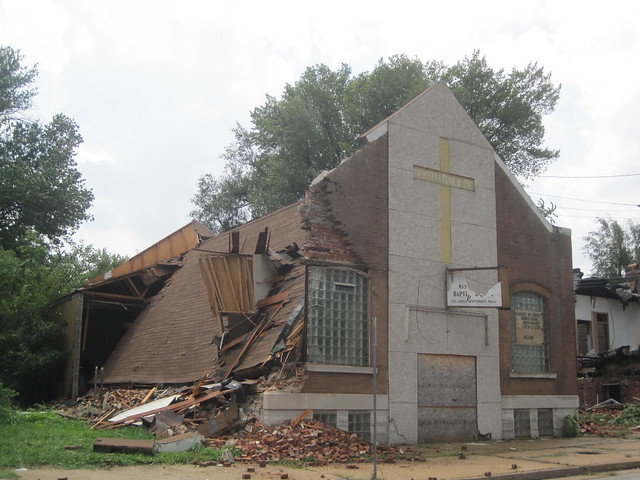 North Galilee Missionary Baptist Church, August 2010
 Today was a lovely day on the near north side of our fair city. At 14th Street in Old North, the two-block former pedestrian mall now has a paved street, full sidewalks and street signs. With the addition of street lights, all will be set for the final opening of 14th Street in the heart of the neighborhood.
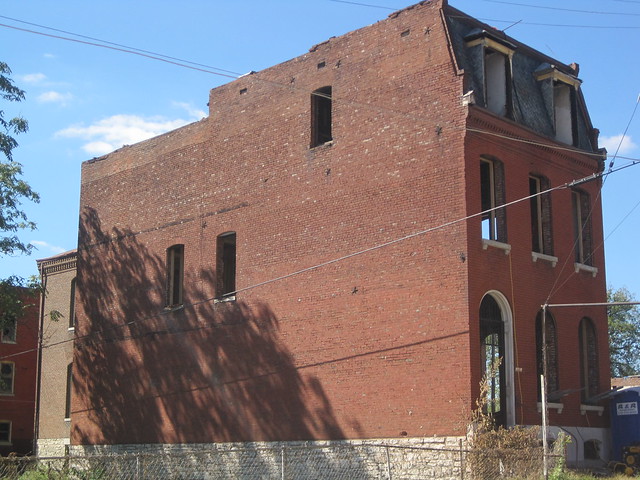 Up in Hyde Park, as I attended a meeting I heard the clamor of tools around 19th and Mallinckrodt streets. The sounds were unmistakable, and plainly beautiful to hear. They came from two buildings on each side of 19th street in block south of the park. Eliot School LP is rehabilitating these 19th century brick buildings for housing. The long-vacant single family home shown here will hold multiple families.
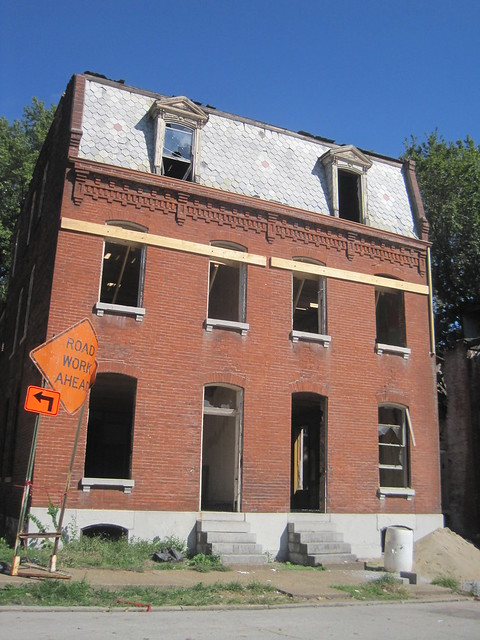 Another vacant four-family will remain in service as a multi-family building, maintaining the residential density that enlivened Hyde Park in the past. Nearby, Salisbury Avenue is getting new sidewalks and street lights. The Salisbury project is in full swing as well, causing traffic to back up around the entrance to the McKinley Bridge. Let no one mistake the sidewalk work for anything other than a catalyst for future growth. Salisbury offers potential for infill construction and rejuvenated mixed-use buildings. Apartments in solely residential buildings are a great part of neighborhood life, but not the only one. The buildings being rehabbed now will someday join a wave of mixed-use buildings old and new on one of the north side’s most humanely-scaled commercial streets. Both 14th Street and Salisbury are central to neighborhood economy, and while much has been renewed around them their historic function — facilitating exchange through commerce – is fragile.