Categories
Historic Preservation Schools SLPS South St. Louis Tower Grove East Tower Grove South

Shenandoah School May Be Spared

by Michael R. Allen

Shenandoah Elementary School at 3412 Shenandoah Avenue in Tower Grove East received a reprieve tonight when St. Louis Public Schools Superintendent recommended to the Special Administrative Board (SAB) that the school remain open in its current building. Although the final decision of Adams’ recommendation won’t be made by the SAB until March 12, the news is a relief to a neighborhood concerned that the future a community resource might become a huge question mark.

Under the proposal from consultants MGT of America unveiled in January, Shenandoah was set to be combined with Mann Elemantary School in Tower Grove Soth and Sherman Elementary School in Shaw in a new building to be build “near” Shenandoah. Neighborhood residents feared that “near” in a dense, landlocked neighborhood meant “on” and that an architectural gem would be lost. The MGT recommendations came only a year after the SLPS had proposed closing Shenandoah outright.

The school is a remarkable building, known widely for the braided limestone columns of its striking entrance (pictured above). Designed by Rockwell Milligan and built in 1925, Shenandoah School is an excellent example of the eclectic strain in 1920s American architecture. Combining Spanish Revival and Renaissance Revival elements on an imposing buff-brick body with a red tile roof, Shenandoah is an unique school buidling and a treasure to its neighbors.

Unfortunately, Adams’ recommendations still include the closure and merger of Mann and Sherman in a new school. This time, Mann is suggested for demolition.

Categories
Historic Preservation Schools SLPS

Adams Proposes 17, Not 29, School Closings

by Michael R. Allen

Tonight, St. Louis Public Schools (SLPS) Superintendent Kelvin Adams presented to the Special Administrative Board (SAB) his recommendations for school closures and consolidations. While consultants MGT of America had recommended 29 closures, Adams recommends 17. Adams’ plan makes one wonder why MGT was hired at all, given how far off their plan was from the needs of the district identified by its superintendent.

Adams recommends closing the following schools in June 2009:
Ashland Branch
Baden Elementary School
Henry eMINTS Elemntary School
Clark eMINTS Elementary School
Big Picture at Des Peres School
Mark Twain Elementary School
Meda P. Washington Early Childhood Center
Scruggs Elementary School
Shepard Elementary School
Simmons-Marshall School
Blewett Middle School
Stowe Middle School
Big Picture at Turner School
Roosevelet Ninth Grade Center at Humboldt School
Big Picture at Kottmeyer School

Adams recommends closing the following schools in June 2011:
Cote Brilliante Elementary School
Mann Elementary eMINTS School
Sherman Elementary School

The following schools that MGT had proposed closing will remain open:
Gallaudet School
Patrick Henry Elementary School
Mallinckrodt Elementary School
Ames Elementary VPA School
Shaw Elementary VPS School
Shenandoah Elementary School
Hickey Elementary School
Bunche Middle School
L’Overture Middle School
Langston Middle School
McKinley Middle School
Stevens Middle School
Gateway High School (possibly in new building on site)
Nottingham CJAT School
Cleveland High @ Pruitt (no return to Cleveland)
Northwest Academy of Law

Adams retains the idea from MGT of constructing two new elementary schools — one south and one north. The south side school will combine Mann and Sherman and astonishingly is proposed for the Mann School site.

Among other recommendations from Adams is a proposal to turn the 13 SLPS-run community education centers into full service schools along the line proposed by the Board of Education; and two new alternative schools that could occupy existing buildings that have scored an overall 70 or higher in MGT’s survey.

Overall, the closures will save the district slightly less than $14 million.

The Special Administrative Board will make its final decision at a public meeting held on March 12, 2009.

Categories
Historic Preservation Schools SLPS

Superintendent to Present Facilities Recommendations on Thursday at Public Meeting

by Michael R. Allen

A very important meeting in the St. Louis Public Schools facilities management process occurs tomorrow night. The Special Administrative Board (SAB) will meet to hear a presentation from Superintendent Kelvin Adams on his recommendations for the facilities management plan, including a closure list. Adams’ recommendations could very well become the plan adopted by the SAB.

Neighborhood activists across the city would do well to attend and find out what the superintendent recommends.

The public meeting takes place at 6:00 p.m. on Thursday, February 26 at the Gateway Schools complex gymansium, 1200 N. Jefferson.

A demonstration against the MGT of America facilities recommendations will commence at 5:25 p.m. outside of the Gateway Schools complex.

Categories
Dutchtown Historic Preservation Housing LRA South St. Louis

The Corner Anchor at Osceola and Grand

by Michael R. Allen

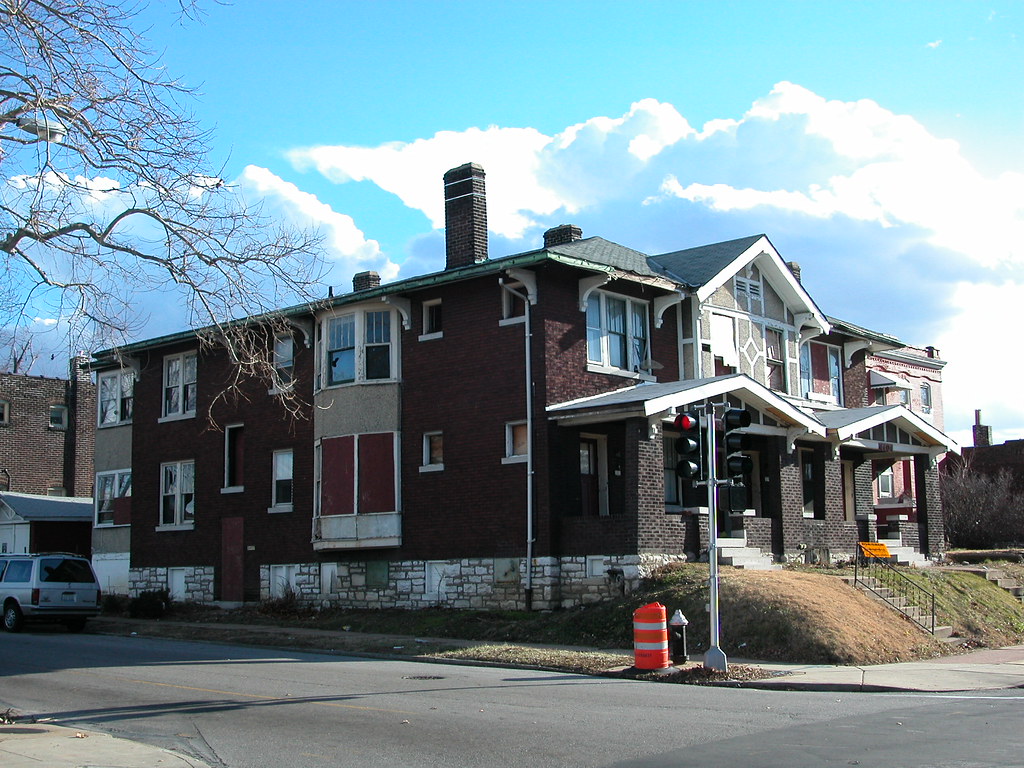
This amazing four-family building in Dutchtown is located at 4400 South Grand Boulevard just south of the large Cleveland High School athletic field. Whether or not this fits in the Tudor Revival or the Craftsman styles does not matter — this is one cool building. The building dates to 1923, when row housing had long faded from the residential vernacular of local architecture. Yet, as a double two-flat, this building acts like the old row housing found in older neighborhoods. The double front porches reinforce the distinction between the two sections, while the roof overhang with its might brackets and the central half-timbered gable pull the sections together.

This is an outstanding example of the 1920’s south city multi-family architectural vernacular, and an impressive anchor for the corner that frames the view of Cleveland High School from Grand. I’ll note the bad news last: this building has been vacant for years, and it’s owned by the city’s Land Reutilization Authority. The Citizens’ Service Bureau records for the property number 107. Despite the woes, the building has solid architectural integrity.

What a great rehabilitation project this could be! Matthew Sisul, Housing Development Analyst with the Community Development Administration, reports that:

LRA purchased this property in April 2008 using CDA’s federal development funds from the 25th Ward. CDA is actively seeking proposals for the rehabilitation of this building (see RFP). The selected developer will be required to adhere towards Section 106 Design Review Guidelines. Assistance towards acquisition and construction costs may be available through CDA. Interested parties should contact me for additional information or to schedule a viewing of the property.

Matthew Sisul can be reached at (314) 622-3400 ext. 322 or sisulm@stlouiscity.com.

Categories
Dutchtown Historic Preservation Schools SLPS South St. Louis

Aldermen Support Re-Opening Cleveland High School

by Michael R. Allen

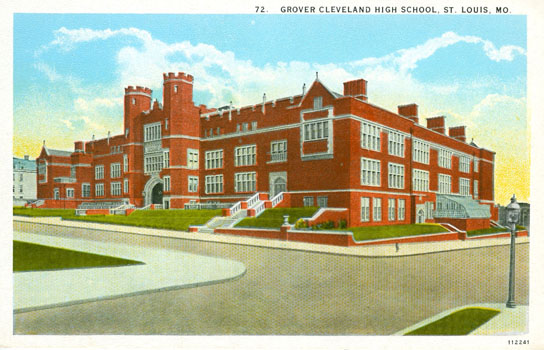
Postcard from the collection of Landmarks Association of St. Louis.


At the Monday meeting of the Intergovernmental Affairs Committee of the St. Louis Board of Aldermen, three aldermen spoke strongly in favor of reopening the shuttered Cleveland High School at 4352 Louisiana Avenue in Dutchtown. The Special Administrative Board (SAB) appeared at the committee to present the proposed facilities management plan and take comments and questions from committee members.

Alderwoman Dorothy Kirner (D-25th), whose ward includes the magnificent school, was direct. During her inquiry, Kirner reminded the Board of the earlier plan to reopen Cleveland, and stated that “I want to know that still holds.”

In response, SAB Member Richard Gaines stated only that the cost of reopening Cleveland would be at least $40 million. Gaines made no further comment.

The Board of Education authorized closure of Cleveland High School in 2006 with the stipulation that it be renovated and reopened. In 2007, the Missouri Department of Elementary and Secondary Education placed the St. Louis Public Schools under the control of a three-person appointed Special Administrative Board. That Board has made no move to find funding for making good on the District’s earlier pledge to Dutchtown that the school would open again.

Cleveland housed a successful Naval JROTC program that is now temporarily housed at Pruitt School. The in the proposed District facilities plan drafted by consultants MGT of America, the Naval JROTC program would move to Vashon High School. Teachers and students in the JROTC program oppose the move.

Cleveland alum Alderman Craig Schmid (D-20th) also spoke in favor of reopening the school. According to Schmid, the school’s last principal disliked the building and sought its closure despite support for the building from students and faculty. Schmid reminded the SAB that the District has worked closely with Dutchtown organizations, including the Alliance to Save Cleveland High School, to create plans for rehabilitation.

Schmid wondered why the SAB was not taking action against the state of Missouri, which owes the St. Louis Public School millions of dollars as part of the desegregation settlement.

“We are not united together marching on our state capital” to get the money, said Schmid. Schmid wondered if those funds would allow the District to reduce the number of schools that it plans to close, or fund projects like rehabilitation of Cleveland High School.

Alderwoman Marlene Davis (D-19th), whose ward includes Vashon High School, joined with Kirner and Schmid to voice support for reopening Cleveland as the home of the JROTC program. Davis stated that federal funds might help the District get Cleveland reopened.

Categories
Historic Preservation Schools SLPS

Hilliker Sale Listings for Historic City Schools

by Michael R. Allen

On the website of the Hilliker Corporation brokerage is a page listing all for-sale buildings owned by the St. Louis Public Schools. Also on the website are documents related to the sale process, including a sample sales contract with the current deed addendum that prohibits a buyer from demolishing a building and requires rehabilitation be conducted following the Secretary of the Interior’s Standards for Rehabilitation (see page 14 of the contract).

The schools that are included in Landmarks Association’s survey of school buildings built before 1938 currently for sale are Central High School at 3616 N. Garrison Avenue (1902, William B. Ittner), Hempstead Elementary School at 5872 Minerva Avenue (1907, William B. Ittner), Gardenville School at 6651 Gravois (1907, William B. Ittner), Jackson School at 1632 Hogan Street (1898, William B. Ittner), Hodgen School at 2730 Eads Avenue (1884, Otto Wilhelmi), Garfield School at 3200 Texas Avenue (1937, George Sanger), Eliot School at 4242 Grove Avenue (under contract; 1898, William B. Ittner) and Scullin School at 4610 N. Kingshighway (1927, Rockwell Milligan). Besides those eight buildings, there are other post-1938 buildings for sale.

Hilliker’s website includes historic information about each school, including the name of the architect, date of construction and even architectural style. The presentation clearly is designed to call attention to the beauty and unique history of the buildings to lure responsible buyers.

Categories
Demolition JeffVanderLou North St. Louis

Corner Storefront No More

by Michael R. Allen

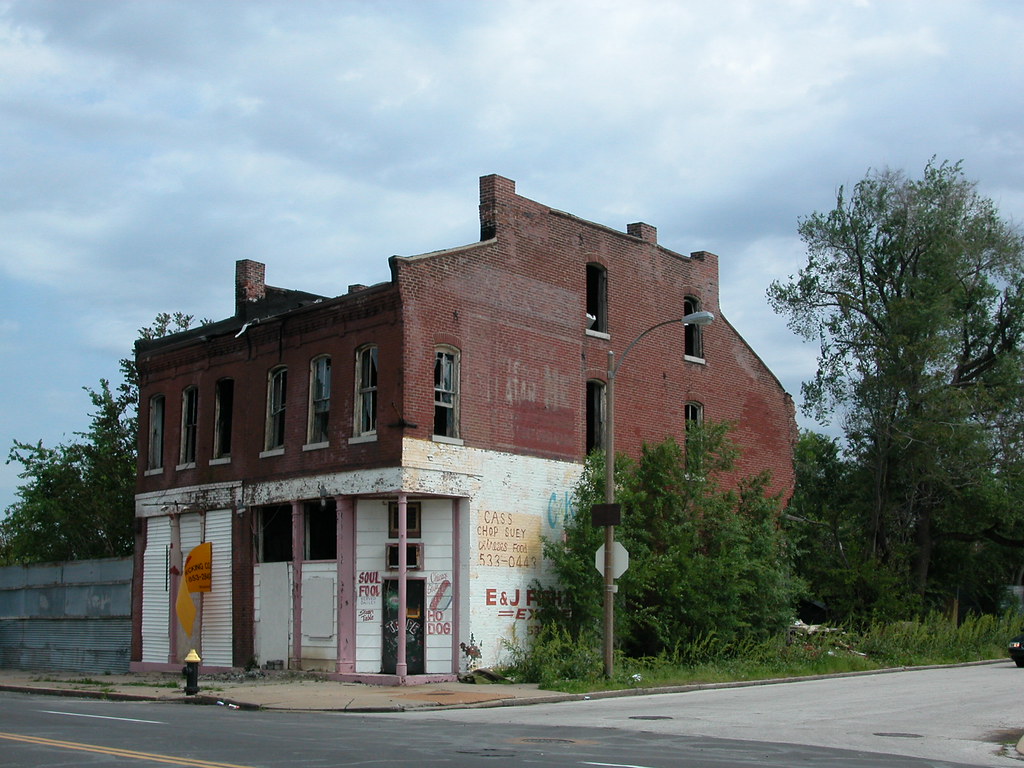
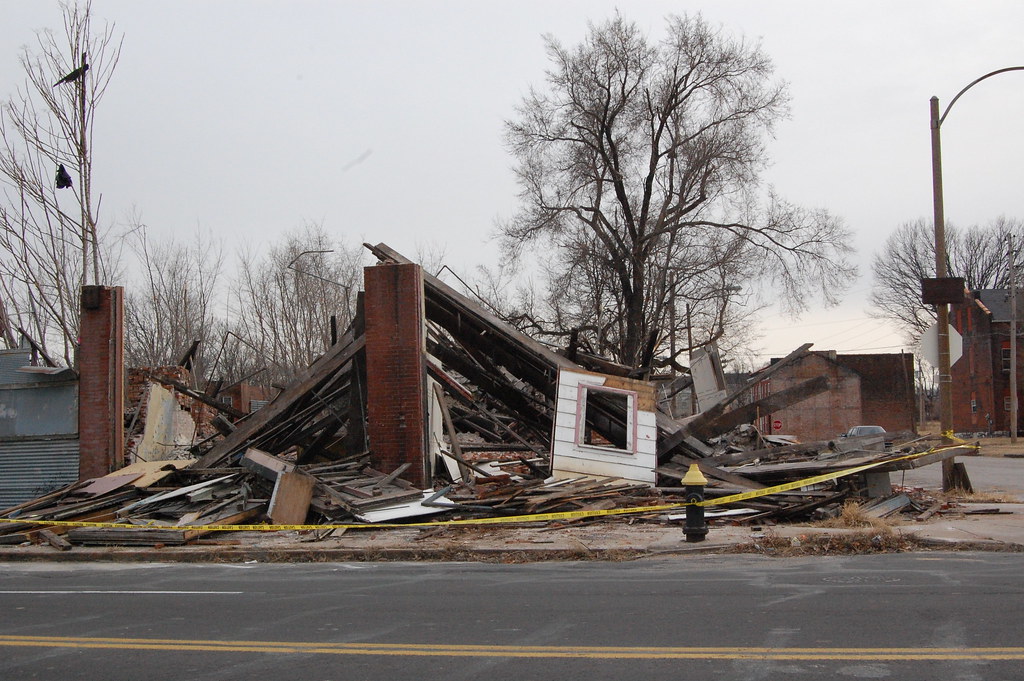
The corner storefront at 2742 Cass Avenue, subject of the previous post “Corner Storefront on Cass Avenue” (May 14, 2008), is under demolition.

There is little left of the once-beautiful building.

Categories
Demolition East St. Louis, Illinois Industrial Buildings Metro East

The Pens

by Michael R. Allen

The new Mississippi River Bridge entails construction of an extension of I-70 that will run parallel to St. Clair Avenue in East St. Louis. As part of this project, much of the National City Stockyards in East St. Louis will be demolished. While the abandoned Armour and Hunter packing plants will not be disturbed, the landmark concrete stock pens will be gone forever by year’s end. The flip side is that the Illinois Department of Transportation will be conducting archaeological work on the site that will help us learn more about the history of the stockyards.

Yesterday, I led a group of sixth graders from the College School on a tour of East St. Louis. We stopped at the stockyards, and got out of the bus to look inside the long cattle pen shown above. A security guard ushered us away, and told teacher John Colbert that we should leave because the pens were about to be demolished. In fact, we were there precisely because the pens will be demolished, removing the chance for future generations to physically connect with an important part of St. Louis’ industrial past as well as a lost system of food production. While I am not prepared to strongly advocate for saving any of the ruins of the stockyards, yesterday’s tour led me to wonder how any of the sixth graders will explain what they saw to their children. Will they drive on the I-70 connector and explain that once upon a time they stood in cattle pens on that site? Will their children care about a history that has no living physical embodiment?

Categories
Demolition North St. Louis Old North St. Louis Place

Crown Mart Plaza is a Missed Opportunity

by Michael R. Allen

City Block 599 is bounded by North Fourteenth Street on the west, Cass Avenue on the south and North Florissant Avenue on the east and north. Starting with the construction of Florissant Avenue in 1935, the block was slowly cleared across the 20th and early 21st centuries. Once a dense near north residential and commercial mixed-us block, by the 1980s the block only held two buildings. By October 2005, when I took the photograph above, the block was fully clear of buildings.

Since November, the block has risen with construction again. This time, the building that will occupy City Block 599 will be a strip mall and gas station known as Crown Mart Plaza. While a strip mall is better than an empty block, and the area desperately needs stores, the site deserves something better. The photograph above shows the Mullanphy Emigrant Home (before the April 2006 storm struck) and buildings in the Old North St. Louis neighborhood in the background. This site is a visual gateway to Old North and St. Louis Place. While Tucker Boulevard and North 13th Street are currently closed, that combined major thoroughfare will open again. When it reopens, the new Mississippi River Bridge will be completed, with its ramps dropping cars on Cass Avenue just one block east. Thousands of people will pass by this block on their way to the historic neighborhoods of the near north side.

The Crown Mart Plaza is a missed opportunity to build something on the site that is an appropriate architectural entrance to great north city neighborhoods. The first impression of north city made on many people will be another gas station rather than a building that is distinct and proclaims community support for high design standards. Some day, the Emigrant home will be rehabilitated, and Old North and St. Louis Place will begin seeing infill construction. MetroLink will pass by City Block 599 on Florissant Avenue. The Crown Mart Plaza does not anticipate the changes to come, or encourage them.

Crunden Branch Library photograph by Rob Powers, Built St. Louis.

Of course, many of us anticipated such a future for the block when the former Crunden Branch Library, owned by the city’s Land Reutilization, abruptly disappeared in August 2005. Students at Washington University recently had submitted a nomination to the National Register of Historic Places of the landmark building when the city’s Building Division wrecked the Crunden Library building. Built in 1909 and designed by Eames and Young, the Crunden Branch Library served the educational needs of area residents until 1954, when the branch moved west and the building was remodeled for use by Pulaski Bank. This building signaled the greatness of its surrounding neighborhoods, and its loss was a huge blow to the Cass Avenue street scape.

Just north of the Crunden Branch Library on Fourteenth Street stood a bus maintenance garage that dated to the 1930s. This building was a utilitarian building, and not an outstanding work of architecture, but a building that could have been adapted to many uses — including a retail strip. Since the land between this building and North Florissant was vacant, its footprint is remarkably similar to that proposed for Crown Mart Plaza.

The bus garage was destroyed in a large fire on September 15, 2005, so soon after the Crunden Library demolition that bits of terra cotta from the old library still littered the straw-covered earth. Since that fire and the garage’s subsequent demolition, City Block 599 has stood vacant as rumors of retail development have swirled. If only the planned retail use could have aligned with an effort to improve the architectural character of Cass and North Florissant avenues, the tone for great development on these streets could have been set.

Categories
Downtown Historic Preservation Mid-Century Modern

Gentry’s Landing Remodeling Mars Modern Buildings

by Michael R. Allen

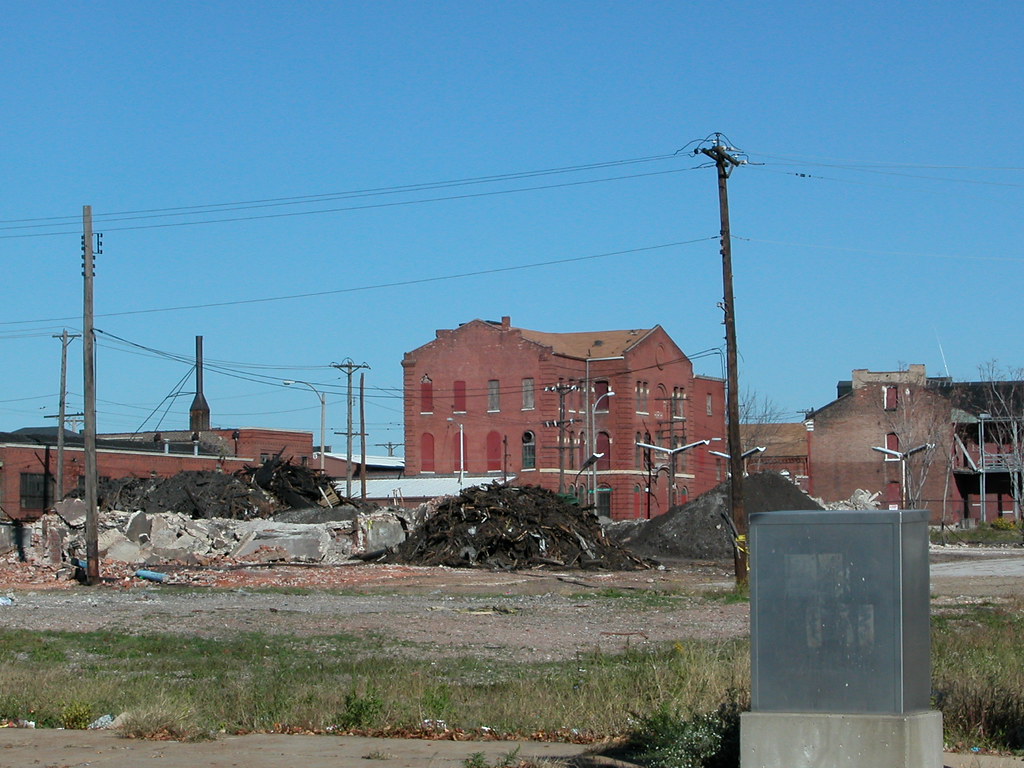
What’s wrong with this picture?

If you answered “two perfectly fine mid-century buildings have been given ugly pink brick socks,” you are right. This is a view looking northwest across Fourth Street at the Gentry’s Landing apartment tower and the three-story office building to the north. These buildings are part of the Mansion House Center, whose three nearly-identical towers and three nearly-identical office buildings are part of an urban renewal project completed in 1966 and designed by renowned St. Louis architects Schwarz & Van Hoefen. The Mansion House Center is a solid work of mid-century architecture, although like many of its contemporaries is somewhat hostile to its urban setting. The buildings are a homespun working of Mies van der Rohe, replacing the sleekness of pure glass and steel compositions with a more pedestrian mix of glass, steel and concrete.

The Mansion House Center is connected by a large parking garage on the east with a delightful upper garden deck. The garage blocks Olive, Locust and St. Charles streets to form a super-block, and is interrupted only by the already-extant Peabody Coal Company Building (1958, Ralph Cole Hall) and a former Washington University alumni club building built as part of Mansion House Center. The garage causes the project to present a public face to Fourth Street and a dull, mostly-utilitarian wall to the Arch grounds on the east.

However, the towers and office buildings were meant to harmonize with the new monument. Schwarz & Van Hoefen designed the Mansion House buildings to frame view of the Arch through downtown with equally-modern architecture. The architects wisely avoided upstaging the Arch with innovative design, instead providing an architectural supporting player. The garage’s monotony belies the fact that its garden roof was supposed to extend the lushness of the Arch grounds into downtown via a unique vantage point. Architecturally, Mansion House does well, although functionally its garage is a barrier between downtown and the Arch grounds that could stand some alteration. (Read Steve Patterson’s ideas for changes here at Urban Review.)

Yet none of the needed alteration involves changing the architectural vocabulary of the Mansion House buildings, whose minimal modern lines evoke the mid-century optimism of St. Louis and only enhance the presence of the Arch. The pink brick applied to the column bases at Gentry’s Landing and its neighbor undermine the grace of the original architectural gesture by making the buildings stick out. Perhaps this gesture is good for leasing apartments, but it is not good for the street scape on Fourth Street.
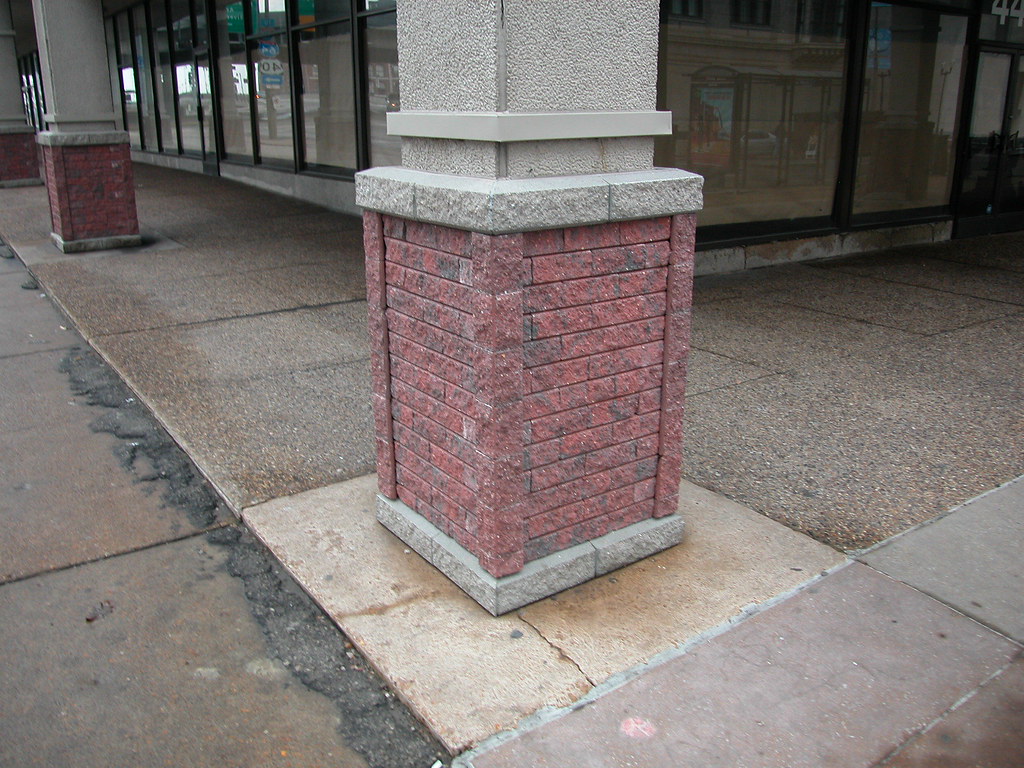
Up close, the brickwork reveals itself to be thin applied rough-faced brick sandwiched between fake stone. The contrast between these bases and the straight lines of the pale concrete columns could not be stronger. Additionally, the columns have been given little concrete bump-outs above these bases.
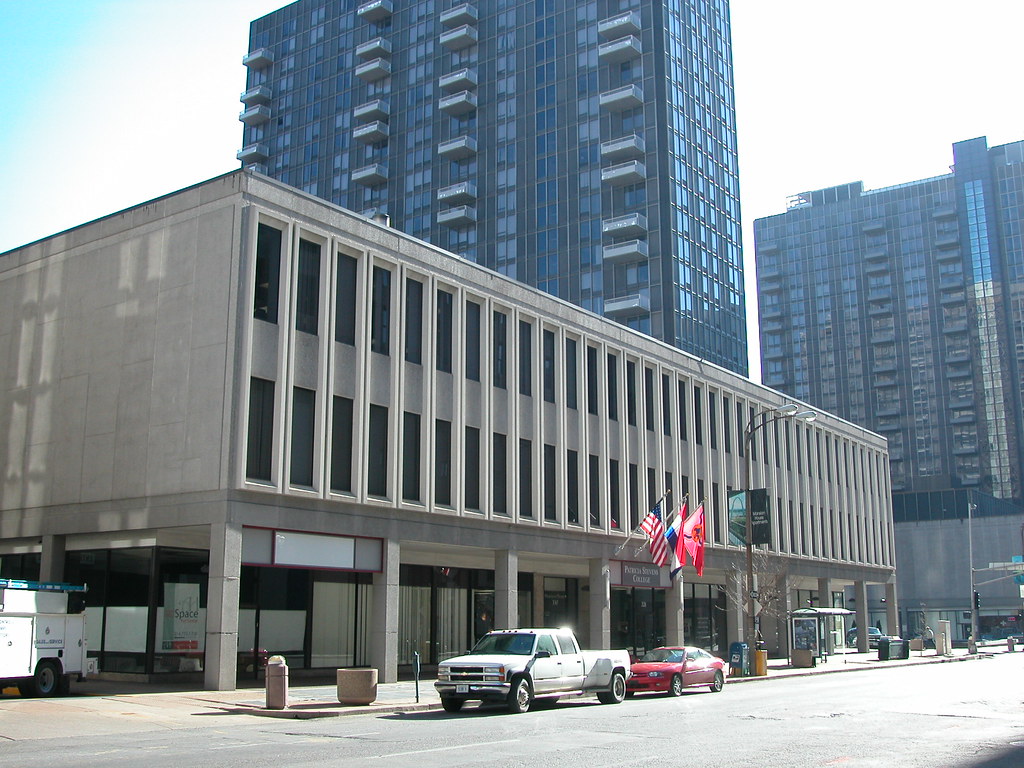

The photograph above shows the original appearance of the column bases of the next office building south of Gentry’s Landing, which falls under different ownership. One can see how the straight lines of the columns accentuate the projecting window surrounds of the upper two floors.
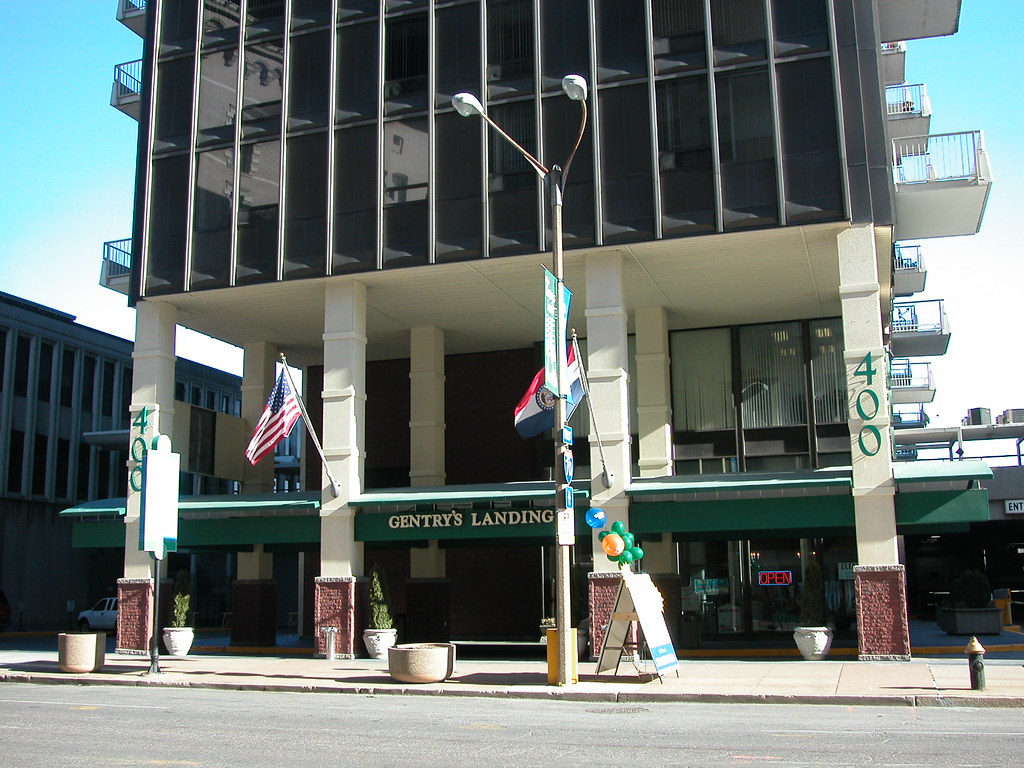
The restrained modern entrance to Gentry’s Landing is now ablaze with the pink brick bases, a yellow paint on the concrete and green signage. Yes, times change, and developers need to be profitable, but there are many ways to make changes and make money without making bad design decisions. In fact, bad decisions might turn out to be less profitable in the long turn as applied materials age and appear dated while original materials — even mid-century concrete, I submit — retains a sobriety that is attractive.
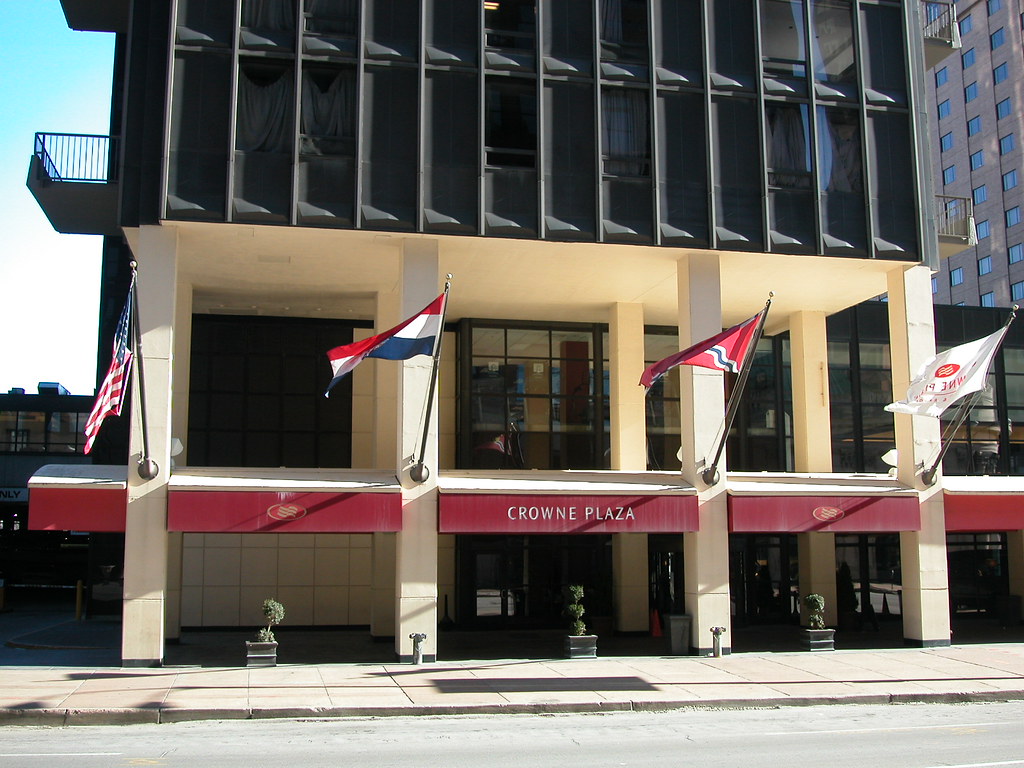
The entrance of the south tower at Mansion House Center retains its original appearance despite changes of use (apartment to hotel) and addition of awnings (which can be removed). The curved concrete canopy and hotel lobby have been extended through replication of form and material. Changes here have retained the modern lines of the building.

Alas, the Gentry’s Landing project is not the only remodeling project to mar a mid-century building on Fourth Street. Just to the north across Washington Avenue is one of the worst architectural slipcover jobs to hit downtown St. Louis, the 2003 conversion of the former Bel Air East into a Hampton Inn.
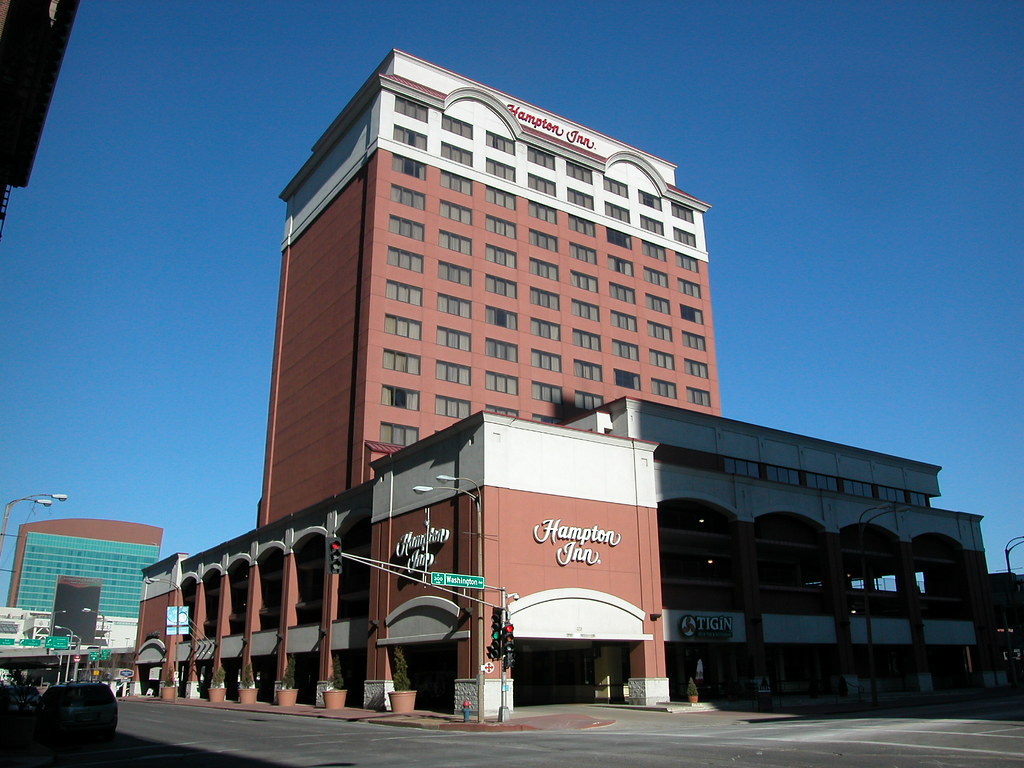
Opened in 1964 replete with a Trader Vic’s tiki lounge, the Bel Air East was also a complementary modern building that embraced its location near the Gateway Arch. While the Bel Air East was imperfect, none of its flaws justified the complete covering of the building in pink EIFS. The result of the cladding project is reminiscent of the works of the 1980’s American postmodern classical movement — that is, dull and pretentious.

Of course, one could take the retroactive view further back in time and look at the Adam’s Mark Hotel, whose 1985 construction entailed the complete covering of the Pierce Building (1906, Frederick Bonsack) with flat gray granite and unarticulated brown brick. That disaster destroyed an earlier office building in favor of a work of architecture that doesn’t even deserve the descriptor “mediocre.” Who knew that what happened to the Pierce would happen again to the street’s mid-century buildings?