
The public has only until Monday, March 16 to submit comments on the National Park Service’s draft General Management Plan for the Jefferson National Expansion Memorial. Read the draft plan here. Make your comments online here.
by Michael R. Allen
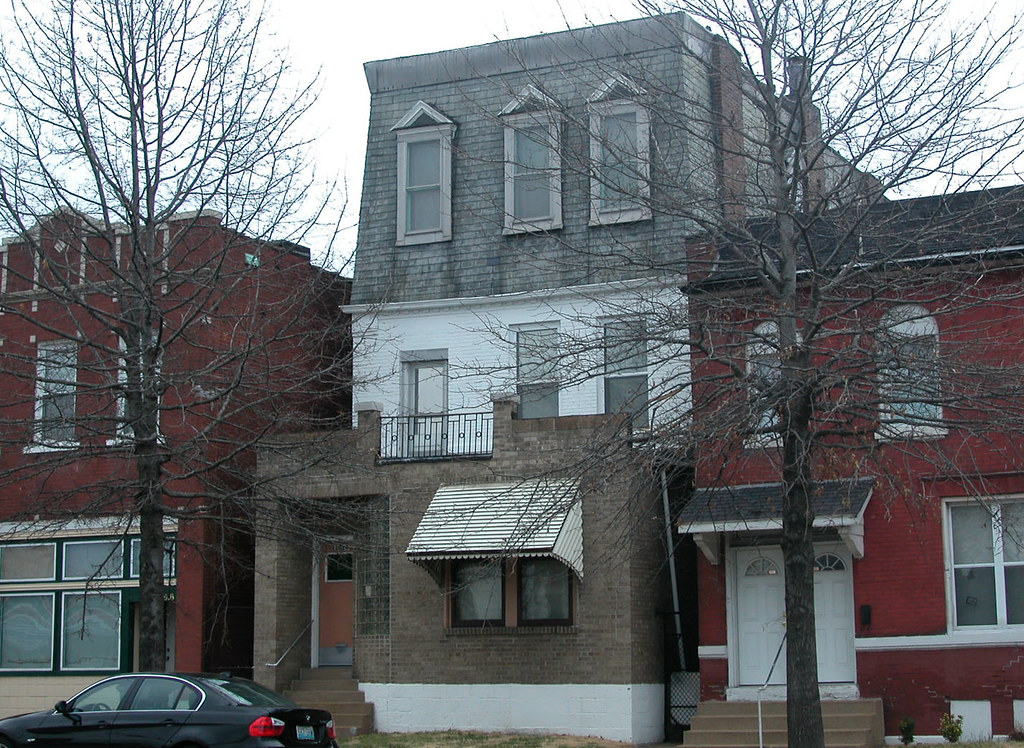 The storefront addition at 2620 S. Jefferson in Benton Park was perhaps inevitable. The three-story house with an unusually tall wrap-around mansard roof was built in 1900, and soon afterward was the only building in a quarter-block stretch to not sit at the sidewalk line. When a building was built at 2618 S. Jefferson next door in 1916, any advantage to having a proper front lawn eroded. This was a commercial district now.
The addition sits at the house floor level rather than at the sidewalk level, so its entrance is atop a few steps. The curved wall at the entrance sweeps one’s eye to the door. What is most lovely about this storefront addition is that its roof is actually a porch for the house, which received a door to access the space. The parapet wall even has a cut-away center carrying a section of iron railing — a charming gesture in keeping with the gentility of the elegant late Second Empire house. (Who was building Second Empire houses in 1900 anyhow? People who liked strange mansard dimensions, I guess.)
by Michael R. Allen
ST. LOUIS, Mo. – One hundred public school supporters held a Save Our Schools Rally at Shepard Elementary School at 3405 Wisconsin this morning to show support for keeping the school open. They then marched to Monroe Elementary, Carnahan High School, Meramec Elementary, three schools that have been recommended to stay open, with a concluding rally at Cleveland High School on S. Grand (which was closed three years ago).
At Shepard Alderman Craig Schmid urged participants to sign a petition opposing the closure of St. Louis Public Schools such as Shepard (e-MINTS) Elementary, Meramec Elementary, Cleveland High and Scruggs Elementary. “There are plenty of children in the area, but we have not seen sufficient efforts to market or recruit students to participate in quality St. Louis Public School programming,†Schmid said. Shepard pre-schoolers led those gathered in saying the pledge of allegiance to the flag and singing “The Star Spangled Banner†before reciting a portion of a speech by Dr. Martin Luther King, Jr.
At Monroe Elementary, Schmid told the history of the school’s successful re-opening after almost 20 years of being closed. He questioned whether charter schools would be accountable to the community for quality education and noted that charter schools already operating in the area do not compare well with student achievement at Monroe.
At Carnahan High School and Meramec Elementary School, marchers stopped to celebrate successes, including recent awards given to Dr. Alice Roach, principal of Carnahan. Student ambassadors told about high tech classroom aids available at the school and announced that Carnahan had just received accreditation through the North Central Association.
John Chen of The Alliance to Save Cleveland High greeted marchers at the final stop of the Save Our Schools event and told them about work that citizens are doing to get the high school re-opened. Chen said they hope to see the building used as a much-needed community center and “as a collection of small learning communities in one large building.†Such a model has operated successfully, according to Cleveland supporters who have been researching “best practices†in other cities.
Alderwoman Dorothy Kirner (Ward 25) and State Representative Jeanette Mott Oxford (District 59) were also present to show support for keeping the schools open. Those interested in joining efforts to support any of these schools are invited to call Schmid at 314-589-6816 or Oxford at 314-771-8882.
by Michael R. Allen
 Just south of the intersection of Virginia and Meramec in downtown Dutchtown stands the storefront addition at 4212 Virginia Avenue. Records indicate the mansard-roofed house was built in 1889. The storefront has an early twentieth century shaped parapet as well as later modern elements like the steel canopy and glass block.
by Michael R. Allen
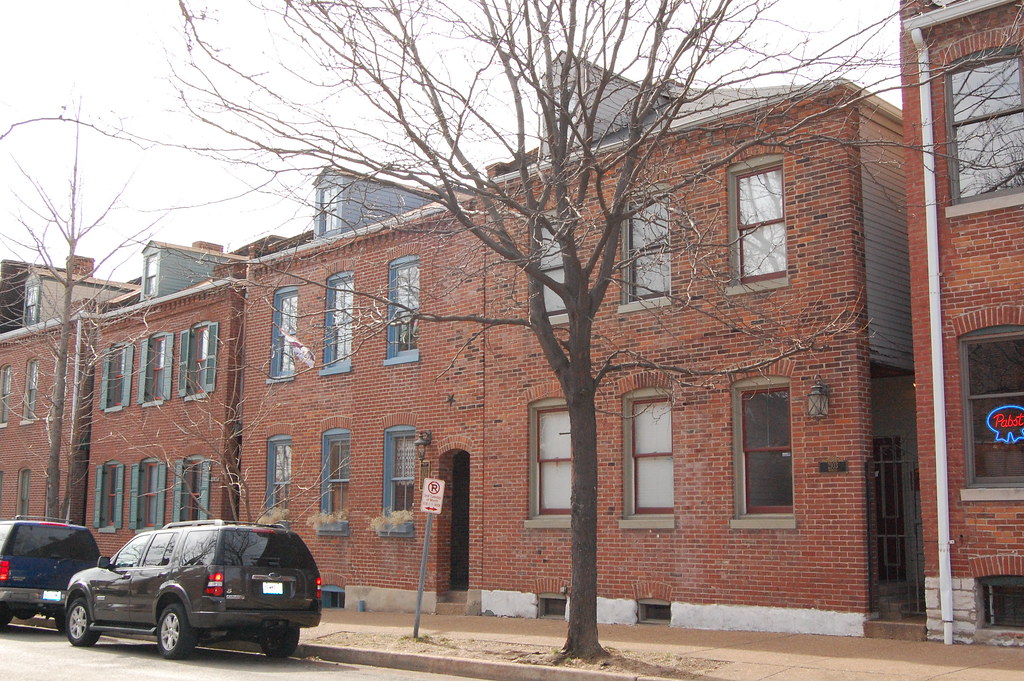 The “Menard triplets” are three 19th century flounder houses in Soulard located on the west side of Menard Street just south of Russell. Many flounder roofs simply form a half-gable, running down from one side of the building to the other. These houses have a hip to their roofs that allows for a front-facing dormer. Still, the roof form is within the flounder house range. St. Louis seems to have the largest concentration of flounder houses, which are found in few American cities (Alexandria, Virginia and Philadelphia have them).
 The center house (left here) was extended to the south to meet the northern house, creating a “mousehole” entrance to the gangway.
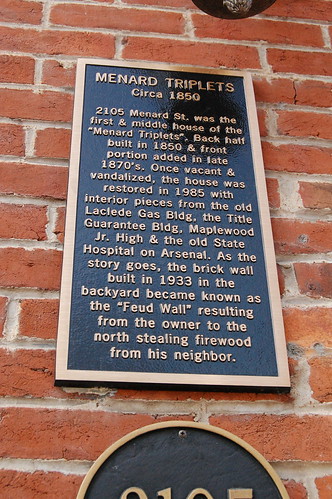 A plaque on the wall of the center house tells some of the story of the houses, including a wide range of salvage pieces that went into rehabilitation of the center house. Plaques like these are a great part of the urban fabric in that they allow buildings to tell some of their own story. Forget the Internet or a guidebook — the best way to explore is on foot, and the best way to learn about historic architecture is to study the buildings themselves. A few more clues always help.
by Michael R. Allen
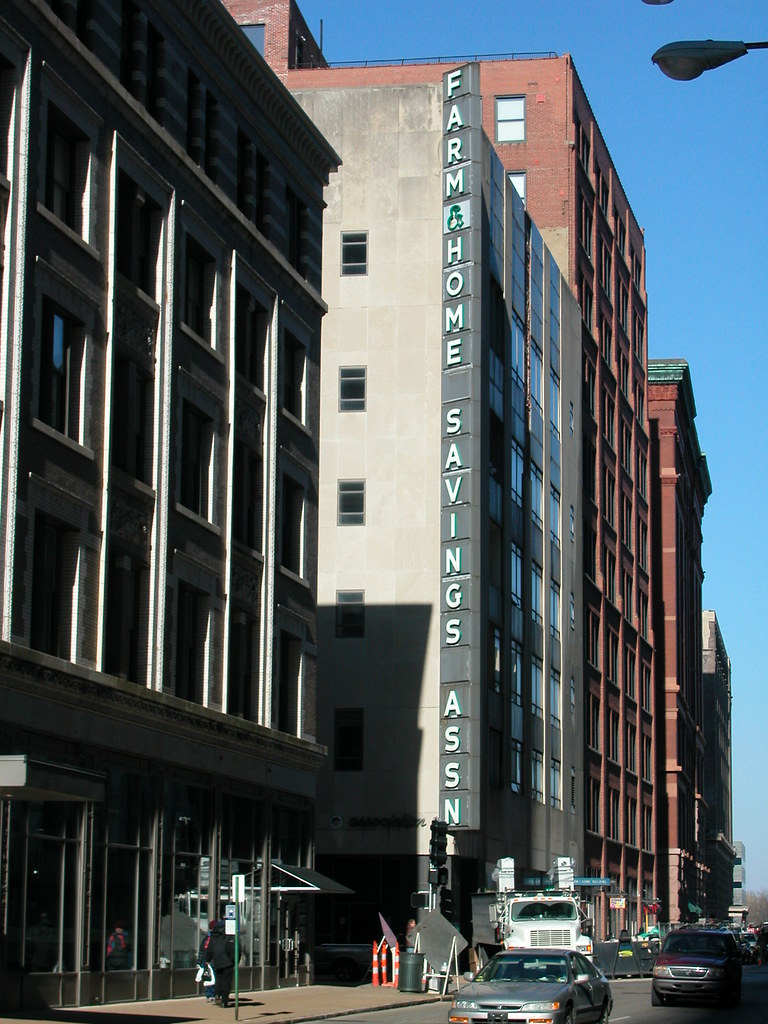 Downtown development may be crawling along right now, but one stand-out project is leaping ahead. LoftWorks is redeveloping the Farm and Home Building (to be known by its 10th Street address as the “411”) at the northwest corner of 10th and Locust streets. Several things are notable about the project, which is well underway and due for completion next year. For one thing, the end use will be the original — office space with ground-floor retail. For another, the 60,000 square-foot building will get a green rehab, with a vegetation roof and gray- and rainwater recycling systems. The $12.7 million project shows that LoftWorks is downtown’s Little Engine That Will. LoftWorks just completed rehabilitation of the Syndicate Trust Building, opened Left Bank Books across the street from the Farm and Home.
What is most astounding to me, however, is that the rehabilitation will preserve the existing exterior appearance of the building. In most cases, that’s a given, but the Farm and Home Building is actually a morphed version of the Kinloch Building. In 1954, the owners of the Classical Revival building designed by Widmann, Walsh and Boisselier decided to join the downtown modernization trend. With construction materials scarce and expensive after World War II, many owners tried inexpensive projects to give their buildings a mid-century vibe. Some simply removed cornices. Others reclad just the ground floors so that the sidewalk views were clean and modern. Others went all-out and completely clad historic buildings in modern materials.
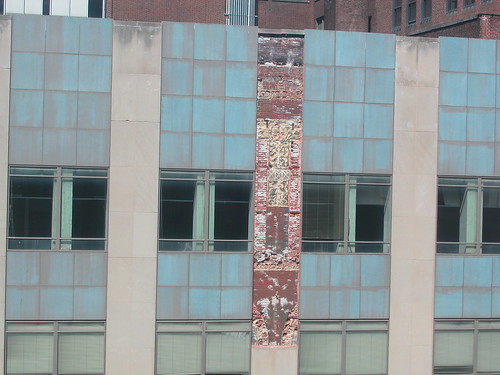 The Farm and Home Building is one of the most extensive of these projects — not only was the masonry building reclad, but its terra cotta ornament ground off to accept the new granite, concrete and metal panels. (Other notable projects from this period include the Dorsa Building, the St. Louis Post-Dispatch Building and the Mercantile Library Building.)
While the Farm and Home is not a knock-out work of mid-century slipcover design, it’s handsome. Other recladding jobs, like the garish work that covered the Post-Dispatch Building at 1139 Olive Street, dated rather quickly and raised the question of whether or not they were actually an improvement. Many developers have chosen to remove their cladding, like at the Post-Dispatch Building, and mostly the recladding work has proven reversible. Not so at Farm and Home.
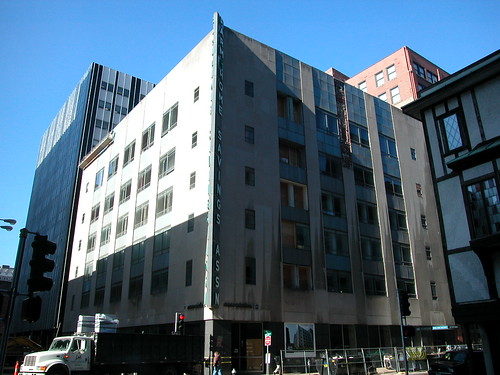 In order to qualify for the National Register of Historic Places and thus for state historic rehabilitation tax credits, a building must exhibit integrity of historic design. To nominate the Farm and Home Building as the Kinloch Building would have required extensive reconstruction work — not eligible for credits — before a nomination could even take place. Hence, LoftWorks successfully explored a different strategy: list the Farm and Home for what it now is, an early example of extensive mid-century modernization design. The National Park Service listed the Farm and Home Building on the National Register on October 29, 2008. The Farm and Home Building now is officially historic because of its slipcover.

by Michael R. Allen
 Here’s the sort of neighborhood stabilization issue that you probably won’t hear being discussed by any mayoral candidates. Above is the corner storefront at 2001 S. Jefferson (at Allen) in Fox Park. Built in 1892, the two-story building is a contributing resource to the Compton Hill Certified Local Historic District, and anchors the first solid corner of Fox Park on Jefferson south of I-44.
Believe it or not, this building has been condemned for demolition by the Building Division! (Of course, the New Vision Demolition banner on the front takes some of the surprise out.) In June 2007, the Building Division issued a condemnation for demolition order. Why? Take a look.
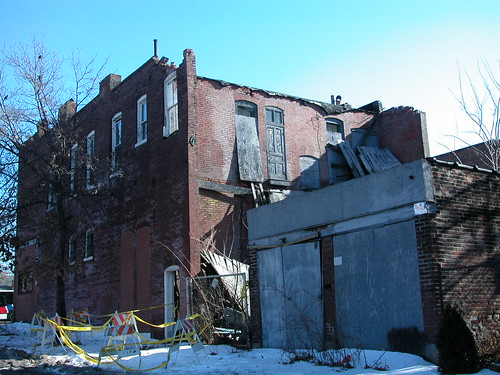 This is definitely not a good situation here, but it is hardly grounds for demolition. This building has that great detail found on some of the city’s neighborhood commercial buildings: the wall extends to shield the end of a multi-story gallery porch at the rear that provides access to residential flats above.
Obviously, the porch collapsed. Permit records show that a permit to replace the “rear deck” was issued on April 2, 2007. Obviously, the owners failed to replace the porch and left the building in terrible shape. The Building Division was wise to act with condemnation, by why is the order “for demolition”? The Building Division is allowed to condemn buildings “for repair,” and in this case should have done so. The loss of the porch caused damage, but not anything that makes the building unsound.
Of course, a condemnation for demolition order could scare a problem property owner to sell. However, that order could also lead to a building’s being placed in a city demolition package down the road, no matter if the building truly is unsound under the definitions established in our public safety laws and preservation ordinances. The good thing is that a demolition permit in a local historic district will go to the Cultural Resources Office. In this case, neither owner nor the Building Division has pursued demolition — for now.
What is then accomplished by this condemnation order? Very little, except creating another threat to this building. Clearly, the order has made no impact on the owners, who have not even removed much of the debris behind the building.
Instead of condemnation for demolition, an order used too often, why not condemn buildings for repair with enforceable deadlines? There is, after all, more than one way to enforce the public safety laws, but the Building Division too often relies on the ineffective, destructive “condemnation for demolition.” The Building Division would do well to help neighborhoods stabilize their neighborhoods while preserving valuable buildings. Clearly, demolition contractors would not get as much work but hopefully better-paying construction work would be encouraged.
Whoever is Mayor on April 7 should make changes at the Building Division. At the very least, all demolition decisions should be made by a qualified structural engineer. At the most, there should be a reorientation of code enforcement away from the mindset that the Division should eliminate all that is broken. The Building Division’s goal should be fixing all that is broken for the benefit of our citizens, and reserving demolition orders for those cases where public safety is truly threatened.
by Michael R. Allen
 Here is another corner storefront addition in located at 2800 James Cool Papa Bell (at Leffingwell) JeffVanderLou. This is made for high density, with a storefront on James Cool papa Bell and two additional (although now filled) storefront bays on Leffingwell. Although vacant and now owned by Union Martin LLC, the house and the addition are in good condition. Note the dentillated cornice on the storefront, and the intact dormer details on the main house.
Categories
A Ramshackle Masterpiece
by Michael R. Allen
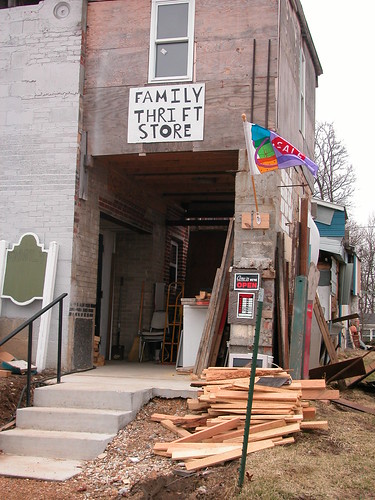 Welcome to the Family Thrift Store loacted on Fitzgerald Avenue in Gerald, Missouri. Gerald is a small town in Franklin County southwest of St. Louis. The Family Thrift Store building is a tour de force of homemade architecture. Literally, there may be no common American building material not used in the construction of this ramshackle masterpiece. This building has it all — brick, clay tile, concrete block, metal siding, wood, vinyl siding, polished granite, limestone and even a piece of terrazzo embedded in the wall.
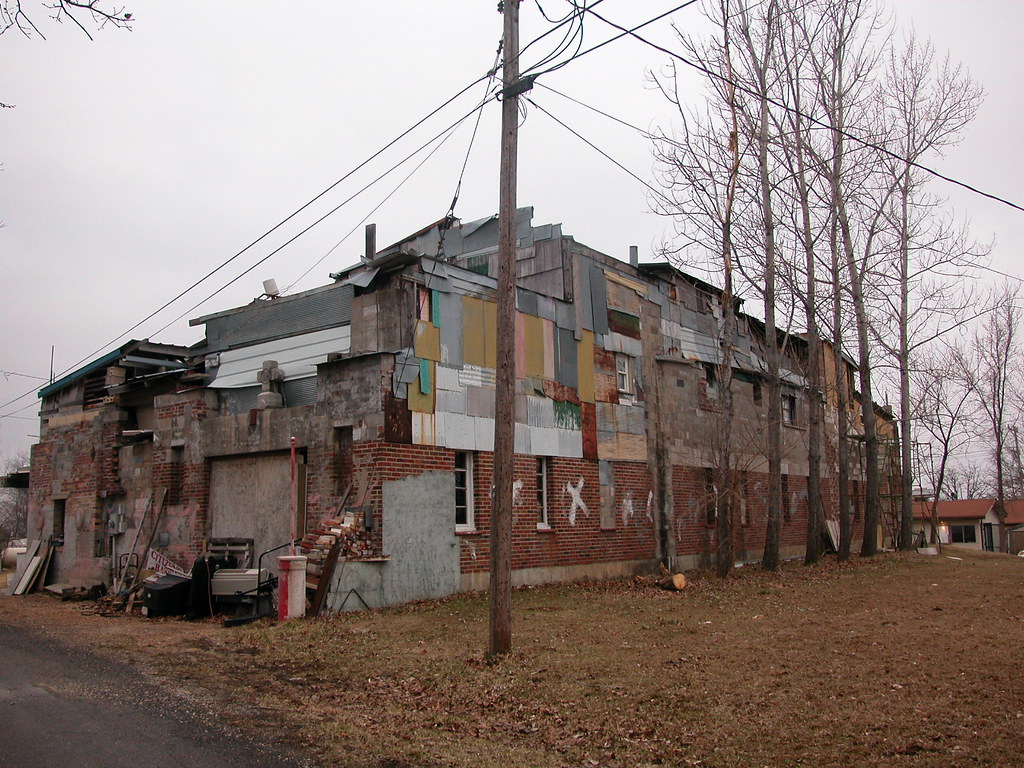 The construction uses a lot of plausible leftover materials, but also some salvage parts. Many of these salvaged pieces appear to come from a Roman Catholic Church, with a stone bearing the name of Joseph Cardinal Ritter and a date in 1967. There is even a carved limestone cross — much earlier than 1967 — over the rear garage door.
 |
 |
While the colorful mess of materials is the piecemeal handiwork of a builder, there seems to be a unitary component on the east side, where a brick wall on the first floor uses the matching bricks laid conventionally across its run. This appears to be the remnant of either a destroyed, altered or unfinished building.
The wood-heated thrift store is open to the public, but its wares are not as exotic as the exterior would suggest. The origin of the thrift store building remains unknown to this writer, who would love to learn how the brick wall became an unfinished, gaudy and unique work of folk architecture. Does Missouri have anything else like this? This building is as idiosyncratic, hand-made and strangely alluring as the Watts Towers. All my notions of architectural propriety wither in the face of the Family Thrift Store. I dig it.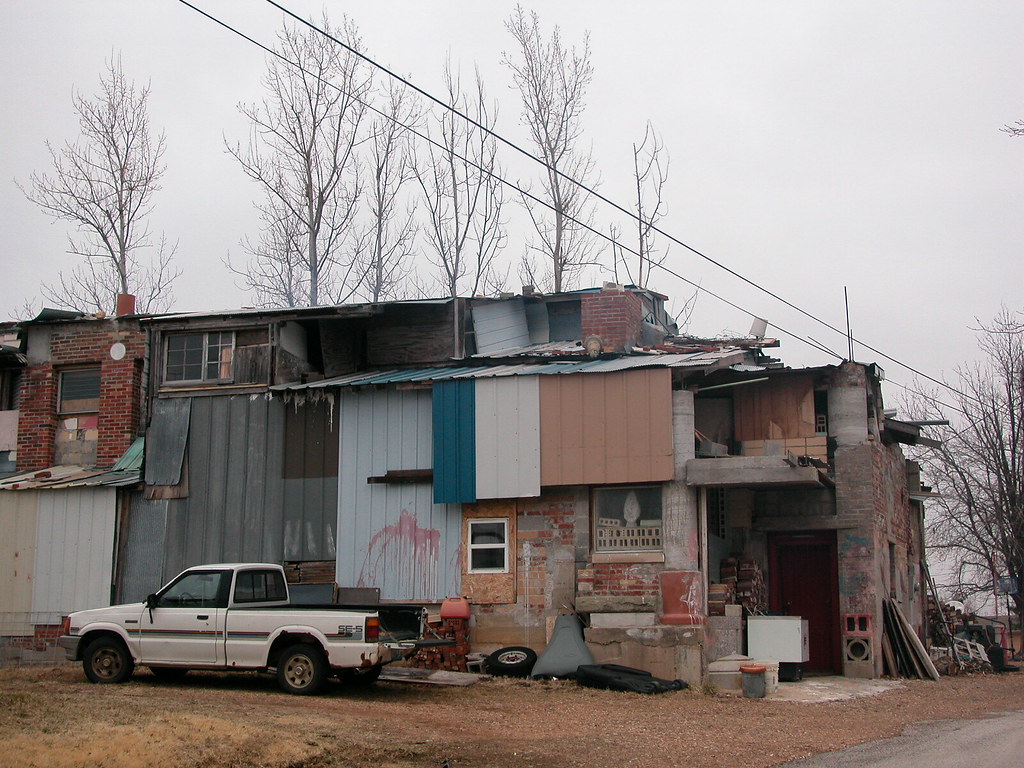
by Michael R. Allen
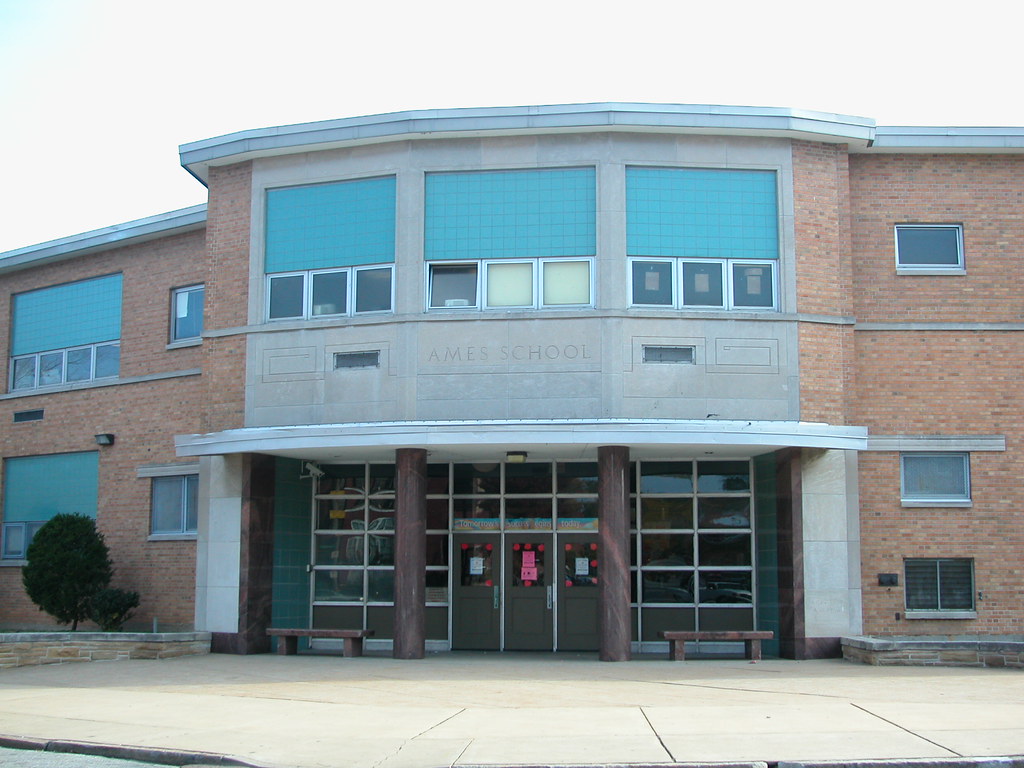 St. Louis Public Schools Superintendent Kelvin Adams is recommending that Ames Visual and Performing Arts (VPA) Elementary School at 2900 Hadley Street in Old North St. Louis remain open. On Thursday, February 26, Adams recommended to the Special Administrative Board (SAB) that the Board reject the proposal from consultants MGT of America that Ames combine with Shaw VPA Elementary School at the Blewett Middle School on Cass Avenue, and the two schools’ buildings close.
While the SAB will not approve Adams’ recommendations until March 12, the shift from the consultants’ recommendations is welcome in Old North, a neighborhood that remains beset by an earlier school closure. In 2007, the Board of Education closed Webster Middle School at 2127 N. 11th Street. Webster is a large historic school whose site encompasses an entire city block. Since its closure, which came after the opening of charter school Confluence Academy in Old North, the district has not placed Webster for sale nor determined its future use. The building sits vacant in a neighborhood saddled with many large, vacant historic buildings, including the partly-stabilized Mullanphy Emigrant Home, the Meier and Pohlmann factory and the burned-out Fourth Baptist Church. The neighborhood did not need another building added to that list.
Opened in 1956, Ames is a fine mid-century building that provides a pleasant contrast with its 19th-century red-brick surroundings. Ames closes eastward views down both Wright and Sullivan streets. In 1992 under the Capital Improvement Program, Ames was expanded with a substantial addition. Later, in 2006, Ames closed for a period to be fully air-conditioned. Ames is a polling place, community meeting space and has been a source for student volunteers in neighborhood garden programs.