Categories
Downtown

Columbia Building (Truncated)

by Michael R. Allen

Once upon a time there stood a nine-story building — ten stories including its attic — at the southeast corner of Eighth and Locust streets in the heart of downtown St. Louis. This grand building was named the Columbia Building, a name apt for a building completed in 1892, 400 years after Christopher Columbus arrived in North America. The builders commissioned prominent Saint Louis architect Isaac Taylor, who had recently designed the great Romanesque Merchandise Mart (then Liggett Building) at 1000 Washington, which opened in 1888.

From left to right: the Columbia Building, the L & N Building and the Turner Building. (Source: Scan from derivative in the collection of Landmarks Association of St. Louis.)

Taylor handled the design for the Columbia Building deftly, filling the small but prominent lot — located directly across the street from the Old Post Office — with a tall, narrow steel-framed office building that utilized the principles of the emergent Chicago School of design with a restrained Romanesque formality. The building was a small masterpiece of downtown design, and remained so for many years.

The Columbia Building in a 1904 postcard view. (Source: Collection of Michael R. Allen.)

Then, abruptly, the Columbia Building’s world fell apart. Its first damage came from the 1971 demolition of the Victoria Building diagonally across the intersection. The Victoria Building was what model railroaders would call a “kit-bashed” building: a mix of some parts of Louis Sullivan’s St. Nicholas Hotel at that site, which had suffered a bad fire in 1905, and some new construction below. The St. Nicholas Hotel, completed in 1893, had been dazzling in its eclectic application of Sullivan’s principles to a pitched-roof hotel building. Its later incarnation was slightly dull, flat-roofed but certainly not ugly. The remains of Sullivan’s design were strong enough to suggest latent grandeur, and that grandeur heightened the dramatic qualities in the other buildings at the intersection, including the Columbia.

Yet, after the demolition of the Victoria Building, the owners of the Columbia were not content to let their building take on the task of holding together the integrity of this part of the Old Post Office district. They proposed a ghastly destruction of the building that continues to puzzle observers of Saint Louis architecture: they wanted to remove the building’s top eight floors (including the attic), leaving a two-story storefront box at the corner. After receiving city approval, the owners went forward with their plans in 1977 and left behind a bizarre little Columbia Building that still stands today.

One could find some poetic justice in the diminution of a building named for the Italian invader Columbus. Certainly, his legacy is unworthy of a whole fine Isaac Taylor building. Had this been a bold anti-imperialist gesture coming in 1977, it would have seemed gloriously prescient, ahead of the historical scholarship of the 1980’s and 1990’s that has punctured the heroism of Columbus.

Yet the lopping of the Columbia building was not an act of anti-imperial sentiment, but a calculated move on the part of capitalists trying to squeeze greater profit from their piece of a decaying imperial city. Saint Louis was in decline, and the real-estaters could no longer afford to venerate their own monuments. The Columbia Building owners, however, managed to do something few other downtown building owners did. Perhaps this is due to the irrationality of their act; other owners tore down “unprofitable” buildings for supposedly-profitable parking lots and garages. No one else assumed that the way to make money on the old buildings of downtown was to remove the unprofitable portions while saving the rest.

The Columbia Building as it appeared on November 26, 2004. The dentils on the new cornice are painted on.

In the early 1990’s, developer Larry Deutsch attempted to utilize the Columbia Building owners’ strategy, and proposed to remove the top two floors of — coincidentally — Taylor’s Merchandise Mart. The city’s Heritage and Urban Design Commission voted down Deutsch’s plans, perhaps anticipating the current downtown housing boom. Nowadays one can see the wasted fortunes of the short-sighted custodians of Isaac Taylor’s buildings: another developer has profitably renovated the entire Merchandise Mart for housing, while the owners of the Columbia Building have no upper floors to enter into the condominium speculation. I will suggest that the Columbia Building, with its small floor areas and corner location, would have been one of the easiest downtown buildings to adapt to housing. Instead, it is a strange relic, with its first floor retail space currently vacant.   Ah, what a New World we always seem to live in!

Categories
North St. Louis Old North

Old North Yard Could Win KSHE Contest With Your Help

Good news from Old North could become great news from Old North, with your help. Last week Graham and Viveca Lane’s Old North side yard was just a contestant in the KSHE Great Green Yard Giveaway. This week, thanks to our support, they are among the five finalists!

Please help them win by voting for them on the KSHE contest site. (You will have to register, but that takes just a few seconds.) You can vote once per day.

Categories
Marine Villa South St. Louis

Fire Engine House No. 3

by Michael R. Allen

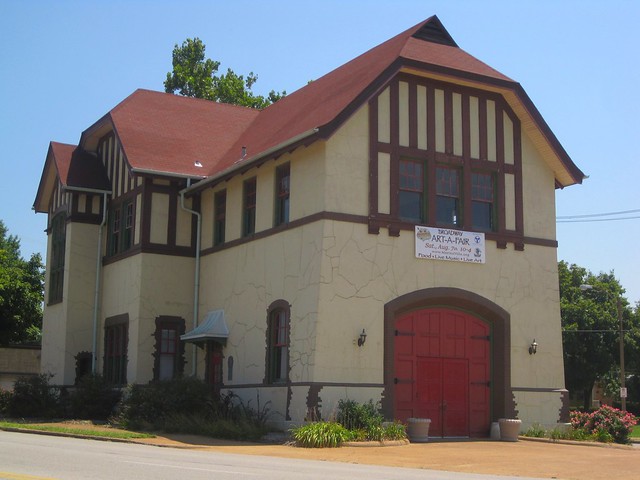
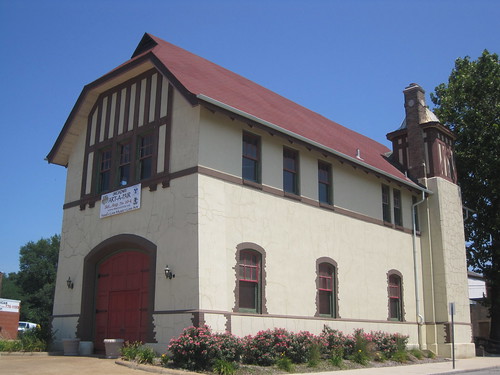
Thanks to the Marine Villa Neighborhood Association, the venerable Fire Engine House Number 3 on South Broadway was open to the public this past Saturday during the lively Broadway Art-A-Fair. The fire station sits on a flatiron block bounded by Broadway, Miami and Salena streets, making it a visual fulcrum in the neighborhood.

The Bavarian-influenced fire house was built in 1918 and operated as an engine house until 1968. Alderman Craig Schmid (D-20th, then D-10th) used ward capital improvement funds to renovate the building in 2001, and it is now leased to an individual user. It is rarely open to the public.

The interior is remarkably intact, with bakery brick walls, concrete floor, historic light fixtures and tin ceiling in excellent condition.  The bright red paint on the doors and ceilings is a nice touch.  Unconfirmed legend enshrined on a building plaque holds that the gleaming white bakery bricks used inside were left over from the construction of buildings at the Anheuser-Busch brewery, not far up Broadway.  Bakery brick manufactured by local makers, chiefly the Hydraulic Press Brick Company, was widely used for interiors of industrial and garage buildings by 1918.  Many buildings also used bakery brick for exterior accents or wall cladding as well.

Not knowing much about the history of Fire Engine House Number 3, I sought out Mike Seemiller at the Board of Public Service early this week and he showed me drawings for the building. Drawings dated April 1918 and signed by E.R. Kinsey, President of the Board of Public Service and L.R. Bowen, Engineer of Bridges and Buildings show that the fire station’s current appearance is almost exactly as it was built. The drawings also show that the building is the work of staff designers at the Board of Public Service. The building’s Bavarian style is similar to that of Bavarian and Tudor Revival tavern buildings built by Anheuser-Busch in the teens, including the Stork Inn (1910), Gretchen Inn (1913) and Bevo Mill (1917). All of these were designed by the firm Klipstein & Rathmann, leading some historians to suspect that the fire station was also the work of the firm.  The Stork Inn occupies a similar flatiron-shaped block, bounded by Virginia, Idaho and Taft streets.  However, the architectural drawings for Fire Engine Station Number 3 show that its beautiful, picturesque design is the work of lesser-known public servants.

Categories
Historic Preservation

Historic Preservation Course at Washington University

This fall, the University College at Washington University is offering “Introduction to Historic Preservation” (SUST 315) as part of the curriculum for its Sustainability major and its Sustainable Communities certificate.  Anyone can enroll, however, so spread the word.  Preservation architect Jeff Brambila, former president of Missouri Preservation and   current board member of Landmarks Association of St. Louis, teaches the course.

Here is the description:

This course explores the history and practice of historic preservation with an emphasis on regional urban issues and the way in which historic preservation contributes toward the development of sustainable communities. Students are exposed to a diverse range of preservation topics that will enable them to apply sound historic preservation principles in professional practice. Course topics include: evaluation and recording of historic properties and districts; Secretary of the Interior’s standards in the process of planning or designing a project; historic preservation in community planning; application process for state and federal tax credit programs; conservation of historic building materials; historic preservation vs. modern building codes and user requirements. We examine case studies of completed projects or projects in progress.

Registration information is available on the University College site here; search for “introduction to historic preservation.”

Categories
Uncategorized

Follow Us on Twitter

Michael Allen has been tweeting for awhile, but it became time that Preservation Research Office has its own public Twitter account with multiple contributors.

Done. Follow us @PreservationSTL. The Twitter feed will announce our projects as well news and events that connect you to the architectural heritage of the St. Louis area. And we won’t shy away from sending out calls to action.

Categories
Chicago Public Policy

Chicago Landmark Ordinance Case Returns to Circuit Court

by Michael R. Allen

The legal battle to to overturn Chicago’s 42-year-old landmark ordinance continues, with a chilling effect on designation in Chicago and cautious attention elsewhere. Two property owners in local historic districts sued the city a few years ago on the grounds that the ordinance was an “arbitrary and capricious” exercise of city police power. Last year, after the plaintiffs appealed a Circuit Court ruling against them, the Illinois Appellate Court ruled that the ordinance was indeed unconstitutional due to vague wording. The City of Chicago appealed to the Illinois Supreme Court, which denied the appeal and remanded the case to Circuit Court.

This week Chicago Tribune critic Blair Kamin reported that the case is headed for a hearing on August 27. There is a possibly hopeful twist: the circuit judge has split the case into two parts, one on the ordinance and one on the enabling ordinances for the two districts themselves. The August 27 hearing is on that second part only.  The judge has placed the challenge to the Chicago landmark ordinance on hold.

Categories
Events Marine Villa South St. Louis

South Broadway Fire House Open During Art-A-Fair Tomorrow


The historic former fire house at South Broadway and Miami will be open for tours tomorrow during the Broadway Art A Fair, 10 a.m. until 4 p.m.

Here’s some of what’s going on at the Art-A-Fair tomorrow:

A dozen local artists showcasing their talents, have a portrait sketched of yourself, significant other or children, by long time MV [Marine Villa] resident Bob Dielman, Enjoy music by MV’s very own, Ned and Pee Wee followed by the infamous Box of Nerves.  Performances by the St. Louis Hoops group…Did I mention FIRE, Oh Yeah! The day rounds out with a fantastic Capoeira performance, this Afro-Brazilian art form combines, music, dance and martial arts and is sure to amaze onlookers!

Categories
North St. Louis The Ville

“Sarah-Lou” Building at Risk

by Michael R. Allen


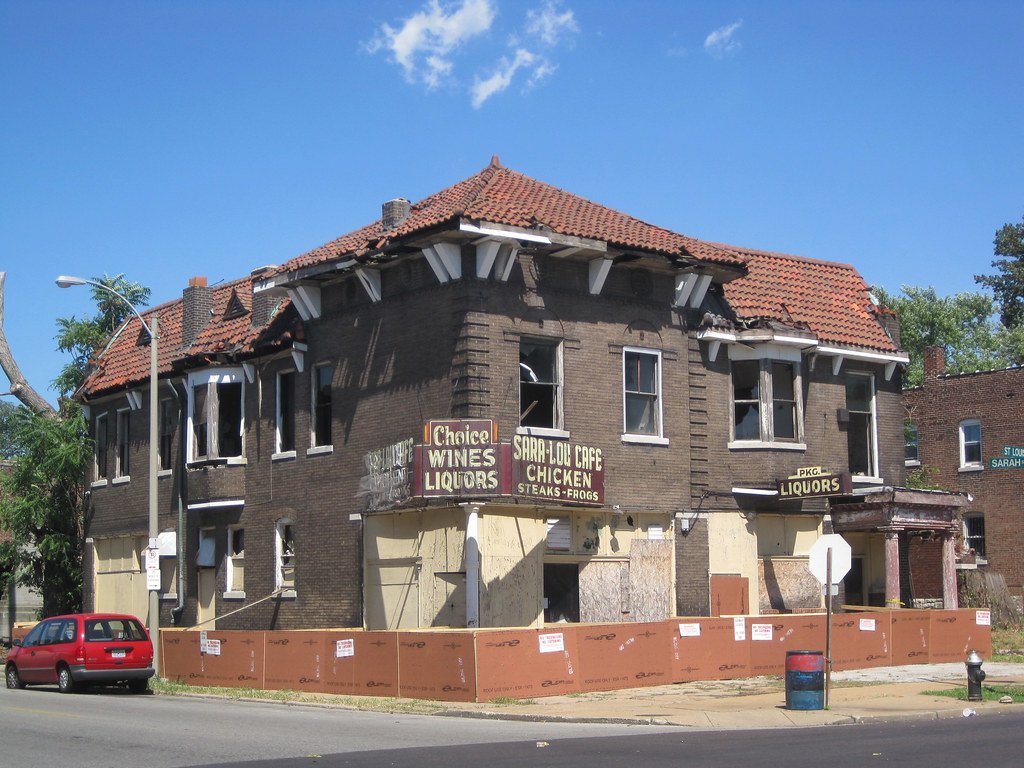
If photographs of its old neon sign measured anything, the “Sarah-Lou” building at the northeast corner of St. Louis and Sarah avenues in the Greater Ville is a winner. Although the building has been abandoned for years, its sign for the famous, shuttered Sarah-Lou Cafe attracts a great deal of attention.  Alas, the attention the building needs to attract is that of an owner willing  to rehabilitate the fine corner mixed-use building.

The building, which dates to 1906, was condemned for demolition in the year of its centennial. This year, the city erected a fence around the building to protect the sidewalks from falling clay tiles.  The tiles’ fall was triggered by damage caused through theft of the metal guttering. Yet the privately-owned building is far from a wreck.


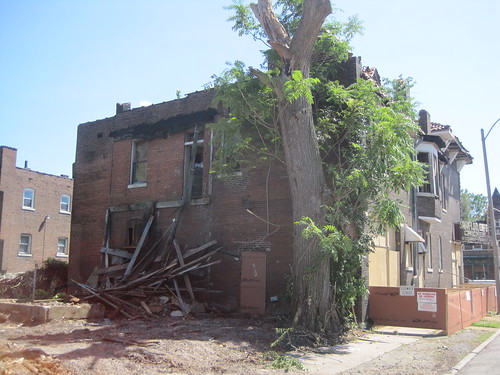
A look at the rear wall shows no structural problems with the masonry walls.  Someone wisely demolished a sagging frame porch that had been enclosed and which provided access to the second floor.  Beyond the holes in the roofs of the false gables, the roof seems sound.  Hopefully someone will come along and rescue this building, which is one of four two-story corner mixed-use buildings at the intersection.  This is the only one that is vacant, and it also happens to be the most architecturally stunning of the group.

Categories
Flounder House JeffVanderLou North St. Louis Northside Regeneration

Flounder House on Cass Avenue

by Michael R. Allen

Tucked alongside a commercial building, sometimes obscured by trees and with a partly collapsed roof, the one-story flounder house at 2704 Cass Avenue evades attention.  Yet the small house’s craftsmanship shows in details like the dentillated cornice on the side elevation.  There are signs that the front originally had a wooden or galvanized cornice, but the chance that anyone will ever know for certain is slim.  The chance that the house will survive the next decade may be slimmer still.

The house may date to 1885, but could be older.  It stands on City Block 1843, bounded by Cass, Elliott, Sheridan and Leffingwell avenues — a city block that has never had an alley.  This house and much of the rest of the block is owned by Northside Regeneration LLC.  Once part of dense urban fabric, the little house has become doubly noteworthy: it is one of only three buildings left on this block, and one of perhaps as few as 160 remaining flounder houses in St. Louis.

Categories
Iowa Terra Cotta

Lemp in Ft. Madison

by Michael R. Allen

While working in Ft. Madison, Iowa recently I noticed an unmistakable emblem of the St. Louis empire. At the southwest corner of 7th Avenue and Avenue G downtown, the parapet of a building caught my eye.

Joined with the corner building — and united by lovely green mid-century tile — to form a Sears store, the narrow building told me of its connection to my city.
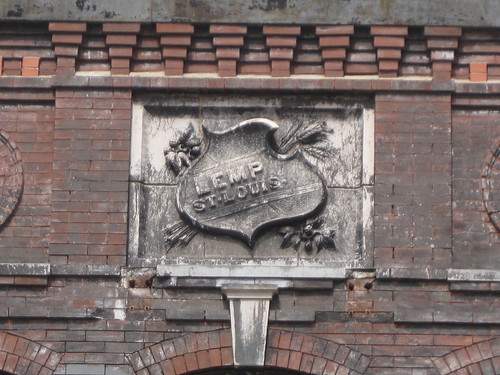
Two stories above the sidewalk in an Iowa river city, arrested in fine terra cotta, was the mighty shield of the William J. Lemp Brewing Company.
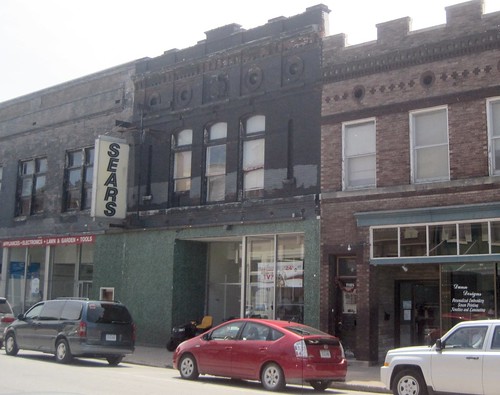
As I rounded the corner, I saw that the building wrapped the corner building in an L-shape. On Avenue G, the wider elevation was definitely the main entrance.  Research showed that this building was built for Kiel & Burster Liquor Dealers, the exclusive distributor of Lemp beer in this area.  Many brewery distributors and tavern owners in the late 19th and early 20th century adorned their buildings with terra cotta brewery emblems.  Anheuser-Busch’s emblem is more prevalent than Lemp’s, but there are some surviving buildings with the Lemp shield outside of St. Louis.