Categories
Missouri Public Policy

House Committee Does Not Take Up Tax Credit Bill; Action in the Senate?

by Michael R. Allen

Yesterday evening the Missouri House Jobs and Economic Development Committee did not take up the substitute to the “economic development” bill HR 2399. Chairman Tim Flook (R) mentioned the bill at the committee meeting but did not call it. Apparently Flook is still working with members of the Senate on getting the Senate to pass a bill that changes the tax credit policies.

One version of reform said to be favored by Flook is capping the historic tax credit program at $100 million and lowering its reimbursement percentage from 25% to 20%. This proposal would be combined with a provision forbidding use of both historic tax credits and low income housing tax credits on the same project.

Expect a version of this proposal to be debated in the Senate before the end of the session.

Categories
Central West End DeVille Motor Hotel Historic Preservation Mid-Century Modern Preservation Board

Missouri Court of Appeals to Hear San Luis Appeal Tomorrow

by Michael R. Allen

Demonstrating against the San Luis demolition, June 2009.
Tomorrow at 11:00 a.m., the Eastern District of the Missouri Court of Appeals hears oral arguments in Friends of the San Luis v. the Archdiocese of St. Louis. The court meets on the third floor of the Old Post Office downtown, and supporters of the Friends of the San Luis are invited to attend. The Court of Appeals will issue its ruling later.

What is happening? After the Preservation Board approved by a thin 3-2 margin a preliminary application for demolition in June 2009, the Friends of the San Luis (disclaimer: I serve as the organization’s president) filed a petition for injunction to halt the demolition of the mid-century modern San Luis Apartments (originally the DeVille Motor Hotel) 1t 4483 Lindell Boulevard in the Central West End. Under city preservation law, a preliminary grant of demolition cannot be appealed until a demolition permit is issued. That stipulation makes appeals moot, at least beyond procedural review.

Circuit Court Judge Robert Dierker, Jr. dismissed the Friends’ petition with prejudice. Dierker opined that preservation laws were an encumbrance on private property rights, and that only persons with direct financial interest — essentially, adjacent property owners — have standing under the city’s preservation ordinance. (Dierker’s forthcoming ruling in the Northside Regeneration suit should be interesting given that he must choose between the divergent interests of private property owners.) The ruling cut against city government’s own interpretation of the ordinance by granting only narrow right to redress.

Given Dierker’s conservative judicial activism, the Friends could have let the matter go. Yet we appealed to ensure that Dierker’s ruling does not stand as precedent in the future. Who knows when and why citizens will need rights to appeal the Preservation Board’s decisions? All we know is that the right to appeal should apply to any citizen of the city of St. Louis. After all, the ordinance states that “[t]he intent of this ordinance is to promote the prosperity and general welfare of the public, including particularly the educational and cultural welfare.”

Categories
Agriculture Belleville, Illinois Demolition Southern Illinois

Farm House Facing Death In Belleville

by Michael R. Allen

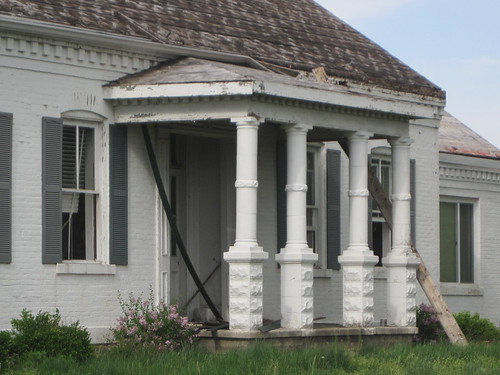
I have been conducting an architectural survey at Scott Air Force Base and passing back through Belleville. Last week, just east of town I came across this 19th century brick farmhouse on Highway 161 east of town. The rest of the farm — a clay tile silo and some outbuildings — are well under demolition, but work has yet to really start on the house. A porch and the roofing have been removed, but the old building is painfully still able to be saved. The demolition set me to thinking.

I know, I know. Illinois is full of these one-story brick center-hall houses, with their two-over-two wooden windows and simple brick cornices. Yet that’s really the point: these vernacular houses give the state’s rural areas unique architectural character compatible with the rich and lovely landscape upon which they reside.

Besides, this house has an interesting hipped roof, and lovely cast stone porch columns (definitely not original, but certainly a historic alteration). With a new Wal-Mart and strip retail in this vicinity, I think I know what happens next to this farm. Even if one does not see the folly of the wasted building, what about thinking through losing soil that has fed people for over 100 years?

St. Louisans should think about these things too. What happens in Belleville matters to St. Louis. The loss of good farm land and usable farm building stock within 100 miles weakens our renewing regional food economy. We lost much of the good farm land in St. Louis and St. Charles counties, but we still have a lot left across the river. Some talk about “balancing” the region’s sprawl, but without regional growth that is tantamount to doubling the waste: settled and unsettled areas, wasted. When do we stop?

Categories
Housing North St. Louis O'Fallon Rehabbing

Busy Saturday: Open Streets and the 21st Ward Home Repair Blitz

by Michael R. Allen

It’s an exciting busy day in the city, and an appropriate start to this year’s Historic Preservation Month. Open Streets has just wrapped up, and while giving a walking tour on Lindell with Toby Weiss I saw dozens of pedestrians and cyclists taking advantage of the street closure. Can’t wait for it to happen again!

Up in the 21st Ward, today is a big blitz of home repair by Rebuilding Together. Alderman Antonio French already has posted a video.

While big rehab projects garner most headlines, most homeowners in the city don’t need or can’t afford expensive projects. Neighborhood stabilization requires many showcase projects but many more efforts to retain existing residents. Kudos to the volunteers working today in the 21st ward!

Categories
Missouri Public Policy

Peter Kinder and Historic Tax Credits

by Michael R. Allen

Yesterday, Missouri Lieutenant Governor Peter Kinder convened a press conference on tax credits on Old Post Office Plaza in downtown St. Louis. (Coverage: St. Louis Business Journal, KWMU, St. Louis Globe-Democrat and St. Louis Beacon.) The location was ironic given that Old Post Office developer Steve Stogel has close ties to Governor Jay Nixon.

The scene was set as if this were an official response to Governor Nixon’s tax credit proposal, with Kinder citing statistics between statements of strong support for the state’s redevelopment incentives, especially the historic rehabilitation tax credit. Of course, the spate of press conferences by Nixon and Kinder are more prelude to the 2012 governor’s race than official actions. Both are shoring up bases, with a twist: Democrat Nixon is pandering to the perceived “Missourah” base that abhors the state’s urban areas, and Kinder is aiming to gain support in the urban areas that helped propel Nixon into the governor’s mansion.

Kinder was surrounded by St. Louis Democrats, including aldermanic President Lewis Reed, Aldermen Antonio French (D-21st) and Jeffrey Boyd (D-22nd), State Representative Tishaura Jones (D-63rd) and former Carnahan adminstration Director of Revenue Janette Lohman. Also on hand were Reverend Ken McKoy, developers Paul J. McKee, Jr. and Peter George, Landmarks Association of St. Louis Executive Director Jeff Mansell, RHCDA President Stephen Acree, Association of General Contractors of America President Leonard P. Toenjes and others. These people have different reasons for supporting the historic rehabilitation tax credit, but most talked about the importance of using the credits in distressed neighborhoods.

Kinder’s words resonated in St. Louis. The press has picked up on his jab about Blagojevich-style politics, but he mostly stuck to reasons why tax credit programs build the state economy. Kinder stated emphatically that Missouri should be proud of how much money it spends on historic preservation. Missouri leads all states in historic preservation-related development due to the tax credit. That’s not a bad thing, Kinder said.

Kinder questioned Nixon’s recent attempt to tie tax credit expenditures to loss of revenue for public education. According to Kinder, “he leaves out one simple part of the equation in that tax credits create jobs and without jobs there will be no place for our educated workforce to earn a living.” Missouri has indeed long suffered from lack of economic opportunity, and the historic rehabilitation tax credit has spurred job creation for skilled labor. Of course, public education should not be underfunded to spur job creation.

Kinder pointed out that leading the country in one type of development has created jobs that Missouri otherwise may not have had. “Nixon’s plan to cut tax credits is a boon to states like Kansas and Tennessee, which are courting our businesses away and taking their hundreds of millions of investment and jobs with them,” Kinder said.

Aldermen French and Boyd talked about the difference that the historic tax credit could make in north St. Louis, where use has not been as widespread as in other areas. Boyd talked about the upcoming renovation of Arlington School, which would not have happened without credits. French talked about plans to get most of his ward eligible for use of the credits. Each acknowledged that the credits alone are not the answer, but essential parts of larger strategies.

Surprisingly, Kinder was candid about his support for last year’s cap on the historic tax credit, which many who stood behind him opposed. Kinder stated that he might support a lower cap, but not “gutting” the program as proposed by the Nixon administration. While Kinder avoided any specific ideas for changes — not a good thing to do, I guess, with developers standing behind him — he did suggest that some changes have to happen. The end of the press conference was a sober reminder that, while there is wide recognition of the benefits of the Missouri rehabilitation tax credit, supporters have to face Missouri’s budget reality. After all, Governor Nixon is as right about that point as he is wrong about the solution.


Categories
Historic Preservation Preservation Board South St. Louis

Preservation Board Spares Chouteau Avenue Buildings; Now What?

by Michael R. Allen

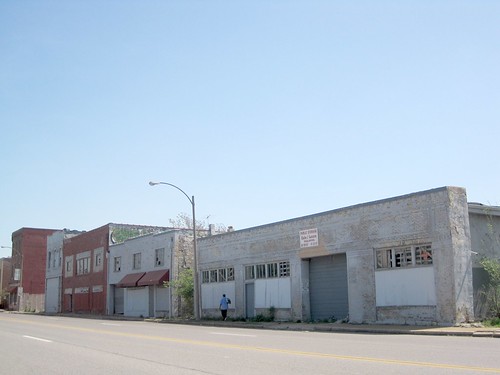
On Monday, the St. Louis Preservation Board unanimously voted to uphold the Cultural Resources Office’s denial of an application to demolish the commercial buildings at 2612-30 Chouteau Avenue. The applicant, Crown 40, Inc., was represented in testimony by Charles Mace of Chuck’s Brick and Demo and John Zumwalt of Crown 40. Speaking against demolition — briefly, because the Board already seemed ready to reject the appeal — were Andrew Weil of Landmarks Association, Lafayette Square resident Jason Stokes and myself.

Zumwalt testified that Crown 40 purchased the properties to prevent a competitor from purchasing the buildings and opening a gas station that might compete with Crown 40’s new Crown Mart gas station near I-44 and Jefferson Avenue. Crown 40 has no intention of building a gas station on the site but — and this gets weird — wants to buy the two buildings to the east, demolish all of them and some day build something new there. This desire is odd because the corner building is occupied by a dental clinic that was not represented in Monday’s proceedings. The other building is for sale.

Perhaps 2626-30 Chouteau (the large wagon company warehouse at right in the photograph above) is eligible for listing in the National Register of Historic Places. In my professional opinion, the other buildings are not — not even as a district. The alterations have damaged historic integrity, and there is not sufficient context for a larger listing.

Of course, many buildings are preserved without official landmark designation and without tax credits. Can these be? Sure, but the owner doesn’t seem interested. What can change his mind?

Categories
Chicago Illinois Public Policy

Illinois Historic Tax Credit Bill Not Down or Out

by Michael R. Allen

Illinois may yet pass a state historic rehabilitation tax credit this year. On March 18, the Illinois Senate passed SB 2559, which is now heading through the House committee process in the final days of this year’s legislative session.

Apparently Governor Pat Quinn (D) is favorable to the bill. Supporters wisely have crafted a substitute that lowers the per-county cap from $25 million to $5 million, requires each project pass a “but for” test and subjects projects to a per-project issuance cap. These are provisions that make the bill — and the dream that downstate communities like East St. Louis and Alton gain a powerful tool for neighborhood development — alive. There may be one particular county that generated the per-county cap, and the per-project cap as well, but those are excellent ideas to ensure that the credit gets used where it is most needed — where development actually needs a stimulus.

Update: The Illinois House never took up the bill before adjourning in May 2010.

Categories
Events

Built Environment / Blog Ecosystem / Media Landscape: May 5th

I am pleased to be part of this event:

Built Environment / Blog Ecosystem / Media Landscape

A conversation about the opportunities and complexities of blogs and websites pertaining to architecture, urbanism, preservation, and politics in St. Louis

Wednesday, May 5th
7 PM
1310 South 18th Street (Lafayette Square)
St. Louis, MO 63104.

Speakers:

Alex Ihnen (urbanSTL)

Antonio D. French (Pub Def, 21st Ward Alderman)

Jami Schoeneweis (56 House Left)

Michael Allen (Ecology of Absence)

Rick Bonasch (STL Rising)

Toby Weiss (BELT)

(This event is part of the week-long Chautauqua Art Lab 2010. For more information, see http://infleshwebuild.blogspot.com/)

Categories
Events

Preservation Month Calendar Posted

I have posted a calendar of Preservation Month events in May 2010, which the National Trust for Historic Preservation recognizes as the national month for historic preservation. Check out the wide range of events, which range from walking tours of mid-century modern buildings to a used book sale benefiting the Chatillon-DeMenil House to a historic St. Louis County farm tour to a liability-waiver tour of the James Clemens House. There are also tours of Harris Armstrong houses, an exhibit on lost riverfront architecture, a rock ‘n’ roll show later in the month and a Pecha Kucha night (head-scratchers, check the calendar).

I’m sure that I have left a few events out, so please point those out to me via email or in the comments section here.

Also, when earlier today I went to reserve my spot in Landmarks Association of St. Louis’ tour of the Beaux Arts Building on Tuesday, May 11, I received a response stating that the tour already was full and that I would be put on a wait list. The tour announcement set no attendance limit, while other Landmarks tours has specific limits. I’d recommend making reservations as soon as possible for these popular tours!

Categories
DALATC Missouri Public Policy

Nixon’s Tax Credit Explanation

by Michael R. Allen

This morning in the St. Louis Post-Dispatch I read the worst-ever explanation of how the Missouri historic rehabilitation tax credit works:

“Right now, if a building is old and somebody in essence wants to develop that, they automatically get certain amounts of these credits,” [Governor Jay] Nixon said. “We want to have an ability to cap that.”

Does that sort of knowing oversimplification even play well out-state any more?

This is no the correct way to describe a program that:

1. Requires buildings to be listed in the National Register of Historic Places — either individually or in historic districts — before a tax credit application can be approved. The National Register has strict criteria for listing and many buildings do not make the cut;

2. Requires owners to submit up-front through preliminary application itemized expenditures and detailed work descriptions, and then subjects the developers to review by design professionals working for the State Historic Preservation Office;

3. Has rules that reimburse only for “qualified rehabilitation expenses”;

4. That last year was capped at $140 million for projects of $1.1 million or more in qualified rehabilitation expenditures (a cap that Nixon supported without stating that he wanted a more drastic cut);

5. Governor Nixon has supported in previous years, including the year he ran for governor.

Nixon also does not mention that last year he signed the economic development bill that increased Missouri’s annual obligation in Distressed Areas Land Assemblage tax credits from $10 to $20 million to allow developer Paul J. McKee, Jr. to receive over $19 million in those credits before the end of 2009. Nixon remains silent on the merits of that particular program while attacking a program used mostly for small-scale neighborhood redevelopment.

Nixon’s push to make tax credits available for the most politically connected is problematic, because that’s a continuation of the worst aspects of Missouri’s tax credit policy. There are other ideas for reform that have merit, such as placing caps on existing programs — including the special-interest programs — or independent study of the economic impact of all existing programs and the courage to eliminate the bad programs.